 Purdue University - Extension - Forestry and Natural Resources
Got Nature? Blog
 Woodland owners seem to have a lot to worry about these days. Threats to the health of their woodlands are announced regularly as new insects or diseases are detected, drought rages or invasive plant species compete with native vegetation. Some threats, like the emerald ash borer or a large tornado, can result in nearly unstoppable destruction. However, there are some actions that woodland owners can take to make their woodlands more resistant to other damaging agents or events. One of the best preventative measures is to use forest management practices to make the trees in your woodland as healthy and vigorous as possible. Competition between trees is a natural part of forest growth and development, but excessive competition as trees become more crowded and fight for growing space can make trees more susceptible to attack by insects and diseases and damage by weather extremes like droughts. Thinning around desirable trees provides additional growing space and reduces stress on these trees. Thinning can be done by harvesting trees for firewood or other personal use products, selling trees in a timber sale, or felling or girdling trees to be left for wildlife habitat. Gradual thinning in your woodland helps maintain the vigor of the remaining trees much like thinning carrots in a garden result in larger, faster growing carrots.
Vines and invasive plants can also create problems for tree health. Some vines, like wild grape, kudzu and Asian bittersweet, can climb over the crown of the tree, covering the leaves and reducing growth and vigor, and in some cases, killing the tree. Trees with large vines in their crowns may also be more susceptible to damage during wind, snow or ice storms, due to the extra weight of the vines. Cutting vines that climb into desirable trees is a good way to protect their health. Invasive plants like Asian bush honeysuckles and tree-of-heaven can become serious competitors with native forest trees and shrubs for space, water and nutrients required for tree growth and regeneration. Heavy infestations of invasive plant species can even change the soil environment, making it more difficult for trees to regenerate. Controlling invasive plants in your woodland is an important step in encouraging long-term woodland health.
Professional foresters and arborists can help you manage the health of your woodland. You can find professional foresters through the website findindianaforester.org or from the Indiana Division of Forestry.
The Education Store, available through Purdue Extension, has many resources available to help you manage your woodlands. Just place the keyword “woodland” in the search field box.
Forest Improvement Handbook.
Resources:
Resources and Assistance Available for Planting Hardwood Seedlings, The Education Store, Purdue Extension’s resource center
Creating a Wildlife Habitat Management Plan for Landowners, The Education Store
How to Build a Plastic Mesh Deer Exclusion Fence, The Education Store
Planting Forest Trees and Shrubs in Indiana, The Education Store
Shrubs and Woody Vines of Indiana and the Midwest, The Education Store
Investing in Indiana Woodlands, The Education Store
Woodland Stewardship for Landowners Purdue Extension – Forestry & Natural Resources (FNR) Extension YouTube Playlist
ID That Tree, Purdue Extension-FNR YouTube playlist
Woodland Management Moment , Purdue Extension-FNR YouTube playlist
Lenny Farlee, Extension Forester
Hardwood Tree Improvement and Regeneration Center (HTIRC)
Forestry and Natural Resources, Purdue University
 The National Association of State Foresters (NASF) posts an Purdue Agriculture research article titled “Hunting Gives Deer-Damaged Forests in Indiana State Parks a Shot at Recovery.” The Purdue research team led by Michael Jenkins, associate professor of forest ecology, shares that a 17-year-long Indiana Department of Natural Resources policy of organizing hunts in state parks has successfully spurred the regrowth of native tree seedlings, herbs and wildflowers rendered scarce by browsing deer.
“We can’t put nature in a glass dome and think it’s going to regulate itself,” Jenkins said. “Because our actions have made the natural world the way it is, we have an obligation to practice stewardship to maintain ecological balance.”
Resources
Electric Fences for Preventing Browse Damage by White-Tailed Deer, The Education Store, Purdue Extension
Emerging Issues in White-Tailed Deer Management and Conservation, The Education Store, Purdue Extension
Corn and Soybean Crop Depredation by Wildlife, Purdue Extension
As hellbenders continue to decline, Dr. Rod Williams and his research team have been sharing awareness of how important it is that these salamanders continue to thrive in the current ecosystem.
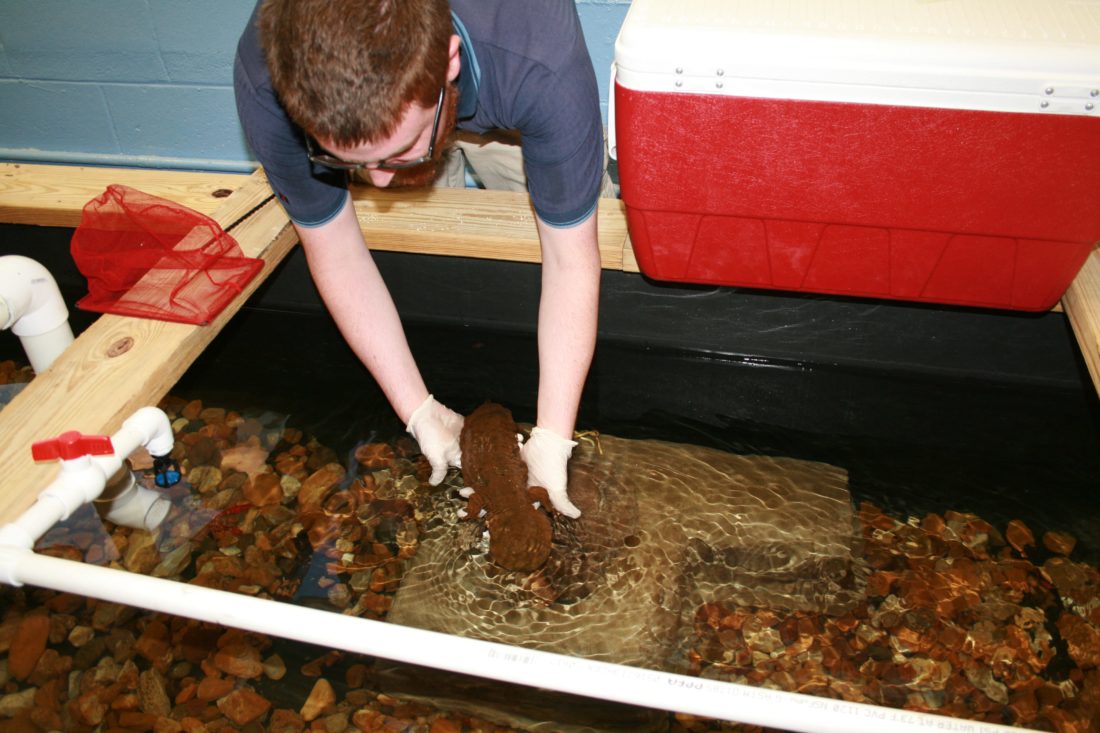
Eastern hellbenders are the largest salamander in North America. Adults can reach 29 inches in length, though most individuals are typically 11-24 inches long. Clean water is important for Hellbenders because they obtain most of their oxygen from the water by “breathing” through their skin. When breathing, their fleshy folds expand in surface area, enabling them to absorb more oxygen from the water.
Hellbender populations are declining across their range, from Missouri to New York. This decline, which affects the hellbender population in Indiana’s Blue River, is likely caused by human influences such as habitat degradation and destruction. The stream-bottom habitat of hellbenders can be degraded by sediment from eroded banks and fields and destroyed when streams are dammed or dredged. Hellbenders are also captured inadvertently by anglers or purposefully for illegal sale in the pet trade. Finally, emerging diseases may be impacting some populations of hellbenders.
Many states are developing conservation programs to help the hellbender. For more information and to learn more on conservation efforts, view Help the Hellbender.
Dr. Rod Williams and his hellbender research team have recently made national news:
CBS News
Trying To Save The Hellbender, America’s Largest Salamander
July 10, 2014
Resources:
Help the Hellbender Facebook page
Ask the Expert: Learn All About Hellbenders and Take a Tour, Subscribe Purdue Extension – Forestry & Natural Resources (FNR) YouTube Channel
Ask the Expert video: Help the Hellbender – Dr. Stephen Spear of The Wilds, Purdue Extension – FNR YouTube Channel
Ask the Expert video: Live with Mesker Park Zoo and Botanical Gardens – Hellbenders, Purdue Extension – FNR YouTube Channel
A Moment in the Wild video: Hellbender Hide, Purdue Extension – FNR YouTube Channel
A Moment in the Wild video: Release Moment of Hellbenders,
How Anglers and Paddlers Can Help the Hellbender video, Purdue Extension – FNR YouTube Channel
Eastern Hellbender ID Video, Purdue Extension – FNR YouTube Channel
Hellbenders Rock!, The Education Store, Purdue Extension’s resource center
Help the Hellbender, North America’s Giant Salamander, The Education Store
How Our Zoos Help Hellbenders, The Education Store
The Nature of Teaching: Adaptations for Aquatic Amphibians, The Education Store
Healthy Water, Happy Home – Lesson Plan, The Education Store
Purdue Expert: Hellbender Salamander, Purdue University News YouTube Channel
FNR Assists in First Natural Breeding of Eastern Hellbender in Captivity, Purdue FNR News & Stories
Helping the Hellbender: Mesker Park Zoo Begins Captive Breeding Efforts, Purdue Agriculture News
Rod Williams, Professor of Wildlife science and Assistant Provost for Engagement at Purdue University
Department of Forestry and Natural Resources, Purdue University
Diana Evans, Extension Information Coordinator
Department of Forestry and Natural Resources, Purdue University
Logs need to be at least 8 inch diameter inside bark small end, at least 8 feet long and straight and sound. Good grade logs do not develop until you get into at least the 14 inch diameter range and up. To be commercial, you will need at least a semi load. The issue here is hauling as well as the need to have a loader to load the semi.
If the above is not an option, you might go to the Wood-Mizer website and search for a sawyer. You will likely find one that would saw the logs for you and maybe one that would be interested in smaller quantities of logs.
You might also check with any local sawmill operation or district forester.
Resources
Wood-Mizer (Find a local portable sawmill service)
Indiana District Foresters
Forestry and Natural Resources Extension Workshops (Hardwood Lumber workshop)
The Education Store (Search the keyword “lumber” to find a large list of resources)
Dan Cassens, professor of wood products
Department of Forestry and Natural Resources
Purdue University
Indiana Department of Natural Resources (INDNR) recently received inquiries asking what to do with an abandoned animal. The INDNR web resource titled Orphaned and Injured Animals has steps to follow as you decide if the animal is truly abandoned.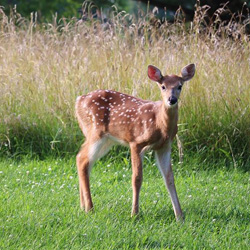
Resources
Got Nature? Orphaned Animals, author Brian MacGowan, extension wildlife specialist, Purdue University:
In most cases, the young animal is simply “spreading its wings” and exploring, or mom simply left it to get something to eat. Fawn deer are programmed to hide and remain motionless while mom is away. The fact is wildlife rarely abandons their young. They may leave briefly only to return.
Remember that you should never handle wild animals unless absolutely necessary. Any animal can bite you, and many harbor diseases and pests that can be transmitted to people.
In Indiana, wildlife rehabilitators have necessary state and federal permits to house and care for sick or injured wild animals. If you think you have found a sick or injured animal, you can find a list of licensed Wild Animal Rehabilitators in your area on the DNR Division of Fish and Wildlife’s website.
Mammals of Indiana, J.O. Whitker and R.E. Mumford
Common Indiana Mammals, R.N. Chapman and R.N. Williams, publication number FNR-413-W
Orphaned and Injured Animals, Indiana DNR
The Education Store (Search keywords to find the resources you need)
It doesn’t sound like there would be much chance of the chemical to get into the shrubs if the imidacloprid is applied close to the base of the tree. Also another thing to consider is unless you’re eating solely certified organic food, there’s a really good chance you’ve consumed very small amounts of imidacloprid at some time.
The United States Department of Agriculture (USDA) Pesticide Data Program monitored imidacloprid residues in food and published their findings in 2006. Imidacloprid was detected in a range of fresh and processed fruits and vegetables. It was detected in over 80% of all bananas tested, 76% of cauliflower and 72% of spinach samples. In all cases, however, the levels detected were below the U.S. EPA’s tolerance levels. Imidacloprid was also found in 17.5% of applesauce and 0.9% raisin samples, although percentage of detections were greater in the fresh unprocessed fruit (26.6% of apples sampled and 18.1% of grapes sampled).
These findings were on direct application to the plant, which would indicate higher concentrations than that which you would find on plants nearby those that were treated. Additionally, it is advised that if homeowners want to use a product with imidacloprid as the active ingredient, then they use one specifically labeled for edible food crops. The product label will contain specific instructions on application, pre-harvest intervals and special instructions on limiting harm to pollinators.
Resources
Purdue Pesticide Programs
Office of Indiana State Chemist – Pesticide Section
Lindsey Purcell, Urban Forestry Specialist
Department of Forestry and Natural Resources, Purdue University
 Woodlots are dynamic, vital ecosystems in the urban and suburban landscapes of the Midwest. People own these small wooded lots in urbanized areas for a variety of reasons: timber production, firewood production, recreation, wildlife habitat, aesthetics and alternative forest products. Many owners who keep and nurture these natural areas are motivated by powerful, non-economic motives based primarily on aesthetics and environmental protection.
This new Purdue Extension publication titled Indiana’s Urban Woodlots is a great way to aid you in a management plan and build your knowledge of what trees can do for you and the environment. This 24-page booklet covers benefits of trees, laws and zoning, stewardship planning, management, planting and renewal, and more.
View The Education Store for this and other Purdue Extension publications. Just type keywords in the search field to find the resources you need.
Lindsey Purcell, Urban Forestry Specialist
Department of Forestry and Natural Resources, Purdue University
Lenny Farlee, Sustaining Hardwood Extension Specialist
Hardwood Tree Improvement and Regeneration Center (HTIRC)
Department of Forestry and Natural Resources, Purdue University
As foresters, woodland owners and tree and wildlife enthusiasts, we hear the word safety and immediately think about making sure our hard hat is packed, our gas tank is full, our cell phone is charged and we have a buddy to call in case of an emergency. How many of us think about diseases? Who thinks about West Nile Virus (WNV) or Eastern Equine Encephalitis (EEE)? For those of us that take our pets into the field, WNV and EEE are very real threats. West Nile Virus originated in Africa but spread quickly throughout the United States after an outbreak in New York in 1999. By 2003, 46 states had been infected, and nearly 10,000 people had fallen ill.
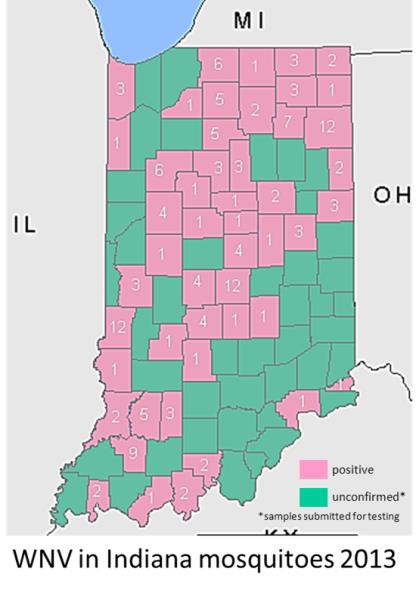
Although not contagious by contact with an infected person or animal, a protective layer is recommended when handling potential infected subjects. Most infected humans show no symptoms while a minority exhibit fevers, headaches, skin rashes, meningitis or encephalitis. Very few people die from WNV (< 1:1,000), but precautions should always be taken to prevent exposure. A total of 156 cases of WNV have been reported in Indiana this year with one sample being human. Other cases have been found in bordering states with 741 cases (mosquito) in Illinois, two mosquito and four human cases in Michigan, 64 mosquito cases in Ohio and zero cases of any kind in Kentucky as of August 20, 2013.
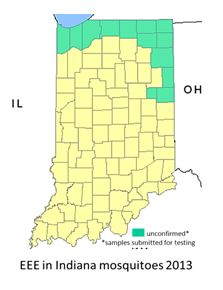
Eastern Equine Encephalitis is a rare viral disease that can be transmitted from host mosquitoes to a number of other animal species. Historical accounts of the disease show that in Midwestern states, EEE is most often found in southwestern Michigan; however, infected horses in Indiana have been found. EEE infects nearly all game birds, amphibians and reptiles, and last year in Michigan, an 8-week-old puppy.
Humans are not immune to EEE. Nearly 30% of people that develop the disease die, and approximately 50% of survivors have permanent neurological complications. Symptoms of infection may or may not occur and will often take between three and 10 days to be realized. EEE symptoms in humans range from fever, headache and nausea to abdominal pain, paralysis, seizures and fainting. An elderly woman in New England died on August 21, 2013, and was the first human casualty of the disease this year. A vaccine has been developed to prevent EEE in horses; however, no vaccine or treatment is available to protect humans or other animals from EEE or WNV. Elimination of standing water is our only defense against potential EEE and WNV threats.
As the summer is in full swing and more and more of us head out to the field, please do not forget to protect yourself and your pets from potential exposure to mosquitoes.
Sourced Information:
Beasley, D.W.C. et al. (2013) Resurgence of West Nile neurologic disease in the United States in 2012: What happened? What needs to be done? Antiviral Research 99:1–5.
Wendell, L.C. et al. (2013) Successful Management of Severe Neuroinvasive Eastern Equine Encephalitis. Neurocritical Care 19:111–115.
USGS Disease Maps
Van Buren County Horse Dies of Eastern Equine Encephalitis, Horse Owners Urged to Vaccinate Animals, MLIVE Media Group
Weymouth Officials Urge Caution After EEE Death, The Patriot Ledger
Resources
Mosquitoes, Purdue Extension Entomology
Shaneka Lawson, Plant Physiologist
Hardwood Tree Improvement and Regeneration Center (HTIRC)
Department of Forestry and Natural Resources, Purdue University
An unsatisfactory approach to tree maintenance or pruning is “topping” it. Topping is the indiscriminant removal of branches of a tree above an arbitrary height, leaving unnatural, grotesque stubs and misshapen tree forms. In addition, increased risk tree conditions are introduced with development of decay, weak branch attachments and poor health.
Large evergreen trees do not respond well to topping. The removal of the upper main stem through topping opens the tree to internal decay, disease or damaging insects; it also removes the most productive portion of the tree. The practice of topping to control tree size or growth is not justified. If the tree is too large to fit the space, it should be removed and replaced with a smaller, more suitable species for its growing space.
Be aware that unprofessional tree service crews use this approach because it takes little skill and is easiest for them to perform. Do not let yourself be persuaded that topping serves your best interest; both you and your tree will suffer from such mistreatment.
The topmost part of an evergreen whose shape is pyramidal, such as a spruce tree, has a growing point known as the apical meristem. In evergreen trees, the apical meristem contains a hormone that suppresses lateral growth, helping it to keep its excurrent or pyramidal form. The further away from the tip (apical meristem), the less affect this hormone has on the lateral growth of the tree’s branches. This is why spruce trees have that pyramidal shape and are not more rounded or decurrent. By topping evergreen trees, it will destroy the apical dominance of the plant and result in growing more round than tall with a misshaped top. It will try to re-establish apical dominance as it matures, but it will most likely look very unusual and not like these species should appear with multiple competing growing tips. Remember, this is a natural form for many evergreens to help shed the heavy loads from snowfall. Remove the apical meristem (tip), and you reduce the suppression of lateral growth. This affects the shape of the spruce tree and exposes it to potentially splitting the tree down the trunk as well as exposure to the problems associated with topping.
Resources
Trees are Good
What’s Wrong with Topping Trees?
Lindsey Purcell, Urban Forestry Specialist
Department of Forestry and Natural Resources, Purdue University
According to the USDA Forest Service, an invasive species is defined as “a species that is non-native to the ecosystem under consideration and whose introduction causes or is likely to cause economic or environmental harm or harm to human health.” Invasive species, along with habitat loss and pollution, are the most severe threats to biodiversity and ecosystem function. Why are they such a problem? One factor that my colleague, Lenny Farlee, points to is that people don’t know they have a problem. That is, they are all around us, and most folks don’t even know it. People must first be able to recognize invasive species from non-invasive species. One of the more recent invaders is tree-of-heaven (Ailanthus altissima).
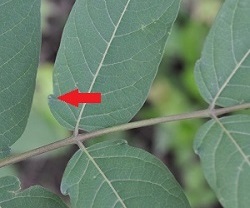
Figure 1. Tree-of-heaven have pinnately compound leaves with 11 to 27 leaflets. Each leaflet has one to several glandular teeth near the base. These are lacking on other trees and shrubs.
Don’t be fooled by the name. They are far from heaven for us. It’s actually been around for a couple hundred years. However, only over the past 10-20 years has it really begun to expand its range. This pattern is very typical of invasive species invasion. Mid-summer is one of the best times to identify and control this tree. Ohio State produced a publication on control methods, and this is linked at the end of this article. I want to focus on identification here.
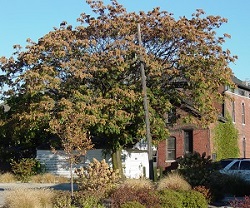
Figure 2. The fruit of tree-of-heaven are winged samaras. They can be green, red or brown in color. Numerous clusters of fruit are easily observed on tree-of-heaven during the summer.
Tree-of-heaven may be confused with similar-sized sumacs or even black walnut to the untrained eye. Because tree-of-heaven can grow very rapidly, they will often have several feet between branching along the main trunk. Some have also described the strong odor from tree-of-heaven similar to rotting peanuts. For most folks, the leaflets and fruit are the easiest features to go by. Each leaflet has one or more glandular lobes or teeth near the base. This is the best feature to differentiate it from similar species of similar size. On older trees, numerous fruit clusters will begin to form towards the end of June and will be present throughout most of July or longer. Black walnuts and other native trees with compound leaves lack these seed clusters.
Resources
Controlling Non-Native Invasive Plants in Ohio Forests: Ailanthus
Indiana Invasive Species Council
Dr. Brian MacGowan, Extension Wildlife Specialist
Department of Forestry & Natural Resources, Purdue University

Recent Posts
- 2026 Winter Bat Survey In Progress, MyDNR
Posted: March 27, 2026 in Wildlife - Fast-Growing Trees for the Landscape, Purdue Landscape Report
Posted: March 26, 2026 in Forestry, Urban Forestry, Woodlands - Urban Tree Spotlight: Planting Deciduous Shade Trees, Purdue Landscape Report
Posted: March 25, 2026 in Forests and Street Trees, Urban Forestry, Woodlands - Beetle that attacks Tree-of-Heaven found in Indiana, Purdue Landscape Report
Posted: March 20, 2026 in Invasive Insects, Wildlife, Woodlands - ID That Tree: Dwarf Chinkapin Oak
Posted: in Forestry, Urban Forestry, Wildlife, Woodlands - IN-PREPared: Essential Resources for Indiana’s Severe Weather Season
Posted: March 11, 2026 in How To, Safety - DNR Hiring for Indiana Conservation Officer Positions, MyDNR
Posted: March 9, 2026 in Urban Forestry, Wildlife, Woodlands - ID That Tree: Shumard Oak
Posted: in Plants, Urban Forestry, Wildlife, Woodlands - A Woodland Management Moment: Windbreak Around Walnut Plantings
Posted: March 3, 2026 in Forestry, Urban Forestry, Woodland Management Moment - Getting Certified as an Indiana Certified Prescribed Burn Manager
Posted: March 2, 2026 in How To, Urban Forestry, Woodlands
Archives
Categories
- Alert
- Aquaculture/Fish
- Aquatic/Aquaculture Resources
- Ask the Expert
- Christmas Trees
- Community Development
- Disease
- Drought
- Forestry
- Forests and Street Trees
- Gardening
- Got Nature for Kids
- Great Lakes
- How To
- Invasive Animal Species
- Invasive Insects
- Invasive Plant Species
- Land Use
- Natural Resource Planning
- Nature of Teaching
- Plants
- Podcasts
- Ponds
- Publication
- Safety
- Spiders
- Timber Marketing
- Uncategorized
- Urban Forestry
- Webinar
- Wildlife
- Wood Products/Manufacturing
- Woodland Management Moment
- Woodlands