 Purdue University - Extension - Forestry and Natural Resources
Got Nature? Blog
The eastern hellbender is an endangered salamander found in the Blue River in southern Indiana. It requires cool, clean rivers and streams with high water quality in order to thrive. Water quality in the Blue River is affected by many factors. One relatively unknown contributor to poor water quality is pollution entering sinkholes. Many landowners have sinkholes on their properties and treat them like outdoor waste sites without knowing that these sinkholes have a direct link to our water supplies. In this video, Purdue biologists interview a local cave expert and a local conservationist about how sinkholes are connected to our rivers, streams, and water supplies and how we can help protect them.
Resources:
Improving Water Quality by Protecting Sinkholes on Your Property, The Education Store, Purdue Extension’s resource center
A Landowner’s Guide to Sustainable Forestry: Part 5: Forests and Water, The Education Store
Improving Water Quality Around Your Farm, The Education Store, YouTube
Animal Agriculture’s Effect on Water Quality: Pastures and Feedlots, The Education Store
Improving Water Quality At Your Livestock Operation, The Education Store, YouTube
Nick Burgmeier, Research Biologist & Extension Wildlife Specialist
Purdue Department of Forestry and Natural Resources
Dr. Rod Williams, Professor of Wildlife Science
Purdue Department of Forestry and Natural Resources
The Department of Forestry and Natural Resources’ extension team have received four Purdue Extension Issue-Based Action Team (IBAT) awards out of seven. These new initiatives have been chosen from 30 submitted proposals. In an ever-changing world, Purdue Extension is launching big ideas to identify and address priority issues to enhance quality of life as well as the efficiency and/or effectiveness of organizations through research-based education.
Congratulations to the following FNR teams that are moving the world forward:
ENHANCING THE VALUE OF PUBLIC SPACES: HEALTH, WELLNESS, AND DESIGNING THE BUILT ENVIRONMENT
Project Overview: Expand upon the existing Enhancing the Value of Public Spaces program to include a health component — building community capacities for accessible means for physical activity. $50,000.
Team: Michael Wilcox, Assistant Program Leader for Community Development Extension, Purdue Center for Reginal Development; and Kara Salazar, Sustainable Communities Extension Specialist, Department of Forestry & Natural Resources; Donna Vandergraff, Extension Specialist, Nutrition Science; Lisa Graves, Assistant Program Leader and Extension Specialist, Nutrition Science; Melissa Maulding, Director, Nutrition Education Programs; and Steve Yoder, Extension Educator, Agriculture and Natural Resources (ANR), Tippecanoe County.
MARKET BASKET 360
Program Overview: A wealth of resources on a website, educational workshop agendas, certification programs, uniform materials for cooking demonstrations, and more for Farmers’ Market Masters, producers, and consumers. Market Basket 360 centralizes, streamlines, and enhances existing farmers’ market resources available through Purdue Extension, Indiana State Department of Health, the USDA Agricultural Marketing Service, and other industry organizations.
Team: James Wolff, Extension Educator, Agriculture and Natural Resources (ANR), Allen County; Julie Gray, Central District Director, ANR; Morgan Roddy, Extension Educator/Health & Human Sciences (HHS), ANR, Henry County; Curt Campbell, Extension Educator, ANR, Wabash County; Jodee Ellett, Local Foods Coordinator, Purdue Extension; Vickie Hadley, HHS Extension Educator/CED, ANR, Allen County; Nancy Manuel, HHS Extension Educator, ANR, Adams County; Gail Peitzmeier, HHS Extension Educator, Crawford County; Tim Vining, Development Educator, ANR; Teresa Witkoske, HHS Extension Educator/CED, Wabash County; Kwamena Quagrainie, Aquaculture Marketing Director and Associate Professor, Department of Forestry & Natural Resources and Agriculture Economics; Bob Rode, Aquaculture Research Lab Manager and Extension Specialist, Department of Forestry and Natural Resources.
NATURAL RESOURCES LEADERSHIP PROGRAM
Program Overview: Expanding Extension’s capacity to develop and deliver statewide natural resource programs and enhance decision-making for implementation at the community level. $30,000.
Team: Kara Salazar, Assistant Program Leader for Community Development and Sustainable Communities Extension Specialist, Department of Forestry and Natural Resources/Illinois-Indiana Sea Grant; Angie Tilton, Extension Educator, Agriculture and Natural Resources (ANR), Hendricks County Team; Lenny Farlee, Sustaining Hardwood Extension Specialist, Department of Forestry and Natural Resources; Liz Jackson, Hardwood Tree Improvement and Regeneration Center (HTIRC), Engagement Specialist and Executive Director of the Indiana Forestry and Woodland Owners Association and the Walnut Council; Steve Yoder, Regional Extension Educator, Community Development
THE NATURE OF HEALTH
Project Overview: A multifaceted approach to engaging families in nature-learning opportunities that will utilize emerging research to connect Health and Human Sciences and Agriculture and Natural Resources using curriculum developed by Rod Williams titled “The Nature of Teaching.” $20,000.
Team: Rod Williams, Professor of Wildlife Science, Department of Forestry & Natural Resources; Angie Frost, Extension Specialist-Healthy Living, College of Agriculture; Stephanie Woodcox, Extension Specialist-Health & Wellness, College of Health and Human Sciences; Deb Arseneau, Extension Educator, Agriculture Natural Resources (ANR), Newton County; Jay Christiansen, Extension Educator, ANR, Vigo County; Jan Dougan, Extension Educator, ANR, Dubois County; Molly Hoag, Extension Educator, ANR, Wells County; Molly Hunt, Extension Educator, ANR, Delaware County; Gracie Marlatt, Extension Educator, ANR, Rush County; Kelsie Muller, Extension Educator, ANR, Benton County; Lindsey Pedigo, Extension Educator, ANR, Howard County; Katie Zuber, Extension Educator, ANR, Lawrence County.
View the College of Agriculture Strategic Plan and the Purdue Extension Annual Report for more information on Purdue Extension.
For extension resources on Forestry and Natural Resources view Purdue Extension-FNR website.
Diana Evans, Extension and Web Communications Specialist
Purdue University Department of Forestry and Natural Resources
 Trees in Rice Cemetery in Elkhart, IN, were cut down due to verticillium wilt, a disease causing discoloration and wilt of branches. The fungus causing this disease spreads through roots. Many trees in the cemetery have been marked with a red dot and will be removed. If all goes well, new younger trees will take their place in the fall. If you have witnessed verticillium wilt, please notify the Indiana Department of Natural Resources.
Resources
Rice Cemetery Trees Cut Down Due to Verticillium Wilt as Elkhart Forestry Workers Fight to Save Those Left, The Elkhart Truth
Verticillium Wilt of Shade Trees, The Education Store, Purdue Extension’s resource center
Diseases in Hardwood Tree Plantings, The Education Store
Forest Health Informer, Indiana Department of Natural Resources
How to Check for Verticillium Wilt, July “In The Grow” (Q&A), Indiana Yard and Garden – Purdue Consumer Horticulture
What are Invasive Species and Why Should I Care?, (What to do if you see any disease) Purdue Extension-Forestry & Natural Resources Got Nature? Blog
Diana Evans, Extension and Web Communication Specialist
Purdue University Department of Forestry and Natural Resources
 Woodland owners seem to have a lot to worry about these days. Threats to the health of their woodlands are announced regularly as new insects or diseases are detected, drought rages or invasive plant species compete with native vegetation. Some threats, like the emerald ash borer or a large tornado, can result in nearly unstoppable destruction. However, there are some actions that woodland owners can take to make their woodlands more resistant to other damaging agents or events. One of the best preventative measures is to use forest management practices to make the trees in your woodland as healthy and vigorous as possible. Competition between trees is a natural part of forest growth and development, but excessive competition as trees become more crowded and fight for growing space can make trees more susceptible to attack by insects and diseases and damage by weather extremes like droughts. Thinning around desirable trees provides additional growing space and reduces stress on these trees. Thinning can be done by harvesting trees for firewood or other personal use products, selling trees in a timber sale, or felling or girdling trees to be left for wildlife habitat. Gradual thinning in your woodland helps maintain the vigor of the remaining trees much like thinning carrots in a garden result in larger, faster growing carrots.
Vines and invasive plants can also create problems for tree health. Some vines, like wild grape, kudzu and Asian bittersweet, can climb over the crown of the tree, covering the leaves and reducing growth and vigor, and in some cases, killing the tree. Trees with large vines in their crowns may also be more susceptible to damage during wind, snow or ice storms, due to the extra weight of the vines. Cutting vines that climb into desirable trees is a good way to protect their health. Invasive plants like Asian bush honeysuckles and tree-of-heaven can become serious competitors with native forest trees and shrubs for space, water and nutrients required for tree growth and regeneration. Heavy infestations of invasive plant species can even change the soil environment, making it more difficult for trees to regenerate. Controlling invasive plants in your woodland is an important step in encouraging long-term woodland health.
Professional foresters and arborists can help you manage the health of your woodland. You can find professional foresters through the website findindianaforester.org or from the Indiana Division of Forestry.
The Education Store, available through Purdue Extension, has many resources available to help you manage your woodlands. Just place the keyword “woodland” in the search field box.
Forest Improvement Handbook.
Resources:
Resources and Assistance Available for Planting Hardwood Seedlings, The Education Store, Purdue Extension’s resource center
Creating a Wildlife Habitat Management Plan for Landowners, The Education Store
How to Build a Plastic Mesh Deer Exclusion Fence, The Education Store
Planting Forest Trees and Shrubs in Indiana, The Education Store
Shrubs and Woody Vines of Indiana and the Midwest, The Education Store
Investing in Indiana Woodlands, The Education Store
Woodland Stewardship for Landowners Purdue Extension – Forestry & Natural Resources (FNR) Extension YouTube Playlist
ID That Tree, Purdue Extension-FNR YouTube playlist
Woodland Management Moment , Purdue Extension-FNR YouTube playlist
Lenny Farlee, Extension Forester
Hardwood Tree Improvement and Regeneration Center (HTIRC)
Forestry and Natural Resources, Purdue University
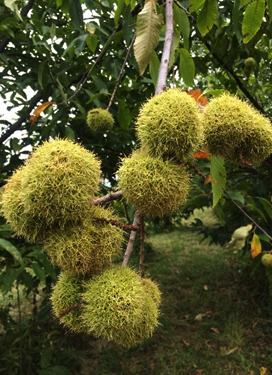
American chestnut fruit protected by a spiny bur. Photo: Dr. Shaneka Lawson, USDA Forest Service, Purdue HTIRC
In the late 1800s, 25% of hardwood trees in North America’s eastern forest were American chestnuts, 40 meters high and two meters across, they provided abundant resources for both people and wildlife in the form of food, shelter and building materials. Lightweight, rot-resistant, straight-grained and easy to work with, chestnut wood was used to build houses, barns, telegraph poles, railroad ties, furniture and even musical instruments. The rapid decline of the chestnut due to the pathogenic fungus Cryphonectria parasitica has been a subject of much debate and despair over the years, but now, chestnuts engineered to battle the fungus might give the iconic trees a chance to reclaim the North American stage.
Research conduced in 2014 was taking genes from wheat, Asian chestnuts, grapes, peppers and other plants and inserting them into American chestnut trees. William Powell of S.U.N.Y.–ESF and scores of collaborators, created hundreds of transgenic trees with the goal of almost 100 percent genetically identical wild American chestnut yet immune to C. parasitica. Testing and gathering data continues to help with future research.
Douglass Jacobs, the Fred M. van Eck Professor of Forest Biology at Purdue University, and a team of scientists at Purdue, use genomics which involves working with the complete set of an organism’s genetic material, to learn more about what causes disease. Genomics also can help identify the genes responsible for useful traits such as pest resistance.
Blight began afflicting the American chestnut in the 1900s, killing billions of trees. Despite being the target of decades-long tree-breeding efforts, the chestnut’s prospects remain in doubt. The list of at-risk species also includes ash, butternut, and bristlecone pine among other members of the five-needle white pine family.
The Hardwood Tree Improvement & Regeneration Center, a joint effort between Purdue and the Forest Service, for years has maintained a breeding program for pest resistance. Almost all of the center’s efforts to date have focused on traditional tree breeding and genomics.
“The chance to work with chestnut and help reintroduce it back to the landscape was a big reason I took the Purdue job in the first place back in December of 2001,” Jacobs said. “Watching species disappear from the landscape provides me personally with a lot of motivation to contribute whatever I can toward helping to save some of these at-risk species.”
To learn more about his research and collaboration with the U.S. Forest Service view full article Biotechnology offers holistic approach to restoration of at-risk forest tree species – Purdue University News, by Purdue Agriculture News.
Resources
A New Generation of American chestnut Trees May Redefine America’s Forests – Scientific American
Consequences of Shifts in Abundance and Distribution of American Chestnut for Restoration of a Foundation Forest Tree – Forests Open Access Forestry Journal
Transgenic American chestnuts show enhanced blight resistance and transmit the trait to T1 progeny – Science Direct (Plant Science)
Scientists Work to Create a Blight-Resistant Chestnut with Hopes of Restoring Tree to America, Forest Service, U.S. Department of Agriculture
FNR Hardwood – American Chestnut, Purdue Arboretum Explorer
Hardwood Tree Improvement Regeneration Center (HTIRC) Research Publications
American Chestnut Trees return to the Hoosier National Forest, Indiana Woodland Steward
Forest Regeneration and Restoration Laboratory, Purdue Forestry and Natural Resources, Dr. Doug Jacobs
Indiana American Chestnut Foundation
Purdue Extension – Forestry and Natural Resources (FNR)
 As the snow finally melts, we are approaching the prime time for planting bare-root trees and shrubs in Indiana. Planting bare-root seedlings is a proven, cost-efficient method to establish trees and shrubs on your property for a variety of purposes, as long as some basic steps are followed.
Prior to planting, prepare your site by eliminating competing vegetation where the seedlings will be planted. This can be done with tillage or herbicides. Areas with heavy sod or perennial weed growth are very difficult sites for small seedlings to survive and thrive. Clear all the competing vegetation in the planting area or create circles or bands two to three feet wide where the seedlings can grow. Be sure your site is suited to the species you want to plant. Soil survey and tree planting information from the USDA Natural Resources Conservation Service is available for every county in the state, either at NRCS offices or on the Web Soil Survey website: http://websoilsurvey.sc.egov.usda.gov.
When you receive your seedlings, keep them cool and moist until you can plant them. Plant them as soon as possible since the best place to store a seedling is in the soil! If you can’t plant them within a few days of their arrival, you can dig a trench and “heel in” the seedlings by planting them very close together and covering the roots with soil and/or moist mulch. This is still a short-term storage solution. You want to have your trees planted in their final locations before buds start to open.
When planting, keep seedlings stored in the shade, and roots should be kept moist until placed in the ground. A five gallon bucket with wet peat or sphagnum moss will work just fine for transporting seedlings to their planting locations. You can use several tools for planting, including shovels and commercial tree planting bars. The critical factors are planting the seedling at the correct depth and getting the root system in the ground such that it has good contact with the soil and is ready to grow. Seedlings should be planted with the root collar at or slightly below ground line. The root collar is where the stem changes to the root and is recognized by a color and texture change on the seedling stem. Be sure the soil is firmed around the seedling to close any air pockets that can dry out roots. Get your planting done as early in the spring as you can to take advantage of spring rains and a longer growing season for the seedling.
There are many more considerations for planning and implementing a successful tree planting that you can review in extension publications. See resources below for publications and videos.
To view the large photo used in this posting, visit How To Plant Seedlings.
Resources:
Planting Forest Trees and Shrubs in Indiana, The Education Store, Purdue Extension’s resource center
Native Trees of the Midwest, Purdue University Press
Shrubs and Woody Vines of Indiana and the Midwest, Purdue University Press
Investing in Indiana Woodlands, The Education Store
Forest Improvement Handbook, The Education Store
ID That Tree, Purdue Extension-Forestry & Natural Resources (FNR) YouTube playlist
Woodland Stewardship for Landowners Purdue Extension – FNR Extension YouTube Playlist
Woodland Management Moment, Purdue Extension-FNR YouTube playlist
Conservation Tree Planting: Steps to Success, Purdue Extension – FNR Got Nature? Blog
Lenny Farlee, Extension Forester
Hardwood Tree Improvement and Regeneration Center
Forestry and Natural Resources, Purdue University

Recent Posts
- New Indiana Woodland Steward Newsletter
Posted: August 12, 2026 in Forestry, Urban Forestry, Wildlife, Woodlands - ID That Tree: Nannyberry Viburnum
Posted: July 22, 2026 in Forestry, Plants, Wildlife, Woodlands - ID That Tree: Eastern Swamp Privet
Posted: in Forestry, Plants, Wildlife, Woodlands - ID That Tree: Carolina Buckthorn
Posted: July 15, 2026 in Forestry, Wildlife, Woodlands - Identifying Evergreens
Posted: June 24, 2026 in Forestry, Wildlife, Woodlands - Pruning Highlight-Pollarding Trees: A Traditional Pruning Practice with Modern Uses
Posted: June 11, 2026 in Forestry, Forests and Street Trees, Urban Forestry, Wildlife, Woodlands - Danielle Howard Hired as FNR Extension Prescribed Fire Specialist
Posted: June 10, 2026 in Forestry, Wildlife, Woodlands - Flat-Faced Longhorn Beetle Found in Hardwood Logs – IDNR Division of Entomology
Posted: June 8, 2026 in Alert, Forestry, Forests and Street Trees, Invasive Insects, Urban Forestry, Wildlife, Woodlands - Connecting Research to Practice: Natural Resources & Land Use Spring Training
Posted: June 5, 2026 in Forestry, Forests and Street Trees, How To, Invasive Animal Species, Invasive Plant Species, Land Use, Natural Resource Planning, Urban Forestry, Wildlife, Woodlands - Spring Storms Are Coming: How to Reduce Tree Damage and Risk
Posted: May 1, 2026 in How To, Urban Forestry, Wildlife, Woodlands
Archives
Categories
- Alert
- Aquaculture/Fish
- Aquatic/Aquaculture Resources
- Ask the Expert
- Christmas Trees
- Community Development
- Disease
- Drought
- Forestry
- Forests and Street Trees
- Gardening
- Got Nature for Kids
- Great Lakes
- How To
- Invasive Animal Species
- Invasive Insects
- Invasive Plant Species
- Land Use
- Natural Resource Planning
- Nature of Teaching
- Plants
- Podcasts
- Ponds
- Publication
- Safety
- Spiders
- Timber Marketing
- Urban Forestry
- Webinar
- Wildlife
- Wood Products/Manufacturing
- Woodland Management Moment
- Woodlands