 Purdue University - Extension - Forestry and Natural Resources
Got Nature? Blog
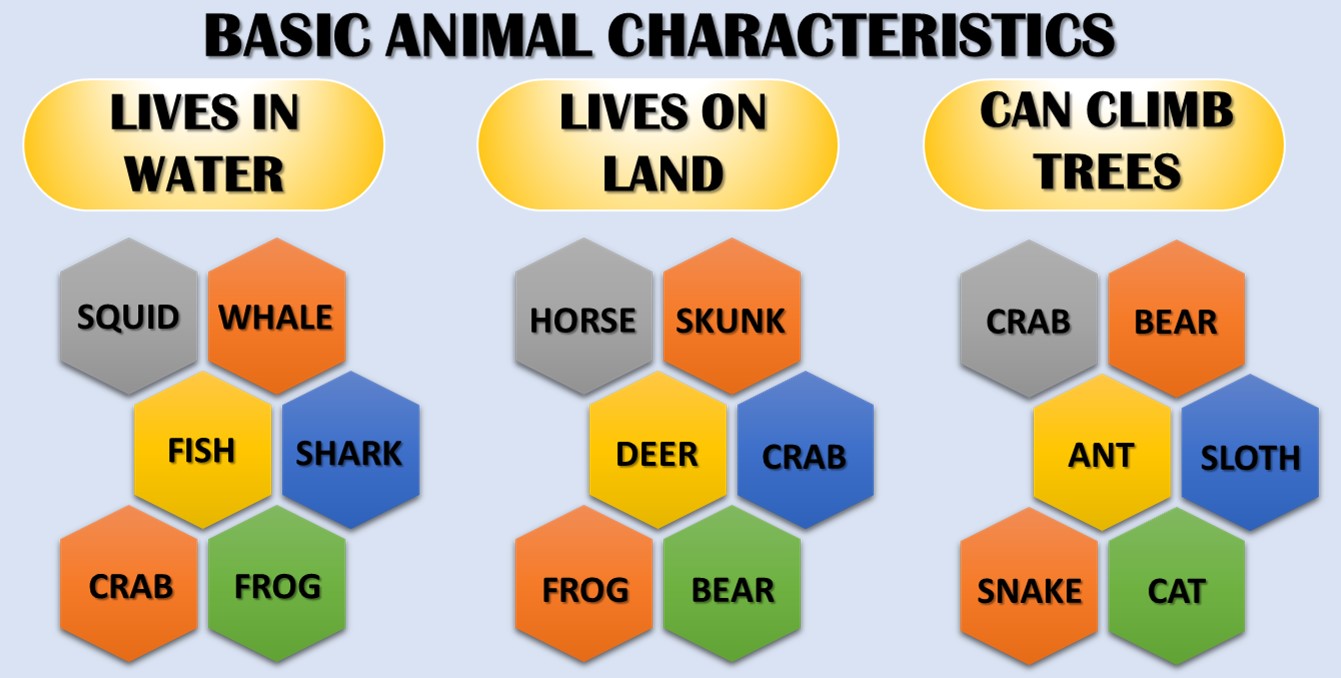 When you look at a photo of basic animal traits, you rarely expect surprises. Our educational background has taught us the answers as children. Researchers in Hong Kong, China have made a discovery that changes how we look at one particular species.
Mangrove Ecology and Evolution Lab scientists from the Swire Institute of Marine Sciences (SWIMS) and School of Biological Sciences, based in Hong Kong have recently discovered a new species of mangrove-climbing micro-crab. These crabs, named Haberma tingkok (Haberma for the genus of mangrove crabs and tingkok for the Ting Kok region where they were found), are less than a centimeter long, predominantly dark brown, with a squarish carapace, very long legs and orange claws. All specimens were found 1.5–1.8 meters (~ 5 to 6 feet) above chart datum (the water level that nautical charts are measured from).
 This new species represents only the first to be described in Hong Kong since Pseudosesarma patshuni, a much larger but non-climbing crab, in 1975. This crap is Hong Kong’s first truly arboreal crab. This small crab lives in mangrove branches and breathes air. Several known relatives have been found in the mangroves of Singapore and Indonesian New Guinea but none can climb trees.
Discovery of a new crab species in Hong Kong shows that more can be learned about crab diversity in Hong Kong. Projects like this one are paramount to the continued development of the Biodiversity Strategy Action Plan (BSAP) initiated by the Government of the Hong Kong Special Administrative Region under the United Nations’ Convention of Biological Diversity. Now, the scientists in Hong Kong are looking up in the trees rather than only at the ground in the search for additional marine species. With as estimate by marine biologists that we only know 50–60% of the real diversity of coastal and littoral crabs in Hong Kong, surely there are more surprises in store.
Journal Reference:
Cannicci S. and Ng PLK. 2017. A new species of micro-mangrove crab of the genus Haberma Ng & Schubart, 2002 (Crustacea, Brachyura, Sesarmidae) from Hong Kong. Science Direct doi: www.sciencedirect.com/org/science/article/pii/S1313298917002890
Web Reference:
The University of Hong Kong. “Marine ecologists discover and name the first endemic tree-climbing crab.” ScienceDaily. ScienceDaily, 11 April 2017. www.sciencedaily.com/releases/2017/04/170411104534.htm.
Resources:
Bagworm caterpillars are out feeding, be ready to spray your trees, Got Nature?, Purdue Extension-FNR
A New Drone Supports Pollinator Efforts, Got Nature?, Purdue Extension-FNR
Shaneka Lawson, USDA Forest Service/HTIRC Research Plant Physiologist/Adjunct Assistant Professor
Purdue University Department of Forestry and Natural Resources
A drone can be defined in a myriad of ways. A constant humming sound can be called a drone. Your professor going over a lecture you find boring can be described as droning on and on about a particular topic. That friend of yours with the uncanny ability to come by your place to eat right at dinnertime but never offers to pay for the food is also a drone. In nature, male bees are also known as drones. These insects, the products of unfertilized eggs have an easy but vital role within the hive; mate with the queen. In technology, a drone is a remote-controlled aircraft either publicly available (those who fly them are termed ‘enthusiasts’) or held by the military that that has dramatically increased in popularity over the last decade. What happens when drone bees and remote-controlled drones meet?

Researchers in Japan have come up with an inventive pollination plan. As bees continue to die out, insect sized drones are being used to pollinate lilies. The miniature robots are covered in horse hair and a sticky gel that allows pollen picked up from one plant to be deposited on another. By no means a solution to the global decline in insect pollinators, these robots are working to help alleviate the demands placed on bee colonies to ensure adequate pollination of agricultural crops.
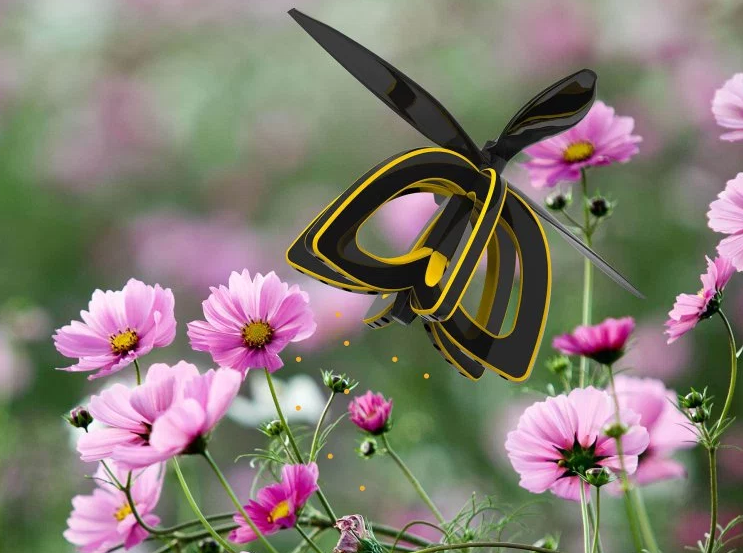 The creative ‘bug’ has reached the industrial design field where 24-year-old senior Anna Haldewang (Savannah College of Art and Design, Georgia) developed Plan Bee. Rather than being the size of the bee, this black-and-yellow drone is the size of hand and resembles a flower. Plan Bee passes over flowers collecting pollen for later cross-pollination. Haldewang has filed a patent application and is roughly two years from having a product for the market. The primary role of Plan Bee is as an educational tool, however, hydroponic and large-scale applications may also be possible.
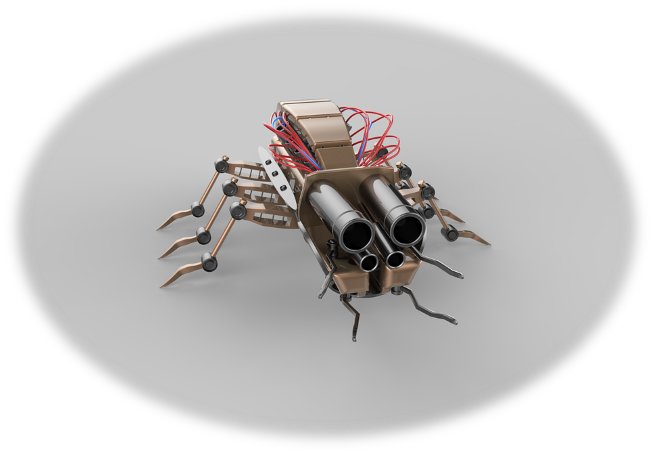 In addition to efforts of the Japanese groups, a research group in Maryland has taken the bee drone one step further. This group, led by Sarah Bergbreiter and her colleagues from the Maryland Microrobotics Laboratory at the University of Maryland, College Park has built tiny, microelectromechanical systems (MEMS) devices that look like and share the same movement as other insects such as fleas and ants. This group hopes to use their tiny robots to evaluate bridges and other structures for breakdown and search for survivors after a natural disaster.
The moral of the story is, when you see a bee hard at work, appreciate the job it’s doing to ensure that our crops are fertilized, our flowers are pollinated, and we have honey to eat.
Literature Cited:
Chechetka et al. 2017. Materially engineered artificial pollinators. Chem 2, 224–239.
AVS: Science Array Technology of Materials, Interfaces, and Processing. Insect-like microrobots move just like real insects. ScienceDaily, 7 November 2016.
Web Resources:
Researchers use drone to pollinate flower, CNN Tech
Biometric Trees: A Shockingly Cool Development, Got Nature?, Purdue Extension-FNR
Consider Pollinators When Planning Your Garden, Got Nature?, Purdue Extension-FNR
Shaneka Lawson, USDA Forest Service/HTIRC Research Plant Physiologist/Adjunct Assistant Professor
Purdue University Department of Forestry and Natural Resources
 Purdue University has teamed up with four zoos to protect hellbenders. This effort is a worldwide collaboration as zoos, government agencies, and other conservation groups, implement much-needed conservation initiatives. This recently published publication titled How Our Zoos Help Hellbenders shares the current zoos in Indiana that are collaborating with Purdue in this conservation effort. Zoos are conservation and research organizations that play critical roles both in protecting wildlife and their habitats and in educating the public. Thus, with hellbenders experiencing declines over the past several decades, teaming up with zoos in order to preserve and protect the hellbender species is ideal. The zoos that are currently partners with Purdue University in this effort are: Mesker Park Zoo in Evansville, Indiana; Columbian Park Zoo in Lafayette, Indiana; Fort Wayne Children’s Zoo in Fort Wayne, Indiana; and Nashville Zoo in Nashville, Tennessee.
Three videos have been released showing how the zoos are working with Purdue University to help protect hellbenders. You can check them out below!
Resources:
Conservation Efforts, Mesker Park Zoo
Hellbender Research Participation Spotlight, Columbian Park Zoo
Conservation, Fort Wayne Children’s Zoo
Hellbender Conservation, Nashville Zoo
Purdue Partners with Indiana Zoos for Hellbender Conservation – Purdue Newsroom
Help the Hellbender, Purdue Extension-FNR
Nature of Teaching, Purdue Extension-FNR
I found this in my barn. Is it a Hellbender? – Purdue FNR Extension, Got Nature
Purdue University Department of Forestry and Natural Resources
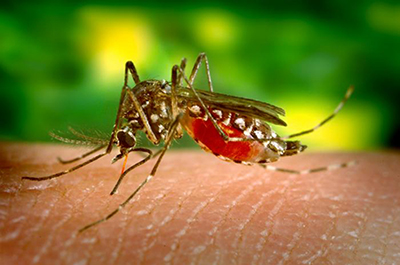
Photo by: James Gathany, Center for Disease Control and Prevention
While researchers say it is difficult to determine whether unusual weather patterns this winter and spring will lead to larger mosquito and tick populations in the Upper Midwest this summer, one thing is certain – anyone planning to spend time outdoors should take steps to avoid the potentially dangerous pests.
“Every year we face the same risks and every year it is wise to take precautions,” said Catherine Hill, Purdue University medical entomologist. “If you’re going to be outside anytime from early spring to late summer and early fall, you need to be thinking about prevention and protection.”
Both mosquitos and ticks can carry a number of pathogens that could pose a serious threat to people and animals. Mosquitos can transmit several viruses that can cause severe encephalitis (inflammation of the brain and spinal cord), including Zika and West Nile virus, among others. Ticks are known carriers of Lyme disease, which infects about 300,000 people each year, as well as less common but equally dangerous conditions such as anaplasmosis, babesiosis, Powassan and Rocky Mountain spotted fever.
To avoid mosquito bites, the best advice is to stay indoors during peak biting times, which is typically dusk to dawn for the mosquitoes that transmit West Nile virus and during the day for mosquitoes that transmit Zika.
“If you have to be outside during those times, it is best to wear clothing that can help prevent bites,” Hill said. Appropriate wardrobe choices include long-sleeve shirts and long pants tucked into socks. It is also advisable to use an effective repellant, such as products containing a minimum of 20 to 30 percent – of diethyltoluamide, commonly known as DEET. The Centers for Disease Control also recommends products containing picaridin, lemon of eucalyptus and IR3535. More information is available on the CDC website at https://wwwnc.cdc.gov/travel/yellowbook/2016/the-pre-travel-consultation/protection-against-mosquitoes-ticks-other-arthropods.
Mosquitoes breed in standing water and their larvae and pupae need water to develop. Homeowners can help reduce mosquito populations in their back yard by dumping standing water out of buckets and wading pools, keeping lawns mowed and removing piles of brush or yard waste, Hill said.
Ticks can thrive in back yards as well, particularly those adjacent heavily wooded areas, in tall grass and brush and under leaf piles.
Hill said the warmer winter and wet spring could have created ideal conditions for ticks in some areas although conditions vary significantly from region to region.
“We’ve already been getting plenty of ticks,” Hill said. “They’re certainly active.”
The best defense against ticks is to wear light colored clothing with long sleeves and pants and to use a U.S. Environmental Protection Agency-approved repellant. It is also a good idea to check your body and clothing for ticks immediately after coming back indoors.
“If you can remove a tick within 24 hours, you have a very good chance of catching them before they transmit,” Hill said.
Ticks feed on blood and tend to attach themselves to tender areas of the skin, including around the hairline and in the armpit and groin.
For the full article, see Purdue Agriculture News.
Resources:
Mosquitoes, Purdue Extension Entomology
One Small Bite: One Large Problem, Got Nature?, Purdue Extension-FNR
Darrin J Pack, Writer/Editor
Purdue University Department of Agricultural Communication
Catherine A Hill, Professor of Entomology/Vector Biology
Purdue University Department of Entomology
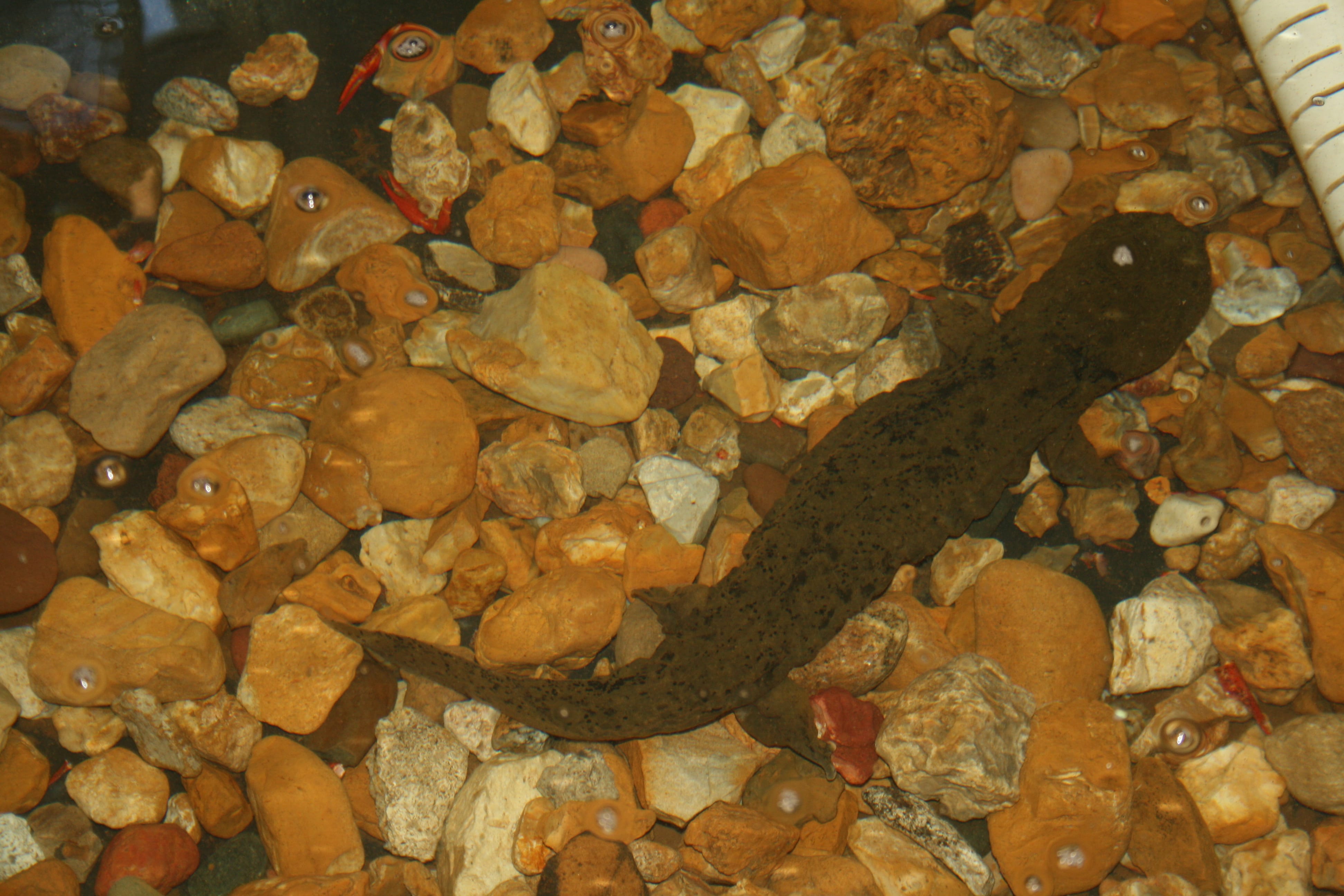 Eastern Hellbender We have written about the Eastern Hellbender salamander (Cryptobranchus alleganiensis alleganiensis) in this blog multiple times. It is a unique species and plays an important role in the aquatic ecosystem in which it inhabits. Unfortunately, the species has been declining throughout much of its range over the past several decades and can no longer be found in many of the rivers and streams where it used to be common. In Indiana, the Eastern Hellbender can only be found in the Blue River. However, this population is also declining and without intervention will likely disappear within the next 20 years. To help prevent this, Purdue University’s “Help the Hellbender” has teamed with Mesker Park Zoo and Botanic Garden (MPZ) to attempt to captive breed the Eastern Hellbender. Purdue University biologists have been capturing wild Eastern Hellbenders from the Blue River and transporting them to MPZ. MPZ has built an indoor stream designed to mimic the conditions in the Blue River. They have followed the advice of members of the highly successful Ozark Hellbender subspecies (C. a. bishopi) breeding program at St. Louis Zoo.  Mesker Park Zoo and Botanic Garden zookeeper, Bryan Plis, places a wild Eastern Hellbender into the new breeding raceway If successful, this captive population will provide a long-term, easily accessible source of young Hellbenders for eventual release. This will allow us to continue to repopulate the Blue River while expanding our release efforts to include other southern Indiana rivers with suitable habitat. The breeding program also will reduce the need to spend countless hours searching the river in the hopes of finding increasingly rare Hellbender nests. Through these efforts we will hopefully be able to reestablish self-sustaining populations of Hellbenders throughout southern Indiana and help prevent the extinction of a truly magnificent animal. For more ways you can help, please visit HelptheHellbender.org. |
Resources:
Mesker Park Zoo: Helping the Hellbender , Purdue Extension-Forestry and Natural Resources, YouTube
Help the Hellbender, Purdue Extension-Forestry and Natural Resources
Mesker Park Zoo and Botanic Garden
Hellbender Information, St. Louis Zoo
Purdue Partners with Indiana Zoos for Hellbender Conservation, Purdue Newsroom
I found this in my barn. Is it a Hellbender?, Purdue Got Nature?, Forestry and Natural Resources
Nick Burgmeier, Research Biologist and Extension Wildlife Specialist
Purdue University Department of Forestry and Natural Resources
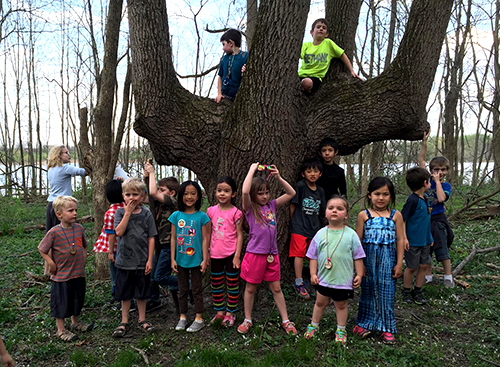
Students in Forestry and Natural Resources (FNR) continue to volunteer for Hands of the Future, Inc., a non-profit program whose mission is to help educate children about the outdoors and natural resources. As this program continues to grow, one of their dreams has been to find woods to create a children’s forest. To have a natural site that has been embellished upon with children’s needs in mind and to encourage outdoor play and adventures.
The students plan on transforming 18.8 acres of idle woods into Zonda’s Children’s Forest. The children’s forest will be composed of six main areas:
- A children’s garden, equipped with a greenhouse and kitchen, that’ll allow children to learn how to properly grow and cook food.
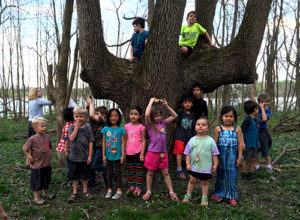
- An enclosed area dedicated to allowing children having fun and safe adventures.
- A viewing area for butterflies, birds and other organisms of the wild, allowing children to easily enjoy the life of the forest.
- A maze designed by sunflowers, where children can have fun and do problem-solving, while close to nature.
- A walk dedicated to viewing the owls and other organisms composing the forest.
- Another enclosed area of the woods for adventures; However, it’ll also contain tree houses, bridges and other fun additions for the children.
Donations:
Donations to help make Zonda’s Children’s Forest a reality can be made here. They have six months to raise $235,000 in order to purchase the woods.
Volunteers & Interns:
Older students and adults can apply to be a volunteer. Volunteers are always appreciated, no past experience necessary. If you love nature and kids you will enjoy this program. Internships are available for college students, contact Zonda Bryant.
Resources:
Family Nature Clubs in Indiana – Indiana Children and Nature Network
Zonda Bryant, Director
765.366.9126
director@hands-future.org
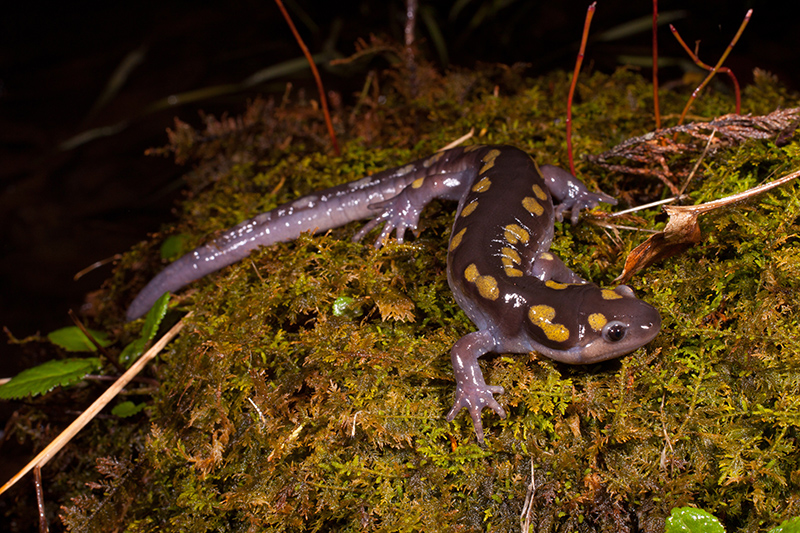
The Spotted Salamander (Ambystoma maculatum) is a common species of mole salamander. Photo credit: T. Travis Brown.
I have been asked some variation of this question multiple times over the past several years. Sometimes the “hellbender” is found in a barn, on a basement floor, crawling across a driveway, or occasionally in a pond. The common denominator is always that someone has found a salamander, and they are concerned it is an Eastern Hellbender that needs help.
I appreciate this concern. I am glad to see that people have become more aware of the existence of the Eastern Hellbender and that it is something worth helping. The Eastern Hellbender is an endangered species in Indiana, and we always welcome reports from concerned citizens. However, the Eastern Hellbender is a very rare species in Indiana and is uncommon throughout most of its range in the eastern United States. The species has been declining in Indiana over the past several decades and is now known only from the Blue River in Washington, Harrison, and Crawford Counties. For this reason alone, it is unlikely that anyone would find a Hellbender on their property.
However, another equally important reason that it is unlikely a Hellbender involves the species biology. The Eastern Hellbender is fully aquatic and lives exclusively in rivers and streams. Unlike most amphibians, its primary means of respiration is by absorbing oxygen directly from the water through its skin. One adaptation Hellbenders have evolved to help with oxygen absorption is the development of wavy skin-folds along the sides of their bodies. These skin-folds provide greater surface area for oxygen absorption. Hellbenders have lungs, but they do not function well enough to allow them to survive extended periods of time on land. Hellbenders have been found on land immediately next to rivers and streams, but this is rare and is generally considered an anomaly.
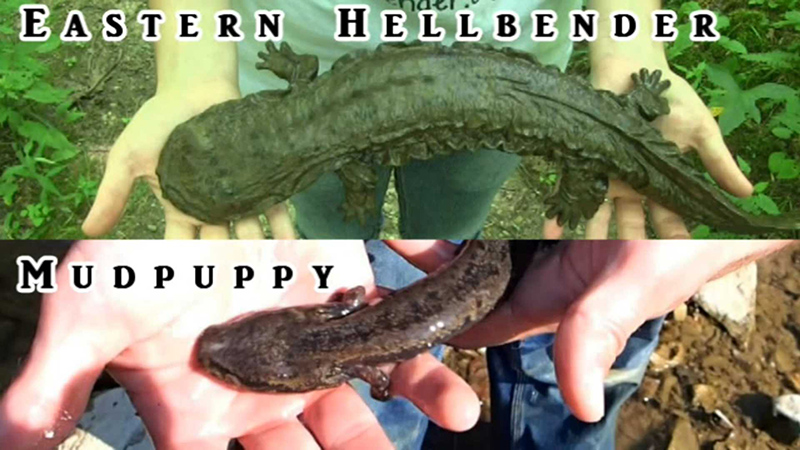
Top: Hellbender, Bottom: Common Mudpuppy.
While this rules out finding them on land away from rivers and streams, what about ponds and lakes? Hellbenders typically prefer clean, cool, swift flowing rivers and streams with a high oxygen content. These conditions are not typically found in ponds and lakes, and would make it unlikely that hellbenders would willingly reside in them. Moreover, these water bodies are usually landlocked with no close access from rivers and streams, and since hellbenders do not like to travel overland, they will likely never encounter a pond or lake.
There are two unlikely possibilities that might result in a Hellbender being found in a pond or lake. The first would be if someone captured a hellbender and moved it there. The second would be a pond or lake owner that lives in the floodplain of a river containing Hellbenders. Hellbenders do occasionally get dislodged by flooding and washed downstream. A large flood has the potential, however unlikely, to wash a Hellbender into a nearby pond. I am unaware of this ever happening, but it is a possibility.
So if you haven’t found a Hellbender, what have you found? If you found your salamander on land, it is very likely one of a group of salamanders known as mole salamanders. Mole salamanders are common throughout most of Indiana. They typically breed in ponds in the spring and then hide under logs or bury themselves underground. They are commonly found during spring breeding migrations and are frequently seen in large numbers. They often times find themselves wandering onto our properties and getting stuck in window wells or hiding themselves under rocks, firewood, or in our barns.
If you found your salamander in the water then it could be either the aforementioned mole salamander or a Common Mudpuppy. Mudpuppies are commonly confused with hellbenders and do live in ponds, wetlands, and creeks. Like the Hellbender, they are fully aquatic and don’t go on land except in very rare circumstances. Mudpuppies have large, fluffy gills behind their heads, which Hellbenders do not have. Mudpuppies also lack the skins folds along the sides of their bodies.
While most people will go their entire lives without ever seeing a Hellbender, if you live in the right areas it is a possibility. If you think you have seen a Hellbender, then please take a photo and let us know by visiting our Hellbender Reporting Webpage below. We are always happy to help.
Resources:
Hellbender ID – video, The Education Store, Purdue Extension resource center
HelptheHellbender.org, Purdue Extension
Help the Hellbender: North America’s Giant Salamander, The Education Store
Salamanders of Indiana, The Education Store
Appreciating Reptiles and Amphibians, The Education Store
Nick Burgmeier, Research Biologist and Extension Wildlife Specialist
Purdue Department of Forestry and Natural Resources
 If you or someone you know loves to learn about wildlife, especially reptiles and amphibians, then you will be interested in our new special offer package. We are offering our complete collection of reptile and amphibian field guides (4 softcover books) for 10% of the price of each individual book. These books cover all of the reptiles and amphibians that are found in the state of Indiana. They include detailed physical descriptions, distribution maps, and interesting information about the ecology of each species. All of the included books have been peer-reviewed by experts in the field of herpetology.
The Indiana Amphibian and Reptile ID Package can be purchased from the Purdue Education Store for $36.00.
Additional Resources, The Education Store, Purdue Extension:
Frogs and Toads of Indiana
Salamanders of Indiana
Snakes and Lizards of Indiana
Turtles of Indiana
More Resources Available:
Help the Hellbender, Purdue Extension
The Nature of Teaching, Lesson Plans K-12, Purdue Extension
Nick Burgmeier, Research Biologist and Extension Wildlife Specialist
Purdue Department of Forestry and Natural Resources
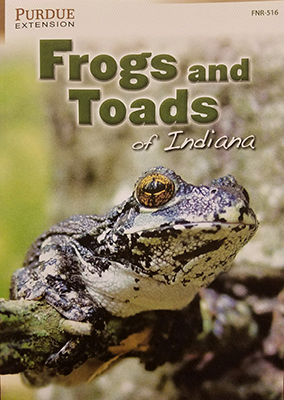 Frogs and Toads of Indiana is the latest and final addition to Purdue Extension’s line of field guides focused on the reptiles and amphibians of Indiana. Readers of this guide will not only learn how to ID the Anuran species of Indiana but will also learn about their distribution throughout the state along with their habits and behaviors. The guide is richly illustrated, filled with interesting facts, and has been peer-reviewed by expert herpetologists.
As many herpetologists and recreational herpers can attest, seeing what you are hearing is not always possible. With this in mind, we developed a website The Frogs and Toads of Indiana for users that wish to learn the calls of Indiana Anuran species.
The Frogs and Toads of Indiana, FNR-516, can be purchased from the The Education Store for $10.00.
Resources, The Education Store-Purdue Extension resource center:
Salamanders of Indiana
Snakes and Lizards of Indiana
Snakes of the Central and Northeastern United States
Turtles of Indiana
Additional resources:
The Nature of Teaching, Lesson Plans K-12, Purdue Extension
Nick Burgmeier, Research Biologist and Extension Wildlife Specialist
Purdue Department of Forestry and Natural Resources
It’s Arbor Day again, and it’s time to celebrate the importance of trees. The fact that trees are essential to both humans and wildlife is well-established. However, most people think of trees in the context of oxygen production, wood products, and habitat for wildlife such as squirrels and birds. I’d like to focus on one of the less well-known services that trees provide, keeping water clean. This service not only benefits people but also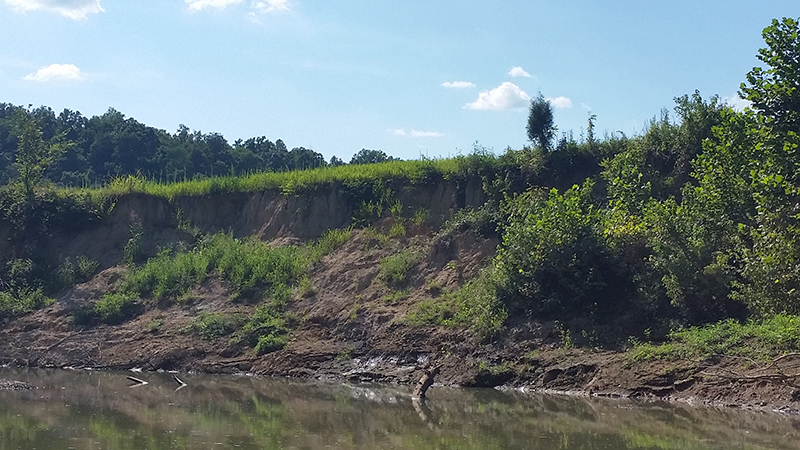 aquatic wildlife like the Hellbender salamander.
The Hellbender salamander is North America’s largest salamander. It is fully aquatic, living its entire life in rivers and streams throughout the midwest and southeast. Hellbenders require cool, clean rivers and streams with rocky substrates to thrive and reproduce. Unfortunately, over the past few decades the species has declined or disappeared from many of these areas. There are several causes that scientists suspect, but the loss of trees due to increases in agriculture and urban/suburban areas is at the top of the list.
Trees do a number of things to keep our water clean. The forest canopy intercepts rainfall and slows the rate at which water enters the ground. This helps reduce flooding. Trees provide shade to rivers and streams thus keeping them cool and allowing for higher levels of dissolved oxygen. Trees also filter nutrients and chemicals from runoff, preventing them from entering streams. One of the most important functions that trees provide is stabilizing our riverbanks and hillsides and preventing sediment from entering the stream and changing our rocky river bottoms to mud bottoms. These functions are especially important in our modern landscape, where agriculture and hard surfaces dominate many areas.
All of these functions help to create a clean environment for Hellbenders and other aquatic wildlife to live. Without trees, it is likely that our rivers and streams would be too dirty for many species to survive. If you are looking for a way to help the Hellbender, then please consider planting a tree this Arbor Day. Several Arbor Day celebrations for 2017 will be held on Saturday, April 29th. Check out activities around your area: Purdue Extension County Offices, Indiana Department of Natural Resources or Tippecanoe Soil & Water Conservation District.
For more ways you can help, please visit Help the Hellbender.org.
Resources:
Rainscaping, Purdue Extension
How Anglers and Paddlers Can Help the Hellbender, The Education Store-Purdue Extension resource center
Hellbender ID, The Education Store
Improving Water Quality by Protecting Sinkholes on Your Property, The Education Store
Improving Water Quality at Your Livestock Operation video, The Education Store
Healthy Water, Happy Home – Lesson Plan, The Education Store
Tree Planting Part 1: Choosing a Tree video, The Education Store
Tree Planting Part 2: Planting Your Tree video, The Education Store
Tree Installation: Process and Practices, The Education Store
Nick Burgmeier, Research Biologist and Extension Wildlife Specialist
Purdue Department of Forestry and Natural Resources

Recent Posts
- Beetle that attacks Tree-of-Heaven found in Indiana, Purdue Landscape Report
Posted: March 20, 2026 in Invasive Insects, Wildlife, Woodlands - ID That Tree: Dwarf Chinkapin Oak
Posted: in Forestry, Urban Forestry, Wildlife, Woodlands - DNR Hiring for Indiana Conservation Officer Positions, MyDNR
Posted: March 9, 2026 in Urban Forestry, Wildlife, Woodlands - ID That Tree: Shumard Oak
Posted: in Plants, Urban Forestry, Wildlife, Woodlands - Uniting Indiana Residents Against Invasive Species
Posted: February 27, 2026 in Community Development, Invasive Insects, Wildlife - Have You Seen a Soaring Eagle Lately? Morning Ag Clips
Posted: February 25, 2026 in Urban Forestry, Wildlife - Register for Natural Resources Teacher Institute’s Class of 2026
Posted: February 19, 2026 in Forestry, Wildlife, Woodlands - ID That Tree: Fragrant Sumac
Posted: February 4, 2026 in Plants, Urban Forestry, Wildlife - Woodsy Owl Edition for Educational Learning, USDA – U.S. Forest Service
Posted: January 21, 2026 in Forestry, Forests and Street Trees, Got Nature for Kids, Urban Forestry, Wildlife - Opt-in to the Deer Management Survey, MyDNR
Posted: January 12, 2026 in Forestry, Wildlife
Archives
Categories
- Alert
- Aquaculture/Fish
- Aquatic/Aquaculture Resources
- Ask the Expert
- Christmas Trees
- Community Development
- Disease
- Drought
- Forestry
- Forests and Street Trees
- Gardening
- Got Nature for Kids
- Great Lakes
- How To
- Invasive Animal Species
- Invasive Insects
- Invasive Plant Species
- Land Use
- Natural Resource Planning
- Nature of Teaching
- Plants
- Podcasts
- Ponds
- Publication
- Safety
- Spiders
- Timber Marketing
- Uncategorized
- Urban Forestry
- Webinar
- Wildlife
- Wood Products/Manufacturing
- Woodland Management Moment
- Woodlands