 Purdue University - Extension - Forestry and Natural Resources
Got Nature? Blog
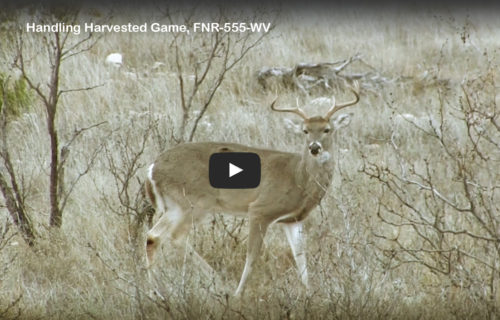 In this new video series Handling Harvested Game: Field Dressing, wildlife biologist Bob Cordes with the Maine Department of Inland Fisheries and Wildlife shows how to properly treat and handle deer in order to receive the best results for your venison. This video shares step by step safe handling techniques to reach your goals in providing a wholesome source of meat for you and your family.
More resources:
Handling Harvested Game – Episode 2, Purdue Extension-Forestry and Natural Resources YouTube Playlist
How to Score Your White-tailed Deer, video, The Education Store, Purdue Extension Resource Center
Age Determination in White-tailed Deer, video, The Education Store,
How to Build a Plastic Mesh Deer Exclusion Fence, The Education Store,
Bovine Tuberculosis in Wild White-tailed Deer, The Education Store,
Indiana Deer Hunting, Biology and Management, Indiana Department of Natural Resources (IDNR)
Rod Williams, Associate Professor of Wildlife Science/Engagement Faculty Fellow
Purdue University Department of Forestry and Natural Resources
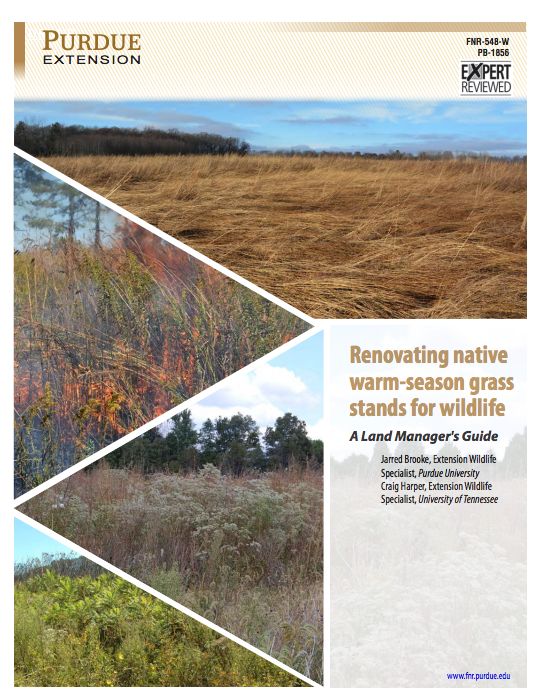 A new extension publication co-authored by Purdue Extension Wildlife Specialist, Jarred Brooke, and University of Tennessee Extension Wildlife Specialist, Dr. Craig Harper, provides landowners and land managers with practical recommendations to assist in the management and renovation of existing native-warm season grass stands for wildlife. The publication provides information on how to use various habitat management tools to fix common issues in planted native grass stands. The publication was produced in partnership with University of Tennessee Extension, Indiana DNR Fish & Wildlife Division, and the Indiana State Chapter of the National Wild Turkey Federation.
The electronic copy of the publication is available to download for free from the Purdue Education Store. Printed copies are also available from the Education Store for $10.
Resources:
Sericea Lespedeza, Plague on the Prairie, Got Nature?, Purdue Extension-FNR
Prescribed fire: 6 things to consider before you ignite, Got Nature?, Purdue Extension-FNR
If Your Native Grasses Look Like This, It’s Time for Management, Got Nature?, Purdue Extension-FNR
Jarred Brooke, Extension Wildlife Specialist
Purdue Department of Forestry and Natural Resources
 Question
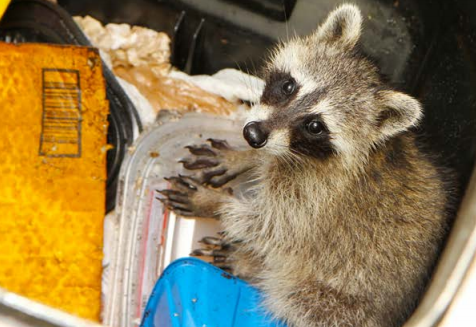
I have raccoons in my attic. Before I evict them, I want to provide an alternate place for them to go. There aren’t really enough trees around here anyway, so I want to make a raccoon house or two. Do you have any plans you could recommend? Also, in order to deter them from trying to get back in, is it true that they dislike wire/hardware cloth, and so I could reinforce those areas with that on the outside?
They shouldn’t be pregnant yet, should they?
Answer
Raccoons usually breed in the end of January into February, but that is not a concern for your issue. Even sows with young can move from one “den” site to another. You will need to remove the raccoon prior to repairing how the animal got in. You need to be absolutely sure that the raccoon is not in the attic before you exclude it. If you simply put up a box and fix your house, that will likely not solve your problem. The raccoon will likely try and get back in your attic, which is their “den tree” from the animal’s perspective. You can lawfully trap and relocate raccoons without a permit. Check out the Indiana Department of Natural Resources (IDNR) Wildlife Removal website for more information
A resident landowner or tenant can legally capture these species of wild animals listed above without a permit on the property that he/she owns or rents if the animal is:
- causing or threatening to cause damage to property, or
- posing a health or safety threat to people or domestic animals.
The landowner/tenant also can designate another person to take the animal for them if:
- the landowner/tenant provides written permission (which must be on the person while taking the animal),
- and no compensation of any kind is given to the person who takes the animal.
- A hunting or trapping license, or a nuisance wild animal control permit, is required to take wild animals on land that you do not own or rent.
Within 24 hours of capture, the person who takes the animal must release it or euthanize it. Animals that are released must be released on land in the county where it was captured. Furthermore, the landowner or property manager must give permission for the release. These nuisance animals cannot be possessed for more than 24 hours and cannot be sold, traded, bartered or gifted.
For excluding the raccoon, or others, from your attic, you will need to use good materials. Hardware cloth or metal flashing typically work well. It isn’t that they don’t like those materials, they are sturdy enough to hold up. Also, repairing the damage to its original constructed method is good. Usually where animals enter it is either worn or damaged areas, or gaps in construction (even in new houses).
Resources:
Raccoon Box Plan – Pennsylvania Game Commission
Preventing Wildlife Damage – Do You Need a Permit?, The Education Store, Purdue Extension Resource Center
Selecting a Nuisance Wildlife Control Professional, The Education Store
Trapping Nuisance Wildlife, Got Nature?, Purdue FNR-Extension
Brian MacGowan, Extension Wildlife Specialist
Department of Forestry & Natural Resources, Purdue University
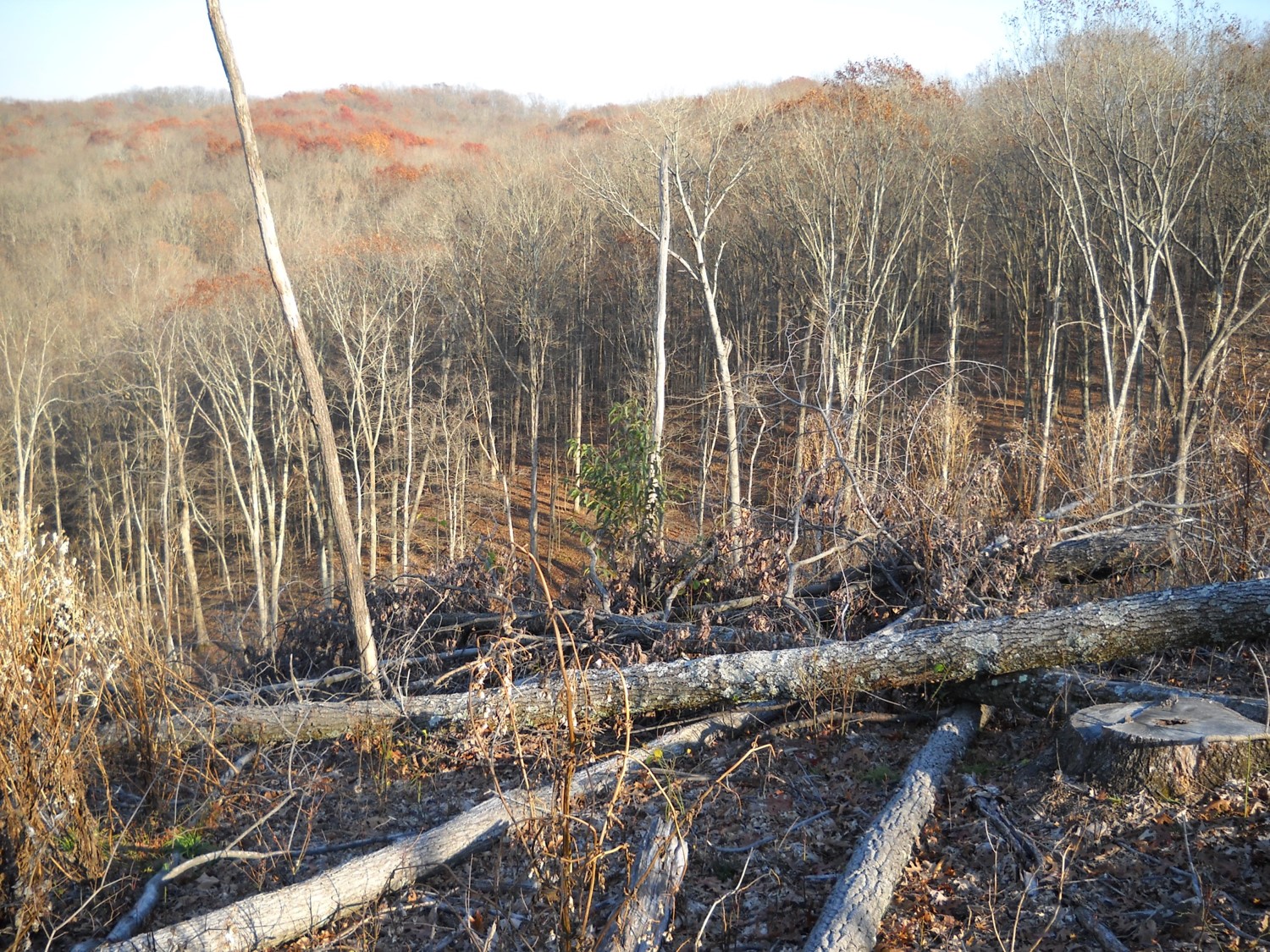 There has been much debate in the popular press lately regarding the role of timber harvesting on forest communities. A common focus of this debate is the perceived impacts to wildlife. Most believe that leaving our forests alone is best for wildlife. However, to provide habitat for all of our native forest wildlife species, forests need to be diverse in terms of age, species and area. Harvesting timber is the primary means of achieving this structural diversity. The purpose of this article is to summarize some key points regarding the effects of harvesting on reptiles and amphibians. These points are drawn mostly from the Hardwood Ecosystem Experiment (HEE), an ongoing research study in southern Indiana. Its primary focus is to study forest management and its effects on plants and animals. A more detailed summary may be found in Forest Management for Reptiles and Amphibians.
There has been several large-scale studies that have investigated the effects of tree canopy removal on amphibians and reptiles. These include the HEE in Indiana, the Missouri Ozark Forest Ecosystem Project (MOFEP), and the Land-use Effects on Amphibian Populations (LEAP). Much of the work from these projects has been published in the scientific literature. All of these studies demonstrate that the response of amphibians and reptiles to timber harvesting is variable—it cannot simply be quantified as good or bad. Indeed, avoiding negative impacts to all reptiles and amphibians as a result of timber harvesting is neither possible nor desirable since disturbance-dependent wildlife species1,2 and many mature forest species3, require early successional forests.
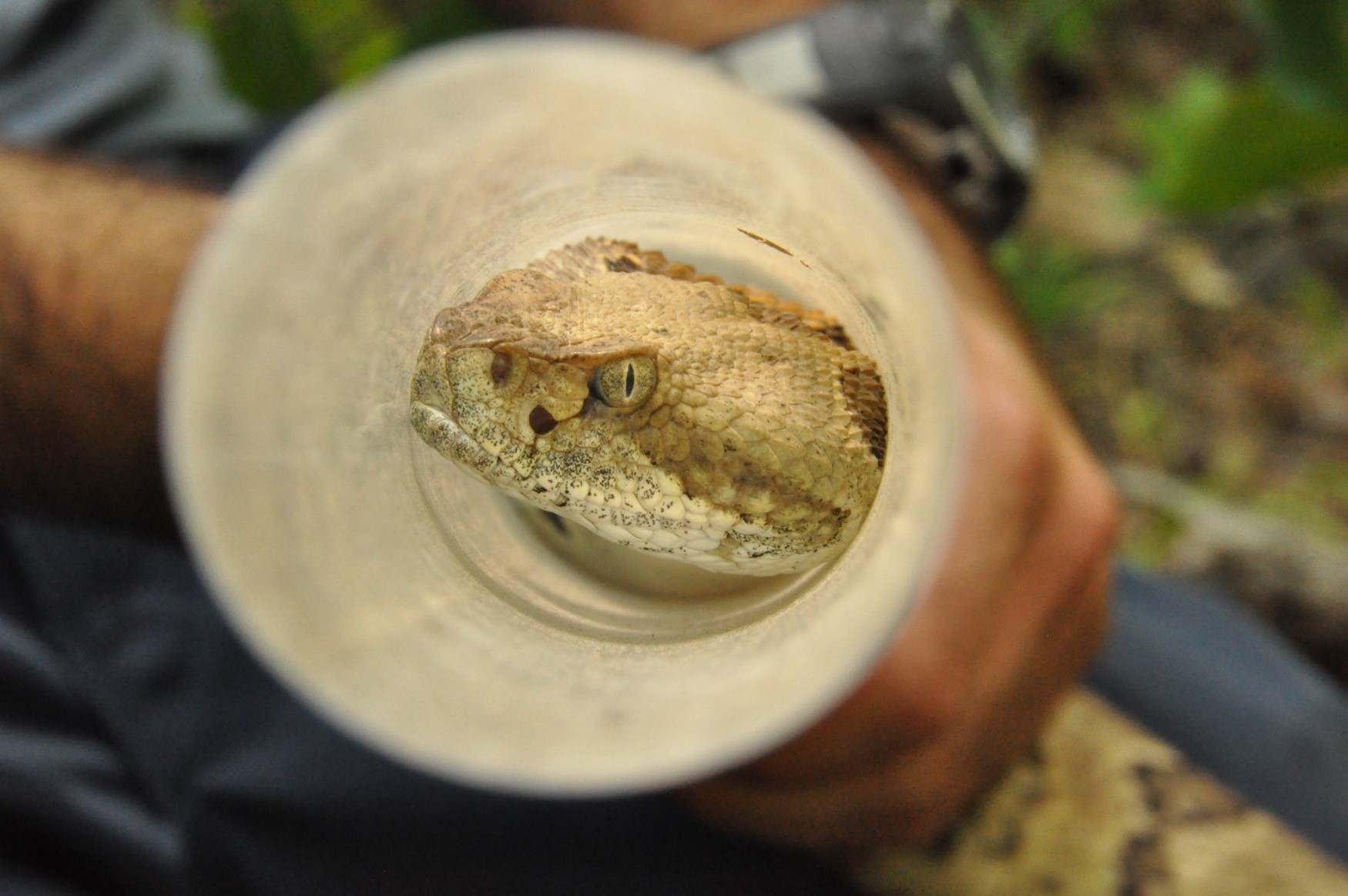
Timber Rattlesnake
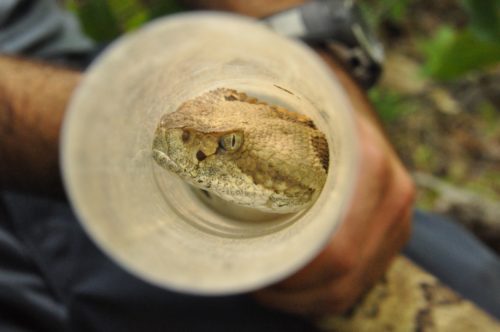 For the focal species studied on the HEE, most exhibited moderate or no response in 1-3 years following timber harvests. The focal species I and colleagues have studied were timber rattlesnakes (Crotalus horridus), eastern box turtles (Terrapene carolina), and terrestrial salamanders. Timber harvests had no effect on the area male or female adult timber rattlesnakes used during the active season. There was no evidence that snakes changed movement behaviors to avoid clearcuts4. Indeed, several snakes were observed within clearcuts for several weeks and across multiple years. Annual survival of rattlesnakes on the HEE sites was high during the active season (72-98%) and winter (97-99%). Timber harvesting had no impact on survival. Declines in female survival was most affected by declines in prey abundance the previous year which were due to tree mast failures5. The level of acorns and nuts (i.e., mast) produced in woodlands naturally vary from year to year. When the small mammal population declined due to mast failure, these snakes were apparently impacted the following year.
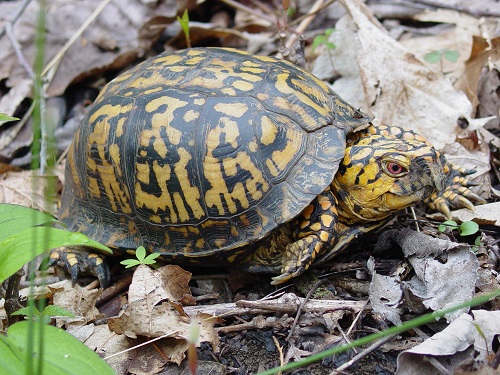
Eastern Box Turtle
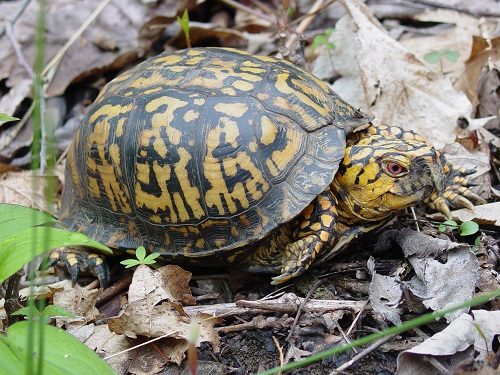 For box turtles, there was no effect of timber harvests on home-range size, but the average daily distance traveled by turtles decreased by 30 percent following harvest, and turtles maintained 9 percent higher body temperatures6. Temperatures in harvest openings were 29 percent warmer in the summer and 31 percent colder in the winter than forested sites. Despite this change, turtles continued to use harvest openings during the active season, but tended to make shorter, more frequent movements in and out of harvests. Turtles likely used harvest edges for cover, thermoregulation and, possibly, foraging opportunities6. Harvested areas offered potential hibernation sites based on soil profile temperatures, slope aspect and depth of hibernation7. Both active and hibernal data suggest the level of harvesting on the HEE has modest effects on box turtle behavior, at least in the short term. To date, there is no evidence to support whether these changes have any impact—positive or negative—on box turtles.
Woodland Salamanders
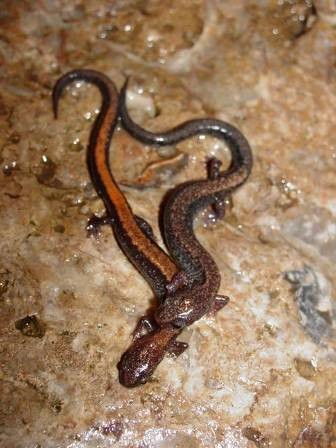 The response of woodland salamanders to harvests was species-specific8. The relative abundance of eastern red-backed salamanders (Plethodon cinereus) and northern slimy salamanders (Plethodon glutinosus) declined from pre- to post-harvest in patch cuts (1 to 3 acres) and clearcuts (10 acres). Red-backed salamanders also declined in control sites, suggesting factors other than the harvests contributed to salamander declines over the study period. However, red-backed salamander declines observed in control sites were not as severe as those seen within patch cuts and clearcuts, indicating harvests were at least partially responsible for observed declines within the harvest boundaries. The relative abundance of northern zigzag salamanders (Plethodon dorsalis) did not decline from pre- to post-harvest in any harvest type, and increased on sites adjacent to clearcuts.
- These findings suggest canopy removal (2-10 acre gaps) has short-term local impacts on terrestrial salamanders in terms of relative abundance, but effects do not necessarily extend to the adjacent forest matrix. A caveat to these findings is that the ultimate fate of displaced individuals remains unknown. That is, changes in relative abundance does not mean declines in survival. Indeed, sites adjacent to clearcuts experienced an increase in counts of zigzag salamanders, which could reflect the evacuation of individuals from the clearcut into the intact forest. It is also important to note that other factors influence the abundance of terrestrial salamanders. For example, in addition to differences between seasons (spring versus fall), drought played a significant role in declines in salamander abundance across all study area.
Forest management sometimes leads to short-term loses for some species but is critical to the long-term sustainability of many other species. Looking at the responses of just a few species, within cutover areas for a few years paints an incomplete picture. A large-scale, long-term perspective is necessary when considering forest management. This is the true value of well-designed studies such as the HEE. With experimental control and replication, researchers can untangle the story on what are the true effects of forest management over a large area over many decades. The HEE has shed light on many answers so far. We can look forward towards many more to come.
Resources
Wildlife Responses to Timber Harvesting, Video-The Education Store-Purdue Extension Resource Center
Hardwood Ecosystem Experiment – Forest Birds, Video-The Education Store
Managing Woodlands for Birds, Video-The Education Store
Sustaining Our Oak-Hickory Forests, Video-The Education Store
Breeding Birds and Forest Management: the Hardwood Ecosystem Experiment and the Central Hardwoods Region, The Education Store
Forest Management for Reptiles and Amphibians: A Technical Guide for the Midwest, The Education Store
Hardwood Ecosystem Experiment (HEE)
Brian MacGowan, Extension Wildlife Specialist
Department of Forestry & Natural Resources, Purdue University
Citations
1 Thompson, F. R., III, and D. R Dessecker. 1997. Management of early-successional communities in central hardwood forests: with special emphasis on the ecology and management of oaks, ruffed grouse, and forest songbirds. U.S. Forest Service General Technical Report NC-195, St. Paul, MN, USA.
2 Greenberg, C. H., B. Collins, F. R. Thompson, III, and McNab, W. H. 2011. “What are early successional habitats, why are they important, and how can they be sustained?” Pages 1-10 in Sustaining young forest communities: ecology and management of early successional habitats in the Central Hardwood Region, USA. C. H. Greenberg, B. Collins, and F. R. Thompson, III., editors. Springer, New York, NY, USA.
3 Chandler, C. C., D. I. King, and R. B. Chandler. 2012. Do mature birds prefer early-successional habitat during the post-fledging period? Forest Ecology and Management 264:1-9.
4 MacGowan, B.J., Currylow, A.F.T., and MacNeil, J.E. 2017. Short-term responses of Timber Rattlesnakes (Crotalus horridus) to even-aged timber harvests in Indiana. Forest Ecology and Management 387(1):30-36.
5 Olson, Z.H., B.J. MacGowan, M.T. Hamilton, A.F.T. Currylow, and R.N. Williams. 2015. Survival of timber rattlesnakes: Investigating individual, environmental, and ecological effects. Herpetologica 71:274-279.
6 Currylow, A.F., B.J. MacGowan, and R.N. Williams. 2012a. Hibernal thermal ecology of eastern box turtles within a managed forest landscape. Journal of Wildlife Management 77(2):326-335.
7 Currylow, A.F., B.J. MacGowan, and R.N. Williams. 2012b. Short-term forest management effects on a long-lived ectotherm. PLoS ONE 7(7):e40473.
8 MacNeil, J.E. and R.N.Williams. 2014. Effects of timber harvests and silvicultural edges on terrestrial salamanders. PLoS ONE, 9(12):e114683.
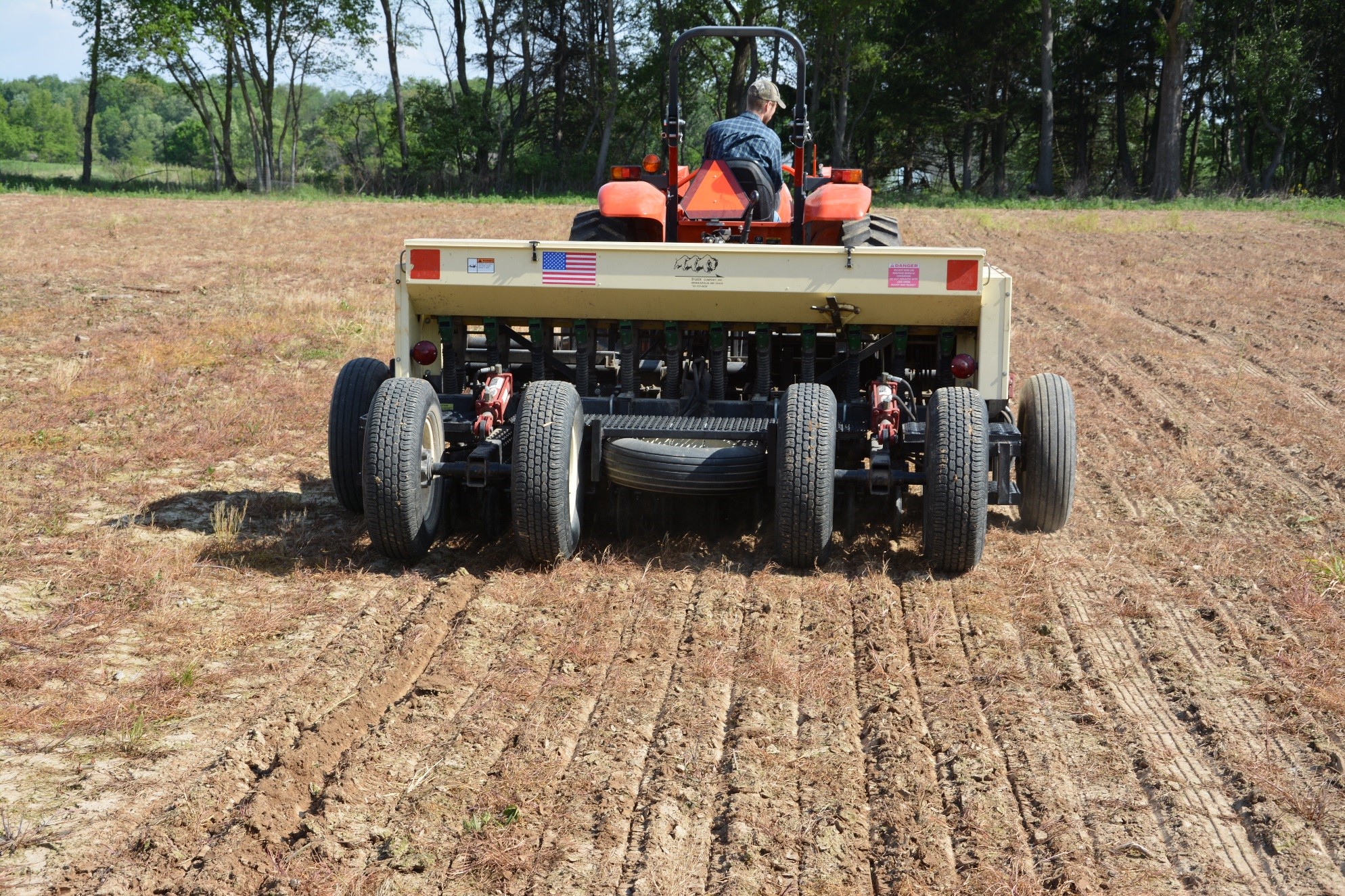
Seeding rates for native warm-season grass and forb mixtures (NWSG) have changed drastically over time. In the past, native grasses were planted without forbs at rates exceeding 10 lbs/ac. This may be ideal from a forage production standpoint, but this created dense stands of native grass with little to no forb component and lacked benefits to most wildlife.
Mixtures have shifted from heavy planting rates of tallgrass species with few forbs to reduced rates of mid-stature grasses with an abundance of forbs. Recommended seeding rates of some current mixtures may be lower than what no-till drills are capable of planting. In this case, fillers may be needed to increase the bulk weight of the seed to allow the equipment to plant at the correct rate.
Seed mixtures are also more commonly being established by broadcasting seed during late winter (frost seeding) using cyclone fertilizer spreaders. Broadcasting native warm-season grass and forb seed usually requires the use of a carrier to ensure the mixture flows correctly through the spreader and the seed is distributed evenly across the field.
Using fillers when no-till drilling native warm-season grass and forb mixtures
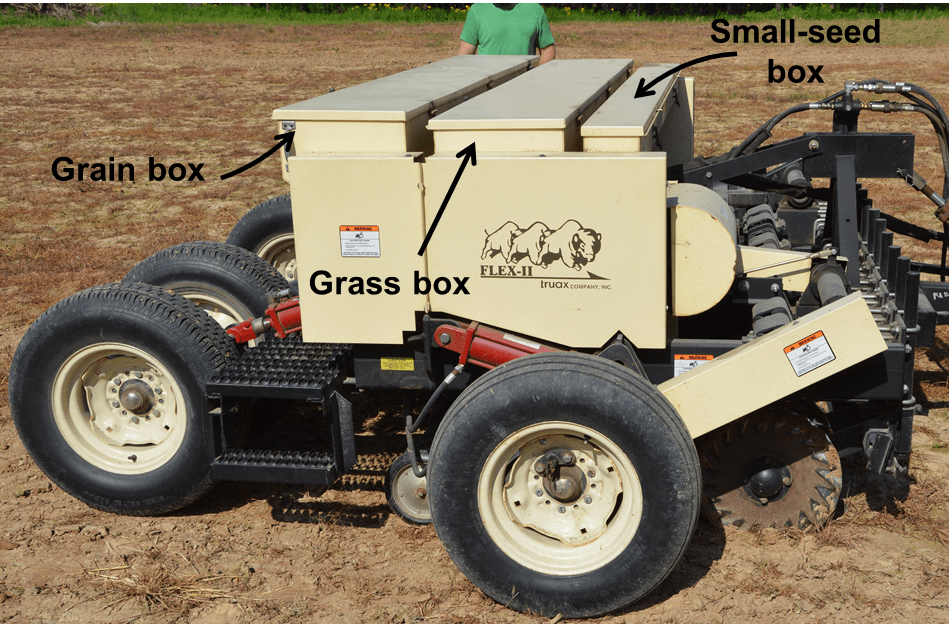
Planting native grass and forb mixtures with a no-till drill is the most common establishment method for NWSG plantings. It may be difficult to achieve the correct seeding rate with a no-till drill because of the combination of reduced bulk weight of dechaffed seed and reduced seeding rates of common mixtures. Fillers can be used to increase the bulk weight of native grass and forb seed if a drill cannot achieve the recommended seeding rate. Traditionally, native grass and forbs have been planted separately using the grass or fluffy-seed box for the native grass seed and the small-seed box for the forbs. However, if the seed has been cleaned and dechaffed it is common for seed companies to mix the seed and recommend it be planted together using the fluffy or grain box on a no-till drill. Fillers can be used when planting native grasses and forbs separately or when planting native grass and forb mixtures. Refer to the chart below for recommended fillers for the different seed boxes of a no-till drill.
Example:
We are planting a 10-acre field to a native warm-season grass and forb mixture using a no-till drill. The recommended seeding rate is 6 lbs/acre. The seed will be planted with the grain box of the drill, but the drill will only plant a minimum of 10 lbs/acre of our seed mixture.
10 acre field * 6 lbs/acre bulk seeding rate = 60 lbs of the seed mixture
Minimum seeding rate for the no-till drill is 10 lbs/acre = 10 lbs/acre * 10 acres = 100 lbs
We need to add a filler to increase the bulk weight of the seed mixture to be able to plant at the correct seeding rate. We added a 1:1 ratio (by weight) of cracked corn to our seed mixture:
60 lbs of seed + 60 lbs of cracked corn = 120 lbs of bulk weight for 10 acres
We now need to adjust our bulk seeding rate to account for the added crack corn.
120 lbs of bulk weight for 10 acres = 12 lbs/acre
We need to calibrate our drill to plant 12 lbs/acre in order to plant 6 lbs/ac of our initial seed mixture.
Generally, you should use a 1:1 ratio (by weight) of filler-to-seed, but in some cases you may need to use a higher ratio (e.g., 2:1, 3:1, or 4:1 filler-to-ratio) to achieve the correct seeding rate.
Using carriers when broadcasting native warm-season grass and forb mixtures
Broadcasting native warm-season grass and forbs mixtures is most commonly accomplished with a cyclone fertilizer spreader. These spreaders may have issues broadcasting the native grass and forb seed. The 2 main issues are: (1) the seed is not heavy enough to flow through the spreader and (2) the seeds of various size will settle and will not be spread evenly across the field. Carriers will add more bulk weight to the native grass seed and will help ensure the seed stays mixed across the field. Common carriers that are used with native grasses are cracked corn, pelletized lime, wheat, or oats. The recommended rates of common carriers are in the table below:
Pelletized lime
Wheat
Oats
Cracked corn
200 lbs/acre
40 lbs/acre
32 lbs/acre
1:1 ratio of seed-to-cracked corn by weight
Table adapted from the publication Warm season grass establishment,
Indiana Department of Natural Resources, 2006.
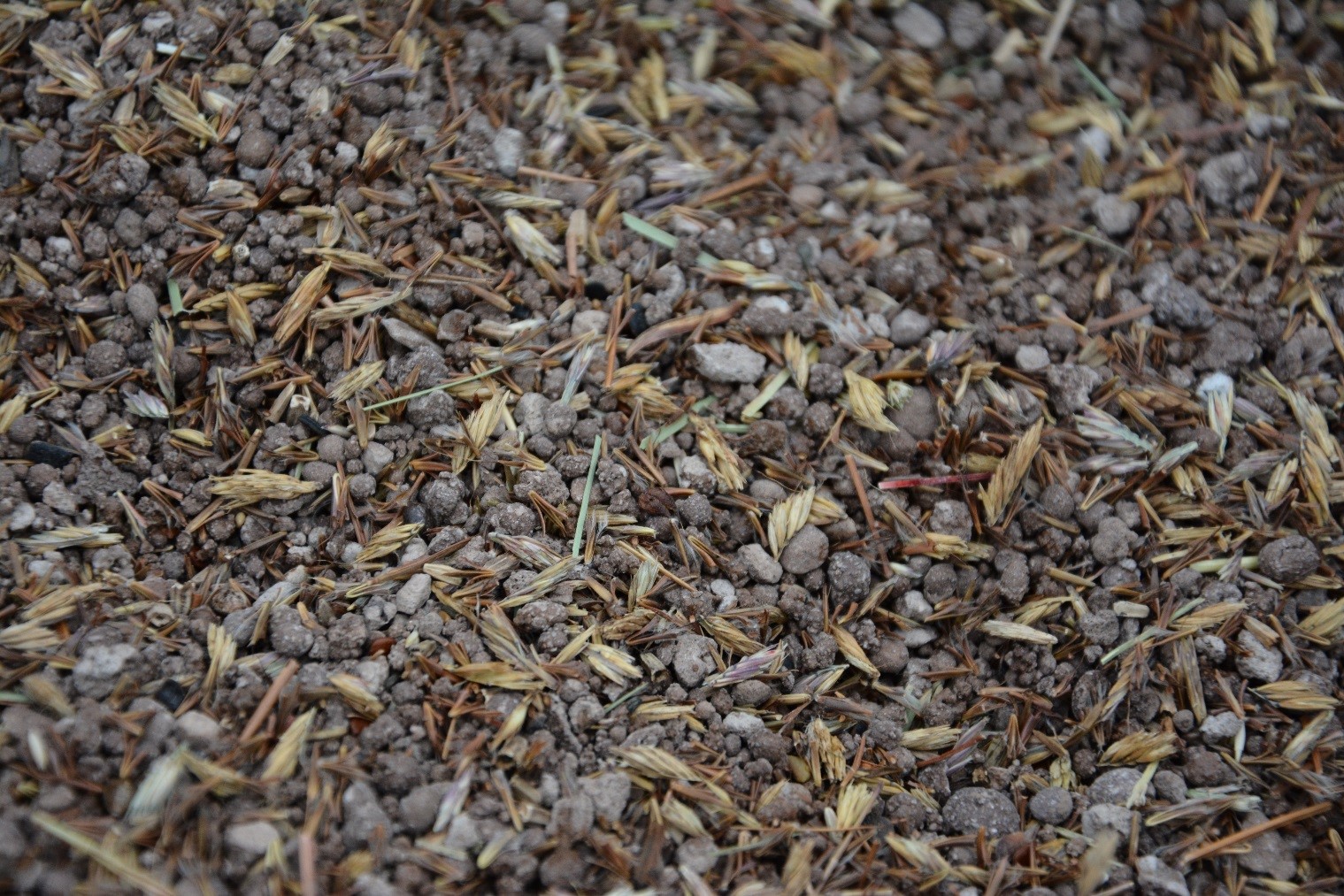
Pelletized lime mixed with native grass and forb seed prior to broadcasting.
Example:
We plan to broadcast a native grass and forb mixture on a 10-acre field. The recommended bulk seeding rate is 6 lbs/acre.
10 acre field * 6 lbs/acre bulk seeding rate = 60 lbs of the seed mixture
We need to add a carrier to the mixture to increase the bulk weight of the seed mixture. We plan to add 200 lbs of pelletized lime per acre:
200 lbs/ac of lime * 10 acres = 2000 lbs of lime
60 lbs of seed + 2000 lbs of pelletized lime = 2060 lbs of bulk weight for 10 acres
We now need to adjust our bulk seeding rate to account for the added pelletized lime.
2060 lbs of bulk weight for 10 acres = 206 lbs/acre
We need to calibrate the spreader to broadcast 206 lbs/acre in order to plant 6 lbs/acre of our seed mixture.
Conclusions
Planting native warm-season grass and forb mixtures at the correct rate is a critical step in ensuring a successful planting. Using fillers and carriers when establishing native warm-season grasses and forbs can help ensure the mixtures are planted at the proper rates, flow correctly through the seeding equipment, and ensure the seed is spread evenly across the field.
Other Resources:
Pure Live Seed: Calculations and Considerations for Wildlife Food Plots, Detailed Resource, Purdue Extension-FNR
Renovating Native Warm-Season Grass Stands for Wildlife: A Land Manager’s Guide, free pdf download
Calibrating a No-Till: FNR 556-WV, free pdf download
VIDEO: Calibrating a No-Till Drill for Conservation Plantings and Wildlife Food Plots
VIDEO: Frost Seeding to Establish Wildlife Food Plots & Native Grass and Forb Plantings
Printable Version:
PDF available for print: Seed Fillers and Carriers for Planting Native Warm-Season Grasses and Forbs (pdf 771.45) detail resource.
Moriah Boggess, Purdue Extension Wildlife Intern
Jarred Brooke, Purdue Extension Wildlife Specialist
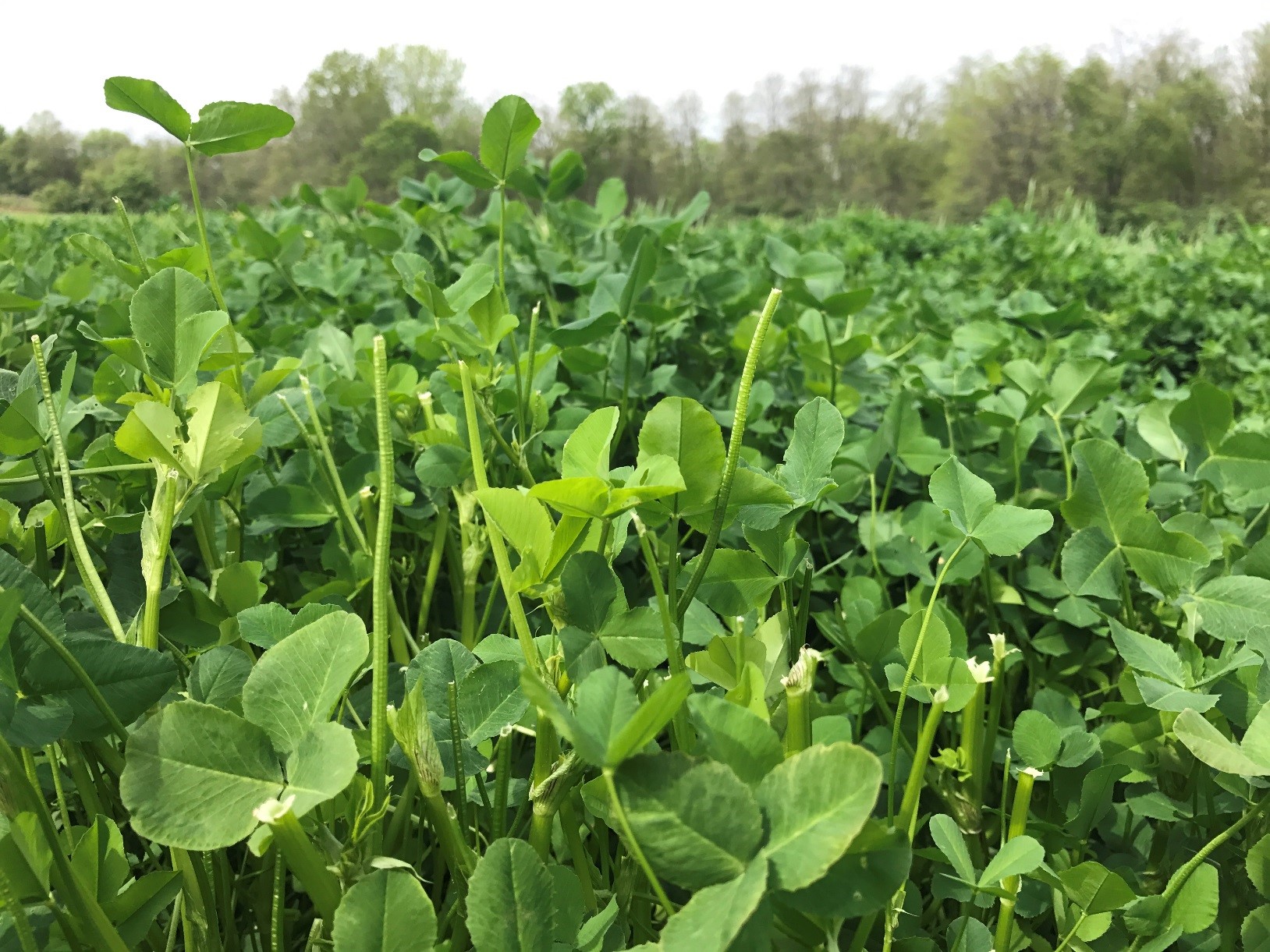
Have you heard the old adage “proper planning prevents poor performance?” This adage applies perfectly to establishing food plots for wildlife; you just have to adjust the words, “Proper planting prevents poor food plot performance”.
When we talk about planting we include planting method, timing, depth, and planter calibration (see video), but we also include seeding rate. While there are many steps prior to planting to ensure a successful food plot, including taking a soil test, adjusting the soil fertility, and proper site preparation, determining the proper seeding rate based on pure live seed rather than bulk weight may be one aspect that people skip or ignore.
All agronomic seeds have a recommended seeding rate. This is the rate that maximizes forage or grain production and minimizes seed costs. Planting food plot seed too heavily is often a waste of money, because it increases your seed cost, but does not necessarily increase you forage or grain production. Planting food plots too lightly is an inefficient use of field space, opening areas up for weeds to overtake your planting, and could result in failure because of overbrowsing.
Seeding rate also varies by planting method and it’s important to make sure to follow the recommended seeding rate for the planting method you will be using. This rate is greater when broadcasting rather than when drilling or planting seed (broadcast rate: 75-100 lbs/ac vs. drilling rate: 50 lbs/ac for iron-clay cowpeas).
It is important to recognize the difference in how seed is sold (bulk weight) and how seeding rates are recommended (pure live seed [PLS]). When you buy seed from a supplier you are buying it in the form of bulk weight. Bulk weight is the total weight inside the bag, including the food plot seed, as well as the weight of the seed coating and other material (other crop seed and weed seed).
While seed is sold by bulk weight, seeding recommendations are commonly given as PLS rates. This distinction is important. For example, all the recommendations in A Guide to Wildlife Food Plots and Early Successional Plants by Dr. Craig Harper, University of Tennessee Extension are given in PLS rates. Pure live seed is the living seed of the intended crop that will germinate from a seed bag and accounts for the weight of the bag made up of impurities, weed seed, and other crop seed.
Percent PLS in a seed bag varies, depending on the amount of pure seed in the bag as well as the germination rate of that seed. It is important to know the difference between PLS and bulk weight so that you can calculate the amount of bulk weight you need to achieve the recommended PLS seeding rate.
Keep the distinction between bulk weight and PLS weight in mind when buying seed to ensure you purchase enough seed to cover the entire area of your food plot. In this article we will explain how to calculate PLS based on information given to you when you purchase seed.
Dissecting a seed tag – know what you’re getting before you purchase
Before we get too far into calculating PLS, it is important to understand what information you get when purchasing seed. Regardless of whether you buy a seed mix or a single species from a co-op, feed store, or sporting goods store, all agricultural seed sold in Indiana must come with a label – commonly called a seed tag. By law, that seed tag must contain these 12 items: 1) commonly accepted name (species) and variety, 2) lot number, 3) origin of seed, 4) company who labeled the seed, 5) percentage of pure seed (>5% of weight), 6) percentage of other crop seeds, 7) percentage of inert matter, 8) percentage of weed seed, 9) species and amount of any noxious weeds (if present), 10) germination rate, 11) hard seed, and 12) calendar month and year the bag was tested.
Important items to look for when purchasing seed are explained below.
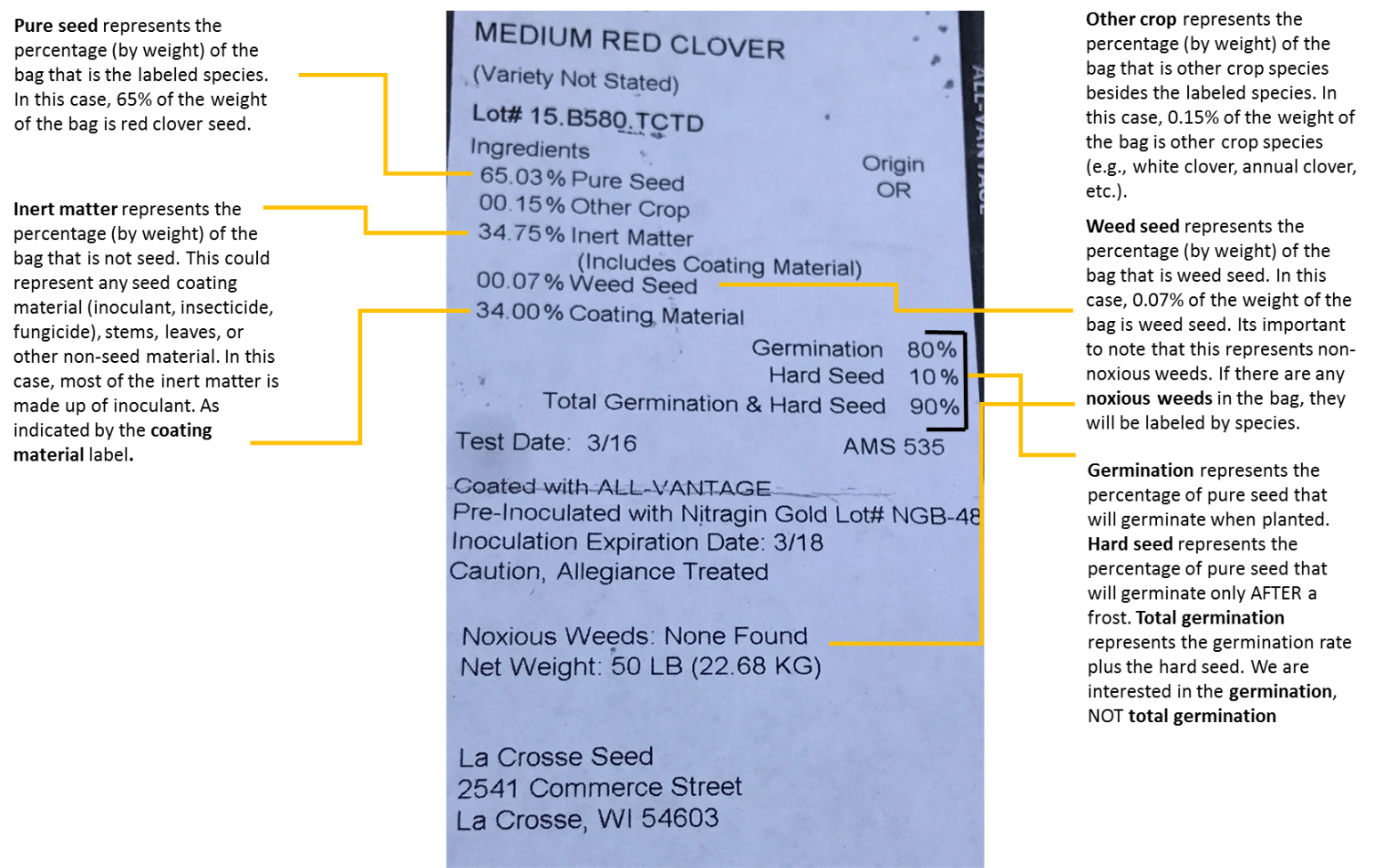
As we can see from this red clover seed tag above, only 65% (32.5 lbs) of the 50 lb bag is actually red clover (Pure Seed). Most of the other weight is the inoculant (Coating Material; 34% or 17 lbs). Of the 32.5 lbs of red clover seed, 80% will germinate after planting (Germination). So, if you planted 15 lbs (bulk weight) from this bag (recommended PLS rate) you would actually be planting 9.75 lbs of pure seed, of which only 7.8 lbs would germinate. Meaning you would be planting a little over half the recommended rate. See why PLS is so important now?
Clover seed: bag half empty or half full?
It may seem odd to buy a 10 lb clover seed bag only to expect 5 lbs to actually grow, but in the case of legumes – like clovers – the 5 lbs in the bag that isn’t seed may actually save you money in the long run. Having as little as 50% PLS in a bag of clover is not uncommon, as much of the weight is made up of the seed coating, which is typically an inoculant. The inoculant on clover, soybeans, alfalfa, or other legumes is living bacteria that help fix nitrogen from the air and make it usable to plants. Planting inoculated seed – whether you inoculate it yourself or purchase pre-inoculated seed – reduces the amount of nitrogen fertilizer needed, ultimately saving you money on fertilizer application. The benefit of buying pre-inoculated seed is that it saves you the hassle of inoculating the seed yourself.
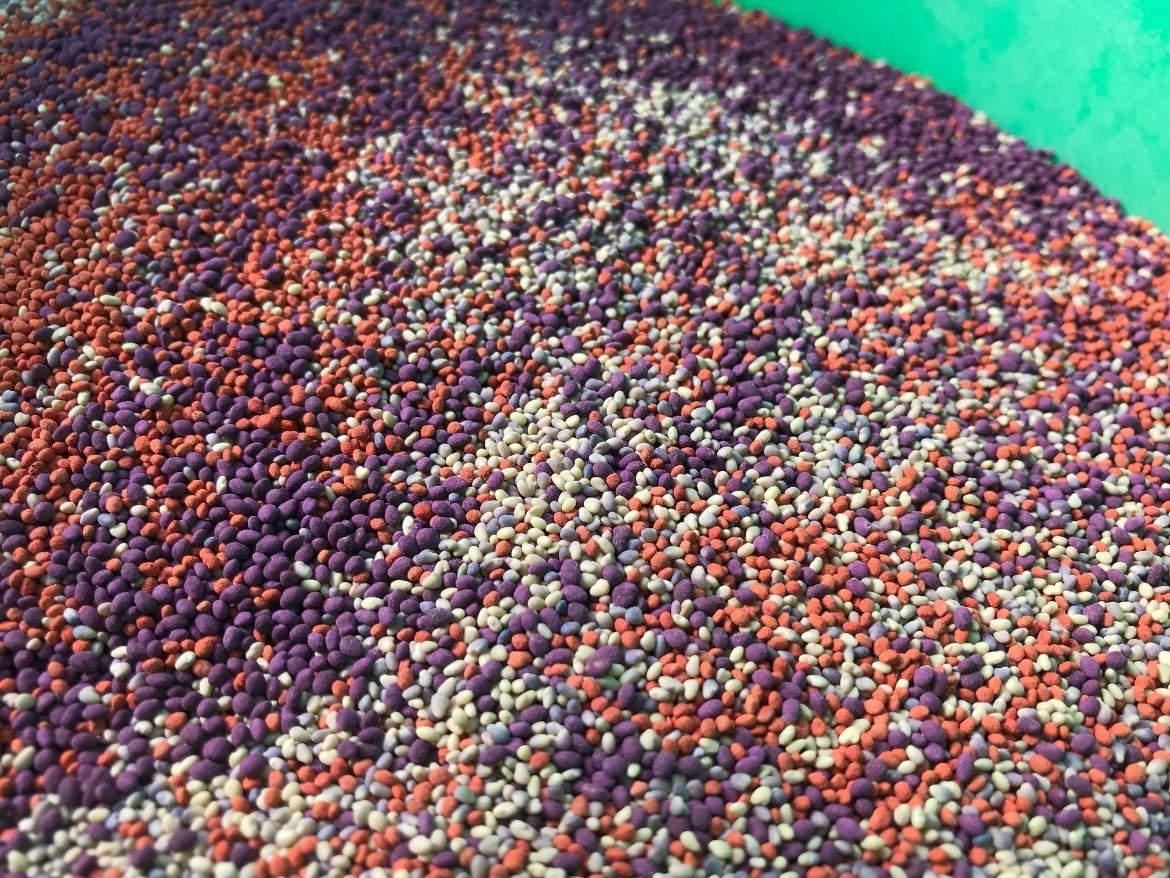
Most pre-inoculated clover seed will have a colored seed coating (purple and orange seed), which helps distinguish it from uninoculated seed (tan seed in this mix).
Calculating pure live seed (PLS)
Now that you know the importance of reading the seed tag before purchasing seed, you can now think about calculating PLS. All the information you need is right there on the tag. Using the example seed tag below locate the two items labeled “PURE SEED” and “GERMINATION”.
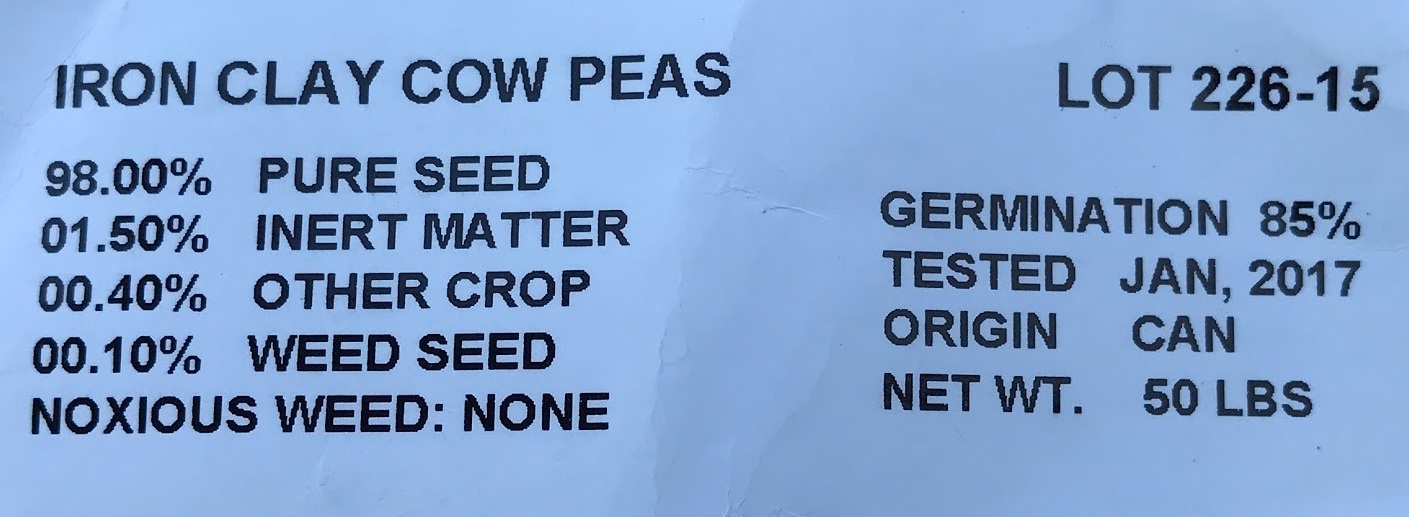
Our example is 98% pure seed, meaning in a 10 lb bag there are 9.8 pounds of pure iron-clay cowpea seed. The next number we will need is the germination rate; this will also be indicated as a percentage. Our example has an 85% germination rate.
To calculate percent PLS for this seed, multiply pure seed and germination and then multiply by 100 (example below). The result is the percentage of pure live seed for this bag of seed.
98% pure seed
85% germination
(0.98 x 0.85) x 100 = 83% (Percent PLS)
We now know that 83% of our bag is iron-clay cowpeas capable of germinating. Now that we have the PLS of our seed we can calculate the amount (lbs) of pure live seed in our bag. To do this, multiply the bulk seed weight by the percent PLS.
50 lb bag x 0.83 (Percent PLS) = 42 lbs PLS
For example, a 50 lb bag would equal 42 lbs of iron-clay cowpea seed that will germinate.
Determining bulk seed rate
Using the percent PLS information we can also find the amount of bulk seed necessary to plant at a recommended seeding rate. To do this, take the recommended seeding rate for your planting method and divide it by the percent PLS of the seed you are using (example below). The result is the bulk weight that you will need to plant per acre to achieve the recommended seeding rate.
50 lbs/acre = recommended seeding rate for iron-clay cowpeas when drilling
0.83 = percent PLS of seed being planted (from example above)
50/0.83 = 60 lbs/acre
In order to plant a cowpea food plot at the recommended rate of 50 lbs/acre, we will need to plant 60 lbs/acre from this particular seed bag.
Another benefit of calculating pure live seed? Comparing seed prices
Not all seeds are of the same quality. Some have lower pure seed and germination rates than others. For this reason, it is not always most cost effective to buy the cheapest bag of seed on the shelf. If you wish to compare pure live seed prices between seed bags, first divide the price of the bag by the weight of the bag. This will give you the price per pound of bulk seed (example below). Now divide this price per pound by the percent PLS of the seed. The result is the price per pound of PLS.
Seed Manufacturer X 10lbs
Pure seed 97%
Germination 92%
Price $33
PLS (0.97 x 0.92) x 100 = 89%
$/lb (bulk) 33/10 = $3.30/lb
$/lb (PLS) 3.3/0.89 = $3.70/lb
Seed Manufacturer Y 10lbs
Pure seed 91%
Germination 82%
Price $30
PLS (0.91 x 0.82) x 100 = 74.%
$/lb (bulk) 30/10 = $3/lb
$/lb (PLS) 3.0/0.74 = $4.05/lb
According to these calculations, seed manufacturer X is actually a better value than Y. Using this process, especially when purchasing seed in bulk, you can be a practical money saver.
Let’s Plant
Now that you know what all those numbers on the seed tag of your favorite food plot seed mean and you know how to calculate PLS, you will be able to plant your food plots at the most effective rate possible. Remember, regardless of whether you are planting acres of soybeans with a no-till drill or frost seeding a ½-acre clover patch, knowing how to calculate PLS will allow you to be more successful and save money when planting food plots.
Other Resources:
Seed Fillers and Carriers for Planting Native Warm-Season Grasses and Forbs, Detailed Resource, Purdue Extension-FNR
Renovating Native Warm-Season Grass Stands for Wildlife: A Land Manager’s Guide, free pdf download
VIDEO: Calibrating a No-Till Drill for Conservation Plantings and Wildlife Food Plots
VIDEO: Frost Seeding to Establish Wildlife Food Plots & Native Grass and Forb Plantings
Printable Version:
PDF available for print: Pure Live Seed: Calculations and Considerations for Wildlife Food Plots (pdf 636.75) detail resource.
Moriah Boggess, Purdue Extension Wildlife Intern
Jarred Brooke, Purdue Extension Wildlife Specialist
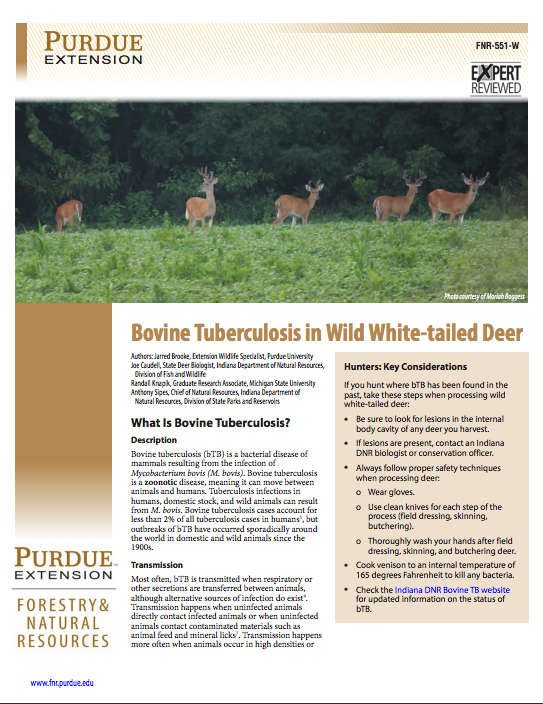 Outbreaks of bovine tuberculosis have occurred sporadically around the world since the 1900s. In Bovine Tuberculosis in Wild White-tailed Deer, Bovine tuberculosis transmission, hosts, current status in Indiana, clinical signs, effects on deer populations, effect on white-tailed deer meat, management, and monitoring is extensively covered. If you’re a hunter or cattle producer, the information provided within this free publication would greatly benefit you!
Resources:
Bovine Tuberculosis in wild white-tailed deer, Got Nature?, Purdue Extension-FNR
Jarred Brooke, Extension Wildlife Specialist
Purdue Department of Forestry and Natural Resources
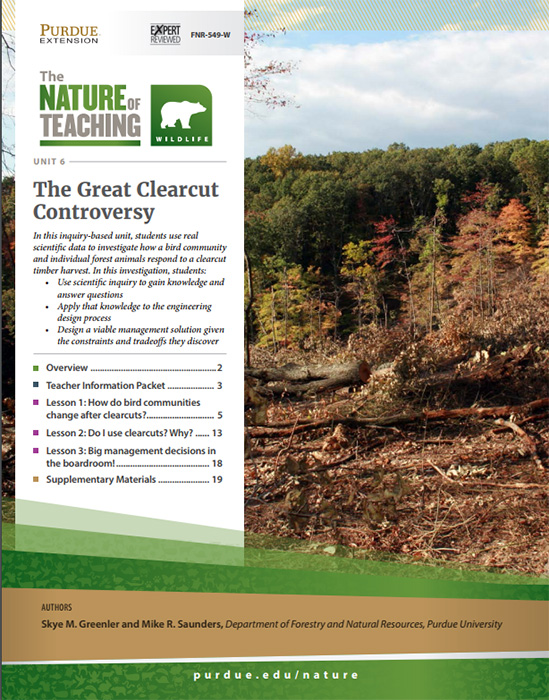 Teachers, parents and outdoor enthusiasts will want to download this free new Purdue Extension-Forestry and Natural Resources publication, The Great Clearcut Controversy. In this inquiry-based teaching unit, students use real scientific data to investigate how a bird community and individual forest animals respond to a clearcut timber harvest. In this investigation, students: use scientific inquiry to gain knowledge and answer questions; apply that knowledge to the engineering design process; and design a viable management solution given the constraints and tradeoffs they discover. All materials used in the three lessons are easily accessible and free.
Resources:
The Nature of Teaching, Purdue Extension
Got Nature? Podcast, Forestry and Natural Resources
Benefits of Connecting with Nature, The Education Store
Skye M Greenler, Graduate Research Assistant
Purdue University. Department of Forestry and Natural Resources
Mike Saunders, Associate Professor of Ecology and Natural Resources
Purdue University, Department of Forestry and Natural Resources
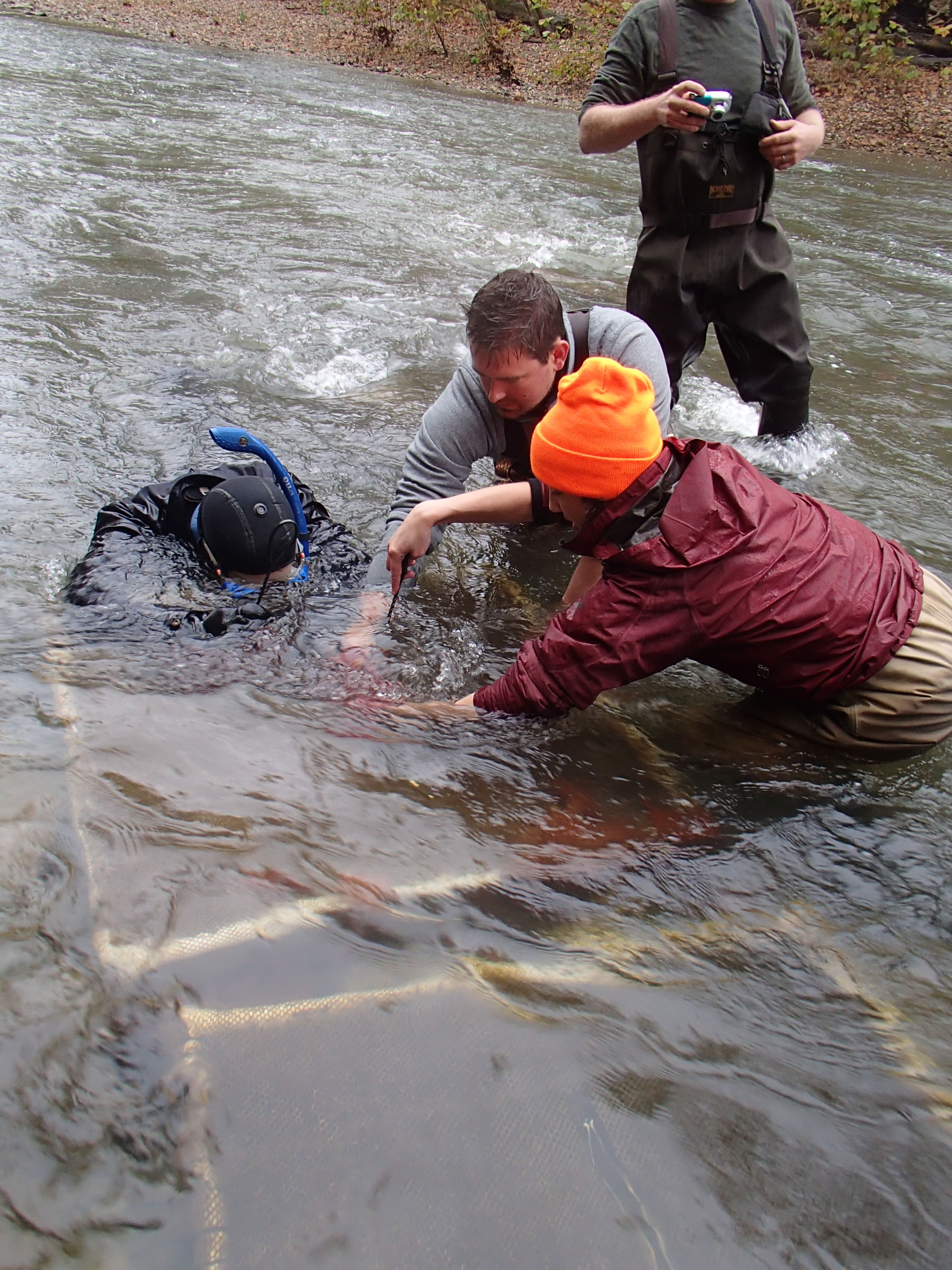
Hellbender release – Purdue biologists help a release attendee place a Hellbender in its temporary holding pen. Photo credit: Marci Skelton.
 The Hellbender salamander is North America’s largest salamander. It is fully aquatic, living its entire life in rivers and streams throughout the midwest and southeast. Hellbenders require cool, clean rivers and streams with rocky substrates to thrive and reproduce. Unfortunately, over the past several decades the species has declined or disappeared from many of these areas. In Indiana, the species can only be found in the Blue River in south-central Indiana where there remains only a very small, geriatric population incapable of sustaining itself. In order to save the species in the state, Purdue University and its many partners have joined together to reverse the decline.
On November 1st and 2nd of this year, Purdue FNR’s Williams lab released 80, 4-year old Hellbenders into a site chosen as the best Hellbender habitat in the Blue River. Members from Purdue University, Mesker Park Zoo and Botanic Garden, Columbian Park Zoo, Fort Wayne Children’s Zoo, Indianapolis Zoo, the Indiana Department of Natural Resources, the Indiana Department of Environmental Management, Duke Energy, and more all helped in the task of releasing the individuals into their new homes.
The chosen Hellbenders had been raised in captivity at Purdue University. Unfortunately, captive-raised animals are often times not equipped with the necessary set of skills to survive life outside of an aquarium. However, these were not all aquarium-raised individuals more akin to pets than wild animals. Forty of the individuals were raised in specially designed tanks called raceways that incorporated water flow to mimic that found in a natural river setting. The remaining forty individuals were raised in standard, low-flow conditions. The idea behind raising the animals in these differing conditions is to compare whether or not the individuals raised in conditions that are more natural (i.e., higher flow rates) will be better able to survive the varying water levels they will encounter in the wild than those that are raised without flow.
In order to document success, all 80 Hellbenders were implanted with radio-transmitters. These transmitters emit a signal that allows biologists to detect them with antennae and locate the exact location an individual is hiding. For the next six to ten months, through rain, snow, and shine, Purdue biologists will follow these animals to document their behavior, habitat preferences, and whether or not they survive life in the wild.
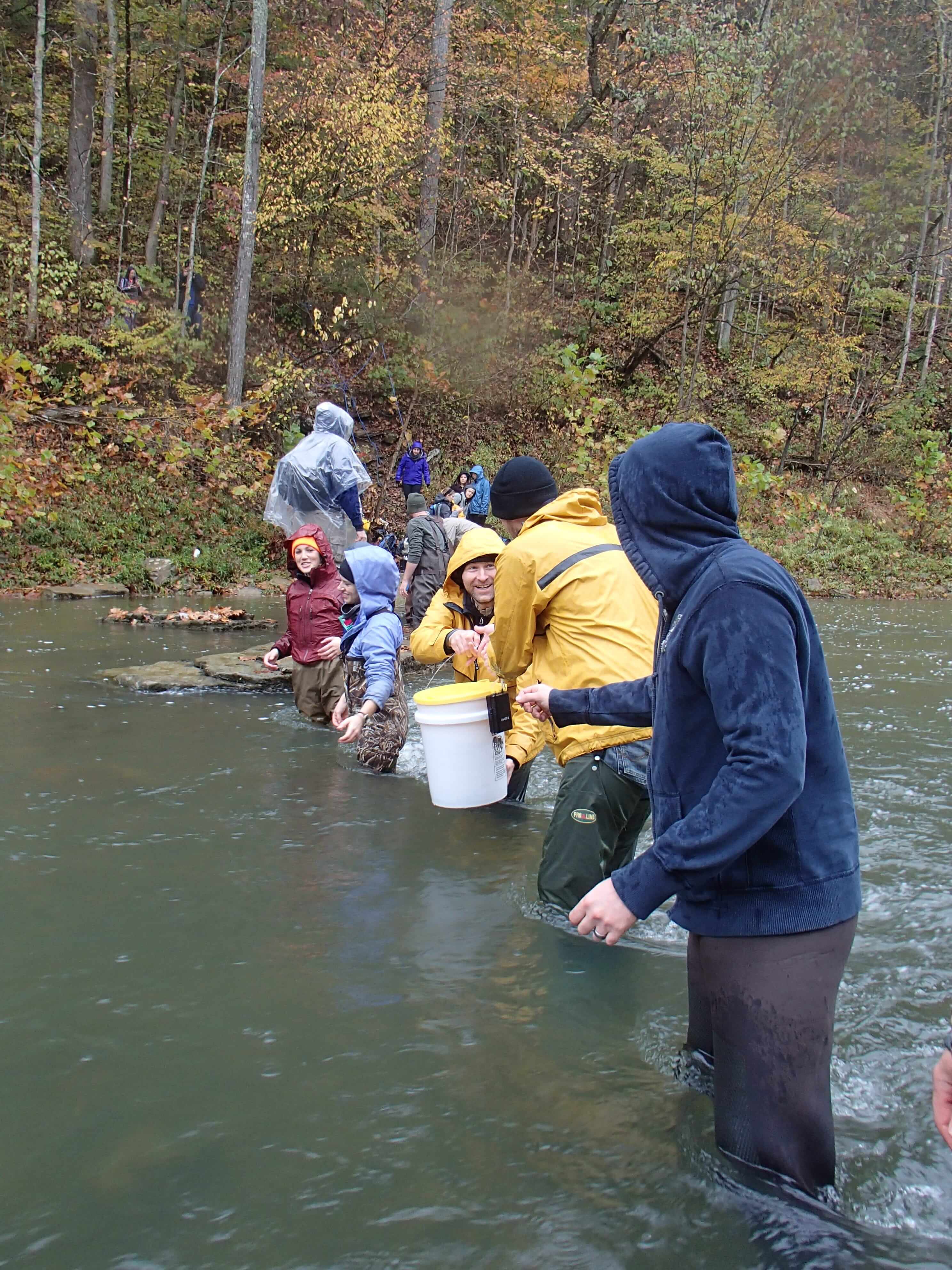
Transporting Hellbenders – Release attendees work together to transport Hellbenders across the river to be processed before release. Photo credit: Marci Skelton.
The outcomes of this study could help solve two major problems facing Hellbender conservation. The first is that the addition of Hellbenders into the system could help spur natural reproduction and help to start stabilizing the system. This small step is important towards our eventual goal of repopulating the Blue River and other former Hellbender streams. The second problem this study will hopefully address is the issue of poor survival of captive-reared animals when released into the wild. If we find that raising animals in more natural conditions improves survival over those raised in the more common no-flow conditions, this technique could be easily adopted at captive-rearing facilities throughout the nation and help increase the overall success of Hellbender conservation in the United States.
For more information, please visit HelptheHellbender.org.
Resources:
Hellbender ID, The Education Store
HelptheHellbender.org, Purdue Extension
Help the Hellbender: North America’s Giant Salamander, The Education Store
How Our Zoos Help Hellbenders, The Education Store
Nick Burgmeier, Research Biologist and Extension Wildlife Specialist
Purdue University Department of Forestry and Natural Resources
Wild animals have a dispersal period where young move on to new ground to establish their own home range. This is nature’s way of mixing the gene pool. It also allows for species to reoccupy small, isolated habitat patches. Late summer and early fall is a common time to see juvenile snakes because of dispersal.
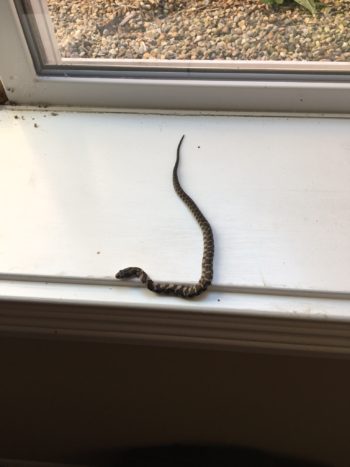
Northern Watersnake (Photo provided by R. Dearing)
Snake identification questions are one of my most common that I receive from the public. Usually, people want to know if the snake is venomous or not. Most snakes in Indiana are not venomous. In fact, there are only four venomous species in Indiana. Their distributions are generally limited.
The snake pictured here to the right is a Northern Watersnake (Nerodia sipedon). Photo and identification request was submitted to our “Ask an Expert” web submission by Mr. R. Dearing. While only about a foot long here, adults can reach several feet in length. Coloration in them is variable, but they typically have dark bands on a lighter tan or brown background. The bands are complete towards the head and fragment towards the tail. This little snake found its way into Mr. Dearing’s house. Fortunately, he was able to catch it and return it to the creek behind their house—which explains why it was there in the first place.
Resources:
Snakes and Lizards of Indiana, The Education Store, Purdue Extension
How can I tell if a snake is venomous, FAQs, Purdue Extension-Forestry and Natural Resources
Indiana Amphibian and Reptile ID Package, The Education Store, Purdue Extension
Ask An Expert, Purdue Extension-Forestry and Natural Resources
Brian MacGowan, Extension Wildlife Specialist
Department of Forestry & Natural Resources, Purdue University

Recent Posts
- Beetle that attacks Tree-of-Heaven found in Indiana, Purdue Landscape Report
Posted: March 20, 2026 in Invasive Insects, Wildlife, Woodlands - ID That Tree: Dwarf Chinkapin Oak
Posted: in Forestry, Urban Forestry, Wildlife, Woodlands - DNR Hiring for Indiana Conservation Officer Positions, MyDNR
Posted: March 9, 2026 in Urban Forestry, Wildlife, Woodlands - ID That Tree: Shumard Oak
Posted: in Plants, Urban Forestry, Wildlife, Woodlands - Uniting Indiana Residents Against Invasive Species
Posted: February 27, 2026 in Community Development, Invasive Insects, Wildlife - Have You Seen a Soaring Eagle Lately? Morning Ag Clips
Posted: February 25, 2026 in Urban Forestry, Wildlife - Register for Natural Resources Teacher Institute’s Class of 2026
Posted: February 19, 2026 in Forestry, Wildlife, Woodlands - ID That Tree: Fragrant Sumac
Posted: February 4, 2026 in Plants, Urban Forestry, Wildlife - Woodsy Owl Edition for Educational Learning, USDA – U.S. Forest Service
Posted: January 21, 2026 in Forestry, Forests and Street Trees, Got Nature for Kids, Urban Forestry, Wildlife - Opt-in to the Deer Management Survey, MyDNR
Posted: January 12, 2026 in Forestry, Wildlife
Archives
Categories
- Alert
- Aquaculture/Fish
- Aquatic/Aquaculture Resources
- Ask the Expert
- Christmas Trees
- Community Development
- Disease
- Drought
- Forestry
- Forests and Street Trees
- Gardening
- Got Nature for Kids
- Great Lakes
- How To
- Invasive Animal Species
- Invasive Insects
- Invasive Plant Species
- Land Use
- Natural Resource Planning
- Nature of Teaching
- Plants
- Podcasts
- Ponds
- Publication
- Safety
- Spiders
- Timber Marketing
- Uncategorized
- Urban Forestry
- Webinar
- Wildlife
- Wood Products/Manufacturing
- Woodland Management Moment
- Woodlands