 Purdue University - Extension - Forestry and Natural Resources
Got Nature? Blog
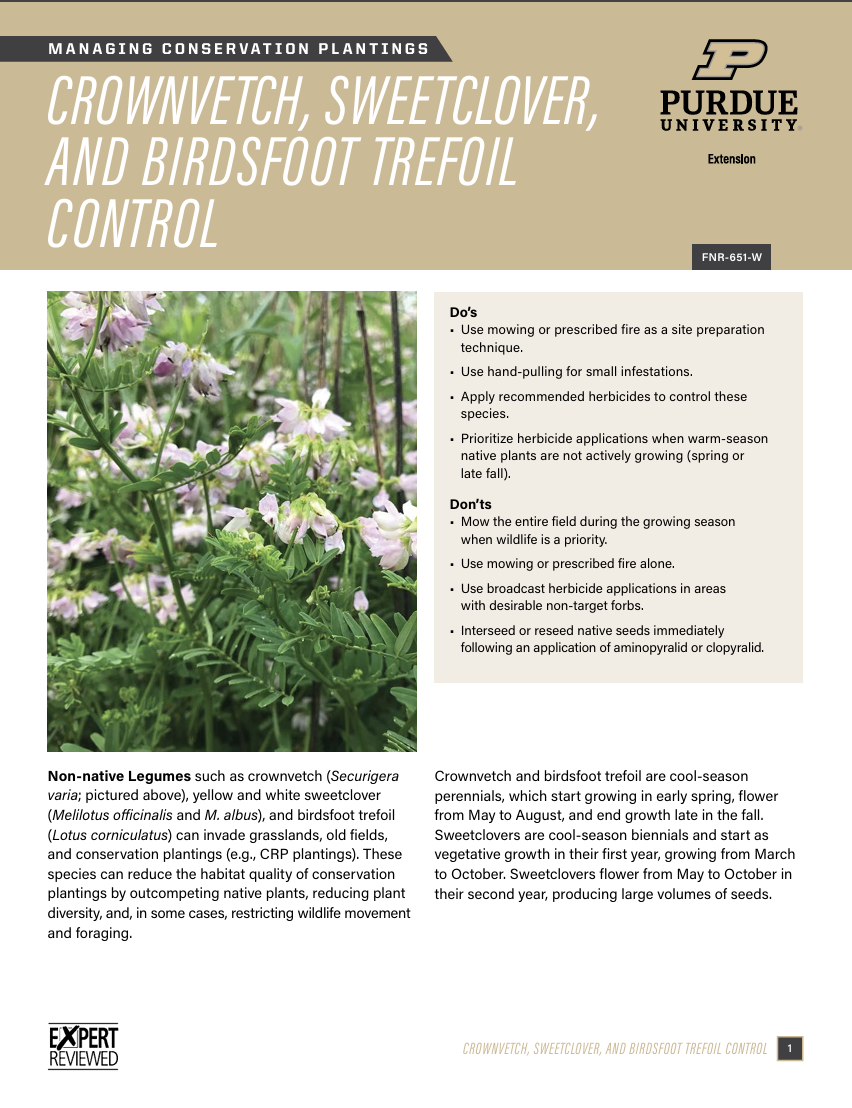 Discover the impact of non-native legumes like crownvetch, sweetclover, and birdsfoot trefoil on grasslands and conservation plantings. This guide provides control options for these non-native legumes. Essential reading for conservationists and land managers interested in grassland ecosystems: Crownvetch, Sweetclover and Birdsfoot Trefoil Control.
Check out the Managing Conservation Plantings Series which include details on how to control invasive species and other problematic plants in Conservation Reserve Program (CRP) plantings and native warm-season grass and wildflower conservation plantings.
Publications in this series include:
- Golden Rod Control
- Thinning Native Warm-Season Grasses
- Sericea Lespedeza Control
- Woody Encroachment and Woody Invasives
- Jonhsongrass Control
- Reed Canarygrass Control
- Teasel Control (Common and Cut Leaved)
- Controlling Introduced Cool-Season Grasses
- Crownvetch, Sweetclover and Birdsfoot Trefoil Control
Resources:
Deer Impact Toolbox & Grassland Management, Purdue Extension Pond and Wildlife Management
Pond and Wildlife Management, Purdue Extension
Forestry for the Birds Virtual Tour and Pocket Guide, Got Nature? Blog, Purdue Extension – FNR
Frost Seeding to Establish Wildlife Food Plots and Native Grass and Forb Plantings – Purdue Extension – FNR YouTube channel
Wildlife Habitat Hint: Tips for Evaluating a First Year Native Grass and Forb Plantings, Purdue Extension – FNR YouTube Channel
Drone Seeding Native Grasses and Forbs: Project Overview & Drone Setup, Purdue Extension – FNR YouTube channel
Ask an Expert: Wildlife Food Plots, video, Purdue Extension – FNR YouTube Channel
Handling Harvested Game: Episode 1, Field Dressing, video, Purdue Extension – FNR YouTube Channel
Managing Your Woods for White-Tailed Deer, The Education Store
Forest Improvement Handbook, The Education Store
Forest Management for Reptiles and Amphibians: A Technical Guide for the Midwest, The Education Store
A Template for Your Wildlife Habitat Management Plan, The Education Store
Woodland Stewardship for Landowners, Playlist, Purdue Extension – FNR YouTube channel
Nature of Teaching Unit 1: Animal Diversity and Tracking, The Education Store
Nature of Teaching, Purdue College of Agriculture
Invasive Species Playlist, Playlist, Purdue Extension – FNR YouTube Channel
Report Invasive, Purdue Extension
Subscribe Purdue Extension – Forestry and Natural Resources YouTube Channel
Jarred Brooke, Wildlife Extension Specialist
Purdue Department of Forestry and Natural Resources
 Dive into the latest stories from the Illinois-Indiana Sea Grant (IISG) Newsletter which highlights research, outreach, and partnerships making a difference across the Great Lakes region. In this issue, explore how communities, scientists and educators are working together to protect water quality, strengthen coastal resilience, and inspire stewardship.
Highlights from the newsletter include:
- IISG has a long history of supporting teachers through Great Lakes activities and resources
Read the blog from Stuart Carlton. - Freshwater jellyfish may increase in numbers as Illinois and Indiana waters continue to warm
A closer look at how climate trends are affecting unexpected species in our region’s freshwater systems. - New step-by-step guide and veterinary brochures expand UnwantedMeds.org resources
New tools help communities safely dispose of unwanted or expired medicine—from household to veterinary use—reducing pollution and protecting public health. - The Know Your H₂O Kit gets a real-world lab test by middle schoolers
Students dove into hands-on learning with IISG’s Know Your H₂O Kit, testing their local water and connecting science concepts to real environmental data. - Educators engage with Great Lakes scientists aboard the Lake Guardian
Teachers joined researchers on Lake Michigan aboard the R/V Lake Guardian, collecting samples, learning new field techniques, and bringing Great Lakes science back to their students. - IISG looks back on 30 years of AIS outreach
Illinois-Indiana Sea Grant is in the midst of its 30th year of dedicated outreach to address the spread of aquatic invasive species (AIS) in Great Lakes waters. - Coastal communities face challenges in managing beach sand and structures
Beginning in 2025, IISD has not one, but two coastal resilience specialists who are providing support for communities along the southern Lake Michigan shore. - The Helm
Our latest edition of The Helm brings together insights from field research, outreach efforts, and education across the Great Lakes region. - Shaping the Shoreline: Video Series
Explore how natural and engineered structures shape our Great Lakes coastlines. - Welcome Stuart Carlton, new IISG director
Stuart Carlton, longtime Sea Grant communicator and leader, steps into the director role—continuing IISG’s mission of connecting research, education, and outreach. - Tomas Höök reflects on a legacy of leadership, collaboration and impact at IISG
After more than a decade as director, Tomas Höök looks back on milestones that shaped IISG’s growth and lasting partnerships.
Subscribe to the IISG newsletter by sending your name and email to iisg@purdue.edu. To view the full newsletter visit: Illinois-Indiana Sea Grant (IISG) Quarterly Newsletter.
More Resources:
Prescription For Safety: How to Dispose of Unwanted Household Medicine, IISG Publications
A Guide to Marketing for Small-Scale Aquaculture Producers, The Education Store, Purdue Extension resource center
A Guide to Small-Scale Fish Processing Using Local Kitchen Facilities, The Education Store
Marine Shrimp Biofloc Systems: Basic Management Practices, The Education Store
Sustainable Aquaculture: What does it mean to you?, The Education Store
The Benefits of Seafood Consumption The Education Store
Walleye Farmed Fish Fact Sheet: A Guide for Seafood Consumers, The Education Store
Fish Muscle Hydrolysate, The Education Store
Fish Cleaning with Purdue Extension County Extension Director, Got Nature? Blog, Purdue Extension – Forestry and Natural Resources
Aquatics & Fisheries, Playlist, Purdue Extension – Forestry and Natural Resources
Eat Midwest Fish, Illinois-Indiana Sea Grant online resource hub
Community Development, Purdue Extension
Climate Change and Sustainable Development, The Education Store
Climate Change: Are you preparing for it?, The Education Store
Natty Morrison, Communications Coordinator
Illinois-Indiana Sea Grant (IISG)
Diana Evans, Extension & Web Communications Specialist
Purdue University Department of Forestry and Natural Resources
MyDNR, Indiana’s Outdoor Newsletter: There are many options for enjoying outdoor recreation across Indiana this fall, especially with deer hunting season upon us. Learn more about deer hunting, how to support healthy wildlife populations, important regulations and how your hunting can support Hoosiers in need. Pay special attention to deer regulation changes, season dates and the importance of purchasing your license.
- Reduction Zone Season: Sept. 15, 2025 – Jan. 31, 2026
- Archery Season: Oct. 1, 2025 – Jan. 4, 2026
- Firearms Season: Nov. 15 – Nov. 30, 2025
- Muzzleloader Season: Dec. 6- Dec. 21, 2025
Deer Hunting Regulation Changes
Indiana DNR has made big changes to Indiana’s deer hunting rules. These changes are in effect for the 2025-2026 hunting season. The changes were made, in part, to make Indiana’s hunting regulations easier to understand.
Rule changes include:
- The statewide bag limit is now 6 antlerless deer and 1 antlered deer.
- A newly created county antlerless bag limit replaces the season antlerless bag limits and county bonus antlerless quotas. Because of this change, the new multi-season antlerless license has replaced the bonus antlerless license.
- Antlerless deer cannot be taken with a firearm during firearms season at Fish & Wildlife areas.
- Only 1 antlered and 2 antlerless deer can be taken with the bundle license.
- The use of crossbow equipment is now allowed using the archery license.
- Portable tree stands and ground blinds can now be placed on DNR properties in Deer Reduction Zones between noon Sept. 1 and Feb. 8.
- State law prohibits the use of drones (unmanned aerial aircraft) to search for, scout, locate or detect a wild animal during the hunting season and for 14 days prior to the hunting season for that animal.
- Hunters can now use rifles with a centerfire cartridge that has a bullet diameter of .219 inches (5.56 mm) or larger on both public and private lands.
For questions about equipment, regulations or changes in them, or which license you need, contact the Deer Information Line at INDeerInfo@dnr.IN.gov or 812-334-3795.
View a webinar recording explaining deer regulation changes.
Hunting Safety Tips and Reminders
Indiana DNR reminds you to stay safe this deer season. Hunting injuries most commonly involve elevated platforms and tree stands, so stay safe by following the guidelines below.
Tree stand safety before the hunt:
- Read, understand, and follow the tree stand manufacturer’s instructions.
- Check tree stands and equipment for wear, fatigue, rust, and cracks or loose nuts/bolts, paying particularly close attention to parts made of material other than metal.
- Practice at ground level with a responsible adult. If you need to sight in your equipment, find a shooting range near you.
- Learn how to properly wear your full-body safety harness.
- Make a hunt plan and share it with someone before your hunt.
- Wear your full-body safety harness.
- Use a tree stand safety rope.
- Make certain to attach your harness to the tree or tree stand safety rope before leaving the ground and check that it remains attached to the tree or tree stand safety rope until you return to the ground.
- Maintain three points of contact during ascent and descent.
- Wear boots with nonslip soles.
- Use a haul line to raise and lower firearms, bows, and other hunting gear.
- Make sure firearms are unloaded, action is open, and safety is on before attaching them to the haul line.
General reminders:
- Hunter Orange – know when to wear it and how much is needed on a ground blind
- Hunter orange is required for all deer hunters during youth, firearms, and muzzleloader season. Hunter orange must be worn at all times during the hunt, including walking to and from the hunting location. Regardless of hunting equipment being used (archery, crossbow or firearm), if it is firearms season, you are required to wear hunter orange.
- A ground blind must have at least 144 square inches of hunter orange material that is visible from any direction during any season in which a hunter is already required to wear hunter orange.
- Firearm Safety – Treat every firearm as if it is loaded, keep the muzzle pointed in a safe direction, keep your finger off the trigger until you are ready to shoot, and be sure of your target and what is beyond it.
- Print and complete a Landowner Permission Form if hunting on private land that isn’t your own.
- Remember to complete and attach a deer transportation tag immediately upon taking a deer. The tag should be attached to the deer during transportation and any time the deer is unattended.
Always bring emergency equipment with you on your hunt, such as a cellphone, flashlight, small first aid kit and extra water.
Read more about the guidelines and property rules here: Fish & Wildlife Properties.
Deer Reduction Zones
For information or any questions, view: Deer Reduction Zones.
Deer Disease Updates
Chronic wasting disease (CWD), a fatal disease impacting white-tailed deer, has been detected in wild deer in two areas of Indiana: LaGrange County and Posey County. These detections resulted in a CWD Positive Area including LaGrange, Noble, Steuben, and DeKalb counties and a one-year CWD Enhanced Surveillance Zone including Posey, Vanderburgh, and Gibson counties.
DNR offers free, statewide CWD testing for hunters by either taking your deer to one of DNR’s drop-off coolers at select Fish & Wildlife areas (FWAs), state parks, state fish hatcheries (SFHs) or through advertised private businesses such as taxidermists. These options are available during all seasons. Find out more about how to get your deer tested here: Chronic Wasting Disease (CWD).
Resources:
Ask an Expert: Wildlife Food Plots, video, Purdue Extension – Forestry and Natural Resources (FNR) YouTube Channel
Handling Harvested Game: Episode 1, Field Dressing, video, Purdue Extension – FNR YouTube Channel
Handling Harvested Game: Episode 2, Hanging & Skinning, video, Purdue Extension – FNR YouTube Channel
Handling Harvested Game: Episode 3, Deboning, video, Purdue Extension – FNR YouTube Channel
Handling Harvested Game: Episode 4, Cutting, Grinding & Packaging, video, Purdue Extension – FNR YouTube Channel
Deer Harvest Data Collection, Got Nature? Blog, Purdue Extension – FNR
How to Score Your White-tailed Deer, video, Purdue Extension
White-Tailed Deer Post Harvest Collection, video, The Education Store
Age Determination in White-tailed Deer, video, Purdue Extension
Handling Harvested Deer Ask an Expert? video, Purdue Extension – FNR YouTube Channel
How to Build a Plastic Mesh Deer Exclusion Fence, The Education Store
Bovine Tuberculosis in Wild White-tailed Deer, The Education Store
Woodland Stewardship for Landowners: Managing Deer Damage to Young Trees, video, Purdue Extension – FNR YouTube Channel
Integrated Deer Management Project, Purdue FNR
New Deer Impact Toolbox, Purdue Extension-Forestry and Natural Resources (FNR)
Division of Fish and Wildlife, Indiana Department of Natural Resources
Welcome to ID That Tree! In this episode, Purdue Extension Forester Lenny Farlee introduces us to a familiar and useful native shrub, the Blackberry. Commonly found along woodland edges, open fields and roadsides across Indiana, this hardy plant is easy to spot in summer thanks to its features. Learn how to identify Blackberry by its stems, leaves and growth pattern. Whether you’re a forager, landowner, or someone who simply enjoys exploring nature, this video offers a quick and engaging look at how to recognize Blackberry and appreciate its role in Indiana’s natural landscapes.
If you have any questions regarding wildlife, trees, forest management, wood products, natural resource planning or other natural resource topics, feel free to contact us by using our Ask an Expert web page.
Resources:
ID That Tree – Video Playlist, Purdue Extension – Forestry and Natural Resources (FNR) YouTube Channel
Purdue Arboretum Explorer
Conservation Tree Planting: Steps to Success, Purdue Extension – FNR YouTube Channel
A Woodland Management Moment, Playlist, Purdue Extension – FNR YouTube Channel
Woodland Stewardship for Landowners, Playlist, Purdue Extension – FNR YouTube Channel
Fifty Common Trees of Indiana, Purdue Extension – FNR
Indiana Invasive Species Council
Cooperative Invasive Species Management Area (CISMA)
Report Invasive, Purdue Extension
Habitat University, Episode 12 – Exploring the challenges of Invasive Species, Habitat University-Natural Resource University
Shrubs and Woody Vines of Indiana and the Midwest, Purdue University Press
Native Trees of the Midwest, Purdue University Press
Professional Forester, Indiana Forestry Woodland Owners Association
District Forester, Indiana Department of Natural Resources, 10+ acres
Find an Arborist, International Society of Arboriculture
Forest Improvement Handbook, The Education Store
Lenny Farlee, Extension Forester
Hardwood Tree Improvement and Regeneration Center
Purdue Department of Forestry & Natural Resources
Purdue College of Agriculture News: An armored mammal, once limited to the swamps and forests of the Deep South, is now burrowing its way through the backyards and woodlands of Indiana. The nine-banded armadillo—a 10 to 15 pound mammal often associated with Texas or Louisiana—has become an increasingly common sight in the Hoosier state.
Brian MacGowan, Purdue Extension wildlife specialist and coordinator in Purdue University’s Department of Forestry and Natural Resources, explains that while this isn’t a brand-new arrival, the armadillo population and range have grown steadily and moved north in recent years.
“The nine-banded armadillo was first discovered living in Indiana around 2003,” MacGowan said. “Since then, they have been found throughout most of the state, even into the far northeast corner of Steuben County.”
MacGowan explains that armadillos are known to establish themselves in woodland areas in search of their food source. “Their diet is generally ground insects,” he said. “If an animal wants to find loads of insects, they will find an abundance in decaying wood.”
Another distinct characteristic of the nine-banded armadillo is their burrowing tactics.
“In some studies, these armadillos have been known to use multiple burrows, sometimes over 30 in a single year,” MacGowan said. “If they run into trouble, their first response is often to jump up and run into their burrow as fast as they can.”
As a nocturnal animal with many burrows to call home, their chances of being seen by humans are diminished. However, occasionally homeowners and farmers will find signs of armadillos on their property, such as where they dig up insects and grubs or burrow under a deck.
While armadillos are not known to be dangerous, there is a risk of humans or animals stepping into their open burrows. MacGowan compares this concern with the challenge farmers face with groundhogs and ground squirrels.
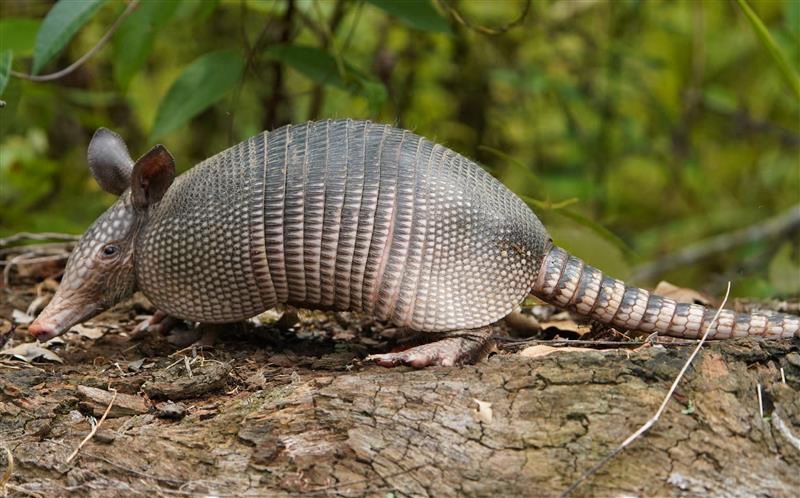 Rather than navigating by sight or sound, the nine-banded armadillos rely on smell, which could lead them to roadways while searching for food, MacGowan explains.
“The nine-banded armadillos also cannot curl up in a ball and protect their soft underbelly like other armadillo species can, so they’re vulnerable to predation by coyotes and other predators, said MacGowan.
Armadillo sightings are also influenced by the temperatures and moisture in an area. “If there’s a drought, it can kill off a lot of armadillos because the ground gets so hard and a lot of the insects and things they eat move below ground,” MacGowan said.
Typically, when it is cold out, the nine-banded armadillo adjusts its behavior to be more active during the day, partly because that helps them warm up. Also, some of the things they eat are more likely to be active when it’s warmer. MacGowan encourages people who encounter these animals to let them be.
“Armadillos are susceptible to a variety of diseases just like any wild animal,” he said. “You might have heard talk that armadillos can carry leprosy. That is generally an endemic issue for those animals specifically found in some regions in the south. While leprosy is quite deadly to armadillos, there is absolutely no evidence of transmission to people. However, they are wild animals, and the DNR will always caution people to keep their distance from any wild animal.”
The next time you spot this rare visitor in your backyard or scurrying across a Hoosier road, remember that you are witnessing history in motion. Reporting unusual animal sightings, like the nine-banded armadillo, not only helps the DNR track these shifts, but also deepens our understanding of a continually evolving ecosystem. After all, you never know what remarkable creature might be unexpectedly making its home in Indiana.
You can help the Indiana Division of Fish & Wildlife by submitting reports of certain mammals of interest. These mammals can potentially be seen from the comfort of your home, on your way to work, or while out biking, hiking, or camping. Reports can be made to the DNR here.
To view this article along with other news and stories posted on the Purdue College of Agriculture website view: Unexpected Plants and Animals of Indiana: The nine-banded armadillo.
Resources:
A Template for Your Wildlife Habitat Management Plan, The Education Store, Purdue Extension resource center
Wildlife Habitat Hint, Purdue Extension – Forestry & Natural Resources (FNR) YouTube Playlist
Woodland Stewardship for Landowners, Purdue Extension – FNR YouTube Playlist
Woodland Management Moment, Purdue Extension – FNR YouTube Playlist
Invasive Species, Playlist, Purdue Extension – FNR Youtube Channel
Invasive Plant Species Identification, Video, Purdue Extension – FNR Youtube Channel
Invasive plants: impact on environment and people, The Education Store, Purdue Extension’s resource center
Woodland Invaders, Got Nature? Blog, Purdue Extension – FNR
Preventing Wildlife Damage – Do You Need a Permit? – The Education Store, Purdue Extension resource center
Selecting a Nuisance Wildlife Control Professional, The Education Store
How to Construct a Scent Station, The Education Store
Question: How do I properly relocate raccoons from my attic?, Got Nature? Blog, Purdue Extension FNR
Nuisance Wildlife – Indiana Department of Natural Resources
Subscribe to our FNR Extension YouTube Channel with over 250 videos which include: aquatic, forestry, urban forestry, wildlife, community planning videos and much more.
Ericka Bethel, Digital Content Specialist
Purdue University Department of Forestry and Natural Resources
Dr. Brian MacGowan, Extension Wildlife Specialist
Department of Forestry & Natural Resources, Purdue University
IN-PREPared: The Indiana State Board of Animal Health has confirmed cases of Highly Pathogenic Avian Influenza (HPAI) in northeast Indiana. As millions of wild birds traverse the state during peak migration, the risk of additional outbreaks remains high. To support awareness and preparedness, Indiana PREPared offers a comprehensive resource library with science-based information on avian influenza, biosecurity practices, and public health guidance.
 What is HPAI?
Avian influenza, or “bird flu,” is a contagious viral disease of domestic and wild birds. It’s a major threat to the poultry industry, animal health, trade, and the economy worldwide.
Caused by influenza type A viruses, the disease varies in severity depending on the strain and species affected. Highly pathogenic avian influenza (HPAI) strains are deadly to domestic poultry and can wipe out entire flocks within a matter of days. Low pathogenicity avian influenza (LPAI) strains typically cause few or no signs of illness. They occur naturally in wild birds around the world. However, some LPAI strains can become highly pathogenic in poultry. (USDA-APHIS)
According to the Centers for Disease Control and Prevention (CDC):
- H5 bird flu is widespread in wild birds worldwide and is causing outbreaks in poultry and U.S. dairy cows with several recent human cases in U.S. dairy and poultry workers.
- While the current public health risk is low, CDC is watching the situation carefully and working with states to monitor people with animal exposures.
To learn more, visit the webpage: Avian Influenza.
More Resources:
Avian Flu (Bird Flu), IN DNR, Fish and Wildlife
Question: Is there any risk of becoming infected with avian influenza virus by feeding backyard birds?, Purdue Extension – FNR Got Nature? Blog
Virtual Tour Brings Forest Management for Birds to Life, Purdue Extension – Forestry and Natural Resources (FNR) Got Nature? Blog
Breeding Bird Atlas, Indiana Department of Natural Resources
IN DNR Shares How to Keep Your Backyard Birds Healthy, Purdue Extension – FNR Got Nature? Blog
Breeding Birds and Forest Management: the Hardwood Ecosystem Experiment and the Central Hardwoods Region, The Education Store, Purdue Extension resource center
Forest Birds, Purdue Extension – FNR YouTube Channel
Managing Woodlands for Birds Video, Purdue Extension – FNR YouTube Channel
The Birders’ Dozen, Profile: Baltimore Oriole, Indiana Woodland Steward
Birds and Residential Window Strikes: Tips for Prevention, The Education Store, Purdue Extension resource center
No Room at the Inn: Suburban Backyards and Migratory Birds, Education Store
The National Audubon Society
Subscribe, Purdue Extension – FNR YouTube Channel
Ed Sheldon, Farm/Veteran Job Coach and Engagement Coordinator
Department of Agriculture & Biological Engineering, Purdue University
Purdue Landscape Report: Spotted lanternfly (SLF) has been the subject of a lot of media attention in the last few years. In the east, states like Pennsylvania and New York have been dealing with heavy infestations since the insect was first detected in 2014. In Indiana, this invasive planthopper arrived three years ago, infesting two counties on the eastern side of the state. Since then, the Indiana Department of Natural Resources and Purdue University have been working together to mitigate the spread of this insect as well as educate Hoosiers on what they can do to help. Spotted lanternfly is still on the move, and this update will help refresh you on how this bug works, and where they are headed.
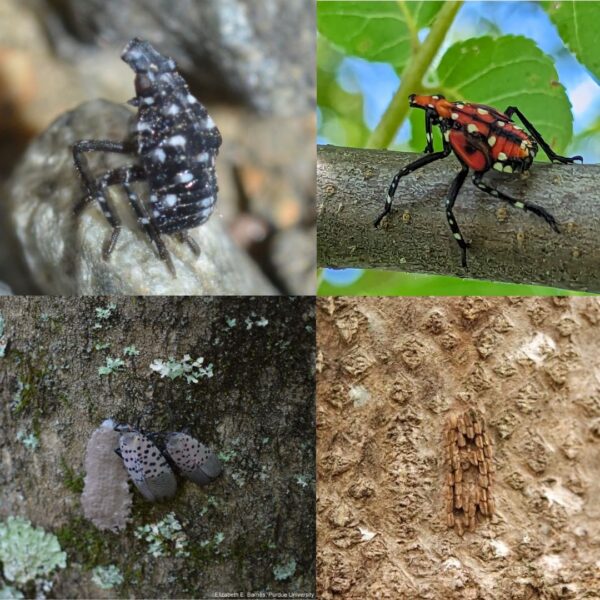
Figure 1. Upper left: early-instar SLF; upper right: late-instar SLF; bottom left: adult SLF with egg mass; bottom right: uncovered SLF eggs.
Life cycle
Spotted lanternfly is an annual insect, having only a single generation in a year under normal conditions. The insect goes through incomplete metamorphosis; immature stages, called nymphs, resemble smaller, wingless versions of the adults. Nymphs will begin to appear in April or May, developing through four instars, until they reach adulthood in late summer. With each instar, the period in between molting, the nymph will grow larger, develop wingpads, and eventually change color. Early instars are black with a white dot pattern, while later instars will be bright red with black and white patterning (Fig. 1). Late instar nymphs are often compared to milkweed bugs or lady beetles. Once they complete development in the late summer or early fall, they will mate and lay egg masses covered in a protective substance that makes them resemble mud. Eggs masses will overwinter until the spring, while adult insects will die as temperatures cool. In Indiana, depending on temperature, adults can be seen as late as early November.
Impact
Spotted lanternfly is a sap-feeding insect, using syringe-like mouthparts to drain nutrients directly from plant tissues. Like other sap-feeding insects, the activity of SLF wounds the plant, creating openings for various pathogens to exploit. Feeding by SLF has been shown to reduce overall health of their hosts, reducing their capacity to survive overwintering, and potentially kill the host plant depending on species. They also produce a sugary waste known as honeydew; while honeydew itself is not harmful, it acts as a growing substrate for sooty mold, which can have a serious impact the photosynthesis of understory foliage as well as attract other nuisance insects.
Spotted lanternfly is a generalist herbivore and can feed on over 100 different species of plant and tree in Indiana. However, this insect has shown strong preference towards certain species, often with devastating consequences. The most preferred host is tree-of-heaven, an invasive tree species in North America. Tree-of-heaven is the primary host of SLF in their shared native range, and the insect appears to experience high reproductive success on it even when they share a new environment. Grapes are also highly preferred by SLF, and infestations will typically result in overfeeding and the death of the plant. Black Walnut, American river birch, and various maple species are also at risk of severe damage from this insect. Evidence has also suggested that maple, when used for syrup production, will experience reductions in yield and quality when attack by spotted lanternfly.
Where are they now?
Spotted lanternfly has been present in Indiana since 2021, first arriving in Huntington and Switzerland Counties. In Huntington, the infestation occupies a stand of tree-of-heaven next to an industrial parking lot. Tree-of-heaven moved into the neighboring residential area, allowing SLF to also spread with it. The more rural infestation in Switzerland County was traced to a vehicle transported from Pennsylvania, and the insect has taken advantage of patches of tree-of-heaven in nearby wooded areas. While both infestations have strongly associated with the insect’s primary host, there is some evidence that SLF is beginning to take advantage of other nearby plants, such as maple. In the last year, SLF moved a significant distance and has been detected in several more counties, including Elkhart, St. Joseph, Porter, Allen, Dekalb, and Noble Counties. Most of the activity has been found on tree-of-heaven along rail lines, supporting the idea that the insect is dispersed by rail traffic moving westward out of infested areas.
It’s important to remember that trains aren’t the only vehicles that can have SLF passengers. These insects, and their egg masses, can be found on just about any surface, including the car you drive to work, the RV you used for recreation, semi-trucks that cross the country, and more. Purdue Entomology and Indiana DNR are encouraging everyone to inspect their vehicles when traveling through any of the infested areas. Also check all recreational vehicles and trailers for spotted lanternfly egg masses; if found, scrape them off into a bag or bucket filled with soapy water. This fall and winter, we also want to encourage everyone to please burn any firewood where you buy it, and please don’t move it off your property if you chop it yourself- especially if you are burning tree of heaven. Egg masses will stick to firewood and can survive our winters very well.
What can I do?
We are still learning about the spotted lanternfly’s distribution through Indiana, and we need the help of citizen scientists to effectively track the insect’s movement. If you believe you’ve seen spotted lanternfly, please report it using any of the resources listed below. You can also feel free to reach out to Bob Bruner, Exotic Forest Pest Educator, by emailing them at rfbruner@purdue.edu, or you can report sightings by calling 1-866-NOEXOTIC.
Original article posted: Spotted Lanternfly is on the Move!.
Subscribe and receive the newsletter: Purdue Landscape Report Newsletter.
Spotted Lanternfly Resources:
Spotted Lanternfly Found in Indiana, Indiana Woodland Steward
Spotted Lanternfly – includes map with locations, Indiana Department of Natural Resources Entomology
Report Spotted Lanternfly, Purdue College of Agriculture Invasive Species
Other Resources Available:
Invasive plants: impact on environment and people, The Education Store, Purdue Extension’s resource center
Woodland Management Moment: Invasive Species Control Process, Video, Purdue Extension – Forestry and Natural Resources (FNR) YouTube Channel
Invasive Species, Playlist, Purdue Extension – FNR YouTube Channel
What are invasive species and why should I care?, Got Nature? Blog, Purdue Extension – FNR
Report Invasive, Purdue College of Agriculture – Entomology
ReportINvasive, Purdue Report Invasive Facebook posts include webinars and workshops
Bob Bruner, Exotic Forest Pest Educator
Purdue Entomology
Welcome to ID That Tree! In this episode, Purdue Extension Forester Lenny Farlee introduces us to multiflora, a non-native invasive shrub that has become widespread across Indiana. Once planted for practical purposes, it now creates big challenges for landowners and natural areas. Learn where you’re most likely to encounter it, why it spreads so aggressively and what makes it stand out on the landscape. Whether you’re a student, nature enthusiast or land manager, this video gives you a quick introduction to one of Indiana’s most troublesome invasive plants.
If you have any questions regarding wildlife, trees, forest management, wood products, natural resource planning or other natural resource topics, feel free to contact us by using our Ask an Expert web page.
Resources:
ID That Tree – Video Playlist, Purdue Extension – Forestry and Natural Resources (FNR) YouTube Channel
Purdue Arboretum Explorer
Conservation Tree Planting: Steps to Success, Purdue Extension – FNR YouTube Channel
A Woodland Management Moment, Playlist, Purdue Extension – FNR YouTube Channel
Woodland Stewardship for Landowners, Playlist, Purdue Extension – FNR YouTube Channel
Fifty Common Trees of Indiana, Purdue Extension – FNR
Indiana Invasive Species Council
Cooperative Invasive Species Management Area (CISMA)
Report Invasive, Purdue Extension
Habitat University, Episode 12 – Exploring the challenges of Invasive Species, Habitat University-Natural Resource University
Shrubs and Woody Vines of Indiana and the Midwest, Purdue University Press
Native Trees of the Midwest, Purdue University Press
Professional Forester, Indiana Forestry Woodland Owners Association
District Forester, Indiana Department of Natural Resources, 10+ acres
Find an Arborist, International Society of Arboriculture
Forest Improvement Handbook, The Education Store
Lenny Farlee, Extension Forester
Hardwood Tree Improvement and Regeneration Center
Purdue Department of Forestry & Natural Resources
Welcome to ID That Tree! In this episode, Purdue Extension Forester Lenny Farlee introduces us to a widespread native shrub called smooth sumac. Found in open fields, roadsides and woodland edges across Indiana, this shrub is easily identified by its recognizable stems and leaves. Watch the video to learn about these characteristics, along with the differences in smooth sumac through the different seasons. For example, in summer, this shrub has flowers that turn into fruit heads! Whether you’re a student, naturalist or simply curious about native plants, this video offers a quick and helpful guide to identifying smooth sumac in the wild.
If you have any questions regarding wildlife, trees, forest management, wood products, natural resource planning or other natural resource topics, feel free to contact us by using our Ask an Expert web page.
Resources:
ID That Tree – Video Playlist, Purdue Extension – Forestry and Natural Resources (FNR) YouTube Channel
Purdue Arboretum Explorer
Conservation Tree Planting: Steps to Success, Purdue Extension – FNR YouTube Channel
A Woodland Management Moment, Playlist, Purdue Extension – FNR YouTube Channel
Woodland Stewardship for Landowners, Playlist, Purdue Extension – FNR YouTube Channel
Fifty Common Trees of Indiana, Purdue Extension – FNR
Indiana Invasive Species Council
Cooperative Invasive Species Management Area (CISMA)
Report Invasive, Purdue Extension
Habitat University, Episode 12 – Exploring the challenges of Invasive Species, Habitat University-Natural Resource University
Shrubs and Woody Vines of Indiana and the Midwest, Purdue University Press
Native Trees of the Midwest, Purdue University Press
Professional Forester, Indiana Forestry Woodland Owners Association
District Forester, Indiana Department of Natural Resources, 10+ acres
Find an Arborist, International Society of Arboriculture
Forest Improvement Handbook, The Education Store
Lenny Farlee, Extension Forester
Hardwood Tree Improvement and Regeneration Center
Purdue Department of Forestry & Natural Resources
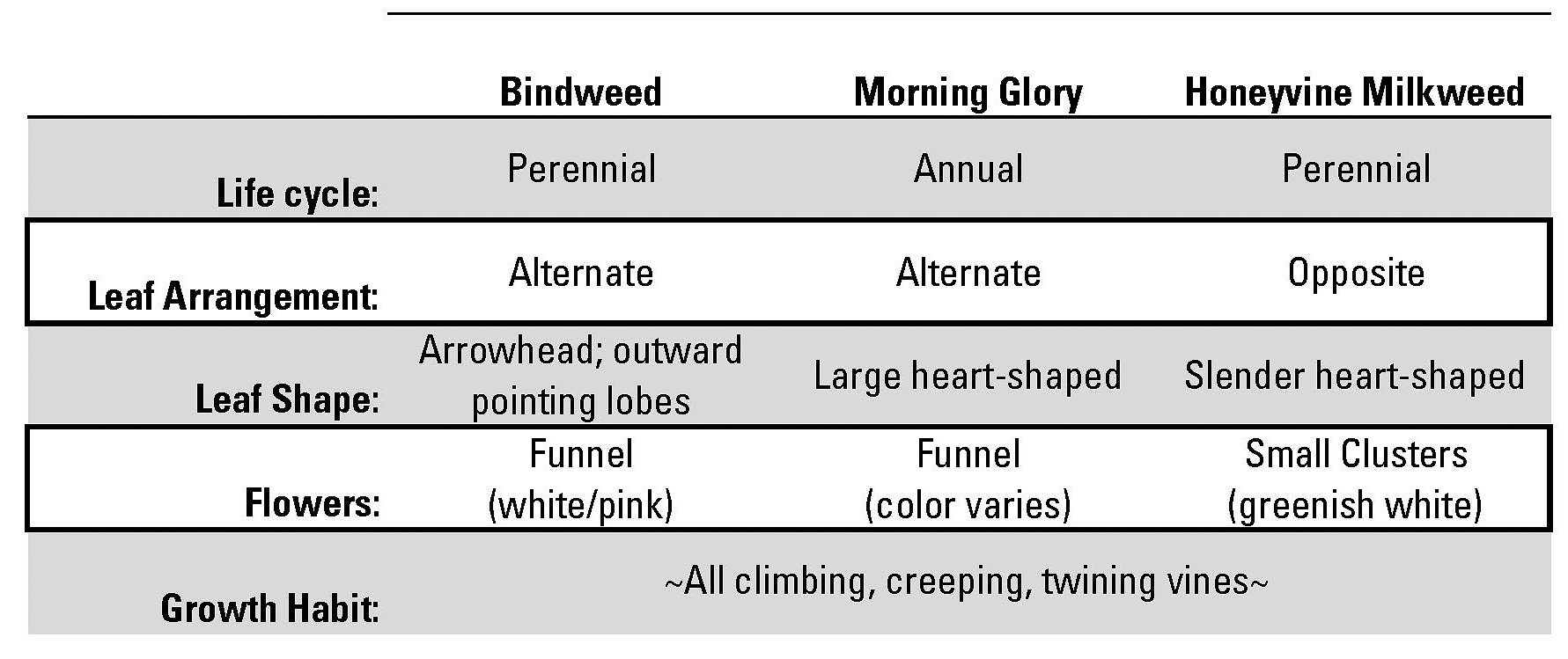
Figure 1. Chart comparing plant traits of bindweed, morning glory, and honeyvine milkweed. Credit: K. Mitchell
Purdue Landscape Report: Few garden problems cause as much frustration as untangling vines. Sometimes the vines are beautiful climbers planted with intention. Other times, they creep in uninvited and smother everything in their path. Among the most common, and the most confusing, vines in Indiana are bindweed, morning glory, and honeyvine milkweed. To the untrained eye, they look similar: all are fast-growing vines with heart-shaped leaves. However, there are noticeable differences in their physiological traits (Fig. 1) and ecological value. Recognizing the distinctions can improve management and help strike a balance between aesthetics, control, and ecological benefits.
Bindweed (Hedge bindweed: Calystegia sepium; Field bindweed: Convolvulus arvensis)
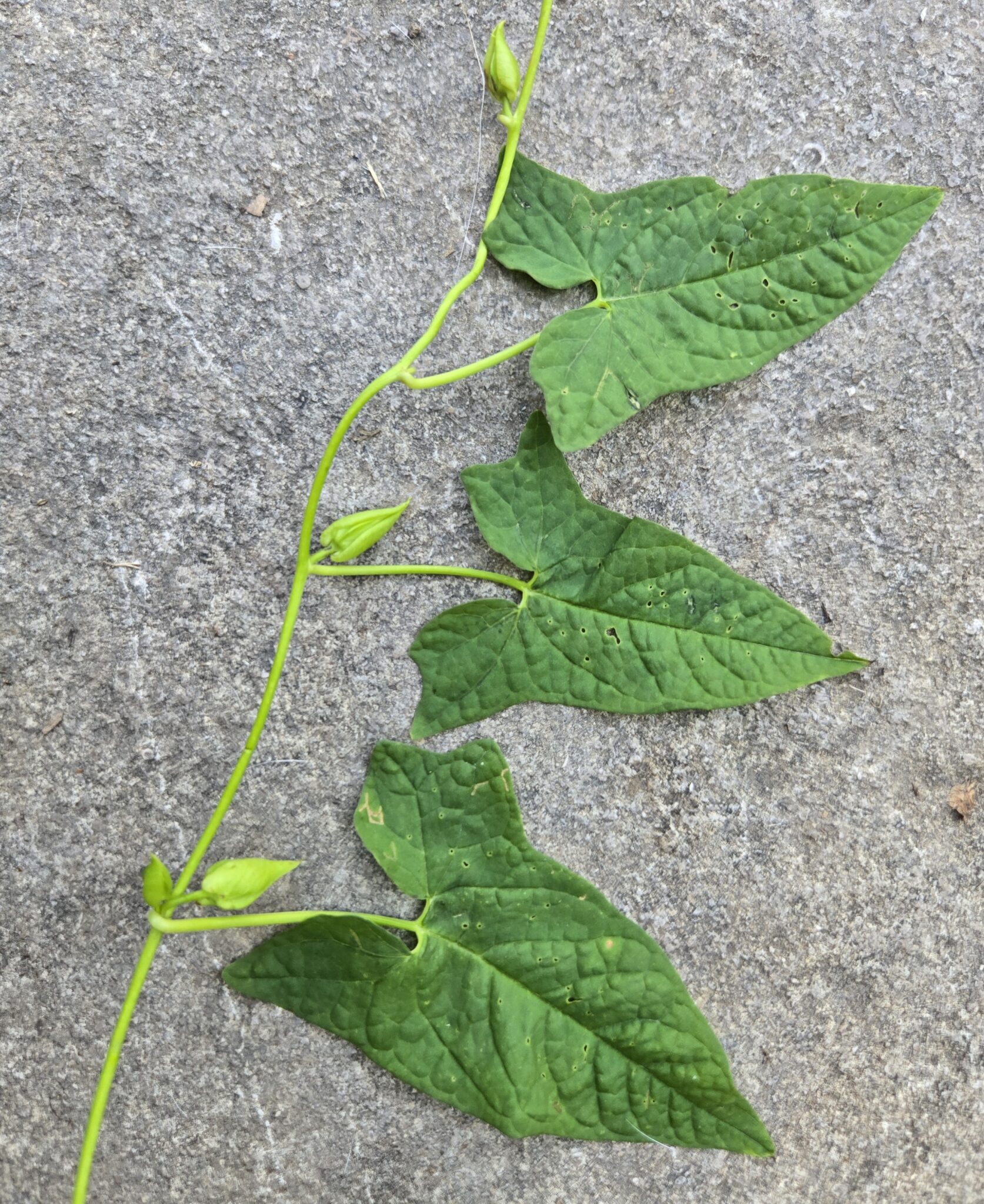
Bindweed is an aggressive vine with alternate, arrowhead-shaped leaves (Fig. 2) and small white or pink funnel-shaped flowers (Fig. 3). This perennial spreads readily from rhizomes (underground stems), forming vegetative colonies that become increasingly difficult to control. Hedge bindweed and field bindweed differ slightly in appearance, but both are aggressive invaders; in fact, field bindweed is listed as a prohibited noxious weed in Indiana. Cultural control methods, such as cultivation or light exclusion, can take 3 to 5 years to achieve eradication. The best results often come from combining these approaches with carefully timed herbicide applications.

Morning Glory (Ipomoea spp.)
Morning glories are a familiar vine often planted intentionally for their large, colorful flowers. Unlike bindweed, morning glory is an annual and dies off in winter. However, its abundant seed production allows it to return year after year. A single vigorous vine can produce hundreds of colorful, funnel-shaped flowers (Fig. 4) resulting in over a thousand seeds which may remain viable in the soil for decades. Morning glory will become weedy if left unmanaged. Thoughtful containment and regular deadheading can help to keep it under control.


Two types are most often seen (Fig. 5):
- Common morning glory (Ipomoea purpurea) has large, heart-shaped leaves and showy, funnel-shaped flowers in a wide variety of colors.
- Ivy-leaf morning glory (Ipomoea hederacea) has leaves with three distinct lobes that resemble ivy, and its smaller flowers are typically light blue or purple with white.
Honeyvine Milkweed (Cynanchum laeve)
Honeyvine milkweed has slender heart-shaped leaves like bindweed, but unlike bindweed, this native vine provides ecological value as a food source for monarch caterpillars. It’s easily distinguished from morning glory and bindweed by its opposite leaf arrangement (Fig. 6), small clusters of greenish-white flowers (Fig. 7), and long seed pods, typical of the milkweed family, that release hundreds of windblown seeds. While beneficial to pollinators, honeyvine can overwhelm a home landscape and should be contained to naturalized areas or pollinator gardens.


Correct identification is the first step toward effective management. Though bindweed, morning glory, and honeyvine milkweed are all fast-growing vines, they have key differences in their physiological traits and ecological value. Proper identification determines whether you are eradicating noxious weeds, containing ornamentals, or conserving natives where appropriate.
Quick Tips for Identification
- Leaf arrangement:
- Alternating leaves (only one leaf per node) – bindweed or morning glory
- Opposite leaves (two leaves per node) – honeyvine milkweed
- Flowers:
- White or pink funnel-shaped (~1 to 3 in) – bindweed
- Colorful funnel-shaped (2 to 4 in) – morning glory
- Small, greenish white clusters – honeyvine milkweed
- Seed pods:
- Tiny capsules – bindweed or morning glory
- Long pods with silky seeds – honeyvine milkweed
View the original article on the Purdue Landscape Report website: Untangling the Vines: Identifying Bindweed, Morning Glory, and Honeyvine Milkweed.
Subscribe and receive the newsletter: Purdue Landscape Report Newsletter.
Resources:
ReportINvasive, Purdue College of Agriculture
What are Invasive Species and Why Should I Care?, Got Nature? Blog, Purdue Extension – Forestry and Natural Resources
Large Spots on Maple Leaves that Look Like Tar, Purdue Extension News
Find an Arborist, International Society of Arboriculture
Fifty Common Trees of Indiana
An Introduction to Trees of Indiana
Native Trees of the Midwest, The Education Store
Shrubs and Woody Vines of Indiana and the Midwest, The Education Store
Tree Installation: Process and Practices, The Education Store
Planting Your Tree Part 1: Choosing Your Tree, Video, Purdue Extension – Forestry & Natural Resource (FNR) YouTube Channel
Investing in Indiana Woodlands, The Education Store
Forest Improvement Handbook, The Education Store
ID That Tree, Purdue Extension-FNR YouTube playlist
Purdue Plant and Pest Diagnostic Laboratory
Karen Mitchell, Consumer Horticulture Extension Specialist
Purdue Horticulture & Landscape Architecture

Recent Posts
- Beetle that attacks Tree-of-Heaven found in Indiana, Purdue Landscape Report
Posted: March 20, 2026 in Invasive Insects, Wildlife, Woodlands - ID That Tree: Dwarf Chinkapin Oak
Posted: in Forestry, Urban Forestry, Wildlife, Woodlands - DNR Hiring for Indiana Conservation Officer Positions, MyDNR
Posted: March 9, 2026 in Urban Forestry, Wildlife, Woodlands - ID That Tree: Shumard Oak
Posted: in Plants, Urban Forestry, Wildlife, Woodlands - Uniting Indiana Residents Against Invasive Species
Posted: February 27, 2026 in Community Development, Invasive Insects, Wildlife - Have You Seen a Soaring Eagle Lately? Morning Ag Clips
Posted: February 25, 2026 in Urban Forestry, Wildlife - Register for Natural Resources Teacher Institute’s Class of 2026
Posted: February 19, 2026 in Forestry, Wildlife, Woodlands - ID That Tree: Fragrant Sumac
Posted: February 4, 2026 in Plants, Urban Forestry, Wildlife - Woodsy Owl Edition for Educational Learning, USDA – U.S. Forest Service
Posted: January 21, 2026 in Forestry, Forests and Street Trees, Got Nature for Kids, Urban Forestry, Wildlife - Opt-in to the Deer Management Survey, MyDNR
Posted: January 12, 2026 in Forestry, Wildlife
Archives
Categories
- Alert
- Aquaculture/Fish
- Aquatic/Aquaculture Resources
- Ask the Expert
- Christmas Trees
- Community Development
- Disease
- Drought
- Forestry
- Forests and Street Trees
- Gardening
- Got Nature for Kids
- Great Lakes
- How To
- Invasive Animal Species
- Invasive Insects
- Invasive Plant Species
- Land Use
- Natural Resource Planning
- Nature of Teaching
- Plants
- Podcasts
- Ponds
- Publication
- Safety
- Spiders
- Timber Marketing
- Uncategorized
- Urban Forestry
- Webinar
- Wildlife
- Wood Products/Manufacturing
- Woodland Management Moment
- Woodlands