 Purdue University - Extension - Forestry and Natural Resources
Got Nature? Blog
Observing the colors and patterns of blooming plants is an enjoyable spring activity that reinforces the plant world is becoming active after the long pause of winter. Most mature flowering plants produce some sort of flower structure, but some are more noticeable than others. Some of the earliest among native Indiana trees are red and silver maple, the elms, serviceberry and Ohio buckeye. Some of the showiest blooms are found on redbud, flowering dogwood, tuliptree and magnolias. Keeping a journal of when first blooms are sighted or taking date-stamped photos is a good way to track this sign of spring from year to year and give you a hint of when future blooms may happen.
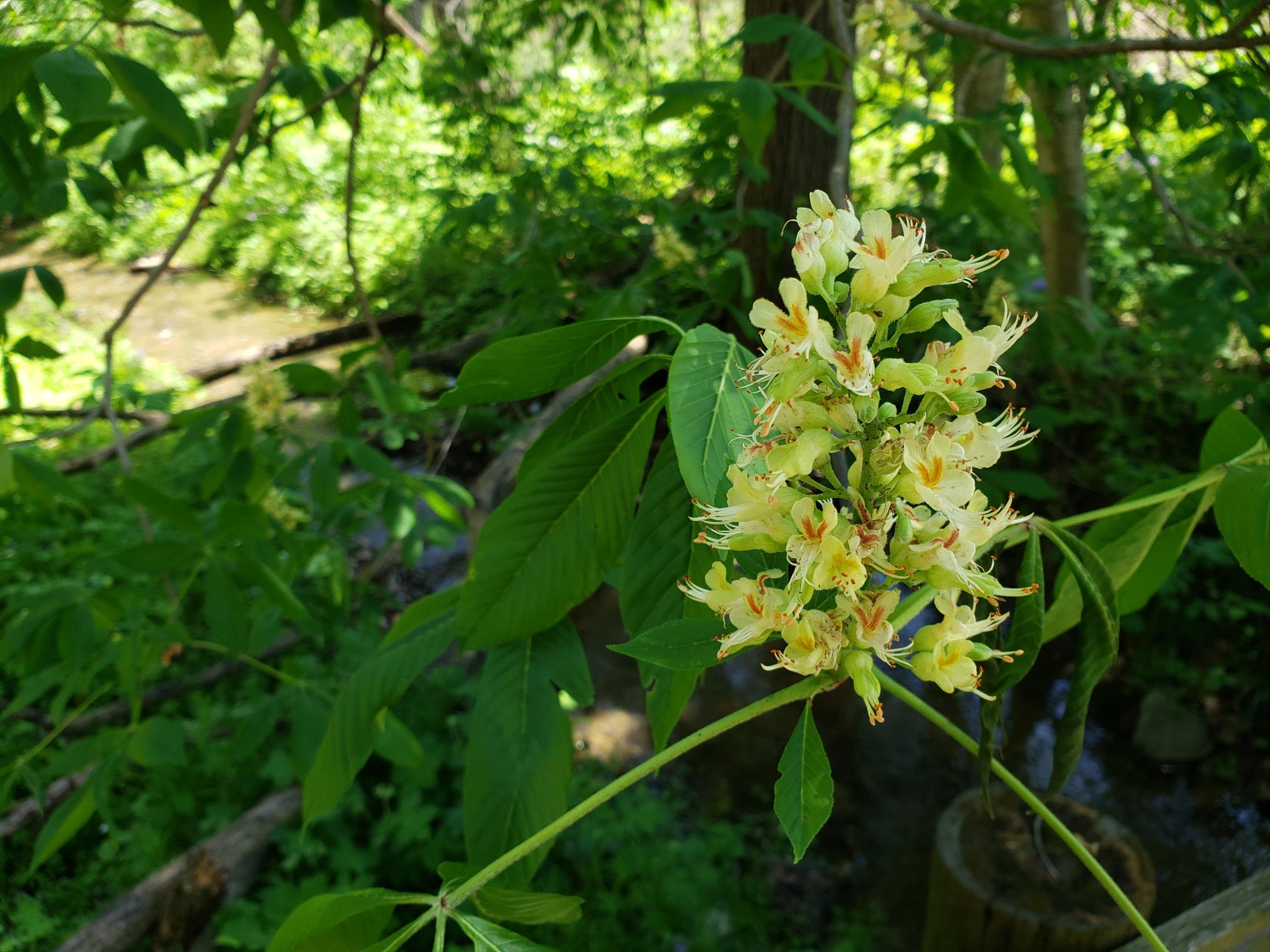

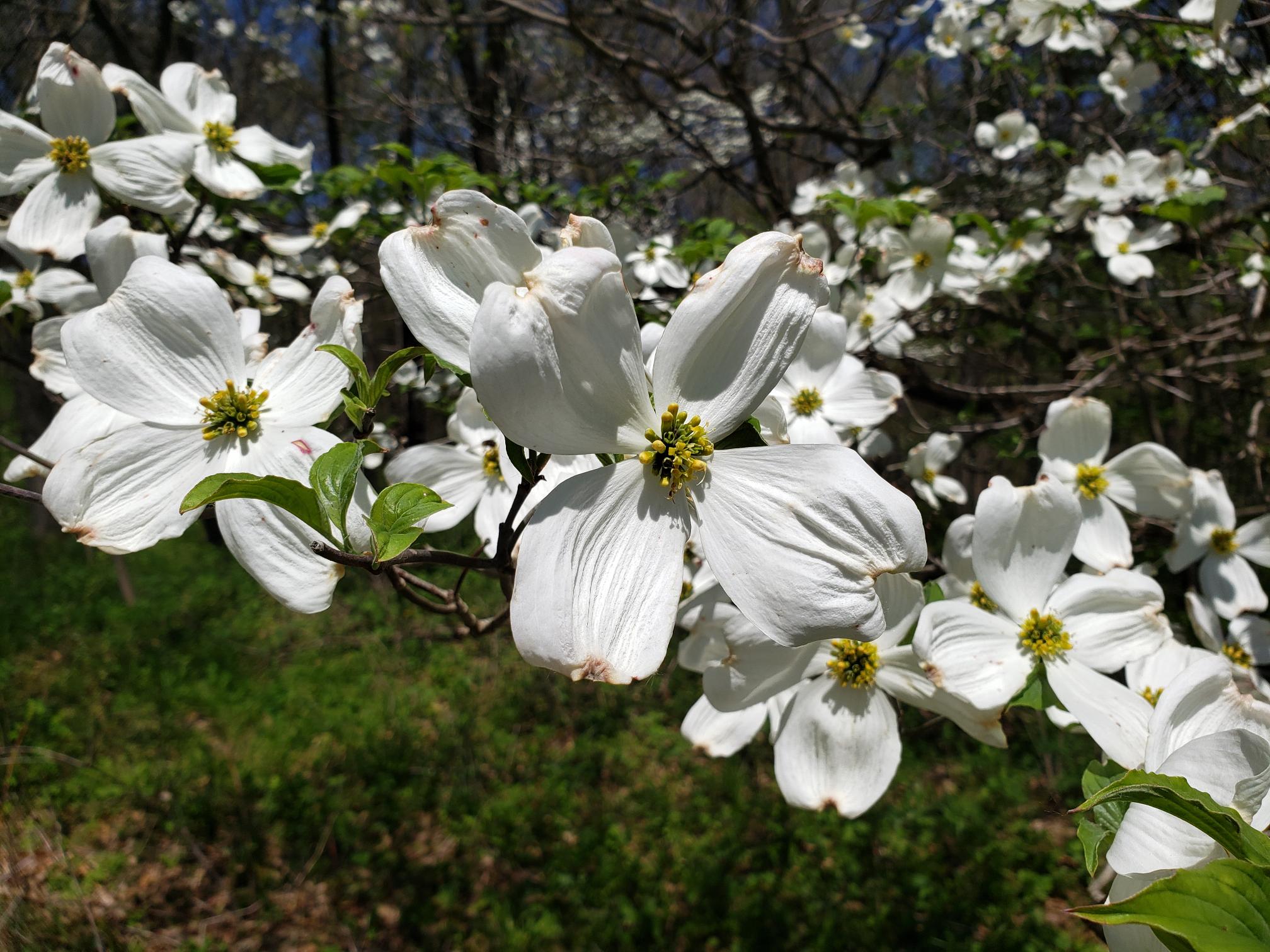
There is also a substantial show on the forest floor. Early-blooming wildflowers emerge and bloom before trees and shrubs expand leaves, allowing them access to sunlight in early spring. Some plants to look for include spring beauty, trilliums, Dutchman’s’ breeches, and bloodroot. Tree, shrub and plant field guides as well as plant ID apps can help you learn the ID features and life histories of these native plants.
Check out our Purdue Extension YouTube Channel to learn from Lenny Farlee, Extension Forester. In this Purdue Extension-FNR “YouTube Shorts” video below you will learn about early blooming trees in the spring time.
Resources:
ID That Tree, Playlist, Purdue Extension – Forestry and Natural Resources (FNR) YouTube Channel
Invasive Species Playlist, Playlist, Purdue Extension – FNR YouTube Channel (Asian Bush Honeysuckle, Burning Bush, Callery Pear, Multiflora rose)
A Woodland Management Moment, Playlist, Purdue Extension – FNR YouTube Channel (Against Invasives, Garlic Mustard, Autumn Olive)
Woodland Stewardship for Landowners, Playlist, Purdue Extension – FNR YouTube Channel (Common Buckthorn, Japanese Barberry)
Indiana Department of Natural Resources: Invasive Species
Indiana Invasive Species Council
Cooperative Invasive Species Management Area (CISMA)
Report Invasive, Purdue Extension
Aquatic Invasive Species, Illinois-Indiana Sea Grant (IISG)
Episode 11 – Exploring the challenges of Invasive Species, Habitat University-Natural Resource University
What are invasive species and why should I care?, Got Nature? Blog, Purdue Extension – FNR
Shrubs and Woody Vines of Indiana and the Midwest, The Education Store, Purdue Extension Resource Center
Native Trees of the Midwest, The Education Store
Lenny Farlee, Extension Forester
Hardwood Tree Improvement and Regeneration Center
Purdue Department of Forestry & Natural Resources
In this edition of ID That Tree, we’re going to introduce you to yet another native Indiana elm found in the far southwest corner of Indiana, and that is winged elm. It’s named for its prominent corky ridges that we see extending off the main stems and twigs. It has alternate leaf arrangement, simple leaves, and doubly serrated margins.
If you have any questions regarding wildlife, trees, forest management, wood products, natural resource planning or other natural resource topics, feel free to contact us by using our Ask an Expert web page.
Resources:
Winged Elm, Native Trees of Indiana River Walk, Purdue Fort Wayne
ID That Tree, Playlist, Purdue Extension – Forestry and Natural Resources (FNR) YouTube Channel (Invasive White Mulberry, Siberian Elm, Tree of Heaven)
Invasive Species Playlist, Playlist, Purdue Extension – FNR YouTube Channel (Asian Bush Honeysuckle, Burning Bush, Callery Pear, Multiflora rose)
A Woodland Management Moment, Playlist, Purdue Extension – FNR YouTube Channel (Against Invasives, Garlic Mustard, Autumn Olive)
Woodland Stewardship for Landowners, Playlist, Purdue Extension – FNR YouTube Channel (Common Buckthorn, Japanese Barberry)
How long do seeds of the invasive tree, Ailanthus altissima remain viable? (Invasive Tree of Heaven), USDA Forest Service
Indiana Department of Natural Resources: Invasive Species
Indiana Invasive Species Council
Cooperative Invasive Species Management Area (CISMA)
Report Invasive, Purdue Extension
Aquatic Invasive Species, Illinois-Indiana Sea Grant (IISG)
Episode 11 – Exploring the challenges of Invasive Species, Habitat University-Natural Resource University
What are invasive species and why should I care?, Got Nature? Blog, Purdue Extension – FNR
Shrubs and Woody Vines of Indiana and the Midwest, The Education Store, Purdue Extension Resource Center
Native Trees of the Midwest, The Education Store
Investing in Indiana Woodlands, The Education Store
Professional Forester, Indiana Forestry Woodland Owners Association
District Forester 10+acres of woodlands, Indiana Department of Natural Resources
Forest Improvement Handbook, The Education Store
Lenny Farlee, Extension Forester
Hardwood Tree Improvement and Regeneration Center
Purdue Department of Forestry & Natural Resources
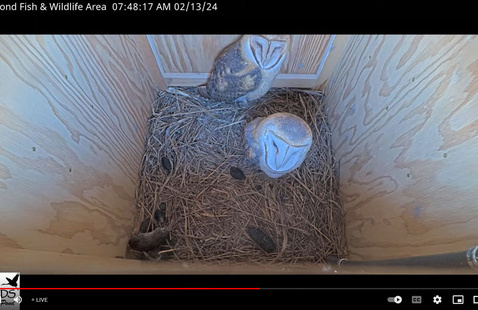
A capture from the Goose Pond webcam of barn owls in a nest box.
MyDNR, Indiana’s Outdoor Newsletter: A pair of barn owls have made a home in the property’s nest box, and you can watch this couple via a live webcam by going to the Goose Pond FWA camera page.
Barn owls are an endangered species in Indiana due to grassland habitat loss. Fewer than 50 nests are found annually in Indiana. To provide barn owls with secure nesting sites that are protected from predators, the DNR has built more than 400 nest boxes and erected them in barns and other structures with suitable habitat during the last 30 years.
The barn owl nest box at Goose Pond FWA was completed in March 2022 and is located next to its Visitors Center. This is the first nesting pair that has decided to call it home. The Friends of Goose Pond group helped provide funding for the camera and box, which has marine-grade plywood to keep the residents dry. It was painted the same color as the Visitors Center and looks like a house.
To learn more please visit the DNR Calendar.
Sign up to receive the MyDNR Newsletter by email: MyDNR Email Newsletter
Resources:
Barn Owl, Indiana Department of Natural Resources
Barn Owl Nest Webcam, Indiana Department of Natural Resources
Creating a Wildlife Habitat Management Plan for Landowners, The Education Store, Purdue Extension’s resource center
A Template for Your Wildlife Habitat Management Plan, The Education Store
Birds and Residential Window Strikes: Tips for Prevention, The Education Store, Purdue Extension resource center
Breeding Birds and Forest Management: the Hardwood Ecosystem Experiment and the Central Hardwoods Region, The Education Store
Managing Woodlands for Birds Video, Purdue Extension-Forestry and Natural Resources (FNR) YouTube Channel
Developing a Wildlife Habitat Management Plan, The Education Store
The Nature of Teaching, YouTube channel
Nature of Teaching: Common Mammals of Indiana, The Education Store
Subscribe to Purdue Extension-Forestry & Natural Resources YouTube Channel, Wildlife Playlist
Indiana Department of Natural Resources
In this edition of ID That Tree, we’re going to introduce you to yet another southern Indiana oak species. This one is a member of the broad white oak group and it’s called post oak. It’s called that because it’s a very rot resistant and hard wood that used to be used for fence posts. It has rounded lobes, no bristle tips, and typified by a cruciform shape of leaf.
If you have any questions regarding wildlife, trees, forest management, wood products, natural resource planning or other natural resource topics, feel free to contact us by using our Ask an Expert web page.
Resources:
Post Oak, Native Trees of Indiana River Walk, Purdue Fort Wayne
ID That Tree, Playlist, Purdue Extension – Forestry and Natural Resources (FNR) YouTube Channel (Invasive White Mulberry, Siberian Elm, Tree of Heaven)
Invasive Species Playlist, Playlist, Purdue Extension – FNR YouTube Channel (Asian Bush Honeysuckle, Burning Bush, Callery Pear, Multiflora rose)
A Woodland Management Moment, Playlist, Purdue Extension – FNR YouTube Channel (Against Invasives, Garlic Mustard, Autumn Olive)
Woodland Stewardship for Landowners, Playlist, Purdue Extension – FNR YouTube Channel (Common Buckthorn, Japanese Barberry)
How long do seeds of the invasive tree, Ailanthus altissima remain viable? (Invasive Tree of Heaven), USDA Forest Service
Indiana Department of Natural Resources: Invasive Species
Indiana Invasive Species Council
Cooperative Invasive Species Management Area (CISMA)
Report Invasive, Purdue Extension
Aquatic Invasive Species, Illinois-Indiana Sea Grant (IISG)
Episode 11 – Exploring the challenges of Invasive Species, Habitat University-Natural Resource University
What are invasive species and why should I care?, Got Nature? Blog, Purdue Extension – FNR
Shrubs and Woody Vines of Indiana and the Midwest, The Education Store, Purdue Extension Resource Center
Native Trees of the Midwest, The Education Store
Investing in Indiana Woodlands, The Education Store
Professional Forester, Indiana Forestry Woodland Owners Association
District Forester 10+acres of woodlands, Indiana Department of Natural Resources
Forest Improvement Handbook, The Education Store
Lenny Farlee, Extension Forester
Hardwood Tree Improvement and Regeneration Center
Purdue Department of Forestry & Natural Resources
In this edition of ID That Tree, we’re going to introduce you to a southern oak found in Indiana, cherrybark oak. This species can typically be found in bottomland areas in extreme southern Indiana. It’s a member of the broad red oak group. It has hairlike bristle tips, relatively large leaves, a waxy coating on the top, and lobes that have one or tow hair-like spines on the end.
If you have any questions regarding wildlife, trees, forest management, wood products, natural resource planning or other natural resource topics, feel free to contact us by using our Ask an Expert web page.
Resources:
Cherrybark Oak, Native Trees of Indiana River Walk, Purdue Fort Wayne
ID That Tree, Playlist, Purdue Extension – Forestry and Natural Resources (FNR) YouTube Channel (Invasive White Mulberry, Siberian Elm, Tree of Heaven)
Invasive Species Playlist, Playlist, Purdue Extension – FNR YouTube Channel (Asian Bush Honeysuckle, Burning Bush, Callery Pear, Multiflora rose)
A Woodland Management Moment, Playlist, Purdue Extension – FNR YouTube Channel (Against Invasives, Garlic Mustard, Autumn Olive)
Woodland Stewardship for Landowners, Playlist, Purdue Extension – FNR YouTube Channel (Common Buckthorn, Japanese Barberry)
How long do seeds of the invasive tree, Ailanthus altissima remain viable? (Invasive Tree of Heaven), USDA Forest Service
Indiana Department of Natural Resources: Invasive Species
Indiana Invasive Species Council
Cooperative Invasive Species Management Area (CISMA)
Report Invasive, Purdue Extension
Aquatic Invasive Species, Illinois-Indiana Sea Grant (IISG)
Episode 11 – Exploring the challenges of Invasive Species, Habitat University-Natural Resource University
What are invasive species and why should I care?, Got Nature? Blog, Purdue Extension – FNR
Shrubs and Woody Vines of Indiana and the Midwest, The Education Store, Purdue Extension Resource Center
Native Trees of the Midwest, The Education Store
Investing in Indiana Woodlands, The Education Store
Professional Forester, Indiana Forestry Woodland Owners Association
District Forester 10+acres of woodlands, Indiana Department of Natural Resources
Forest Improvement Handbook, The Education Store
Lenny Farlee, Extension Forester
Hardwood Tree Improvement and Regeneration Center
Purdue Department of Forestry & Natural Resources
Indiana Arborist Association
P.O. Box 946
Cicero, IN 46034
Press Release February 14, 2024
The Indiana Arborist Association (IAA) has received funding from Indiana Department of Natural Resource’s Community and Urban Forestry program to launch the first ever workforce development program dedicated to training certified arborists from underserved and disadvantaged communities in Northwest Indiana (NWI). This grant is funded through the U.S. Department of Agriculture (USDA) Forest Service Urban & Community Forestry program.
The IAA strives to enhance the quality of life for Indiana residents by encouraging the planting, maintenance and preservation of trees and promoting the advantages of working with qualified professional arborists who use current industry standards. Ashley Mulis, who will serve as program manager for the initiative is excited for this opportunity. “The need for qualified arborists in NWI has consistently surpassed the number of available practitioners. The IAA is thrilled to be able to launch such an important program in an area of the state that has historically suffered from both lack of tree canopy and certified arborists.” The State of Indiana along with many states across the U.S. struggle to fill jobs in the green industry with skilled labor. To effectively manage the urban forest, communities need skilled practitioners in arboriculture who understand the biology, management needs, and critical ecosystem services trees provide.
The Arborist Apprenticeship program will be a collaborative effort with several partners in NWI including Purdue University Northwest (PNW), Purdue Extension, and the Center for Workforce Innovation who will assist in the education and training of arborists who will go on to care for trees in disadvantaged communities of NWI. PNW Chancellor Kenneth Holford had this to say of the program partnership with IAA: “Purdue University Northwest is pleased to be a partner in this innovative workforce development program aimed at filling a growing and increasingly important gap in local talent to enhance the urban forests and ecosystems throughout Northwest Indiana. This program is consistent with PNW’s goal of building a strong, skilled, and sustained workforce for the region.”
Northwest Indiana has been the focus of a large multi-year tree planting effort led by CommuniTree. CommuniTree is NWI’s flagship urban and community forestry program that brings non-profits, communities, government agencies, universities, and businesses together to deliver a shared goal of creating a more diverse, healthy, and equitable urban forest across the region. As of 2024, CommuniTree partners including the Northwestern Indiana Regional Planning Commission (NIRPC), the Student Conservation Association (SCA), the US Forest Service (USFS), the NWI Urban Waters Federal Partnership (NWI UWFP) and others, have planted over 10,000 trees across the region. These trees require professional management provided by trained certified arborists. “CommuniTree, an outgrowth of the NWI UWFP, has created an unparalleled opportunity for workforce development initiatives to continue to grow, sustain and diversify urban forests in the region by drawing on the strengths that regional partnerships bring to the table. The NWI UWFP fully supports the IAA in their endeavor to provide professionally trained and certified Arborists for NWI.” Victoria Wittig, Ph.D., the Northwest Indiana Urban Waters Federal Partnership Ambassador. “The Center of Workforce Innovations applauds IAA on their work to bring this transformational program to NWI. Disadvantaged communities often bear the brunt of climate change impacts and environmental degradation. Training individuals from these communities in climate adaptation and mitigation strategies can lead to healthier local environments. The CommuniTree program, in conjunction with this Arborist Apprenticeship program specifically aims to not only reverse these environmental impacts but also equip residents of those same communities with the skills and knowledge necessary to thrive in the emerging green economy through a proven work-and-learn model.” Shaun Sahlhoff, Director of Planning and Fundraising at the Center of Workforce Innovations.
To learn more about the Indiana Arborist Association visit www.indiana-arborist.org or email info@indiana-arborist.org.
Media Contact: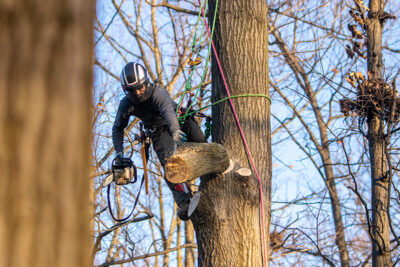
Ashley Mulis, Business Manager
Indiana Arborist Association
Email: ashley@indiana-arborist.org
Phone: (219) 295-0048
Lindsey Purcell, Executive Director
Indiana Arborist Association
Email: lindsey@indiana-arborist.org
Phone: (219) 295-0048
Other Resources:
Urban Forestry, Playlist, Purdue Extension – Forestry and Natural Resources (FNR) YouTube Channel
How to Find an Arborist Near You!, Purdue Extension – FNR Got Nature? Blog
What is Urban Forestry? Do You Know?, Purdue Extension – FNR Got Nature? Blog
Urban Forestry Minor, Purdue Forestry & Natural Resources (FNR)
Storms Can Cause Damage and Tree Cleanup, What You Need to Know, Purdue Extension – FNR Got Nature? Blog
Purdue Landscape Report, Purdue Science-Based Midwest Landscaping
Forest Improvement Handbook, The Education Store, Purdue Extension’s resource center
Investing in Indiana Woodlands, The Education Store
Woodland Wildlife Management, The Education Store
ID That Tree, Playlist, Purdue Extension – Forestry & Natural Resources (FNR) YouTube Channel
IN DNR-Division of Entomology & Plant Pathology Report: Jarred Spokowsky, Nursery Inspector & Compliance Officer, encourages professionals and enthusiast beekeepers to check out the new Honey Bee Nutrition-A Review and Guide to Supplemental Feeding which he shared in the February 2024 Report. The guide lists useful information and an interesting summary of research as it relates to current supplements. “You will also find real-world feedback from multiple migratory operations from around the country and what their nutritional supplement routines are,” states Jarred Spokowsky.
This guide is presented by the Honey Bee Health Coalition which brings together beekeepers, growers, researchers, government agencies, agribusinesses, conservation groups, manufacturers, and consumer brands to improve the health of honey bees.
Jarred also shared the upcoming seminar that many will want to attend March 6, 2024, presented by the Project Apis m. The seminar title is From Forage to Feeding, Honey Bee Health Seminar.
You will be able to listen to the following professionals:
- Dr. Priyadarshini Chakrabarti Basu
Mississippi State University - Dr. Diana Cox-Foster
USDA-ARS Pollinating Insect Research Unit, Logan Utah - Dr. Vanessa Corby-Harris
USDA-ARS Carl Hayden Bee Research Center in Tucson. AZ
If you would like to subscribe to the informal report by the Division of Entomology & Plant Pathology view the Entomology Weekly Review web page.
Resources:
Social Bees and Wasps, The Education Store
Indiana Beekeepers Swarm List, Indiana DNR
New Invasive Predator of Honeybees, Purdue Landscape Report
Protecting Pollinators: Why Should We Care About Pollinators?, The Education Store, Purdue Extension resource center
Ask The Expert: What’s Buzzing or Not Buzzing About Pollinators , Purdue Extension – Forestry & Natural Resources (FNR) YouTube Channel
Purdue Pollinator Protection publication series, Purdue Extension Entomology
Invasive Species, Playlist, Purdue Extension – FNR YouTube Channel
Report Invasive Species, Purdue Invasive Species
What are invasive species and why should I care?, Got Nature? Blog, Purdue Extension – Forestry and Natural Resources
Pest Management, The Education Store
Subscribe Purdue Extension-Forestry and Natural Resources YouTube Channel
Jarred Spokowsky, Nursery Inspector & Compliance Officer
Division of Entomology & Plant Pathology
Diana Evans, Extension and Web Communications Specialist
Purdue University Department of Forestry and Natural Resources
Indiana Department of Natural Resources
 Governor Eric Holcomb has proclaimed February 25th to March 2nd as 2024 Invasive Species Awareness Week in Indiana.
This serves as an important reminder for Hoosiers to be aware and report potentially devastating invasives.
This proclamation states “invasive aquatic, riparian and terrestrial species influence the productivity, value and management of land and water resources in Indiana and the cost to prevent, monitor and control invasive species costs Indiana millions annually and after habitat destruction, invasive species are a great threat to biodiversity and threaten the survival of native plants and animals and interfere with ecosystem functions by changing processes like fire, nutrient flow and flooding”.
It continues with “invasive species impede industry, threaten agriculture, endanger human health and are becoming increasingly harder to control as a result of rapid global commercialization and human travel; and invasive species are as significant threat to almost half of the native species currently listed as federally endangered.”
As Invasive Species Awareness Week starts Sunday, February 25th, the Indiana Department of Natural Resources (IN DNR), Purdue Extension-Forestry and Natural Resources and the Indiana Invasive Species Council will answer any questions you may have.
For Questions:
Ask an Expert, Purdue Extension-Forestry and Natural Resources
Invasive Species – Indiana Department of Natural Resources (IDNR)
Indiana Invasive Species Council – Includes: IDNR, Purdue Department of Entomology and Professional Partners
Cooperative Invasive Species Management Area (CISMA)
Report and Learn More About Invasive Species –
Great Lakes Early Detection Network App (GLEDN) – The Center for Invasive Species & Ecosystem Health
EDDMaps – Early Detection and Distribution Mapping System
Purdue University Report Invasive Species, College of Agriculture
Check Out Our Invasive Species Videos –
Subscribe: Purdue Extension-Forestry and Natural Resources (FNR) YouTube Channel
Invasive Species YouTube Video Playlist includes:
- Asian Bush Honeysuckle
- Burning Bush
- Callery Pear
- Multiflora Rose
- Invasive Plants Threaten Our Forests Part 1: Invasive Plant Species Identification
- Invasive Plants Threaten Our Forests Part 2: Control and Management
More Purdue Extension-FNR YouTube Video Series –
Woodland Management Moment:
Woodland Stewardship for Landowners:
ID That Tree:
More Resources –
FNR Extension Publications, The Education Store:
- Invasive Plant Species: Tree of Heaven
- Invasive Plant Species: Oriental Bittersweet
- Invasive Plant Species: Wintercreeper
- Japanese Chaff Flower
- Kudzu in Indiana
- Mile-a-minute Vine
Purdue Landscape Report:
FNR Extension Got Nature? Blog:
Don’t Miss These Resources:
Episode 11 – Exploring the challenges of Invasive Species, Habitat University-Natural Resource University
What Are Invasive Species and Why Should I Care?, Purdue Extension-FNR Got Nature? Blog
Emerald Ash Borer Information Network, Purdue University and Partners
Aquatic Invasive Species, Illinois-Indiana Sea Grant (IISG)
Invasive plants: impact on environment and people, The Education Store, Purdue Extension’s resource center
Purdue Extension-Forestry and Natural Resources
The podcast series housed within the Natural Research University network delivers expert-based knowledge of natural resource management. The network is a partnership between the extension services at several land-grant university, including Mississippi State Extension Service, University of Florida Extension, Iowa State University Extension and Outreach and Purdue Extension. Funding for the project comes from the Renewable Resources Extension Act.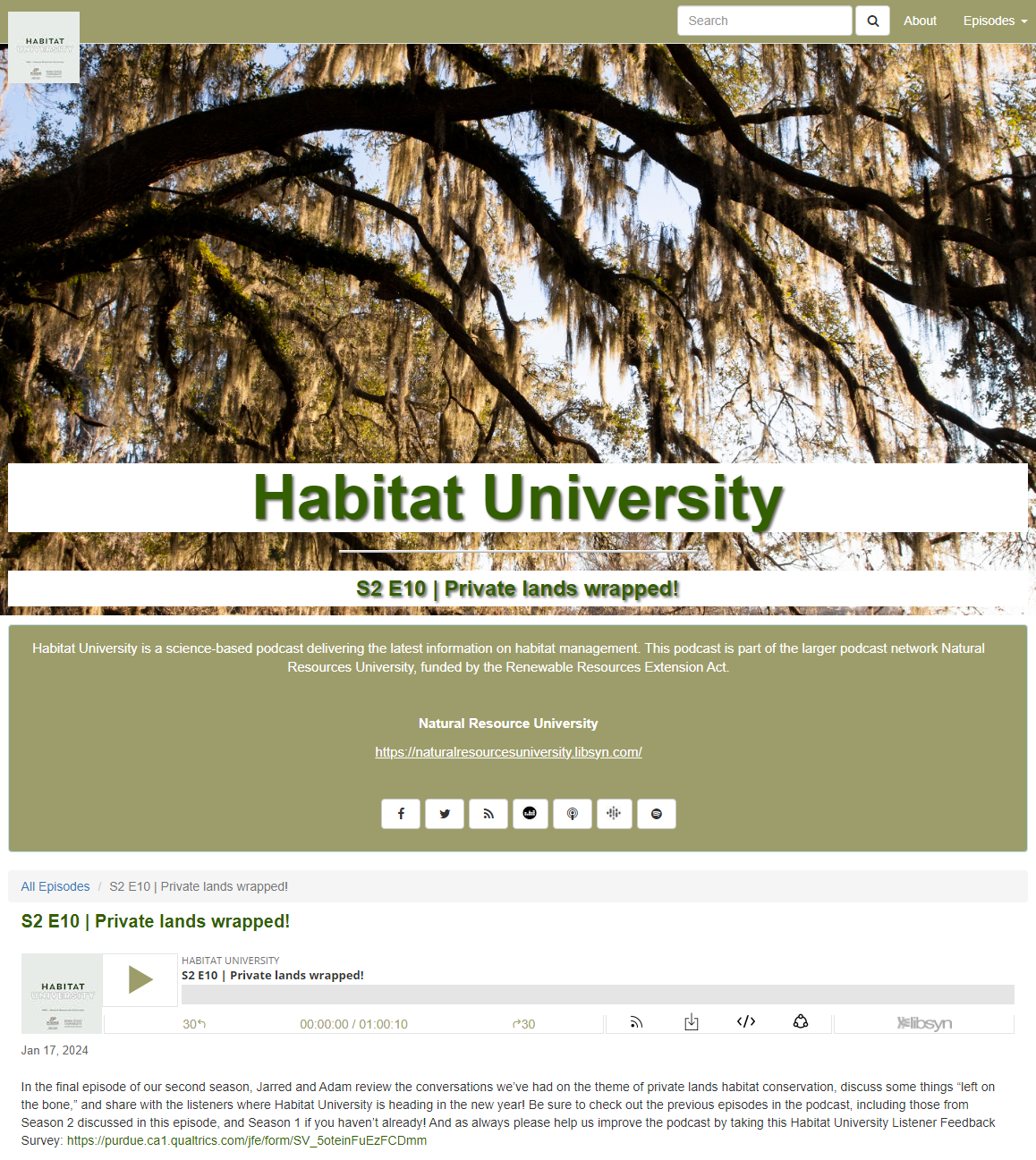
Check out the new podcast in the Habitat University, hosted by Jarred Brooke and Adam Janke, discusses the science behind wildlife habitat management and how landowners and manages can use different habitat management practices to improve their land for wildlife. This podcast is part of the larger podcast network Natural Resources University (NRU), funded by the Renewable Resources Extension Act (RREA).
In the final episode of this second season, Jarred and Adam review the conversations we’ve had on the theme of private lands habitat conservation, discuss some things “left on the bone,” and share with the listeners where Habitat University is heading in the new year! Be sure to check out the previous episodes in the podcast, including those from Season 2 discussed in this episode, and Season 1 if you haven’t already! And as always please help us improve the podcast by taking this Habitat University Listener Feedback Survey.
To listen to this episode, please visit Habitat University.
The Natural Resources University podcasts are available through the individual podcast websites, through the NRU podcast main hub or wherever podcasts are available to download.
Check out this article regarding the NRU groups award received: Purdue Forestry and Natural Resources News & Stories, Natural Resources University Podcasts Earn ANREP Gold Award .
More Resources:
Ask an Expert: Pond Management, Purdue Extension-Forestry & Natural Resources (FNR) YouTube playlist
Pond Management: Managing Fish Populations, The Education Store, Purdue Extension’s resource center
Yellow Perch Farmed Fish Fact Sheet, The Education Store
Frogs and Toads of Indiana, The Education Store
Snakes and Lizards of Indiana, The Education Store
Forest Improvement Handbook, The Education Store
Frost Seeding Native Grasses and Forbs with a Drone (UAV), Purdue Extension-FNR
Hardwood Ecosystem Experiment – Wildlife Responses to Timber Harvesting, The Education Store
Invasive Plants: Impact on Environment and People, The Education Store
Community Development, Purdue Extension
Ask the Expert: Turtles and Snakes video, Got Nature? post
ID That Tree, Purdue Extension-FNR YouTube playlist
Woodland Management Moment , Purdue Extension-FNR YouTube playlist
Jarred Brooke, Wildlife Extension Specialist
Purdue Forestry and Natural Resources
Many forest landowners own and manage their land for hunted wildlife species such as white-tailed deer, wild turkey, and a host of other game species. This presentation titled Managing Your Woods for Game Species by Jarred Brooke, Extension Wildlife Specialist for Purdue University, discusses how forest management can be tailored to enhance habitat for game species and how forest management focused on game species can provide habitat for a suite of non-game wildlife.
The Toms, Tines, and Tanagers is a webinar event hosted by the Illinois Extension, College of Agricultural, Consumer & Environmental Sciences.
Resources:
Hunting Guide for 2023-2024, Indiana Department of Natural Resources
How to Score Your White-tailed Deer, video, The Education Store, Purdue Extension Resource Center
White-Tailed Deer Post Harvest Collection, video, The Education Store
Age Determination in White-tailed Deer, video, The Education Store
How to Build a Plastic Mesh Deer Exclusion Fence, The Education Store
Managing Your Woods for White-Tailed Deer, The Education Store
Bovine Tuberculosis in Wild White-tailed Deer, The Education Store
Frost Seeding Native Grasses and Forbs with a Drone (UAV), Purdue Extension-FNR
Help With Wild Turkey Populations, Video, Purdue Extension – Forestry and Natural Resources YouTube Channel
Turkey Brood Reporting, Indiana Department of Natural Resources (IDNR)
Wild Turkey, Indiana Department of Natural Resources (IDNR)
Wild Turkey Hunting Biology and Management, Indian Department of Natural Resources (IDNR)
Subscribe to Purdue Extension-Forestry & Natural Resources YouTube Channel, Wildlife Playlist
Woodland Management Moment YouTube Playlist, Purdue Extension – FNR
Finding help from a professional forester, Indiana Forestry & Woodland Owners Association
Forest Improvement Handbook, The Education Store, Purdue Extension resource center
Jarred Brooke, Wildlife Extension Specialist
Purdue Department of Forestry and Natural Resources
Illinois Extension, College of Agricultural, Consumer & Environmental Sciences

Recent Posts
- Beetle that attacks Tree-of-Heaven found in Indiana, Purdue Landscape Report
Posted: March 20, 2026 in Invasive Insects, Wildlife, Woodlands - ID That Tree: Dwarf Chinkapin Oak
Posted: in Forestry, Urban Forestry, Wildlife, Woodlands - DNR Hiring for Indiana Conservation Officer Positions, MyDNR
Posted: March 9, 2026 in Urban Forestry, Wildlife, Woodlands - ID That Tree: Shumard Oak
Posted: in Plants, Urban Forestry, Wildlife, Woodlands - Uniting Indiana Residents Against Invasive Species
Posted: February 27, 2026 in Community Development, Invasive Insects, Wildlife - Have You Seen a Soaring Eagle Lately? Morning Ag Clips
Posted: February 25, 2026 in Urban Forestry, Wildlife - Register for Natural Resources Teacher Institute’s Class of 2026
Posted: February 19, 2026 in Forestry, Wildlife, Woodlands - ID That Tree: Fragrant Sumac
Posted: February 4, 2026 in Plants, Urban Forestry, Wildlife - Woodsy Owl Edition for Educational Learning, USDA – U.S. Forest Service
Posted: January 21, 2026 in Forestry, Forests and Street Trees, Got Nature for Kids, Urban Forestry, Wildlife - Opt-in to the Deer Management Survey, MyDNR
Posted: January 12, 2026 in Forestry, Wildlife
Archives
Categories
- Alert
- Aquaculture/Fish
- Aquatic/Aquaculture Resources
- Ask the Expert
- Christmas Trees
- Community Development
- Disease
- Drought
- Forestry
- Forests and Street Trees
- Gardening
- Got Nature for Kids
- Great Lakes
- How To
- Invasive Animal Species
- Invasive Insects
- Invasive Plant Species
- Land Use
- Natural Resource Planning
- Nature of Teaching
- Plants
- Podcasts
- Ponds
- Publication
- Safety
- Spiders
- Timber Marketing
- Uncategorized
- Urban Forestry
- Webinar
- Wildlife
- Wood Products/Manufacturing
- Woodland Management Moment
- Woodlands