 Purdue University - Extension - Forestry and Natural Resources
Got Nature? Blog
In this episode of A Woodland Management Moment, Purdue Extension forester Lenny Farlee discusses the regeneration of small forest openings. Even forested areas of an acre or less can offer excellent opportunities for growth. Light-loving species thrive in the center, while more shade-tolerant plants flourish at the edges. This practice enhances the diversity of your woodlands. Adequate sunlight is crucial for creating a well-structured opening. By regenerating light-loving species, you can also add valuable wildlife habitat diversity to your property.
If you have any questions regarding trees, forests, wildlife, wood products or other natural resource topics, feel free to contact us by using our Ask an Expert web page.
Resources:
A Woodland Management Moment, Playlist, Purdue Extension – Forestry and Natural Resources (FNR) YouTube Channel
The Nature of Oaks Webinar, Purdue Extension-FNR YouTube Channel, Shared from Indiana Forestry & Woodland Owners Association
Conservation Tree Planting: Steps to Success, Purdue Extension – FNR YouTube Channel
Shrubs and Woody Vines of Indiana and the Midwest, The Education Store, Purdue Extension Resource Center
Native Trees of the Midwest, The Education Store
ID That Tree, Playlist, Purdue Extension – FNR YouTube Channel
Investing in Indiana Woodlands, The Education Store
Woodland Stewardship for Landowners Video Series, Playlist, Indiana Department of Natural Resources YouTube Channel
Ask an Expert: Tree Selection and Planting, Purdue Extension – FNR YouTube Channel
Forest Improvement Handbook, The Education Store
Find an Indiana Professional Forester, Indiana Forestry & Woodland Owners Association (IFWOA)
Purdue Arboretum Explorer
Lenny Farlee, Extension Forester
Hardwood Tree Improvement and Regeneration Center
Purdue Department of Forestry & Natural Resources
Wild Bulletin, Indiana Department of Natural Resources (DNR) Fish and Wildlife: Each year, the Indiana DNR invites the public to provide feedback on the management of white-tailed deer via the Deer Management Survey. The electronic survey gathers opinions of deer management at both the county and state level, covering deer population management, trends in deer populations and other relevant topics such as chronic wasting disease (CWD), land access and equipment types permitted for hunting.
 Anyone can sign up to receive the survey, if you have previously filled out the survey, you will automatically receive the survey in future years. Find more information at DNR: Deer Management Survey webpage.
Resources:
Purdue Extension Pond and Wildlife Management
Introduction to White-tailed Deer Impacts on Indiana Woodlands
Understanding White-tailed Deer and Their Impact on Indiana Woodlands, The Education Store
Monitoring White-tailed Deer and Their Impact on Indiana Woodlands, The Education Store
Managing White-tailed Deer Impacts on Indiana Woodlands, The Education Store
Ask an Expert: Wildlife Food Plots, video, Purdue Extension – FNR YouTube Channel
How to Build a Plastic Mesh Deer Exclusion Fence, The Education Store
Managing Your Woods for White-Tailed Deer, The Education Store
Bovine Tuberculosis in Wild White-tailed Deer, The Education Store
Handling Harvested Game: Episode 1, Field Dressing, video, Purdue Extension – FNR YouTube Channel
Deer Harvest Data Collection, Got Nature? Blog, Purdue Extension – FNR
How to Score Your White-tailed Deer, video, The Education Store, Purdue Extension Resource Center
White-Tailed Deer Post Harvest Collection, video, The Education Store
Age Determination in White-tailed Deer, video, The Education Store
Handling Harvested Deer Ask an Expert? video, Purdue Extension – FNR YouTube Channel
Subscribe to Purdue Extension-Forestry & Natural Resources YouTube Channel, Wildlife Playlist
Indiana Department of Natural Resources – Division of Fish & Wildlife
Wild Bulletin, Indiana Department of Natural Resources (DNR) Fish and Wildlife: Snow blanketing the ground creates a canvas for spotting wildlife tracks. Here are some tips for exploring snow-covered trails or your own backyard to reveal a whole world of activity you might otherwise miss.
Tips and Tricks:

Photo by: Indiana Department of Natural Resources
- Look near water sources, tree lines, or feeding spots where animals are more likely to gather.
- Find an Indiana wildlife track identification book or website to help you identify the animal you are tracking. Some animal tracks are more common to spot in Indiana, and here are some examples:
- Deer: Heart-shaped hooves, often in pairs.
- Rabbits: A hopping pattern with large back feet and small front feet.
- Foxes and Coyotes: Oval-shaped paw prints with claw marks visible.
- Bring tools like a small ruler or notebook. This will help you record measurements for identification. Snapping a photo is also helpful for identifying the track later on!
- Follow the tracks. Tracks often lead to other signs, like nests, scat, or feeding areas. Stay quiet and watch—you might even spot the animal itself!
Are you ready to track wildlife and connect with the creatures around you? Bundle up, head out, and see what stories the snow has to tell!
For more information, visit the DNR Rare and Endangered Mammals page.
Resources:
ID That Tree, Playlist, Purdue Extension – Forestry and Natural Resources (FNR) YouTube Channel
Invasive Species Playlist, Playlist, Purdue Extension – FNR YouTube Channel (Asian Bush Honeysuckle, Burning Bush, Callery Pear, Multiflora rose)
Report Invasive, Purdue Extension
Forestry for the Birds Virtual Tour and Pocket Guide, Got Nature? Blog, Purdue Extension – FNR
Injured Wildlife and What to Do, Got Nature? Blog, Purdue Extension – FNR
Frost Seeding to Establish Wildlife Food Plots and Native Grass and Forb Plantings – The Education Store, Purdue Extension’s resource center
Wildlife Habitat Hint: Tips for Evaluating a First Year Native Grass and Forb Plantings, Purdue Extension – FNR YouTube Channel
Drone Seeding Native Grasses and Forbs: Project Overview & Drone Setup, Purdue Extension – FNR YouTube channel
Forest Improvement Handbook, The Education Store
Forest Management for Reptiles and Amphibians: A Technical Guide for the Midwest, The Education Store
Ask the Expert: Hardwood Ecosystem Experiment – Birds and Salamander Research, Purdue Extension – FNR
A Template for Your Wildlife Habitat Management Plan, The Education Store
Managing Your Woods for White-Tailed Deer, The Education Store
Woodland Stewardship for Landowners, Playlist, Purdue Extension – FNR YouTube channel
Nature of Teaching Unit 1: Animal Diversity and Tracking, The Education Store
Subscribe Purdue Extension – Forestry and Natural Resources YouTube Channel, Playlists include wildlife, Nature of Teaching, Moments in the Wild and much more.
Indiana Department of Natural Resources – Division of Fish & Wildlife
In this edition of ID That Tree, Purdue Extension Forester Lenny Farlee showcases the unique features of prickly ash. The northeast member of the Citrus family (not the Ash family!) is a shrub with stout, paired thorns, reddish-brown buds and also has other traits shared in the video that makes it easy to spot out in the wild. This video contains nice close-up shots so you can identify this plant, which is native to Indiana and an important part of the habitat.
If you have any questions regarding wildlife, trees, forest management, wood products, natural resource planning or other natural resource topics, feel free to contact us by using our Ask an Expert web page.
Resources:
ID That Tree: Firs and Spruces, Video Playlist, Purdue Extension – Forestry and Natural Resources (FNR) YouTube Channel
ID That Tree – Jack Pine, Scotch Pine, Red Pine, Virginia Pine, Eastern White Pine, Video Playlist, Purdue Extension – Forestry and Natural Resources (FNR) YouTube Channel
Beat Back Borers Attacking Pines and Other Cone Bearing Trees, Purdue Landscape Report
Tree Diseases: White Pine Decline in Indiana, The Education Store, Purdue Extension Resource Center
Purdue Arboretum Explorer
Conservation Tree Planting: Steps to Success, Purdue Extension – FNR YouTube Channel
A Woodland Management Moment, Playlist, Purdue Extension – FNR YouTube Channel
Woodland Stewardship for Landowners, Playlist, Purdue Extension – FNR YouTube Channel
Indiana Department of Natural Resources: Invasive Species
Indiana Invasive Species Council
Cooperative Invasive Species Management Area (CISMA)
Report Invasive, Purdue Extension
Episode 11 – Exploring the challenges of Invasive Species, Habitat University-Natural Resource University
Shrubs and Woody Vines of Indiana and the Midwest, The Education Store
Native Trees of the Midwest, The Education Store
Professional Forester, Indiana Forestry Woodland Owners Association
Forest Improvement Handbook, The Education Store
Find an Arborist, International Society of Arboriculture
Lenny Farlee, Extension Forester
Hardwood Tree Improvement and Regeneration Center
Purdue Department of Forestry & Natural Resources
In this episode of A Woodland Management Moment, Purdue Extension forester Lenny Farlee discusses the benefits of maintaining certain areas of your forest land with alternative types of cover rather than traditional forest. It’s a good idea to keep some areas open not only for recreational purposes but also for future timber harvesting and to provide habitat for many wildlife. By allowing some of your land to be open, you help maintain the natural habitat around you and can even get some interesting plants that will grow on their own.
If you have any questions regarding trees, forests, wildlife, wood products or other natural resource topics, feel free to contact us by using our Ask an Expert web page.
Resources:
A Woodland Management Moment, Playlist, Purdue Extension – Forestry and Natural Resources (FNR) YouTube Channel
Learn How to Support Oak-Hickory Ecosystems, Purdue Extension – FNR Got Nature? Blog
The Nature of Oaks Webinar, Purdue Extension-FNR YouTube Channel, Shared from Indiana Forestry & Woodland Owners Association
Oak Leaf Tatters, Purdue Landscape Report
Inonotus Dryadeus, Butt and Root Rot of Oaks, Purdue Extension – FNR Got Nature? Blog
Predicting the Height Growth of Oak Species Reproduction Over a 23-year Period Following Clearcutting, Hardwood Tree Improvement & Regeneration Center (HTIRC)
Conservation Tree Planting: Steps to Success, Purdue Extension – FNR YouTube Channel
Shrubs and Woody Vines of Indiana and the Midwest, The Education Store, Purdue Extension Resource Center
Native Trees of the Midwest, The Education Store
ID That Tree, Playlist, Purdue Extension – FNR YouTube Channel
Investing in Indiana Woodlands, The Education Store
Woodland Stewardship for Landowners Video Series, Playlist, Indiana Department of Natural Resources YouTube Channel
Ask an Expert: Tree Selection and Planting, Purdue Extension – FNR YouTube Channel
Forest Improvement Handbook, The Education Store
Find an Indiana Professional Forester, Indiana Forestry & Woodland Owners Association (IFWOA)
Purdue Arboretum Explorer
Lenny Farlee, Extension Forester
Hardwood Tree Improvement and Regeneration Center
Purdue Department of Forestry & Natural Resources
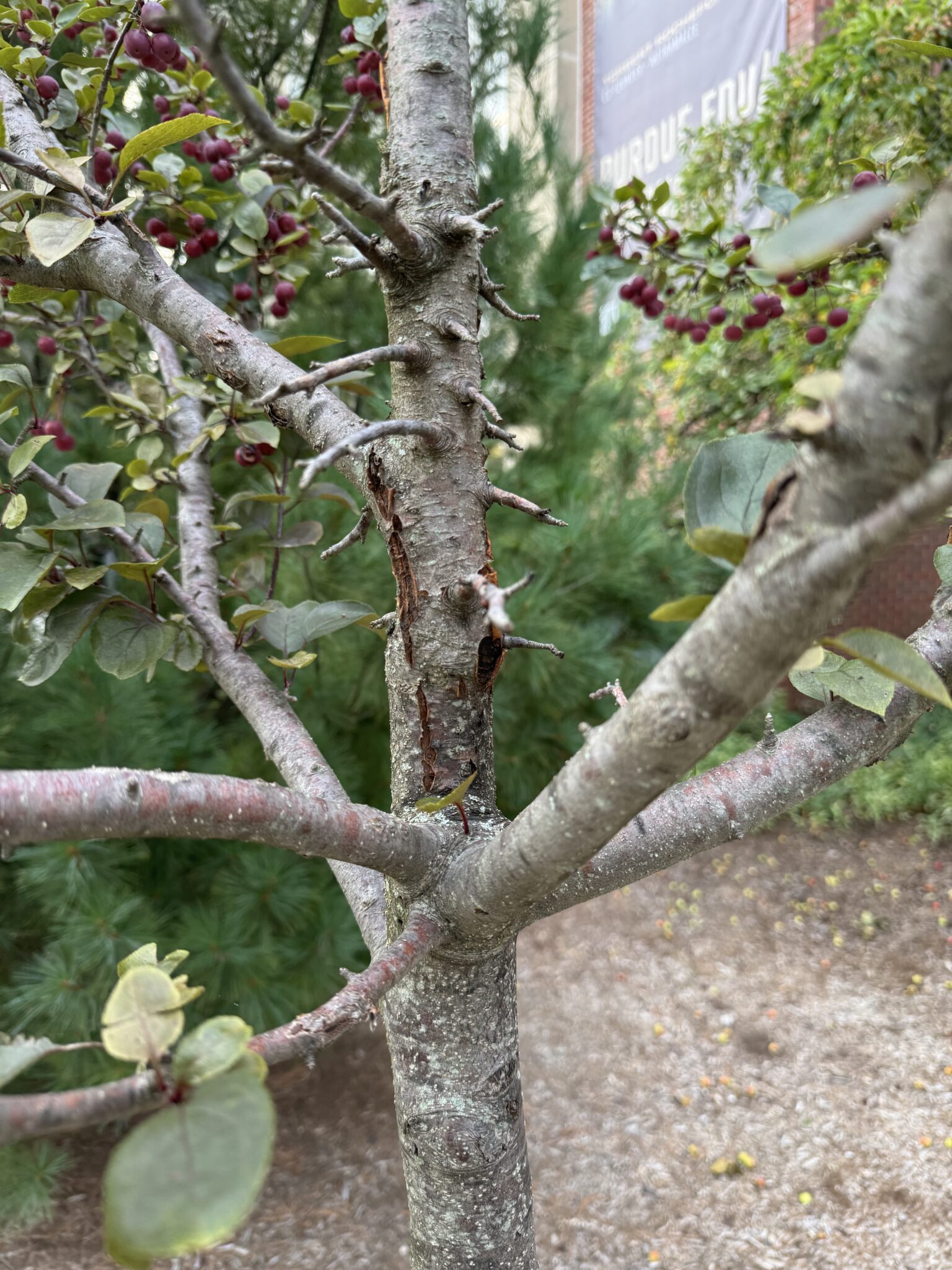
Figure 1: This crabapple tree was attacked first by fire blight and later by Botryosphaeria canker, killing the main trunk.
Purdue Landscape Report: Dieback and canker diseases caused by Botryosphaeria, Sphaeropsis, Diplodia and other closely related fungal pathogens are exceptionally common on woody landscape plants. This group of diseases are often referred to collectively as Botryosphaeria diseases and this article will follow that convention to discuss them as a group. Examine any mature oak tree long enough and you’re likely to find at least some stems dying due to Botryosphaeria. Check the base of dying stems of cranberry bush viburnum and you’re likely to find a Botryosphaeria canker. Look closely at sunken cracked stems and dieback on redbud and, you guessed it, more Botryosphaeria.
Botryosphaeria is opportunistic and is often seen killing individual branches that have been wounded or attacked by other diseases, providing an entry point for the fungus. (Fig 1) Stress factors like drought, freezing or defoliation due to disease or insect attack increases susceptibility to infection, and reduces plant defenses so that existing infections often move faster down the stem. However, wounds are not required for infection. In susceptible trees and shrubs, the fungus may attack the smallest twigs and later spread to larger branches where they cause cankers.
Symptoms:
Discoloration and death of leaves on individual stems may point to Botryosphaeria canker at the base of the dying stem (Fig 2). As the canker girdles a stem, the portion of the stem above the canker gradually dies. Smaller twigs with immature bark may become discolored as the pathogen spreads. Symptoms may vary depending on the plant species infected. In many cases the infection fails to completely encircle the stem, resulting in stems with half necrotic and half living stem tissue (Fig 3).
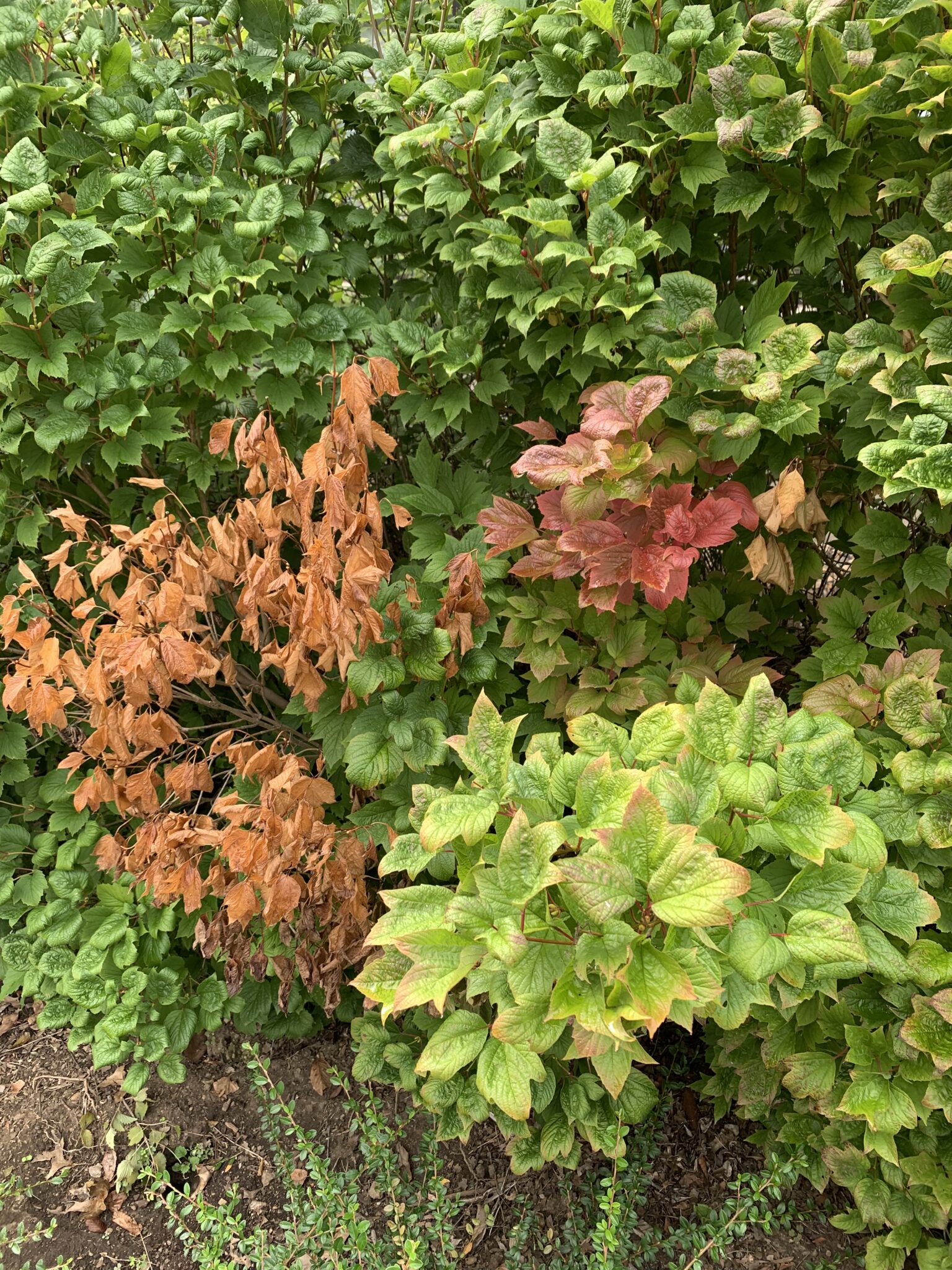
Figure 2: A viburnum hedge with dieback caused by Botryosphaeria. Leaf color may progress from yellow to red to brown as branches die.
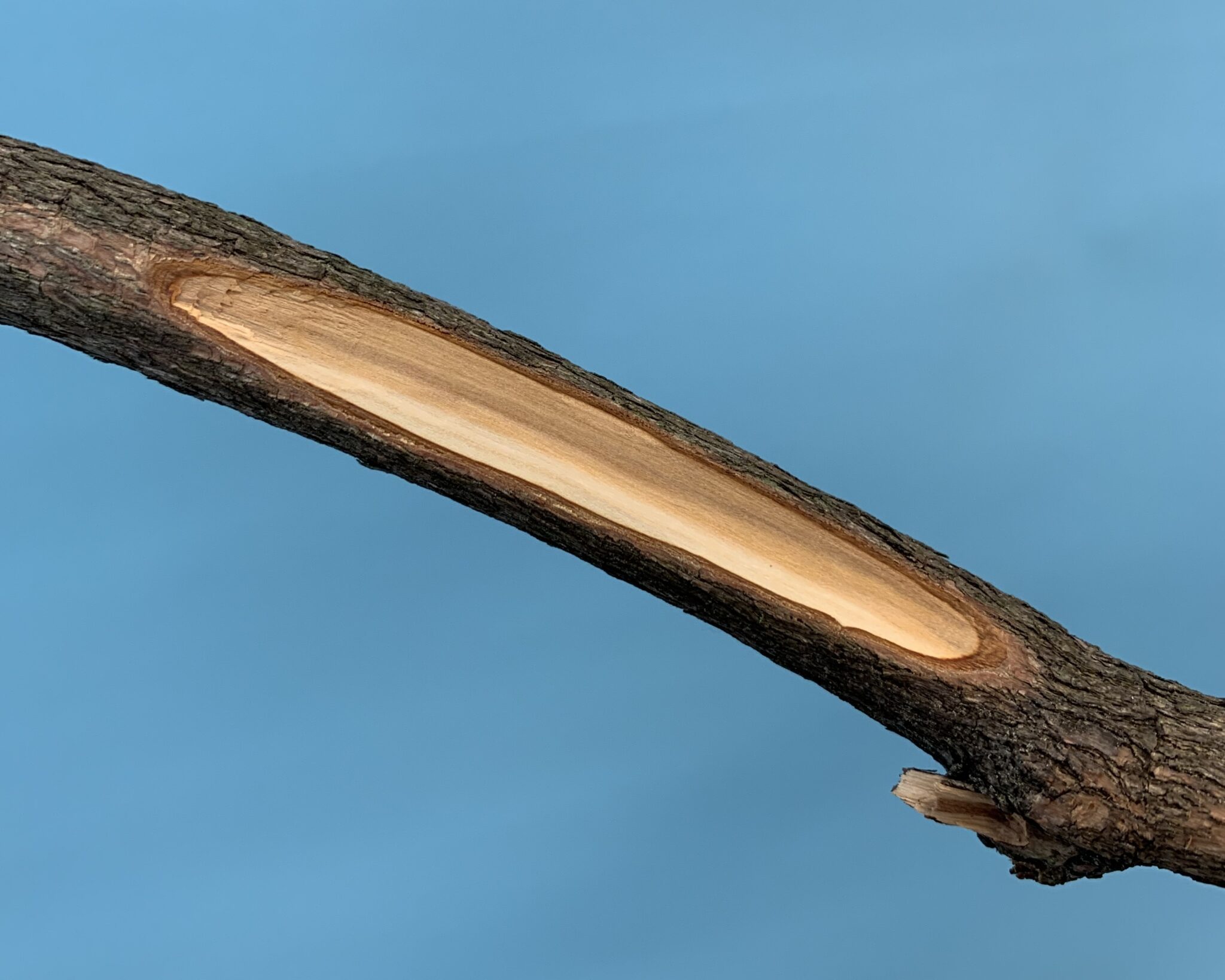
Figure 3: A rhododendron stem showing one-sided necrosis caused by Botryosphaeria infection. The tan to brown discoloration in the wood is typical of Botryosphaeria on many deciduous trees and shrubs.
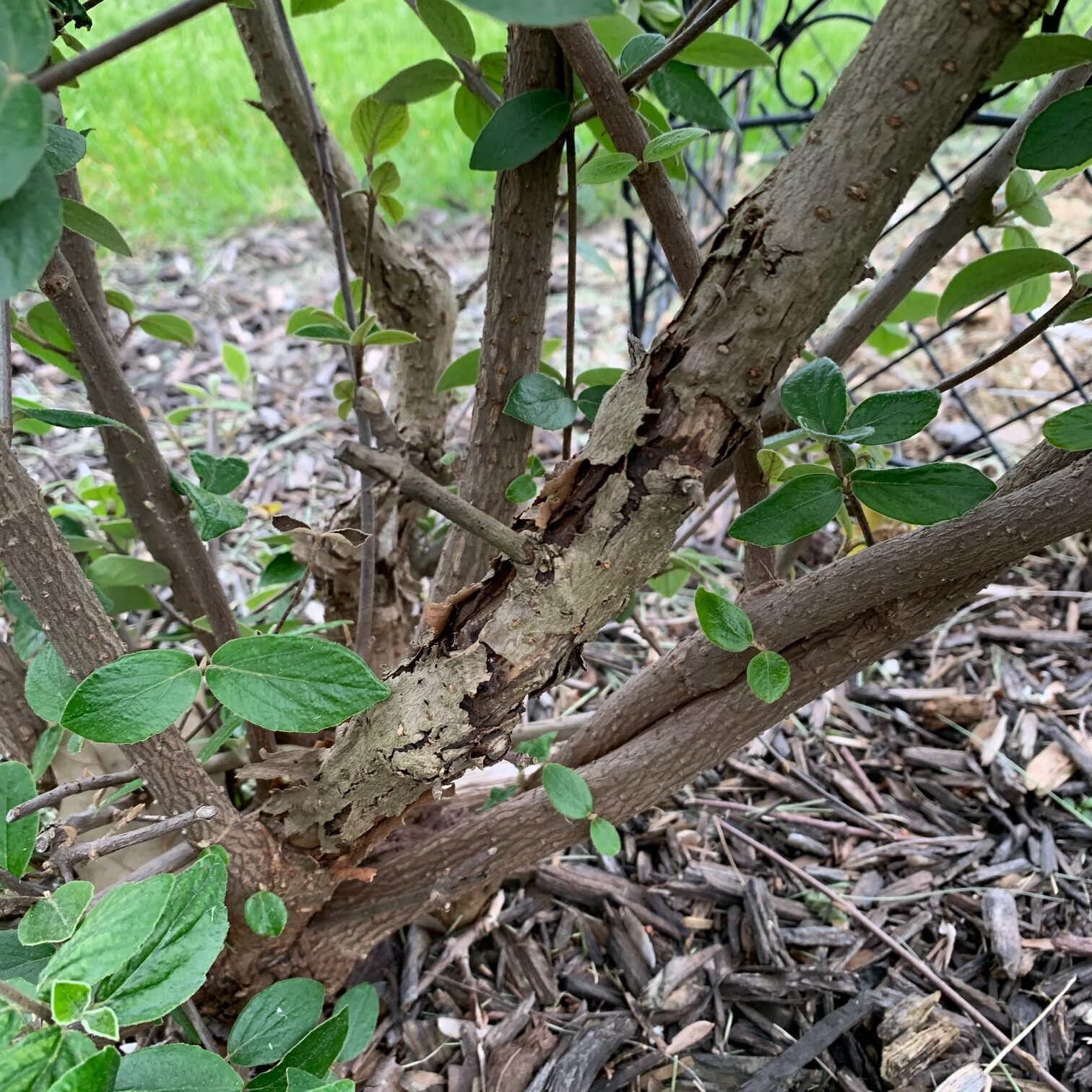
Figure 4: This Viburnum x burkwoodii stem has a large Botryosphaeria canker at the base, killing the branch above that point. After the branch was pruned out the remainder of the shrub survived.
Botryosphaeria cankers usually cause bark to be cracked, sunken and discolored (Fig 4). Fruiting bodies of the fungus appear as pinhead-sized black specks embedded in the bark, which may be raised in small bumps covering the cankers.
Management:
Prevention of infection depends mainly upon avoiding unnecessary wounding and minimizing environmental stresses that induce susceptibility. Avoid allowing trees and shrubs, especially those recently transplanted, to become drought stressed. Keep plants in good condition and in moderate growth. Avoid high fertilizer rates that induce rapid, succulent growth that may be more susceptible to infection.
Prune out and destroy any dead branches at least six inches below discoloration in the bark or sapwood. Be sure to clean pruning tools with a disinfectant after working on infected plants.
Fungicides have not been effective at preventing infections, and once the fungus is inside the wood fungicides can’t touch it, so they are generally not recommended in the landscape.
Avoid using highly susceptible plants, such as Viburnum trilobum or Salix spp., in drought prone sites.
Resources:
Botryosphaeria Canker, Purdue Plant Doctor
Beat Back Borers Attacking Pines, Purdue Landscape Report
Black Spot of Elm, Purdue Landscape Report
Inonotus Dryadeus – Butt and Root Rot of Oaks, Purdue Landscape Report
Stories in the Bark – Patterns and Growth, Purdue Extension – Forestry & Natural Resources Got Nature? Blog
Root Rot in Landscape Plants, The Education Store, Purdue Extension resource center
Dead Man’s Fingers, Purdue Landscape Report
ID That Tree Fall Color: Sugar Maple, Purdue Extension – Forestry and Natural Resources (FNR) YouTube Channel
ID That Tree Fall Color Edition: Black Gum, Purdue Extension – FNR YouTube Channel
An Introduction to Trees of Indiana, The Education Store
Tree Defect Identification, The Education Store
Tree Wound and Healing, Got Nature? Blog, Purdue Extension – FNR
Shrubs and Woody Vines of Indiana and the Midwest, The Education Store
Ask an Expert: Tree Selection and Planting, Purdue Extension – FNR YouTube playlist
ID That Tree, Purdue Extension – FNR YouTube playlist
Invasive Species, Playlist, Purdue Extension – FNR YouTube Channel
Report Invasive Species, Purdue Invasive Species
Find an Arborist, International Society of Arboriculture
Subscribe, Purdue Extension – FNR YouTube Channel
Tom Creswell, Plant & Pest Diagnostic Laboratory Director
Purdue Botany and Plant Pathology
 Wild Bulletin, Indiana Department of Natural Resources (DNR) Fish and Wildlife: Instead of raking and bagging leaves this fall, consider allowing them to stay and naturally decay. Fallen leaves, plant stems, flower heads, twigs, and logs provide crucial winter habitat for Indiana’s wildlife.
The warmth and cover of leaves provide shelter for Eastern box turtles, salamanders and frogs, as well as insulation for butterflies and moths. Leaf piles can even benefit landscaping, as they can suppress weeds, retain moisture, and add nutrients to the soil as they decay. Leaves don’t have to be left exactly where they fall—you can rake them into flower beds and around tree bases.
For more information about creating habitat for wildlife in your backyard, visit the DNR website and the Wildlife Habitat Fact Sheet.
Resources:
Frost Seeding to Establish Wildlife Food Plots and Native Grass and Forb Plantings – The Education Store, Purdue Extension’s resource center
Wildlife Habitat Hint: Tips for Evaluating a First Year Native Grass and Forb Plantings, Purdue Extension – FNR YouTube Channel
Drone Seeding Native Grasses and Forbs: Project Overview & Drone Setup, Purdue Extension – FNR YouTube channel
Forest Improvement Handbook, The Education Store
Ordering Seedlings from the State Forest Nursery System, Got Nature? – Purdue Extension-Forestry & Natural Resources (FNR)
Designing Hardwood Tree Plantings for Wildlife – The Education Store
ID That Tree – YouTube Playlist
Forest Management for Reptiles and Amphibians: A Technical Guide for the Midwest, The Education Store
Ask the Expert: Hardwood Ecosystem Experiment – Birds and Salamander Research, Purdue Extension – FNR
A Template for Your Wildlife Habitat Management Plan, The Education Store
Managing Your Woods for White-Tailed Deer, The Education Store
Woodland Stewardship for Landowners, Playlist, Purdue Extension – FNR YouTube channel
Nature of Teaching Unit 1: Animal Diversity and Tracking, The Education Store
Subscribe Purdue Extension – Forestry and Natural Resources YouTube Channel, Playlists include wildlife, Nature of Teaching, Moments in the Wild and much more.
Indiana Department of Natural Resources – Division of Fish & Wildlife
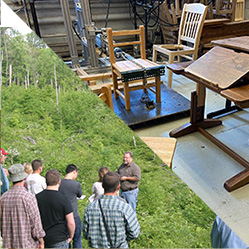 Purdue Extension’s annual report showcases the accomplishments, outcomes and activities that highlight the impact of Purdue Extension across Indiana. Extension specialists and educators provide educational programs and research-based knowledge to help families, individuals, and communities prosper and thrive.
The Purdue Extension – Forestry and Natural Resources specialists featured:
Private Woodland Owners Make Decisions and Take Actions to Improve Acreage Value – project specialist include Lenny Farlee, Ron Rathfon, Don Carlson, and Jarred Brooke, along with county extension educators Dave Osborne, and Phil Woolery. Indiana has 20% forest lands, most privately owned. Forests are important habitats for wildlife and provide environmental and social benefits. Purdue Extension offers Forest Management for the Private Woodland Owner, in-person and virtually. The in-person program has eight 2.75-hour evening sessions and two Saturday three-hour field day tours. Purdue Extension and local forestry and natural resource professionals provide presentations and direct activities. Participants receive a tree measuring stick and a flash drive containing more than 100 publications and resources.
Participant forest management knowledge improved after the program. More than 90% found it useful for making decisions, and 80% plan to take actions in the next year. A participant said, “This course provided exactly the information I needed to understand the DNR forester’s report on my classified forest and to act on it. It will also help form a land management plan of my own (beyond what the forester provided), find programs to help manage and expand the forest, and earn a little money from the property in future years.”
Furniture Production Addresses Workforce Development and Rebuilds Lives in Indiana – project specialist include Dr. Eva Haviarova and Dr. Henry Quesada. Most U.S. school furniture is made overseas and from nonrenewable materials (steel, plastic, and composite). Increasingly, the product sustainability, the circular economy, and the benefits of natural materials are being shown to be important in learning environments.
To create a new market for low-value hardwoods, urban woods, and plantation resources by designing and producing innovative products, including wooden school furniture, Purdue’s Wood Research Lab has tested all strength and environmental attributes. At the same time, Purdue Extension is focusing on workforce development for Indiana’s wood products industry. An approach is to provide potential employment and entrepreneurial opportunities to residents with troubled pasts, underprivileged workers, and those needing a second chance in life by partnering with Purposeful Design, the Forest Service, Indiana Hardwood Lumbermen’s Association, Urban Forest Products and other industry players to train workers in furniture production and qualify for future work.
To view full report visit: Purdue Extension Showcase.
To learn more about Purdue Extension visit: About Us.
For all Purdue Extension – Forestry and Natural Resources publications, videos, webinars and initiatives view: Purdue Extension – Forestry and Natural Resources.
Resources:
A Woodland Management Moment, Playlist, Purdue Extension – Forestry and Natural Resources Youtube Channel
Invasive Species, Playlist
Woodland Stewardship for Landowners, Playlist
Invasive Plant Species Identification, Video
Invasive plants: impact on environment and people, The Education Store, Purdue Extension resource center
Investing in Indiana Woodlands, The Education Store
Woodland Invaders, Got Nature? Blog
District Forester, Indiana DNR Division of Forestry, for over 10 acres of woodlands
Directory of Professional Foresters, Indiana Forestry & Woodland Owners Association (IFWOA)
Indiana Woodland Steward E-newsletters, Eleven Member Organization
Conservation Tree Planting: Steps to Success, Purdue Extension – FNR Youtube Channel
Forest Improvement Handbook, The Education Store
Joint Design Manual for Furniture Frames Constructed of Plywood and Oriented Strand Board, The Education Store
The Shrinking and Swelling of Wood and Its Effect on Furniture, The Education Store
Performance Test Method for Intensive Use Chairs – FNEW 83-269: A Description of the Test Method with Drawings, The Education Store
How Baby Bear’s Chair Was Made, The Education Store
Diana Evans, Extension & Web Communications Specialist
Purdue University Department of Forestry and Natural Resources
In this edition of ID That Tree, Purdue Extension forester Lenny Farlee takes us through the different characteristics of Hoptree, a relatively common shrub here in Indiana. This is a unique native plant with three-part leaves and hop-like seed pods. Also called Wafer Ash due to its distinctive wafer-shaped seeds, this shrub can often be confused with Poison Ivy or Bladdernut, so be sure to pay attention to key differences in the video. Features include trifoliate leaves and the temperate areas in which it grows.
If you have any questions regarding wildlife, trees, forest management, wood products, natural resource planning or other natural resource topics, feel free to contact us by using our Ask an Expert web page.
Resources:
ID That Tree: Firs and Spruces, Video Playlist, Purdue Extension – Forestry and Natural Resources (FNR) YouTube Channel
ID That Tree – Jack Pine, Scotch Pine, Red Pine, Virginia Pine, Eastern White Pine, Video Playlist, Purdue Extension – Forestry and Natural Resources (FNR) YouTube Channel
Beat Back Borers Attacking Pines and Other Cone Bearing Trees, Purdue Landscape Report
Tree Diseases: White Pine Decline in Indiana, The Education Store, Purdue Extension Resource Center
Purdue Arboretum Explorer
Conservation Tree Planting: Steps to Success, Purdue Extension – FNR YouTube Channel
A Woodland Management Moment, Playlist, Purdue Extension – FNR YouTube Channel
Woodland Stewardship for Landowners, Playlist, Purdue Extension – FNR YouTube Channel
Indiana Department of Natural Resources: Invasive Species
Indiana Invasive Species Council
Cooperative Invasive Species Management Area (CISMA)
Report Invasive, Purdue Extension
Episode 11 – Exploring the challenges of Invasive Species, Habitat University-Natural Resource University
Shrubs and Woody Vines of Indiana and the Midwest, The Education Store
Native Trees of the Midwest, The Education Store
Professional Forester, Indiana Forestry Woodland Owners Association
Forest Improvement Handbook, The Education Store
Find an Arborist, International Society of Arboriculture
Lenny Farlee, Extension Forester
Hardwood Tree Improvement and Regeneration Center
Purdue Department of Forestry & Natural Resources
Purdue Landscape Report: In the last newsletter, an article on triclopyr brought up much discussion on the Roundup brands now containing multiple active ingredients other than glyphosate. Professionals in the industry may encounter a client with herbicide damage symptoms that mimic growth-regulator injury instead of typical glyphosate damage symptoms. While the client may have used Roundup, they didn’t necessarily use glyphosate. Going forward, it’s important to keep in mind that Roundup no longer means glyphosate in the consumer market.
Roundup has been one of the most used herbicides for many different weed control applications. Roundup, with the active ingredient glyphosate, was first registered with the EPA in 1974. When Roundup went off patent in 2000, glyphosate started being sold under many different names. According to the National Pesticide Information Center there are currently over 750 products containing glyphosate. Formulations may differ with salt carriers, adjuvants, concentrations, and mixed with other herbicides.
Recently, Bayer announced glyphosate would be phased out of consumer Roundup products. In its place, consumer Roundup products include other active ingredients. This can lead to confusion in the consumer market. It’s important to note that professional-use Roundup (turf and ornamental, agronomic crops, etc.) still contains glyphosate.
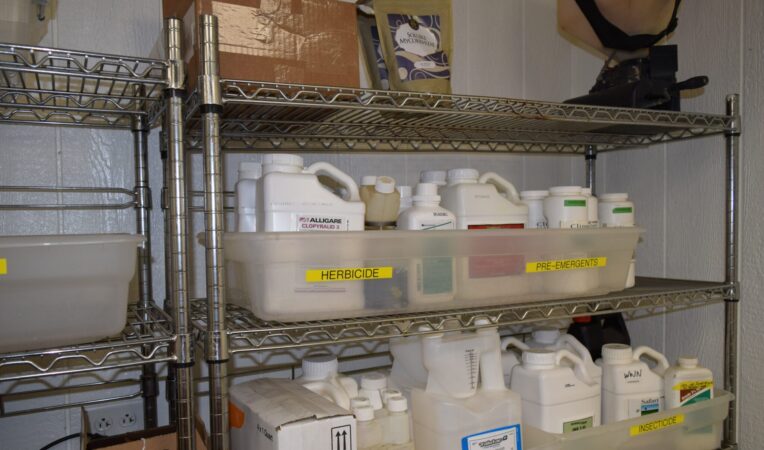
Figure 1. Consumer versions of Roundup are no longer glyphosate. Pay close attention to the active ingredients on labels to prevent unwanted plant injury.
Within the consumer Roundup product line, there are many different formulations designed for specific purposes, which include Roundup Weed and Grass Killer, Roundup for Lawns, Roundup for Lawns: Crabgrass Destroyer, Roundup Dual Action Weed and Grass Killer, Roundup Poison Ivy and Tough Brush Killer, among others. Each of these products contains distinct active ingredients that target different types of weeds.
Roundup Weed and Grass Killer: Glyphosate as the Active Ingredient
The original Roundup herbicide contains glyphosate as its primary active ingredient. Glyphosate is a systemic, non-selective herbicide, meaning it is absorbed by the plant and translocated throughout the vascular system, ultimately leading to the plant’s death. Glyphosate works by inhibiting the enzyme 5-enolpyruvylshikimate-3-phosphate synthase (EPSPS), which is a key component of the shikimic acid pathway—a pathway critical for the synthesis of aromatic amino acids in plants.
Active Ingredient:
- Glyphosate: The ‘traditional’ version of Roundup that controls many different weeds. Can take 10-14 days to kill weeds.
- Pelargonic Acid: A contact herbicide that quickly breaks down cell walls. This is added to provide a quick burndown of the weed.
Roundup Dual Action Weed and Grass Killer Plus 4 Month Preventer: Multiple modes of action
Round Dual Action is a formulation that includes four very different herbicides that is intended for use in areas with limited vegetation (i.e. sidewalks, driveways, mulched beds). In addition to postemergence herbicides, this product includes two preemergence active ingredients.
Active Ingredients:
- Triclopyr: Systemic herbicide that mimics auxins. Very effective herbicide for woody plants, which is used frequently in invasive species treatments.
- Fluazifop: Grass-specific herbicide (graminicide) that controls several annual and perennial grasses.
- Diquat: Contact herbicide that exhibit symptoms rapidly. Good for annual weeds.
- Imazapic: Pre- and Postemergence control of several grasses and broadleaf weeds.
Roundup for Lawns: A Combination of Selective Herbicides
Roundup for Lawns is a specialized formulation designed for residential use, particularly for controlling broadleaf weeds in lawns. Unlike traditional Roundup, which contains glyphosate, Roundup for Lawns contains a combination of selective herbicides, including MCPA, quinclorac, dicamba, and sulfentrazone. These ingredients are chosen for their ability to target broadleaf weeds and grassy weeds without harming most turfgrass species. This product is similar to the traditional ‘three-way’ herbicides that are commonly used in turf.
Active Ingredients:
- MCPA: MCPA is a selective herbicide that mimics the action of natural plant hormones known as auxins. When absorbed by broadleaf weeds, it causes uncontrolled growth, leading to the plant’s death.
- Quinclorac: Quinclorac is effective against grassy weeds, primarily used for crabgrass control in turf. It can be similar to auxin herbicides, causing epinasty, curling, and a change of color.
- Dicamba: Similar to MCPA, dicamba disrupts the growth of broadleaf weeds by mimicking natural plant hormones.
- Sulfentrazone: Pre- and postemergence activity in turf. Very effective on nutsedge.
Roundup for Lawns: Crabgrass Destroyer
Roundup for Lawns: Crabgrass Destroyer is a product designed to control grassy weeds and several broadleaf weeds in cool-season turf. In addition to crabgrass, other grassy weeds and some broadleaves can be controlled.
Active Ingredients:
- Topramezone: Very effective herbicide for several annual and perennial grassy weeds and some common broadleaf weeds.
Roundup Poison Ivy and Tough Brush Killer: Triclopyr for Tough Woody Plants
Roundup Brush Killer is formulated to tackle tough, woody plants, such as brush, brambles, and small trees. The active ingredient in this product is triclopyr, a selective herbicide that targets broadleaf plants with less damage to grasses. This product can be effective on invasive woody plants.

Figure 2. Glyphosate damage to sycamore.
Active Ingredients:
- Triclopyr: Systemic herbicide that mimics auxins. Very effective herbicide for woody plants, which is used frequently in invasive species treatments.
- Glyphosate: The ‘traditional’ version of Roundup that controls many different weeds. Can take 10-14 days to kill weeds.
Conclusion
All of the consumer Roundup products contain unique active ingredients tailored to specific weed control needs. There can be understandable confusion around these products due to the historical uses of glyphosate. The Green Industry needs to be aware of the confusion around these products to better inform their clients. Understanding the active ingredients and mechanisms of action of these herbicides is crucial for their effective and safe use in various settings.
View the original article here: When Roundup Isn’t Roundup: Clearing up the confusion between products
Subscribe and receive the newsletter: Purdue Landscape Report Newsletter.
Resources:
Beyond Roundup: Alternatives to consider adding to your weed management plan, Purdue Landscape Report
Diagnosing Herbicide Injury on Garden and Landscape Plants, The Education Store, Purdue Extension’s resource center
Herbicide Injury, Purdue Plant Doctor
Find an Arborist video, Trees are Good-International Society of Arboriculture (ISA)
ID That Tree, Playlist, Purdue Extension – FNR YouTube Channel
Invasive Species Playlist, Playlist, Purdue Extension – FNR YouTube Channel
A Woodland Management Moment, Playlist, Purdue Extension – FNR YouTube Channel (Against Invasives, Garlic Mustard, Autumn Olive)
Woodland Stewardship for Landowners, Playlist, Purdue Extension – FNR YouTube Channel (Common Buckthorn, Japanese Barberry)
Report Invasive Species, Purdue Invasive Species
The GLEDN Phone App – Great Lakes Early Detection Network
EDDMaps – Early Detection and Distribution Mapping System
Episode 11 – Exploring the challenges of Invasive Species, Habitat University-Natural Resource University
What Are Invasive Species and Why Should I Care?, Purdue Extension-FNR Got Nature? Blog
Emerald Ash Borer Information Network, Purdue University and Partners
Aquatic Invasive Species, Illinois-Indiana Sea Grant (IISG)
Invasive plants: impact on environment and people, The Education Store
Subscribe Purdue Extension-Forestry and Natural Resources YouTube Channel
Kyle Daniel, Commercial Landscape and Nursery Crops Extension Specialist
Purdue Horticulture & Landscape Architecture

Recent Posts
- ID That Tree: Dwarf Chinkapin Oak
Posted: March 20, 2026 in Forestry, Urban Forestry, Wildlife, Woodlands - DNR Hiring for Indiana Conservation Officer Positions, MyDNR
Posted: March 9, 2026 in Urban Forestry, Wildlife, Woodlands - ID That Tree: Shumard Oak
Posted: in Plants, Urban Forestry, Wildlife, Woodlands - A Woodland Management Moment: Windbreak Around Walnut Plantings
Posted: March 3, 2026 in Forestry, Urban Forestry, Woodland Management Moment - Getting Certified as an Indiana Certified Prescribed Burn Manager
Posted: March 2, 2026 in How To, Urban Forestry, Woodlands - Have You Seen a Soaring Eagle Lately? Morning Ag Clips
Posted: February 25, 2026 in Urban Forestry, Wildlife - ID That Tree: Fragrant Sumac
Posted: February 4, 2026 in Plants, Urban Forestry, Wildlife - Tree Silvics and Succession Webinar: A Biological Basis for Management
Posted: January 30, 2026 in Forests and Street Trees, Urban Forestry, Woodlands - Southwest Damage, Scalding or Frost Cracking
Posted: in Forestry, Urban Forestry - A Woodland Management Moment: Wide Spacing for Nut Production
Posted: January 29, 2026 in Urban Forestry, Woodland Management Moment, Woodlands
Archives
Categories
- Alert
- Aquaculture/Fish
- Aquatic/Aquaculture Resources
- Ask the Expert
- Christmas Trees
- Community Development
- Disease
- Drought
- Forestry
- Forests and Street Trees
- Gardening
- Got Nature for Kids
- Great Lakes
- How To
- Invasive Animal Species
- Invasive Insects
- Invasive Plant Species
- Land Use
- Natural Resource Planning
- Nature of Teaching
- Plants
- Podcasts
- Ponds
- Publication
- Safety
- Spiders
- Timber Marketing
- Uncategorized
- Urban Forestry
- Webinar
- Wildlife
- Wood Products/Manufacturing
- Woodland Management Moment
- Woodlands