 Purdue University - Extension - Forestry and Natural Resources
Got Nature? Blog
Question: We want to plant five fastigiata (upright blue spruce) in an area with heavily compacted soil with large percentage of clay content in the soil. The soil essentially feels and handles like play dough. Water cannot drain down in the soil because of the high clay content. Ewes were planted but they are dying since they are sitting in clay soil with water standing around the roots. A swimming pool was built nearby three years ago and the equipment used was rolled over this area numerous times to remove soil for the pool area, and the clay soil is heavily compacted and won’t allow water to drain. We are thinking we will dig out the soil maybe five feet deep, 10 feet wide, and 20 feet deep and replace it with good compost top soil mix. We are not sure if we need a T drain or not. We want to plant five of the upright blue spruce in this area. Do you have an arborist you can suggest to come out and look at our situation?
Answer: This is a typical issue with soils in our area being composed of primarily clay which leads to heavy, poorly drained soils. The fact that there has been a great deal of construction damage worsens the problem even further. Traffic of this magnitude can render landscape sites virtually useless for any type of sustainable tree planting without mitigation. Your ideas of creating an adjusted planting space may not correct the problem completely, but may help alleviate the damage and improve planting conditions.
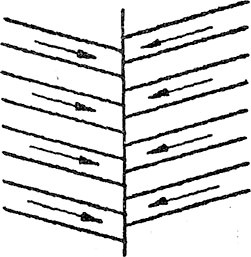 I am not certain that digging up and replacing the soil would be of much value, long term. I have had success with site improvements, but it isn’t guaranteed. It may provide temporary improvements to get the trees established, however, once they mature and outgrow your “prepared planting space”, the troubles could begin. Once the roots try to expand into the compacted, native soils, most likely they would be redirected back into the pit, minimizing good root spread for health and stability. Additionally, you would be creating a “bathtub effect” with poor drainage in your excavated pit.
It may be possible to remove and replace the soils in that excavated area with lateral drainage at the bottom of the planting area to remove the water and prevent prolonged exposure to wetness on the root system. Perforated tiles draining outside of the planting area may work. Create a single, central line with a herringbone lateral system that goes past the dimensions of the pit. Use good topsoil with no amendments to the new planting area. One other consideration would be roots clogging the drainage system if not set deep enough. Again, this is a stretch for mitigation, but may be successful with proper preparation.
I would suggest contacting a company with an ISA certified arborist who can assist you with the process. Use Trees Are Good’s Arborist Search to help locate an arborist in your area. Also, try reviewing the publications on construction damage for some corrective and preventative treatments for the future.
Resources:
Collecting Soil Samples for Testing, The Education Store
Soil and Water Conservation Districts, Indiana State Department of Agriculture
Certified Soil Testing Laboratories, Purdue Department of Agronomy/Extension
Arborist Search – Trees Are Good
Tree Installation: Process and Practices – The Education Store, Purdue Extension Resource Center
Mechanical Damage to Trees: Mowing and Maintenance Equipment – The Education Store
Why Is My Tree Dying? – Got Nature? Blog, Purdue Extension – Forestry and Natural Resources
Tree Risk Management – Got Nature? Blog, Purdue Extension – FNR
Lindsey Purcell, Urban Forestry Specialist
Purdue University Department of Forestry and Natural Resources
 Question: I have noticed that a lot of very mature (> 80 ft) sycamore trees look ill. They don’t seem to have as many leaves, or as large as they usually get and some have already turned brown and died. There are at least 2 in my 5 acres of woods and have noticed the same with other sycamores while driving from Mooresville to Indianapolis. Is there a certain blight/canker/pest that is damaging sycamores this year?
Answer: I have also noticed that many sycamores appear relatively bare and may have brown or wilted leaves on the stems and littering the ground around the trees. The culprit is sycamore anthracnose, a fungal disease that causes damage and death of leaves as well as stem cankers. Sycamore anthracnose symptoms can be severe when we have cool, moist spring weather at the time of bud-break and leaf emergence, but healthy trees generally recover and put on new leaf area once the environmental conditions that favor the disease change to the warmer, drier conditions of late spring and summer.
Normally, the best management practices for sycamore anthracnose are patience and maintaining good tree health. The disease cycle is dependent on cool, moist spring weather, so it will run its course by late spring or summer when the average temperatures rise. Trees that are repeatedly defoliated could be reduced in vigor and be more susceptible to other problems, so steps to promote good tree health can be used as a preventative measure.
Resources:
Purdue Plant Doctor – Purdue Extension
Fertilizing Woody Plants – The Education Store, Purdue Extension’s resource center
Anthracnose of Shade Trees or Wind Injury: Look Alike Symptoms Can be Perplexing, Purdue Plant & Pest Diagnostic Laboratory
Sycamore – The Education Store
Native Trees of the Midwest, The Education Store
Shrubs and Woody Vines of Indiana and the Midwest, The Education Store
Investing in Indiana Woodlands, The Education Store
Forest Improvement Handbook, The Education Store
ID That Tree, Purdue Extension-Forestry & Natural Resources (FNR) YouTube playlist
Woodland Management Moment, Purdue Extension-FNR YouTube playlist
Lenny Farlee, Extension Forester
Purdue University Department of Forestry and Natural Resources
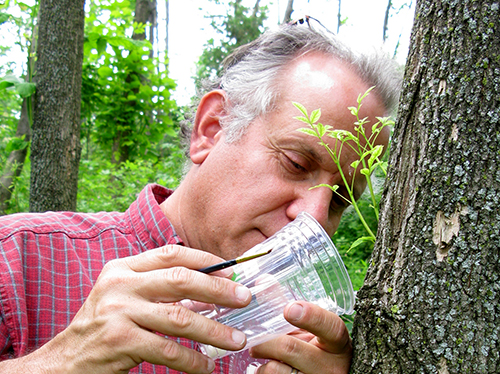 Cities and towns with “urban forests” such as parks and streets lined with trees could spend less money by taking steps to save emerald ash borer-infested trees early rather than wait until they can only replace them, Purdue University researchers concluded in a study.
Cliff Sadof, professor of Entomology and Matt Ginzel, associate professor in the Department of Entomology and Department of Forestry and Natural Resources, developed a model to help foresters predict the progression of ash decline over time. This model helps them use early reports of damaged trees to alert the community to the imminent threat posed by EAB. The percentage of damaged ash trees in a city typically doubles every year.
Owners of ash trees in Indiana, as well as all around the country, are encouraged to check out the full article provided by Purdue Agriculture News EAB research: Saving trees early less costly than replacing them. You will find several resources on what we can do to aid the ash trees.
Resources:
EAB research: Saving trees early less costly than replacing them – Purdue Agriculture News
Purdue Tree Doctor – Purdue Botany and Plant Pathology
Emerald Ash Borer in Indiana – Purdue Extension
Emerald Ash Borer Cost Calculator – Purdue Extension Entomology
Emerald Ash Borer – Purdue Extension Entomology
Cliff Sadof, Professor of Ornamental and Pest Management
Purdue University Department of Entomology
Matt Ginzel, Associate Professor
Department of Entomology and Department of Forestry & Natural Resources
When you hear about endangered species, most of us think about the plights of our furry or feathered friends.
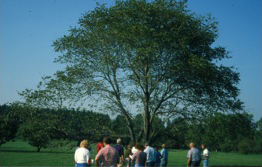
Surviving butternut tree. Photo: Richard Webb, Bugwood.org (Reproduced with permission)
This article describes the plight of some of the less cuddly members of the endangered species list.
Indiana is home to a number of endangered and threatened tree species. In this multi-part series, we will identify some of these tree species and describe some of their unique characteristics.
Our second species is the Butternut (Juglans cinerea), known also by lemon-nut, oil nut, or white walnut. It is a close relative of the more common black walnut. Butternut is a small/medium sized tree that most often reaches a maximum height of 60 to 90 ft., although some trees as tall as 120 ft. have been reported. This short-lived tree often has a forked or crooked trunk and wide-spreading branches, although it can grow straight in forest settings. It rarely reaches 75 years of age or greater than 24 in dbh. Butternut trees are easily grown and have quickly developing fibrous root systems. Butternuts produce both male and female flowers on the same tree and have bright green compound pinnate leaves (alternate) that extend to between 15 and 25 inches.
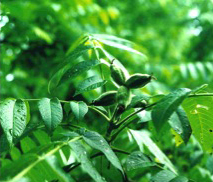
Young butternut tree with nuts. Photo: Dr. Keith Woeste, USDA Forest Service, Purdue FNR
Butternut trees are more valued for their nuts than for lumber as the nuts are sweet and prized as a food source by both humans and wildlife. In fact, these trees served as one of the primary mast species for numerous woodland species prior to its sudden population decline. The average seed-bearing age for butternut is 20 and becomes optimal between 30 and 60 years. Heavy crops occur every 2 to 3 years but nuts are produced each year after seed-bearing age is reached. Butternut is able to naturally hybridize with several other walnut (Juglans) species. The nuts collected from most Juglans spp. including butternut can vary in size and shape however, distinctive differences among species can be noted.
Similar to black walnut, the roots of butternut trees release a chemical known as juglone. Juglone (5 hydroxy-1, 4 naphthoquinone) is toxic to a number of plant species. Planting ornamental plants such as azaleas, lilacs, peonies, and rhododendrons, or fruits and vegetables like blueberries, eggplants, peppers, potatoes, and tomatoes near butternut trees is discouraged, as juglone from the butternut roots may kill them or stunt their growth. The toxic zone around walnuts extends 60 to 80 ft. from the base of the trunk, or about twice the size of the crown, and it is likely the same for butternut. Juglone has never been shown to harm humans, but butternut husks exude a strong dye that stains clothing and skin.

Japanese walnut tree with nuts. Photo: Rob Routledge, Sault College, Bugwood.org (Reproduced with permission)
Butternut was once a common tree in North America. Its range was expansive; in Canada from Manitoba east to Quebec, south to Georgia and west to Arkansas. In the past, the states with the most robust butternut timber trades were West Virginia, Wisconsin, Indiana, and Tennessee. Butternut trees are found almost exclusively in mixed hardwood forests composed primarily of basswood (Tilia spp.), black cherry (Prunus serotina), beech (Fagus grandifolia), black walnut (Juglans nigra), elm (Ulmus spp.), hemlock (Tsuga canadensis), hickory (Carya spp.), Oak (Quercus spp.), red maple (Acer rubrum), sugar maple (A. saccharum), yellow-poplar (Liriodendron tulipifera), white ash (Fraxinus americana), and yellow birch (Betula alleghaniensis), although in the northernmost portions of its range it can also be found with sweet birch (Betula lenta) or white pine (Pinus strobus). Typically, a stand only contains a few butternut trees as they thrive best among mixed forests.
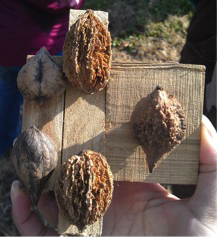
Comparison of nuts. (Left to right) Heartnuts (Juglans ailantifolia var. cordiformis), Butternuts (J. cinerea), and a Hybrid butternut. Photo: Dr. Shaneka Lawson, USDA Forest Service, Purdue FNR
The ranges of butternut and black walnut (Juglans nigra) are similar, however butternut is found farther north and at higher elevations (1500 m) than black walnut. Unfortunately, butternut tree populations have declined significantly throughout the majority of its former range. Conservative estimates have indicated that roughly 13,000 trees remain in Ontario and between 7,000 and 17,000 in New Brunswick. The Forest Service estimated that greater than 77 percent of butternut populations in the southeastern United States had succumbed to the fungus twenty years ago. Today, those estimates approach 90 percent nationwide. A subset of these remaining trees are nearly dead and carrying heavy infection loads, while most of the remaining trees are not reproducing.
A fungal disease known as butternut canker has decimated populations of butternut trees throughout their native range. The causal agent of butternut canker is Ophiognomonia clavigignenti-juglandacearum. The speed at which butternut populations have disappeared has led many to believe that butternut canker was yet another introduced pathogen. The primary hallmarks of butternut canker disease are numerous branch and stem cankers. These lesions are typically elliptical in shape and have sunken centers with a dark brown or black exudate stain that can be easily seen against butternut’s ashy grey bark.
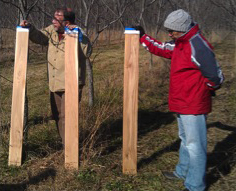
Comparison of timber. Hybrid butternut, Butternut, and Black walnut (left to right). Photo: Dr. Shaneka Lawson, USDA Forest Service, Purdue FNR
Aside from butternut canker disease, butternuts are also in danger from a host of insect pests such as bark beetles, the butternut curculio, defoliators, husk flies, lace bugs, nut weevils, and wood borers. Unlike the American chestnut (Castanea dentata), the tree described in our first blog entry on trees at risk, the great majority of butternut do not sprout after stem death. Butternut is now rare everywhere, but most of the few populations that still exist are found in riparian areas. At present, insufficient knowledge about management of butternut and how to regenerate butternut seedlings in natural forest stands has hindered strategies for conservation. Some butternut trees have survived; these paltry few trees may show some resistance to butternut canker, but that is still being evaluated. A Japanese Juglans species, Japanese walnut (Juglans ailantifolia), appears more resistant to butternut canker than is butternut, so researchers in Tennessee have begun butternut restoration using hybrids between Japanese walnut and butternut. A breeding strategy using these hybrids, known by the common name buartnut or buarts, may be a promising avenue for the restoration of a butternut-type tree to the eastern forest. Backcrossing buarts to butternuts and development of a disease screening technique could be a step towards restoring this species, however progress towards this goal has been slow.
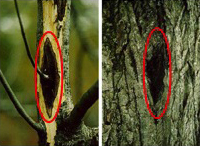
Butternut cankers. Elliptical staining (left) and sunken bark (right). Photo courtesy: USDA Forest Service (modified)
Resources:
Surviving Butternut Trees Benefit From Better Sites Rather than Disease Resistance – USDA Forest Service
A Forest Manger’s Guide to Butternut – USDA Forest Service
Butternut Profile – USDA Forest Service
Endangered Trees of Indiana: Part 1 – American Chestnut (Castanea dentata) – Got Nature?
The Morton Arboretum
Shaneka Lawson, USDA Forest Service and HTIRC Research Plant Physiologist & Adjunct Assistant Professor
Purdue University Department of Forestry and Natural Resources
Keith Woeste, Adjunct Professor Emeritus, USDA Forest Service and HTIRC Research Plant Physiologist
Purdue University Department of Forestry and Natural Resources
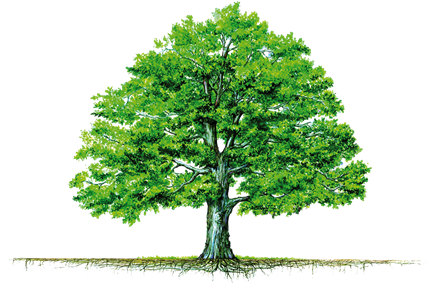 Question: I have two White Ash trees growing in my front yard along the street. One is 8″ in diameter and the other 12″. Large roots are growing out of the ground horizontally away from the trees. Should I try to cut these roots and risk hurting the tree or should I try to mound dirt over them to allow grass to grow? The roots are unsightly and ruining my lawn.
Answer: Trees provide many benefits including clean air and water. Also, they can provide up to 10% greater property value by keeping trees on your site healthy. First, make sure they are treated against Emerald Ash Borer to prevent from losing them to the pest.
Tree roots can grow a great distance from a tree, sometimes two to three times the height of the tree. These are very important for stability and health. Cutting tree roots can be a very risky choice as well as covering them with soil. When you cover existing tree roots with soil the results are similar to smothering the tree by not allowing gas exchange between the roots and the air above.
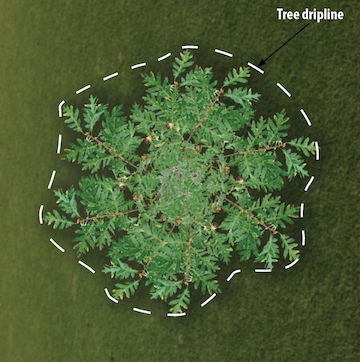
I would suggest not doing anything to the roots within the drip line of the tree. Outside of this critical root zone area is less risky and changes can be made with minimal risk. The best option under the drip line would be to add a light layer of two to three inches of hardwood mulch creating tree rings to help the tree, reduce mowing and cover the roots.
Resources:
When Tree Roots Surface – Purdue Extension
Emerald Ash Borer in Indiana – Purdue Extension
Mechanical Damage to Trees: Mowing and Maintenance Equipment – The Education Store, Purdue Extension Resource Center
Why Is My Tree Dying? – Got Nature? Blog, Purdue Extension – Forestry and Natural Resources
Tree Owner’s Manual – Indiana Department of Natural Resources
Lindsey Purcell, Urban Forestry Specialist
Purdue University Department of Forestry and Natural Resources
Ornamental plants provide many environmental and ecological benefits to landscapes and urban areas. They can be aesthetically pleasing, reduce stormwater 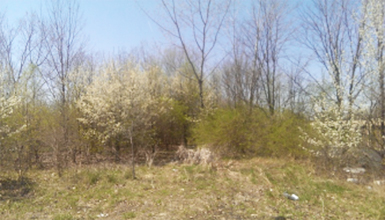 runoff, lower carbon dioxide and pollutants, alleviate the urban “heat island” effect, and provide habitats to pollinators, birds, and mammals. Unfortunately, a few of these landscape species can escape into wild areas and create ecological problems in unintended areas such as forests and woodlands.
The Indy Star shares article titled, “Bradford pears and other backyard bullies to avoid in Indiana” listing some of the invasive species that are taking over Indiana woodlands. If you are planning on adding trees or shrubs to your property this spring, you will want to view this article before planting.
Author:
Cara Anthony, cara.anthony@indystar.com
Release date of article April 2, 2016.
IndyStar
Resources from The Education Store, Purdue Extension Resource Center:
Commercial Greenhouse and Nursery Production: Alternative Options for Invasive Landscape Plants
Invasive Plant Species in Hardwood Tree Plantations
Invasive Plant Species Fact Sheets: Poison Hemlock
Mile-a-minute Vine
Native Trees of the Midwest
Shrubs and Woody Vines of Indiana and the Midwest: Identification, Wildlife Values, and Landscaping Use
Videos:
Invasive Plant Species: Callery Pear
Invasive Plant Species: Oriental Bittersweet
Invasive Plant Species: Wintercreeper
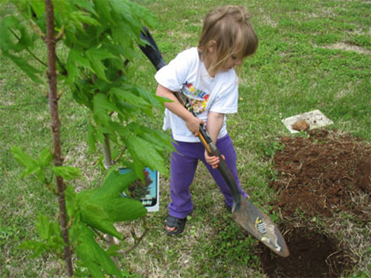 Arbor Day is always the last Friday of April in Indiana and it falls on April 29th this year. Many of us are familiar with the tradition of planting a tree in celebration of this holiday, but have we stopped to count the benefits and reasons why we celebrate planting trees? In honor of Arbor Day, here are 10 reasons to remember why we love and plant trees:
- Public health: Research shows that trees planted in the city make people happier! The result is a reduction in stress levels, crime rates, and improves patient recovery time.
- Beauty: Trees are a great way to soften the often harsh city environment. A tree with vibrant fall color, interesting branch structure or bark patterns in the winter, flowering in the spring, or providing shade with its lush, green leaves in the summer will always provide a pleasing distraction from the urban environment.
- Clean air: Trees are an important source of life-giving oxygen in the air that we breathe. They filter out harmful particulate matter and other pollutants common in the urban or suburban areas that would otherwise make it into our lungs.
- Clean water: Trees help filter the water we drink. The leaves of a tree slow rainfall on the ground, preventing soil erosion and pollutants from washing into our water sources.
- Energy conservation: Trees shade our houses from the sun and provide insulation and create windbreaks, keeping heating and cooling costs during the extreme temperatures of summer and winter lower.
- Property Value: Benefits of trees include lower energy costs and beauty and are recognized and reflected in higher property values where trees are strategically placed.
- Wildlife: Trees provide shelter and food for wildlife that we love to watch, such as songbirds and squirrels.
- Beloved landmarks: City trees properly cared for will provide years of memories for residents. They can serve as a place to gather and as a source of civic pride, as well as a way to mark the changing of the seasons and progression of time.
- Global warming: – Trees are a major factor in carbon sequestration. CO2 is a major contributor to global warming and tress put it to good use rather than causing harm in the atmosphere.
- Our children: Every day, many trees are cut down to allow for our continued growth as populations expand. We must work to replace them if we want our children to receive the same benefits from them in the future that we enjoy today.
We have our 10 reasons, now where will we get our 10 trees? For a $10 contribution you can become a member of the National Arbor Day Foundation and receive a gift of 10 trees through the mail. Also with your membership, you will receive discounts on over 100 other varieties of trees and a free guide to planting and care called The Tree Book.
To become a member, you can join online at the Arbor Day Foundation website.
Resources:
Membership – Arbor Day Foundation
Indiana Arborist Association
Tree Installation: Process and Practices – The Education Store, Purdue Extension Resource Center
Importance of Hardwood Tree Planting – The Education Store
‘Twas The Day Before Arbor Day – Got Nature?
Amy Wetzel, Former Urban Forestry Student
Lindsey Purcell, Urban Forestry Specialist
Purdue University Department of Forestry and Natural Resources
With spring comes planting of trees and shrubs along with questions of best practices to ensure success. This 20-page publication titled “Planting Forest Trees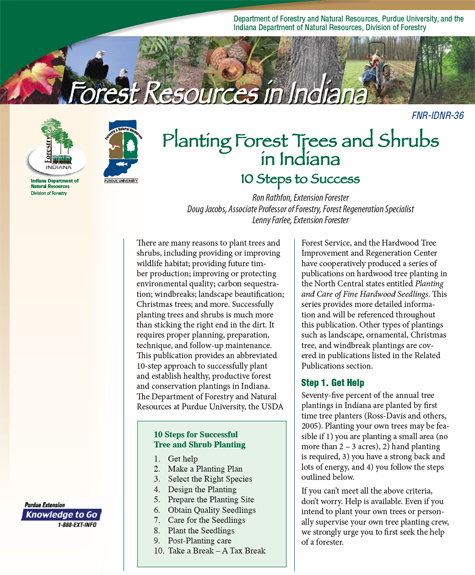 and Shrubs in Indiana” provides an abbreviated 10-step approach to successfully plant and establish healthy, productive forest and conservation plantings in Indiana. It discusses types of plantings, site selection, site preparation, how to obtain seedlings, planting methods, and care after planting. You will also find resources with further planting details, how to increase wildlife on your properties, along with how to contact a professional forester.
To order a hardcopy for $5.50 visit Planting forest Trees and Shrubs in Indiana in The Education Store. It is also available as a free download.
Resources:
Planting & Care of Fine Hardwood Seedlings, Indiana Department of Agriculture Forest Service
Woodland Wildlife Management, The Education Store
Shrubs and Woody Vines of Indiana and the Midwest: Identification, Wildlife Values, and Landscaping Use, The Education Store
Ron Rathfon, Regional Extension Forester-Southern Indiana Purdue Agricultural Center (SIPAC)
Purdue Department of Forestry & Natural Resources
 Spring is a prime time for improving your property with new trees. They provide many benefits which everyone can share. Trees mean more attractive landscapes, lower energy bills and a healthier environment. However, just planting a tree without some thought and planning can create a liability rather than an asset to your site. Wise planning is essential to ensure the new trees meet your design needs and functional solutions as well. Follow these tips to get your tree started right and make it a long-lasting sustainable planting. For more information, download the free publication Tree Installation: Process and Practice.
Right Tree-Right Place.
Location, location, location! Planning before planting can help ensure that the right tree is planted in the right place. Proper tree selection and placement enhances your property value, prevents costly and sometimes unsightly maintenance trimming, and lowers the risk of damage to your home and property. In some instances, trees are the innocent victim of poor planting locations and must be removed. Always allow room for growth!
Look Up, Look Down, and Look All around!
Regardless if the planting is in the front yard or the back yard of the home or business, be sure there will be no interference with utilities; Call 811 before you dig. It can save money and maybe a life. In addition, if the tree is going to be planted along the street, typically, there is an ordinance requiring a permit to plant in the right of way. This is a free permit helping City Forestry keep up the street tree inventory and allows the Certified Arborists on staff a chance to offer free advice to help in the planting decisions.
It comes from good stock…
Choose the tree twice, meaning get the right species for your location and make an informed choice on the nursery stock. Be sure the function of the tree is understood then choose the right tree for the location. Shade? Flowers? Screening? Sound Barrier? Trees can be used as tools to work for you on the site. “You get what you pay for” applies to nursery stock as well. Purchase plant material from a reputable source and get a professional opinion on the tree species for your application. One hint, if it is a fast growing tree, it probably won’t last long.
This Hole is a Home!
It is a permanent home for the trees… understand the planting site prior to planting. Determine soil type and pH, drainage and exposure to the sun. If the tree isn’t naturally suited to the planting place, it doesn’t have a chance. Drainage is crucial to survival. Use the two-hour test. Dig the hole, fill it with water. If the hole is empty upon returning, there is suitable drainage for any tree. Plant the tree properly and at the proper depth, you only get one chance… Don’t dig a $10 hole for a $100 tree.
Keep good care of the investment.
Once the tree is in the ground, take good care of it. At least an inch of water per week to keep it growing vigorously, apply clean, hardwood mulch on the root zone to keep soils cool and moist, but never exceed three inches in depth. Remember to remove any tags on the tree and don’t forget to remove the twine from around the trunk. Don’t worry about the fertilizer at planting time; wait until next year, after the tree has gotten settled in to its new home. Enjoy your new addition to the home and landscape!
Resources:
Tree Installation: Process and Practice – The Education Store, Purdue Extension Resource Center
Planting & Transplanting Landscape Trees and Shrubs – The Education Store
Trees Need a Proper Start – Plant Them Right! – Purdue Extension
Tree Pruning Essentials – The Education Store
Tree Risk Management – The Education Store
Lindsey Purcell, Urban Forestry Specialist
Purdue University Department of Forestry and Natural Resources
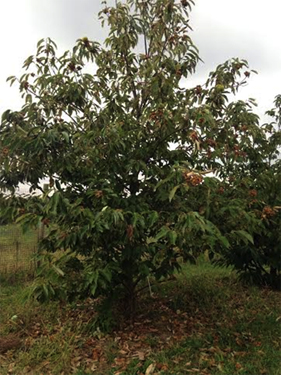
10 year old American chestnut tree. Photo: Jim McKenna
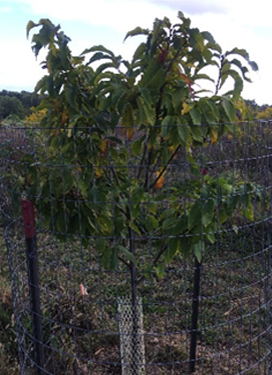
Juvenile American chestnut (Castanea dentata) tree. Photo: Dr. Shaneka Lawson, USDA Forest Service, Purdue FNR
When you hear about endangered species, most of us think about the plights of our furry or feathered friends. This article describes the plight of some of the less cuddly members of the endangered species list. Indiana is home to a number of endangered and threatened tree species. In this multi-part series, we will identify some of the tree species and describe some of their unique characteristics.
Our first species is the American chestnut (Castanea dentata) sometimes called the “Sequoia of the East”. This species was once found thriving throughout eastern forests from central Maine west to southeastern Michigan, and south to northern Mississippi, Alabama, and Georgia.

American chestnut fruit (nuts) inside an opened bur. Photo: Jim McKenna
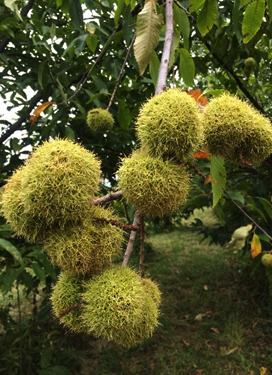
American chestnut fruit protected by a spiny bur. Photo: Dr. Shaneka Lawson, USDA Forest Service, Purdue HTIRC
Early 20th century estimates indicated that these trees numbered closed to 4 billion with the finest, most productive stands found in the Appalachian Mountains and southern New England. American chestnut is a fast growing species that can reach a pinnacle of 120 feet high and 10 feet or more in diameter. The majority of the mature trees were between 3 and 5 feet in diameter and 60 to 90 feet high. The fruit from this tree has been a valued food source for humans, wildlife, and livestock alike. Timber from this former giant is naturally rot-resistant and nearly as durable as oak yet lighter.
American chestnut populations went into decline after the introduction of chestnut blight.
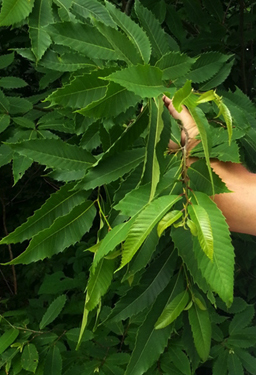
Mature American chestnut leaves. Photo: Dr. Shaneka Lawson, USDA Forest Service, Purdue FNR
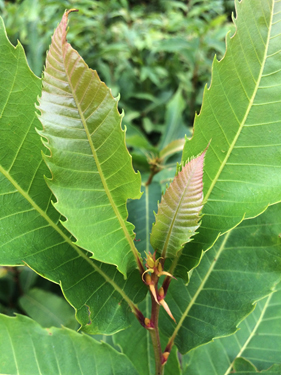
Immature American chestnut leaves. Photo: Dr. Shaneka Lawson, USDA Forest Service, Purdue FNR
Chestnut blight is caused by the fungal pathogen (Cryphonectria parasitica), and was accidentally introduced into the American population by imported Asian chestnut trees a century ago. American chestnut is highly susceptible to the fungus which enters the tree through any small wound or crack in the bark. The fungus replicates beneath the bark and produces toxins which lead to plant cell death. The fungus continues to grow until it has circumnavigated the tree and effectively stopped the flow of nutrients. Everything above the girdled circle of fungus will die. The primary symptoms of chestnut blight disease are a sunken canker and orange spores covering the bark.
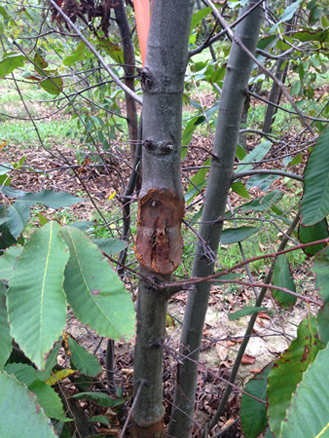
Chestnut blight canker four months after inoculating a susceptible chestnut tree. Photo: Jim McKenna
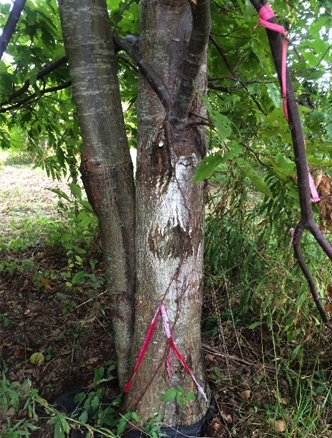
12 year old resistant 15/16 American chestnut after direct challenge with (Cryphonectria parasitica) fungus. Photo: Dr. Shaneka Lawson, USDA Forest Service, Purdue FNR
Loss of American chestnut on the landscape has resulted in reduced species diversity and severely reduced fall mast for woodland animal species. In addition, leaves of American chestnut contain greater nutrient concentrations (nitrogen [N], phosphorus [P], potassium [K]) than most other co-occurring trees therefore its loss affects soil nutrient cycling.
American chestnut has survived thus far because it has the ability to sprout from roots and stumps of diseased trees. However, these trees rarely live to maturity thus are often unable to flower and bear fruit. Numerous efforts to restore the tree to its former glory have been and are currently being attempted. Thus far, two of the most effective methods of breeding for resistance are hybridizing with resistant Asian parents and attempting to intercross surviving pure American chestnuts. The HTIRC within the Forestry and Natural Resources Department at Purdue University is working on hybridization of American chestnuts with Asian chestnuts for future restoration of resistant American-like chestnuts for Indiana.
Resources:
The American Chestnut Foundation
A New Generation of American chestnut Trees May Redefine America’s Forests – Scientific American
Consequences of Shifts in Abundance and Distribution of American Chestnut for Restoration of a Foundation Forest Tree – Forests Open Access Forestry Journal
Transgenic American chestnuts show enhanced blight resistance and transmit the trait to T1 progeny – Science Direct (Plant Science)
Scientists Work to Create a Blight-Resistant Chestnut with Hopes of Restoring Tree to America, Forest Service, U.S. Department of Agriculture
FNR Hardwood – American Chestnut, Purdue Arboretum Explorer
Hardwood Tree Improvement Regeneration Center (HTIRC) Research Publications
American Chestnut Trees return to the Hoosier National Forest, Indiana Woodland Steward
Forest Regeneration and Restoration Laboratory, Purdue Forestry and Natural Resources, Dr. Doug Jacobs
Shaneka Lawson, USDA Forest Service and HTIRC Research Plant Physiologist & Adjunct Assistant Professor
Purdue University Department of Forestry and Natural Resources

Recent Posts
- Popular Landscape Shrub is Invasive
Posted: October 15, 2026 in Alert, Forestry, Forests and Street Trees, Invasive Plant Species, Plants, Woodlands - Purdue Extension’s Regional Teams Are Here: Connecting Communities with Expertise and Opportunity
Posted: October 14, 2026 in Community Development, Forestry, Forests and Street Trees, Gardening, How To, Timber Marketing, Urban Forestry, Wildlife, Woodlands - Why Do Our Trees Go From Green Leaves to Different Colors?
Posted: in Forestry, Forests and Street Trees, Urban Forestry, Woodlands - October Is Firewood Month: Protect Indiana’s Forests by Making Smart Choices
Posted: October 1, 2026 in Forestry, Forests and Street Trees, How To, Invasive Insects, Urban Forestry - Question: Why Did the Shagbark Hickories Survive the Tornado?
Posted: August 27, 2026 in Forests and Street Trees, How To, Urban Forestry - Jarred Brooke Receives Early Career Award for Prescribed Fire Work
Posted: July 20, 2026 in Forestry, Forests and Street Trees, Natural Resource Planning, Safety - Pruning Highlight; Espalier Pruning: Training Trees into Living Patterns
Posted: July 8, 2026 in Forestry, Forests and Street Trees, Gardening - Pruning Highlight-Pollarding Trees: A Traditional Pruning Practice with Modern Uses
Posted: June 11, 2026 in Forestry, Forests and Street Trees, Urban Forestry, Wildlife, Woodlands - Flat-Faced Longhorn Beetle Found in Hardwood Logs – IDNR Division of Entomology
Posted: June 8, 2026 in Alert, Forestry, Forests and Street Trees, Invasive Insects, Urban Forestry, Wildlife, Woodlands - Connecting Research to Practice: Natural Resources & Land Use Spring Training
Posted: June 5, 2026 in Forestry, Forests and Street Trees, How To, Invasive Animal Species, Invasive Plant Species, Land Use, Natural Resource Planning, Urban Forestry, Wildlife, Woodlands
Archives
Categories
- Alert
- Aquaculture/Fish
- Aquatic/Aquaculture Resources
- Ask the Expert
- Christmas Trees
- Community Development
- Disease
- Drought
- Forestry
- Forests and Street Trees
- Gardening
- Got Nature for Kids
- Great Lakes
- How To
- Invasive Animal Species
- Invasive Insects
- Invasive Plant Species
- Land Use
- Natural Resource Planning
- Nature of Teaching
- Plants
- Podcasts
- Ponds
- Publication
- Safety
- Spiders
- Timber Marketing
- Urban Forestry
- Webinar
- Wildlife
- Wood Products/Manufacturing
- Woodland Management Moment
- Woodlands