 Purdue University - Extension - Forestry and Natural Resources
Got Nature? Blog
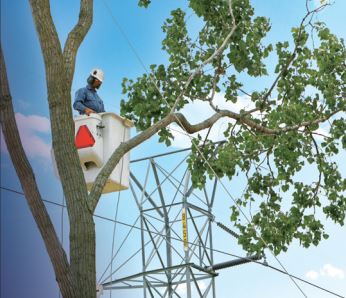 Electrical utility lines serve nearly every neighborhood, adding efficiency and luxury to every day of our lives.
Likewise, trees enhance our neighborhoods and bring beauty to our surroundings. Trees improve our air and water quality. They shade our homes, screen undesirable views, and help reduce noise along with many other ecosystem services.
We want both.
Purdue FNR Urban Forestry Specialist Lindsey Purcell addresses the conflicts that sometimes arise when trees and electrical lines must share space and ways to avoid them in his latest publication “Trees and Electric Lines“. Check out the publication to learn more about how to avoid boundary issues, safety concerns, power outages, and more while dealing with trees and electric lines.
Resources:
Trees and Electric Lines – The Education Store, Purdue Extension Resource Center
Tree Risk Management – The Education Store
Trees and Storms – The Education Store
Urban Forestry and Arboriculture – Purdue Forestry and Natural Resources
Power Friendly Trees – Indiana Department of Natural Resources
Lindsey Purcell, Urban Forestry Specialist
Purdue University Department of Forestry and Natural Resources
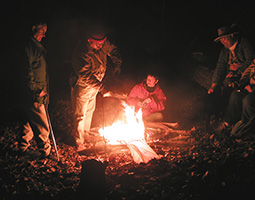 In the summer, it can be a lot of fun spending time outside and making campfires with friends and family. However, it can also be dangerous if you aren’t aware of proper safety techniques.
Smokey the Bear is here to help keep you and your family informed on the best practices while making a fire. On the Prevention How-Tos section of Smokey’s website, you can find tips on how to pick a good spot, how to build a fire pit, how to build and maintain your fire and how to extinguish it when you are done. There are also other bits of useful advice about burning debris, maintaining equipment to reduce wildfire risk and things to consider while indoors.
Take a look at Smokey’s website to make sure you are enjoying summer campfires safely!
Resources
Fire Prevention, Purdue Fire Department
Smokey Bear, National Association of State Foresters
Wildfire Prevention, National Association of State Foresters
Wildfire Safety Outreach Materials, United States Fire Administration
Let’s Have Fun with Fire Safety, United States Fire Administration
Smokey the Bear: Ad Council, National Association of State Foresters, USDA-U.S. Forest Service
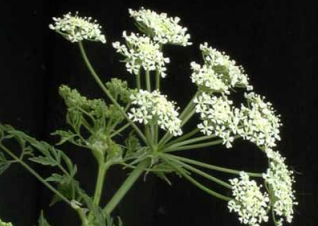
Photo credit: Pedro Tenorio-Lezama, Bugwood.org
Made infamous through the trial of Socrates, Shakespeare’s Hamlet and Macbeth, and several other works of classic literature, poison hemlock is an extremely toxic plant that will pose a risk this summer and should be handled with caution.
Poison hemlock is a biennial plant, meaning that it has a two year lifespan. Last summer, it went through vegetative growth and largely stayed out of sight. This summer, it will produce small white clusters of flowers and will be more likely to catch the attention of animals and people. Poison hemlock is a member of the parsley family and can sometimes be confused with wild carrot. However, its distinguishing feature is its hairless hollow stalks with purple blotches. If you see these, be careful!
The biggest risk with poison hemlock is ingestion. Lethal doses are fairly small, so it is important for animal owners or parents of young children to identify it in their area and remove it if possible. The toxins can also be absorbed through the skin and lungs, so be sure to wear gloves and a mask when handling these plants.
Symptoms of hemlock poisoning include dilation of the pupils, weakening or slowing pulse, blue coloration around the mouth and eventually paralysis of the central nervous system and muscles leading to death. Quick treatment can reverse the effects, so act quickly.
Resources
Invasive Plant Species Fact Sheets: Poison Hemlock, The Education Store, Purdue Extension Resource Center
Recognizing and Managing Poison Hemlock, Purdue Landscape Report
Poison Hemlock, Pest & Crop Newsletter, Purdue Extension – Entomology
Hemlock Woolly Adelgid: Distribution Update, Purdue Landscape Report
What are Invasive Species and Why Should I Care?, Purdue Extension – Forestry and Natural Resources (FNR)
Indiana Invasive Species Council
Report INvasive, Purdue Extension & Indiana Invasive Species Council
Poison Hemlock (Conium maculatum), United States Department of Agriculture (USDA)
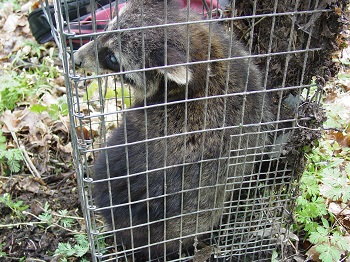
This is the time of year that many homeowners start their annual battle with nuisance wildlife. While trapping animals is not always required or desirable, it may be necessary in some cases to alleviate damage. Homeowners will typically use a box-style or cage “live” trap. Before you take action, there are a few key points you should first consider.
What permits, if any, are required?
Some animals require a permit prior to trapping. Raccoons, skunks, opossums, groundhogs, gray squirrels and fox squirrels are examples of mammals that do not require a permit in Indiana. Resident landowners or tenants can legally capture these species if the animal is causing damage to the property. However, you no longer have to report capture of wildlife to a conservation officer within 72 hours. Perhaps to the surprise of probably most people, rabbits do require a Nuisance Animal Control Permit prior to trapping. The Indiana DNR has a list of permitting requirements.
What do you do with wildlife you catch?
You have two choices of what to do with wildlife you capture: let it go or euthanize it (put to death humanely by injection). In either case, you may not possess an animal for more than 24 hours. If you relocate an animal, you must have permission of the landowner or property manager (even for public lands) AND you may only release that animal within the county of capture.
A common question I receive is, “What should I do?” There is no answer for which is best because circumstances differ. Most people probably prefer to let them go somewhere else because they find euthanizing animals unacceptable. They also may think that letting them go allows them to live out their lives, but this may not be the case. There has been some research on what happens to translocated raccoons and tree squirrels. In both cases, the animals don’t stay where they were let go. In the case of squirrels, a high number died within 88 days of release. Raccoons removed from structures tended to relocate in another structure.
Other things to consider
- Despite being cute and furry, wild animals are exactly that – wild animals. You should always use caution when handling traps that contain wildlife. Wear thick leather gloves and avoid sticking fingers inside the trap.
- If you transport an animal to be released (assuming you have gotten permission), do not place the trap inside your vehicle. Use a pickup truck to avoid contaminating your vehicle with animal waste and to minimize the spread of disease. Wildlife carry many pathogens and diseases that are transmittable to people.
- Animals can roll traps or pull in vegetation from the immediate vicinity. Be careful where you place the trap. Staking box traps is also a good idea.
- Be sure the trap is stable or “bedded” when you set it. Remove rocks and debris from under the trap. You may have to “work” the trap into the ground. Just be sure that debris doesn’t get caught under the treadle. If it does, the trap may not fire.
- You may want to cover your trap by wrapping it with cardboard and wire.
- Check your traps frequently. Indiana has a 24-hour trap check law. It is often a good idea to check them more frequently – perhaps 2 to 3 times a day. This is especially true if you are trapping during extremely hot or cold weather.
- Wildlife species have different times of activity, so you can be selective what time of day you trap. For example, tree squirrels and groundhogs are not active at night. Closing traps at night can avoid non-targets but would also require opening the trap at sunrise.
If you are interested in hiring a state licensed animal control professional, you can visit the Indiana DNR Nuisance Wildlife page and click on the link to “Nuisance Wildlife Control Operators.”
Additional Resources
Preventing Wildlife Damage – Do You Need a Permit?
Indiana Wildlife Conflicts Information
Indiana DNR Nuisance Wildlife
Brian MacGowan, Wildlife Extension Specialist
Department of Forestry and Natural Resources, Purdue University
When you rush to the closet to grab your favorite shorts and T-shirt, remember that you are not the only creature looking forward to the warmer weather. It is important to check yourself or have a buddy check you for passengers when you get back from the field to lessen the likelihood of bringing ticks home with you.
Indiana has 15 tick species, but the three listed below are the most prevalent.
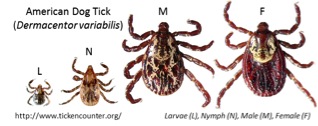
American Dog Tick (Dermacentor variabilis): Found primarily along trails, walkways or in fields, American Dog ticks are rarely found in forests. Despite their name, these ticks feed on a multitude of hosts in addition to the family pet and can transmit Rocky Mountain Spotted Fever, a potentially fatal disease contracted by 32 people in Indiana last year. The American Dog Tick also carries Tularemia, a rare but dangerous disease that is often misdiagnosed for the flu.
American Dog ticks can survive for two years at any stage in life until a suitable host is found. Male ticks mate with the female while she is feeding as after she is sated, she drops off of the host and lays 4,000+ eggs before dying. Larval ticks only feed for three to four days from a host before molting into nymphs. The nymph feeds on a variety of small/medium-sized hosts before dropping to the leaf litter and molting into adults. Interestingly, these ticks are least likely to bite humans.
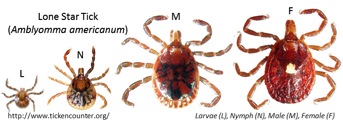 Lone Star Tick (Amblyomma americanum): Found primarily in dense underbrush and forested areas. As with the American Dog Tick, these ticks are capable of transmitting Rocky Mountain Spotted Fever in addition to Monocytic Ehrlichiosis, another tickborne disease that presents with symptoms similar to the flu but was confirmed in 49 Indiana cases in 2013. ‘Stari’ (Southern Tick-Associated Rash Illness) Borreliosis is a tick-vectored disease that presents with a large round or elliptical rash and flu symptoms transmitted by the Lone Star Tick.
Voracious eaters, adult Lone Star ticks often take human hosts or other large mammals. After a week, the female is capable of laying 3,000+ eggs. The larval Lone Star ticks only feed for four days before detaching, burying themselves in leaf litter and molting into nymphs. Able to quickly ascend up pant legs, these nymphs can be firmly attached to a host in < 10 minutes. After five days, the nymphs detach and molt into adults.
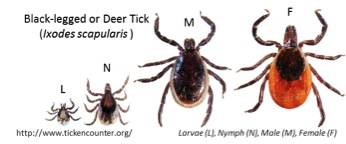
Black-legged or Deer Tick (Ixodes scapularis): Found primarily in deciduous forests, these ticks predominantly use white-tailed deer or other large mammals as hosts. Unlike the relatively accelerated life cycles of the American Dog and Lone Star ticks, the Deer Tick life cycle takes nearly two years to complete.
Deer ticks are most notorious for spreading Lyme disease, a dangerous disease that causes flu-like symptoms that, if left untreated, can spread to joints and compromise the nervous system. More than 100 cases of Lyme disease were confirmed in Indiana in 2013. Babesiosis is caused by microscopic parasites that infect red blood cells, and Anaplasmosis is caused by the bacterium Anaplasma phagocytophilum. Both of these diseases are transmitted through the bite of an infected Deer Tick.
Only the female Deer Tick feeds, and once completely engorged, they lay an egg mass of 1,900+ eggs before dying in late-May. Deer Tick larvae and nymphs remain in the moist leaf litter within forested areas and prefer smaller hosts. After feeding for three days in each developmental stage, they burrow into the litter to molt. Larvae emerge as nymphs in spring, and nymphs emerge as adults in fall.
 The table here illustrates the months of activity for the larval, nymph, male and female tick life cycle stages which gives you a quick reference for Indiana. This information was gathered from the resources listed in this post.
Indiana ticks can carry several diseases, but the three most common are Rocky Mountain Spotted Fever, Lyme Disease and Ehrlichiosis. Symptoms of all three diseases range from spreading rashes, headaches, fatigue, fevers and muscle aches. Likelihood of infection is rare; however, instances of each disease are increasing in Indiana.
Be careful and try not to pick up eight-legged hitchhikers. If you suspect that you have been bitten by a tick or develop a rash along with flu symptoms, contact your local health department for a disease screening.
Resources
Ticks, Indiana Department of Natural Resources
Ticks, Medical Entomology, Purdue University
Rocky Mountain Spotted Fever, Centers for Disease Control and Prevention
Tularemia, Centers for Disease Control and Prevention
Lyme Disease, Centers for Disease Control and Prevention
Ehrlichiosis, Centers for Disease Control and Prevention
Parasites – Babesiosis, Centers for Disease Control and Prevention
Anaplasmosis, Centers for Disease Control and Prevention
‘Stari’ Borreliosis, Columbia University Medical Center
tickencounter.org, Tick Encounter Resource Center, University of Rhode Island
Shaneka Lawson, Adjunct Assistant Professor
Department of Forestry and Natural Resources
When you rush to the closet to grab your favorite shorts and T-shirt, remember that you are not the only creature looking forward to the warmer weather. It is important to check yourself or have a buddy check you for passengers when you get back from the field to lessen the likelihood of bringing ticks home with you.
Indiana has 15 tick species, but the three listed below are the most prevalent.
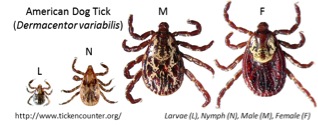
American Dog Tick (Dermacentor variabilis): Found primarily along trails, walkways or in fields. American Dog ticks are rarely found in forests. Despite their name, these ticks feed on a multitude of hosts in addition to the family pet and can transmit Rocky Mountain Spotted Fever, a potentially fatal disease contracted by 32 people in Indiana last year. The American Dog Tick also carries Tularemia, a rare but dangerous disease that is often misdiagnosed for the flu.
American Dog ticks can survive for two years at any stage in life until a suitable host is found. Male ticks mate with the female while she is feeding because after she is sated, she drops off of the host and lays 4,000+ eggs before dying. Larval ticks only feed for three to four days from a host before molting into nymphs. The nymph feeds on a variety of small/medium-sized hosts before dropping to the leaf litter and molting into adults. Interestingly, these ticks are least likely to bite humans.
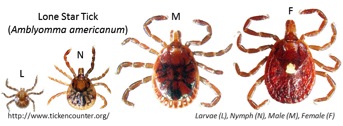
Lone Star Tick (Amblyomma americanum): Found primarily in dense underbrush and forested areas. As with the American Dog Tick, these ticks are capable of transmitting Rocky Mountain Spotted Fever in addition to Monocytic Ehrlichiosis, another tickborne disease that presents with symptoms similar to the flu but was confirmed in 49 Indiana cases in 2013. STARI (Southern Tick-Associated Rash Illness) Borreliosis is a tick-vectored disease that presents with a large round or elliptical rash and flu symptoms transmitted by the Lone Star Tick.
Voracious eaters, adult Lone Star ticks often take human hosts or other large mammals. After a week, the female is capable of laying 3,000+ eggs. The larval Lone Star ticks only feed for four days before detaching, burying themselves in leaf litter and molting into nymphs. Able to quickly ascend up pant legs, these nymphs can be firmly attached to a host in less than 10 minutes. After five days, the nymphs detach and molt into adults.
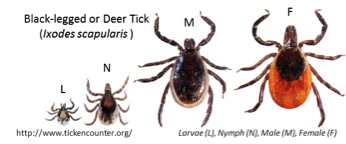
Black-legged or Deer Tick (Ixodes scapularis): Found primarily in deciduous forests, these ticks predominantly use white-tailed deer or other large mammals as hosts. Unlike the relatively accelerated life cycles of the American Dog and Lone Star ticks, the Deer Tick life cycle takes nearly two years to complete.
Deer ticks are most notorious for spreading Lyme disease, a dangerous disease that causes flu-like symptoms that, if left untreated, can spread to joints and compromise the nervous system. More than 100 cases of Lyme disease were confirmed in Indiana in 2013. Babesiosis is caused by microscopic parasites that infect red blood cells, and Anaplasmosis is caused by the bacterium Anaplasma phagocytophilum. Both of these diseases are transmitted through the bite of an infected Deer Tick.
Only the female Deer Tick feeds, and once completely engorged, it lays an egg mass of 1,900+ eggs before dying in late-May. Deer Tick larvae and nymphs remain in the moist leaf litter within forested areas and prefer smaller hosts. After feeding for three days in each developmental stage, they burrow into the litter to molt. Larvae emerge as nymphs in spring, and nymphs emerge as adults in fall.
The table here illustrates the months of activity for the larval, 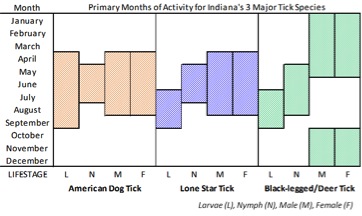 nymph, male and female tick life cycle stages.
Indiana ticks can carry several diseases, but the three most common are: Rocky Mountain spotted fever, Lyme disease and Ehrlichiosis. Symptoms of all three diseases range from spreading rashes and headaches to fatigue, fevers and muscle aches. Likelihood of infection is rare; however, instances of each disease are increasing in Indiana.
Be careful and try not to pick up these six-legged hitchhikers. If you suspect that you have been bitten by a tick or develop a rash along with flu symptoms, contact your local health department for a disease screening.
Resources
Rocky Mountain Spotted Fever, Centers for Disease Control and Prevention
Tularemia, Centers for Disease Control and Prevention
Lyme Disease, Centers for Disease Control and Prevention
Ehrlichiosis, Centers for Disease Control and Prevention
Parasites – Babesiosis, Centers for Disease Control and Prevention
Anaplasmosis, Centers for Disease Control and Prevention
STARI Borreliosis, Columbia University Medical Center
Shaneka Lawson, Adjunct Assistant Professor
Department of Forestry and Natural Resources
 “Community medicine collection programs make it easy for people to rid their homes of unwanted pharmaceuticals, but they can be difficult to get off the ground. That’s where our Unwanted Meds team comes in. They have helped police departments across Illinois and Indiana establish collection programs and raise awareness of the importance of proper disposal.
How to Dispose of Unwanted Medicine and Personal Care Products, Illinois-Indiana Sea Grant
Unwanted Medicine, IN.gov
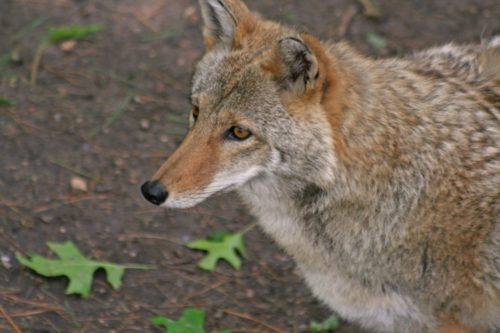 There have been multiple sightings of coyotes in the Indianapolis suburbs, especially the southern part of Indianapolis. As habitats for these animals shrink, the coyote sightings have increased. Coyotes no longer have any natural predators, but they are afraid of humans. These animals mainly eat small animals like rabbits, mice and squirrels but have been known to attack small pets. It is imperative to go outside with your pet to ensure their safety from coyotes. The Indiana Department of Natural Resources (INDNR) will be hosting a coyote seminar for the public in April.
What: Living with Coyotes, Greenwood
Where: Greenwood Library, 310 S. Meridian St., Greenwood, IN
When: April 2, 2015
Time: 5:30-7:30 pm
Cost: Free
Registration is required.
Resources
Coyotes a Constant Problem in Indy Suburbs, IndyStar
Dealing with Nuisance Coyotes, INDNR
Should I Be Worried About Coyotes In My Yard?, Got Nature?
Coyotes, Wildlife Conflicts, Department of Entomology, Purdue University
Dealing with Nuisance Coyotes, Indiana Department of Natural Resources
Permitted Wildlife Rehabilitators, Indiana Department of Natural Resources
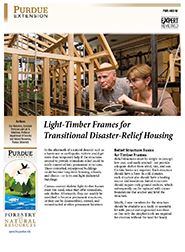 In the aftermath of a natural disaster such as a hurricane or earthquake, victims could get more than temporary help if the structures erected to provide immediate relief could be easily converted into permanent structures. These converted repurposed buildings could become long-term housing, schools and clinics—or farm and light-industrial buildings. This six-page publication describes two different approaches to building canvas-covered, skeletal, light-timber frames to meet this need.
Light-Timber Frames for Transitional Disaster-Relief Housing is available as a free download at The Education Store.
Resources
First Steps to Flood Recovery, The Education Store
Disaster Recovery, IN.gov
Eva Haviarova, Associate Professor of Wood Products
Department of Forestry and Natural Resources
The Guardian has published an article in regards to the large loss of wildlife in the past 40 years. Due to humans’ rapid consumption practices and our ecological footprint, the Earth cannot replenish what we use fast enough. The WWF analyzed 10,000 different populations consisting of animals, fish and birds in the study to create a representative “Living Planet Index” (LPI). The study showed that freshwater ecosystems had the fastest declining population. While the biggest decline in animal numbers are in low income, developing nations, rich nations are “outsourcing” wildlife decline in developing countries by importing food and other goods produced through habitat destruction. What can you do to make a difference to help keep the Earth clean?
View the full article, Earth Has Lost Half of its Wildlife in the Past 40 Years, says WWF, at theguardian.com.
Resources
Living Planet Report 2014, WWF.panda.org
Land and Water Conservation Fund, Indiana DNR
Saving Energy in Your Home series, The Education Store

Recent Posts
- Combine & Field Fires, IN-PREPared
Posted: September 25, 2025 in Safety, Urban Forestry, Woodlands - Researchers Study Deer-Vehicle Collision Reduction Method
Posted: July 31, 2024 in Safety, Wildlife - MyDNR – First positive case of chronic wasting disease in Indiana
Posted: April 29, 2024 in Alert, Disease, How To, Safety, Wildlife - Cicadas in Spring! – Purdue Landscape Report
Posted: April 9, 2024 in Forestry, Plants, Safety, Wildlife - New Deer Impact Toolbox
Posted: April 7, 2024 in Forestry, Land Use, Plants, Publication, Safety, Wildlife, Woodlands - Help Research Chronic Wasting Disease – Wild Bulletin
Posted: April 3, 2024 in Disease, Forestry, How To, Safety, Wildlife, Woodlands - How to Interact with Young Wildlife This Spring, MyDNR
Posted: March 28, 2024 in Forestry, How To, Safety, Wildlife, Woodlands - Barn Owls in Goose Pond Fish & Wildlife Area Nest Box, MyDNR
Posted: March 4, 2024 in Forestry, Land Use, Safety, Wildlife, Woodlands - Learn About Lead: Avoiding Lead Ingestion in Wild Game, Wild Bulletin
Posted: December 8, 2023 in Alert, Disease, How To, Safety, Wildlife - Wildlife Wins of 2023, Wild Bulletin
Posted: in Aquaculture/Fish, Aquatic/Aquaculture Resources, How To, Safety, Wildlife
Archives
Categories
- Alert
- Aquaculture/Fish
- Aquatic/Aquaculture Resources
- Ask the Expert
- Christmas Trees
- Community Development
- Disease
- Drought
- Forestry
- Forests and Street Trees
- Gardening
- Got Nature for Kids
- Great Lakes
- How To
- Invasive Animal Species
- Invasive Insects
- Invasive Plant Species
- Land Use
- Natural Resource Planning
- Nature of Teaching
- Plants
- Podcasts
- Ponds
- Publication
- Safety
- Spiders
- Timber Marketing
- Uncategorized
- Urban Forestry
- Webinar
- Wildlife
- Wood Products/Manufacturing
- Woodland Management Moment
- Woodlands