 Purdue University - Extension - Forestry and Natural Resources
Got Nature? Blog
When you rush to the closet to grab your favorite shorts and T-shirt, remember that you are not the only creature looking forward to the warmer weather. It is important to check yourself or have a buddy check you for passengers when you get back from the field to lessen the likelihood of bringing ticks home with you.
Indiana has 15 tick species, but the three listed below are the most prevalent.
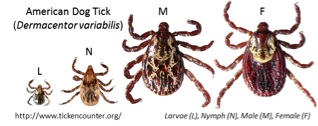
American Dog Tick (Dermacentor variabilis): Found primarily along trails, walkways or in fields. American Dog ticks are rarely found in forests. Despite their name, these ticks feed on a multitude of hosts in addition to the family pet and can transmit Rocky Mountain Spotted Fever, a potentially fatal disease contracted by 32 people in Indiana last year. The American Dog Tick also carries Tularemia, a rare but dangerous disease that is often misdiagnosed for the flu.
American Dog ticks can survive for two years at any stage in life until a suitable host is found. Male ticks mate with the female while she is feeding because after she is sated, she drops off of the host and lays 4,000+ eggs before dying. Larval ticks only feed for three to four days from a host before molting into nymphs. The nymph feeds on a variety of small/medium-sized hosts before dropping to the leaf litter and molting into adults. Interestingly, these ticks are least likely to bite humans.
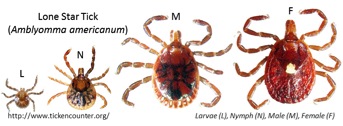
Lone Star Tick (Amblyomma americanum): Found primarily in dense underbrush and forested areas. As with the American Dog Tick, these ticks are capable of transmitting Rocky Mountain Spotted Fever in addition to Monocytic Ehrlichiosis, another tickborne disease that presents with symptoms similar to the flu but was confirmed in 49 Indiana cases in 2013. STARI (Southern Tick-Associated Rash Illness) Borreliosis is a tick-vectored disease that presents with a large round or elliptical rash and flu symptoms transmitted by the Lone Star Tick.
Voracious eaters, adult Lone Star ticks often take human hosts or other large mammals. After a week, the female is capable of laying 3,000+ eggs. The larval Lone Star ticks only feed for four days before detaching, burying themselves in leaf litter and molting into nymphs. Able to quickly ascend up pant legs, these nymphs can be firmly attached to a host in less than 10 minutes. After five days, the nymphs detach and molt into adults.
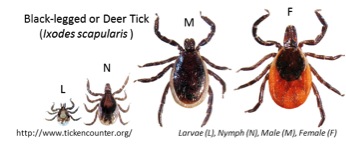
Black-legged or Deer Tick (Ixodes scapularis): Found primarily in deciduous forests, these ticks predominantly use white-tailed deer or other large mammals as hosts. Unlike the relatively accelerated life cycles of the American Dog and Lone Star ticks, the Deer Tick life cycle takes nearly two years to complete.
Deer ticks are most notorious for spreading Lyme disease, a dangerous disease that causes flu-like symptoms that, if left untreated, can spread to joints and compromise the nervous system. More than 100 cases of Lyme disease were confirmed in Indiana in 2013. Babesiosis is caused by microscopic parasites that infect red blood cells, and Anaplasmosis is caused by the bacterium Anaplasma phagocytophilum. Both of these diseases are transmitted through the bite of an infected Deer Tick.
Only the female Deer Tick feeds, and once completely engorged, it lays an egg mass of 1,900+ eggs before dying in late-May. Deer Tick larvae and nymphs remain in the moist leaf litter within forested areas and prefer smaller hosts. After feeding for three days in each developmental stage, they burrow into the litter to molt. Larvae emerge as nymphs in spring, and nymphs emerge as adults in fall.
The table here illustrates the months of activity for the larval, 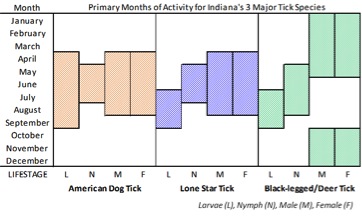 nymph, male and female tick life cycle stages.
Indiana ticks can carry several diseases, but the three most common are: Rocky Mountain spotted fever, Lyme disease and Ehrlichiosis. Symptoms of all three diseases range from spreading rashes and headaches to fatigue, fevers and muscle aches. Likelihood of infection is rare; however, instances of each disease are increasing in Indiana.
Be careful and try not to pick up these six-legged hitchhikers. If you suspect that you have been bitten by a tick or develop a rash along with flu symptoms, contact your local health department for a disease screening.
Resources
Rocky Mountain Spotted Fever, Centers for Disease Control and Prevention
Tularemia, Centers for Disease Control and Prevention
Lyme Disease, Centers for Disease Control and Prevention
Ehrlichiosis, Centers for Disease Control and Prevention
Parasites – Babesiosis, Centers for Disease Control and Prevention
Anaplasmosis, Centers for Disease Control and Prevention
STARI Borreliosis, Columbia University Medical Center
Shaneka Lawson, Adjunct Assistant Professor
Department of Forestry and Natural Resources
 “Community medicine collection programs make it easy for people to rid their homes of unwanted pharmaceuticals, but they can be difficult to get off the ground. That’s where our Unwanted Meds team comes in. They have helped police departments across Illinois and Indiana establish collection programs and raise awareness of the importance of proper disposal.
How to Dispose of Unwanted Medicine and Personal Care Products, Illinois-Indiana Sea Grant
Unwanted Medicine, IN.gov
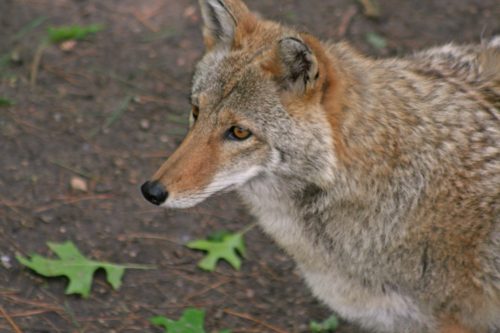 There have been multiple sightings of coyotes in the Indianapolis suburbs, especially the southern part of Indianapolis. As habitats for these animals shrink, the coyote sightings have increased. Coyotes no longer have any natural predators, but they are afraid of humans. These animals mainly eat small animals like rabbits, mice and squirrels but have been known to attack small pets. It is imperative to go outside with your pet to ensure their safety from coyotes. The Indiana Department of Natural Resources (INDNR) will be hosting a coyote seminar for the public in April.
What: Living with Coyotes, Greenwood
Where: Greenwood Library, 310 S. Meridian St., Greenwood, IN
When: April 2, 2015
Time: 5:30-7:30 pm
Cost: Free
Registration is required.
Resources
Coyotes a Constant Problem in Indy Suburbs, IndyStar
Dealing with Nuisance Coyotes, INDNR
Should I Be Worried About Coyotes In My Yard?, Got Nature?
Coyotes, Wildlife Conflicts, Department of Entomology, Purdue University
Dealing with Nuisance Coyotes, Indiana Department of Natural Resources
Permitted Wildlife Rehabilitators, Indiana Department of Natural Resources
 In the aftermath of a natural disaster such as a hurricane or earthquake, victims could get more than temporary help if the structures erected to provide immediate relief could be easily converted into permanent structures. These converted repurposed buildings could become long-term housing, schools and clinics—or farm and light-industrial buildings. This six-page publication describes two different approaches to building canvas-covered, skeletal, light-timber frames to meet this need.
Light-Timber Frames for Transitional Disaster-Relief Housing is available as a free download at The Education Store.
Resources
First Steps to Flood Recovery, The Education Store
Disaster Recovery, IN.gov
Eva Haviarova, Associate Professor of Wood Products
Department of Forestry and Natural Resources
The Guardian has published an article in regards to the large loss of wildlife in the past 40 years. Due to humans’ rapid consumption practices and our ecological footprint, the Earth cannot replenish what we use fast enough. The WWF analyzed 10,000 different populations consisting of animals, fish and birds in the study to create a representative “Living Planet Index” (LPI). The study showed that freshwater ecosystems had the fastest declining population. While the biggest decline in animal numbers are in low income, developing nations, rich nations are “outsourcing” wildlife decline in developing countries by importing food and other goods produced through habitat destruction. What can you do to make a difference to help keep the Earth clean?
View the full article, Earth Has Lost Half of its Wildlife in the Past 40 Years, says WWF, at theguardian.com.
Resources
Living Planet Report 2014, WWF.panda.org
Land and Water Conservation Fund, Indiana DNR
Saving Energy in Your Home series, The Education Store
 One of the most dangerous pests of trees is humans, especially humans with equipment. Lawn mowers and weed trimmers can cause injuries that can create a hazard when an injury leads to tree disease or death. This publication explains why the damage is so dangerous and suggests ways to protect your trees.
View Lindsey Purcell’s new publication, Mechanical Damage to Trees: Mowing and Maintenance Equipment, today at The Education Store.
Resources
Indiana’s Urban Woodlots, The Education Store
Tree Installation: Process and Practices, The Education Store
Lindsey Purcell, Urban Forestry Specialist
Department of Forestry and Natural Resources
The National Association of State Foresters (NASF) has now provided a Forest Action Plan for Indiana. With our dependency on forests, from clean air and timber to water and wildlife habitat, the sustainability of the forest resources was in question. The Indiana Forest Action Plan recognizes important issues that threaten the sustainability and ecological capacity of Indiana’s forests to provide for all Hoosier citizens.
The Forest Action Plan assessment and strategy can be found on the Forest Action Plans website.
Resources
Forest Action Plan, Indiana Department of Natural Resources
Forest Ecosystem Management in Indiana, The Education Store
Importance of Hardwood Tree Planting, The Education Store

Recent Posts
- Deer and Turkey Archery Seasons Opening Soon, MyDNR
Posted: October 13, 2026 in Alert, Safety, Wildlife - Burning for Benefits: Why Fire Belongs in Indiana
Posted: October 12, 2026 in Forestry, Safety, Woodlands - Is It Too Early to Think About Christmas Tree Pests?
Posted: September 22, 2026 in Christmas Trees, Invasive Insects, Safety - Heavy August Rains Bring More Mosquitoes to Indiana
Posted: September 9, 2026 in How To, Invasive Insects, Safety, Wildlife - Lighting a Spark: Prescribed Burn Associations
Posted: August 6, 2026 in Community Development, Forestry, Safety, Wildlife - Jarred Brooke Receives Early Career Award for Prescribed Fire Work
Posted: July 20, 2026 in Forestry, Forests and Street Trees, Natural Resource Planning, Safety - IN-PREPared: Essential Resources for Indiana’s Severe Weather Season
Posted: March 11, 2026 in How To, Safety - Fall Tree Care Tips
Posted: September 20, 2025 in Forestry, Forests and Street Trees, Gardening, How To, Land Use, Plants, Safety, Timber Marketing, Urban Forestry, Wood Products/Manufacturing, Woodlands - Researchers Study Deer-Vehicle Collision Reduction Method
Posted: July 31, 2024 in Safety, Wildlife - MyDNR – First positive case of chronic wasting disease in Indiana
Posted: April 29, 2024 in Alert, Disease, How To, Safety, Wildlife
Archives
Categories
- Alert
- Aquaculture/Fish
- Aquatic/Aquaculture Resources
- Ask the Expert
- Christmas Trees
- Community Development
- Disease
- Drought
- Forestry
- Forests and Street Trees
- Gardening
- Got Nature for Kids
- Great Lakes
- How To
- Invasive Animal Species
- Invasive Insects
- Invasive Plant Species
- Land Use
- Natural Resource Planning
- Nature of Teaching
- Plants
- Podcasts
- Ponds
- Publication
- Safety
- Spiders
- Timber Marketing
- Urban Forestry
- Webinar
- Wildlife
- Wood Products/Manufacturing
- Woodland Management Moment
- Woodlands