 Purdue University - Extension - Forestry and Natural Resources
Got Nature? Blog
This unit, part of the Nature of Teaching series, explores the effects of barriers and human assistance on wildlife gene flow. Students will learn about the effects of human-induced factors on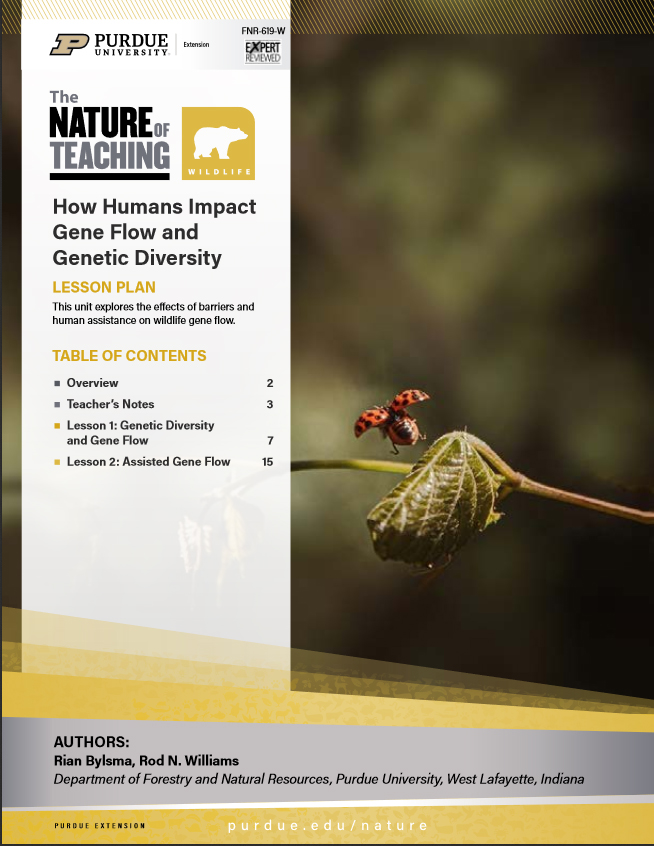 wildlife movement and gene flow, and the effectiveness of human interventions that promote gene flow among wildlife. You will find in the complete curriculum: teachers’ notes, vocabulary words, objectives and required materials for activities including gene flow simulation and estimating genetic variations in lady beetles.
The Nature of Teaching includes formal standards-based curricula and informal activity-based curricula all centered around getting youth outside. The three program areas of the formal curricula include: Wildlife, Health and Wellness, and Food Waste. Each program area provides standards-based lesson plans free as a downloadable PDF. Lesson plans are classroom ready for grades K-12.
Resources:
Nature of Teaching website and Nature of Teaching Youtube Channel
Ask An Expert: Anurans (Frogs and Toads) video, Got Nature?, Purdue Extension-Forestry and Natural Resources
The Nature of Teaching, Unit 3: Reptiles, Amphibians, and the Scientific Method, The Education Store, Purdue Extension resource center
The Nature of Teaching: Ecotoxicology and Environmental Health, The Education Store
Introduction to Nature of Teaching Sneak Peek Videos, Got Nature? Blog, Purdue Extension – Forestry and Natural Resources
Rod Williams, Professor of Wildlife Science
Purdue University Department of Forestry and Natural Resources
Jason Hoverman, Professor of Vertebrate Ecology
Purdue University Department of Forestry and Natural Resources
 Did you know that the majority of tilapia grown in the Midwest region of the United States are sold live in ethnic markets? And the majority of tilapia eaten in the United States are imported from Asia and Latin America?
Farmed tilapia is considered safe to eat. In fact, they are identified as a “Best Choice” fish for pregnant women, breastfeeding mothers and children according to the EPA and FDA.
This publication, “Tilapia Farmed Fish Fact Sheet“, is the third in a series of consumer guides that describe fish and shellfish farmed in the Midwest region of the United States. The fact sheet also includes culinary characteristics, cooking tips and a recipe for Sauteed Tilapia.
To view other consumer guide publications and video resources, check out Purdue Extension’s The Education Store website.
Resources:
Fish: Healthy Protein Handout, The Education Store, Purdue Extension resource center
Walleye Farmed Fish Fact Sheet, The Education Store
Yellow Perch Farmed Fish Fact Sheet, The Education Store
Salmon and Trout of the Great Lakes: A Visual Identification Guide, The Education Store
Eat Midwest Fish, Illinois-Indiana Sea Grant online resource hub
Amy Shambach, Aquaculture Marketing Outreach Associate
Purdue Department of Forestry and Natural Resources
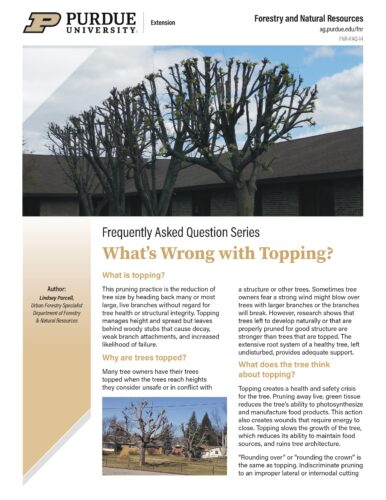 As trees grow and reach heights which many consider to be unsafe, tree owners would often top their trees by reducing the tree size. This is by heading back most of the large, live branches from the tree. However, topping trees proves to be more damaging than beneficial.
Topping trees can cause decay, weak branch attachments, and an increased likelihood of failure. If we do not top our trees and leave them to develop naturally, the structural strength of the trees is stronger than those that are not topped. The extensive root system, when left undisturbed, provides adequate support for the trees.
This publication titled What’s Wrong with Topping goes in-depth on the implications of topping and provides better alternatives to topping.
To view other urban forestry publications and video resources, check out Purdue Extension’s The Education Store website.
Resources:
Planting Your Tree Part 1: Choosing Your Tree, Purdue Extension YouTube Channel
Tree Planting Part 2: Planting a Tree, Purdue Extension YouTube Channel
Tree Selection for the “Un-natural” Environment, The Education Store, Purdue Extension resource center
Tree Installation: Process and Practices, The Education Store
Tree Pruning Essentials Video, Purdue Extension YouTube Channel
Lindsey Purcell, Urban Forestry Specialist
Purdue Department of Forestry and Natural Resources
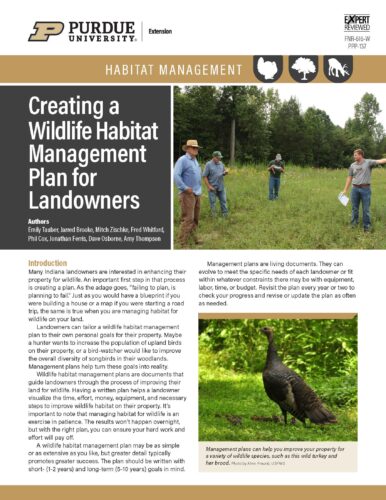 Many landowners are interested in enhancing their property for wildlife. An important first step in that process is creating a plan. As the adage goes, “failing to plan, is planning to fail.” Just as you would have a blueprint if you were building a house or a map if you were starting a road trip, the same is true when you are managing habitat for wildlife on your land.
Landowners can tailor a wildlife habitat management plan to their own personal goals for their property. Maybe a hunter wants to increase the population of upland birds on their property, or a bird-watcher would like to improve the overall diversity of songbirds in their woodlands. Management plans help turn these goals into reality.
This 12 page publication titled Creating a Wildlife Habitat Management Plan for Landowners is packed with photos, resources and suggestions to help meet your goals.
View other wildlife habitat management publications and video resources as you place keywords in the search field located on The Education Store website.
Resources
A Template for Your Wildlife Habitat Management Plan, Got Nature?, Purdue Extension
Managing Your Woods for White-Tailed Deer, The Education Store
Woodland Stewardship for Landowners, Playlist, Purdue Extension – Forestry and Natural Resources YouTube channel
A Woodland Management Moment, Purdue Extension – FNR playlist
Wildlife Habitat Hint, Purdue Extension – FNR playlist
Ask an Expert: Wildlife Food Plots, Video, Purdue Extension – Forestry and Natural Resources YouTube channel
Jarred Brooke, Wildlife Extension Specialist
Purdue Department of Forestry and Natural Resource
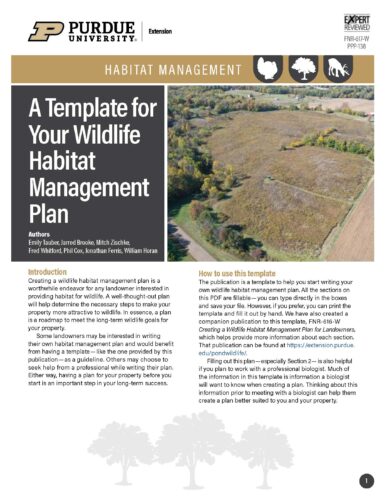 Many landowners are interested in enhancing their property for wildlife. An important step in that process is creating a plan. This publication provides a template to help landowners write a wildlife habitat management plan.
View other wildlife habitat management publications and video resources as you place keywords in the search field located on The Education Store website.
Resources
Creating a Wildlife Habitat Management Plan for Landowners, The Education Store, Purdue Extension resource center
Managing Your Woods for White-Tailed Deer, The Education Store
Woodland Stewardship for Landowners, Playlist, Purdue Extension – Forestry and Natural Resources YouTube channel
A Woodland Management Moment, Purdue Extension – FNR playlist
Wildlife Habitat Hint, Purdue Extension – FNR playlist
Ask an Expert: Wildlife Food Plots, Video, Purdue Extension – Forestry and Natural Resources YouTube channel
Jarred Brooke, Wildlife Extension Specialist
Purdue Department of Forestry and Natural Resource
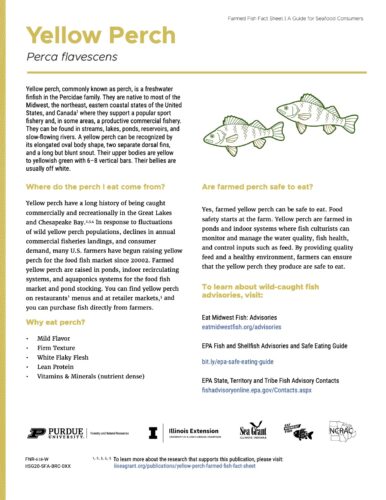 The publication Yellow Perch is the second in a series of fact sheets that describe fish and shellfish produced in the Midwest region of the United States. (See FNR-608-W, Walleye Farmed Fish Fact Sheet.) Yellow perch have been popular among anglers for many years, and since 2002, responding to greater demand, U.S. farmers are raising perch in ponds, aquaponic systems, etc. The fact sheet also includes culinary characteristics, cooking tips, and a recipe for Baked Parmesan Perch.
View other seafood publications and video resources as you place keywords in the search field located on The Education Store website.
Resources
Fish: Healthy Protein Handout, The Education Store, Purdue Extension resource center
Walleye Farmed Fish Fact Sheet: A Guide for Seafood Consumers, The Education Store
Fish Cleaning with Purdue Extension County Extension Director, Got Nature? Blog, Purdue Extension – Forestry and Natural Resources
Eat Midwest Fish, Website
Sustainable Aquaculture: What does it mean to you?, The Education Store, Purdue Extension resource center
Best Practices Guide for Charter Fishing and COVID-19, The Education Store
Pond Management: Managing Fish Populations, The Education Store
Aquatics & Fisheries, Playlist, Purdue Extension – Forestry and Natural Resources
Amy Shambach, Aquaculture Marketing Outreach Associate
Purdue Department of Forestry and Natural Resources/Illinois Indiana Sea Grant Program
A well-managed woodland can promote wildlife diversity and forest health. Two of the more common techniques that we use are single-tree selection and patch-cut harvesting. Used together in the long term, these two techniques will create trees of multiple generations or different age trees within the same woodland. In this video, Purdue Wildlife Extension Specialist Brian MacGowan will talk about what these two techniques are, what trees they help grow and how wildlife species respond to them.
If you have any questions regarding wildlife, trees, forest management, wood products, natural resource planning or other natural resource topics, feel free to contact us by using our Ask an Expert web page.
Resources
Woodland Stewardship For Landowners, Playlist, Purdue Extension – Forestry and Natural Resources (FNR) YouTube Channel
Woodland Management Moment, Purdue Extension – FNR Playlist
Hardwood Ecosystem Experiment: Uneven-aged Management, Purdue Extension – FNR Video
Hardwood Ecosystem Experiment: Even-aged Management, Purdue Extension – FNR Video
Forest Improvement Handbook, The Education Store, Purdue Extension resource center
Brian MacGowan, Wildlife Extension Specialist & Extension Coordinator
Purdue Department of Forestry and Natural Resources
 Aquaculture is a rapidly growing industry in the United States. This publication describes what sustainable aquaculture is, a sampling of aquaculture species are produced in the Midwest, health benefits associated with eating fish as part of a balanced diet, and dietary recommendations. Don’t miss trying the recipe shared in this publication: Parmesan Crusted Perch.
Resources
Walleye Farmed Fish Fact Sheet: A Guide for Seafood Consumers, The Education Store, Purdue Extension resource center
Best Practices Guide for Charter Fishing and COVID-19, The Education Store
Pond Management: Managing Fish Populations, The Education Store
Pond and Wildlife Management website, Purdue Extension
Natural Resources University Podcasts, Collaboration with Mississippi, Florida, Iowa and Indiana Extension Services
Indiana Pond Fish, Species Identification Card Set, The Education Store
Fish Cleaning with Purdue Extension County Extension Director, Got Nature? Blog, Purdue Extension – Forestry and Natural Resources
Aquatics & Fisheries, Playlist, Purdue Extension – Forestry and Natural Resources
Amy Shambach, Aquaculture Marketing Outreach Associate
Purdue Department of Forestry and Natural Resources/Illinois Indiana Sea Grant Program
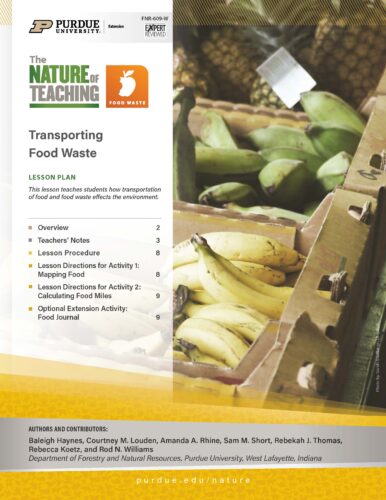 This Nature of Teaching lesson plan teaches students how the transportation of food and food waste affects the environment. Students will expand their vocabulary, broaden their geography, and have fun working on their math skills as they calculate food miles. A list of materials needed and activity instructions for interactive, hands-on activities are included, along with Next Generation Science Standards and/or Core Standards met by these lesson plans.
The Nature of Teaching includes formal standards-based curricula and informal activity-based curricula all centered around getting youth outside. The three program areas of the formal curricula include: Wildlife, Health and Wellness, and Food Waste. Each program area provides standards-based lesson plans free as a downloadable PDF. Lesson plans are classroom ready for grades K-12.
Resources
Nature of Teaching, website and Youtube Channel
The Nature of Teaching: Food Waste Solutions, The Education Store, Purdue Extension resource center
The Nature of Teaching: Food Waste and the Environment, The Education Store
Food Waste and Natural Resources Lesson Plans, The Education Store
Introduction to Nature of Teaching Sneak Peek Videos, Got Nature? Blog, Purdue Extension – Forestry and Natural Resources
Rod Williams, Professor of Wildlife Science
Purdue Department of Forestry and Natural Resources
 Well-maintained trees provide many benefits including increased property values, improved air quality and curb appeal. Trees are living organisms making them vulnerable to pests and environmental extremes resulting in health issues which result in defects. This publication will help guide you on where and how to identify tree defects and a better understanding of when to contact an arborist for assistance.
Resources
Tree wounds and healing, Got Nature? Blog, Purdue Extension – Forestry and Natural Resources
How to Identify Tree Defects and What to Do About It?, Got Nature? Blog
Iron Chlorosis of Trees and Shrubs, The Education Store, Purdue Extension resource center
Surface Root Syndrome, The Education store
Tree Appraisal and the Value of Trees, The Education Store
Lindsey Purcell, Urban Forestry Specialist
Purdue University, Department of Forestry and Natural Resources

Recent Posts
- Publication – Direct Marketing Guidebook for Small/Medium-Scale Aquaculture Businesses
Posted: March 7, 2025 in Aquaculture/Fish, Aquatic/Aquaculture Resources, Publication - Publication – Handbook on Processing Fish for Small-Scale Fish Farmers
Posted: October 17, 2024 in Aquaculture/Fish, Aquatic/Aquaculture Resources, How To, Publication, Wildlife - Virtual Tour Brings Forest Management for Birds to Life
Posted: July 19, 2024 in Forestry, How To, Publication, Wildlife - Publication – Quality of Place and Community Development
Posted: July 18, 2024 in Community Development, Land Use, Publication, Urban Forestry - Publication – Introduction to White-tailed Deer Impacts on Indiana Woodlands
Posted: April 28, 2024 in Forestry, Land Use, Plants, Publication, Wildlife, Woodlands - Publication – Understanding White-tailed Deer and Their Impact on Indiana Woodlands
Posted: in Forestry, Land Use, Plants, Publication, Wildlife, Woodlands - Publication – Monitoring White-tailed Deer and Their Impact on Indiana Woodlands
Posted: in Forestry, Land Use, Plants, Publication, Wildlife, Woodlands - Publication – Managing White-tailed Deer Impacts on Indiana Woodlands
Posted: in Forestry, Land Use, Plants, Publication, Wildlife, Woodlands - New Deer Impact Toolbox
Posted: April 7, 2024 in Forestry, Land Use, Plants, Publication, Safety, Wildlife, Woodlands - Publication- Bluegill Farmed Fish Fact Sheet
Posted: December 15, 2023 in Aquaculture/Fish, Aquatic/Aquaculture Resources, Publication, Wildlife
Archives
Categories
- Alert
- Aquaculture/Fish
- Aquatic/Aquaculture Resources
- Ask the Expert
- Christmas Trees
- Community Development
- Disease
- Drought
- Forestry
- Forests and Street Trees
- Gardening
- Got Nature for Kids
- Great Lakes
- How To
- Invasive Animal Species
- Invasive Insects
- Invasive Plant Species
- Land Use
- Natural Resource Planning
- Nature of Teaching
- Plants
- Podcasts
- Ponds
- Publication
- Safety
- Spiders
- Timber Marketing
- Uncategorized
- Urban Forestry
- Webinar
- Wildlife
- Wood Products/Manufacturing
- Woodland Management Moment
- Woodlands