 Purdue University - Extension - Forestry and Natural Resources
Got Nature? Blog
Issue:
The No Adverse Impact approach to floodplain management was developed by the Association of State Floodplain Managers (ASFPM) in 2001. This managing principal was the product of a realization; that despite the progress made nation-wide as a result of the National Flood Insurance Program’s minimum standards and billions of dollars spent on structural flood control projects, flood damages have continued to increase. Since 1990 flood damage losses have increased fivefold, costing the nation $10 billion annually on average. The No Adverse Impact (NAI) approach to floodplain management was designed to help reverse this trend by providing communities with the tools to reduce the frequency and severity of flood events, and to protect their citizens now and in the future. In general, these tools prevent the actions of one property owner or even a community from adversely impacting other property owners or neighboring communities. When applied at the watershed or regional level, this approach creates a network of resilient communities.
What Has Been Done:
Planning for the Coastal No Adverse Impact Workshop began in the winter of 2015 when staff from Wisconsin and Illinois-Indiana Sea Grant expressed interest in coordinating two additional workshops modeled on the “Great Lakes Community Resilience: A No Adverse Impact Approach” workshop delivered in Milwaukee Wisconsin in August 2014. With $2,500 workshop funding allocated to Purdue University from the Federal Emergency Management Agency (FEMA) and the National Oceanic and Atmospheric Administration’s Coastal Storms Program (NOAA CSP), ASFPM and Illinois-Indiana Sea Grant partnered with representatives from the Lake Michigan Coastal Program, Northwest Indiana Regional Planning Commission, and the Porter County Survey to develop a target audience, objectives and agenda for this day-long event. Specifically this workshop was designed to provide participants with an opportunity to:
- Learn from regionally-renowned experts and boots-on-the ground managers about the legal constructs that are central to floodplain management, planning, and hazard mitigation,
- Build relationships with practitioners who represent a variety of different professions: floodplain, stormwater, and coastal resource managers, land use and hazard mitigation planners, attorneys, health department staff, and local decision makers, and
- Discover how flooding has impacted Indiana’s municipalities and novel solutions individuals and organizations across the state are implementing to increase their resilience.
The Indiana Coastal No Adverse Impact Workshop was held on June 25th at the Hammond Marina in Hammond, Indiana. Over the course of the day, seven 30-45 minute presentations were given. The 41 workshop participants included certified floodplain managers, planners, attorneys, coastal resource managers, health department staff, stormwater managers, and local officials. In an effort to draw this target audience to the workshop , the planning committee offered continuing education credits for the following organizations and certification programs: Indiana Commission for Continuing Legal Education, Continuing Legal Education Credits; ASFPM, Certified Floodplain Manager credits; and Indiana Professional Licensing Agency, Professional Engineers and Professional Surveyor credits. The beginning of the day focused heavily on No Adverse Impact, while the second half of the day highlighted flooding case studies and other special topics. The workshop was organized in this way to ensure that all participants had a strong understanding of No Adverse Impact and common legal concerns associated with floodplain management, prior to exploring specific applicable examples and topics in further detail.
Results:
The Indiana Coastal No Adverse Impact Workshop provided participants with the opportunity to learn about the core tenants of ASFPM’s No Adverse Impact approach to floodplain management, common legal issues faced by floodplain managers and planners in the region, specific actions that have been taken in Indiana to enhance flood resilience, the value of green infrastructure, and benefit of wetlands and how they are regulated in the United States. All of the evaluation respondents felt that they could apply the information presented at this workshop to their work and that presenters had given them the tools to implement the knowledge that was shared. In addition, all respondents noted that they would recommend this workshop to others. These results are reinforced by comments that were collected in response to an open ended question regarding how participants planned to use what they learned at the workshop. Respondents noted that they would use/incorporate the information presented at the workshop into various on-going projects and initiatives, and that they planned to pass it along to others who were not able to attend through technical assistance programs or interpersonal communications.
Issue:
Woodlands provide a multitude of environmental (e.g., carbon sequestration, enhance water quality, wildlife habitat), economic (e.g., timber, wood products manufacturing, tourism), and social (e.g., recreation, aesthetics) benefits to Indiana residents. The sustainability of these benefits is strongly tied to stability of the resource. In Indiana, 75 percent of the 4.65 million acres of forestland is owned by families. Actions they take on their property can impact the benefits woodlands provide all Indiana residents. However, many do not understand available options or sources of assistance.
What Has Been Done:
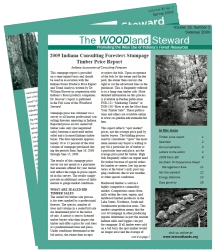 The Department of Forestry and Natural Resources, in partnership with many other organizations, helps produce and mail over 31,000 copies of the Indiana Woodland Steward to woodland owners three times each year. This 16-page, two-color publication includes in-depth articles on forest stewardship and health, invasive species and pests, wildlife habitat management, economics, and more.
Results:
Subscribers owned more woods (71.6 ac) for a longer tenure (33 years) than the average woodland owner in Indiana based on data from the National Woodland Owner Survey. As a group, they were also more active managers based on the proportion enrolled in assistance programs and who had a written stewardship plan. Fifty-four percent regularly utilized information from the Woodland Steward. In addition, 51 percent of respondents have implemented at least one practice they read about from The Woodland Steward, potentially impacting an estimated 1.2 million acres of forestland. His use of print media to communicate with woodland owners could be considered expensive, but clearly a large number of woodland owners regularly read and utilize the information making the average investment per landowner much lower.
Description of Bovine Tuberculosis:
Bovine tuberculosis (bovine Tb) is a disease found in mammals caused by the bacteria Mycobacterium bovis (M. bovis). In North America, bovine Tb is most commonly found in domestic cattle and captive and wild cervids (white-tailed deer, elk, etc.) and less commonly in other mammals such as raccoon, opossums, coyotes, and wild boars.
Bovine Tb has been greatly reduced in the cattle industry since the National Cooperative State-Federal Bovine Tuberculosis eradication program began in 1917. Currently, most states are accredited as “Bovine Tuberculosis-Free” by the United States Department of Agriculture, however, sporadic outbreaks do still occur throughout the United States.
Cattle, captive cervids, and wild white-tailed deer are considered reservoir hosts for bovine Tb. A reservoir host is a species in which bovine Tb can persist and be transmitted among individuals within a species or be transmitted to another species. Wild white-tailed deer may pose the greatest threat to the establishment of bovine Tb on the landscape because they move freely across the landscape and may contact multiple domestic cattle herds.
In Indiana, bovine Tb was detected in domestic cattle in 2008, 2010, and 2011 and most recently in April 2016 and a captive red deer and elk herd in Franklin County in 2009. The first case of bovine Tb in a wild white-tailed deer in Indiana occurred in August 2016 in Franklin County. All confirmed cases of bovine Tb in Indiana have been from the same strain of M. Bovis.
As of Dec 14th, 2016, 2,024 white-tailed deer samples have been collected, 2 exhibited lesions consistent with bovine Tb; 1,897 samples have been tested and 0 samples have tested positive for bovine Tb.
Frequently asked questions:
Yes, bovine Tb is transmissible to humans but bovine Tb accounts for <2% of tuberculosis cases in the United States. Most cases of bovine Tb in humans are caused by consuming unpasteurized dairy products and the likelihood of contracting bovine Tb from a wild deer is minuscule. There has been only one confirmed case of transmission of bovine Tb to a human from an infected white-tailed deer. In that case, bovine Tb was thought to be transmitted via bodily fluids from the infected deer contacting an open wound on the person during the field dressing process.
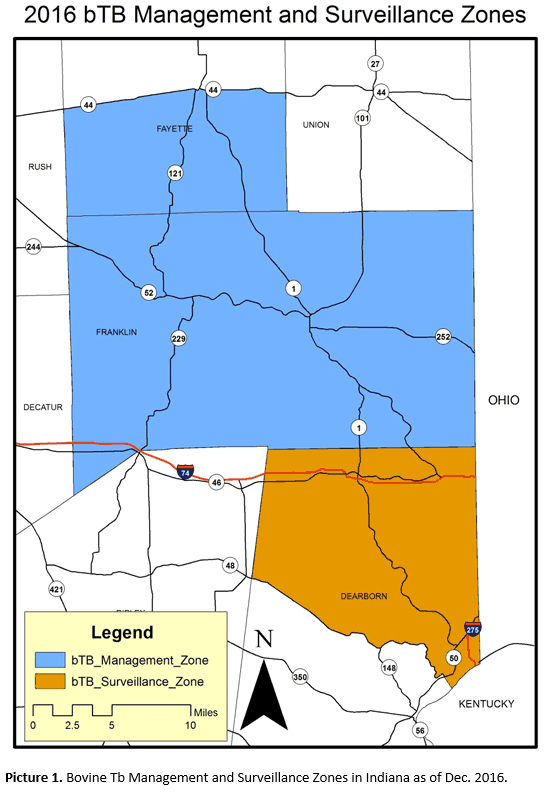
Picture 1. Bovine Tb Management and Surveillance Zones in Indiana as of Dec. 2016.
Both Michigan and Minnesota have had outbreaks of bovine Tb in wild white-tailed deer. Currently, bovine Tb occurs in less than 2% of deer in the Bovine Tb Management Zone in Michigan and has not been detected since 2009 in a wild deer in Minnesota. There are certainly lessons to be learned from both states and those lessons are being incorporated in the management of bovine Tb in Indiana.
Human health is the main concern; given that bovine Tb is transmissible to humans. Additionally, bovine Tb is not a naturally occurring disease in white-tailed deer. Deer can also be a reservoir for bovine Tb potentially transmitting bovine Tb to uninfected deer and also to uninfected cattle through direct contact or through shared feeding. Because deer are free-ranging they have the potential to contact multiple cattle herds and transmit bovine Tb across the landscape. If bovine Tb is maintained in the wild deer herd, Indiana is at risk of losing the “Bovine Tuberculosis-Free” accreditation from the USDA, which has negative economic impacts for the cattle industry in Indiana.
An animal infected with bovine Tb can shed the M. bovis bacteria through repertory secretions, feces, urine, or unpasteurized milk. Under the right environmental conditions, the bacteria can remain viable in the environment for months. The disease is spread when an uninfected animal comes into direct contact with secretions of an infected animal or indirectly through an M. bovis contaminated source in the environment (e.g. feed pile). Deer can contract bovine Tb through direct contact with an infected animal, either another deer or cattle or through sharing feeding with an infected animal at wildlife supplemental feeding piles or areas where cattle are fed or cattle feed is stored. Deer can transmit bovine Tb in the same ways as contracting the disease. Indirect contact, by means of shared feeding, is believed to be the primary pathway between deer and cattle.
Both Michigan and Minnesota have followed the same general approach to eradicating bovine Tb. Their approach consisted of (1) reducing deer density in the bovine Tb management zone, (2) eliminating baiting and supplemental feeding of wildlife, and (3) continual monitoring for bovine Tb in wild deer.
The Indiana Department of Natural Resources (IDNR) and Indiana Board of Animal Health (BOAH) are considering similar steps as in Michigan and Minnesota to eliminate bovine Tb in wild deer in Indiana. First, a bovine Tb Management Zone has been established in Franklin County and southern Fayette County and a Bovine Tb Surveillance Zone has been established in Dearborn County (Picture 1). In the management and surveillance zones, the IDNR sampled >2,000 hunter harvested deer during the 2016 deer season – none of which tested positive for bovine Tb. As a result, the IDNR determined active population reduction through sharp shooting (as used in other states) is not warranted at this time. The IDNR is still allowing landowners in the management zone to request disease permit to control deer near cattle farms in an effort to reduce cattle and deer interactions. Also, feeding deer or any wildlife is banned in the management zone. Management and surveillance will continue into the future. More information on the management of bovine Tb in Indiana can be found on the Indiana Department of Natural Resources (IDNR)-Bovine Tb Surveillance and Management and the Indiana State Board of Animal Health (BOAH)-Bovine Tuberculosis.
Reducing deer density is important to eliminate bovine Tb because the disease is density-dependent and spreads more efficiently in areas with high deer densities. In densely populated areas, deer come into contact with other wild deer, captive cervids, and cattle herds more frequently, thus potentially spreading bovine Tb to uninfected animals. The purpose of deer reductions is to reduce the risk of transmission by reducing population density, removing diseased deer, and to estimate the percentage of the population with bovine Tb.
One of the primary routes in which bovine Tb can be spread is through shared feeding. This is because supplemental feeding artificially concentrates deer in a very small area increasing contact among deer and other wildlife species. Additionally, M. bovis can survive for months on a supplemental feed pile. Thus, banning supplemental feeding is a critical step to limit the contact of infected and uninfected animals.
To date, there are no effective treatments for bovine Tb in wild white-tailed deer. This is why practices such as deer density reduction, a ban on supplemental feeding, and continued surveillance are vital in combating bovine Tb in wild deer.
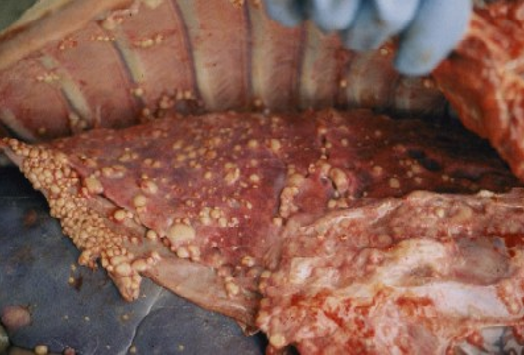
Picture 2. Lesions from bovine Tb infection in the chest cavity of a wild white-tailed deer. Photo by the Michigan Department of Natural Resources.
The clinical signs of bovine Tb recognizable to hunters would be small to large white, tan, or yellow lesions on the lungs, rib cage, or in the chest cavity (Picture 2). However, in Michigan only 64% of deer exhibited lesions and only 42% would have been recognizable to hunters. If you harvest a deer in the bovine Tb management or surveillance zone, you should submit it for sampling. After submitting you can search for the bovine Tb test results of your submission by going to the Indiana Department of Natural Resources – IDNR’s bovine Tb management website and clicking the “Look up the results of a deer you submitted” link.
Check the IDNR’s Bovine Tb website for information on submitting harvested deer for sampling.
Venison from deer harvested within the Bovine Tb Management and Surveillance Zone should be cooked to an internal temperature of 165 degrees Fahrenheit to kill M. bovis and other bacteria. Bovine Tb is rarely present on muscle tissue (meat) and the most likely way bovine Tb would be on meat would be through contamination from secretions within the body cavity.
Bovine Tb may be transmitted through bodily secretions of an infected deer contacting an exposed wound on a person during the field dressing process. If lesions consistent with bovine Tb are found inside a harvested deer you should contact the IDNR and submit the deer for testing. It’s important to mention that the likelihood of contracting bovine Tb from wild deer is very rare, but there are some steps you can take to further minimize the risk.
*Always wear gloves when field dressing, skinning, and processing a deer because bovine Tb may be present in fluids from the internal body cavity.
* Make sure to clean knives that are used for field dressing thoroughly prior to using them to skin or process a deer, or use different knives for each step.
* Thoroughly wash your hands after field dressing, skinning, and processing deer.
* Cook all venison to an internal temperature of 165 degrees Fahrenheit.
Cattle operators in the Bovine Tb Management and Surveillance Area should limit contact between deer and cattle or cattle feed by:* Only feed cattle an amount that can be consumed in one day
* Fence areas where cattle feed is stored
* Store feed away from deer
* Close the end of large plastic bags used to store corn, haylage, or silage and also remove any feed from the ground around the ends of the bag
* Use hunting and additional landowner permits from the IDNR as a management tool to reduce deer density around your farm
If you own land in the Bovine Tb Management Zone (Picture 1) you should contact Joe Caudell (812) 334-1137, the Indiana State Deer Biologist, or the Indiana Bovine Tb Hotline at (844) 803-0002.
Additional Bovine Tb Resources:
Bovine Tuberculosis in Wild White-tailed Deer, FNR-551-W publication, Purdue Extension – Forestry & Natural Resources
Bovine Tb, Indiana Department of Natural Resources (IDNR)
Bovine Tb, Indiana State Board of Animal Health (BOAH)
Bovine Tb Disease, USDA, Animal and Plant Health Inspection Service
Bovine Tb, Michigan Department of Natural Resources
Bovine Tb, Minnesota Department of Natural Resources
Bovine Tb factsheet, Center for Disease Control
Information provided by: Jarred Brooke, Extension Wildlife Specialist
Purdue Department of Forestry and Natural Resources
The eastern hellbender is an endangered salamander found in the Blue River in southern Indiana. It requires cool, clean rivers and streams with high water quality in order to thrive. Water quality in the Blue River is affected by many factors. One relatively unknown contributor to poor water quality is pollution entering sinkholes. Many landowners have sinkholes on their properties and treat them like outdoor waste sites without knowing that these sinkholes have a direct link to our water supplies. In this video, Purdue biologists interview a local cave expert and a local conservationist about how sinkholes are connected to our rivers, streams, and water supplies and how we can help protect them.
Resources:
Improving Water Quality by Protecting Sinkholes on Your Property, The Education Store, Purdue Extension’s resource center
A Landowner’s Guide to Sustainable Forestry: Part 5: Forests and Water, The Education Store
Improving Water Quality Around Your Farm, The Education Store, YouTube
Animal Agriculture’s Effect on Water Quality: Pastures and Feedlots, The Education Store
Improving Water Quality At Your Livestock Operation, The Education Store, YouTube
Nick Burgmeier, Research Biologist & Extension Wildlife Specialist
Purdue Department of Forestry and Natural Resources
Dr. Rod Williams, Professor of Wildlife Science
Purdue Department of Forestry and Natural Resources
The Department of Forestry and Natural Resources’ extension team have received four Purdue Extension Issue-Based Action Team (IBAT) awards out of seven. These new initiatives have been chosen from 30 submitted proposals. In an ever-changing world, Purdue Extension is launching big ideas to identify and address priority issues to enhance quality of life as well as the efficiency and/or effectiveness of organizations through research-based education.
Congratulations to the following FNR teams that are moving the world forward:
ENHANCING THE VALUE OF PUBLIC SPACES: HEALTH, WELLNESS, AND DESIGNING THE BUILT ENVIRONMENT
Project Overview: Expand upon the existing Enhancing the Value of Public Spaces program to include a health component — building community capacities for accessible means for physical activity. $50,000.
Team: Michael Wilcox, Assistant Program Leader for Community Development Extension, Purdue Center for Reginal Development; and Kara Salazar, Sustainable Communities Extension Specialist, Department of Forestry & Natural Resources; Donna Vandergraff, Extension Specialist, Nutrition Science; Lisa Graves, Assistant Program Leader and Extension Specialist, Nutrition Science; Melissa Maulding, Director, Nutrition Education Programs; and Steve Yoder, Extension Educator, Agriculture and Natural Resources (ANR), Tippecanoe County.
MARKET BASKET 360
Program Overview: A wealth of resources on a website, educational workshop agendas, certification programs, uniform materials for cooking demonstrations, and more for Farmers’ Market Masters, producers, and consumers. Market Basket 360 centralizes, streamlines, and enhances existing farmers’ market resources available through Purdue Extension, Indiana State Department of Health, the USDA Agricultural Marketing Service, and other industry organizations.
Team: James Wolff, Extension Educator, Agriculture and Natural Resources (ANR), Allen County; Julie Gray, Central District Director, ANR; Morgan Roddy, Extension Educator/Health & Human Sciences (HHS), ANR, Henry County; Curt Campbell, Extension Educator, ANR, Wabash County; Jodee Ellett, Local Foods Coordinator, Purdue Extension; Vickie Hadley, HHS Extension Educator/CED, ANR, Allen County; Nancy Manuel, HHS Extension Educator, ANR, Adams County; Gail Peitzmeier, HHS Extension Educator, Crawford County; Tim Vining, Development Educator, ANR; Teresa Witkoske, HHS Extension Educator/CED, Wabash County; Kwamena Quagrainie, Aquaculture Marketing Director and Associate Professor, Department of Forestry & Natural Resources and Agriculture Economics; Bob Rode, Aquaculture Research Lab Manager and Extension Specialist, Department of Forestry and Natural Resources.
NATURAL RESOURCES LEADERSHIP PROGRAM
Program Overview: Expanding Extension’s capacity to develop and deliver statewide natural resource programs and enhance decision-making for implementation at the community level. $30,000.
Team: Kara Salazar, Assistant Program Leader for Community Development and Sustainable Communities Extension Specialist, Department of Forestry and Natural Resources/Illinois-Indiana Sea Grant; Angie Tilton, Extension Educator, Agriculture and Natural Resources (ANR), Hendricks County Team; Lenny Farlee, Sustaining Hardwood Extension Specialist, Department of Forestry and Natural Resources; Liz Jackson, Hardwood Tree Improvement and Regeneration Center (HTIRC), Engagement Specialist and Executive Director of the Indiana Forestry and Woodland Owners Association and the Walnut Council; Steve Yoder, Regional Extension Educator, Community Development
THE NATURE OF HEALTH
Project Overview: A multifaceted approach to engaging families in nature-learning opportunities that will utilize emerging research to connect Health and Human Sciences and Agriculture and Natural Resources using curriculum developed by Rod Williams titled “The Nature of Teaching.” $20,000.
Team: Rod Williams, Professor of Wildlife Science, Department of Forestry & Natural Resources; Angie Frost, Extension Specialist-Healthy Living, College of Agriculture; Stephanie Woodcox, Extension Specialist-Health & Wellness, College of Health and Human Sciences; Deb Arseneau, Extension Educator, Agriculture Natural Resources (ANR), Newton County; Jay Christiansen, Extension Educator, ANR, Vigo County; Jan Dougan, Extension Educator, ANR, Dubois County; Molly Hoag, Extension Educator, ANR, Wells County; Molly Hunt, Extension Educator, ANR, Delaware County; Gracie Marlatt, Extension Educator, ANR, Rush County; Kelsie Muller, Extension Educator, ANR, Benton County; Lindsey Pedigo, Extension Educator, ANR, Howard County; Katie Zuber, Extension Educator, ANR, Lawrence County.
View the College of Agriculture Strategic Plan and the Purdue Extension Annual Report for more information on Purdue Extension.
For extension resources on Forestry and Natural Resources view Purdue Extension-FNR website.
Diana Evans, Extension and Web Communications Specialist
Purdue University Department of Forestry and Natural Resources
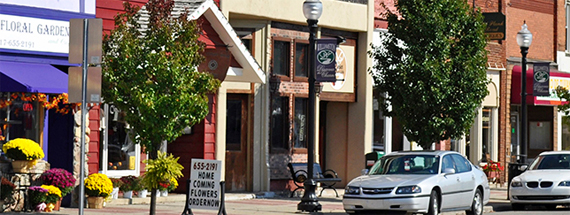 A Purdue Extension program that helps Indiana communities improve public spaces such as parks and town centers is surveying West Lafayette residents to get input on the city parks and recreation department’s next five-year master plan.
Specialists and educators in Extension’s Enhancing the Value of Public Spaces program are administering the survey and collecting and analyzing the feedback. The objective is to create a five-year plan for improving facilities, services and programs.
Citizens can access the survey online. Those who do not have access to a computer but would like to participate can receive a copy of the survey at the Morton Community Center, the Riverside Skating Center, the Lilly Nature Center and the West Lafayette Parks & Recreation Service Center on Kalberer Road. Deadline to complete the survey is March 15.
“The Enhancing program is strongly rooted in the community development principles of good practice,” said Kara Salazar, sustainable communities Extension specialist. “As such, we concentrate on participation, inclusion, capacity building and balancing action planning with long-term sustainability.”
To read more, check out Purdue Agriculture News‘ full article titled “Purdue Extension program’s objective: enhance public spaces.” Further questions about the survey can be directed to Kara Salazar at 765.496.1070 or salazark@purdue.edu.
Resources:
Purdue Extension program’s objective: enhance public spaces – Purdue Agriculture News
Enhancing the Value of Public Places Home Page – Purdue Extension
Enhancing the Value of Public Places Action Plan – The Education Store, Purdue Extension Resource Center
Kara Salazar, Sustainable Communities Extension Specialist
Purdue University Department of Forestry and Natural Resources

Recent Posts
- Purdue Extension: Empowering Indiana Through Innovation, Education and Community Impact
Posted: January 28, 2026 in Community Development, How To, Invasive Insects, Invasive Plant Species, Natural Resource Planning, Woodlands - Kara Salazar and Team Win National Runner-up for Innovation & Creativity Award
Posted: September 29, 2025 in Community Development, Land Use, Natural Resource Planning - Hardwood Tree Improvement Regeneration Center (HTIRC) Shares Fall Newsletter, Research and Outreach
Posted: December 13, 2024 in Forestry, Land Use, Natural Resource Planning, Woodlands - Purdue Extension’s Showcase, Impacting Indiana
Posted: November 8, 2024 in Community Development, Forestry, Forests and Street Trees, Gardening, Land Use, Natural Resource Planning, Timber Marketing, Urban Forestry, Wildlife, Wood Products/Manufacturing, Woodlands - IAA Receives $250,000 Grant for Arborist Apprenticeship
Posted: February 21, 2024 in Forestry, Forests and Street Trees, Natural Resource Planning, Urban Forestry, Wildlife, Woodlands - Build a Better Habitat for Wildlife This Winter – Wild Bulletin
Posted: February 1, 2024 in Forestry, How To, Land Use, Natural Resource Planning, Plants, Wildlife, Woodlands - Cost Assistance for Landowners Planning Conservation Practices
Posted: October 13, 2023 in Forestry, Invasive Plant Species, Natural Resource Planning, Woodlands - MyDNR: New multi-agency research partnership to benefit Indiana’s wildlife and wild places
Posted: September 7, 2023 in Aquaculture/Fish, Aquatic/Aquaculture Resources, Forestry, Natural Resource Planning, Plants, Wildlife, Woodlands - Purdue Extension to Connect Underserved Communities with Funding for Energy and Environmental Improvements
Posted: June 6, 2023 in Community Development, How To, Natural Resource Planning - Question: what resources do you have on wind energy, contracts?
Posted: April 11, 2023 in How To, Land Use, Natural Resource Planning
Archives
Categories
- Alert
- Aquaculture/Fish
- Aquatic/Aquaculture Resources
- Ask the Expert
- Christmas Trees
- Community Development
- Disease
- Drought
- Forestry
- Forests and Street Trees
- Gardening
- Got Nature for Kids
- Great Lakes
- How To
- Invasive Animal Species
- Invasive Insects
- Invasive Plant Species
- Land Use
- Natural Resource Planning
- Nature of Teaching
- Plants
- Podcasts
- Ponds
- Publication
- Safety
- Spiders
- Timber Marketing
- Uncategorized
- Urban Forestry
- Webinar
- Wildlife
- Wood Products/Manufacturing
- Woodland Management Moment
- Woodlands