Purdue Extension forester Lenny Farlee shares about the pecan, one of Indiana’s native hickories. Learn how to identify this species by more than just its nut production.
If you have any questions regarding trees, forests, wildlife, wood products or other natural resource topics, feel free to contact us by using our Ask an Expert web page.
Get to know one of our small Indiana trees, good for landscaping, that has purple flowers in the summer and pink fruit in the fall. Meet the American Burning Bush or Wahoo. Purdue Extension forester Lenny Farlee shares about where you can find this species, and more identifying characteristics.
The American Burning Bush is a native and desirable small tree found in our Indiana woodlands, not to be confused with winged burning bush, which is an exotic and invasive shrub that has escaped into woodlands from landscape plantings.
If you have any questions regarding trees, forests, wildlife, wood products or other natural resource topics, feel free to contact us by using our Ask an Expert web page.
Purdue Extension forester Lenny Farlee introduces you to one of the bright flowering stars of spring, the Redbud. This native tree is known for its pink and lavender flowers in early spring, its heart-shaped leaves and for its home along the edge of open fields and brushy areas.
If you have any questions regarding trees, forests, wildlife, wood products or other natural resource topics, feel free to contact us by using our Ask an Expert web page.
Unexpected Plants and Animals of Indiana: What is roughly the size of a potato, tastes like a banana and had its own dedicated month on the Native American Shawnee tribe’s calendar?
It’s not a riddle it’s the pawpaw fruit, borne by the pawpaw tree (Asimina triloba), a tree with close tropical relatives that is native to much of North America.
Known affectionately as the Hoosier banana (and to Kentuckians as the Kentucky banana, and so on), the pawpaw fruit is the largest native fruit in North America and has a rich cultural and culinary history throughout the Midwest. A staple of many Native American tribes’ diets, the pawpaw was also consumed by early settlers in the region and relied on during the Great Depression as a substitute to other, more expensive, fruits. Before the pawpaw became known as the Hoosier banana, it was called the poor man’s banana.
In recent decades, however, the pawpaw fell out of culinary vogue. While the trees can be found growing in the wild, usually in forested areas, or in backyards of the ambitious gardener, pawpaw is consumed and grown largely as a novelty.
“Not that many people grow pawpaws in their backyard,” Rosie Lerner, Extension consumer horticulturist, said. “It’s a native tree, has rather specific pollination requirements to be able to set fruit, is difficult to transplant and is not widely available at local nurseries.”
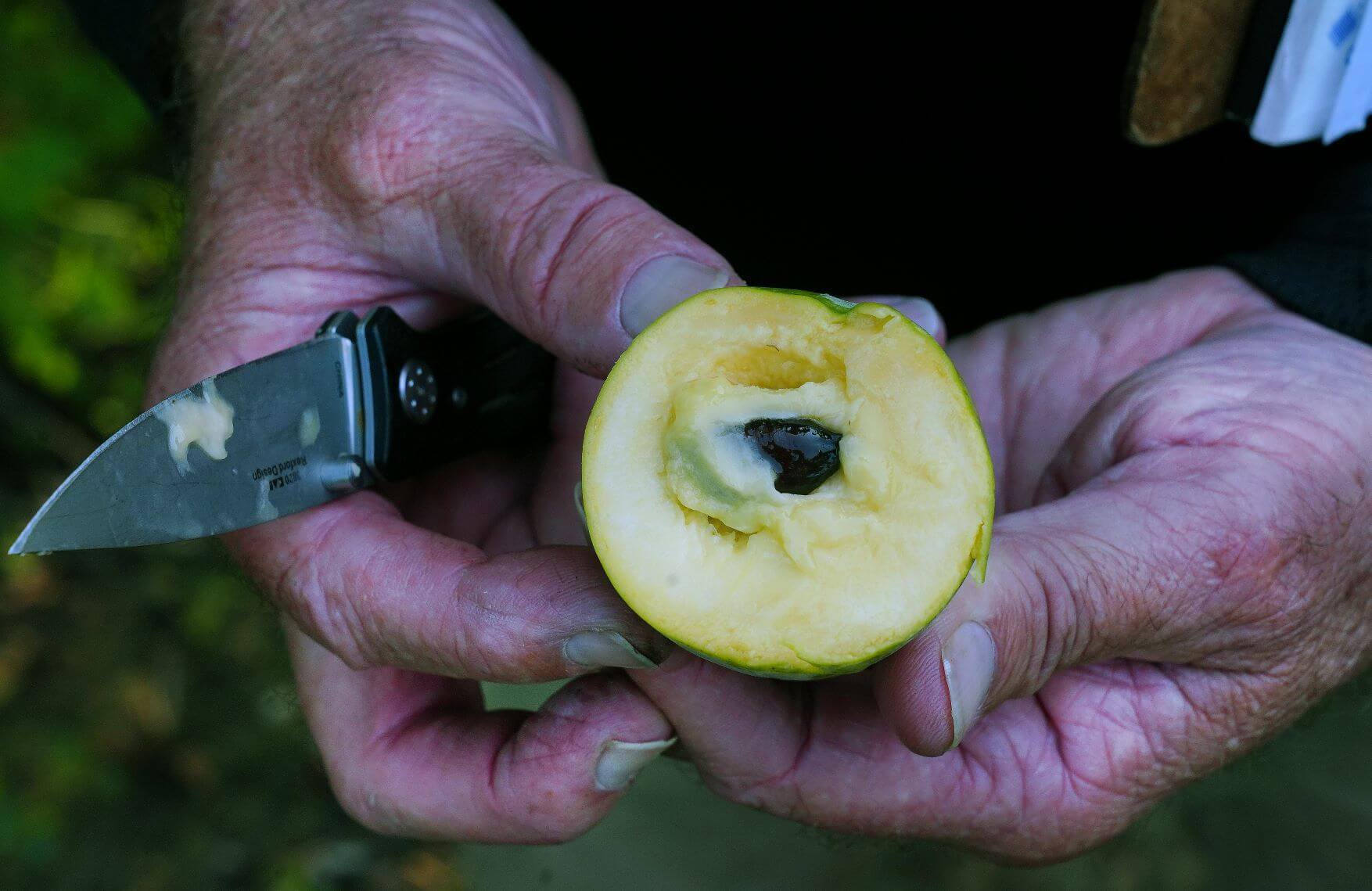
Bruce Bordelon, professor of horticulture, shows off the inside of a pawpaw fruit. Photos by Tom Campbell.
Emily Wendel, a freshman in horticulture and landscape architecture, grew up on an Indiana farm surrounded by naturally occurring pawpaw trees. While she doesn’t care for the fruit, her father has developed a passion for harvesting pawpaws, eating them raw or incorporating them into different recipes. He even delivers them regularly to Wendel’s grandmother who lives just down the road.
“My grandma and I don’t really like pawpaws raw but my dad kept bringing her buckets full,” Wendel said. “My grandmother used to be a home economics teacher. She didn’t want them to go to waste, so she started using them in different things. She makes this bread that we both really like.”
When Wendel’s grandmother heard her granddaughter recently discussed and tried pawpaws in her introductory botany class, she baked a batch of bread for Wendel to bring her peers.
“I grew up in a small town so it was normal to bring something grandma baked to class. People would get excited,” Wendel added. “In college I thought maybe people would wonder about the strange girl with the pawpaw bread. But most people were willing to try it and really enjoyed it. And it made my grandmother’s day.”
Wendel’s grandmother even wrote out the recipe below for her to share with others.
“Even though I don’t always like the taste, it’s really neat to have a fruit like pawpaws native to Indiana,” Wendel said. “I hope trying it in the bread has opened people’s eyes to its uses.”
Purdue Extension forester Lenny Farlee introduces you to the flowering dogwood, a species with simple leaves with an interesting venation pattern on them, white blossoms in the spring and red to maroon foliage in the fall.
If you have any questions regarding trees, forests, wildlife, wood products or other natural resource topics, feel free to contact us by using our Ask an Expert web page.
Meet the Eastern Hemlock, one of Indiana’s native conifers, which is typically found near canyons, ravines and steep slopes. They can grow to be more than 100 feet tall and to be 200-300 years old. Learn more from Purdue Extension forester Lenny Farlee below.
If you have any questions regarding trees, forests, wildlife, wood products or other natural resource topics, feel free to contact us by using our Ask an Expert web page.
Blackberry is a great wildlife plant as the berries are eaten by many different songbirds and wildlife, but this plant also has an important role for wildlife. In this video by wildlife extension specialist Jarred Brooke, you will learn what part this important plant plays in helping wildlife in our native grasslands.
If you have any questions regarding wildlife, trees, forest management, wood products, natural resource planning or other natural resource topics, feel free to contact us by using our Ask an Expert web page.
Purdue Extension forester Lenny Farlee introduces you to the Devil’s Walking Stick, a small tree from the ginseng family found in southern Indiana. It is identifiable by thorns or spikes along the stem, unique doubly compound leaves, and large clusters of small white flowers.
If you have any questions regarding trees, forests, wildlife, wood products or other natural resource topics, feel free to contact us by using our Ask an Expert web page.
In this edition of Wildlife Habitat Hint, Purdue wildlife extension specialist Jarred Brooke shares methods to control the invasive sericea lespedeza. This plant species, though was once used for erosion control and mineland reclamation, is too invasive and of little wildlife value.
If you have any questions regarding wildlife, trees, forest management, wood products, natural resource planning or other natural resource topics, feel free to contact us by using our Ask an Expert web page.
Brown or black spots with yellowing are signs of anthracnose.
This time of year, many black walnut trees’ leaves may have black spots, turn yellow and begin to drop. This is commonly known as anthracnose, a fungal disease that causes trees to drop their leaves prematurely.
Anthracnose is worsened by wet weather, and some trees are more genetically susceptible to anthracnose than others. It is not fatal but can look like a serious problem. The absence of leaves can slow a tree’s growth and can reduce the nut crop, although by this time of year growth may have slowed or stopped for the season.
Anthracnose generally begins as small circular brown to black areas on the leaflets. Over the season those spots expand and cause leaf drop. There are a few other leaf spot diseases of black walnut, see the references below for descriptions of those diseases.
Although unsightly, there is no need for further action if you are growing timber and have anthracnose in a plantation or woods. It can be an issue if you are growing walnuts for a nut crop, and there are resources and spray products to help manage the fungus in those situations.
If you have individual landscaping trees and want to limit anthracnose spread there are few things you can do:
Gather fallen leaves and compost or remove them from the site.
Control weeds which could carry the fungus.
Plant walnut trees where there is good air circulation.
Keep the trees healthy and vigorous by managing soil fertility and thinning competition as needed.
Liz Jackson, Manager Walnut Council / IN Forestry Woodland Owners Association (IFWOA) & Engagement Specialist
Purdue University Department of Forestry and Natural Resources