 Purdue University - Extension - Forestry and Natural Resources
Got Nature? Blog
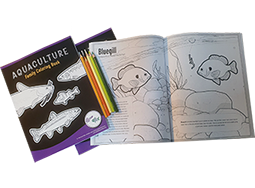
This print-your-own coloring book provides a fun and active way for children and adults to learn about the many kinds of aquatic animals raised on farms for aquaculture. Each spread highlights one species, pairing a beautifully illustrated coloring page with accompanying text for advanced and beginning readers with information about fisheries, recreational fishing, and cooking tips.
This publication is a collaborative project of Illinois-Indiana Sea Grant, the North Central Regional Aquaculture Center, University of Illinois Extension, and Purdue University’s Department of Forestry and Natural Resources.
To receive the free download for the Aquaculture Family Coloring Book visit The Education Store.
About the Author
Amy Shambach is Illinois-Indiana Sea Grant’s (IISG) aquaculture marketing outreach associate who works with the aquaculture industry in the USDA’s North Central Regional Aquaculture Center. Her work focuses on the demand side of domestic farm raised seafood products. She provides outreach and extension services to producers, potential producers, and consumers. Along with Dr. Kwamena Quagrainie, producers, aquaculture associations, and consumers, she works to determine the needs of stakeholders. View the Aquaculture Family Coloring Book Development Team with the free download of the book.
Resources:
Walleye Farmed Fish Fact Sheet, The Education Store
Pacific White Shrimp Farmed Fact Sheet, The Education Store
Yellow Perch Farmed Fish Fact Sheet, The Education Store
Tilapia Farmed Fish Fact Sheet, The Education Store
Rainbow Trout Farmed Fish Fact Sheet, The Education Store
American Paddlefish, The Education Store
Eat Midwest Fish, Illinois-Indiana Sea Grant online resource hub
Illinois-Indiana Sea Grant (IISG), Illinois-Indiana Sea Grant
Amy Shambach, Aquaculture Marketing Outreach Associate
Purdue Department of Forestry and Natural Resources/Illinois Indiana Sea Grant Program
Photo credit: Adobe Stock
Lawn to Lake Midwest is a great resource as the experts share each month care tips on how to have a healthy lawn all year long while using natural lawn care practices. For the month of May check out the things to watch out for and why testing your soil is important.
You will also find resources for more options for a sustainable lawn:
- Take the Natural Lawn Care Quiz and see where you are at with your lawn care practices.
- Take a look at some simply ways to incorporate more natural lawn care practices.
- If you’re ready, jump into the weeds to explore even more sustainable lawn management practices.
- Find answers to commonly asked lawn care questions.
Resources:
Forest Improvement Handbook, The Education Store
Turfgrass Science, Department of Horticulture & Landscape Architecture
Turfgrass Insect Management, The Education Store
Tree Planting Part 1: Choosing a Tree, Video, The Education Store
Purdue Turf Doctor app for Apple iOS, Apple App Store
Illinois-Indiana Sea Grant (IISG)
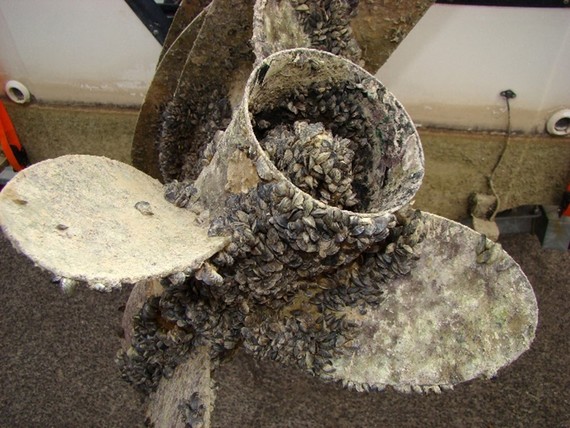 Wild Bulletin, Indiana Department of Natural Resources: As you prepare your boat or recreational equipment to get back on the water this spring, remember to look for aquatic hitchhikers. Zebra mussels, aquatic plants like Eurasian watermilfoil or starry stonewort, and many other invasive species continue to be a threat to Indiana’s waters by degrading fish habitat and negatively affecting recreational boating and fishing. The most common locations where plants, mussels, and animals hitch a ride include:
- Transom well near the drain plug
- Axle of the trailer
- Lower unit and propeller on the boat motor
- The rollers and bunks that guide the boat onto the trailer
- Anchor and lines
- Bait bucket and live well
Boat owners are asked to drain water from bait buckets, live wells, and boats before leaving the boat landing; leave drain plugs out while travelling on land; clean and dry anything that came in contact with water; and dispose of unwanted bait in the trash. Learn more about aquatic invasive species and how to prevent their movement.
Learn how to stop aquatic hitchhikers.
Find more information about aquatic invasive plants and aquatic invasive invertebrates. Subscribe and receive the Wild Bulletin, Indiana Department of Natural Resources.
Resources:
Invasive plants: Impact on Environment and People, Purdue Extension – Forestry and Natural Resources (FNR)
Report Invasive Species, Purdue Invasive Species
The GLEDN Phone App – Great Lakes Early Detection Network
EDDMaps – Early Detection and Distribution Mapping System
Indiana Department of Natural Resources: Invasive Species
Indiana Invasive Species Council
Cooperative Invasive Species Management Area (CISMA)
Aquatic Invasive Species in the Great Lakes: The Quagga Mussel, Purdue Extension – FNR
Lampreys, Indiana Division of Fish and Wildlife’s Animal Informational Series
Aquatic Invaders in the Marketplace, Illinois-Indiana Sea Grant (IISG)
Great Lakes Sea Grant Network (GLERL), NOAA – Great Lakes Environmental Research Laboratory
Purdue Researchers Get to the Bottom of Another Quagga Mussel Impact, Illinois-Indiana Sea Grant (IISG)
Protect Your Waters, U.S. Fish and Wildlife Service & U.S. Coast Guard
Nongame and Endangered Wildlife, Indiana Department of Natural Resources
Indiana Department of Natural Resources
In this episode of A Moment in the Wild, wildlife technician Zach Truelock introduces you to the southern two-lined salamander, a member of the lungless salamander family, which true to their name do nearly all of their respiration through their skin.
If you have any questions regarding wildlife, trees, forest management, wood products, natural resource planning, or other natural resource topics, feel free to contact us by using our Ask an Expert web page.
Resources
Question: Which salamander is this?, Got Nature? Blog, Purdue Extension – Forestry and Natural Resources
Salamanders of Indiana Book, The Education Store, Purdue Extension resource center
Amphibians: Frogs, Toads, and Salamanders, Purdue Nature of Teaching
The Nature of Teaching: Adaptations for Aquatic Amphibians, The Education Store, Purdue Extension resource center
Hellbender ID, Playlist, Purdue Extension – Forestry and Natural Resources YouTube Channel
A Moment in the Wild, Playlist, Purdue Extension – FNR YouTube Channel
Help the Hellbender, YouTube Playlist & Website
Zach Truelock, Hellbender Technician
Purdue University Department of Forestry and Natural Resources
Rod Williams, Assistant Provost for Engagement/Professor of Wildlife Science
Purdue University Department of Forestry and Natural Resources
Dr. Rod Williams‘ hellbender research, the Purdue rearing lab and more than 12 years of the lab’s work are featured in a new documentary, Hellbender in the Blue, produced by Teardrop Pictures.
The film premiered on January 12 at the Kan-Kan Cinema and Brasserie in Indianapolis and is now available to purchase and stream through Vimeo on Demand. Hellbender in the Blue is also heading out on the festival tour, including the Indiana Humanities Waterways Film Tour.
The Indiana Humanities Waterways Film Tour is a nine-city tour featuring six short documentary films about Indiana’s waterways. The films feature stories told by individuals from across the state and highlight their diverse relationships with water. Screenings are free and open to the public, although advance registration is requested. Select events will also include a panel featuring the filmmakers prior to the screening.
- Thursday, March 31, 6 p.m. CT/7 ET; New Harmony Atheneum, 401 Arthur St., New Harmony, IN 47631
- Tuesday, April 5, 6 p.m. ET; Jefferson County Public Library, 420 W. Main St., Madison, IN 47250
- Thursday, April 7, 8 p.m. ET; Taggart Amphitheatre (outdoor screening), 1856 Burdsal Pkwy., Indianapolis, IN 46208
- Tuesday, April 19, 6 p.m. ET; Fowler Theatre, 111 E. 5th St., Fowler, IN 47944
- Wednesday, April 20, 6:30 p.m. ET; Strand Theatre, 221 S. Main St., Kendallville, IN 46755
- Friday, April 29, 7 p.m. CT/8 p.m. ET; Marshall J. Gardner Center for the Arts, 540 S. Lake St., Gary, IN 46403
- Wednesday, May 11, 6:30 p.m. ET; Harrison County Arts, 113 E. Beaver St., Corydon, IN 47112
- Tuesday, May 17, 6:30 p.m. ET; Studebaker 112, 635 S. Lafayette Blvd., South Bend, IN 46601
- Tuesday, June 22, 6:30 p.m. ET; Richmond Art Museum, 350 Hub Etchison Pkwy., Richmond, IN 47374
The soundtrack to Hellbender in the Blue is available on Spotify, care of Eric Salazar, also known as @theclarinetguy on Instagram.
Purdue Forestry and Natural Resources’ involvement in the Hellbender in the Blue project began in April 2020, when Katelyn Calhoun, a documentary film maker with Teardrop Pictures, contacted Williams and research biologist/extension wildlife specialist Nick Burgmeier, regarding her desire to make a film about hellbenders in Indiana, as well the efforts Purdue, The Nature Conservancy and others have undertaken to protect/restore their populations and the efforts to remove dams from their habitat. The eventual goal is to make a more wide-ranging documentary about hellbenders throughout their range.
“We hope the film helps reach a broader audience to expand awareness of the project and encourages people to support efforts to protect hellbenders and Indiana’s water resources,” Burgmeier said.
Resources:
A Moment in the Wild, Playlist, Purdue Extension – Forestry and Natural Resources YouTube Channel
Improving Water Quality by Protecting Sinkholes on Your Property, Video, Purdue Extension – FNR YouTube Channel
Question: Which salamander is this?, Got Nature? Blog, Purdue Extension – Forestry and Natural Resources
Is it a Hellbender or a Mudpuppy?, Got Nature? Blog
Amphibians: Frogs, Toads, and Salamanders, Purdue Nature of Teaching
Help the Hellbender, Playlist & Website
The Nature of Teaching: Adaptations for Aquatic Amphibians, The Education Store, Purdue Extension resource center
Hellbenders Rock!, The Education Store
Help the Hellbender, North America’s Giant Salamander, The Education Store
Wendy Mayer, FNR Communications Coordinator
Purdue University Department of Forestry and Natural Resources
Rod Williams, Assistant Provost for Engagement/Professor of Wildlife Science
Purdue University Department of Forestry and Natural Resources
Nick Burgmeier, Research Biologist and Wildlife Extension Specialist
Purdue Department of Forestry and Natural Resources
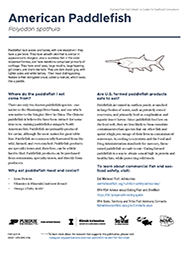
This publication American Paddlefish FNR-625-W is the fifth in a series of consumer guides that describe fish and shellfish farmed in the Midwest region of the United States. The fact sheet also includes culinary characteristics, cooking tips and a recipe for Zesty Grilled Paddlefish.
Paddlefish lack scales and bones, with one exception— the have a jawbone. They have smooth skin that is similar in appearance to sturgeon, also a scaleless fish in the order Acipenseriformes, and have skeletons comprised primarily of cartilage. They have small eyes, large mouths, large tapering gill covers, and shark-like tails. They are dark bluish gray, with lighter sides and white bellies. Their most distinguishing feature is their elongated snout, called a rostrum, which looks like a paddle.
There are only two known paddlefish species- one native to the Mississippi River basin, and one which was native to the Yangtze River in China. The Chinese paddlefish is believed to have been extinct2 for some time now, making paddlefish a uniquely North American fish. Paddlefish are primarily produced for caviar, although the meat makes for great table fare. Paddlefish are commercially harvested from the wild, farmed, and even ranched. Paddlefish products are specialty items and, therefore, can be a little hard to find. Paddlefish products can be purchased from restaurants, specialty stores, and directly from producers.
Resources:
Walleye Farmed Fish Fact Sheet, The Education Store
Pacific White Shrimp Farmed Fact Sheet, The Education Store
Yellow Perch Farmed Fish Fact Sheet, The Education Store
Tilapia Farmed Fish Fact Sheet, The Education Store
Rainbow Trout Farmed Fish Fact Sheet, The Education Store
Eat Midwest Fish, Illinois-Indiana Sea Grant online resource hub
Illinois-Indiana Sea Grant (IISG), Illinois-Indiana Sea Grant
Amy Shambach, Aquaculture Marketing Outreach Associate
Purdue Department of Forestry and Natural Resources/Illinois Indiana Sea Grant Program
In this episode of A Moment in the Wild, wildlife technician Zach Truelock introduces you to another member of the lungless salamander family, the cave salamander. This species, identifiable by its bright orange/red coloration covered in black spots, lives in caves as well as crevices along streams, rocky bluffs and springs.
If you have any questions regarding wildlife, trees, forest management, wood products, natural resource planning, or other natural resource topics, feel free to contact us by using our Ask an Expert web page.
Resources
Question: Which salamander is this?, Got Nature? Blog, Purdue Extension – Forestry and Natural Resources
Salamanders of Indiana Book, The Education Store, Purdue Extension resource center
Amphibians: Frogs, Toads, and Salamanders, Purdue Nature of Teaching
The Nature of Teaching: Adaptations for Aquatic Amphibians, The Education Store, Purdue Extension resource center
Hellbender ID, Playlist, Purdue Extension – Forestry and Natural Resources YouTube Channel
A Moment in the Wild, Playlist, Purdue Extension – FNR YouTube Channel
Help the Hellbender, YouTube Playlist & Website
Zach Truelock, Hellbender Technician
Purdue University Department of Forestry and Natural Resources
Rod Williams, Assistant Provost for Engagement/Professor of Wildlife Science
Purdue University Department of Forestry and Natural Resources
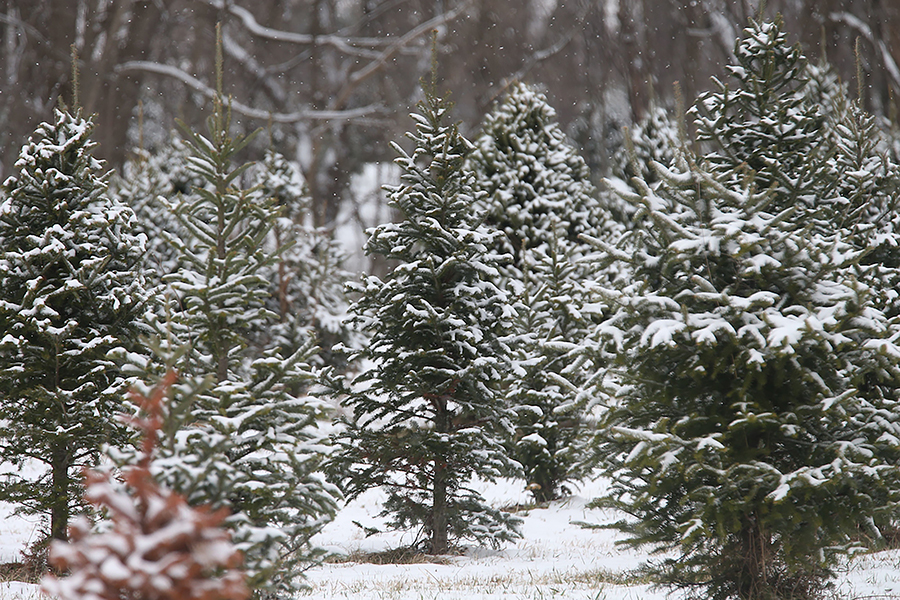 With the holidays over the needles are beginning to fall from your natural Christmas tree, continue to spread holiday cheer by returning your tree to nature.
Jarred Brooke, Extension wildlife specialist, shares a few creative ways you can repurpose and recycle your tree this year.
“Before you throw your used natural Christmas tree in the trash, think about recycling it on your property. Instead of taking up space in the landfill, your tree could decompose naturally while providing cover and food for fish, wildlife or insects,” said Brooke.
No matter how you choose to repurpose your tree, make sure it is free from ornaments and decorations. Do not recycle trees that have been sprayed with “fake” snow or treated with chemicals.
Create a habitat for fish
Throwing used Christmas trees in ponds is a great way to recycle the tree and provide a fish habitat to your pond. The small branches provide hiding spots for small fish to escape from larger predators.
If the pond is frozen with more than four inches of ice, you can drag your tree onto the ice. The tree will fall into place once the ice melts.
You should only add Christmas trees to your ponds or other private ponds with the permission of the pond owner. While they do provide great habitats for fish, they can be a nuisance for fishing as hooks and lines may get caught on branches. It is recommended that you keep trees away from popular fishing areas like docks.
Resources:
Selecting a Real Christmas Tree, Got Nature? Blog, Purdue Extension-Forestry and Natural Resources
A Choose-and-Cut Pine and Fir Christmas Tree Case Study, The Education Store, Purdue Extension’s resource center
Living Christmas Trees For The Holidays and Beyond, The Education Store
Growing Christmas Trees, The Education Store
Selecting an Indiana-Grown Christmas Tree, The Education Store
Forest/Timber Playlist, subscribe to Purdue Extension – Forestry and Natural Resources YouTube Channel
Aquatics & Fisheries, Playlist, Purdue Extension – Forestry and Natural Resources YouTube Channel
Ask an Expert: Pond Wildlife Management, Video, Purdue Extension – FNR YouTube Channel
Ask an Expert: Pond Management: What to Do in Winter, How to Plan for Spring, Video, Purdue Extension – FNR YouTube Channel
Aquatic Plant Management: Identifying and Managing Aquatic Vegetation, The Education Store
Pond and Wildlife Management, Purdue Extension-Forestry and Natural Resources
Jarred Brooke, Wildlife Extension Specialist
Purdue Forestry and Natural Resources
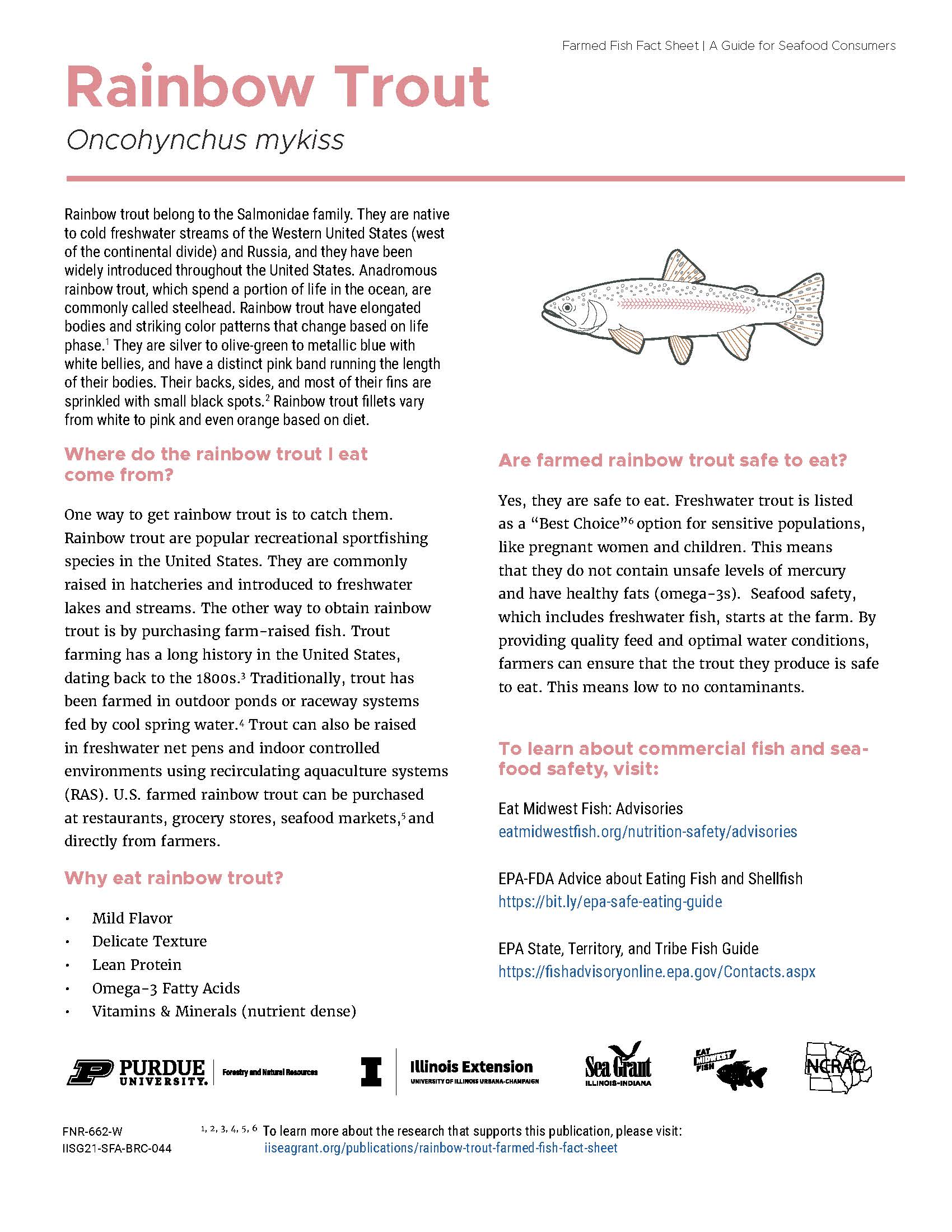 Find the answer in this free downloadable publication titled Rainbow Trout Farmed Fish Fact Sheet, FNR-622-W, along with culinary characteristics, cooking tips and a recipe for Grilled Rainbow Trout with Apricot Salsa.
This is the fourth in a series of consumer guides that describe fish and shellfish farmed in the Midwest region of the United States. (See FNR-608-W, Walleye Farmed Fish Fact Sheet, FNR-618-W, Yellow Perch Farmed Fish Fact Sheet and FNR-621-W, Tilapia Farmed Fish Fact Sheet).
Resources:
Fish: Healthy Protein Handout, The Education Store, Purdue Extension resource center
Walleye Farmed Fish Fact Sheet: A Guide for Seafood Consumers, The Education Store
Fish Cleaning with Purdue Extension County Extension Director, Got Nature? Blog, Purdue Extension – Forestry and Natural Resources (FNR)
Eat Midwest Fish, Website
Sustainable Aquaculture: What does it mean to you?, The Education Store
Best Practices Guide for Charter Fishing and COVID-19, The Education Store
Pond Management: Managing Fish Populations, The Education Store
Aquatics & Fisheries, YouTube Playlist, Purdue Extension – FNR
Amy Shambach, Aquaculture Marketing Outreach Associate
Purdue Department of Forestry and Natural Resources/Illinois Indiana Sea Grant Program

Pacific white shrimp, also known as whiteleg shrimp, is a variety of prawn in the order Decapod. Pacific white shrimp have ten legs on the underside of their carapace (head), ten appendages (pleopods) on their abdomen for swimming, a pair of antennae, and can reach a maximum length of 9 inches (230 mm). Shrimp color can vary slightly depending on habitat, feed, and water turbidity, and tend to range in color from translucent white to reddish-brown. When cooked, they turn pink.
Shrimp is the most popular seafood product in the United States. However, the majority of farmed shrimp is grown in Asia. The Pacific white shrimp is the most common farm-raised shrimp species in the world, and it is well suited for pond and indoor production. In the Midwest and other parts of the U.S., Pacific white shrimp are grown in indoor environmental controlled systems. U.S. farm raised shrimp can be purchased at farmers markets, restaurants, and directly from farmers.
This publication, Pacific White Shrimp, FNR-623-W, is the fifth in a series of consumer guides that describe fish and shellfish farmed in the Midwest region of the United States. The fact sheet also includes culinary characteristics, cooking tips and a recipe for Sautéed Old Bay® Shrimp.
Resources:
Walleye Farmed Fish Fact Sheet, The Education Store
Yellow Perch Farmed Fish Fact Sheet, The Education Store
Tilapia Farmed Fish Fact Sheet, The Education Store
Rainbow Trout Farmed Fish Fact Sheet, The Education Store
Eat Midwest Fish, Illinois-Indiana Sea Grant online resource hub
Illinois-Indiana Sea Grant (IISG), Illinois-Indiana Sea Grant
Amy Shambach, Aquaculture Marketing Outreach Associate
Purdue Department of Forestry and Natural Resources

Recent Posts
- Publication Helps Midwest Fish Producers “Catch a Following” with Consumers
Posted: October 12, 2026 in Aquaculture/Fish, Aquatic/Aquaculture Resources, Wildlife - Minecraft Meets the Hellbender
Posted: September 22, 2026 in Aquaculture/Fish, Aquatic/Aquaculture Resources, Wildlife - Saving Giants of the Blue River: Purdue Team Earns Statewide Recognition
Posted: May 14, 2026 in Aquaculture/Fish, Aquatic/Aquaculture Resources, Wildlife - Discover the Great Lakes, The 2025 Helm Magazine is Available
Posted: November 17, 2025 in Aquaculture/Fish, Aquatic/Aquaculture Resources, Wildlife - Illinois-Indiana Sea Grant Newsletter Shares New Resources
Posted: November 13, 2025 in Aquaculture/Fish, Aquatic/Aquaculture Resources, Wildlife - Learn to Process Your Own Deer – Wild Bulletin
Posted: November 11, 2024 in Aquatic/Aquaculture Resources, Forestry, How To, Wildlife - Publication – Handbook on Processing Fish for Small-Scale Fish Farmers
Posted: October 17, 2024 in Aquaculture/Fish, Aquatic/Aquaculture Resources, How To, Publication, Wildlife - Economics and Aquaculture Expert Kwamena Quagrainie is Featured Specialist in ANR Newsletter
Posted: October 15, 2024 in Aquatic/Aquaculture Resources, Great Lakes - Buoys Keep Eye on Great Lake Conditions
Posted: July 11, 2024 in Aquatic/Aquaculture Resources, Great Lakes, How To - IISG Adds New Water Safety Videos
Posted: May 8, 2024 in Aquaculture/Fish, Aquatic/Aquaculture Resources, Community Development, Great Lakes, Wildlife
Archives
Categories
- Alert
- Aquaculture/Fish
- Aquatic/Aquaculture Resources
- Ask the Expert
- Christmas Trees
- Community Development
- Disease
- Drought
- Forestry
- Forests and Street Trees
- Gardening
- Got Nature for Kids
- Great Lakes
- How To
- Invasive Animal Species
- Invasive Insects
- Invasive Plant Species
- Land Use
- Natural Resource Planning
- Nature of Teaching
- Plants
- Podcasts
- Ponds
- Publication
- Safety
- Spiders
- Timber Marketing
- Urban Forestry
- Webinar
- Wildlife
- Wood Products/Manufacturing
- Woodland Management Moment
- Woodlands