 Purdue University - Extension - Forestry and Natural Resources
Got Nature? Blog
 Question: What resources does Purdue Extension have on wind energy/contracts?
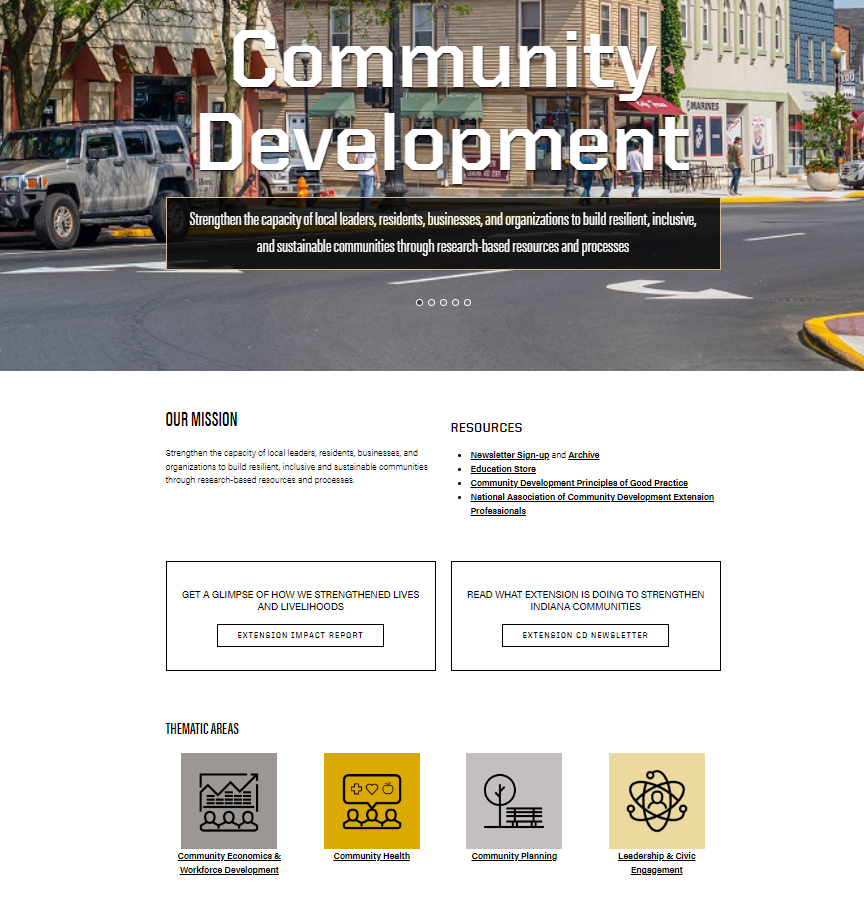
Answer: Purdue Extension has wind energy resources and information through the Purdue Extension – Community Development program. This program strengthens the capacity of local leaders, residents, businesses, and organizations to build resilient, inclusive and sustainable communities through research-based resources and processes. The team actively partners with a variety of state-level entities, including state agencies, private and nonprofit organizations, as well as universities and colleges. Such partnerships have facilitated the launch of applied research projects, the development of innovative educational programs and the delivering of technical assistance and non-formal education programs that are designed to meet the unique needs of Indiana communities and regions.
Under “Community Planning” you will find the resources and information for Renewable Energy. Learn more about the Purdue Extension Land Use Team as you visit the overview and find contacts, events, publications, general renewable energy, solar and wind resources.
Here are just a few of the resources listed on the Community Development-Community Planning-Wind Energy web page:
Agricultural Impact Statements: Wind Farms – State of Wisconsin Department of Agriculture, Trade and Consumer Protection
This article provides construction recommendations for commercial scale wind farms on farmland located specifically in the state of Wisconsin. This resource has links to licenses, permits, impact statements and groundwater quality reports that all pertain to the impacts of wind turbines on green-fields and the surrounding areas.
An Examination of the Community Level Dynamics Related to the Introduction of Wind Energy in Indiana
A team of researchers from Purdue University focused on where wind farm projects have and have not been located and examined socio-economic conditions that have resulted since the wind farms were (or were not) installed and made operational.
Blowing in the Wind: The Answer to Farmland Preservation – University of Michigan
This resource highlights the ways commercial wind farms can be used to preserve farmland and farming communities. This resource also emphasizes that wind farms are another source of income for farmers without having to sell their land.
Does my Land Qualify for a Wind Lease, LandGate Resources
This article highlights the requirements of a proper site for a commercial wind farm. These requirements include acreage, power grid access and the quality of the land. Included is a wind land estimator, designed to provide a rough estimate of a possible wind lease.
Sample Zoning for Wind Energy Systems – Michigan State University Extension
This publication presents a zoning ordinance sample amendment for utility-scale wind energy systems and smaller wind electric generation systems for an individual business or home.
These resources are just a glimpse from the Community Development program which shares many aspects of wind energy, along with other community planning, community economics and workforce development, community health, leadership and civic engagement. If you have further questions, feel free to reach out to the Renewable Energy Team.
Other Resources:
Environmental Planning in Community Plans, The Education Store, Purdue Extension’s resource center
Enhancing the Value of Public Spaces: Creating Healthy Communities, The Education Store
Conservation through Community Leadership, The Education Store
Tree Installation: Process and Practices, The Education Store
Planting Forest Trees and Shrubs in Indiana, The Education Store
Planting Your Tree Part 1: Choosing Your Tree, Video, Purdue Extension – Forestry and Natural Resources YouTube Channel
Subscribe – Purdue Extension – Forestry and Natural Resources YouTube Channel
Purdue Extension-Forestry and Natural Resources Calendar, workshops and Conferences
Michael Wilcox, Program Leader
Purdue Extension Community Development
Kara Salazar, Assistant Program Leader for Community Development and Sustainable Communities Extension Specialist
Purdue Forestry and Natural Resources/Illinois-Indiana Sea Grant/Purdue Extension
Diana Evans, Extension and Web Communication Specialist
Purdue University Department of Forestry and Natural Resources
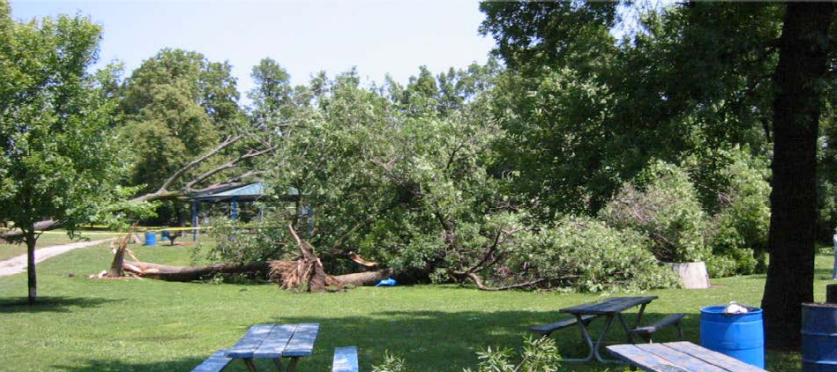 Safety first! Stay clear and look for dangerous hanging limbs, broken branches and other failures before beginning cleanup or inspections. Keep others clear of the areas beneath and around damaged trees. Be alert for power lines that could be involved with damaged trees. All utility lines should be considered energized and dangerous.
Lindsey Purcell, Chapter Administrator & Master Arborist with Indiana Arborist Association, shares, “in my experience, during storm cleanup, many tree owners are faced with the decision of what to do with their trees relative to restoration or removal”. There are several types of tree damage that occur from violent weather. Each has its own specific assessment considerations. All parts of the tree should be inspected during a post-storm assessment. This requires the expertise of trained, professional arborists to assist with the decision making regarding the best course of action. Unfortunately, there are those who take advantage of the situation and overcharge or provide poor advice when it comes to the best decision on their trees. Don’t make any hasty decisions and be sure you are hiring an International Society of Arboriculture (ISA) Certified Arborist, ask for references and proof of insurance in the process. To find an arborist near you, verify credentials and to find more information on trees view video: Find an Arborist, Trees are Good, ISA.
View publication Trees and Storms located in The Education Store, Purdue Extension’s resource center, for more information.
Resources:
Find an Arborist video, Trees are Good-International Society of Arboriculture (ISA)
Caring for storm-damaged trees/How to Acidify Soil in the Yard – In the Grow, Purdue Extension
Moist soil and rotten roots makes it easy for trees to come crashing down – Fox 59 News
Why Is My Tree Dying? – The Education Store
Tree Risk Management – The Education Store
Mechanical Damage to Trees: Mowing and Maintenance Equipment – The Education Store
Trees and Electric Lines – The Education Store
Indiana Prepared (IN-PREPared), Purdue Extension
Lindsey Purcell, Chapter Administrator & Master Arborist
Indiana Arborist Association
Kara Salazar has been promoted to Assistant Program Leader for Purdue Extension Community Development. She has served in this role part-time but will now be fully dedicated to this program area. Kara will maintain her 25% appointment with Illinois-Indiana Sea Grant (IISG) and serve on the Agriculture Natural Resources (ANR) Extension Advisory Committee. She will still be located in the Forestry Building (FORS 308) and affiliated with the Department of Forestry and Natural Resources (FNR).
Working with multidisciplinary teams, Kara oversees the development and delivery of programs to support environmental planning, community development, and sustainable development strategies in communities across Indiana and the Great Lakes states. Kara provides leadership to the Purdue Extension Community Development Program and serves as a liaison between Illinois-Indiana Sea Grant and Purdue Extension.
Kara has a B.S. in public affairs and environmental science and a M.P.A. in natural resources management and nonprofit management from the Indiana University School of Public and Environmental Affairs. She also received a M.S. Ed . degree from the IU School of Education at Indiana University-Purdue University Indianapolis (IUPUI) with concentrations in community building and science education. Additionally, she is a Ph.D. candidate in Natural Resources Social Science at Purdue University. Kara is a member of the American Institute of Certified Planners (AICP), a Climate Change Professional (CC-P), and a Professional Community and Economic Developer (PCED) with credentials from LEED AP Neighborhood Development, the National Green Infrastructure Certification Program (NGICP), and the National Charrette institute.
Congratulations to Kara in her new position as she continues to move Purdue Extension and IISG forward with her expertise and team building.
Check out Kara’s lead role in the following programs and learn about the vast resources available:
Purdue Extension Community Development – strengthens the capacity of local leaders, residents, businesses, and organizations to build resilient, inclusive and sustainable communities through research-based resources and processes. Examples of a few of the programs and resources available include: Leadership and Civic Engagement, Community and Organizational Planning, Economic and Business Development.
Illinois-Indiana Sea Grant (IISG) – utilizes research, outreach, and education to bring the latest science to Great Lakes communities and their residents. By connecting decision-makers with science, we help strengthen and preserve ecosystems and communities in southern Lake Michigan and beyond.
Agriculture & Natural Resources (ANR), Purdue Extension – ANR Educators serve as research based, unbiased information source for county and state constituents on a variety of topics including: crops, ag business, livestock, natural resource, horticulture, small farms, urban ag, pesticide use, and land conservation.
Purdue Extension – a leader in providing relevant, high-impact educational programs that transform he lives and livelihoods of individuals and communities in Indiana and the world. Purdue Extension – Forestry & Natural Resources (FNR) is a branch of the Cooperative Extension Service/Purdue Extension. FNR Extension provides resources for aquaculture, fish management, urban and forestry management, natural re source planning, wildlife, and sustainable biomaterials. We encourage you to browse, download free publications, utilize our Ask an Expert, subscribe to Got Nature? newsletter and view upcoming workshops.
More Resources including Kara’s publications and videos:
Implementation Examples of Smart Growth Strategies in Indiana, The Education Store, Purdue Extension’s resource center
Conservation Through Community Leadership, The Education Store
Climate Change and Sustainable Development, The Education Store
Climate Change: Are you preparing for it?, The Education Store
Enhancing the Value of Public Spaces, The Education Store
Enhancing the Value of Public Spaces: Creating Healthy Communities, The Education Store
One Water Approach to Water Resources Management, The Education Store
Rainscaping Education Program, Purdue Extension
Community Development, Purdue Extension
Community Planning Playlist, Purdue Extension-Forestry & Natural Resources (FNR) YouTube Channel
Rainscaping and Rain Gardens, Purdue Extension YouTube Channel
Conservation through Community Leadership, Purdue Extension You Tube Channel
Enhancing the Value of Public Spaces Program, Purdue Extension YouTube Channel
Indiana Creek Watershed Project – Keys to Success, Partnerships and People, Purdue Extension You Tube Channel
Subscribe to Purdue Extension – Forestry and Natural Resources YouTube Channel
Diana Evans, Extension and Web Communication Specialist
Purdue University Department of Forestry and Natural Resources
In this webinar hosted by Indiana Forestry & Woodland Owners Association, author Doug Tallamy discusses his book “The Nature of Oaks” and how Oaks sustain a complex and fascinating web of wildlife. Doug has also written Bringing Nature Home: How Native Plants Sustain Wildlife in Our Gardens which was awarded the silver metal in 2008 by the Garden Writers Association, Living Landscape, and Nature’s Best Hope. Tallamy has also founded Homegrown National Parks, a grassroots call-to-action to regenerate biodiversity and ecosystem function by planting native plants and creating new ecological networks.
Join IFWOA for their upcoming webinar that will be recorded and placed on their YouTube Channel:
- April 12, 2023 – Magnificent Trees of Indiana
Check out their Indiana Forestry & Woodland Association YouTube Channel for videos including: What is IFWOA?; A New Carbon Program for Hardwood Landowners Webinar, 202 Charles Deam Forest Stewardship Award and much more.
The Indiana Forestry & Woodland Owners Association (IFWOA) was founded in 1977 and is a non-profit organization dedicated to conservation and sustainable management of woodlands in Indiana. IFWOA advocates for scientific best practices for management to achieve objectives of clean water, wildlife habitat, soil protection, native species diversity, timber production, recreation, carbon sequestration and many others.
IFWOA is an affiliate of the National Woodland Owners Association. IFWOA is a partner, collaborator or is represented on leading National and State organizations. These memberships or collaborations are selected to advance Indiana Woodland owner’s interests. IFWOA monitors and influences legislation and economic trends impacting Indiana woodlands and landowners for our members. Membership in IFWOA provides a valuable network linkage to information and resources at the leading edge of science, industry and politics impacting Indiana woodlands.
Resources:
Find an Indiana Professional Forester, Indiana Forestry & Woodland Owners Association (IFWOA)
Purdue Arboretum Explorer
Native Trees of the Midwest, The Education Store
Shrubs and Woody Vines of Indiana and the Midwest, The Education Store
Investing in Indiana Woodlands, The Education Store
Forest Improvement Handbook, The Education Store
ID That Tree, Purdue Extension-Forestry & Natural Resources (FNR) YouTube playlist
Woodland Management Moment , Purdue Extension-FNR YouTube playlist
Diana Evans, Extension and Web Communication Specialist
Purdue University Department of Forestry and Natural Resources
Liz Jackson, Engagement Lead
Indiana Forestry & Woodland Association
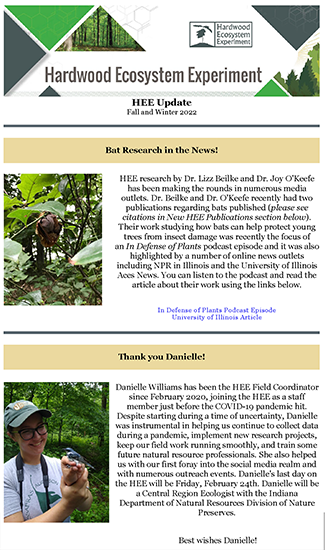 The Fall/Winter 2022 HEE Update newsletter is now available online. Research highlights and student news include:
- Bat Research in the News
- Thank You Danielle
- We Are Hiring
- A Second HEE Departure
- Welcome New Graduate Students
- HEE Publications
“The HEE Update” is distributed to anyone interested in receiving updates on the Hardwood Ecosystem Experiment (HEE). The newsletter includes updates of field work, media attention, committee meetings, extension events, job announcements, publications, and presentations. Anyone can receive this newsletter. If you would like to be added to the newsletter list email Dr. Mike Saunders, associate professor of silviculture, Purdue Forestry and Natural Resources, at msaunder@purdue.edu.
What is HEE?
The focus of forest science is increasingly shifting to the management of forests as complex systems rather than as simple agricultural landscapes—with a much greater appreciation for the interactive ecosystem processes. In addition, now for many forest landowners, the ecological value of their land is at least as important as the economic return. It is, therefore, vital to understand how forest management affects not only timber production, but also the overall function of forested ecosystems.
The Hardwood Ecosystem Experiment (HEE) is a long-term, large-scale experimental study of forest management and its impacts. The project was initiated in 2006 with partners including: Ball State University, Drake University, Indiana State University, Purdue Entomology, Indiana Department of Natural Resources (IN DNR), and the Indiana Chapter of the Ruffed Grouse Society.
For information about study sites, harvesting treatments, sampling design, and more, see our Project Overview and Design page and US Forest Service General Technical Report NRS-P-108, The Hardwood Ecosystem Experiment: A Framework For Studying Responses to Forest Management.
Resources
Hardwood Ecosystem Experiment, Website
Hardwood Ecosystem Experiment (HEE), YouTube Playlist, Purdue Extension–Forestry and Natural Resources (FNR)
Prescribed Fire, Hardwood Ecosystem Experiment (HEE) YouTube Video
Ask an Expert: Hardwood Ecosystem Experiment (HEE) Birds and Salamander Research, Video, Purdue Extension-FNR YouTube Channel
Hardwood Ecosystem Experiment – Wildlife Responses to Timber Harvesting, The Education Store, Purdue Extension’s resource center
The Hardwood Ecosystem Experiment: Indiana Forestry and Wildlife, The Education Store
The Help the Hellbender Project is a joint project involving partners from across the country. The conservation outreach continues as the team shares how important it is that our household and farm management practices are aiming to help keep our rivers and streams clean.
 The Help the Hellbender conservation efforts will continue expanding as the U.S. Department of Agriculture (USDA) announced it is awarding $197 million for 41 locally led conservation projects through the Regional Conservation Partnership Program (RCPP). RCPP is a partner-driven program that leverages partner resources to advance innovative projects that address climate change, enhance water quality, and address other critical challenges on agricultural land. The “Farmers Helping Hellbenders” project, led by Dr. Rod Williams and Purdue Extension wildlife specialist/Help the Hellbender project coordinator Nick Burgmeier, is among the projects set to receive funding through the RCCP Classic fund, which uses NRCS contracts and easements with producers, landowners and communities in collaboration with project partners. To view article and the fourteen contributing partners in the article USDA Awards Farmers Helping Hellbenders Project $2.7 Million in Funding.
Help the Hellbender Recent Team Awards
- The team was honored by the Hoosier Outdoor Writers group with its 2022 Bayou Bill Conservation Award. The annual conservation award is given in memory of the legendary Crothersville, Indiana, outdoor writer Bayou Bill Scifres, who was a founding member of HOW in 1969, and had his outdoors column published in The Indianapolis Star newspaper for 50 years. View full article on the Purdue Forestry and Natural Resources’ News: Help the Hellbender Program Receives Hoosier Outdoor Writers Conservation Award.
- The team recently received the Budd Denneman Partners in Conservation Excellence Award, Indiana Department of Natural Resources, Division of Fish & Wildlife
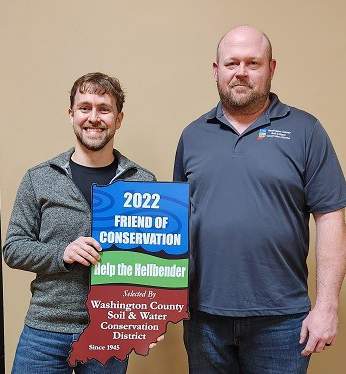
- Awarded the Friends of Conservation Award from the Washington County Soil and Water
The Help the Hellbender website is full of resources, activities, photos, posters, coloring pages and publications for homeowners, farmers, teachers and kids.
Resources:
Help the Hellbender Facebook page
Ask the Expert: Learn All About Hellbenders and Take a Tour, Subscribe Purdue Extension – Forestry & Natural Resources (FNR) YouTube Channel
Ask the Expert video: Help the Hellbender – Dr. Stephen Spear of The Wilds, Purdue Extension – FNR YouTube Channel
Ask the Expert video: Live with Mesker Park Zoo and Botanical Gardens – Hellbenders, Purdue Extension – FNR YouTube Channel
A Moment in the Wild video: Hellbender Hide, Purdue Extension – FNR YouTube Channel
A Moment in the Wild video: Release Moment of Hellbenders,
How Anglers and Paddlers Can Help the Hellbender video, Purdue Extension – FNR YouTube Channel
Eastern Hellbender ID Video, Purdue Extension – FNR YouTube Channel
Hellbenders Rock!, The Education Store, Purdue Extension’s resource center
Help the Hellbender, North America’s Giant Salamander, The Education Store
How Our Zoos Help Hellbenders, The Education Store
The Nature of Teaching: Adaptations for Aquatic Amphibians, The Education Store
Healthy Water, Happy Home – Lesson Plan, The Education Store
Purdue Expert: Hellbender Salamander, Purdue University News YouTube Channel
FNR Assists in First Natural Breeding of Eastern Hellbender in Captivity, Purdue FNR News & Stories
Helping the Hellbender: Mesker Park Zoo Begins Captive Breeding Efforts, Purdue Agriculture News
Diana Evans, Extension and Web Communication Specialist
Purdue University Department of Forestry and Natural Resources
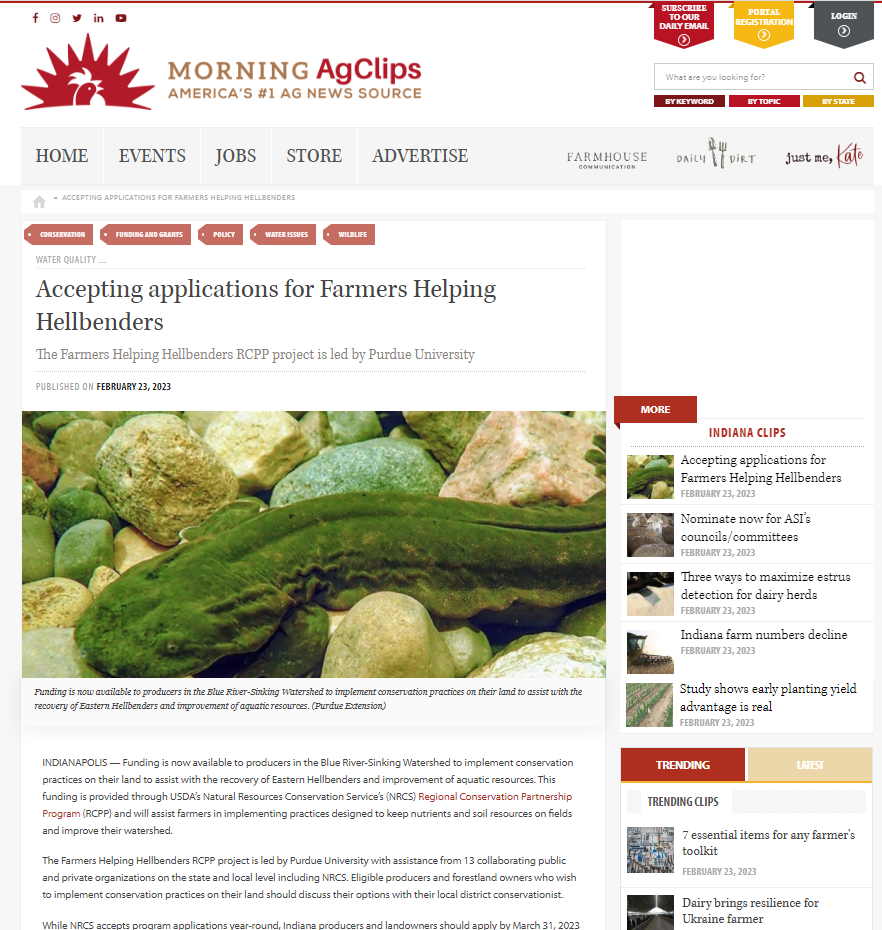 Morning AgClips, Indianapolis, Accepting Applications for Farmers Helping Hellbenders — Funding is now available to producers in the Blue River-Sinking Watershed to implement conservation practices on their land to assist with the recovery of Eastern Hellbenders and improvement of aquatic resources. This funding is provided through USDA’s Natural Resources Conservation Service’s (NRCS) Regional Conservation Partnership Program (RCPP) and will assist farmers in implementing practices designed to keep nutrients and soil resources on fields and improve their watershed.
The Farmers Helping Hellbenders RCPP project is led by Purdue University with assistance from 13 collaborating public and private organizations on the state and local level including NRCS. Eligible producers and forestland owners who wish to implement conservation practices on their land should discuss their options with their local district conservationist.
While NRCS accepts program applications year-round, Indiana producers and landowners should apply by March 31, 2023 to be considered for the current RCPP-Hellbender funding cycle. Applications received after March 31 will automatically be considered during the next funding cycle. For more information or to submit an application, contact your local district conservationist by visiting Farmers.gov/Service-locator.
The goals of the Farmers Helping Hellbenders project include improved water quality due to decreases in runoff, improved aquatic habitat due to decreases in sedimentation, increases in Hellbender and other aquatic wildlife populations due to improved habitat and water quality, increases in riparian and pollinator habitat due to implementation of riparian buffers and pollinator-friendly species, and increased protection of karst due to reduced runoff into sinkholes.
“The Farmers Helping Hellbenders RCPP project enables us to leverage partnerships to make a lasting positive impact on the habitat of the Eastern Hellbender salamander,” said Acting State Conservationist Dan Hovland. “This project will enable Indiana farmers and forestland owners to conserve the vital natural resources on their land while also protecting the habitat for hellbenders and other aquatic animals. It is a win-win.”
The total financial assistance to landowners over the three-year project is more than $1.9 million and is available for agricultural lands in portions of Washington, Harrison, Crawford, and Floyd counties, the only remaining area in Indiana where the Eastern Hellbender can be found and is currently being actively managed.
“This project is the perfect opportunity for land managers to help an imperiled species, while maintaining productive working lands,” said Brianne Lowe, Indiana NRCS state biologist. “Hellbenders are particularly susceptible to sedimentation in the water. Farmers and forest landowners that implement conservation practices can help improve water quality by keeping soil on the land and protecting aquatic nesting beds for the hellbender.”
Indiana eligible practices for farmers in the Blue River-Sinking Watershed for this funding period include conservation cover, grassed waterways, wildlife habitat planting, and nutrient management, riparian buffers and many others. Eligible farmers are encouraged to contact their local NRCS office before March 31 to apply for the current funding cycle. This funding will enable producers to improve the health and productivity of their operations.
Visit https://www.nrcs.usda.gov/indiana/RCPP to learn more about RCPP or click visit www.farmers.gov/working-with-us/service-center-locator find your local USDA-NRCS service center.
USDA Natural Resources Conservation Service
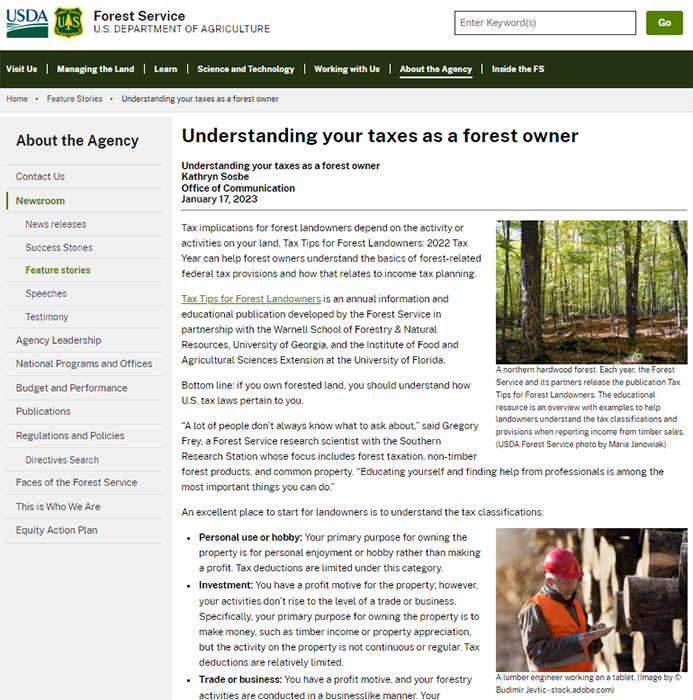 Tax preparation time usually brings with it questions about what is deductible, how do I report this income, and what can I do to save on my taxes in the future. Fortunately for forest landowners, this resource for tax tips from the U.S. Department of Agriculture-Forest Service provides several excellent resources to help you find some guidance. View Understanding Your Taxes as a Forest Owner.
The National Timber Tax Website, which is also shared in this article, addresses tax issues for forest landowners. This site provides updated tax tips for the 2022 filing year, as well as many guides and references to help you effectively plan a tax strategy for your property.
The USDA Forest Service mission of sustaining the health, diversity and productivity of the nation’s forests and grasslands to meet the needs of present and future generations, continues on as they provide many resources including managing your land, science and technology, and working with the U.S. Forest Service.
More resources: Purdue Extension – Forestry and Natural Resources offers some publications covering taxation issues for timber sales and tree planting.
How to Treat Timber Sale Income, The Education Store, Purdue Extension’s resource center
Determining Tax Basis of Timber, The Education Store
Financial and Tax Aspects of Tree Planting, The Education Store
The Education Store (for a list of all timber resources or woodlands place in search field: “timber” or “woodlands”)
Classified Forest and Wildlands Program , Indiana Department of Natural Resources: Division of Forestry
Find an Indiana Professional Forester, Indiana Forestry & Woodland Owners Association (IFWOA)
The Purdue Rainscaping Education Program introduces two new videos as they continue to provide training and resources on rainscaping practices that can be installed in residential settings or small-scale public spaces projects.
Rainscaping and Rain Gardens
Rainscaping is a combination of sustainable landscape design and management practices that prevents polluted runoff from reaching water bodies — directing stormwater to be absorbed by plants and soils.
Rainwater Harvesting with Cisterns
This video demonstrates how rainwater can be harvested with cisterns for future use in your landscaping and gardens.
Rainscaping is a combination of sustainable landscape design and management practices that prevents polluted runoff from reaching water bodies — directing stormwater to be absorbed by plants and soils. Learn more about rainscaping and demo rain gardens at: Purdue Rainscaping Education Program.
Resources:
What is Rainscaping? Purdue Rainscaping Education Program Video, Purdue Extension
Q&A About Drainage Water Recycling for the Midwest, The Education Store, Purdue Extension resource center
Rainscaping Playlist, Purdue Extension – Forestry and Natural Resources (FNR) YouTube Channel
Ask an Expert: Rainscaping, Purdue Extension – FNR YouTube Channel
Rain Gardens Go with the Flow, Indiana Yard and Garden, Purdue Horticulture
Become a Purdue Master Gardener, The Education Store
Master Gardeners Program
Plan Today For Tomorrow’s Flood, The Education Store
John Orick, Purdue Master Gardener State Program Coordinator
Department of Horticulture & Landscape Architecture
Kara Salazar, Assistant Program Leader and Extension Specialist for Sustainable Communities
Department of Forestry and Natural Resources
You may have many reasons why you want to plant trees on your land and this webinar Conservation Tree Planting will help you as you define your objectives and plan your planting. This webinar explains the difference between conservation tree planting and ornamental or landscape tree planting. The research based techniques and resources shared will help guide you as you work toward meeting your goals.
Lenny Farlee, Purdue extension forester, discusses topics including:
- reforestation
- tree species
- growth rates
- ordering seedlings
- weed control/herbicides
- equipment
- erosion control
- windbreaks
- soil health
- post-planting care/thinning
- fencing options
- wildlife habitat management
We Want to Hear From You:
After you have viewed the webinar please fill out the Qualtrics Survey and let us know if the video was helpful.
Resources:
Resources and Assistance Available for Planting Hardwood Seedlings, The Education Store, Purdue Extension’s resource center
Creating a Wildlife Habitat Management Plan for Landowners, The Education Store
Planting Forest Trees and Shrubs in Indiana, The Education Store
Forest Improvement Handbook, The Education Store
How to Build a Plastic Mesh Deer Exclusion Fence, The Education Store
Woodland Stewardship for Landowners Purdue Extension – Forestry & Natural Resources (FNR) Extension YouTube Playlist
Woodland Management Moment, Purdue Extension – FNR YouTube Playlist
Lenny Farlee, Sustaining Hardwood Extension Specialist
Purdue University Department of Forestry and Natural Resources

Recent Posts
- It’s Timberdoodle Time!
Posted: April 3, 2026 in Got Nature for Kids, How To, Wildlife - Keep An Eye Out for Hammerhead Worms, Purdue Landscape Report
Posted: April 2, 2026 in Invasive Animal Species, Wildlife, Woodlands - When is the Peak Migration For Hummingbirds and How Can You Attract Them?
Posted: in How To, Wildlife - ID That Tree Featured in National Woodland Owners Association Newsletter
Posted: April 1, 2026 in Urban Forestry, Wildlife, Woodlands - New 2026 Indiana Woodland Steward Newsletter
Posted: March 30, 2026 in Urban Forestry, Wildlife, Woodlands - A Woodland Management Moment: Why Aspect Matters
Posted: in Urban Forestry, Woodland Management Moment, Woodlands - 2026 Winter Bat Survey In Progress, MyDNR
Posted: March 27, 2026 in How To, Wildlife - Fast-Growing Trees for the Landscape, Purdue Landscape Report
Posted: March 26, 2026 in Forestry, Urban Forestry, Woodlands - Urban Tree Spotlight: Planting Deciduous Shade Trees, Purdue Landscape Report
Posted: March 25, 2026 in Forests and Street Trees, Urban Forestry, Woodlands - Beetle that attacks Tree-of-Heaven found in Indiana, Purdue Landscape Report
Posted: March 20, 2026 in Invasive Insects, Wildlife, Woodlands
Archives
Categories
- Alert
- Aquaculture/Fish
- Aquatic/Aquaculture Resources
- Ask the Expert
- Christmas Trees
- Community Development
- Disease
- Drought
- Forestry
- Forests and Street Trees
- Gardening
- Got Nature for Kids
- Great Lakes
- How To
- Invasive Animal Species
- Invasive Insects
- Invasive Plant Species
- Land Use
- Natural Resource Planning
- Nature of Teaching
- Plants
- Podcasts
- Ponds
- Publication
- Safety
- Spiders
- Timber Marketing
- Uncategorized
- Urban Forestry
- Webinar
- Wildlife
- Wood Products/Manufacturing
- Woodland Management Moment
- Woodlands