 Purdue University - Extension - Forestry and Natural Resources
Got Nature? Blog
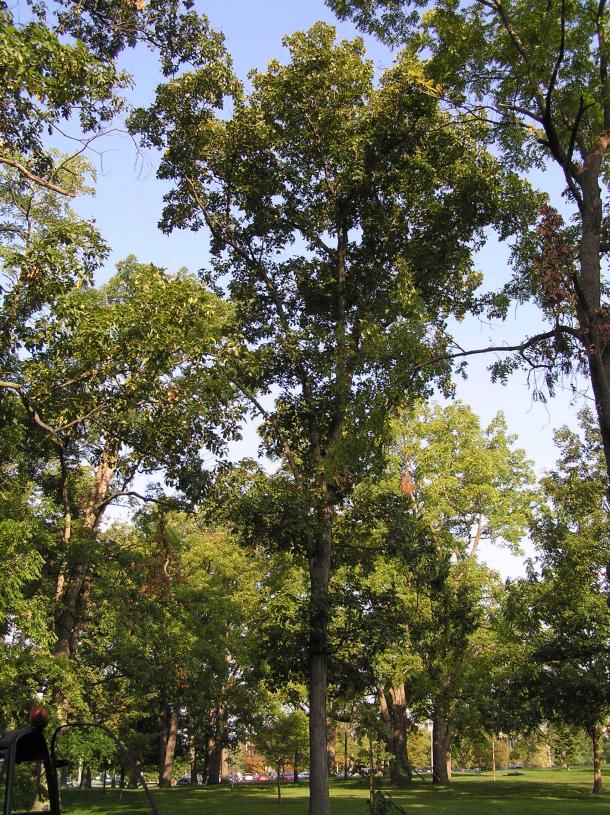 Following a recent tornado in Monroe County, an Indiana homeowner noticed something remarkable among the storm damage. More than 30 trees, including walnut and butternut, were either uprooted or snapped. Yet several mature shagbark hickory trees stood largely untouched amid the destruction.
This observation prompted an interesting question: Is there something about shagbark hickory trees that makes them more resistant to tornadoes and high winds than other hardwood trees?
Answer: While every storm is different and no tree species is completely tornado-proof, the observation aligns with what foresters and arborists know about hickory wood.
Shagbark, along with other hickory species, is among one of the stronger trees native to Indiana. Because of its strength and shock-absorbency quality, hickory is a prime choice for tool handles and baseball bats as well as solid wood furniture and flooring.
Shagbark hickory (Carya ovata) is famous for more than its distinctive peeling bark. The wood itself possesses exceptional mechanical properties.
Hickory wood combines:
- High strength
- Notable elasticity
- Superior shock resistance
- High density
Together, these properties give hickory exceptional toughness – the capacity to absorb and redistribute energy before fracturing. This means its stems and branches may bend under wind loading rather than fail as abruptly as wood with lower toughness.
For that reason, hickory has long been valued for products subjected to repeated impacts. Traditional axe and sledgehammer handles, drumsticks, and baseball bats have often been made from hickory because it can absorb shock and withstand repeated bending stresses without breaking as readily as many other hardwoods.
Healthy Trees:
Healthy trees with vigorous growth and little decay generally withstand stress better than weakened trees. This is one reason why it is important to evaluate your trees before severe weather and storm season arrives. Identifying structural defects, dead branches, decay, or other potential hazards early can help reduce the risk of tree failure during high wind events. The following Purdue Extension-Forestry and Natural Resources (FNR) blog articles can help you assess your trees and recognize common warning signs:
Learn More – Got Nature? Blog Posts:
Tree Risk Management: What Every Property Owner Needs to Know
Spring Storms Are Coming: How to Reduce Tree Damage and Risk
Trees and Storms: Understanding Damage, Risk and Recover
Storms Can Cause Damage and Tree Cleanup: What You Need to Know
Southwest Damage, Scalding or Frost Cracking
Great Resource from The Education Store, Purdue Extension’s resource center:
Publication: Tree Defect Identification
Contact a Certified Arborist:
Consulting a certified arborist can help determine whether a damaged tree remains safe and healthy.
Find an Arborist, Trees are Good-International Society of Arboriculture (ISA)
Ben McAllister, Urban Forestry Specialist
Forestry & Natural Resources
More Resources:
Mechanical Damage to Trees: Mowing and Maintenance Equipment, Got Nature? Blog, Purdue Extension – FNR
Planting Your Tree Part 1: Choosing Your Tree, Purdue Extension YouTube Channel
Tree Pruning Essentials Video, Purdue Extension YouTube Channel
Why Is My Tree Dying?, Got Nature? Blog, Purdue Extension – Forestry and Natural Resources (FNR)
Tree Wound and Healing, Got Nature? Blog, Purdue Extension – FNR
Surface Root Syndrome, The Education Store
Report INvasive, Purdue Extension
Indiana Invasive Species Council
ID That Tree, Playlist, Purdue Extension – FNR YouTube Channel (Invasive White Mulberry, Siberian Elm, Tree of Heaven)
Fifty Common Trees of Indiana
Native Trees of the Midwest, Purdue University Press
Subscribe – Purdue Extension-FNR YouTube Channel

Recent Posts
- Question: Why Did the Shagbark Hickories Survive the Tornado?
Posted: August 27, 2026 in Forests and Street Trees, How To, Urban Forestry - New Indiana Woodland Steward Newsletter
Posted: August 12, 2026 in Forestry, Urban Forestry, Wildlife, Woodlands - Indiana Fall Hunting Licenses on Sale and New Mobile App Available
Posted: in Forestry, How To, Wildlife - Trees and Storms: Understanding Damage, Risk and Recovery
Posted: in How To, Urban Forestry - Lighting a Spark: Prescribed Burn Associations
Posted: August 6, 2026 in Community Development, Forestry, Safety, Wildlife - ID That Tree: Nannyberry Viburnum
Posted: July 22, 2026 in Forestry, Plants, Wildlife, Woodlands - ID That Tree: Eastern Swamp Privet
Posted: in Forestry, Plants, Wildlife, Woodlands - Jarred Brooke Receives Early Career Award for Prescribed Fire Work
Posted: July 20, 2026 in Forestry, Forests and Street Trees, Natural Resource Planning, Safety - Bovine Tuberculosis in Wild White-tailed Deer: Background and Frequently Asked Questions
Posted: in Disease, Natural Resource Planning, Wildlife - ID That Tree: Carolina Buckthorn
Posted: July 15, 2026 in Forestry, Wildlife, Woodlands
Archives
Categories
- Alert
- Aquaculture/Fish
- Aquatic/Aquaculture Resources
- Ask the Expert
- Christmas Trees
- Community Development
- Disease
- Drought
- Forestry
- Forests and Street Trees
- Gardening
- Got Nature for Kids
- Great Lakes
- How To
- Invasive Animal Species
- Invasive Insects
- Invasive Plant Species
- Land Use
- Natural Resource Planning
- Nature of Teaching
- Plants
- Podcasts
- Ponds
- Publication
- Safety
- Spiders
- Timber Marketing
- Urban Forestry
- Webinar
- Wildlife
- Wood Products/Manufacturing
- Woodland Management Moment
- Woodlands