 Purdue University - Extension - Forestry and Natural Resources
Got Nature? Blog
Join Purdue Extension forester Lenny Farlee in this episode of “A Woodland Management Moment” as he discusses the benefits of using windbreak plantings around hardwood tree plantations. Using a black walnut planting as an example, this episode introduces how windbreaks can influence early growth, protection and overall tree form. The video also connects windbreaks to broader planting strategies and long-term management objectives. Watch to learn how thoughtful plantation design can support both tree performance and woodland management goals.
A good resource to learn more is the Walnut Council website. Founded in 1970, the Walnut Council is an international association representing nearly 700 woodland owners, foresters, forest scientists, and wood-producing industry representatives in 45 states and three foreign countries. The purpose is to assist in the technical transfer of forest research to field applications, help build and maintain better markets for wood products and nut crops, and to promote sustainable forest management, conservation, reforestation, and utilization of American black walnut (Juglans nigra) and other high quality fine hardwoods.
If you have any questions regarding trees, forests, wildlife, wood products, or other natural resource topics, feel free to contact us by using our Ask an Expert web page.
Resources:
A Woodland Management Moment, Playlist, Purdue Extension – Forestry and Natural Resources (FNR) YouTube Channel
Explore the Rich World of Oaks with Purdue FNR Extension & Partners, Purdue Extension – FNR Got Nature? Blog
Conservation Tree Planting: Steps to Success, Purdue Extension – FNR YouTube Channel
It’s Not Too Late to Order Trees for Spring Planting, Purdue Extension – FNR Got Nature? Blog
Shrubs and Woody Vines of Indiana and the Midwest, Purdue University Press
Native Trees of the Midwest, Purdue University Press
ID That Tree, Playlist, Purdue Extension – FNR YouTube Channel
Investing in Indiana Woodlands, The Education Store
Woodland Stewardship for Landowners Video Series, Playlist, Indiana Department of Natural Resources YouTube Channel
District Forester, Indiana DNR Division of Forestry, for over 10 acres of woodlands
Professional Forester, Indiana Forestry & Woodland Owners Association (IFWOA)
Forest Improvement Handbook, The Education Store
Purdue Arboretum Explorer
Lenny Farlee, Extension Forester
Hardwood Tree Improvement and Regeneration Center
Purdue Department of Forestry & Natural Resources
Check out the Purdue Extension – Forestry and Natural Resources YouTube Channel for more videos and webinars covering urban and forestry management, woodlands and wildlife.
Lenny Farlee, Extension Forester
Hardwood Tree Improvement and Regeneration Center
Purdue Department of Forestry & Natural Resources
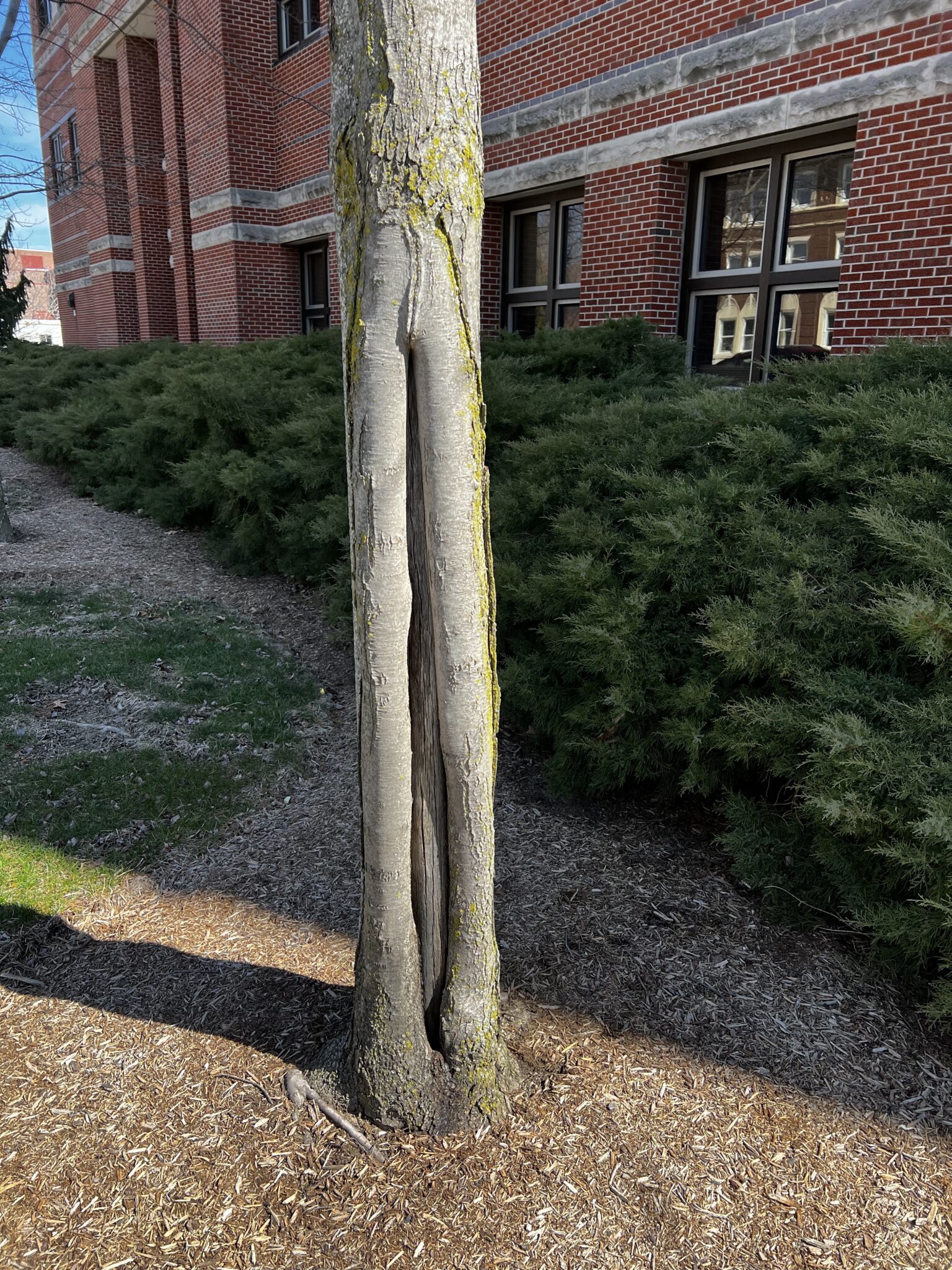
Figure 1 – Southwest damage from the base of the tree up the trunk.
We are now on the other side of the equinox, and while the days are getting longer again, we are beset with Midwest snows and icy temperatures that could persist to the beginning of Spring in March. During this time, there is a likely chance of a “tug-of-war” between our current cold weather and intermittent warm spells, and it’s a good time to check on your trees, especially newly transplanted trees and species with thinner bark.
As you head outdoors, what you might notice are signs of damage to your trees that include splits or cracks that could range in size from less than 1” to up to the entire length of the main stem and/or sunken areas on the trunk (Figs. 1 & 2). What you’re witnessing is winter stem damage known as sunscald or southwest damage (usually located on south to southwest-facing sides of the tree).
So, what is southwest damage and why has your tree been affected by it? It’s a wound that’s opened during winter due to sudden drops in temperature. These drops can come from different instances like the change from day to night or even from sudden cloud cover on a sunny day. The sun warms the trunk on the south to southwest faces of the tree, then the temperature change causes the bark to split. Repeated instances eventually cause dehydration of the damaged area which causes scalding.
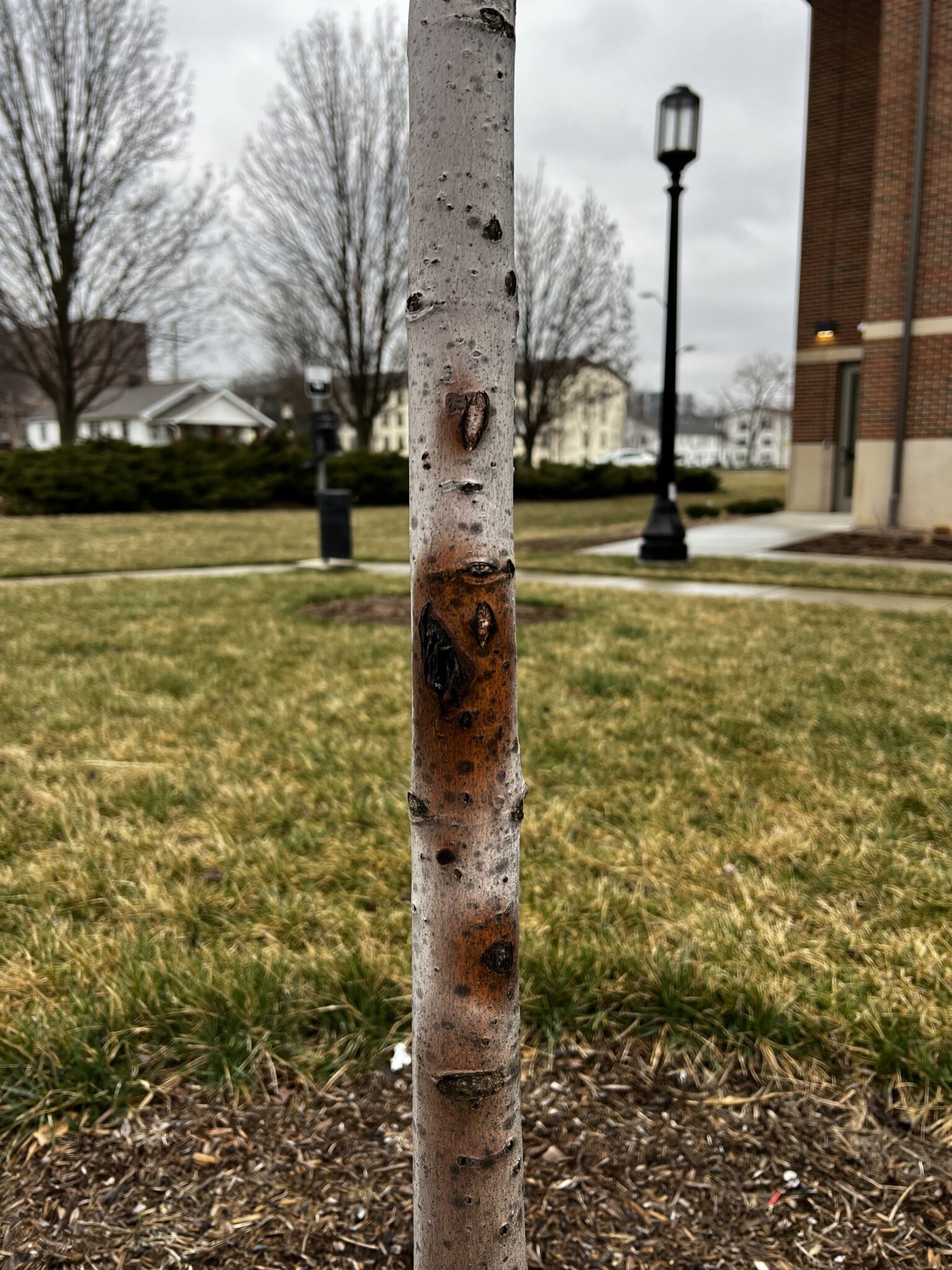
Figure 2 – Sunken wound from scalding damage.
Southwest damage comes from a previously sustained injury and will likely be found on younger trees or species with thin bark including Acer spp., Betula spp., Malus spp., Platanus spp., Prunus spp., and Ulmus spp. If these trees are also stressed, for example, from the dryer hotter summers we’ve been experiencing or other factors, they will be more vulnerable to damage moving into winter months.
As your trees grow and become more established, chances of damage decrease. Install white tree guards in Fall on trees less than 4” to help protect them during the winter. Those of you that are ahead of the game in your tree protection will have already done this last year to help prevent southwest damage (and damage from deer rub if you installed them in the fall before the rut). I commend you on your efforts, but make sure not to leave them on year-round. As things begin to heat up those covers can be a source of moisture retention which can lead to rot on the trunk of your tree. Plan on removing them as Spring sets in and save them for next Fall.
If cracking has already occurred, don’t panic. It’s not the end of your tree. Depending on the extent of the damage the tree may be able to seal off the damage with callus tissue called wound wood (Fig. 4). Healthier trees can produce this more quickly. Some things you can do to assist your tree include the following:
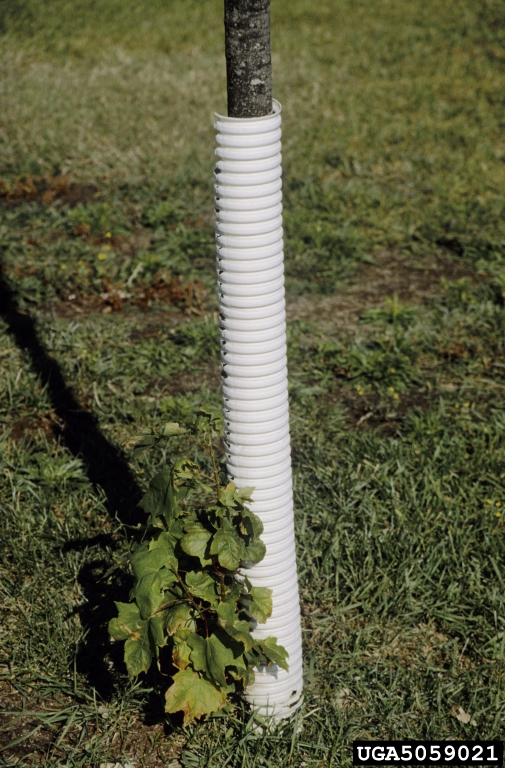
Figure 3 – Use of white tree guards can protect the trunk from temperature changes that cause damage.
- Putting your tree on a watering schedule (especially in the summer) to reduce water and heat stress.
- Mulching your tree (no mulch volcanoes) can help stop mechanical damage from mowing and other lawn maintenance and can also help with water retention in the soil.
- Herbicide use should be limited and done on days with little to no wind to help reduce drift onto the tree.
- Plan on installing white tree guards mid to late Fall. I like the white corrugated drainpipes you can find at local home and garden stores. Make sure to get a diameter larger than you tree to provide airflow to the trunk.
If you are still worried about the health of your tree, you can always find an ISA Certified Arborist nearby using the Trees Are Good website. They will be able to help assess any other issues and provide excellent professional help.
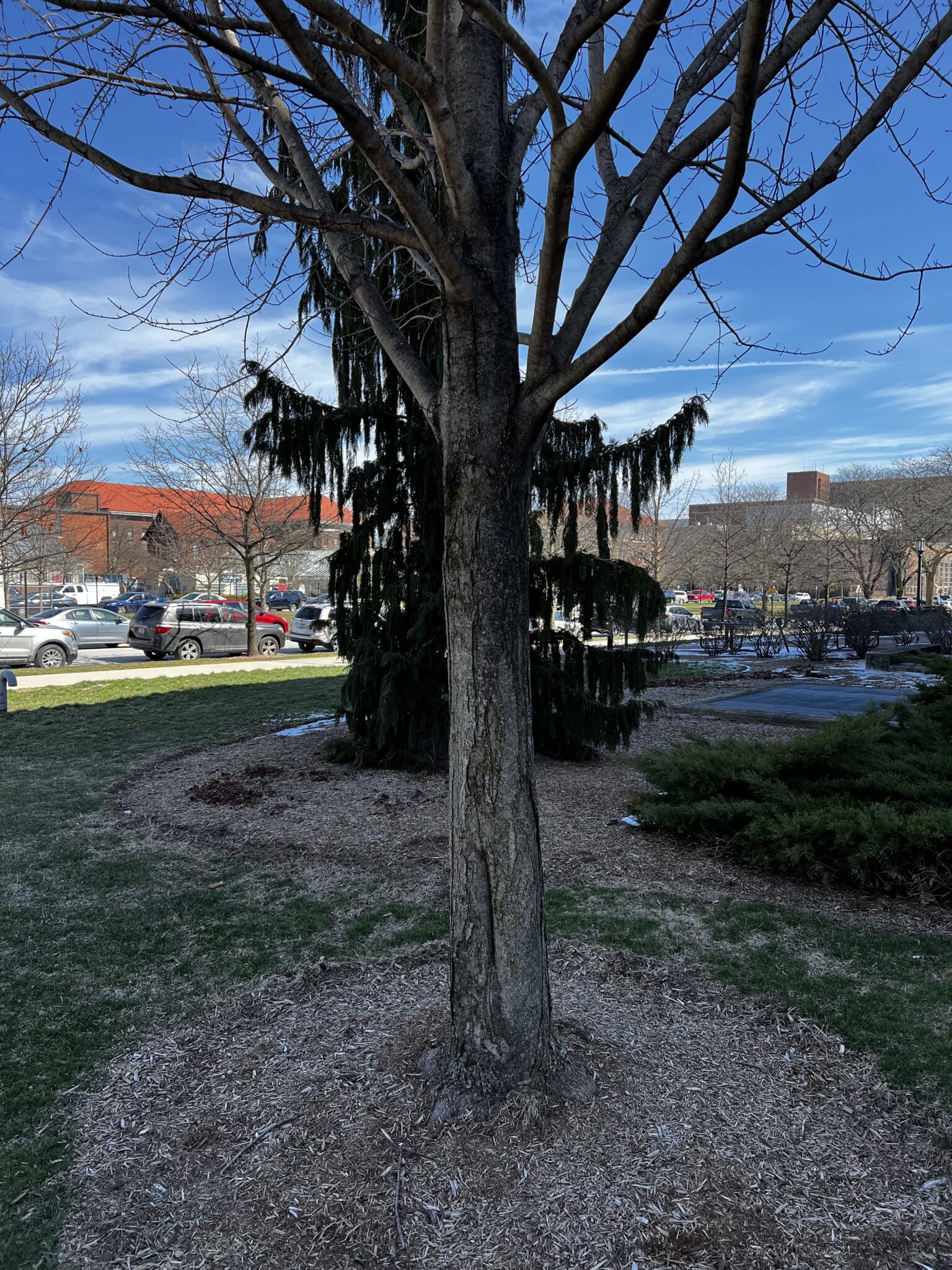
Figure 4 – Callus tissue growth closing over southwest damage.
Resources:
The Purdue Landscape Report
Find an Arborist video, Trees are Good, International Society of Arboriculture (ISA)
Equipment Damage to Trees, Got Nature? Blog
Tree wounds and healing, Got Nature? Blog
Tree Defect Identification, The Education Store, Purdue Extension resource center
Tree Pruning Essentials, Publication & Video, The Education Store
Shrubs and Woody Vines of Indiana and the Midwest, The Education Store
Tree Risk Management – Got Nature? Blog, Purdue Extension – FNR
Why Is My Tree Dying? – Got Nature? Blog, Purdue Extension – Forestry and Natural Resources
ID That Tree, Purdue Extension-Forestry & Natural Resources (FNR) YouTube playlist
Subscribe to Purdue Extension-FNR YouTube Channel
Ben McCallister, Urban Forestry Specialist
Purdue Forestry and Natural Resources
Join Purdue Extension forester Lenny Farlee in this episode of “A Woodland Management Moment” as he talks about planting density when thinking about hardwood tree plantation. In an earlier video, we discussed higher density plantings for timber productions. In this video, we’ll continue that conversation and talk about planting with wide spacing specifically for nut production. This episode explores these nut producing species like black walnut, their growth in the forests and what that means for woodland management decisions. Watch the video to learn about opportunities, challenges and considerations for balancing growth rates with high quality output.
If you have any questions regarding trees, forests, wildlife, wood products, or other natural resource topics, feel free to contact us by using our Ask an Expert web page.
Resources:
A Woodland Management Moment, Playlist, Purdue Extension – Forestry and Natural Resources (FNR) YouTube Channel
The Nature of Oaks Webinar, Purdue Extension-FNR YouTube Channel, Shared from Indiana Forestry & Woodland Owners Association
Conservation Tree Planting: Steps to Success, Purdue Extension – FNR YouTube Channel
Shrubs and Woody Vines of Indiana and the Midwest, Purdue University Press
Native Trees of the Midwest, Purdue University Press
ID That Tree, Playlist, Purdue Extension – FNR YouTube Channel
Investing in Indiana Woodlands, The Education Store
Woodland Stewardship for Landowners Video Series, Playlist, Indiana Department of Natural Resources YouTube Channel
Ask an Expert: Tree Selection and Planting, Purdue Extension – FNR YouTube Channel
Forest Improvement Handbook, The Education Store
Find an Indiana Professional Forester, Indiana Forestry & Woodland Owners Association (IFWOA)
Purdue Arboretum Explorer
Lenny Farlee, Extension Forester
Hardwood Tree Improvement and Regeneration Center
Purdue Department of Forestry & Natural Resources
Rooted in Research, Northern Research Station: The USDA Forest Service Northern Research Station is highlighting one of its most historic and innovative partners in forest science: the Forest Products Laboratory (FPL) in Madison, Wisconsin. This feature appears in the January issue of the Station’s Rooted in Research newsletter, which spotlights science that supports healthy forests, sustainable wood products, and resilient communities.
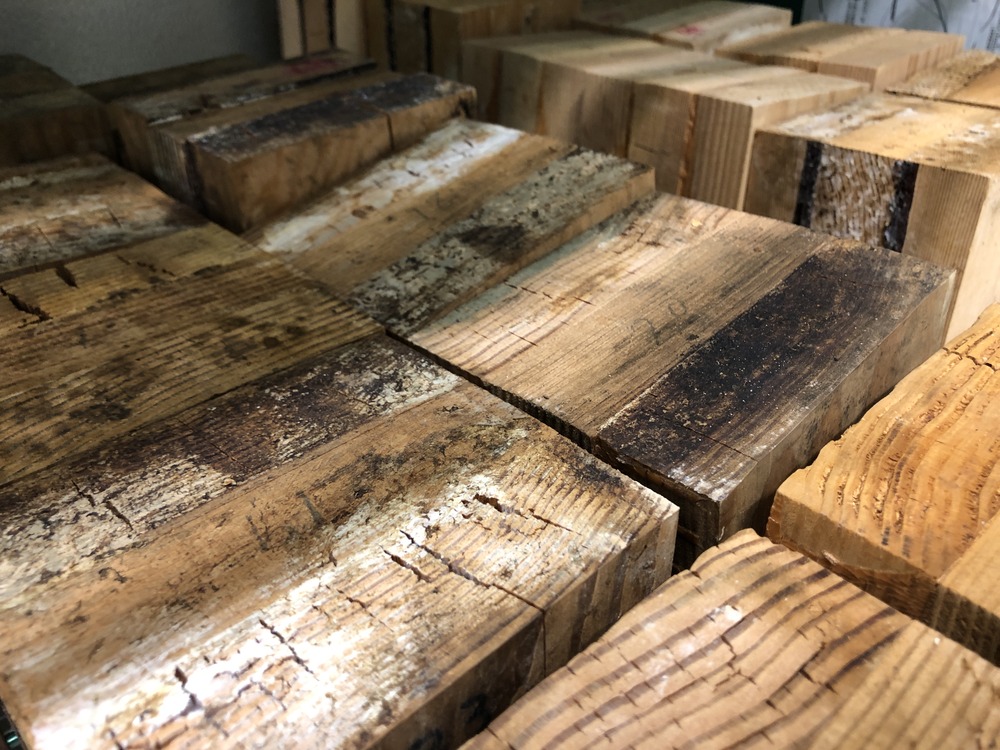
Picture from Northern Research Station, USDA, U.S. Forest Service
Established in 1910, the Forest Products Laboratory focuses on improving the use, durability, and performance of wood and wood‑based materials. Its research supports forest health, climate resilience, and economic development by helping land managers, manufacturers, and communities make informed decisions about forest products.
- Wood durability research
- Innovative wood products
- Dire and materials testing
- Nanocellulose and emerging technologies
FPL scientists collaborate with universities, industry partners and other Forest Service units to bring practical, science‑based solutions to the public. Their work touches everything from housing and transportation to packaging, energy and emerging bio‑based materials.
Learn more by visiting the Forest Products Laboratory webpage.
Additionally, each month, the Northern Research Station’s Rooted in Research newsletter highlights science that supports healthy forests and thriving communities across the region. The January issue introduces readers to the Forest Products Laboratory and explores how FPL’s work complements the Station’s mission to understand and sustain forests from the Midwest to the Northeast.
Subscribe to the newsletter: Northern Research Station – Rooted in Research.
Resources:
Wood Products Manufacturing Technology Minor, FNR Minor
Hardwoods of the Central Midwest, The Purdue Arboretum
Wood Products, Purdue Extension – Forestry & Natural Resources (FNR)
Wood is Best Video, Forestry and Natural Resources YouTube Channel, Woodisbest.org
An Introduction to Trees of Indiana, The Education Store, Purdue Extension resource center
Native Trees of the Midwest, Purdue University Press
Shrubs and Woody Vines of Indiana and the Midwest, Purdue University Press
ID That Tree, Playlist, Subscribe to Purdue Extension – Forestry and Natural Resources YouTube Channel
A Woodland Management Moment, Playlist, Purdue Extension – FNR YouTube Channel
Investing in Indiana Woodlands, The Education Store
Forest Improvement Handbook, The Education Store
Finding help from a professional forester, Indiana Forestry & Woodland Owners Association
District Foresters for 10 plus acres, Indiana Department of Natural Resources
Hardwood Tree Improvement & Regeneration Center (HTIRC)
Diana Evans, Extension & Web Communications Specialist
Purdue University Department of Forestry and Natural Resources
Join Purdue Extension forester Lenny Farlee in this episode of “A Woodland Management Moment” as he discusses the presence of black walnut within a pine plantation. This episode explores how hardwood species like black walnut can become established in planted pine stands and what that means for woodland management decisions. Watch the video to learn about opportunities, challenges and considerations for managing mixed-species woodlands over time.
A good resource to learn more is the Walnut Council website. Founded in 1970, the Walnut Council is an international association representing nearly 700 woodland owners, foresters, forest scientists, and wood-producing industry representatives in 45 states and three foreign countries. The purpose is to assist in the technical transfer of forest research to field applications, help build and maintain better markets for wood products and nut crops, and to promote sustainable forest management, conservation, reforestation, and utilization of American black walnut (Juglans nigra) and other high quality fine hardwoods.
If you have any questions regarding trees, forests, wildlife, wood products, or other natural resource topics, feel free to contact us by using our Ask an Expert web page.
Resources:
A Woodland Management Moment, Playlist, Purdue Extension – Forestry and Natural Resources (FNR) YouTube Channel
The Nature of Oaks Webinar, Purdue Extension-FNR YouTube Channel, Shared from Indiana Forestry & Woodland Owners Association
Conservation Tree Planting: Steps to Success, Purdue Extension – FNR YouTube Channel
Shrubs and Woody Vines of Indiana and the Midwest, Purdue University Press
Native Trees of the Midwest, Purdue University Press
ID That Tree, Playlist, Purdue Extension – FNR YouTube Channel
Investing in Indiana Woodlands, The Education Store
Woodland Stewardship for Landowners Video Series, Playlist, Indiana Department of Natural Resources YouTube Channel
Ask an Expert: Tree Selection and Planting, Purdue Extension – FNR YouTube Channel
Forest Improvement Handbook, The Education Store
Find an Indiana Professional Forester, Indiana Forestry & Woodland Owners Association (IFWOA)
Purdue Arboretum Explorer
Lenny Farlee, Extension Forester
Hardwood Tree Improvement and Regeneration Center
Purdue Department of Forestry & Natural Resources
Families planning the transfer of farms to the next generation of often look for guidance and resources. Purdue Extension’s Succession Planning Resource is designed to help Indiana farm families navigate this critical transition. The succession planning process includes considerations for financial well-being, farm management and risk assessment. It is crucially important for families to properly develop plans that address the transfer of ownership and management.
The Succession Planning Team offers: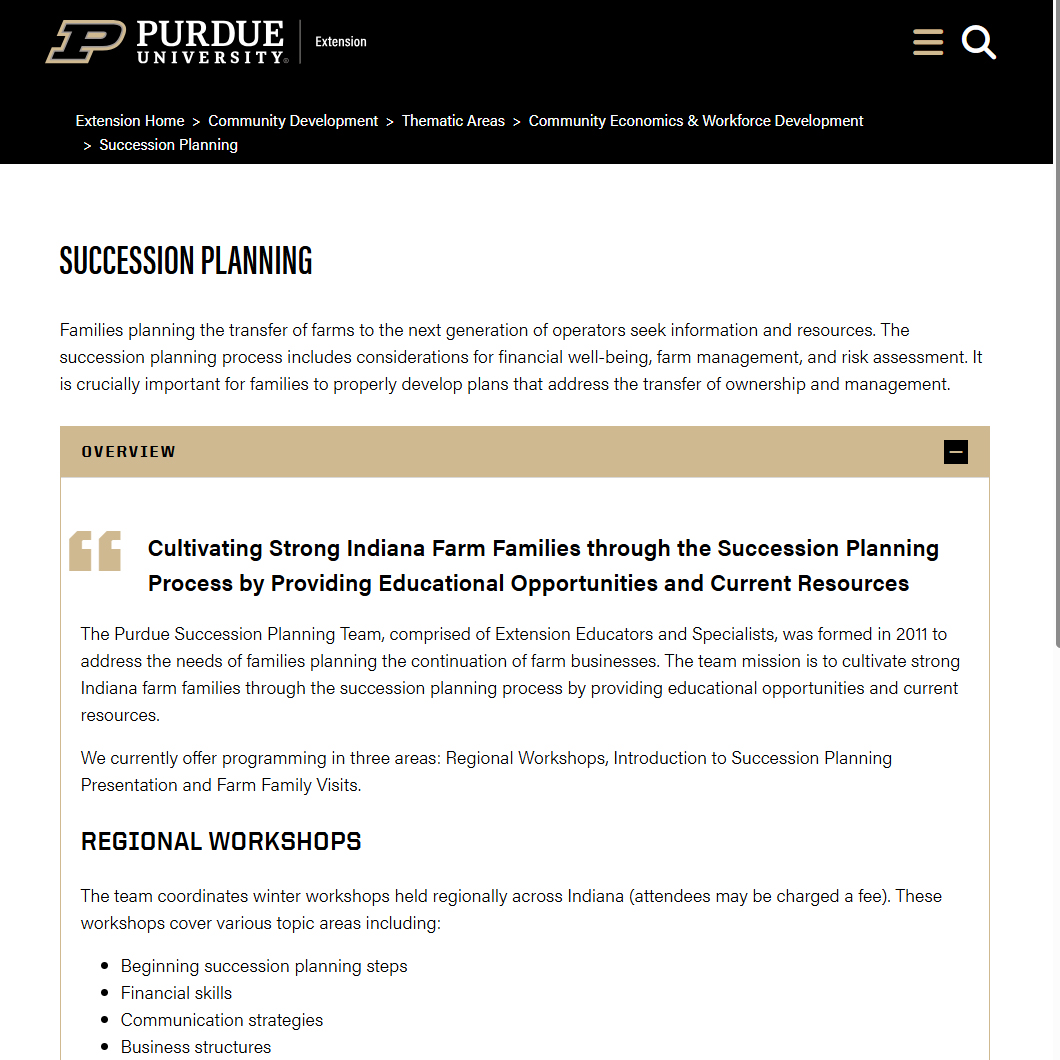
- Regional Workshops with experts in law, finance, and farm management
- Introductory Presentations to kickstart your planning process
- Farm Family Visits for personalized guidance
Regional Workshops
The team coordinates winter workshops held regionally across Indiana (attendees may be charged a fee). These workshops cover various topic areas including:
- Beginning succession planning steps
- Financial skills
- Communication strategies
- Business structures
- Risk management tools
- Options for asset transfer to the next generation
- Management transfer plans
Workshop presenters include experienced professionals (i.e., attorneys and accountants), Extension specialists and Extension Educators. Team members may also hold family meetings with the workshop attendees to help them move forward with the next steps of their succession plans. Fees charged for these workshops have been lowered due to grant funding provided by the North Central Extension Risk Management Education Center.
Explore the resource and start building a stronger foundation for your future: Succession Planning.
Resources:
Community Development, Purdue Extension
Wind Energy, Purdue Community Development
National Renewable Energy Laboratory (NREL)
Environmental Planning in Community Plans, The Education Store, Purdue Extension’s resource center
Enhancing the Value of Public Spaces Program, Purdue Extension YouTube Channel
Enhancing the Value of Public Spaces: Creating Healthy Communities, The Education Store
Conservation through Community Leadership, The Education Store
Conservation through Community Leadership, Purdue Extension You Tube Channel
Implementation Examples of Smart Growth Strategies in Indiana, The Education Store, Purdue Extension’s resource center
Conservation Through Community Leadership, The Education Store
Community Planning Playlist, Purdue Extension-Forestry & Natural Resources (FNR) YouTube Channel
One Water Approach to Water Resources Management, The Education Store
Rainscaping Education Program, Purdue Extension
Rainscaping and Rain Gardens, Purdue Extension YouTube Channel
Indiana Creek Watershed Project – Keys to Success, Partnerships and People, Purdue Extension You Tube Channel
Illinois-Indiana Sea Grant
Subscribe – Purdue Extension – Forestry and Natural Resources YouTube Channel
Purdue Extension-Forestry and Natural Resources Calendar, workshops and Conferences
Diana Evans, Extension & Web Communications Specialist
Purdue University Department of Forestry and Natural Resources
Once the leaves have fallen and the landscape is dominated by shades of brown and gray, bright colors like red catch our attention. There are several red fruits that we may encounter in the late fall and winter here in Indiana that add some color to the landscape. These fruits are retained on trees and shrubs for a variety of reasons. Some are not as palatable to wildlife, so they are eaten later in the season. Some are more resistant to freeze damage and thus cling to branches longer than delicate fruits. There may also be an advantage to their appearance. Many of these plants have seeds dispersed by wildlife like birds, which eat the seeds and excrete them later, providing an opportunity to produce new plants away from the parent. Many birds can see much of the same color spectrum we do, plus enhanced vision in the ultra-violet bands. Brightly-colored seeds with waxy skins may reflect more ultra-violet light and be more noticeable to the birds.
What are some of those red fruits?
One family of plants accounts for several red fruit we can see in late fall and winter, the rose family. This family includes apples, plums, cherries, hawthorns, pears and others as well as the roses. In Indiana we have several hawthorns (Crataegus species) that produce a fruit resembling a tiny apple. These vary in size by species but are typically ¼ to ½ inch diameter and often held in clusters. Hawthorns are typically small trees and may have long thin thorns on the twigs.

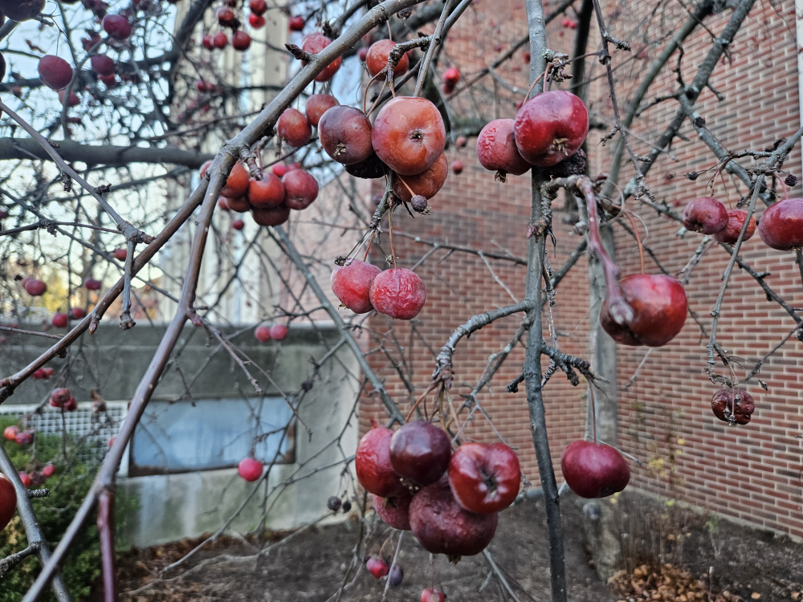
Another rose family member are the apples and crabapples with some small native trees like sweet crabapple, Malus coronaria, and several varieties of fruit-bearing apples and ornamental crabapples planted but sometimes escaping to natural areas. While our native crabapples are usually about 1-2 inches diameter and green to yellow, the domesticated apples and crabapples often have red fruit in various sizes from large apples to ½ inch diameter crabapples.

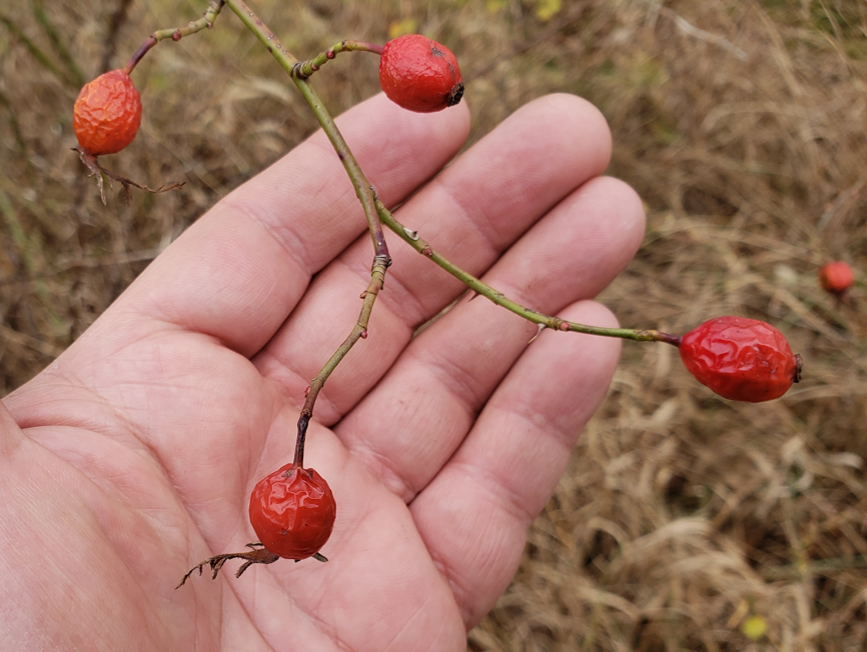
We also have several beautiful native roses in Indiana, and a particularly problematic exotic invasive rose in multiflora rose. Unfortunately, you are more likely to encounter multiflora rose with small ¼ inch clusters of red fruit. Our native roses typically have larger fruit and fewer fruit per cluster.

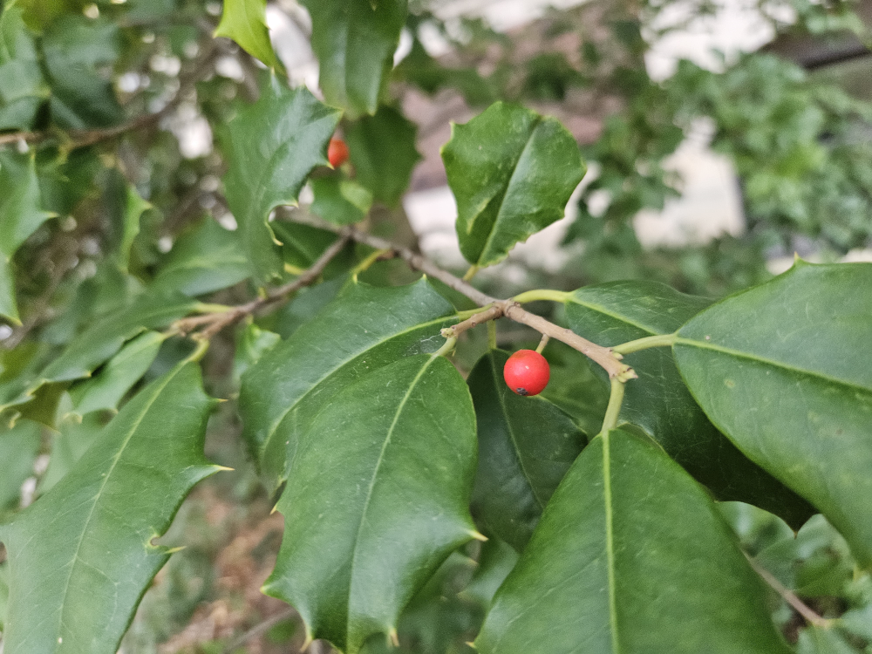
Holly is also noted for red fruit and some being evergreen as well. Our native Indiana hollies are all deciduous, losing their leaves in the fall but often retaining the red fruit on the female plants into winter. The most widespread species is winterberry, Ilex verticillate, a shrub which is seeing more use ornamentally due to its striking red fruit held past Christmas most years. American holly, an evergreen broadleaved tree, is well-known for its glossy, spiny foliage and red fruit on the female trees. Although not native to Indiana, it is spreading from plantings into natural areas. Several evergreen hollies from Europe and Asia are also common in ornamental plantings and may escape into natural areas.
Not only are these late-season showy fruit attractive, but they also provide some important nourishment for wildlife when the many other fruits are long-gone.
Resources:
Ask An Expert: Holidays in the Wild, Purdue Extension – Forestry and Natural Resources (FNR) YouTube Channel
Selecting a Real Christmas Tree, Got Nature? Blog Post, Purdue Extension – FNR
Tips on How You Can Recycle Your Christmas Tree, Got Nature? Blog Post, Purdue Extension – FNR
ID That Tree, Playlist, Purdue Extension – FNR YouTube Channel
ID That Tree: Prickly Ash, Purdue Extension – FNR YouTube Channel
A Woodland Management Moment, Playlist, Purdue Extension – FNR YouTube Channel
Shrubs and Woody Vines of Indiana and the Midwest, The Education Store, Purdue Extension Resource Center
Native Trees of the Midwest, Purdue University Press
Investing in Indiana Woodlands, The Education Store
Forest Improvement Handbook, The Education Store
Tree Installation: Process and Practices, The Education Store
Tree Planting Part 1: Choosing a Tree, video, The Education Store
Lenny Farlee, Extension Forester
Hardwood Tree Improvement and Regeneration Center
Purdue Department of Forestry & Natural Resources
In this edition of ID That Tree, Purdue Extension Forester Lenny Farlee introduces us to Norway Spruce, a non-native conifer that has become a familiar sight across Indiana. Originally brought over from Europe, this species is now commonly planted for windbreaks, landscaping and reforestation. Learn how to recognize its distinctive shape and why it’s often chosen for both farms and front yards. Whether you’re a student, landowner or simply curious about the trees around you, this video offers a quick look at one of Indiana’s most widespread introduced evergreens.
If you have any questions regarding wildlife, trees, forest management, wood products, natural resource planning or other natural resource topics, feel free to contact us by using our Ask an Expert web page.
Resources:
ID That Tree – Video Playlist, Purdue Extension – Forestry and Natural Resources (FNR) YouTube Channel
Purdue Arboretum Explorer
Conservation Tree Planting: Steps to Success, Purdue Extension – FNR YouTube Channel
A Woodland Management Moment, Playlist, Purdue Extension – FNR YouTube Channel
Woodland Stewardship for Landowners, Playlist, Purdue Extension – FNR YouTube Channel
Fifty Common Trees of Indiana, Purdue Extension – FNR
Indiana Invasive Species Council
Cooperative Invasive Species Management Area (CISMA)
Report Invasive, Purdue Extension
Habitat University, Episode 12 – Exploring the challenges of Invasive Species, Habitat University-Natural Resource University
Shrubs and Woody Vines of Indiana and the Midwest, Purdue University Press
Native Trees of the Midwest, Purdue University Press
Professional Forester, Indiana Forestry Woodland Owners Association
District Forester, Indiana Department of Natural Resources, 10+ acres
Find an Arborist, International Society of Arboriculture
Forest Improvement Handbook, The Education Store
Lenny Farlee, Extension Forester
Hardwood Tree Improvement and Regeneration Center
Purdue Department of Forestry & Natural Resources
Welcome to ID That Tree! In this episode, Purdue Extension Forester Lenny Farlee introduces us to multiflora, a non-native invasive shrub that has become widespread across Indiana. Once planted for practical purposes, it now creates big challenges for landowners and natural areas. Learn where you’re most likely to encounter it, why it spreads so aggressively and what makes it stand out on the landscape. Whether you’re a student, nature enthusiast or land manager, this video gives you a quick introduction to one of Indiana’s most troublesome invasive plants.
If you have any questions regarding wildlife, trees, forest management, wood products, natural resource planning or other natural resource topics, feel free to contact us by using our Ask an Expert web page.
Resources:
ID That Tree – Video Playlist, Purdue Extension – Forestry and Natural Resources (FNR) YouTube Channel
Purdue Arboretum Explorer
Conservation Tree Planting: Steps to Success, Purdue Extension – FNR YouTube Channel
A Woodland Management Moment, Playlist, Purdue Extension – FNR YouTube Channel
Woodland Stewardship for Landowners, Playlist, Purdue Extension – FNR YouTube Channel
Fifty Common Trees of Indiana, Purdue Extension – FNR
Indiana Invasive Species Council
Cooperative Invasive Species Management Area (CISMA)
Report Invasive, Purdue Extension
Habitat University, Episode 12 – Exploring the challenges of Invasive Species, Habitat University-Natural Resource University
Shrubs and Woody Vines of Indiana and the Midwest, Purdue University Press
Native Trees of the Midwest, Purdue University Press
Professional Forester, Indiana Forestry Woodland Owners Association
District Forester, Indiana Department of Natural Resources, 10+ acres
Find an Arborist, International Society of Arboriculture
Forest Improvement Handbook, The Education Store
Lenny Farlee, Extension Forester
Hardwood Tree Improvement and Regeneration Center
Purdue Department of Forestry & Natural Resources

Recent Posts
- Disease May Cause Wilting and Eventual Death of Certain Trees and Shrubs, Purdue Landscape Report
Posted: October 5, 2026 in Disease, Forestry, Plants - October Is Firewood Month: Protect Indiana’s Forests by Making Smart Choices
Posted: October 1, 2026 in Forestry, Forests and Street Trees, How To, Invasive Insects, Urban Forestry - Minecraft Meets the Hellbender
Posted: September 22, 2026 in Aquaculture/Fish, Aquatic/Aquaculture Resources, Wildlife - Is It Too Early to Think About Christmas Tree Pests?
Posted: in Christmas Trees, Invasive Insects, Safety - What You Plant Matters to Wildlife
Posted: September 16, 2026 in Plants, Urban Forestry, Wildlife - Woodland Flowers of Late Summer
Posted: September 14, 2026 in Forestry, Gardening, Wildlife, Woodlands - Heavy August Rains Bring More Mosquitoes to Indiana
Posted: September 9, 2026 in How To, Invasive Insects, Safety, Wildlife - Question: Why Did the Shagbark Hickories Survive the Tornado?
Posted: August 27, 2026 in Forests and Street Trees, How To, Urban Forestry - New Indiana Woodland Steward Newsletter
Posted: August 12, 2026 in Forestry, Urban Forestry, Wildlife, Woodlands - Indiana Fall Hunting Licenses on Sale and New Mobile App Available
Posted: in Forestry, How To, Wildlife
Archives
Categories
- Alert
- Aquaculture/Fish
- Aquatic/Aquaculture Resources
- Ask the Expert
- Christmas Trees
- Community Development
- Disease
- Drought
- Forestry
- Forests and Street Trees
- Gardening
- Got Nature for Kids
- Great Lakes
- How To
- Invasive Animal Species
- Invasive Insects
- Invasive Plant Species
- Land Use
- Natural Resource Planning
- Nature of Teaching
- Plants
- Podcasts
- Ponds
- Publication
- Safety
- Spiders
- Timber Marketing
- Urban Forestry
- Webinar
- Wildlife
- Wood Products/Manufacturing
- Woodland Management Moment
- Woodlands