 Purdue University - Extension - Forestry and Natural Resources
Got Nature? Blog
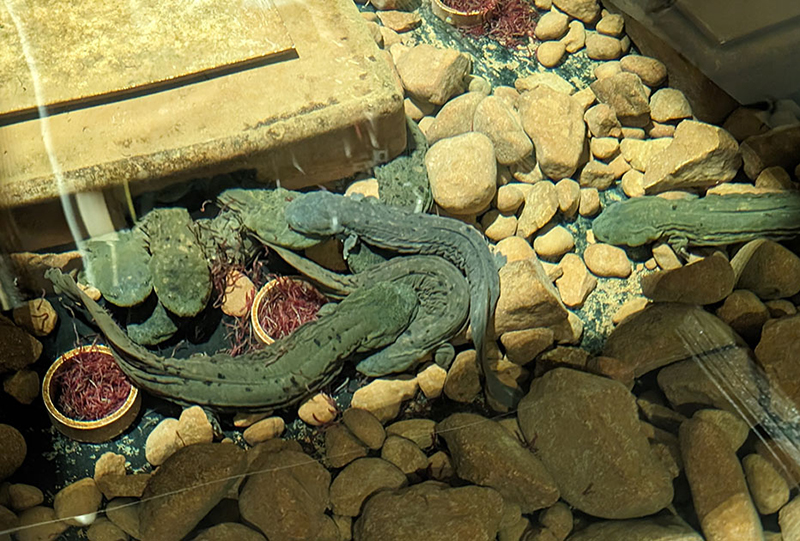
The Farmers Helping Hellbenders program is accepting applications for the second round of its Indiana Natural Resources Conservation Service’s Regional Conservation Partnership Program (RCPP) project. The project aims to assist with the conservation/recovery of eastern hellbender salamanders and improvement of aquatic resources in south central Indiana.
Eligible farmers and landowners, who wish to obtain funding to implement practices designed to keep nutrients and soil resources on fields and improve their watersheds, should contact their local NRCS office before May 10 to apply. Financial assistance is available for agricultural lands within the Blue River-Sinking Watershed boundary in Crawford, Floyd, Harrison and Washington counties, where the eastern hellbender can be found and is being actively managed.
Eligible practices for farmers in the project area include conservation cover, grassed waterways, wildlife habitat planting, nutrient management, riparian buffers and many others. Interested farmers and forest landowners who wish to implement conservation practices on their land should discuss their options with their district conservationist. Contact your local district conservationist by visiting Farmers.gov/Service-locator.
 While NRCS accepts program applications year-round, Indiana producers and landowners should apply by May 10 to be considered for the current RCPP-Hellbender funding cycle. Applications received after May 10 will automatically be considered during the next funding cycle.
“The Farmers Helping Hellbenders RCPP project enables us to leverage partnerships to make a lasting positive impact on the habitat of the eastern hellbender salamander,” said Damarys Mortenson, state conservationist for the USDA’s NRCS in Indiana. “This project allows Indiana farmers and forestland owners to conserve the vital natural resources on their land while also protecting the habitat for hellbenders and other aquatic animals. It is a win-win.”
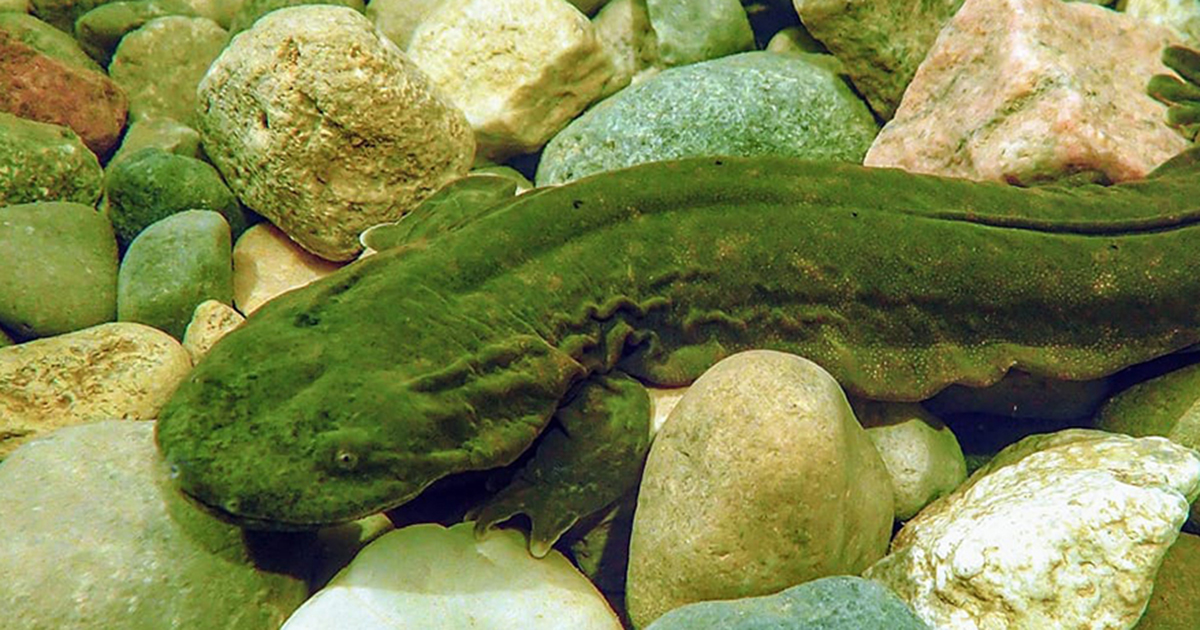
The eastern hellbender (Cryptobranchus alleganiensis) is a large, fully aquatic salamander, nicknamed the snot otter, water dog, devil dog, Allegheny alligator and water eel among other things. Their decline statewide has been documented as far back as the early-to-mid 1900s as a result of habitat loss and poor water quality. Hellbenders, which are listed as an endangered species in Indiana, play an important role in aquatic ecosystems and are indicators of clean water. Eastern hellbenders need clean water to survive as they breathe through their skin by absorbing oxygen from the river and stream water in which they live.
Hellbender populations are declining across their range, from Missouri to New York. This decline, which affects the hellbender population in Indiana’s Blue River, is likely caused by human influences such as habitat degradation and destruction. The stream-bottom habitat of hellbenders can be degraded by sediment from eroded banks and fields and destroyed when streams are dammed or dredged. Hellbenders are also captured inadvertently by anglers or purposefully for illegal sale in the pet trade. Finally, emerging diseases may be impacting some populations of hellbenders. Specifically, the chytrid fungus (Batrachochytrium dendrobatidis) and Ranavirus (family Iridoviridae) are considered to be major threats to the persistence of hellbender populations across their range.
For much of the last 17 years, Dr. Rod Williams and his team have been researching eastern hellbenders, spearheading regional conservation efforts and advancing hellbender captive propagation, or the rearing of this ancient animal in captivity and their eventual return to the wild. The partnership had a major breakthrough over the summer of 2023 with the documentation of a young hellbender salamander in the Blue River while conducting routine surveys. This discovery is significant because over the past three to four decades, only adult hellbenders have been documented in the Blue River. The presence of a young salamander suggests that conservation efforts and rearing programs are accomplishing their goals for the recovery of this endangered species.
The Farmers Helping Hellbenders RCPP project is made possible by $2.7 million in funding from the U.S. Department of Agriculture’s RCPP, Purdue and other partnering organizations. The project is led by Purdue with assistance from 14 collaborating public and private organizations on the state and local level including NRCS. The goal of the project is to improve hellbender habitat in a four-county region in south central Indiana by expanding the use of agricultural conservation practices that lead to decreased sediment in local river systems. The project aims to improve water quality, enhance aquatic habitat, increase aquatic wildlife populations, increase riparian and pollinator habitat and protect karst topography.
To view full article with more photos view Purdue Forestry and Natural Resources News & Stories: Farmers Helping Hellbenders RCPP Program Accepting Applications.
Resources:
USDA Awards Farmers Helping Hellbenders Project in Funding, Purdue Extension – Forestry and Natural Resources (FNR) Got Nature? Blog
Improving Water Quality by Protecting Sinkholes on Your Property, Purdue Extension – FNR YouTube Channel
Improving Water Quality Around Your Farm video, Purdue Extension – FNR YouTube Channel
Adaptations for Aquatic Amphibians, The Education Store, Purdue Extension’s resource center
Hellbenders Rock! Nature of Teaching Lesson Plan, The Education Store
Nature of Teaching – Hellbenders Rock Sneak Peek video, Purdue Extension – FNR YouTube Channel
Nature of Teaching – Hellbenders Rock webinar video, Purdue Extension – FNR YouTube Channel
Learn about hellbenders and take a tour of Purdue’s hellbender rearing facility video, Purdue Extension – FNR YouTube Channel
Learn about the hellbender work at Mesker Park Zoo video, Purdue FNR Facebook
Learn about hellbender work at The Wilds video, Purdue FNR Facebook
Dr. Rod Williams’ 2017 TEDx Talk Help the Hellbenders video, Purdue Extension – FNR YouTube Channel
A Moment in the Wild – Hellbender Hides video, Purdue Extension – FNR YouTube Channel
A Moment in the Wild – Hellbender Release video , Purdue Extension – FNR YouTube Channel
Wendy Mayer, FNR Communications Coordinator
Purdue University Department of Forestry and Natural Resources
The Help the Hellbender team, led by Dr. Rod Williams, professor of wildlife science, has been honored by the Hoosier Outdoor Writers group with its 2022 Bayou Bill Conservation Award.
The annual conservation award is given in memory of the legendary Crothersville, Indiana, outdoor writer Bayou Bill Scifres, who was a founding member of HOW in 1969, and had his outdoors column published in The Indianapolis Star newspaper for 50 years.
“The Hoosier Outdoor Writers group was introduced to Dr. Rod Williams in 2019 when he came to our annual conference and talked to us about his work with hellbenders and the Help the Hellbenders program,” Tom Berg, Executive Director of HOW, explained. “Our members were very interested in learning more about hellbender conservation and restoration, and also about his involvement with captive breeding and propagation efforts across the state. It was interesting to us to hear that Purdue University, the Indiana Department of Natural Resources and other groups were working together on management plans to re-introduce and re-populate hellbenders throughout much of their historical range. This is exactly the type of conservation story that our members like to hear and relate to their audiences. It also aligns very well with our strong belief in the conservation of Indiana’s natural resources, so choosing Dr. Williams and the “Help the Hellbenders” program for this award was an easy task.”
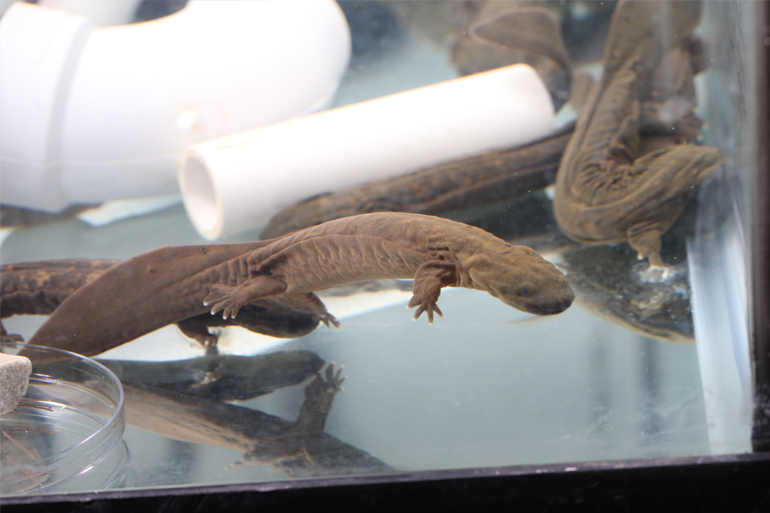 For much of the last 16 years, Williams and his team have been researching eastern hellbenders, spearheading regional conservation efforts and advancing hellbender captive propagation, or the rearing of this ancient animal in captivity and their eventual return to the wild.
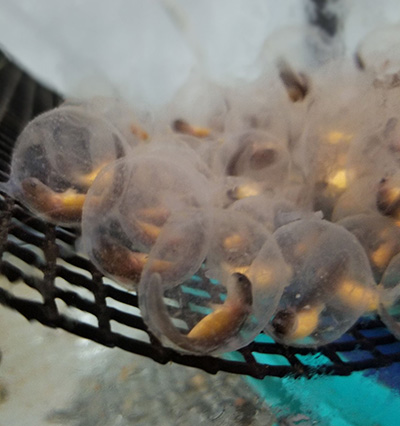
After five years of breeding efforts, Williams’ partners at the Mesker Park Zoo in Evansville, Indiana, successfully bred eastern hellbenders naturally in captivity in October 2020, signifying the culmination of a long and collaborative effort to breed the species and restore this endangered species to its native environment.
Williams’ hellbender lab is actively collaborating with the Indiana Department of Natural Resources, Indiana Division of Fish and Wildlife and The Nature Conservancy as well as several other partners across 13 states on a number of conservation projects and educational opportunities for teachers and children, farmers and more.
For full article with additional photos view: Help the Hellbender Program Receives Hoosier Outdoor Writers Conservation Award.
Resources
Help the Hellbender website
Help the Hellbender Facebook page
Ask the Expert: Learn All About Hellbenders and Take a Tour, Subscribe Purdue Extension – Forestry & Natural Resources (FNR) YouTube Channel
Ask the Expert video: Help the Hellbender – Dr. Stephen Spear of The Wilds, Purdue Extension – FNR YouTube Channel
Ask the Expert video: Live with Mesker Park Zoo and Botanical Gardens – Hellbenders, Purdue Extension – FNR YouTube Channel
A Moment in the Wild video: Hellbender Hide, Purdue Extension – FNR YouTube Channel
A Moment in the Wild video: Release Moment of Hellbenders,
How Anglers and Paddlers Can Help the Hellbender video, Purdue Extension – FNR YouTube Channel
Eastern Hellbender ID Video, Purdue Extension – FNR YouTube Channel
Hellbenders Rock!, The Education Store, Purdue Extension’s resource center
Help the Hellbender, North America’s Giant Salamander, The Education Store
How Our Zoos Help Hellbenders, The Education Store
The Nature of Teaching: Adaptations for Aquatic Amphibians, The Education Store
Healthy Water, Happy Home – Lesson Plan, The Education Store
FNR Assists in First Natural Breeding of Eastern Hellbender in Captivity, Purdue FNR News & Stories
Wendy Mayer, FNR Communications Coordinator
Purdue University Department of Forestry and Natural Resources
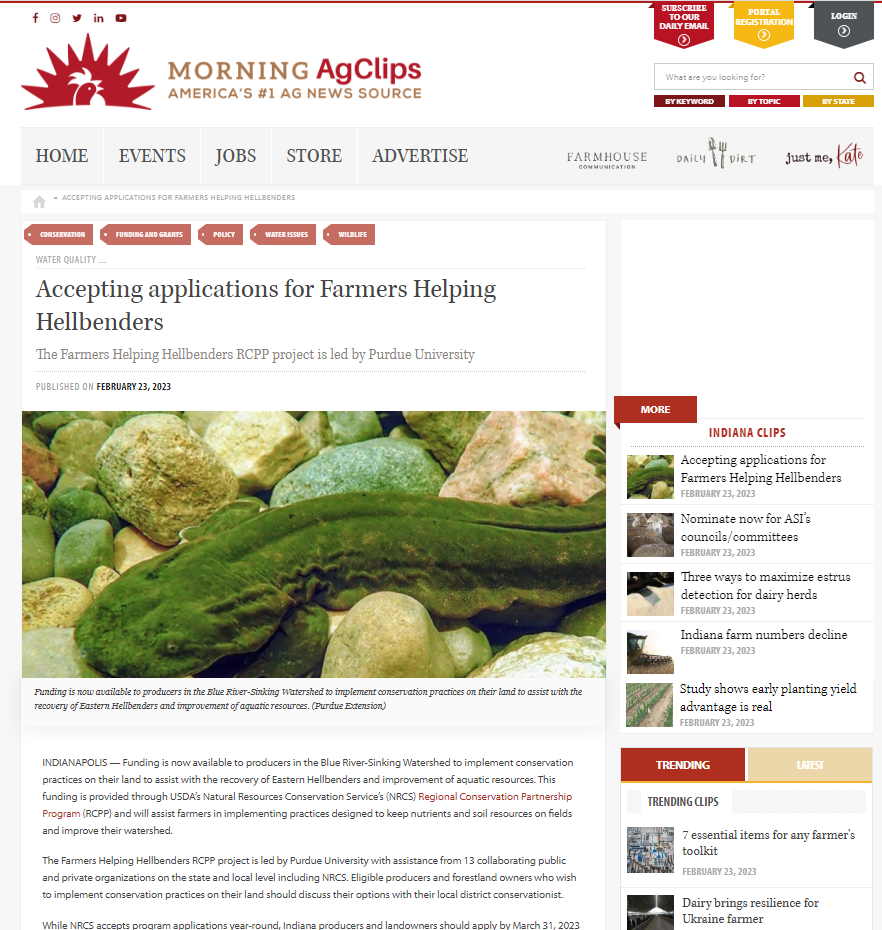 Morning AgClips, Indianapolis, Accepting Applications for Farmers Helping Hellbenders — Funding is now available to producers in the Blue River-Sinking Watershed to implement conservation practices on their land to assist with the recovery of Eastern Hellbenders and improvement of aquatic resources. This funding is provided through USDA’s Natural Resources Conservation Service’s (NRCS) Regional Conservation Partnership Program (RCPP) and will assist farmers in implementing practices designed to keep nutrients and soil resources on fields and improve their watershed.
The Farmers Helping Hellbenders RCPP project is led by Purdue University with assistance from 13 collaborating public and private organizations on the state and local level including NRCS. Eligible producers and forestland owners who wish to implement conservation practices on their land should discuss their options with their local district conservationist.
While NRCS accepts program applications year-round, Indiana producers and landowners should apply by March 31, 2023 to be considered for the current RCPP-Hellbender funding cycle. Applications received after March 31 will automatically be considered during the next funding cycle. For more information or to submit an application, contact your local district conservationist by visiting Farmers.gov/Service-locator.
The goals of the Farmers Helping Hellbenders project include improved water quality due to decreases in runoff, improved aquatic habitat due to decreases in sedimentation, increases in Hellbender and other aquatic wildlife populations due to improved habitat and water quality, increases in riparian and pollinator habitat due to implementation of riparian buffers and pollinator-friendly species, and increased protection of karst due to reduced runoff into sinkholes.
“The Farmers Helping Hellbenders RCPP project enables us to leverage partnerships to make a lasting positive impact on the habitat of the Eastern Hellbender salamander,” said Acting State Conservationist Dan Hovland. “This project will enable Indiana farmers and forestland owners to conserve the vital natural resources on their land while also protecting the habitat for hellbenders and other aquatic animals. It is a win-win.”
The total financial assistance to landowners over the three-year project is more than $1.9 million and is available for agricultural lands in portions of Washington, Harrison, Crawford, and Floyd counties, the only remaining area in Indiana where the Eastern Hellbender can be found and is currently being actively managed.
“This project is the perfect opportunity for land managers to help an imperiled species, while maintaining productive working lands,” said Brianne Lowe, Indiana NRCS state biologist. “Hellbenders are particularly susceptible to sedimentation in the water. Farmers and forest landowners that implement conservation practices can help improve water quality by keeping soil on the land and protecting aquatic nesting beds for the hellbender.”
Indiana eligible practices for farmers in the Blue River-Sinking Watershed for this funding period include conservation cover, grassed waterways, wildlife habitat planting, and nutrient management, riparian buffers and many others. Eligible farmers are encouraged to contact their local NRCS office before March 31 to apply for the current funding cycle. This funding will enable producers to improve the health and productivity of their operations.
Visit https://www.nrcs.usda.gov/indiana/RCPP to learn more about RCPP or click visit www.farmers.gov/working-with-us/service-center-locator find your local USDA-NRCS service center.
USDA Natural Resources Conservation Service
Wild Bulletin, IN DNR Fish and Wildlife: In September, DNR biologists found two species of salamander, the long-tailed salamander, and the southern two-lined salamander, in Knox County, marking the first time since the 1800s that either has been documented along the lower Wabash River.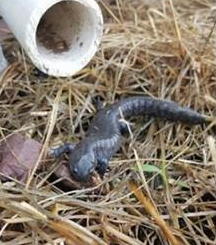
While both species are more widespread in other parts of southern Indiana, the small, rocky streams they inhabit are less common along the lower Wabash. Following this discovery, additional surveys conducted in parts of Knox, Posey, and Sullivan counties revealed more populations of southern two-lined salamanders; however, Knox County contains the only known location of a long-tailed salamander population in the region.
Salamanders and other amphibian surveys conducted by DNR biologists are supported by the Nongame Wildlife Fund. Contributions to this fund support a variety of rare and endangered wildlife.
Please visit Nongame and Endangered Wildlife to determine animals that are listed by the Indiana DNR as endangered or special concerns.
Resources:
Help the Hellbender, Purdue College of Agriculture
Question: Which salamander is this?, Got Nature? Blog, Purdue Extension – Forestry and Natural Resources
Is it a Hellbender or a Mudpuppy?, Got Nature? Blog
Amphibians: Frogs, Toads, and Salamanders, Purdue Nature of Teaching
A Moment in the Wild, Playlist, Purdue Extension – Forestry and Natural Resources
Help the Hellbender, Playlist & Website
The Nature of Teaching: Adaptations for Aquatic Amphibians, The Education Store, Purdue Extension resource center
Hellbenders Rock!, The Education Store
Help the Hellbender, North America’s Giant Salamander, The Education Store
Indiana Department of Natural Resources
The U.S. Department of Agriculture (USDA) announced it is awarding $197 million for 41 locally led conservation projects through the Regional Conservation Partnership Program (RCPP). RCPP is a partner-driven program that leverages partner resources to advance innovative projects that address climate change, enhance water quality, and address other critical challenges on agricultural land.
“Our partners are experts in their fields and understand the challenges in their own backyards,” Agriculture Secretary Tom Vilsack said. “Through RCPP we can tap into that knowledge, in partnership with producers and USDA, to come up with lasting solutions to the challenges that farmers, ranchers, and landowners face. We’re looking forward to seeing the results of public-private partnership at its best, made possible through these RCPP investments.”
The “Farmers Helping Hellbenders” project, led by Dr. Rod Williams and Purdue Extension wildlife specialist/Help the Hellbender project coordinator Nick Burgmeier, is among the projects set to receive funding through the RCCP Classic fund, which uses NRCS contracts and easements with producers, landowners and communities in collaboration with project partners.
Fourteen contributing partners will assist in the project:
- Mesker Park Zoo and Botanic Gardens
- Fort Wayne Children’s Zoo
- Indianapolis Zoo
- Indiana Department of Environmental Management
- Crawford County Soil and Water Conservation District
- Floyd County Soil and Water Conservation District
- Harrison County Soil and Water Conservation District
- Washington County Soil and Water Conservation District
- Crawford County Cattleman’s Association
- Harrison County Cattleman’s Association
- Washington County Cattleman’s Association
- Cryptobranchid Interest Group
- The Nature Conservancy
- Wallace Center at Winrock International
With help from nearly $2.7 million in RCCP funding, the project aims to improve hellbender habitat in a four-county region in south central Indiana, the only remaining habitat for hellbenders in the state, by expanding the use of agricultural conservation practices that lead to decreased sedimentation in local rivers systems.
Sedimentation is a major cause of hellbender decline and reduced sedimentation will increase available habitat for hellbenders, mussels, and aquatic macroinvertebrates. This project also will address soil and nutrient loss, which are concerns for agricultural producers, as the targeted conservation practices and systems have been shown to have long-term benefits for agricultural systems and operations.
 “Through this initiative, focused on Crawford, Floyd, Harrison, and Washington counties, we expect to improve water quality and aquatic wildlife habitat,” Burgmeier said. “Simultaneously, we hope to improve soil retention and nutrient availability to crops by helping farmers implement practices such as cover crops, riparian buffers, grassed waterways, etc. Additional benefits will include increases in riparian and pollinator habitat and increased protection for karst habitat through the selected targeting of sinkholes.”
As part of each project, partners offer value-added contributions to amplify the impact of RCPP funding in an amount equal to or greater than the NRCS investment. Private landowners can apply to participate in an RCPP project in their region through awarded partners or at their local USDA service center.
“RCPP puts local partners in the driver’s seat to accomplish environmental goals that are most meaningful to their community. Joining together public and private resources also harnesses innovation that neither sector could implement alone,” Indiana NRCS State Conservationist Jerry Raynor said. “We have seen record enrollment of privately owned lands in NRCS’ conservation programs and RCPP will be instrumental in building on those numbers and demonstrating that government and private entities can work together for greater impacts on Indiana’s communities.”
For much of the last 16 years, Williams and his team have been researching eastern hellbenders, spearheading regional conservation efforts and advancing hellbender captive propagation, or the rearing of this ancient animal in captivity and their eventual return to the wild.
Additional Resources
Improving Water Quality by Protecting Sinkholes on Your Property video
Improving Water Quality Around Your Farm video
Adaptations for Aquatic Amphibians
Hellbenders Rock! Nature of Teaching Lesson Plan
Nature of Teaching – Hellbenders Rock Sneak Peek video
Nature of Teaching – Hellbenders Rock webinar video
Learn about hellbenders and take a tour of Purdue’s hellbender rearing facility video
Learn about the hellbender work at Mesker Park Zoo video
Learn about hellbender work at The Wilds video
Dr. Rod Williams’ 2017 TEDx Talk Help the Hellbenders video
A Moment in the Wild – Hellbender Hides video
A Moment in the Wild – Hellbender Release video
Wendy Mayer, FNR Communications Coordinator
Purdue University Department of Forestry and Natural Resources
Rod Williams, Assistant Provost for Engagement/Professor of Wildlife Science
Purdue University Department of Forestry and Natural Resources
Follow the hellbenders as they start their journey with the Purdue Forestry and Natural Resources husbandry program starting with eggs found in the wild. Learn how they become part of the breeding program with our partner zoos. Travel with our Help the Hellbender crew and see the fruit of their labor as the team releases adult hellbenders into the Blue River. Be sure to follow the Help the Hellbender Facebook page for more videos as there are several release dates scheduled for this summer.
Learn more about the hellbender program and a locally made documentary in the Purdue Forestry and Natural Resources News & Stories, Hellbender Research Featured in New Documentary.
Resources:
Help the Hellbender website
Help the Hellbender Facebook page
Ask the Expert: Learn All About Hellbenders and Take a Tour, Subscribe Purdue Extension – Forestry & Natural Resources (FNR) YouTube Channel
Ask the Expert video: Help the Hellbender – Dr. Stephen Spear of The Wilds, Purdue Extension – FNR YouTube Channel
Ask the Expert video: Live with Mesker Park Zoo and Botanical Gardens – Hellbenders, Purdue Extension – FNR YouTube Channel
A Moment in the Wild video: Hellbender Hide, Purdue Extension – FNR YouTube Channel
A Moment in the Wild video: Release Moment of Hellbenders,
How Anglers and Paddlers Can Help the Hellbender video, Purdue Extension – FNR YouTube Channel
Eastern Hellbender ID Video, Purdue Extension – FNR YouTube Channel
Hellbenders Rock!, The Education Store, Purdue Extension’s resource center
Help the Hellbender, North America’s Giant Salamander, The Education Store
How Our Zoos Help Hellbenders, The Education Store
The Nature of Teaching: Adaptations for Aquatic Amphibians, The Education Store
Healthy Water, Happy Home – Lesson Plan, The Education Store
FNR Assists in First Natural Breeding of Eastern Hellbender in Captivity, Purdue FNR News & Stories
Wendy Mayer, FNR Communications Coordinator
Purdue University Department of Forestry and Natural Resources
Zach Truelock, Hellbender Technician
Purdue Forestry and Natural Resources
Rod Williams, Assistant Provost for Engagement/Professor of Wildlife Science
Purdue University Department of Forestry and Natural Resources
Dr. Rod Williams‘ hellbender research, the Purdue rearing lab and more than 12 years of the lab’s work are featured in a new documentary, Hellbender in the Blue, produced by Teardrop Pictures.
The film premiered on January 12 at the Kan-Kan Cinema and Brasserie in Indianapolis and is now available to purchase and stream through Vimeo on Demand. Hellbender in the Blue is also heading out on the festival tour, including the Indiana Humanities Waterways Film Tour.
The Indiana Humanities Waterways Film Tour is a nine-city tour featuring six short documentary films about Indiana’s waterways. The films feature stories told by individuals from across the state and highlight their diverse relationships with water. Screenings are free and open to the public, although advance registration is requested. Select events will also include a panel featuring the filmmakers prior to the screening.
- Thursday, March 31, 6 p.m. CT/7 ET; New Harmony Atheneum, 401 Arthur St., New Harmony, IN 47631
- Tuesday, April 5, 6 p.m. ET; Jefferson County Public Library, 420 W. Main St., Madison, IN 47250
- Thursday, April 7, 8 p.m. ET; Taggart Amphitheatre (outdoor screening), 1856 Burdsal Pkwy., Indianapolis, IN 46208
- Tuesday, April 19, 6 p.m. ET; Fowler Theatre, 111 E. 5th St., Fowler, IN 47944
- Wednesday, April 20, 6:30 p.m. ET; Strand Theatre, 221 S. Main St., Kendallville, IN 46755
- Friday, April 29, 7 p.m. CT/8 p.m. ET; Marshall J. Gardner Center for the Arts, 540 S. Lake St., Gary, IN 46403
- Wednesday, May 11, 6:30 p.m. ET; Harrison County Arts, 113 E. Beaver St., Corydon, IN 47112
- Tuesday, May 17, 6:30 p.m. ET; Studebaker 112, 635 S. Lafayette Blvd., South Bend, IN 46601
- Tuesday, June 22, 6:30 p.m. ET; Richmond Art Museum, 350 Hub Etchison Pkwy., Richmond, IN 47374
The soundtrack to Hellbender in the Blue is available on Spotify, care of Eric Salazar, also known as @theclarinetguy on Instagram.
Purdue Forestry and Natural Resources’ involvement in the Hellbender in the Blue project began in April 2020, when Katelyn Calhoun, a documentary film maker with Teardrop Pictures, contacted Williams and research biologist/extension wildlife specialist Nick Burgmeier, regarding her desire to make a film about hellbenders in Indiana, as well the efforts Purdue, The Nature Conservancy and others have undertaken to protect/restore their populations and the efforts to remove dams from their habitat. The eventual goal is to make a more wide-ranging documentary about hellbenders throughout their range.
“We hope the film helps reach a broader audience to expand awareness of the project and encourages people to support efforts to protect hellbenders and Indiana’s water resources,” Burgmeier said.
Resources:
A Moment in the Wild, Playlist, Purdue Extension – Forestry and Natural Resources YouTube Channel
Improving Water Quality by Protecting Sinkholes on Your Property, Video, Purdue Extension – FNR YouTube Channel
Question: Which salamander is this?, Got Nature? Blog, Purdue Extension – Forestry and Natural Resources
Is it a Hellbender or a Mudpuppy?, Got Nature? Blog
Amphibians: Frogs, Toads, and Salamanders, Purdue Nature of Teaching
Help the Hellbender, Playlist & Website
The Nature of Teaching: Adaptations for Aquatic Amphibians, The Education Store, Purdue Extension resource center
Hellbenders Rock!, The Education Store
Help the Hellbender, North America’s Giant Salamander, The Education Store
Wendy Mayer, FNR Communications Coordinator
Purdue University Department of Forestry and Natural Resources
Rod Williams, Assistant Provost for Engagement/Professor of Wildlife Science
Purdue University Department of Forestry and Natural Resources
Nick Burgmeier, Research Biologist and Wildlife Extension Specialist
Purdue Department of Forestry and Natural Resources
The effects of planting or harvesting a tree often takes time to see. What are the long-term effects on the forest ecosystem as a whole, and also on individual species within it?
A new research publication “Response of Terrestrial Salamanders to the Decade Following Timber Harvest in Hardwood Forests” by graduate research assistant/PhD candidate Alison Ochs along with associate professor of ecology and natural resources Mike Saunders and professor of wildlife science Rob Swihart examined an 11-year span at the Hardwood Ecosystem Experiment to answer that question.
Why study salamander abundance? Salamanders, especially terrestrial salamanders such as
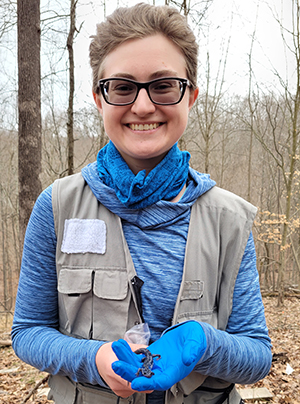
plethodontidae, are critical components of forest ecosystems and potential indicators of ecosystem changes due to their broad range, high densities and sensitivity to ecosystem changes. Salamanders rely on cool, moist conditions, which can be affected by the change in available leaf litter and coarse woody debris, as well as canopy cover.
Methods
The Hardwood Ecosystem Experiment is a long-term, large-scale experimental study of forest management and its impact, which began in 2006. The 100-year project aims to find the ecological and social impacts of long-term forest management on public and private lands in Indiana and the Central Hardwood Region. The HEE features nine units located across the Morgan-Monroe and Yellowwood State Forests, which were analyzed prior to timber harvesting and the years following timber harvests. Units were assigned to utilize even-aged management, uneven aged management or as unharvested controls.
“With salamanders and other amphibians on the decline, understanding how timber harvest affects these vulnerable species is critical,” Ochs said. “Our findings suggest that timber harvesting techniques that keep some canopy cover may help prevent salamander declines, and even help protect them from drought, a concern as such extreme weather events are growing more common. These findings may be useful to land managers who hope to conduct timber management sustainably without damaging delicate ecosystems and species. Land managers particularly concerned about salamander populations may consider using methods such as shelterwood harvesting rather than more impactful clearcutting.”
Data was collected using artificial cover object grids beginning in the fall of 2007 to determine relative salamander abundance. The first harvests occurred in the winter of 2008. Data was collected in the fall (from mid-September to mid-November) and the spring (from the beginning of March to the end of April) each year through November 2014. Sampling then took place from the fall of 2015 through the spring of 2017 and paused, before resuming in March 2019.
Researchers utilized R for statistical computing and used a before-after-control-impact (BACI) design to examine the effects of harvest type on salamander captures with generalized linear mixed effects models.
Resources:
Hardwood Ecosystem Experiment (HEE), Playlist, Purdue Extension – Forestry and Natural Resources
Hardwood Ecosystem Experiment, Website
Hardwood Ecosystem Experiment – Wildlife Responses to Timber Harvesting, The Education Store, Purdue Extension – Forestry and Natural Resources
The Hardwood Ecosystem Experiment: Indiana Forestry and Wildlife, The Education Store
A Moment in the Wild, Playlist, Purdue Extension – Forestry and Natural Resources YouTube Channel
Improving Water Quality by Protecting Sinkholes on Your Property, Video, Purdue Extension – FNR YouTube Channel
Question: Which salamander is this?, Got Nature? Blog, Purdue Extension – Forestry and Natural Resources
Is it a Hellbender or a Mudpuppy?, Got Nature? Blog
Amphibians: Frogs, Toads, and Salamanders, Purdue Nature of Teaching
Wendy Mayer, Communications Coordinator
Purdue University Department of Forestry and Natural Resources
You may have found salamanders while flipping over rocks and logs in the woods or you may have seen them scurrying in and out of your pond. In this episode of FNR Ask the Expert, join Dr. Rod Williams, extension specialist Nick Burgmeier and IU Northwest’s Dr. Spencer Cortwright as they discuss all things salamander, including the different species as well as some threats to these amazing amphibians.
If you have any questions regarding trees, forests, wildlife, wood products or other natural resource topics, feel free to contact us by using our Ask an Expert web page.
Resources
Ask An Expert, Playlist, Purdue Extension – Forestry and Natural Resources YouTube channel
Help the Hellbender, Purdue Extension – FNR Playlist
A Moment in the Wild, Purdue Extension – FNR Playlist
The Nature of Teaching: Adaptations for Aquatic Amphibians, The Education Store, Purdue Extension resource center
How Our Zoos Help Hellbenders, The Education Store
Help the Hellbender, Website, Purdue College of Agriculture
Rod Williams, Professor of Wildlife Science
Purdue University Department of Forestry and Natural Resources
Nick Burgmeier, Research Biologist and Wildlife Extension Specialist
Purdue Department of Forestry and Natural Resources
 The Purdue Extension-Nature of Teaching has recently released a new publication through The Education Store. The Nature of Teaching provides free Indiana Academic Standard-based lesson plans for students in grades second through sixth to guide them on how to help maintain a healthy environment.
Understanding adaptations for aquatic amphibians can help humans learn more about healthy ecosystems. Through this educational unit, students will be able to explain how amphibian adaptations benefit survival, describe the importance of Eastern Hellbender adaptations, and identify impacts that humans have on aquatic amphibians.
These packed lesson plans are great resources for school teachers, parents, 4-H leaders and other natural resource educators. View the Adaptations for Aquatic Amphibians for the latest installment in the Nature of Teaching resources. See below for other related publications, lesson plans and games.
Resources
Frogs and Toads of Indiana, The Education Store, Purdue Extension
Salamanders of Indiana, The Education Store
Snakes and Lizards of Indiana, The Education Store
Turtles of Indiana, The Education Store
Help the Hellbender, Purdue Extension
Hellbender Decline, Purdue Extension-FNR Youtube
The Nature of Teaching, Lesson Plans K-12, Purdue Extension
Nick Burgmeier, Extension Wildlife Specialist & Research Biologist
Purdue University Department of Forestry and Natural Resources

Recent Posts
- Spotted Lanternfly Feeds on Over 70 Plus Plant Species
Posted: May 20, 2026 in Alert, Forestry, Forests and Street Trees, Gardening, Invasive Insects, Urban Forestry, Wildlife - Painted Hickory Borer, Purdue Landscape Report
Posted: May 14, 2026 in Forestry, Invasive Insects, Wildlife - Saving Giants of the Blue River: Purdue Team Earns Statewide Recognition
Posted: in Aquaculture/Fish, Aquatic/Aquaculture Resources, Wildlife - Restoring Roots to Save the Salamanders, USDA – Natural Resources Conservation Service
Posted: May 6, 2026 in Aquaculture/Fish, Forestry, Wildlife - Spring Storms Are Coming: How to Reduce Tree Damage and Risk
Posted: May 1, 2026 in How To, Urban Forestry, Wildlife, Woodlands - Cryptocline Leaf Spot (Anthracnose) of Elm, Purdue Landscape Report
Posted: April 30, 2026 in Disease, Forestry, Woodlands - Mechanical Damage to Trees: Mowing and Maintenance Equipment
Posted: April 24, 2026 in Forestry, Forests and Street Trees, Urban Forestry - A Woodland Management Moment: Growing Quality Black Walnut in Openings
Posted: April 20, 2026 in Urban Forestry, Woodland Management Moment, Woodlands - Spring Into Bloom With ID That Tree
Posted: in Forests and Street Trees, Urban Forestry, Woodlands - Question: Have Whippoorwill Birds Declined in Numbers?
Posted: in Ask the Expert, Wildlife
Archives
Categories
- Alert
- Aquaculture/Fish
- Aquatic/Aquaculture Resources
- Ask the Expert
- Christmas Trees
- Community Development
- Disease
- Drought
- Forestry
- Forests and Street Trees
- Gardening
- Got Nature for Kids
- Great Lakes
- How To
- Invasive Animal Species
- Invasive Insects
- Invasive Plant Species
- Land Use
- Natural Resource Planning
- Nature of Teaching
- Plants
- Podcasts
- Ponds
- Publication
- Safety
- Spiders
- Timber Marketing
- Urban Forestry
- Webinar
- Wildlife
- Wood Products/Manufacturing
- Woodland Management Moment
- Woodlands