 Purdue University - Extension - Forestry and Natural Resources
Got Nature? Blog
Purdue Landscape Report: Sawflies are frequent pests in the landscape that attack a wide variety of plants, from ornamental flowers to large trees. You might start to see them damaging plants around this time of year as the first generations hatch and begin to feed on foliage. They are often mistaken for caterpillars, which are the larval stages of butterflies and moths (Order Lepidoptera). However, sawflies are actually wasp-like insects (Order Hymenoptera).
Let’s review how to tell them apart. Products that are labeled for caterpillars do not always work on sawflies, so proper identification is important.
- The most reliable characteristic are the prolegs. Sawflies have 6+ pairs of prolegs, or false legs, while caterpillars have < 6 pairs of prolegs. (Fig. 1)
- When disturbed, sawflies will lift their posterior into an “S” shape. Caterpillars don’t display this behavior. (Fig. 2)


Integrated management recommendations
Early in the year, before hatching starts, look for sawfly oviposition on your plants. This will vary depending on the species of sawfly. For example, the European Pine sawfly eggs look like yellow-orange spots evenly spaced on the needles (Fig. 3). The Bristly Roseslug sawfly uses her ovipositor to cut a slit into the leaf petiole where she inserts eggs. The gooseberry sawfly lays eggs on a leaf vein (Fig. 4).


If the eggs are readily visible, manual removal will help reduce the populations. This is best accomplished in early spring before the eggs hatch. Use a tool to smash the eggs, or prune of the affected plant material.
You may not notice any problem on the plant until you start to see holes appearing in the foliage. Monitor regularly in the spring for holes and “window pane” damage (Fig. 5). This is the time of year when sawflies are hatching, so don’t wait any longer to check your plants. Sawfly management is best accomplished when the larvae are still small. Prune or shake off the larvae from the plant, or spray with a biorational material so as not to disturb natural enemies and cause a secondary pest outbreak later in the summer.

For more information on sawfly biology, check out this five-minute video: Slaying Sawflies with Purdue Plant Doctor.
Specific management recommendations can be found on the Purdue Plant Doctor website. Type “sawfly” into the search and click on the species you would like to read more about!
Read the original article on Purdue Landscape Report: Sawflies: the caterpillar pests that are not caterpillars.
Ask the Expert: Pests in Your Woods, Purdue Extension – Forestry & Natural Resources (FNR) YouTube Channel
Report Spotted Lanternfly, Purdue Landscape Report
Invasive Species Playlist, Purdue Extension – FNR YouTube Channel
Indiana Department of Natural Resources: Invasive Species
Indiana Invasive Species Council
Cooperative Invasive Species Management Area (CISMA)
Report Invasive, Purdue Extension
What are invasive species and why should I care?, Got Nature? Blog, Purdue Extension – FNR
Purdue Plant Doctor, Purdue Extension
An Introduction to Trees of Indiana, The Education Store, Purdue Extension’s resource center
Fifty Common Trees of Indiana, Forestry & Natural Resources
ID That Tree, Playlist, Purdue Extension – FNR YouTube Channel
A Woodland Management Moment, Playlist, Purdue Extension – FNR YouTube Channel
Woodland Stewardship for Landowners, Playlist, Purdue Extension – FNR YouTube Channel
Native Trees of the Midwest, Purdue University Press
Alicia Kelley, Cooperative Agricultural Pest Survey (CAPS) Coordinator
Purdue Extension – Entomology
Purdue Landscape Report: Recently a homeowner in Hamilton County posted on the Indiana Native Plant Society Facebook page with concerns about aphids, mites, and apple scab in her maple and oak trees. She asked for a second opinion and treatment options for these pests. I reached out to the homeowner and requested permission to collect samples from the trees. Let’s look at what I found (or didn’t find) and discuss when and if these issues should be treated.
Apple Scab on Maples?
First, we can eliminate the concern about apple scab because maple and oak trees are not hosts for this pathogen. Apple scab is caused by the fungus Venturia inaequalis, and hosts include apples, crabapples, hawthorn, mountain ash, firethorn, and loquat. There are other fungal diseases which cause leaf spotting in maples, such as Anthracnose, tar spot, and Phyllosticta leaf spot. To diagnosis these diseases, homeowners can submit a sample to the Purdue Plant & Pest Diagnostic Lab, or hire a certified arborist to assess the tree. However, all these diseases are primarily aesthetic issues. A healthy tree will not die from these pathogens and does not require treatment. You can find more information about maple diseases in this publication: Diseases in Hardwood Tree Plantings. You can also find a previous article on Tar Spot in Maple in the Purdue Landscape Report (Issue 18-12).

Fig. 1. Severe spider mite damage on maple leaves. (Photo: S. D. Frank, North Carolina State University)
Spider Mites
The next pest concern on these trees is spider mites. Out of the dozens of leaves I collected, I found only two immature mites on a couple of maple leaves I examined. This is a very small mite presence, and it is not recommended to treat for spider mites unless the populations threaten the health or appearance of the tree. Limiting pesticide usage will conserve the natural enemies, which are vital to keeping mite populations in check. In fact, improper pesticide applications can kill these important natural enemies and worsen mite infestations.
When do you know if the mite population is large enough to merit intervention? Check your trees for signs of heavy feeding damage, such as leaf stippling (Fig. 1), or dense webbing on the leaves. Mites can also be monitored by placing a sheet of paper (8.5×11”) beneath a branch and striking the limb. Chemical treatments should be considered when you count ≥24 mites per strike. You can find detailed management recommendations and a full list of pesticide options in this Purdue Extension publication: Spider Mites on Ornamentals.

Fig. 2: Adult painted maple aphids found on maple in Hamilton Co, Indiana. (Photo: Andrew Johnston, Purdue University).
Aphids
The aphids I found on the homeowner’s maple trees are Drepanaphis acerifoliae, or the painted maple aphid (Fig. 2). This species only feeds on maple trees, and is not a threat to the oak tree on this homeowner’s property. Painted maple aphid is a very common aphid in our region. I found only a few aphids on one of the maple trees I sampled, which is not enough to require treatment. In addition, one of the aphids was a “mummy”, or a carcass left behind from a parasitoid wasp. This indicates that natural enemies are already at work managing the aphid population. Aphids may rarely require chemical control if their numbers grow large enough to produce significant amounts of honeydew, which can result in sooty mold outbreaks.
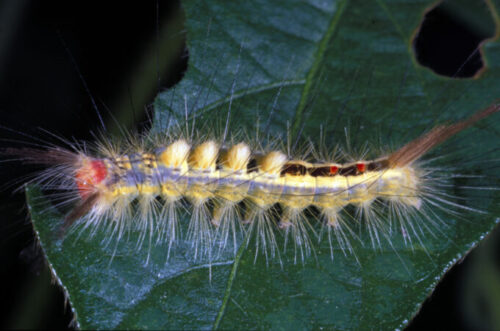
Fig. 3: White-marked tussock moth caterpillar. (Photo: John Obermeyer, Purdue University).
Tussock Moth
The only insect I found on the oak tree was a white-marked tussock moth caterpillar, Orgyia leucostigma (Fig. 3). This is the likely culprit for the minor feeding damage I noticed. These are not significant pests and do not require treatment. Don’t touch them, though! The setae of this caterpillar are irritating and may cause allergic reactions.
Overall, the pests I found were minimal and non-threatening to the trees. It’s normal to find some insect pressure in the landscape. Knowing when and if to treat requires accurate diagnosis and monitoring of pest levels. Check out PurduePlantDoctor.com for an easy-to-use diagnostic aid and treatment recommendations.
Original article posted: Purdue Landscape Report.
Subscribe and receive the newsletter: Purdue Landscape Report Newsletter.
Resources:
Large Spots on Maple Leaves that Look Like Tar, Purdue Extension News
Find an Arborist, International Society of Arboriculture
Diseases in Hardwood Tree Plantings, The Education Store, Purdue Extension’s resource center
Fifty Common Trees of Indiana
An Introduction to Trees of Indiana, The Education Store
Shrubs and Woody Vines of Indiana and the Midwest, The Education Store
Tree Installation: Process and Practices, The Education Store
Forest Improvement Handbook, The Education Store
Invasive Species, Playlist, Purdue Extension – FNR YouTube Channel
Report Invasive Species, Purdue Invasive Species
What are invasive species and why should I care?, Got Nature? Blog, Purdue Extension – Forestry and Natural Resources
Indiana Department of Natural Resources: Invasive Species
Indiana Invasive Species Council
ID That Tree, Purdue Extension-FNR YouTube playlist
Tree Defect Identification, The Education Store
Tree Wound and Healing, Got Nature? Blog, Purdue Extension – Forestry and Natural Resources
Alicia Kelley, Cooperative Agricultural Pest Survey (CAPS) Coordinator
Purdue Extension – Entomology
Purdue Landscape Report: A new invasive insect of concern has been identified in the state of Georgia. In August of 2023, Georgia’s Department of Agriculture, along with the USDA, confirmed the presence of the yellow-legged hornet, Vespa velutina, outside of the city of Savannah. To date, this is the only confirmed identification of this insect in the United States; it has already established in Europe, the Middle East, and parts of Asia outside of its native range. V. velutina is a native of the subtropical and tropical regions of southeast Asia, and it is not yet clear how it arrived in North America. Much like the northern giant hornet, previously known as the Asian giant hornet or ‘murder hornet’, this insect will attack honeybee hives in search of food and represents a potential danger to the beekeeping industry.
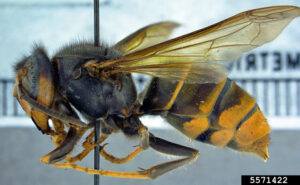
Figure 1. Yellow-Leg Hornet. Image Credit: Allan Smith-Pardo, Invasive Hornets, USDA APHIS PPQ, Bugwood.org
Yellow-legged hornets are predators and will regularly attack honeybees to provide food for their young, though it is possible they could attack other, similar species. Since honeybees concentrate their numbers in hives with a lot of in-and-out traffic, they provide an excellent opportunity for the hornets to hunt and provide food for their young. The hornets are effectively ambush predators, waiting in front of hive entrances and capturing workers with their legs as they leave the hive. The hornets then dismember the bees, returning to their young with only the thorax, which contains the largest amount of protein. However, it is believed that yellow-legged hornets only represent a lethal threat to weaker hives that are already experiencing problems; it is also too early to tell how already-existing honeybee issues, such as mite and disease issues, will interact with the presence of this insect.
The yellow-legged hornet, much like other members of Order Hymenoptera, is a social insect. They create oval or egg-shaped nests in trees that can house as many as 6,000 individuals. Colonies are composed of a foundress and her young, who become the workers within the colony. Female hornets will overwinter within tree hollows, leaf litter, or other environmentally stable locations, and once spring arrives, they start their own colony and give birth to new workers who care for young and hunt.
As with any new invasive species, it is critical to successful identify it and differentiate it from other species of wasps and hornets that we experience in the Midwest. At a glance, the yellow-legged hornet is barely discernable from European hornets, yellowjackets, and similar insects; they possess aerodynamic shapes with heavy yellow and black color patterns like many of their cousins. The most easily identified trait is their namesake: the legs of this insect tend to be black closer to the body, with the lower half of the leg bright yellow. The segments of the abdomen follow a similar pattern, with those segments closer to the center of the body being dominated by black, steadily becoming more yellow as you reach the tip of the abdomen. The yellow-legged hornet is also approximately an inch in length, with reproductive individuals sometimes reaching an inch and a half.
While remaining observant will be critical to reporting any invasive species, there are a few things to keep in mind about the yellow-legged hornet. This insect has only been found in one location in Georgia; no other states have any sightings or confirmed reports of this insect. There is also no evidence the insect has established a population in Georgia, there is only one confirmed sighting. The best course of action for now is to be vigilant and report any potential sightings by calling 1-866-NOEXOTIC, or you can contact our local Purdue Extension educator for assistance.
To view this full article and other Purdue Landscape Report articles, please visit Purdue Landscape Report.
Subscribe and receive the newsletter: Purdue Landscape Report Newsletter.
Resources:
Invasive Species, Playlist, Purdue Extension – FNR YouTube Channel
Report Invasive Species, Purdue Invasive Species
What are invasive species and why should I care?, Got Nature? Blog, Purdue Extension – Forestry and Natural Resources
Pest Management, The Education Store
Protecting Pollinators: Why Should We Care About Pollinators?, The Education Store, Purdue Extension resource center
Ask The Expert: What’s Buzzing or Not Buzzing About Pollinators , Purdue Extension – Forestry & Natural Resources (FNR) YouTube Channel
Purdue Pollinator Protection publication series, Purdue Extension Entomology
Subscribe Purdue Extension-Forestry and Natural Resources YouTube Channel
Bob Bruner, Exotic Forest Pest Educator
Purdue Entomology
Tom Creswell, Plant & Pest Diagnostic Laboratory Director
Purdue Botany and Plant Pathology
Cliff Sadof, Professor, Ornamental, Pest Management
Purdue Entomology Extension Coordinator
Join Purdue Extension urban forester Lindsey Purcell, exotic forest pest educator Elizabeth Barnes and entomology extension specialist Cliff Sadof as they share about how to inspect trees, what to look for, who to contact, etc., as well what invasive pests and diseases you should keep your eye out for.
If you have any questions regarding trees, forests, wildlife, wood products or other natural resource topics, feel free to contact us by using our Ask an Expert web page.
Resources
Ask an Expert, Playlist, Purdue Extension – Forestry and Natural Resources Youtube Channel
Tree Risk Management – Got Nature? Blog, Purdue Extension – FNR
Tree Appraisal and the Value of Trees, The Educational Store
Surface Root Syndrome, The Education Store
Iron Chlorosis of Trees and Shrubs, The Education Store
Facebook Live – Ask The Expert: Pests in Your Woods, Got Nature? Blog, Purdue Extension – Forestry and Natural Resources
Fall webworms: Should you manage them, Got Nature? Blog
How to Identify Tree Defects and What to Do about It?, Got Nature? Blog
Lindsey Purcell, Urban Forestry Specialist
Purdue University, Department of Forestry and Natural Resources
Elizabeth Barnes, Exotic Forest Pest Educator
Purdue University, Department of Entomology
Cliff Sadof, Professor / Ornamental / Pest Management / Coordinator of Extension
Purdue University, Department of Entomology
Do you know what’s “bugging” your trees? There are several exotic insects which may be attacking our trees that you should be on the lookout for. Some have already arrived in Indiana, and others are still beyond our borders but have a risk of showing up here in the future.
Dr. Elizabeth Barnes, exotic forest pest educator with Purdue Department of Entomology, and Liz Jackson Purdue extension forestry specialist, describe these exotic insects, symptoms to watch for in your trees, and discuss what some of the biggest future pest concerns are in this Facebook Live session from June 18, 2020.
Resources
Purdue Report Invasive website
Indiana Department of Natural Resources Division of Entomology & Plant Pathology
Don’t Move Firewood
Purdue Plant and Pest Diagnostic Lab
Indiana District Foresters
Indiana Consulting Foresters
Purdue Landscape Report
Insect specific sites:
Asian Longhorned Beetle Information (from APHIS)
Spotted Lanternfly (Penn State Extension)
Emerald Ash Borer Information from Purdue
EAB University: Invasive insects and pathogens webinar series
Elizabeth Jackson, Manager Walnut Council/IN Forestry Woodland Owners Association (IFWOA) & Engage Specialist
Purdue University Department of Forestry and Natural Resources
Elizabeth Barnes, Exotic Forest Pest Educator
Purdue University Entomology

Recent Posts
- Painted Hickory Borer, Purdue Landscape Report
Posted: May 14, 2026 in Forestry, Invasive Insects, Wildlife - Saving Giants of the Blue River: Purdue Team Earns Statewide Recognition
Posted: in Aquaculture/Fish, Aquatic/Aquaculture Resources, Wildlife - Restoring Roots to Save the Salamanders, USDA – Natural Resources Conservation Service
Posted: May 6, 2026 in Aquaculture/Fish, Forestry, Wildlife - Spring Storms Are Coming: How to Reduce Tree Damage and Risk
Posted: May 1, 2026 in How To, Urban Forestry, Wildlife, Woodlands - Cryptocline Leaf Spot (Anthracnose) of Elm, Purdue Landscape Report
Posted: April 30, 2026 in Disease, Forestry, Woodlands - Mechanical Damage to Trees: Mowing and Maintenance Equipment
Posted: April 24, 2026 in Forestry, Forests and Street Trees, Urban Forestry - A Woodland Management Moment: Growing Quality Black Walnut in Openings
Posted: April 20, 2026 in Urban Forestry, Woodland Management Moment, Woodlands - Spring Into Bloom With ID That Tree
Posted: in Forests and Street Trees, Urban Forestry, Woodlands - Question: Have Whippoorwill Birds Declined in Numbers?
Posted: in Ask the Expert, Wildlife - Invasive Species in Eastern Forests, Webinar Series
Posted: in Invasive Insects, Invasive Plant Species, Urban Forestry, Wildlife
Archives
Categories
- Alert
- Aquaculture/Fish
- Aquatic/Aquaculture Resources
- Ask the Expert
- Christmas Trees
- Community Development
- Disease
- Drought
- Forestry
- Forests and Street Trees
- Gardening
- Got Nature for Kids
- Great Lakes
- How To
- Invasive Animal Species
- Invasive Insects
- Invasive Plant Species
- Land Use
- Natural Resource Planning
- Nature of Teaching
- Plants
- Podcasts
- Ponds
- Publication
- Safety
- Spiders
- Timber Marketing
- Urban Forestry
- Webinar
- Wildlife
- Wood Products/Manufacturing
- Woodland Management Moment
- Woodlands