 Purdue University - Extension - Forestry and Natural Resources
Got Nature? Blog
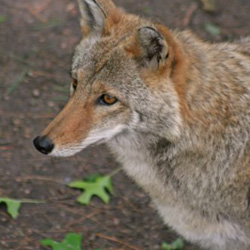 MyDNR Newsletter, Indiana Department of Forestry and Natural Resources (IDNR): Indiana residents are more likely to see coyotes during wintertime, but sightings are no cause for alarm. Coyotes become more active during winter as young coyotes leave their families to find a new home and coyotes begin breeding. Coyotes may look larger than they are due to their thick winter coats, but the average coyote only weighs 20-30 pounds.
General characteristics
- The coyote closely resembles a German shepherd dog in height and shape but it carries its tail below the level of its back instead of curved upward and is generally half the weight of a German shepherd.
- Coyotes have a long slender snout and large, pointed ears.
- The upper body is a grizzled gray or buff, with a reddish brown or gray muzzle and legs. The belly is white, cream-colored or reddish yellow.
- The coyote has a bushy tail, which it carries below the level of its back.
- Coyotes average 25 pounds (ranging from 20 to 50 pounds), and they measure 40 to 50 inches long from nose to tail tip.
- Coyotes are elusive and normally avoid humans.
- They can be active day or night, but are typically most active at dawn and dusk.
- The coyote communicates by barking, yipping and howling.
Distribution and abundance
Coyotes are present in all sections of the state. There are records of coyotes in Indiana as early as 1816, though they likely inhabited Indiana well before that time. Bounties were in place in Indiana on coyotes from at least 1849 through the late 1960s. Despite this persecution by early European settlers, coyotes persisted in Indiana. Historically, coyote populations were limited in range to the prairie regions of the state, and expansion may have partially been limited because wolves suppress coyote populations, and both red and gray wolves were once abundant in Indiana. However, with the eradication of wolves and conversion of habitat to farmland, coyotes have been able to expand and adapt to new habitats. Statewide coyote abundance has slowly increased as coyotes continued to expand into previously unoccupied habitat. Today, coyotes occupy all of Indiana, no matter the habitat type or amount of development.
Detour Coyote
If you see a coyote and want it to go away, try to make it uncomfortable:
- Yell.
- Wave your arms.
- Spray it with a hose.
- Throw tennis balls or small stones at it, but don’t throw anything that could be food, like apples.
- Carry a jar of coins to shake or a small air horn to make noise.
For more information, please visit Indiana Department of Forestry and Natural Resources (IDNR).
To subscribe for the monthly newsletter view: MyDNR Email Newsletter.
Resources
Coyotes, IN DNR
Coyotes (PDF), Wildlife Conflicts, Department of Entomology, Purdue University
Should I Be Worried About Coyotes in My Yard?, Purdue Extension – Forestry & Natural Resources (FNR) Got Nature? Blog
Coexisting With Coyotes, Wild Bulletin, Indiana Department of Natural Resources, Division of Fish and Wildlife
Ask the Expert: Coexisting with Coyotes , Purdue Extension – FNR Got Nature? Blog
Urban Coyotes – Should You Be Concerned?, Purdue Extension – FNR Got Nature? Blog
Pets Disappearing? The Cause May Be Coyotes, Purdue Extension – FNR Got Nature? Blog
Question: Which is the correct species of coyotes I have on my land here in Indiana, coyote or coywolf?, Purdue Extension – FNR Got Nature? Blog
Indiana Department of Forestry and Natural Resources
Across the entire United States, and into Canada and Mexico, coyotes can be found just about everywhere. But what would you do if you encountered a coyote while out all alone? Would you feel comfortable knowing how to act? How about how to keep your children or pets safe in such an encounter?
In our June 11th Ask the Experts series, “Coexisting with Coyotes,” Purdue researchers Brian MacGowan and Bee Overbey talked about these topics and more. As a keystone species in their ecosystem, coyotes play an extremely important role in maintaining population levels of other animals, such as deer, rabbits, raccoons, and voles. By keeping these populations in check, plants and trees are better able to grow, and this creates greater biodiversity and healthier habitat. And coyotes are not going anywhere! This resilient, intelligent species has learned to adapt around humans and every change that we bring.
Check out the video below to learn more about coyotes, how important they are to the lands where they are found, and tips on how to coyote-proof your property and keep yourself and your loved ones safe in coyote encounters. By working together, we can easily and safely coexist with this vital native species.
Resources
Ask an Expert, Playlist, Purdue Extension – Forestry and Natural Resources (FNR) YouTube Channel
Coyotes, IN DNR
Coyotes (PDF), Wildlife Conflicts, Department of Entomology, Purdue University
Coexisting With Coyotes, Wild Bulletin, Indiana Department of Natural Resources, Division of Fish and Wildlife
Urban Coyotes – Should You Be Concerned?, Purdue Extension – FNR Got Nature? Blog
Pets Disappearing? The Cause May Be Coyotes, Purdue Extension – FNR Got Nature? Blog
Question: Which is the correct species of coyotes I have on my land here in Indiana, coyote or coywolf?, Purdue Extension – FNR Got Nature? Blog
Permitted Wildlife Rehabilitators, Indiana Department of Natural Resources
Dealing with Nuisance Coyotes, Indiana Department of Natural Resources (IN DNR)-Fish and Wildlife
Urban Coyote Research Center, Urban Coyote Ecology & Management, Cook County, Illinois
Brian MacGowan, Wildlife Extension Specialist
Purdue Forestry and Natural Resources
Brande (Bee) Overbey
Purdue Forestry and Natural Resources
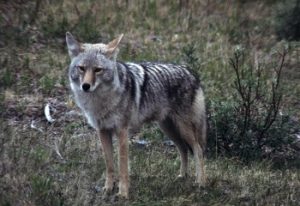
Coyote (Canis latrans) – Photo by Alfred Viola, Northeastern University, Bugwood.org
Question
Can you help me identify the canines that live on my farm? Are they “coyote” or “coywolf”? I have taken photos of the pups and have been confused on trying to identify them from articles I have found online. One article I found suggests a “coywolf” is something unusual; but another article I found suggests every canine we refer to in Indiana as “coyote” is actually a “coywolf” hybrid rather than a “true” coyote. I would like to know. Thank you.
Answer
Thanks for submitting this question. You are correct that many of the online articles we find are confusing and contradicting, and if I might add often just plain wrong. The truth is all coyotes east of the Mississippi River have some level of wolf genes as well as domestic dog genes. What is recent, is that this was discovered regarding wolf genes. Not because of a recent hybridization event, but that new genetic technologies (specifically, next gen sequencing) allowed researchers to detect this. Coyotes we have now are no different than they were 50 years ago. The term coywolf is a poor term at best. It is misleading and its use should be avoided. News outlets use it because it captures viewers attention.
In terms of variation in size and current hybridization, these things can happen but are very rare. The size of coyotes, as with people or any other animal species, can be extreme for a rare individual. However, the vast majority are within a normal range. Published weights of coyotes average 13 to 15 kg. So on average, coyotes in Maine are about 5 lbs heavier than those in Indiana. So, a typical adult coyote is 28 to 33 lbs, you do find one that is 40 lbs or even approaches 50 lbs total. Wolves are capable of breeding with coyotes, but they will most often run them off or kill them as competitors for shared resources. Also, we don’t have any wolves around either.
Stan Gerht is a researcher from Ohio State. His team has studied coyotes in the Chicagoland area for years. They have a lot of good information about them at the Urban Coyote Research website.
Resources
Coyotes, IN DNR
Coyotes (PDF), Wildlife Conflicts, Department of Entomology, Purdue University
Should I Be Worried About Coyotes in My Yard?, Purdue Extension – Forestry & Natural Resources (FNR) Got Nature? Blog
Coexisting With Coyotes, Wild Bulletin, Indiana Department of Natural Resources, Division of Fish and Wildlife
Ask the Expert: Coexisting with Coyotes , Purdue Extension – FNR Got Nature? Blog
Urban Coyotes – Should You Be Concerned?, Purdue Extension – FNR Got Nature? Blog
Pets Disappearing? The Cause May Be Coyotes, Purdue Extension – FNR Got Nature? Blog
Permitted Wildlife Rehabilitators, Indiana Department of Natural Resources
How do you eliminate a nuisance animal on your property?, Indiana Department of Natural Resources (IN DNR)-Fish and Wildlife
Urban Coyote Research Center, Urban Coyote Ecology & Management, Cook County, Illinois
Brian MacGowan, Wildlife Extension Specialist & Extension Coordinator
Purdue University Department of Forestry and Natural Resources Extension
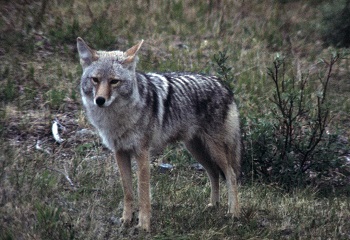
Coyote (Canis latrans) – Photo by Alfred Viola, Northeastern University, Bugwood.org
In acknowledging National Wildlife Week, #nationalwildlifeweek, it seems fitting to place this post regarding several concerned questions that we receive on coyotes. As Spring is just around the corner many urban residents are getting ready for the return of many birds, mammals and amphibians. While folks are quick to recognize the call of spring peepers, or the song of robins, they are surprised to know other types of critters can call their backyard home, or at least visit on occasion. One animal that is getting a lot more attention in recent years is the coyote.
Coyotes are actually native to Indiana, although their historical distribution is much smaller in the state than it is today. Their range expansion is simply the result of their adaptability. Things we have done to the broader landscape combined with less competing animals has opened up new resources to coyotes. You may tend to think that urban landscapes offer little for wildlife species and don’t offer the quality of rural or more “natural” areas. Perhaps surprising to many, urban environments can often support larger densities of wildlife presumably because of increased food resources and lower trapping or hunting pressure. For coyotes, studies have shown that urban coyotes tend to focus activities in natural habitats within the urban landscape. They will still use more well-developed areas and the extent of which varies among animals; however, coyotes will often shift their behavior to avoid human activity.
Coyotes are considered to be a nuisance or even a safety threat by some. They are probably one of the few animals that homeowners want removed simply by seeing them in their yard. However, these fears are rarely justified. Diet studies of urban coyotes indicate they eat primarily rodents and rabbits. Coyote predation may actually help reduce conflicts with other species of wildlife. As a primary predator of Canada goose nests they may limit population growth in urban environments. Similarly, coyotes may do the same for white-tailed deer populations through fawn predation.
Fear of coyotes is derived largely of perceived threats to pets or people. Coyotes have been documented to attack people, but only rarely. Habituation to humans seems to play a role but it is also unclear how other factors contribute to these attacks. For example, the age or social status of the offending coyote and the intentional feeding by humans preceding the attack may play roles. Moreover, not all attacks are the same. Coyotes may attack out of defense, because of disease (e.g., rabies), or other reasons.
The threat to pets, particularly cats or small dogs, is much more real. Coyotes are known predators of cats. In urban areas, predation of cats is slightly higher than in rural areas, although cats still make up only about one percent or less of their diet according to studies. Cat predation may be ecologically beneficial given the impact free ranging cats have on our native wildlife. Attacks on dogs are less common but do occur and are most frequent during the coyote breeding season, December through February. Small dogs are at most risk but larger breeds may be attacked by a pair or family group.
While these facts on coyote behavior may alarm some, the truth is these are all extremely rare cases. Coyotes are around many of us every day and we aren’t even aware of their presence. Coyotes are native to Indiana and can help control populations of other wildlife species that cause more widespread conflicts and property damage. However, there are a few common-sense steps we can do to avoid conflicts with urban coyotes. The most important is to never intentionally feed coyotes or other animals. They don’t need it. Intentional feeding can contribute to coyote’s habitation to people, which is believed to be a contributing factor to attacks. Some also recommend scaring off coyotes you see in the yard by banging pots and pans or similar actions. However, this may cause a defensive response in some animals and it not advisable.
Resources:
Coyotes, IN DNR
Coyotes (PDF), Wildlife Conflicts, Department of Entomology, Purdue University
Should I Be Worried About Coyotes in My Yard?, Purdue Extension – Forestry & Natural Resources (FNR) Got Nature? Blog
Coexisting With Coyotes, Wild Bulletin, Indiana Department of Natural Resources, Division of Fish and Wildlife
Ask the Expert: Coexisting with Coyotes , Purdue Extension – FNR Got Nature? Blog
Urban Coyotes – Should You Be Concerned?, Purdue Extension – FNR Got Nature? Blog
Pets Disappearing? The Cause May Be Coyotes, Purdue Extension – FNR Got Nature? Blog
Question: Which is the correct species of coyotes I have on my land here in Indiana, coyote or coywolf?, Purdue Extension – FNR Got Nature? Blog
Permitted Wildlife Rehabilitators, Indiana Department of Natural Resources
How do you eliminate a nuisance animal on your property?, Indiana Department of Natural Resources (IN DNR)-Fish and Wildlife
Urban Coyote Research Center, Urban Coyote Ecology & Management, Cook County, Illinois
Wildlife Damage, Purdue Extension-Department of Forestry and Natural Resources
Preventing Wildlife Damage – Do You Need a Permit?, The Education Store, Purdue Extension
Internet Center for Wildlife Damage Management (ICWDM), University of Wisconsin
Brian MacGowan, Extension Wildlife Specialist
Department of Forestry & Natural Resources, Purdue University

Recent Posts
- Restoring Roots to Save the Salamanders, USDA – Natural Resources Conservation Service
Posted: May 6, 2026 in Aquaculture/Fish, Forestry, Wildlife - Spring Storms Are Coming: How to Reduce Tree Damage and Risk
Posted: May 1, 2026 in How To, Urban Forestry, Wildlife, Woodlands - Cryptocline Leaf Spot (Anthracnose) of Elm, Purdue Landscape Report
Posted: April 30, 2026 in Disease, Forestry, Woodlands - Mechanical Damage to Trees: Mowing and Maintenance Equipment
Posted: April 24, 2026 in Forestry, Forests and Street Trees, Urban Forestry - A Woodland Management Moment: Growing Quality Black Walnut in Openings
Posted: April 20, 2026 in Urban Forestry, Woodland Management Moment, Woodlands - Spring Into Bloom With ID That Tree
Posted: in Forests and Street Trees, Urban Forestry, Woodlands - Question: Have Whippoorwill Birds Declined in Numbers?
Posted: in Ask the Expert, Wildlife - Invasive Species in Eastern Forests, Webinar Series
Posted: in Invasive Insects, Invasive Plant Species, Urban Forestry, Wildlife - Tree Risk Management: What Every Property Owner Needs to Know
Posted: April 17, 2026 in Forests and Street Trees, Wildlife, Woodlands - As the spring wildflowers emerge, so do the woodland invaders
Posted: April 16, 2026 in Forestry, Forests and Street Trees, Invasive Plant Species
Archives
Categories
- Alert
- Aquaculture/Fish
- Aquatic/Aquaculture Resources
- Ask the Expert
- Christmas Trees
- Community Development
- Disease
- Drought
- Forestry
- Forests and Street Trees
- Gardening
- Got Nature for Kids
- Great Lakes
- How To
- Invasive Animal Species
- Invasive Insects
- Invasive Plant Species
- Land Use
- Natural Resource Planning
- Nature of Teaching
- Plants
- Podcasts
- Ponds
- Publication
- Safety
- Spiders
- Timber Marketing
- Urban Forestry
- Webinar
- Wildlife
- Wood Products/Manufacturing
- Woodland Management Moment
- Woodlands