 Purdue University - Extension - Forestry and Natural Resources
Got Nature? Blog
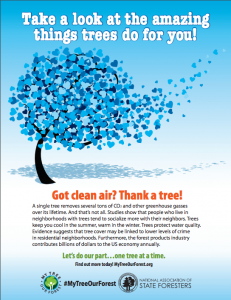 Both urban and community forests alike are indispensable staples of our ecosystem that we cannot live without. The My Tree—Our Forest® campaign, from The National Association of State Foresters, is an urban and community forestry campaign that aims to increase public understanding about the benefits that healthy forests offer to communities across the United States and the role that state forestry agencies play in protecting the nation’s urban trees.
For your next outreach event, consider downloading the My Tree—Our Forest® fact sheet, a free pdf that takes a look at the amazing things trees do for you.
Resources:
Indiana’s Urban Woodlots, The Education Store
Urban Wood and Traditional Wood: A Comparison of Properties and Uses, The Education Store
Tree selection for the “Un-natural” Environment, The Education Store
Planting Your Tree Part 1: Choosing Your Tree – Video, The Education Store
Lumber from Urban and Construction-Site Trees, The Education Store
National Association of State Foresters (NASF)
 Changing human behavior is not easy! But, with the right tools, you can effect change over time. Whether you are designing an education and outreach campaign to get people to protect an endangered species, save energy, reduce waste, or conserve water, one thing remains the same: you have to be vigilant about your campaign.
Using two previously developed campaigns as examples, the Promote Conservation through an Effective Campaign publication walks you through four steps to help you create an effective campaign to change people’s behavior. One campaign takes a comprehensive approach to protecting a group of endangered species and the other a less extensive approach to promoting rain barrel adoption. These two examples demonstrate different levels of complexity that you can refer to as you create your own effective education and outreach campaign.
Resources:
Using Social Indicators to Evaluate the Effectiveness of Outreach in Two Indiana Watersheds, Journal of Contemporary Water Research and Education
Conserving the Eastern Hellbender Salamander, Human Dimensions of Wildlife
Rain Barrel Information and Program, Wabash River Enhancement Corporation (WREC)
Uninteresting, Strange, or Ugly: Protecting non-charismatic species, Purdue Got Nature? blog
Belyna Bentlage, Research Associate/Outreach Coordinator
Purdue University Department of Forestry and Natural Resources
Linda Prokopy, Professor of Natural Resources Social Science
Purdue University Department of Forestry and Natural Resources
 Purdue Extension’s Don’t be a Zombie exhibit is traveling the country to illustrate the need to prepare for emergencies. It urges people to be ready for an emergency and have a plan. Don’t Wait. Communicate. Make an Emergency Communication Plan for you and your family because you just don’t know when disasters will impact your community. At the Indiana State Fair, almost 60,000 visitors got a chance to check out the Don’t be a Zombie – Be Prepared exhibit, complete with zombies, interactive displays, maze, and even a video game made to simulate a zombie apocalypse!
The display aims to have its viewers take away four main points:
- Be informed – know what threats may affect your community
- Make a family emergency plan – a plan for everyone and everything in case of disaster
- Make a 72-hour emergency kit – enough supplies for everyone involved, along with first-aid, a crank radio, and a gallon of water per person each day
- Practice and maintain these plans regularly – a plan is only good if it is up to date and known by everyone
The Don’t Be a Zombie exhibit is currently travelling to museums all over the country, its existence thanks to the collaboration between Purdue Extension and EDEN, a prime source for disaster preparedness information.
Resources:
Purdue Agriculture Traveling Exhibit Program
First Steps to Flood Recovery, The Education Store
Keeping Food Safe During Emergencies, The Education Store
Purdue Traveling Exhibit Program
Trees and all forestlands are a major asset to our cities, towns, and communities. They work hard to provide aesthetic, functional and environmental benefits to improve the quality of life. A well-planted and maintained tree will grow faster and live longer than one improperly planted or maintained. Before planting your tree consider selection, placement, and maintenance to ensure an outcome that will meet your needs. This video will walk you through everything you need to know before you plant your tree.
Resources:
Tree Planting Part 1: Choosing a Tree, The Education Store
Tree Installation: Process and Practices, The Education Store
Financial and Tax Aspect of Tree Planting, The Education Store
Tree Risk Management, The Education Store
Designing Hardwood Tree Plantings for Wildlife, The Education Store
Planning the Tree Planting Operation, The Education Store
Lindsey Purcell, Urban Forestry Specialist,
Purdue Department of Forestry and Natural Resources
You’ve heard about all the traditional careers. But what about being an outdoor scientist? Introducing the world to The Familiar Faces Project which shares careers in fisheries, aquatic sciences, forestry, wildlife and sustainable biomaterials. This video will show by example what it’s like to be an outdoor scientist, walking you through a typical work day of Megan Gunn. For more information about The Familiar Faces Project, contact thefamiliarfacesproject@gmail.com.
Resources:
Aquatic Ecology Research Lab, Forestry and Natural Resources
Megan Gunn, Aquatic Ecology Research Scientist
Purdue University Department of Forestry and Natural Resources
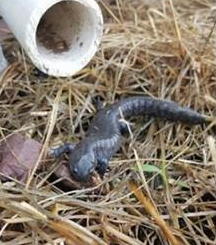 Question from Josh L Lady: Which salamander is this?
Answer:
The picture posted is one of our mole salamanders (family Ambystomatidae). This common family name comes from their habit of staying underground and in burrows of other creatures, except when breeding. Species in this family can be difficult to tell apart at times. Adding to the confusion, there is a species called the Mole salamander (Ambystoma talpoideum) which in Indiana is only found in the extreme southwestern part of the state.
The species below is likely a Small-mouthed Salamander (Ambystoma texanum). It can be found throughout Indiana except the extreme northwestern and southeastern portions of the state. The Small-mouthed Salamander is a moderate sized salamander characterized by its slender head and small mouth. Most individuals are dark gray to grayish brown with light gray speckles (often resembling lichen-like markings), particularly on the lower sides of the body. Adults usually reach 11-19 cm in length and have an average of 15 costal grooves (i.e., the “wrinkles” on the sides of the body; range 13-15).
I say it is likely a Small-mouthed Salamander because they are nearly identical to in appearance to the Streamside Salamander (Ambystoma barbouri). There are minor differences in the teeth and premaxillary bones between the two species; however, these structures are not readily observable in the field. Geographic location and habitat type are the best ways to distinguish these two species. Streamside Salamanders are restricted to extreme southeastern Indiana, occupy hilly areas, and breed in streams. Small-mouthed Salamanders exist nearly statewide, occur in wooded floodplains, and breed in ephemeral wetlands.
Resources:
Salamanders of Indiana, The Education Store, Purdue Extension resource center.
Appreciating Reptiles and Amphibians, The Education Store
Forest Management for Reptiles and Amphibians: A Technical Guide for the Midwest, The Education Store
Ranavirus: Emerging Threat to Amphibians, The Education Store
Brian MacGowan, Wildlife Extension Specialist
Purdue Forestry and Natural Resources
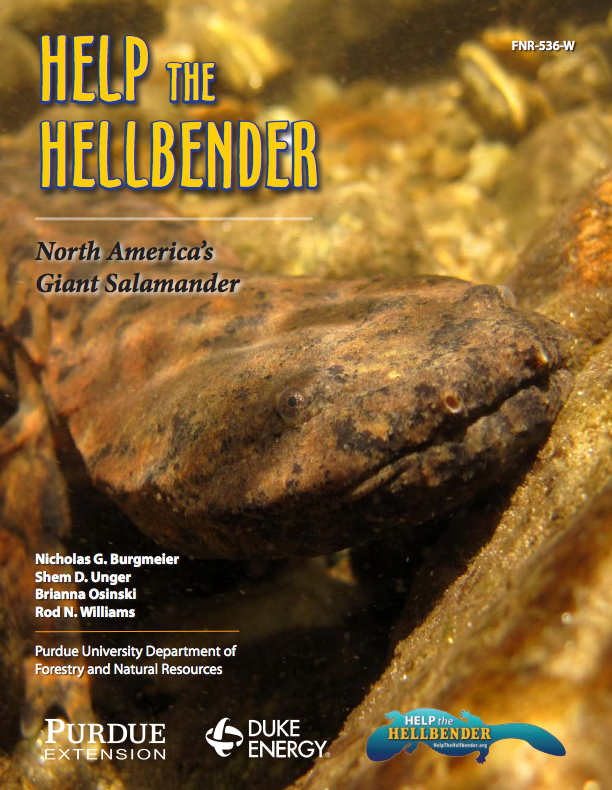 The eastern hellbender is a large, fully aquatic salamander that requires cool, well-oxygenated rivers and streams. Because they require high-quality water and habitat, they are thought to be indicators of healthy stream ecosystems. While individuals may live up to 29 years, possibly longer, many populations of this unique salamander are in decline across their geographic range. It is the largest salamander in North America, found in and around rivers and streams in 17 states from New York to Missouri. Many hellbender populations are in decline within their geographic range. This publication provides information on identifying and preserving this important aquatic animal. You can find Help the Hellbender, FNR-536-W, as well as other great resources that can be found at The Purdue Education Store.
Resources:
How Anglers and Paddlers Can Help the Hellbender, The Education Store
Hellbender ID, The Education Store
Improving Water Quality by Protecting Sinkholes on Your Property, The Education Store
Improving Water Quality at Your Livestock Operation, The Education Store
Healthy Water, Happy Home – Lesson Plan, The Education Store
Nick Burgmeier, Research Biologist and Extension Wildlife Specialist
Purdue Department of Forestry and Natural Resources
Dr. Rod Williams, Associate Head of Extension and Associate Professor of Wildlife Science
Purdue Department of Forestry and Natural Resources
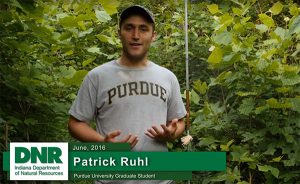 The Indiana Department of Natural Resources (IDNR) has released its latest video – Indiana’s Working Forests.
This video explores the origins of Indiana’s state forest system that developed after pioneer settlers cleared the original forests and left behind a nearly barren landscape.
State forests were established to demonstrate how to use science to grow and sustain healthy forest systems. Beginning with just 2,000 acres at Clark State Forest in 1903, the DNR Division of Forestry has expanded to cover more than 156,000 acres at 15 sites.
In the video, IDNR Forestry professionals discuss how management practices contribute to forest health by mimicking natural disturbances. Those practices promote regeneration of oaks and hickories that are valuable food sources for many forest wildlife species. They explain that although timber harvests have increased in recent years, the selective approach they use removes less than 1 percent of the available trees in any given year.
FNR graduate wildlife student Patrick Ruhl, Purdue adviser Dr. J. Barny Dunning, Jr., shares how the Hardwood Ecosystem Experiment provides him the opportunity to study the effects of forest management and the changes that are taking place among migratory songbirds. This project is a collaborative effort with the following sponsors: Indiana Department of Natural Resources, Division of Forestry; Indiana Department of Natural Resources, Division of Fish and Wildlife, Wildlife Diversity Section; Purdue University; Indiana Chapter of the Ruffed Grouse Society; National Geographic Society; and The Wildlife Management Institute. To view more partners view the Hardwood Ecosystem Experiment website: heeforestudy.org.
Resources:
A Landowner’s Guide to Sustainable Forestry: Part 1: Sustainable Forestry – What does it mean for Indiana?, The Education Store
Indiana Forest Issues and Recommendations, The Education Store
The Hardwood Ecosystem Experiment: Indiana Forestry and Wildlife, The Education Store
Forest Ecosystem Management in Indiana, The Education Store
Forest Ecosystem Management in the Central Hardwood Region, The Education Store
Phil Bloom, Director
Indiana Department of Natural Resources
The Eastern hellbenders are the largest salamander in North America and have survived unchanged for nearly 2 million years. Hellbender populations are declining across their range, from Missouri to New York. This decline is likely caused by human influences such as habitat degradation and destruction. Many states are developing conservation programs to help the hellbender. To find out what you can do visit helpthehellbender.org.
Resources:
How Anglers and Paddlers Can Help the Hellbender, The Education Store
Hellbender ID, The Education Store
Improving Water Quality by Protecting Sinkholes on Your Property, The Education Store
Improving Water Quality at Your Livestock Operation, The Education Store
Healthy Water, Happy Home – Lesson Plan, The Education Store
Nick Burgmeier, Project Coordinator, Research Biologist & Wildlife Extension Specialist
Purdue Department of Forestry and Natural Resources
Dr. Rod Williams, Associate Head of Extension and Associate Professor of Wildlife Science
Purdue Department of Forestry and Natural Resources
Every hunter knows the importance of acorns for game and non-game species alike. When acorns are plentiful it can alter the movements and patterns of game species and when acorns are absent wildlife must rely on alternative food sources to meet their nutritional needs during the fall, winter, and early spring. Knowing the importance of acorns to many wildlife species, it is beneficial to identify which trees are the most reliable and best producing in the woods.
Intro to oaks
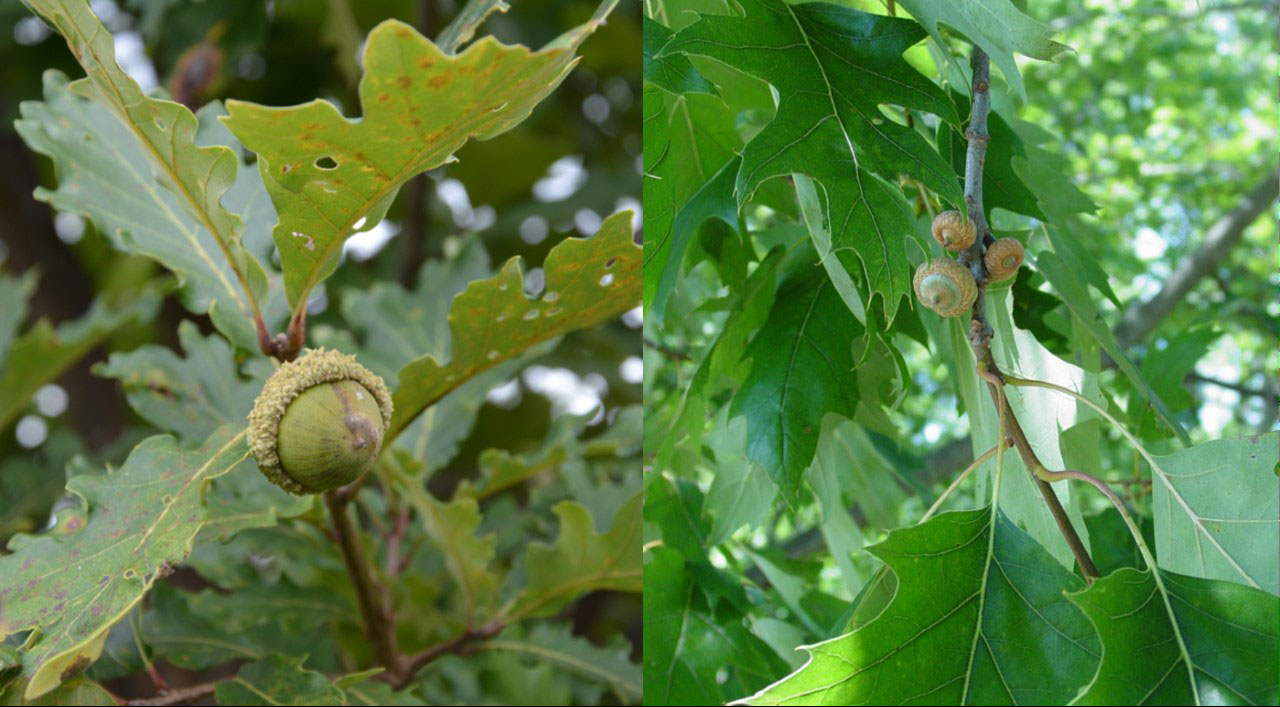
White oak acorns are clustered at the end of the branch – this year’s growth, like on this swamp white oak on the left. Whereas, red oak acorns are farther down the branch at the end of last year’s growth, like the northern red oak acorns on the right. (Photo by Brian MacGowan)
Oak trees in Indiana fall into 1 of 2 groups, white oak (e.g., white, swamp white, and chinkapin) or red oak (e.g., northern red, black, and pin). White oaks produce acorns in 1 growing season (acorns falling in 2016 are from flowers that were pollinated in the spring of 2016) and red oaks produce acorns in 2 growing seasons (acorns falling in 2016 are from flowers that were pollinated in the spring of 2015). This means a late frost in the spring may result in poor acorn production in white oaks in the fall of the same year, but will not influence red oak acorn production the same fall. However, a late frost in back-to-back years may result in a mast failure from both groups.
White oak acorns tend to be selected by wildlife more than red oak acorns because they contain less tannins resulting in a less bitter and more digestible acorn. Check out the Native Trees of the Midwest to learn more about oaks, their value for wildlife, and help you learn to identify different species.
Oak trees can be split into production groups based on their relative acorn production capabilities. Some individual oak trees are inherently poor producers and rarely produce acorns even in a bumper crop. Whereas other individuals are excellent producers and may produce acorns even in the poorest year. Research from the University of Tennessee reported poor mast producing trees represented 50% of white oaks in a stand and produced only 15% of the white oak acorn crop in a given year, whereas excellent producing trees represented 13% of white oaks, but produced 40% of the total white oak acorn production. When you included excellent and good producing white oaks together (31% of trees), they accounted for 67% of the total white oak acorn crop in a stand. This means a minority of the white oaks in a stand may produce a majority of the acorns!
Scouting oak trees
Understanding that some individual oak trees are poor producers, some are excellent, and some fall between poor and excellent, surveying oak trees can help identify important mast producing individuals. The late summer and early fall, just prior to or at the beginning of acorn drop, are perfect times to identify the best and worst producing oaks in your stand of timber. Scouting can be as formal as conducting a mast survey, National Deer Association, or as informal as taking mental notes of oak trees with heavy crops of acorns on the ground while you are walking to and from your tree stands in the fall. Either way, scouting oaks for acorn production capability can provide more information when determining where to hunt in the fall or which trees to retain and which trees to remove during a timber harvest. If wildlife management is an objective on your property, trees that you identify as the best acorn producers in the woods can be retained during a timber harvest, while poor producing trees can be removed with little detriment to overall acorn production. It is important to remember to retain a balance of oaks from both the red and white oak group, favoring red oak, to help safeguard against complete mast failures.
Forest management is insurance for mast failure

The top photo is of a mature forest with very few canopy gaps resulting in very little cover or food for wildlife. The bottom picture is of a forest stand where undesirable trees have been girdled (tree on the right-hand side of picture) to increase light to the forest floor and where multiple prescribed fire have been conducted to increase forage production and cover.
Annual acorn production in a stand of oaks is highly variably and can be dependent on environmental conditions. For example, late frosts, poor pollination, and insect infestations all can be culprits for poor mast production across a stand of oaks. Because of these factors, white oaks tend to only produce reliably 2 out of every 5 years, meaning 3 out of 5 years (60%) there is poor mast production or a failed mast crop in white oaks. Red oaks may produce a good crop as frequently as 2 to 5 years, but only produce a bumper crop an average every 5 to 7 years.
The extreme variability in acorn production underscores the importance in considering alternative food sources for fall, winter, and early spring for wildlife. In most mature forests with few canopy gaps there could be as little as 50-100 lbs of deer selected forage per acre in the understory. However, with some management, like thinning and prescribed fire the amount of deer selected forage can be increased to almost 1000 lbs/ac! Additionally, forest management also increases the amount cover throughout the year for species like white-tailed deer, wild turkey, ruffed grouse, woodcock, and many forest songbirds. Contrary to popular belief, cover can be more of a limiting factor for many wildlife species compared to food availability. Forest management could include girdling undesirable trees to expand growing space for mast producing trees or conducting a timber harvest removing undesirable trees and poor producing oak trees while retaining good producing trees. For more information on conducting a timber harvest for wildlife on your property contact a professional wildlife biologist or professional forester in your area.
When spending time in the woods this fall, take the time to look up and down to see which oaks in your woods are the best producers.
Resources:
Native Trees of the Midwest, The Education Store, Purdue Extension’s resource center
Masting Characteristics of White Oaks: Implications for Management, University of Tennessee
Wildlife Biologists, Indiana Department of Natural Resources (IDNR)
Find a Forester, Indiana Department of Natural Resources (IDNR)
Enrichment Planting of Oaks, The Education Store
Forest Improvement Handbook, The Education Store
The Hardwood Ecosystem Experiment: Indiana Forestry and Wildlife, The Education Store
Jarred Brooke, Wildlife Extension Specialist
Purdue University Department of Forestry and Natural Resources

Recent Posts
- 2026 Winter Bat Survey In Progress, MyDNR
Posted: March 27, 2026 in Wildlife - Fast-Growing Trees for the Landscape, Purdue Landscape Report
Posted: March 26, 2026 in Forestry, Urban Forestry, Woodlands - Urban Tree Spotlight: Planting Deciduous Shade Trees, Purdue Landscape Report
Posted: March 25, 2026 in Forests and Street Trees, Urban Forestry, Woodlands - Beetle that attacks Tree-of-Heaven found in Indiana, Purdue Landscape Report
Posted: March 20, 2026 in Invasive Insects, Wildlife, Woodlands - ID That Tree: Dwarf Chinkapin Oak
Posted: in Forestry, Urban Forestry, Wildlife, Woodlands - IN-PREPared: Essential Resources for Indiana’s Severe Weather Season
Posted: March 11, 2026 in How To, Safety - DNR Hiring for Indiana Conservation Officer Positions, MyDNR
Posted: March 9, 2026 in Urban Forestry, Wildlife, Woodlands - ID That Tree: Shumard Oak
Posted: in Plants, Urban Forestry, Wildlife, Woodlands - A Woodland Management Moment: Windbreak Around Walnut Plantings
Posted: March 3, 2026 in Forestry, Urban Forestry, Woodland Management Moment - Getting Certified as an Indiana Certified Prescribed Burn Manager
Posted: March 2, 2026 in How To, Urban Forestry, Woodlands
Archives
Categories
- Alert
- Aquaculture/Fish
- Aquatic/Aquaculture Resources
- Ask the Expert
- Christmas Trees
- Community Development
- Disease
- Drought
- Forestry
- Forests and Street Trees
- Gardening
- Got Nature for Kids
- Great Lakes
- How To
- Invasive Animal Species
- Invasive Insects
- Invasive Plant Species
- Land Use
- Natural Resource Planning
- Nature of Teaching
- Plants
- Podcasts
- Ponds
- Publication
- Safety
- Spiders
- Timber Marketing
- Uncategorized
- Urban Forestry
- Webinar
- Wildlife
- Wood Products/Manufacturing
- Woodland Management Moment
- Woodlands