In this spring bloom edition of ID That Tree, meet a rare find in Indiana, the yellowwood tree, a species native to Brown County. This species is recognizable by clusters of white flowers that bloom in May/June, compound leaves and smooth gray bark that resembles American beech.
 Purdue University - Extension - Forestry and Natural Resources
Subscribe to our Got Nature? Newsletter


Got Nature? Blog
Posted on August 23rd, 2021 in Forestry, Timber Marketing, Wood Products/Manufacturing, Woodland Management Moment, Woodlands | No Comments »
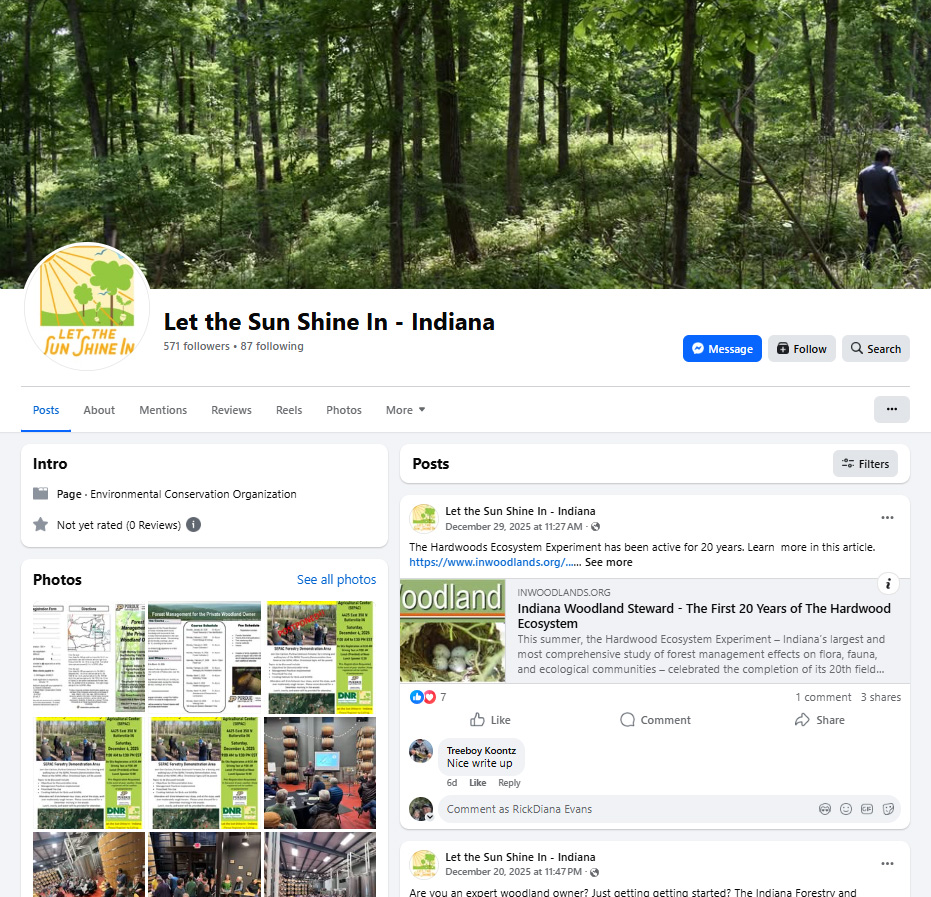 Let the Sun Shine Indiana is a new Facebook page that has resources for landowners and natural resource managers along with woodland lovers. With commitments to sustain the health and diversity of our forests, grasslands and wildlife for future generations, this collaboration will be sharing educational data, problem-solving and management practices, along with main focus on recovering and maintaining oak-hickory ecosystems for the benefit of both the wildlife and the people of southern Indiana.
Followers will find educational content, management tips, and timely discussions focused especially on restoring and maintaining our vital oak–hickory ecosystems, benefiting both the wildlife that rely on these ecosystems and the people who depend on them for recreation, livelihood and long‑term land stewardship.
This collaboration is made up of scientists, natural resource managers, communication specialists, foresters, wildlife biologists, etc. from a variety of organizations, universities and agencies across Indiana, who share a common goal – restore southern Indiana’s open oak woodlands – because with the sun comes life.
To learn more about Let the Sun Shine In Indiana and shared resources visit their website.
Resources:
ID That Tree, Purdue Extension – Forestry and Natural Resources YouTube Channel
A Woodland Management Moment, Purdue Extension – FNR YouTube Channel
Woodland Stewardship for Landowners, Purdue Extension – Forestry and Natural Resources YouTube Channel
Shrubs and Woody Vines of Indiana and the Midwest, Purdue University Press
Native Trees of the Midwest, Purdue University Press
Investing in Indiana Woodlands, The Education Store
Forest Improvement Handbook, The Education Store
Forest Stewardship Practices for Oak-Hickory Ecosystems in Indiana, Purdue Extension – Pond and Wildlife
Forestry for the Birds Pocket Guide, The Nature Conservancy
Directory of Professional Foresters, Indiana Forestry & Woodland Owners Association
Explore the Rich World of Oaks, Purdue Extension – FNR & Partners
Judie Brown, Coordinator
Let the Sun Shine In – Indiana (LSSI)
In this spring bloom edition of ID That Tree, meet the bladdernut, which features clusters of tiny white/yellow flowers in the spring. Learn more about this small shrub from Purdue Extension forester Lenny Farlee inside.
If you have any questions regarding wildlife, trees, forest management, wood products, natural resource planning or other natural resource topics, feel free to contact us by using our Ask an Expert web page.
Resources:
ID That Tree, Playlist, Purdue Extension – Forestry and Natural Resources Youtube Channel
A Woodland Management Moment, Playlist, Purdue Extension – FNR Youtube Channel
Shrubs and Woody Vines of Indiana and the Midwest, Purdue University Press
Native Trees of the Midwest, Purdue University Press
Investing in Indiana Woodlands, The Education Store
Forest Improvement Handbook, The Education Store
Lenny Farlee, Sustaining Hardwood Extension Specialist
Purdue University Department of Forestry and Natural Resources
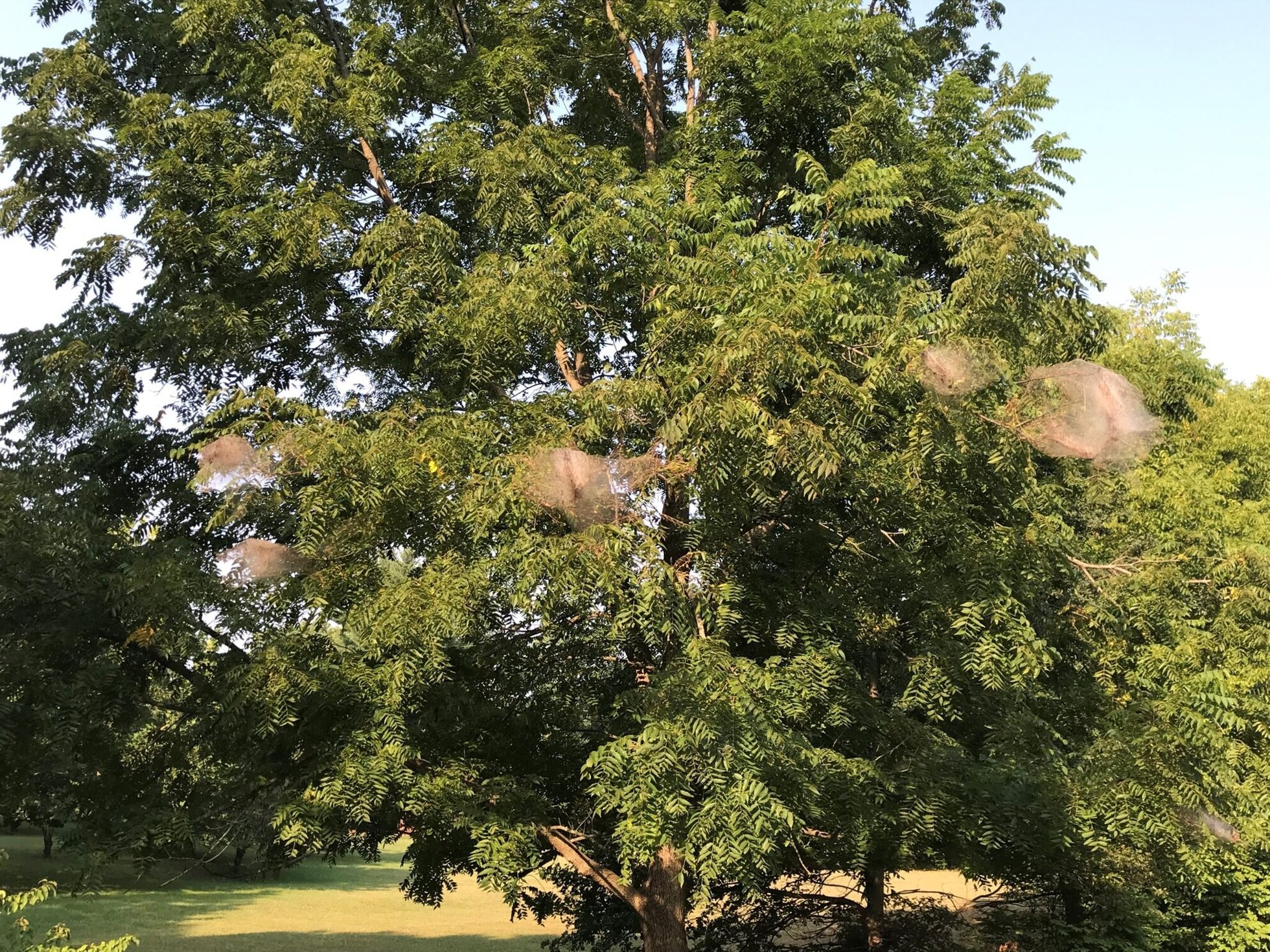
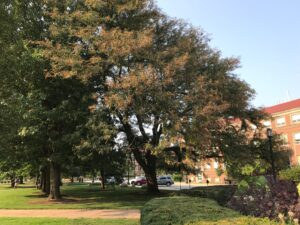
Figure 1. White webs of fall webworm are a common site along roadsides and forest edges.
Purdue Landscape Report: Just after the browned leaves on branches of trees attacked by periodical cicadas began to disappear from view, webworms and their associated browning started to spread through the landscape. Two of the more common webworms I have been seeing are the mimosa and the fall webworm. While neither of them can outright kill trees, they are unsightly, especially at the end of the summer when substantial portions of the tree are disfigured. Treatment late in the summer does little to reduce injury, because it can be difficult to penetrate the webs with insecticides, and because most of the damage has already been done. The best course of action is to plan on managing these insects next year, when they are more easily controlled with insecticides.
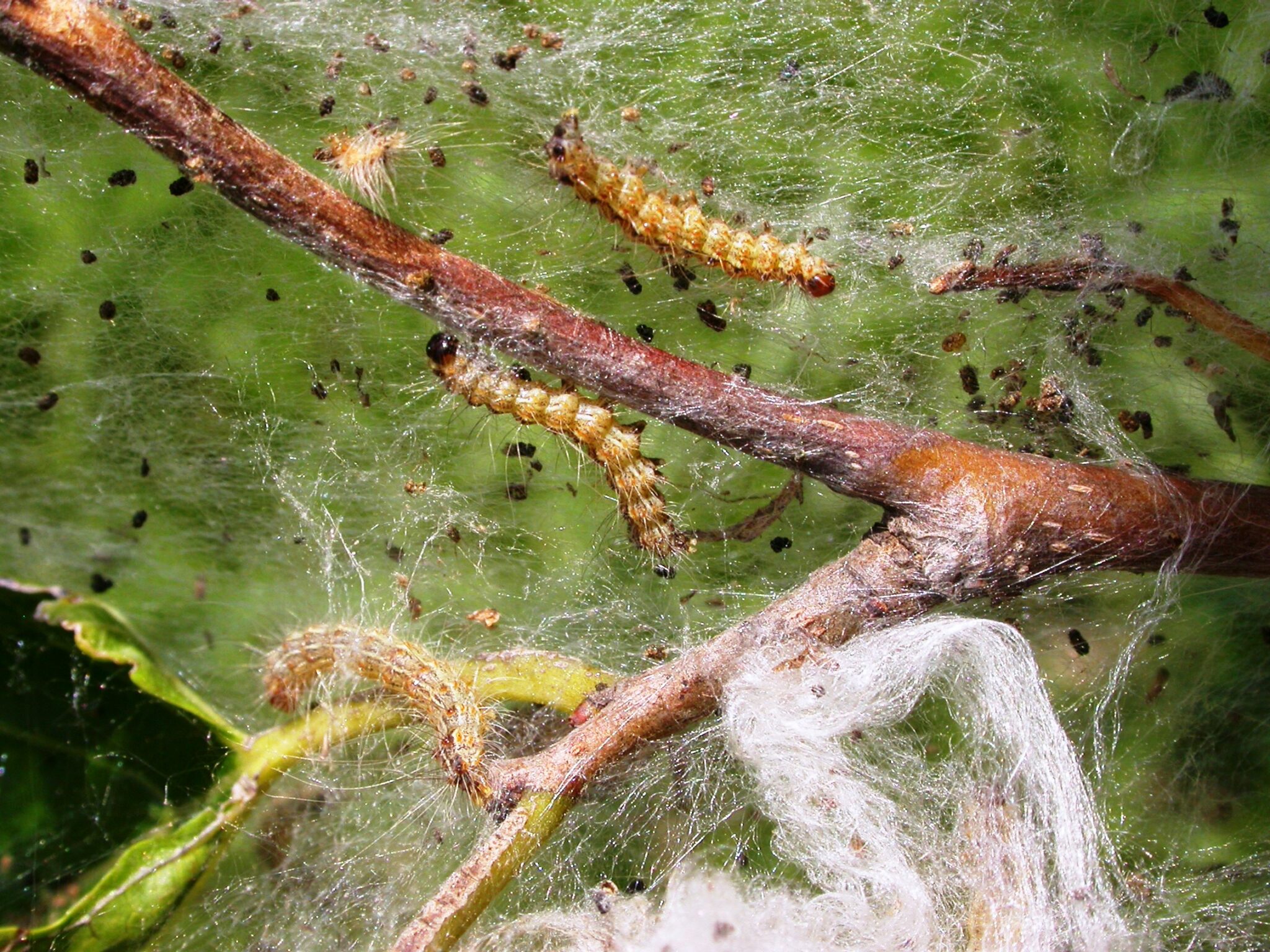
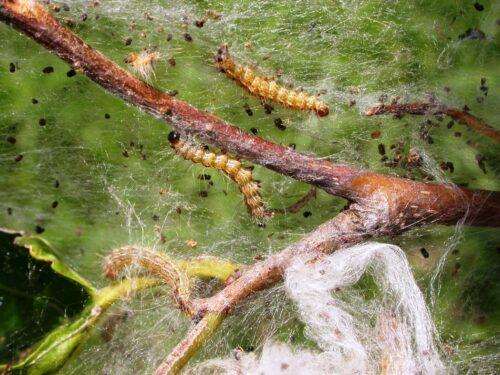
Figure 2. Fall webworms and fecal pellets feeding in web.
Fall webworm attacks a wide range of deciduous trees including flowering fruit trees, black walnuts, elm, hickory and bald cypress. They are most common in suburban areas, roadsides and forest edges that lack the predators and parasites the webworms encounter in the forest. In June adults emerge from wintering sites to lay eggs in the canopy. Eggs hatch into caterpillars that encase branches in webs as they feed. By the end of the second generation in late August webs can cover substantial portions of trees. Caterpillars are yellowish-green with black spots and long white hairs, and grow up to 1.5″. Caterpillar feces falling from trees can be a problem during heavy infestations.
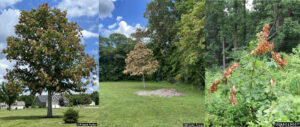
Figure 3. Brown webbing caused by the mimosa webworm is extensive on honeylocust plantings throughout the state.
Unlike fall webworm, the mimosa webworm only attacks honeylocust and mimosa trees. Leaves on ends of branches become webbed together and turn brown as lime-green caterpillars skeletonize leaf tissue. Heavily infested trees appear frosted brown. In early June, adults emerge and lay eggs on trees. First webs can be seen on ends of branches in mid-June when oak leaf hydrangea and tree lilac are in bloom. The second generation of adults fly and lay eggs starting in late July. A third generation occurs in the fall. The dangling caterpillars can be a nuisance under heavily infested trees. We are seeing an uptick in the abundance of this pest because the last two winters have not been cold enough to kill them.
Resources:
Purdue Landscape Report
Ask an Expert, Purdue Extension – Forestry and Natural Resources
Purdue Plant Doctor App Suite, Purdue Extension – Entomology
Landscape & Ornamentals: Bagworms, The Education Store, Purdue Extension
Bagworm caterpillars are out feeding, be ready to spray your trees, Got Nature? Post, Purdue Extension – Forestry and Natural Resources
Fall Webworms: Should You Manage Them, Got Nature? Post, Purdue Extension – Forestry and Natural Resources
On this edition of ID That Tree, meet the American hornbeam, also known as the musclewood or the water or blue beech. This native Indiana understory tree stands out due to its gray bark and striations that resemble muscles and sinews as well as its doubly toothed leaves.
If you have any questions regarding wildlife, trees, forest management, wood products, natural resource planning or other natural resource topics, feel free to contact us by using our Ask an Expert web page.
Resources:
ID That Tree, Playlist, Purdue Extension – Forestry and Natural Resources Youtube Channel
A Woodland Management Moment, Playlist, Purdue Extension – FNR Youtube Channel
Shrubs and Woody Vines of Indiana and the Midwest, Purdue University Press
Native Trees of the Midwest, Purdue University Press
Investing in Indiana Woodlands, The Education Store
Forest Improvement Handbook, The Education Store
American Hornbeam, The Purdue Arboretum Explorer
Lenny Farlee, Sustaining Hardwood Extension Specialist
Purdue University Department of Forestry and Natural Resources
Posted on August 4th, 2021 in Forestry, Forests and Street Trees, Plants, Wildlife, Woodlands | No Comments »
In this edition of ID That Tree, Purdue Extension forester Lenny Farlee introduces you to a member of the Indiana maple family that doesn’t follow the rest of its family’s traditions. Learn about the boxelder and its unique traits inside.
If you have any questions regarding wildlife, trees, forest management, wood products, natural resource planning or other natural resource topics, feel free to contact us by using our Ask an Expert web page.
Resources:
ID That Tree, Playlist, Purdue Extension – Forestry and Natural Resources Youtube Channel
A Woodland Management Moment, Playlist, Purdue Extension – FNR Youtube Channel
Shrubs and Woody Vines of Indiana and the Midwest, Purdue University Press
Native Trees of the Midwest, Purdue University Press
Investing in Indiana Woodlands, The Education Store
Forest Improvement Handbook, The Education Store
Boxelder, The Purdue Arboretum Explorer
Lenny Farlee, Sustaining Hardwood Extension Specialist
Purdue University Department of Forestry and Natural Resources
If you have any questions regarding wildlife, trees, forest management, wood products, natural resource planning or other natural resource topics, feel free to contact us by using our Ask an Expert web page.
Resources:
ID That Tree, Playlist, Purdue Extension – Forestry and Natural Resources Youtube Channel
A Woodland Management Moment, Playlist, Purdue Extension – FNR Youtube Channel
Shrubs and Woody Vines of Indiana and the Midwest, Purdue University Press
Native Trees of the Midwest, Purdue University Press
Investing in Indiana Woodlands, The Education Store
Forest Improvement Handbook, The Education Store
Yellowwood, The Purdue Arboretum Explorer
Lenny Farlee, Sustaining Hardwood Extension Specialist
Purdue University Department of Forestry and Natural Resources
Posted on July 28th, 2021 in Forestry, Gardening, Invasive Plant Species, Plants, Urban Forestry, Woodlands | No Comments »
In this episode of A Woodland Management Moment, Purdue Extension forester Lenny Farlee talks about a variety of hand tools you can use to assist with invasive species control and timber stand improvement on your property if you choose not to use power tools.
If you have any questions regarding trees, forests, wildlife, wood products or other natural resource topics, feel free to contact us by using our Ask an Expert web page.
Resources:
A Woodland Management Moment, Playlist, Purdue Extension – Forestry and Natural Resources (FNR) YouTube Channel
Shrubs and Woody Vines of Indiana and the Midwest, Purdue University Press
Native Trees of the Midwest, Purdue University Press
Investing in Indiana Woodlands, The Education Store
Forest Improvement Handbook, The Education Store
Woodland Stewardship for Landowners Video Series, Playlist, Indiana Department of Natural Resources YouTube Channel
Lenny Farlee, Sustaining Hardwood Extension Specialist
Purdue University Department of Forestry and Natural Resources
In this edition of ID That Tree, Purdue Extension forester Lenny Farlee introduces you to a common understory shrub that features clusters of flowers and simple leaves reminiscent of red maple. Learn more about this native Indiana species inside.
If you have any questions regarding wildlife, trees, forest management, wood products, natural resource planning or other natural resource topics, feel free to contact us by using our Ask an Expert web page.
Resources:
ID That Tree, Playlist, Purdue Extension – Forestry and Natural Resources Youtube Channel
A Woodland Management Moment, Playlist, Purdue Extension – FNR Youtube Channel
Shrubs and Woody Vines of Indiana and the Midwest, Purdue University Press
Native Trees of the Midwest, Purdue University Press
Investing in Indiana Woodlands, The Education Store
Forest Improvement Handbook, The Education Store
Mapleleaf Viburnum, The Purdue Arboretum Explorer
Lenny Farlee, Sustaining Hardwood Extension Specialist
Purdue University Department of Forestry and Natural Resources
Posted on July 19th, 2021 in Forestry, Forests and Street Trees, Gardening, Plants, Urban Forestry, Wildlife, Woodlands | No Comments »
Image 1. Cicada damage is typically restricted to the small, outer twigs. Trees may be completely covered by cicadas or have a few isolated dead twigs. All trees in these images are expected to suffer no serious long term effects from this damage. Images by Clifford Sadof of Purdue University and Pennsylvania Department of Conservation and Natural Resources – Forestry.
Purdue Landscape Report: Dead leaves covering trees (image 1) or on the ground beneath them (image 2) in July would normally be a worrying sign for tree health, but this year much of the damage can be blamed on 17-year cicadas. This damage is unlikely to cause serious trouble for healthy, large trees and management is relatively simple. The choice to prune or not to prune comes down to cost, aesthetics, and concern for the next generation of cicadas.
How Cicadas Damage Plants
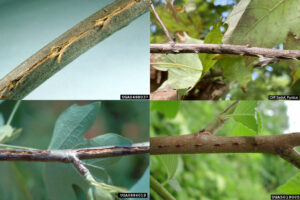
Cicada damage is similar to a light pruning and should not be an issue for healthy, mature trees. Cicadas damage trees when they lay their eggs in small twigs (3/16 to 1/2 inch in diameter) on deciduous trees and shrubs. They have a long, thin body part called an ovipositor that resembles a sewing needle that they stab into plants to lay their eggs. This action creates small holes and cracks in the bark (image 3). If enough cicadas lay their eggs in a twig, it can damage the bark enough to kill the twig (image 1).
Image 2. The dead twigs killed by cicada egg laying may break off the tree and litter the ground underneath. Image by Pennsylvania Department of Conservation and Natural Resources – Forestry.
Recognizing Cicada Damage
The degree of cicada damage depends on insect density and the number of trees in the area. To determine if a tree or bush has been damaged by cicadas, ask the following questions:
Image 3. Cicada egg laying damage varies between tree species, but is consistently in a straight, length-wise line along the branch. Note that all four examples also have signs of either puncture marks, cracks in the bark, or some combination of the two. Images by John Ghent, Clifford Sadof of Purdue University, Tim Tigner of Virginia Department of Forestry, and Pennsylvania Department of Conservation and Natural Resources – Forestry.
1. Were there 17-year cicadas within 50 meters (~164 ft) of the tree this year? Cicadas do not travel very far. If there weren’t noticeable numbers of 17-year cicadas nearby the damage was likely caused by something else.
2. Is the damage on a deciduous tree or bush? Cicadas rarely lay their eggs on evergreen trees and herbaceous plants. Damage on these types of plants is likely caused by something other than the cicadas.
3. What size of branches and twigs are damaged? Cicadas show a strong preference for small twigs (3/16 to 1/2 inch in diameter). As a result, damaged trees may appear as though their outer layer of leaves is dead while the inner leaves remain healthy (image 2). If larger branches are dead, the damage was probably not caused by cicadas.
4. Does the bark have typical egg laying damage? If you can reach the damaged twigs, look for a row of puncture wounds often connected by cracks length-wise along the branch. Their appearance may vary between tree species (image 3), but they will almost always be length-wise.
Resources:
17 Ways to Make the Most of the 17-year Cicada Emergence, Purdue College of Agriculture
Ask an Expert: Cicada Emergence Video, Got Nature? Blog, Purdue Extension-FNR
Periodical Cicada in Indiana, The Education Store, Purdue Extension resource center
Cicada Killers, The Education Store
Cicada, Youth and Entomology, Purdue Extension
Purdue Cicada Tracker, Purdue Extension-Master Gardener Program
Purdue Landscape Report
Elizabeth Barnes, Exotic Forest Pest Educator
Purdue University Department of Entomology
Posted on July 9th, 2021 in Forestry, Invasive Plant Species, Plants, Woodland Management Moment, Woodlands | No Comments »
In this episode of A Woodland Management Moment, Purdue Extension forester Lenny Farlee talks about the process of invasive species control in woodland areas from the combination of various treatments methods to the timing of those treatments.
If you have any questions regarding trees, forests, wildlife, wood products or other natural resource topics, feel free to contact us by using our Ask an Expert web page.
Resources:
A Woodland Management Moment, Playlist, Purdue Extension – Forestry and Natural Resources (FNR) Youtube Channel
Invasive Species, FNR Playlist
Report Invasive Species, Purdue Invasive Species
The GLEDN Phone App – Great Lakes Early Detection Network
EDDMaps – Early Detection and Distribution Mapping System
Indiana Department of Natural Resources: Invasive Species
Indiana Invasive Species Council
Cooperative Invasive Species Management Area (CISMA)
Woodland Stewardship for Landowners: Environmental Quality Incentives Program (EQIP) -helping with invasive species
Invasive plants: impact on environment and people, The Education Store
What are invasive species and why should I care?, Got Nature? Blog, Purdue Extension
Woodland Invaders, Got Nature? Blog
Lenny Farlee, Sustaining Hardwood Extension Specialist
Purdue University Department of Forestry and Natural Resources

Recent Posts
- Heavy August Rains Bring More Mosquitoes to Indiana
Posted: September 9, 2026 in How To, Invasive Insects, Safety, Wildlife - Question: Why Did the Shagbark Hickories Survive the Tornado?
Posted: August 27, 2026 in Forests and Street Trees, How To, Urban Forestry - New Indiana Woodland Steward Newsletter
Posted: August 12, 2026 in Forestry, Urban Forestry, Wildlife, Woodlands - Indiana Fall Hunting Licenses on Sale and New Mobile App Available
Posted: in Forestry, How To, Wildlife - Trees and Storms: Understanding Damage, Risk and Recovery
Posted: in How To, Urban Forestry - Lighting a Spark: Prescribed Burn Associations
Posted: August 6, 2026 in Community Development, Forestry, Safety, Wildlife - ID That Tree: Nannyberry Viburnum
Posted: July 22, 2026 in Forestry, Plants, Wildlife, Woodlands - ID That Tree: Eastern Swamp Privet
Posted: in Forestry, Plants, Wildlife, Woodlands - Jarred Brooke Receives Early Career Award for Prescribed Fire Work
Posted: July 20, 2026 in Forestry, Forests and Street Trees, Natural Resource Planning, Safety - Bovine Tuberculosis in Wild White-tailed Deer: Background and Frequently Asked Questions
Posted: in Disease, Natural Resource Planning, Wildlife
Archives
Categories
- Alert
- Aquaculture/Fish
- Aquatic/Aquaculture Resources
- Ask the Expert
- Christmas Trees
- Community Development
- Disease
- Drought
- Forestry
- Forests and Street Trees
- Gardening
- Got Nature for Kids
- Great Lakes
- How To
- Invasive Animal Species
- Invasive Insects
- Invasive Plant Species
- Land Use
- Natural Resource Planning
- Nature of Teaching
- Plants
- Podcasts
- Ponds
- Publication
- Safety
- Spiders
- Timber Marketing
- Urban Forestry
- Webinar
- Wildlife
- Wood Products/Manufacturing
- Woodland Management Moment
- Woodlands