 Purdue University - Extension - Forestry and Natural Resources
Got Nature? Blog
Purdue Landscape Report: Temperatures are finally dropping and leaves are changing color. Autumn is progressing well in my opinion. Before you know it winter will be here, and some people will be wondering is there anything to be done to better protect the trees around you? The answer is yes, and I applaud you for your initiative to continue caring for your trees. To give your trees the best chance to survive the winter and better thrive next year there is an assortment of activities available ranging from diy projects up to calling in an ISA certified arborist to help you out.
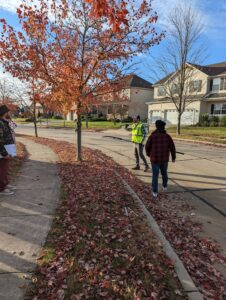
Figure 1. Maintenance of trees in the fall include many tasks before dormancy occurs.
Mulching:
One simple task to better prepare your trees for winter is to add a new layer of mulch, which benefits your trees in multiple ways. Adding a 2-3 inch thick layer of mulch will better maintain moisture levels and buffer extreme temperature changes in the soil and will add some organic matter too. Mulching to the drip line will benefit the tree the most, but in the case of larger trees it’s not always feasible. Try for at least a 3-foot radius from the trunk and make sure to leave a 2 inch or so gap between the trunk and the mulch. Remember, no volcano mulching.
Fertilizing:
That mulch you just added will add some organic material to your soil as it slowly breaks down, but an autumn fertilization can benefit your trees too. Unlike trees in the forest that have a natural supply of nutrients from fallen leaves and twigs, trees around our homes are usually deprived as we rake and clean up our yards. Adding a slow-release fertilizer in the fall helps provide a nutrient boost over the winter, can promote root growth, and better prepare your tree for Spring.
Watering:
Water is still an essential part of your tree care plan, but as temperatures drop and trees begin to head into dormancy they don’t need as much water as is required in the hit summer months. If you have irrigation systems in your yard start to drop the frequency of watering. You can water up until the first freeze, but make sure soils are just a little damp and not soaked. Evergreens in particular will benefit from slow deep watering 1-2 times a week until the soil freezes. Winter winds and temperatures can desiccate the needles without an adequate supply of water.
Pruning:
Now is a good time to prune out any dead, damaged, or diseased limbs in your trees. If you have access to hand saws and pole saws or pruners, you can remove smaller branches or those closer to the ground. Make sure you are making proper pruning cuts though, and if there are large limbs, those at heights, or you are just unsure of how to make a good cut enlist the help of a professional arborist.
Trunk damage:
Sunscald or southwest damage occurs on young and/or thin barked trees in the winter. Wounds can occur between the south to southwest facing part of the trunk on sunny days in the winter as temperatures rise and suddenly drop. Over time these wounds can become quite large. Trees can also incur damage from deer during the rut. Bucks will scrape trees with their antlers, scraping off the bark and damaging the cambium. Both of these injuries can be reduced one younger trees by installing tree guards in the fall. Tree guards are plastic barriers you place around the main stem of the tree. I recommend using white corrugated drainage pipe that can be found at most home centers. You can make a cut lengthwise along the pipe for easy installation and make sure it has a large enough diameter to leave a space between it and the tree. Just remember to remove it come Spring.
Inspections:
Visual inspections can be done year-round, but this time of the year it might be easier to see changes in your tree as leaves are falling and the canopy becomes more visible. From the ground up to the canopy, some of the things you’re looking for include fungal growth around the base of the tree, any sort of damage on the main stem or branches, premature leaf drop or color change, and branches that are dead, cracked, diseased, or seem weak. Any concerns you find are also great information to share with an ISA Certified arborist which can be found using the Trees Are Good website.
To view this full article and other Purdue Landscape Report articles, please visit Purdue Landscape Report.
Subscribe and receive the newsletter: Purdue Landscape Report Newsletter.
Resources:
Re-mulch Your Trees, Purdue Landscape Report
Pruning, Purdue Landscape Report
Southwest Damage/Sunscald, Purdue Landscape Report
Planning the Tree Planting Operation, The Education Store, Purdue Extension’s resource center
Tree Risk Management, The Education Store
Tree Planting Part 2: Planting Your Tree, The Education Store
Planting Your Tree Part 1: Choosing Your Tree, Purdue Extension – Forestry and Natural Resources (FNR) YouTube Channel
Summer Tree Care, Purdue Landscape Report
Tree Defect Identification, The Education Store
Tree Wound and Healing, Got Nature? Blog, Purdue Extension – FNR
Surface Root Syndrome, The Education Store
Shrubs and Woody Vines of Indiana and the Midwest, The Education Store
Ask an Expert: Tree Selection and Planting, Purdue Extension-FNR YouTube playlist
ID That Tree, Purdue Extension-FNR YouTube playlist
Subscribe – Purdue Extension-FNR YouTube Channel
Ben McCallister, Urban Forestry Specialist
Purdue Forestry & Natural Resources
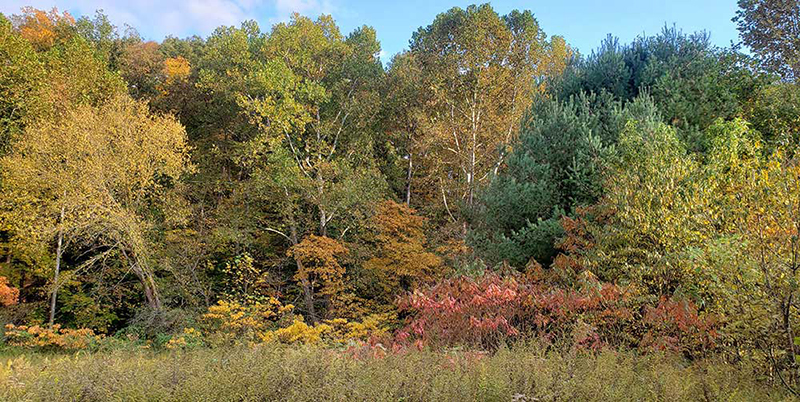 The Indiana Natural Resources Conservation Service (NRCS) is offering an opportunity for landowners to apply for cost assistance with conservation practices like tree planting, forest stand improvement, invasive species control, wildlife habitat improvement and many others.
U.S. Department of Agriculture, Natural Resources Conservation Service News Release, Indianapolis, IN, October 11, 2023 – Farm Bill program application dates have been set for Indiana’s agricultural producers who want to improve natural resources and address concerns on their land. Curtis Knueven, USDA-Natural Resources Conservation Service (NRCS) Acting State Conservationist, announced that December 8 will be the application deadline for the Environmental Quality Incentives Program (EQIP) and Conservation Stewardship Program (CSP) in Indiana. This year’s funding levels are a historic high for Indiana NRCS, bringing $42 million in EQIP and $22 million in CSP for Indiana landowners.
EQIP is a voluntary conservation program available for agricultural producers. Through EQIP, NRCS provides financial and technical assistance to install conservation practices that reduce soil erosion and sedimentation, improve soil health, improve water and air quality and create wildlife habitat. Also included in this sign up are several state and national initiatives. A full list of initiatives can be found by visiting www.nrcs.usda.gov/programs-initiatives/eqip-environmental-quality-incentives/indiana/environmental-quality-incentives.
“EQIP helps agricultural producers in a manner that promotes agricultural production and environmental quality as compatible goals,” said Knueven. “Farmers can receive assistance to implement structural and management conservation practices that optimize environmental benefits on their working agricultural land while helping to increase their yields.”
CSP is an important Farm Bill conservation program that helps producers who are already practicing good stewardship to take their natural resource management to the next level. The program helps to improve both their agricultural production and provide valuable conservation benefits such as cleaner and more abundant water, as well as healthier soils and better wildlife habitat.
“Whether you are looking to improve grazing conditions, increase crop resiliency, or develop wildlife habitat, we can custom design a CSP plan to help you meet those goals,” Knueven said. “We can help you identify natural resource problems in your operation and provide technical and financial assistance to solve those problems or attain higher stewardship levels in an environmentally beneficial and cost-effective manner.”
While applications are accepted year-round, interested producers should work with their local NRCS staff and apply by December 8 to be considered for the current funding period. Applications received after December 8 will automatically be considered during the next funding cycle.
For more information about Farm Bill programs and other technical and financial assistance available through Indiana NRCS conservation programs, visit www.nrcs.usda.gov/indiana or contact your district conservationist www.farmers.gov/working-with-us/service-center-locator.
Resources:
Woodland Stewardship for Landowners: EQUP, video, Purdue Extension-Forestry and Natural Resources (FNR) YouTube Channel
Woodland Stewardship for Landowners: Single Tree and Patch-Cut Harvesting, Purdue Extension – FNR Video
Woodland Stewardship for Landowners YouTube Playlist, Purdue Extension – FNR
Woodland Management Moment: Invasive Species Control Process, Purdue Extension – FNR Video
Woodland Management Moment YouTube Playlist, Purdue Extension – FNR
Invasive Species YouTube Playlist, Purdue Extension – FNR
What are invasive species and why should I care?, Got Nature? Blog, Purdue Extension – Forestry and Natural Resources
Report Invasive Species, Purdue Invasive Species
The GLEDN Phone App – Great Lakes Early Detection Network
EDDMaps – Early Detection and Distribution Mapping System
Hardwood Ecosystem Experiment: Uneven-aged Management, Purdue Extension – FNR Video
Hardwood Ecosystem Experiment: Even-aged Management, Purdue Extension – FNR Video
Finding help from a professional forester, Indiana Forestry & Woodland Owners Association
Forest Improvement Handbook, The Education Store, Purdue Extension resource center
Natural Resources Conservation Service
U.S. Department of Agriculture
Lenny Farlee, Extension Forester
Hardwood Tree Improvement & Regeneration Center (HTIRC)
Purdue University Department of Forestry and Natural Resources
Purdue Landscape Report: Mites are eight-legged arthropods who pierce plant cells to feed on them. Plants that are attacked by mites lose their green color and appear somewhat bronzed. Spider mites will make webs to help them forage on leaves unencumbered by irregular leaf surfaces. The accumulation of webs, and old skins of mites can give heavily infested plants a dusty appearance. This can make plants unsightly and affect their health.

Figure 1. Plants infested with mites appear to be bronzed from tiny stipples.
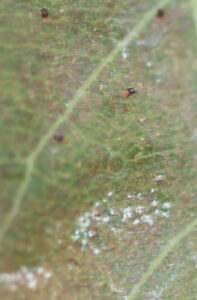
Figure 2. This serviceberry leaf has live European red mites, eggs and old shed skins that accumulate on the leaf.
Lack of rain this summer and fall has spared spider mites from drowning and being washed off leaves during heavy rains. Warm weather in late August and September allowed warm season mites, like two spotted spider mite, European red mite on flowering fruit trees, honeylocust, maple and oak spider mites to flourish. With the daily highs consistently below 85 F, cool season mites like spruce spider mite, boxwood spider mite and southern read mite have been increasing in number.
Now would be a good time to take stock of which plants have spider mites to help you plan your control strategy.
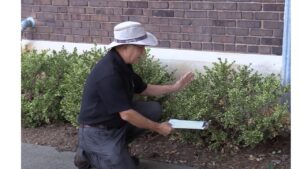
Figure 3. Tap the branches over a white sheet of paper. After giving the mites 10 seconds to grab hold of the paper, turn the sheet sideways to let the debris fall off. Then examine the specs to determine if they are spider mites. A 10X hand lens or smartphone can help you see these small pests.
Cool season mites, including southern red mite, boxwood spider mite and spruce spider mite may require treatment this fall to keep their populations from building. This could be accomplished with a garden hose and a strong stream of water or a 2% solution of horticultural oil or insecticidal soap.
At this point in the season, there is usually no need to spray trees for warm season spider mites. Because most spider mites will winter on trees and shrubs, these mite infested trees can be targeted for a spray of oil during the dormant season. It is important to note that plants with two spotted spider mites will not benefit from an oil spray because they winter in the ground cover. Also, be sure not to spray oil on shrubs with waxy blue leaves. This wax often protects plant leaves from strong winds and sun in the winter.
To view this full article and other Purdue Landscape Report articles, please visit Purdue Landscape Report.
Subscribe and receive the newsletter: Purdue Landscape Report Newsletter.
Resources:
Managing Spider Mite Mayhem with the Purdue Plant Doctor, Purdue Extension Entomology YouTube Channel
Purdue Plant Doctor Website
Spider Mites On Ornamentals, Purdue Extension Entomology Bulletin
Tree Defect Identification, The Education Store
Tree wounds and healing, Got Nature? Blog
Tree Risk Management, The Education Store
Why Is My Tree Dying?, The Education Store
The Woody Plant Seed Manual, U.S. Forest Service
Native Trees of the Midwest, The Education Store
Invasive Species, Playlist, Purdue Extension – FNR YouTube Channel
Report Invasive Species, Purdue Invasive Species
Find an Arborist, International Society of Arboriculture
Subscribe Purdue Extension-Forestry and Natural Resources YouTube Channel
Cliff Sadof, Professor and Extension Fellow
Purdue Entomology
Purdue Landscape Report: Dead man’s fingers is an apt moniker for a gruesome-looking fungus (Xylaria polymorpha and related species) that produces club-shaped fungal fruiting bodies that appear as fingers growing around the base of dying or dead woody plants and even wooden objects in soil (Fig. 1). With more than 25 species of Xylaria, generalizations are difficult to make (Fig. 2), but we will persevere anyways, recognizing that some Xylaria species are limited to a saprophytic existence decomposing wood (like X. polymorpha) while others, like X. mali, cause an opportunistic black root rot on apple and crabapple (Rogers, 1984; Rogers and Callen, 1986) or nothing at all (Fig. 2). Other Xylaria species infect Norway maple, honey-locust, elm and pears (flowering and edible). Perhaps the scariest thing about dead man’s fingers is its taxonomy: X. polymorpha is an extremely variable and complicated species showing “multiple interfaces and intergradations with numerous other taxa” making speciation a challenge (Lee et al, 2000), which may explain why a crabapple with a bad graft union covered in dead man’s fingers looks otherwise healthy!
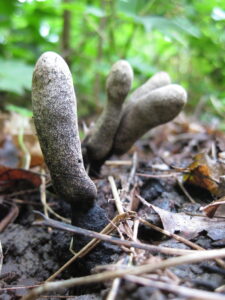
Figure 1. Dead man’s fingers is an apt moniker to describe the fruiting body of Xylaria species. Photo by Janna Beckerman.
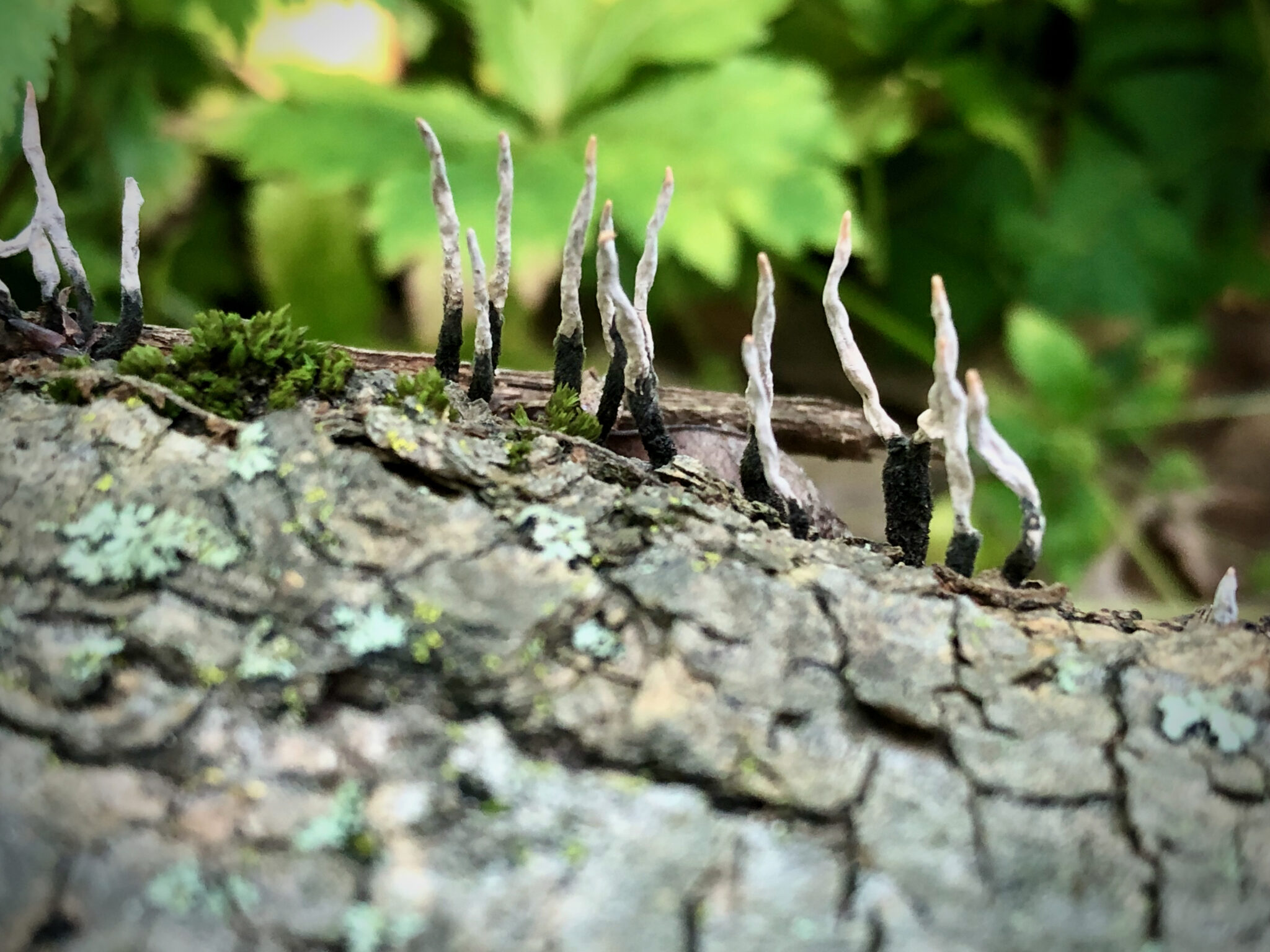
Figure 2. Unknown Xylaria grown on fallen log. Photo by Janna Beckerman.
Symptoms and Signs
Symptoms of infection by Xylaria may appear as stress and decline, including slowed growth, dieback, premature autumn coloration and leaf drop, and even crown or structural root cankers. Apple, crabapple or pear trees infected may produce an unusually large crop of undersized fruit.
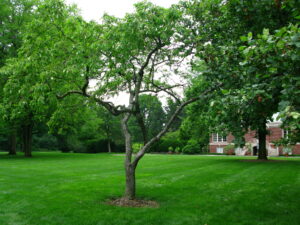
Figure 3a. Dead man’s fingers can be found associated with otherwise healthy, asymptomatic trees, or simply growing on dead wood—not necessarily causing disease.
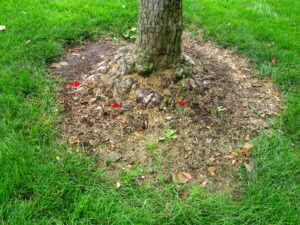
3b. Close-up of the rootstock with multiple croppings of Xylaria on the crown. Photo by Janna Beckerman.
Signs of Xylaria are more readily identified—namely, the dead man’s fingers (Fig. 4)! The club shaped, fingerlike fruiting bodies appear singularly or as clustered “fingers” about 1- 4 inches high, often at the base of infected or dying trees, or nearby large structural roots (Fig 4). In the spring, ascospores are produced by the “fingers”, creating a bluish bloom on the tips of the fingers. Cutting into a finger reveals a white interior with black bubbles that produce the sexual spores (ascospores). The “fingers” can release these spores for several months or years. In the spring, Xylaria can produce asexual spores (called conidia) anywhere on its surface, while also producing threadlike structures (called hyphae) that grow through dead or dying wood. Xylaria can survive as hyphae in roots for up to 10 years and can spread from plant to plant via hyphae when plant roots contact each other.
To view this full article and other Purdue Landscape Report articles, please visit Purdue Landscape Report
Subscribe and receive the newsletter: Purdue Landscape Report Newsletter.
Resources:
Tree Defect Identification, The Education Store
Tree wounds and healing, Got Nature? Blog
Tree Risk Management, The Education Store
Why Is My Tree Dying?, The Education Store
The Woody Plant Seed Manual, U.S. Forest Service
Native Trees of the Midwest, The Education Store
Invasive Species, Playlist, Purdue Extension – FNR YouTube Channel
Report Invasive Species, Purdue Invasive Species
Find an Arborist, International Society of Arboriculture
Subscribe Purdue Extension-Forestry and Natural Resources YouTube Channel
Janna Beckerman, Professor of Plant Pathology
Purdue Department of Botany
Hybrid plants and animals can occur in wild environments and are produced by artificially crossing species for the purpose of selective breeding. An example of a popular commercial application is hybrid striped bass, a striped (Morone saxatilis) and white bass (Morone chrysops) cross. Common names include palmetto and sunshine bass. Hybrid striped bass have broken stripes running the length of their bodies, and forked tails. They have two unconnected dorsal fins—one with hard spines. They often are silver above and white below. Coloration depends on environmental factors, like the color of the water. Their flesh has a mild flavor and flakey texture when cooked.
Where do hybrid striped bass I eat come from?
Hybrid striped bass are farmed for food and for recreational stocking. Commercial production of hybrid striped bass started in the US in the 1970s and has expanded to many other countries since. Hybrid striped bass are commonly sold two ways: live market and fresh, whole fish on ice. US farm raised hybrid striped bass are raised in commercial ponds, tanks, and cages. You are most likely to find US farm-raised hybrid striped bass at ethnic grocery stores selling live fish, where seafood professionals process fish to order.
To receive the free download and recipe visit the Purdue Extension’s resource center: The Education Store – Hybrid Striped Bass Farmed Fish Fact Sheet.
Resources:
Freshwater Prawn Farmed Fish Fact Sheet, The Education Store
Ask An Expert: What is Aquaculture?, Purdue Extension FNR YouTube Channel
Walleye Farmed Fish Fact Sheet, The Education Store, Purdue Extension’s resource center
Pacific White Shrimp Farmed Fact Sheet, The Education Store
Yellow Perch Farmed Fish Fact Sheet, The Education Store
Tilapia Farmed Fish Fact Sheet, The Education Store
Rainbow Trout Farmed Fish Fact Sheet, The Education Store
American Paddlefish, The Education Store
A Guide to Small-Scale Fish Processing Using Local Kitchen Facilities, The Education Store
Aquaculture Family Coloring Book Development, The Education Store
Channel Catfish, The Education Store
Eat Midwest Fish, Illinois-Indiana Sea Grant online resource hub
Amy Shambach, Aquaculture Marketing Outreach Associate
Purdue Department of Forestry and Natural Resources/Illinois Indiana Sea Grant Program
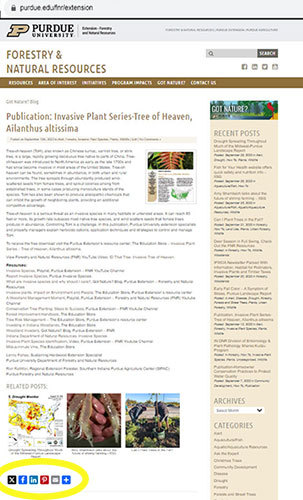 The Purdue Extension – Forestry & Natural Resources (FNR) team would like to take this time to thank our followers for their requests and comments. We received requests to improve our Purdue Extension – FNR’s Got Nature? Blog social media buttons and we would like to announce they are ready for you to share our articles. You can easily share the blog articles to X-Twitter, Facebook, LinkedIn, and Pinterest, along with an Email option.
The Got Nature? Blog was started 11 years ago to allow the FNR Extension team to share aquatic, forestry, natural resources, wildlife, urban forestry and wood products hot topics along with answering any questions regarding these areas. The blog producer Diana Evans, Web and Extension Specialist, has been with the blog from the start. The Got Nature? blog has had over 166,000 web visits in the past three years.
If you have a natural resource topic you would like to hear from our experts about, fill out our quick and easy Contact Us form.
Subscribe to our Got Nature? e-newsletter and receive our resources and updates. All email addresses are secure and only used for the Purdue Extension – Forestry and Natural Resources’ Got Nature? newsletter mailing.
What is Purdue Extension-Forestry and Natural Resources (FNR)?
Purdue Extension – FNR is a part of a larger group, the Cooperative Extension Service (CES), one of the nation’s largest and best-researched providers of science-based information and education. Purdue Extension delivers practical, research-based information and provides high-impact educational programs that enhance lives and livelihoods.
Resources:
Subscribe to Purdue Extension-FNR YouTube Channel
ID That Tree, Purdue Extension-Forestry & Natural Resources (FNR) YouTube playlist
Woodland Management Moment, Purdue Extension-FNR YouTube playlist
Ask An Expert Playlist, Purdue Extension – Forestry and Natural Resources (FNR) YouTube Channel
Wildlife Habitat Hint Playlist, Purdue Extension – FNR YouTube Channel
Subscribe to the Purdue Extension – Forestry and Natural Resources YouTube Channel
Diana Evans, Extension & Web Communications Specialist
Purdue University Department of Forestry and Natural Resources
Freshwater prawn (Macrobrachium rosenbergii), also known as the giant river prawn and giant tiger prawn, is a close relative to marine shrimp. They are one of over 950 species in the Palaemonidae family. Freshwater prawn males can reach a total length of 12.6 inches (320 mm);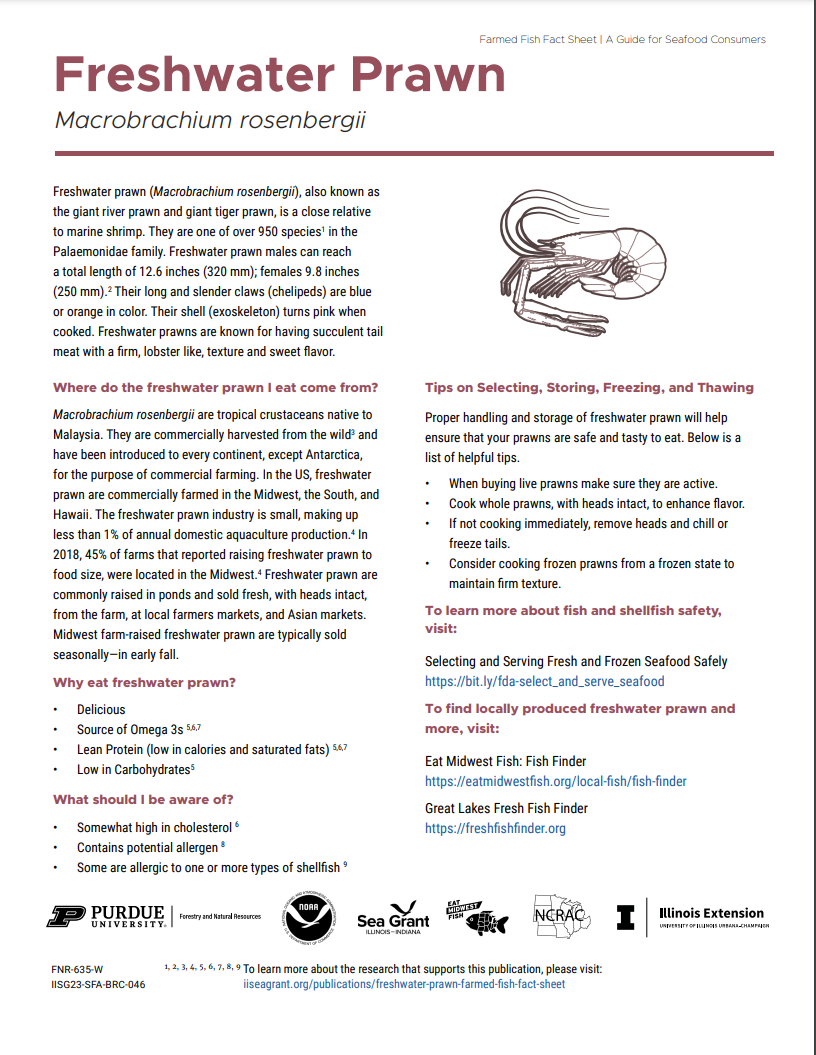 females 9.8 inches (250 mm). Their long and slender claws (chelipeds) are blue or orange in color. Their shell (exoskeleton) turns pink when cooked. Freshwater prawns are known for having succulent tail meat with a firm, lobster like, texture and sweet flavor.
Where do the freshwater prawn I eat come from?
Macrobrachium rosenbergii are tropical crustaceans native to Malaysia. They are commercially harvested from the wild and have been introduced to every continent, except Antarctica, for the purpose of commercial farming. In the US, freshwater prawn are commercially farmed in the Midwest, the South, and Hawaii. The freshwater prawn industry is small, making up less than 1% of annual domestic aquaculture production. In 2018, 45% of farms that reported raising freshwater prawn to food size, were located in the Midwest. Freshwater prawn are commonly raised in ponds and sold fresh, with heads intact, from the farm, at local farmers markets, and Asian markets. Midwest farm-raised freshwater prawn are typically sold seasonally—in early fall.
To receive the free download and recipe visit the Purdue Extension’s resource center: The Education Store – Freshwater Prawn Farmed Fish Fact Sheet.
Resources:
Walleye Farmed Fish Fact Sheet, The Education Store, Purdue Extension’s resource center
Pacific White Shrimp Farmed Fact Sheet, The Education Store
Yellow Perch Farmed Fish Fact Sheet, The Education Store
Tilapia Farmed Fish Fact Sheet, The Education Store
Rainbow Trout Farmed Fish Fact Sheet, The Education Store
American Paddlefish, The Education Store
A Guide to Small-Scale Fish Processing Using Local Kitchen Facilities, The Education Store
Aquaculture Family Coloring Book Development, The Education Store
Channel Catfish, The Education Store
Eat Midwest Fish, Illinois-Indiana Sea Grant online resource hub
Amy Shambach, Aquaculture Marketing Outreach Associate
Purdue Department of Forestry and Natural Resources/Illinois Indiana Sea Grant Program
MyDNR, Indiana’s Outdoor Newsletter: We need the public’s help to update The Big Tree Registry, a list of the largest known specimen of each native tree species in Indiana.
“Indiana’s currently tallest recorded tree is a 152-foot-tall bitternut hickory, and our widest tree circumference is a silver maple at more than 361 inches,” said Jacob Roos, DNR urban forestry director. “We need help getting out across the state to find our new record-setting trees.”
That means it’s time to review the recently updated champions list and start looking for new candidates to nominate for the list, which is maintained by DNR’s Division of Forestry.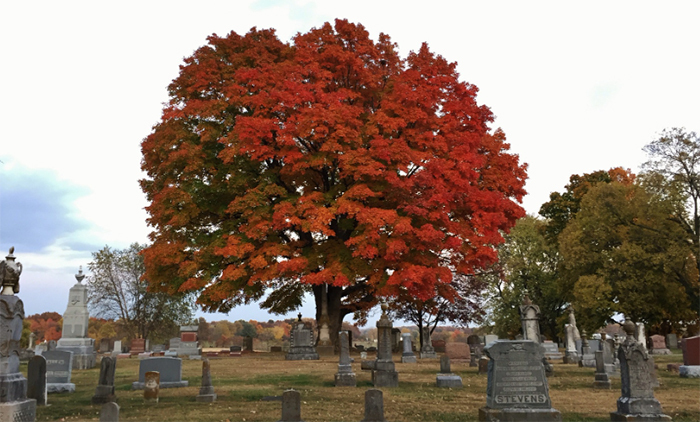 Three measurements are required:• trunk circumference, in inches, at 4 1/2 feet above the ground;• total height, in feet;• and average crown spread, in feet.The total size of each tree nominated is calculated by adding the circumference and height to a quarter of the average crown spread.The individual tree of each Indiana native tree species with the highest total points will be that species’ Big Tree champion. All nominations are reviewed, but only those with the highest scores will be verified.
To see full post please visit IN DNR, It’s Time to Start Looking for Big Trees.
To learn more please visit The Big Tree Registry, IN DNR-Division of Forestry.
Sign up to receive the MyDNR Newsletter by email: MyDNR Email Newsletter
Resources:
Investing in Indiana Woodlands, The Education Store
Forest Improvement Handbook, The Education Store
ID That Tree, Purdue Extension-Forestry & Natural Resources (FNR) YouTube playlist
Woodland Management Moment , Purdue Extension-FNR YouTube playlist
Find an Arborist, International Society of Arboriculture
Planting Your Tree Part 1: Choosing Your Tree, Purdue Extension YouTube Channel
Native Trees of the Midwest, The Education Store
Shrubs and Woody Vines of Indiana and the Midwest, The Education Store
Finding help from a professional forester, Indiana Forestry & Woodland Owners Association
District Foresters for 10 plus acres, Indiana Department of Natural Resources
Indiana Department of Natural Resources
Illinois-Indiana Sea Grant (IISG) Newsroom: At the recent Great Lakes Sea Grant Network meeting in Evanston, Illinois, Amy Shambach, Illinois-Indiana Sea Grant aquaculture marketing outreach associate, was presented with the 2023 Great Lakes Sea Grant Network Early Career Award.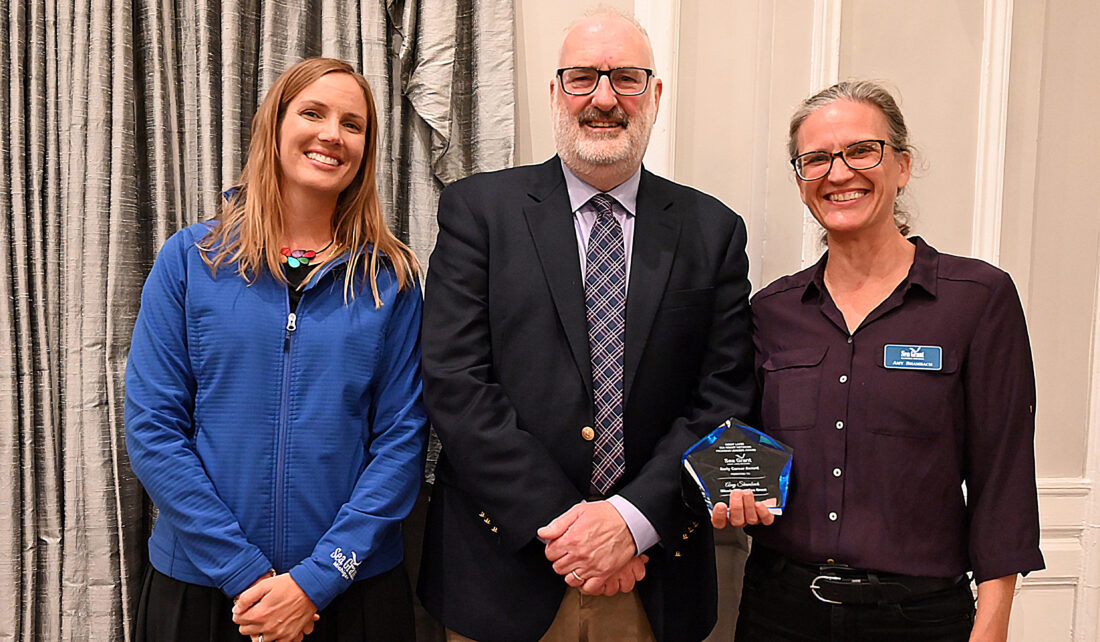
Shambach has been in her role with IISG since 2019. Since then, she has developed numerous outreach products, including videos, factsheets, and websites. She has organized and led webinars and workshops in the two states and helped lead Great Lakes-wide projects.
Throughout her four years with the program, Shambach has worked closely with fish farmers—she has been someone they can turn to for guidance and information. As a result, she was able to help some farmers successfully secure federal support during COVID and then when an ice storm hit southern Illinois.
“It is unusual for someone to launch so many high-output, high-impact programs so early in their Sea Grant career, especially when they begin the job with little outreach experience,” said Stuart Carlton, IISG assistant director. “However, Amy is not usual, she is special, and is well deserving of recognition for her work.”
To see full article, please visit: Illinois-Indiana Sea Grant recognized for outstanding outreach efforts.
Amy provides outreach and extension services to producers, potential producers, and consumers, which is also shared through IISG partner Purdue Extension.
To view Amy’s publications and products, please visit Illinois-Indiana Sea Grant’s Resources Page.
For free downloads of the publications, view The Education Store, Purdue Extension’s resource center, and place “Amy Shambach” in the search field.
Resources:
Freshwater Prawn Farmed Fish Fact Sheet, The Education Store, Purdue Extension’s resource center
Largemouth Bass Farmed Fish Fact Sheet, The Education Store
Atlantic Salmon Farmed Fish Fact Sheet, The Education Store
A Guide to Small-Scale Fish Processing Using Local Kitchen Facilities, The Education Store
Walleye Farmed Fish Fact Sheet: A Guide for Seafood Consumers, The Education Store
Sustainable Aquaculture: What does it mean to you?, The Education Store
Center For Great Lakes Literacy (CGLL), Website
Scientists bring the Great Lakes to students learning from home, Got Nature? Blog
Aquaculture Industry in Indiana Growing, Purdue Today
Largemouth Bass Market Trends, Purdue Extension – Forestry and Natural Resources (FNR) YouTube Channel
Ask An Expert: Hot and Cold, Video, Purdue Extension – FNR YouTube Channel
Video: Cage Culture and Aquaponics, FNR Youtube Channel
Eat Midwest Fish, Illinois-Indiana Sea Grant online resource hub
Illinois-Indiana Sea Grant (IISG)
This one-day workshop will focus on aquaponics in the classroom. Topics that will be covered include fish culture basics, plant culture, water quality, systems, and more. 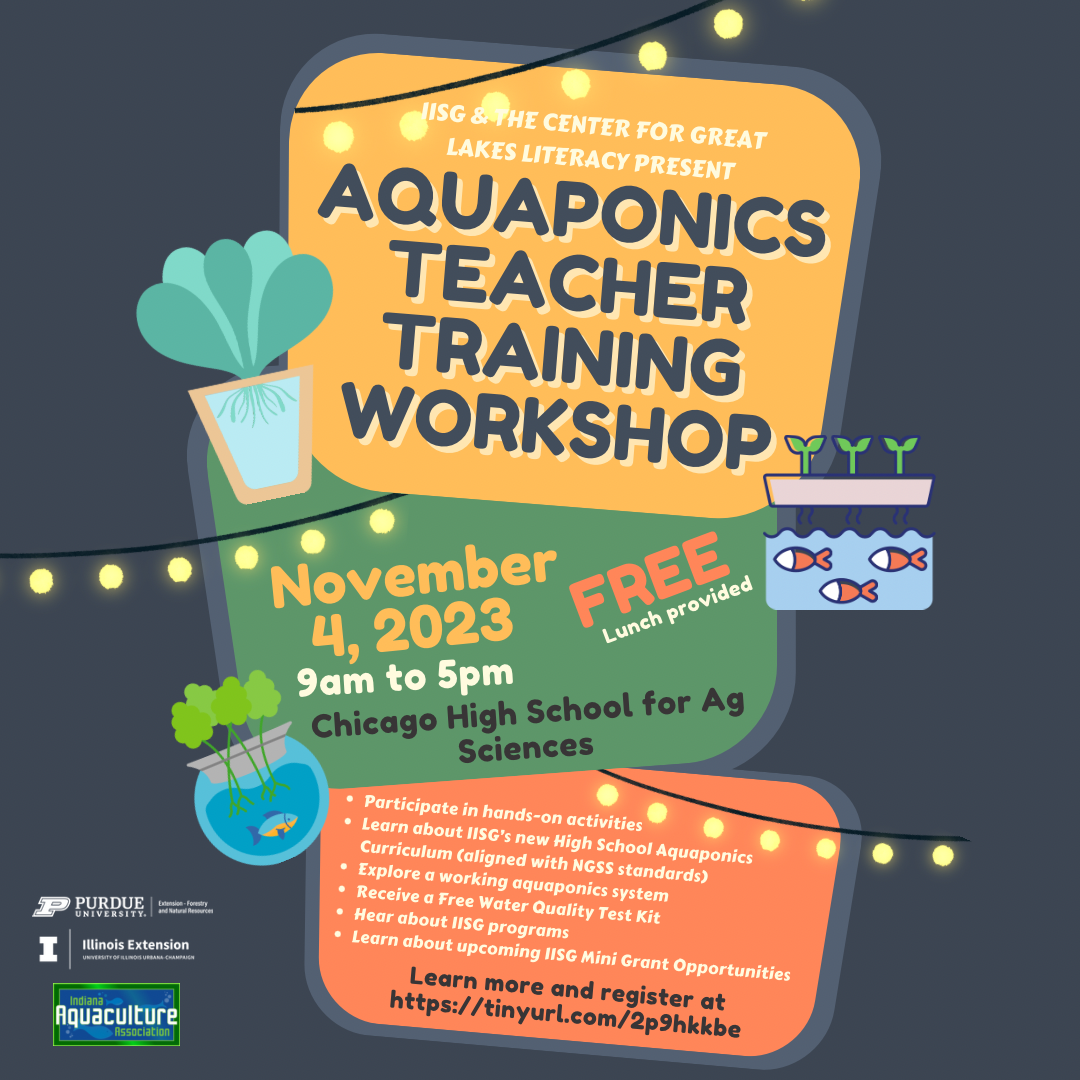
Workshop Participants will:
- Participate in hands-on activities.
- Learn about IISG’s NEW aquaponics curriculum.
- Tour the High School for Ag Sciences aquaponics space.
- Become eligible for a new IISG loan program.
- Hear about IISG programs.
- Be inspired to incorporate aquaponics in the classroom.
Date: Saturday, November 4, 2023
Time: 9 AM – 5 PM Central (CST)
Location: Chicago High School for Agricultural Sciences, 3857 West 111th Street, Chicago, IL, 60655
Program partners include Illinois-Indiana Sea Grant, the Center for Great Lakes Literacy, the Indiana Aquaculture Association, University of Illinois Extension, and Purdue University’s Department of Forestry and Natural Resources.
To learn more about this event and how to register please visit Purdue Extension – Forestry & Natural Resources (FNR) Events.
What is Aquaponics: Fish and Plants Grow Sustainably Through Aquaponics, IISG Newsroom
About IISG: These are trying times for the environment. Climate change and other concerns such as population growth, aquatic invasive species, contaminated waters, and loss of natural habitat, the southern Lake Michigan region faces many challenges. Illinois-Indiana Sea Grant (IISG), with its unique mandate to bring the latest science to those who can best use the information, serves a critical role in empowering people to solve problems in sustainable ways. The program is funded through National Oceanic and Atmospheric Administration (NOAA), the University of Illinois and Purdue University, but IISG also works in partnerships with key organizations, institutions, and agencies in the region to reach more audiences and multiply opportunities for success. IISG brings together scientists, educators, policy makers, community decision makers, outreach specialists, business leaders, and the general public to work towards a healthy environment and economy.
Resources:
Walleye Farmed Fish Fact Sheet, The Education Store, Purdue Extension’s resource center
Freshwater Prawn Farmed Fish Fact Sheet, The Education Store
Adaptations for Aquatic Amphibians, The Nature of Teaching, Purdue Extension – Forestry and Natural Resources (FNR)
Purdue Extension
Sustainable Aquaculture: What does it mean to you?, The Education Store
A Guide to Small-Scale Fish Processing Using Local Kitchen Facilities, The Education Store
Aquaculture Industry in Indiana Growing, Purdue Today
Purdue Aquaponics: Cut Water Usage, Purdue University YouTube Channel
Largemouth Bass Market Trends, Purdue Extension – FNR YouTube Channel
Amy Shambach, Aquaculture Marketing Outreach Associate
Purdue Department of Forestry and Natural Resources/Illinois-Indiana Sea Grant Program
Andrew Coursey, Aquaculture Specialist
Illinois-Indiana Sea Grant Program

Recent Posts
- Beetle that attacks Tree-of-Heaven found in Indiana, Purdue Landscape Report
Posted: March 20, 2026 in Invasive Insects, Wildlife, Woodlands - ID That Tree: Dwarf Chinkapin Oak
Posted: in Forestry, Urban Forestry, Wildlife, Woodlands - IN-PREPared: Essential Resources for Indiana’s Severe Weather Season
Posted: March 11, 2026 in How To, Safety - DNR Hiring for Indiana Conservation Officer Positions, MyDNR
Posted: March 9, 2026 in Urban Forestry, Wildlife, Woodlands - ID That Tree: Shumard Oak
Posted: in Plants, Urban Forestry, Wildlife, Woodlands - A Woodland Management Moment: Windbreak Around Walnut Plantings
Posted: March 3, 2026 in Forestry, Urban Forestry, Woodland Management Moment - Getting Certified as an Indiana Certified Prescribed Burn Manager
Posted: March 2, 2026 in How To, Urban Forestry, Woodlands - Uniting Indiana Residents Against Invasive Species
Posted: February 27, 2026 in Community Development, Invasive Insects, Wildlife - Have You Seen a Soaring Eagle Lately? Morning Ag Clips
Posted: February 25, 2026 in Urban Forestry, Wildlife - Register for Natural Resources Teacher Institute’s Class of 2026
Posted: February 19, 2026 in Forestry, Wildlife, Woodlands
Archives
Categories
- Alert
- Aquaculture/Fish
- Aquatic/Aquaculture Resources
- Ask the Expert
- Christmas Trees
- Community Development
- Disease
- Drought
- Forestry
- Forests and Street Trees
- Gardening
- Got Nature for Kids
- Great Lakes
- How To
- Invasive Animal Species
- Invasive Insects
- Invasive Plant Species
- Land Use
- Natural Resource Planning
- Nature of Teaching
- Plants
- Podcasts
- Ponds
- Publication
- Safety
- Spiders
- Timber Marketing
- Uncategorized
- Urban Forestry
- Webinar
- Wildlife
- Wood Products/Manufacturing
- Woodland Management Moment
- Woodlands