Lenny Farlee, sustaining hardwood Extension specialist for Purdue’s Department of Forestry and Natural Resources (FNR), has been named a 2024 Fellow of the Society of American Foresters (SAF). The SAF Fellow Award, one of the highest honors bestowed on an SAF member by their peers, recognizes long-standing service to forestry at the local, state, regional and national levels.
Farlee was honored with the award during the 2024 SAF National Convention, which took place in Loveland, Colorado from Sept. 17-20.
Zhao Ma accepts the 2024 Family Forests Education Award on behalf of Lenny Farlee and the other project team members.
“Being named a Fellow of the Society of American Foresters is particularly meaningful to me since it originates from a nomination by my peers at the state level,” Farlee said. “I am very grateful that my colleagues in forestry here in Indiana considered my service worthy of recognition, and I owe much of the credit to them for their support of me through my career. It has been my privilege to serve the people and the profession as an Extension forester here at Purdue.”
Farlee educates people about forestry in many ways, including through the popular Extension YouTube series “ID That Tree,” which has over 100,000 views.
Farlee, Ronald Rathfon, Don Carlson, Jonathan Ferris,Dave Osborne and Phil Woolery worked together to develop the course. The course introduces forest landowners to the biology and management of forests and what resources and professional assistance are available. According to survey results from 2021 participants, “94.4% stated that the information was useful to help them make future decisions and 92.5% stated that the information was useful to help act to manage their property objectives.”
“We in FNR, along with forestry professionals in Indiana and the landowners who have communicated with Lenny and his colleagues through the ‘Forest Management for the Private Woodland Owner’ course, know how valuable this program has been to sustainable forest management in Indiana,” said Zhao Ma, interim department head and professor of forestry and natural resources. “So it is absolutely wonderful when others outside of our FNR community and beyond Indiana also recognize the excellent work that Lenny and his colleagues have been doing…, I would also like to share one more note about Lenny – not only has Lenny been a highly valued and respected member of FNR and the forestry profession for many years, but he is also one of the nicest people I have met. He is knowledgeable yet humble, effective yet gentle, serious about his work yet able to have fun, very busy yet always willing to help others and try to be present. We are lucky to have Lenny as our colleague in FNR.”
Purdue Landscape Report: August was National Check Your Tree Month, but this is something that every tree owner/manager should be doing year-round. As the last hot days of summer are finishing up and we look forward to cooler fall days, we can look to our trees for different signs of trouble.
Most people tend to look up at the canopy before anything else in trees. Check leaves for dieback, discoloration, stickiness or signs of chewing. Check branches and the main stem for damage like splits and breaks, peeling bark, tunneling patterns under the bark, oozing wet spots, or sawdust around the tree. These could be signs of issues in the root system, pathogens like bacteria or fungal organisms, insect problems, or structural damage.
This is not an exhaustive list and if you notice these or anything else that seems off, it could be time for a deeper dive into what might be wrong. If you know the species of your tree the Purdue Plant Doctor is a great tool to narrow down a diagnosis. You can also contact your local Extension office or an ISA Certified Arborist.
On a more positive side, you don’t have to be on the lookout for damage, decline, or signs of pathogens and pests. It is also a matter of enjoying the trees in your landscape. Take some time out of your day to sit in the shade especially as we transition from hot summer temperatures into the cooling of autumn. Revel in the color changes as chlorophyll production slows revealing the carotenoids (that give us yellows, oranges, and browns) and anthocyanin (that produces reds and purples). In winter, not only can you better see damage in the canopy hidden by leaves in the growing seasons, but also the structure and architecture of the canopies in different tree species and the differences in bark textures. And in Spring, new growth of leaves and flowers shows us Winter is nearing its end, bringing warmer days.
So check your trees throughout the year. But not only for potential issues and risk management but also for enjoyment. Trees offer us no many benefits and sometimes it takes a little reminder. If you do see any signs of decline or damage, again, be sure to contact your local Extension office or an ISA Certified Arborist.
MyDNR,Indiana’s Outdoor Newsletter: Hunters can apply for reserved hunts at on.IN.gov/reservedhunt, the one-stop information spot for the hunts. The online method is the only way to apply. No late entries will be accepted. Applicants must possess a hunting license that’s valid for the hunt for which they apply.
Applications must be submitted by 11:59 p.m. ET on Sunday, Sept. 15. More specific hunt information for individual properties is available on the website.
Hunters will be selected through a random computerized drawing. An email will be sent to all applicants when draws have been completed. Applicants will be able to view draw results online within two weeks after the application period closes.
Please note that only one application per hunt is allowed. No changes can be made once an application is submitted. The application process is now consolidated into the online services website along with licenses, CheckIN Game, and HIP registration. An online account is not required to apply, but a Customer ID number is needed.
In this system, hunts without a registration fee will follow the same process as those with a fee. Applicants must add a hunt to their cart and place an order to submit their application. If the transaction total is $0, the applicant will not be asked to enter credit card information.
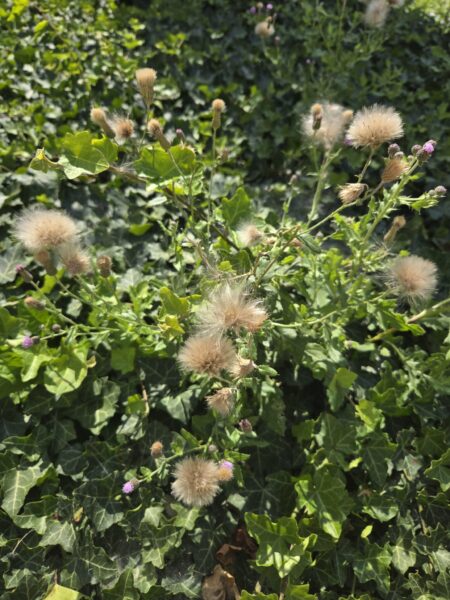
Purdue Landscape Report: As summer comes to a close, plants are rapidly releasing seeds and the most noticeable are the flying fluffy type. Thistles, asters and milkweed are just a few of the summer-flowering plants that depend on the wind to disperse their seeds, sometimes carrying them miles away to potentially suitable locations, though seeds typically land within a few meters of the mother plant. This may not be a concern if it’s a desirable plant, but can become extremely problematic when that seed comes from Canada Thistle (Cirsium arvense) (Fig. 1).
Figure 1. Canada thistle (Cirsium arvense), growing amongst common ivy (Hedera helix), produces a fluffy seed that is dispersed by wind.
Canada thistle is found on the list of Indiana Noxious Weeds (IC 15-16-7-2), which mandates that landowners take necessary steps to control and contain the spread of this highly invasive species. Formal enforcement of this Indiana Code falls to Township Trustees, though weed control is a responsibility that is often overlooked. Landowners and homeowners shouldn’t wait for a notice, or knock at the door, from a Township Trustee to begin controlling Canada thistle. It’s listed as a noxious weed for good reason.
Canada thistle is a perennial plant that can reproduce from seed or rhizomes making it difficult to control and contain. Each plant can produce thousands of wind-blown seeds that may remain viable for up to 20 years in the soil. Rhizomes are horizontal underground stems that can grow several feet and put out new shoots (Fig. 2). To add insult to injury, if a rhizome is cut or tilled, a separate plant may grow from each piece of rhizome.
Mechanical and cultural control options for Canada thistle are limited and may reduce plant density, but are not effective at eradicating large, established populations in a landscape. A new population, without an established root system, may be controlled with frequent mowing to deplete food reserves and prevent seed production.Small, isolated populations may be controlled with hand-pulling, but this will need to be repeated every few weeks.
Figure 2. Canada thistle (Cirsium arvense) reproduces by growing horizontal underground stems called rhizomes. Rhizomes can send up new shoots several feet from the mother plant.
Chemical control options include pre- and post-emergent herbicides and, in many cases, applications of both types are needed for complete eradication. A pre-emergent herbicide, with an active ingredient of dichlobenil, is effective at preventing seed from germinating, but will not control established plants. A post-emergent herbicide with the active ingredient of clopyralid is the most effective option for home gardeners. Clopyralid is a selective herbicide for broadleaf weeds, but most vegetable and ornamental plants are susceptible. Precautions should be taken to avoid off-target damage. Read and understand the herbicide label before use. The label is the law.
Regardless of the method used, complete control of an established Canada thistle population will take persistence over multiple seasons. If the fluffy seed is beginning to fly from your thistle patch, it will likely take many more seasons to rid the garden of this pest, but it is possible. To win the battle against Canada thistle, it takes serious grit and an effective herbicide, or a good realtor.
In this webinar, hosted by Indiana Forestry & Woodland Owners Association, Joe Caudell, state deer biologist with Indiana DNR Division of Fish and Wildlife, shares recent efforts to better understand Indiana deer populations and how they vary across the landscape. The research from the Integrated Deer Management Project, a multi-year research project with Purdue Forestry and Natural Resources team working closely with the DNR biologists, created research management units (RMUs) so that they could be easily incorporated into deer management practices by the DNR.
If you’re interested in learning more about Indiana’s white tailed deer hunting and management, see the IN DNR page. There is a section on deer management with deer reports, survey results, and real time harvest data: White-Tailed Deer Hunting.
Check out the Indiana Forestry & Woodland Association YouTube Channel for videos including: What is IFWOA?; A New Carbon Program for Hardwood Landowners Webinar, Indiana’s Native Orchids, Magnificent Trees of Indiana, Be Tick Aware and much more.
The Indiana Forestry & Woodland Owners Association (IFWOA) was founded in 1977 and is a non-profit organization dedicated to conservation and sustainable management of woodlands in Indiana. IFWOA advocates for scientific best practices for management to achieve objectives of clean water, wildlife habitat, soil protection, native species diversity, timber production, recreation, carbon sequestration and many others.
IFWOA is an affiliate of the National Woodland Owners Association. IFWOA is a partner, collaborator or is represented on leading National and State organizations. These memberships or collaborations are selected to advance Indiana Woodland owner’s interests. IFWOA monitors and influences legislation and economic trends impacting Indiana woodlands and landowners for our members. Membership in IFWOA provides a valuable network linkage to information and resources at the leading edge of science, industry and politics impacting Indiana woodlands.
Purdue Landscape Report: Recently a homeowner in Hamilton County posted on the Indiana Native Plant Society Facebook page with concerns about aphids, mites, and apple scab in her maple and oak trees. She asked for a second opinion and treatment options for these pests. I reached out to the homeowner and requested permission to collect samples from the trees. Let’s look at what I found (or didn’t find) and discuss when and if these issues should be treated.
Apple Scab on Maples?
First, we can eliminate the concern about apple scab because maple and oak trees are not hosts for this pathogen. Apple scab is caused by the fungus Venturia inaequalis, and hosts include apples, crabapples, hawthorn, mountain ash, firethorn, and loquat. There are other fungal diseases which cause leaf spotting in maples, such as Anthracnose, tar spot, and Phyllosticta leaf spot. To diagnosis these diseases, homeowners can submit a sample to the Purdue Plant & Pest Diagnostic Lab, or hire a certified arborist to assess the tree. However, all these diseases are primarily aesthetic issues. A healthy tree will not die from these pathogens and does not require treatment. You can find more information about maple diseases in this publication: Diseases in Hardwood Tree Plantings. You can also find a previous article on Tar Spot in Maple in the Purdue Landscape Report (Issue 18-12).
Fig. 1. Severe spider mite damage on maple leaves. (Photo: S. D. Frank, North Carolina State University)
Spider Mites
The next pest concern on these trees is spider mites. Out of the dozens of leaves I collected, I found only two immature mites on a couple of maple leaves I examined. This is a very small mite presence, and it is not recommended to treat for spider mites unless the populations threaten the health or appearance of the tree. Limiting pesticide usage will conserve the natural enemies, which are vital to keeping mite populations in check. In fact, improper pesticide applications can kill these important natural enemies and worsen mite infestations.
When do you know if the mite population is large enough to merit intervention? Check your trees for signs of heavy feeding damage, such as leaf stippling (Fig. 1), or dense webbing on the leaves. Mites can also be monitored by placing a sheet of paper (8.5×11”) beneath a branch and striking the limb. Chemical treatments should be considered when you count ≥24 mites per strike. You can find detailed management recommendations and a full list of pesticide options in this Purdue Extension publication: Spider Mites on Ornamentals.
Fig. 2: Adult painted maple aphids found on maple in Hamilton Co, Indiana. (Photo: Andrew Johnston, Purdue University).
Aphids
The aphids I found on the homeowner’s maple trees are Drepanaphis acerifoliae, or the painted maple aphid (Fig. 2). This species only feeds on maple trees, and is not a threat to the oak tree on this homeowner’s property. Painted maple aphid is a very common aphid in our region. I found only a few aphids on one of the maple trees I sampled, which is not enough to require treatment. In addition, one of the aphids was a “mummy”, or a carcass left behind from a parasitoid wasp. This indicates that natural enemies are already at work managing the aphid population. Aphids may rarely require chemical control if their numbers grow large enough to produce significant amounts of honeydew, which can result in sooty mold outbreaks.
Tussock Moth
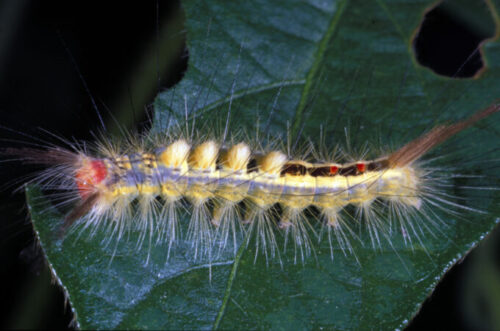
The only insect I found on the oak tree was a white-marked tussock moth caterpillar, Orgyia leucostigma (Fig. 3). This is the likely culprit for the minor feeding damage I noticed. These are not significant pests and do not require treatment. Don’t touch them, though! The setae of this caterpillar are irritating and may cause allergic reactions.
Overall, the pests I found were minimal and non-threatening to the trees. It’s normal to find some insect pressure in the landscape. Knowing when and if to treat requires accurate diagnosis and monitoring of pest levels. Check out PurduePlantDoctor.com for an easy-to-use diagnostic aid and treatment recommendations.
In this episode of A Woodland Management Moment, Purdue Extension forester Lenny Farlee talks about the importance of oak regeneration. Oak is a ‘keystone’ species, integral to supporting many different facets of wildlife. This includes insects to large mammals all across the environment in Indiana and the central hardwood region. This video also shares details regarding Purdue’s initiatives to ensure the diverse ecosystems maintained by oak and to provide the resources needed to keep regenerating this integral tree
If you have any questions regarding trees, forests, wildlife, wood products or other natural resource topics, feel free to contact us by using our Ask an Expert web page.
The long lifespan of many trees, which could be centuries or even millennia in the case of a few species, is a source of awe and inspiration for many. The bark of trees can often tell some stories about their life and history, if we know how to interpret what we see. Here are a few examples you may run across in Indiana.
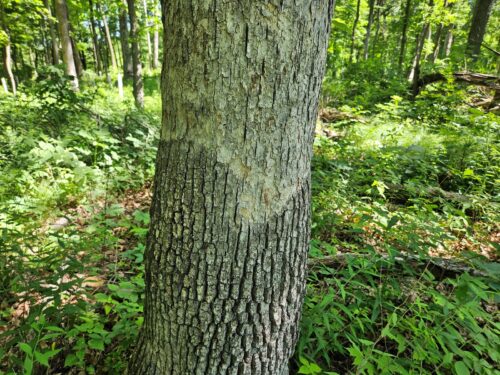
Is this tree sick? That may be a natural question to ask when looking at the striking difference in the bark pattern on this white oak. In fact, it is an infection, but not a harmful one to the survival of the tree. This is called smooth patch and is caused by a fungus that infects the outer bark of oak and some other tree species. There are several species of fungus that may cause this appearance, but the most common is Aleurodiscus oakesii. The fungus gradually decomposes the outer layers of bark, producing the flattened and smooth surfaces which contrast with the rough bark that is uninfected. If you look closely during moist periods, you may see the small cup-shaped fruiting bodies of the fungus on the bark. It is not a threat to the health or integrity of the tree as only the outer bark is impacted.
Figure 1 – Smooth patch on white oak. The normal bark pattern can be seen on the lower trunk.
Figure 2 – Smooth patch fungus, Aleurodiscus oakesii, fruiting body on white oak bark.
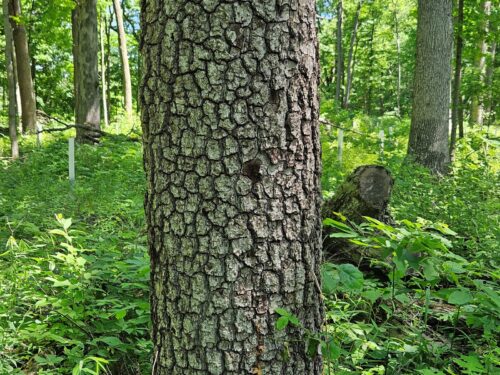
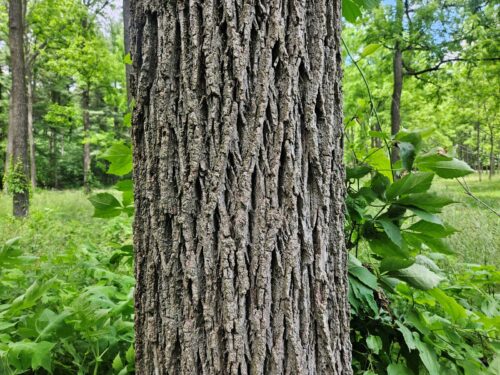
This isn’t the same species of tree, is it? Yes, it is! Bark pattern differences in some species may reflect the growth rate or relative vigor of the tree. These photos show black walnut bark from two very different growing sites. The blocky, alligator-hide bark pattern is often an indication of slow growth and may result from a tree growing on a very difficult site, like the dry hilltop where this tree is located, or severe competition from surrounding trees. The strongly interlacing ridges of the bark in the second photo are from a black walnut growing in a plantation on a creek bench with deep, moist and fertile soils, resulting in more vigorous growth.
Figure 3 – Black walnut with slow-growth bark pattern.
Figure 4 – Black walnut with vigorous growth bark pattern.
What happened here? The pattern in a horizontal line across these trees looks too perfect to be natural, but it was not produced by a human. This is the feeding activity of the yellow-bellied sapsucker, a species of woodpecker that migrates through Indiana. The sapsucker, true to its name, uses its sharp bill to create holes through the bark that ooze sap. The sapsucker feeds on the sap and may also feed on insects drawn to the sap. They tend to create straight lines of holes that leave this diagnostic pattern behind, even long after the birds have ceased their activity. This activity is usually not fatal to the tree, but does cause some damage to the wood beneath the bark, so trees that have been used by sapsuckers may have discolored spots or other blemishes in the wood revealed when processed for wood products.
Figure 5 and 6 – Yellow-bellied sapsucker feeding activity on sugar maple trees. These are older holes being covered by wood growth.
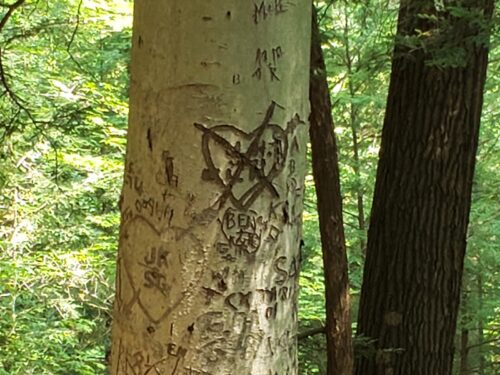
Humans also may leave a history of our presence on trees. This American beech tree in a recreation area has recorded the comings and goings of visitors, with some apparent editing as well! I do not endorse this activity as it can be harmful to the tree by introducing avenues for decay and disease, and is generally prohibited on public property. Instead, enjoy reading the nature stories found in bark.
Figure 7 – American beech bark defaced by carving.
Familiar with surprise lilies? Indiana has a native surprise onion!
Many yards where I grew up in southern Indiana were graced with surprise lilies. These plants grew long narrow leaves in the spring, which faded and died by early summer. After a pause with no evidence of the plant, long stems with pink lily-like flowers emerged, with no leaves to be seen.
Ramps foliage is often found in clusters or patches in early spring. These leaves will die before summer.
While these plants are not a native species, we do have a native with similar habits that is a distant relative of the surprise lily. That plant is ramps, also known as wild leek and a variety of other local names. There are two species of ramps recognized now – the more common broad-leaved ramps, Allium tricoccum, and the narrow-leaved ramps, Allium burdickii. Ramps are related to onions and garlic and have odor and taste reminiscent of those plants. Ramps foliage emerges early in the spring and was one of the earliest green edibles available to First Nations people and early European settlers.
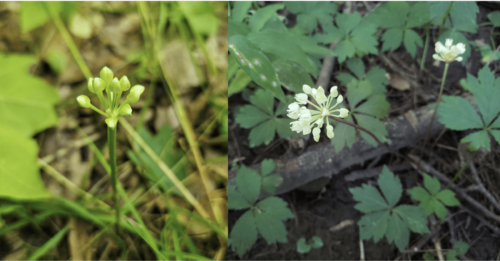
Many communities developed festivals or celebrations centered on the emergence of ramps as a sign of spring and some fresh greens to eat. The bright green leaves emerge before the tree leaves and fade before summer, but by the first half of June expect to see thin stems with a rounded cluster of small white flowers emerge – our surprise onion! It may take a ramps plant seven to ten years from seed to produce a flower, so this is a slow-growing and long-lived forest perennial. The flowers are pollinated by insects and produce round black seeds that may stay on the stalk through winter.
Newly emerged flower stem and buds and the blooming flowers of ramps.
Look for ramps in well-shaded forest areas with moist soils. They have a scattered distribution across Indiana, so you won’t find them in every woodland. The leaves and bulbs are edible, but absolute certainty of ID is essential as there are some toxic plants that look similar. Check ID references and spend some time with experienced foragers before eating any wild plants. The onion/garlic odor of ramps is a good indicator for positive ID.
Since this is a slow growing plant with a limited distribution, over-collection is a threat. A responsible harvesting technique is to harvest one leaf from mature plants, leaving the other leaves and the bulb. If you harvest the whole plant, take less than 5 percent of the plants in a patch, allowing seeding and bulb division to repopulate the area. Seed or bulbs can also be used to plant new patches. So keep you eyes open for our local surprise flowers this June – ramps!
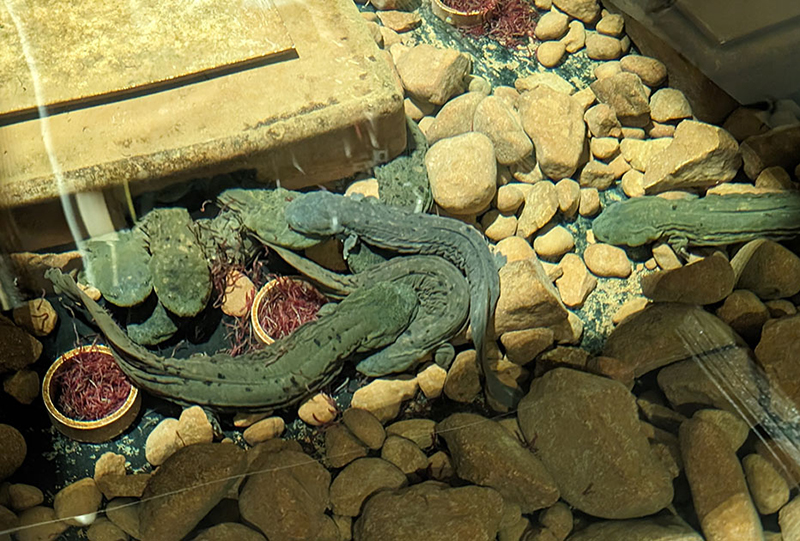
The Farmers Helping Hellbenders program is accepting applications for the second round of its Indiana Natural Resources Conservation Service’s Regional Conservation Partnership Program (RCPP) project. The project aims to assist with the conservation/recovery of eastern hellbender salamanders and improvement of aquatic resources in south central Indiana.
Eligible farmers and landowners, who wish to obtain funding to implement practices designed to keep nutrients and soil resources on fields and improve their watersheds, should contact their local NRCS office before May 10 to apply. Financial assistance is available for agricultural lands within the Blue River-Sinking Watershed boundary in Crawford, Floyd, Harrison and Washington counties, where the eastern hellbender can be found and is being actively managed.
Eligible practices for farmers in the project area include conservation cover, grassed waterways, wildlife habitat planting, nutrient management, riparian buffers and many others. Interested farmers and forest landowners who wish to implement conservation practices on their land should discuss their options with their district conservationist. Contact your local district conservationist by visiting Farmers.gov/Service-locator.
While NRCS accepts program applications year-round, Indiana producers and landowners should apply by May 10 to be considered for the current RCPP-Hellbender funding cycle. Applications received after May 10 will automatically be considered during the next funding cycle.
“The Farmers Helping Hellbenders RCPP project enables us to leverage partnerships to make a lasting positive impact on the habitat of the eastern hellbender salamander,” said Damarys Mortenson, state conservationist for the USDA’s NRCS in Indiana. “This project allows Indiana farmers and forestland owners to conserve the vital natural resources on their land while also protecting the habitat for hellbenders and other aquatic animals. It is a win-win.”
The eastern hellbender (Cryptobranchus alleganiensis) is a large, fully aquatic salamander, nicknamed the snot otter, water dog, devil dog, Allegheny alligator and water eel among other things. Their decline statewide has been documented as far back as the early-to-mid 1900s as a result of habitat loss and poor water quality. Hellbenders, which are listed as an endangered species in Indiana, play an important role in aquatic ecosystems and are indicators of clean water. Eastern hellbenders need clean water to survive as they breathe through their skin by absorbing oxygen from the river and stream water in which they live.
Hellbender populations are declining across their range, from Missouri to New York. This decline, which affects the hellbender population in Indiana’s Blue River, is likely caused by human influences such as habitat degradation and destruction. The stream-bottom habitat of hellbenders can be degraded by sediment from eroded banks and fields and destroyed when streams are dammed or dredged. Hellbenders are also captured inadvertently by anglers or purposefully for illegal sale in the pet trade. Finally, emerging diseases may be impacting some populations of hellbenders. Specifically, the chytrid fungus (Batrachochytrium dendrobatidis) and Ranavirus (family Iridoviridae) are considered to be major threats to the persistence of hellbender populations across their range.
For much of the last 17 years, Dr. Rod Williams and his team have been researching eastern hellbenders, spearheading regional conservation efforts and advancing hellbender captive propagation, or the rearing of this ancient animal in captivity and their eventual return to the wild. The partnership had a major breakthrough over the summer of 2023 with the documentation of a young hellbender salamander in the Blue River while conducting routine surveys. This discovery is significant because over the past three to four decades, only adult hellbenders have been documented in the Blue River. The presence of a young salamander suggests that conservation efforts and rearing programs are accomplishing their goals for the recovery of this endangered species.
The Farmers Helping Hellbenders RCPP project is made possible by $2.7 million in funding from the U.S. Department of Agriculture’s RCPP, Purdue and other partnering organizations. The project is led by Purdue with assistance from 14 collaborating public and private organizations on the state and local level including NRCS. The goal of the project is to improve hellbender habitat in a four-county region in south central Indiana by expanding the use of agricultural conservation practices that lead to decreased sediment in local river systems. The project aims to improve water quality, enhance aquatic habitat, increase aquatic wildlife populations, increase riparian and pollinator habitat and protect karst topography.