 Purdue University - Extension - Forestry and Natural Resources
Got Nature? Blog
Congratulations to Liz Jackson, FNR Extension Specialist, on receiving the 2025 Indiana Hardwood Lumbermen’s Association (IHLA) President’s Award. This award is given for exceptional contribution to the forest products industry and to members of IHL. We are proud to celebrate her achievements along with seeing her featured in the April 2025 edition of the Agriculture & Natural Resources (ANR) newsletter.

Liz presenting an award plaque at a Walnut Council national conference.
Agricultural & Natural Resources (ANR) Newsletter: Liz has worked as an Extension specialist associated with three forestry organizations since March 2004. Liz obtained her BS in forest products (’82) from Purdue’s Forestry & Natural Resources Department and MS in business management (’84) from Krannert School of Business under a special forestry/business master’s program.
Before coming to Purdue Extension, Liz spent 15 years in wood products manufacturing as a plant manager at Aristokraft cabinets (now MasterBrand) and purchasing and inventory control manager at Lafayette Venetian Blind.
Liz’s Extension role is to provide programs and products on sustainable forest management and forest stewardship to address woodland owners’ concerns and needs. While representing the Department of Forestry and Natural Resources, she works on behalf of three organizations.
The Hardwood Tree Improvement and Regeneration Center (HTIRC) is a research partnership between Purdue FNR and the USDA Forest Service focusing on management, protection and improvement of fine hardwood species. For the HTIRC she coordinates annual meetings, research conferences and educational programs.
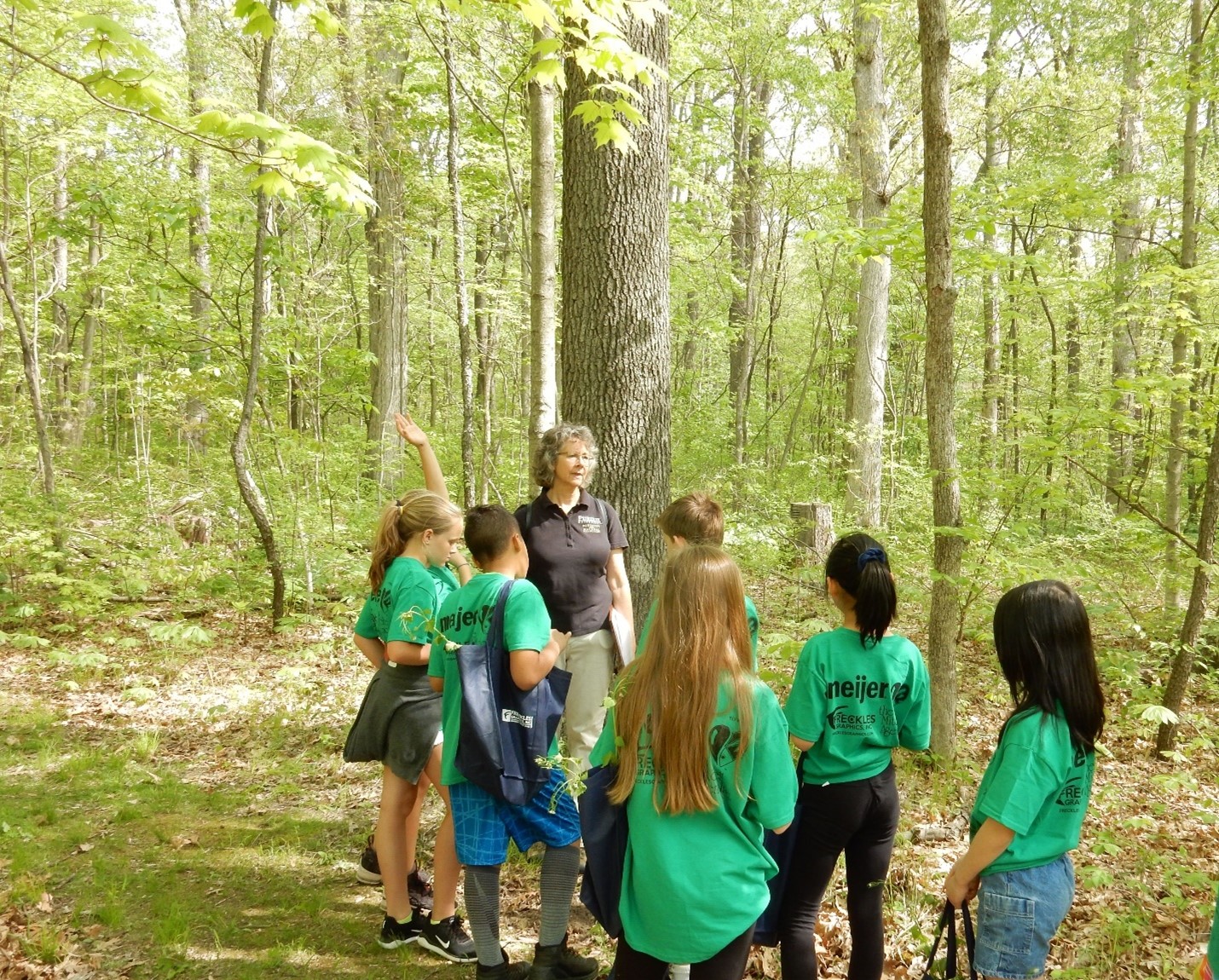
Liz presents on forest management to a group of schoolchildren at Martell Forest.
For the Indiana Forestry & Woodland Owners Association (IFWOA) and National Walnut Council, she represents the interests of the members and manages all business of the associations, including board meetings, annual conferences and education programs, membership and finances, and communications, including newsletters, websites and social media.
Liz is involved in many partnerships around the state, including as a member of the Extension Invasive Species Working Group, on the editorial board for Indiana Woodland Steward newsletter, member of NRCS state technical committee, and advisory partner with Indiana DNR Division of Forestry Forest Stewardship Committee, Sentinel Landscapes, and Let the Sun Shine In Indiana programs.
A highlight of her career was traveling to Washington, D.C., in 2005 to see Sen. Richard Lugar of Indiana and representatives from HTIRC and Indiana forestry plant an Indiana walnut tree on the U.S. Capitol grounds. Ten years later she returned to the site and was thrilled to find the tree and see it was thriving.
Resources:
Indiana Forestry & Woodland Owners Association (IFWOA) YouTube Channel
Observing Seasonal Changes in Nature Webinar with Amanda Wanless, IFWOA YouTube Channel
Magnificent Trees of Indiana Webinar with Author Carroll Ritter, IFWOA YouTube Channel
Ask the FNR Expert: Pests in your Woods, Purdue Extension – Forestry and Natural Resources (FNR) YouTube Channel
Woodland Stewardship for Landowners, Playlist, Purdue Extension – FNR YouTube Channel
Directory of Professional Foresters, Indiana Forestry & Woodland Owners Association (IFWOA)
Indiana Woodland Steward E-newsletters, Eleven Member Organization
Invasive Species, Playlist, Purdue Extension – FNR YouTube Channel
Invasive Plant Species Identification, Video, Purdue Extension – FNR YouTube Channel
Subscribe – Purdue Extension-FNR YouTube Channel
Agricultural & Natural Resources (ANR), Purdue Extension
Join Purdue Extension forester Lenny Farlee in this episode of “A Woodland Management Moment” as he explores the unique ecosystem of bottomlands. These flat, moisture-rich environments are home to a diverse array of species, shrubs, and trees. Watch the video to discover the key features and characteristics of these fascinating sites.
If you have any questions regarding trees, forests, wildlife, wood products, or other natural resource topics, feel free to contact us by using our Ask an Expert web page.
Resources:
A Woodland Management Moment, Playlist, Purdue Extension – Forestry and Natural Resources (FNR) YouTube Channel
The Nature of Oaks Webinar, Purdue Extension-FNR YouTube Channel, Shared from Indiana Forestry & Woodland Owners Association
Conservation Tree Planting: Steps to Success, Purdue Extension – FNR YouTube Channel
Shrubs and Woody Vines of Indiana and the Midwest, Purdue University Press
Native Trees of the Midwest, Purdue University Press
ID That Tree, Playlist, Purdue Extension – FNR YouTube Channel
Investing in Indiana Woodlands, The Education Store
Woodland Stewardship for Landowners Video Series, Playlist, Indiana Department of Natural Resources YouTube Channel
Ask an Expert: Tree Selection and Planting, Purdue Extension – FNR YouTube Channel
Forest Improvement Handbook, The Education Store
Find an Indiana Professional Forester, Indiana Forestry & Woodland Owners Association (IFWOA)
Purdue Arboretum Explorer
Lenny Farlee, Extension Forester
Hardwood Tree Improvement and Regeneration Center
Purdue Department of Forestry & Natural Resources
Purdue Landscape Report: These oak trees are showing the symptoms of smooth patch ( see below Figures 1, 2, 3). This condition is the result of a fungal infection that is restricted to the outer bark, causing it to slough off. The bark layer remaining is smoother and lighter in color than uninfected, normal bark.
Patches can vary from a few inches to a foot or more in diameter and may occur on branches as well as the trunk. Several fungi can cause this condition. A common species, Aleurodiscus oakesii, produces clusters of flat, disc-like spore-bearing structures on the surface of the smooth bark. These structures are gray or beige in color and are usually less than 1⁄2 inch in diameter (Figure 4).
The best time to see this interesting phenomenon in the forest is during wet periods in late winter before new spring growth begins, when the light gray bark stands out in the light penetrating the canopy. The fungal structures shrink when dry so will be more apparent following rainy weather.
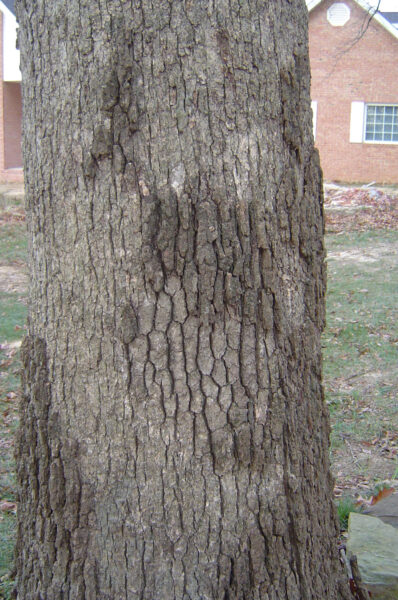

The fungal structures may be mistaken for wood decay fungi, but because smooth patch fungi invade only the nonliving, outer bark tissues, they do not affect the health of the tree. No control measures are needed.
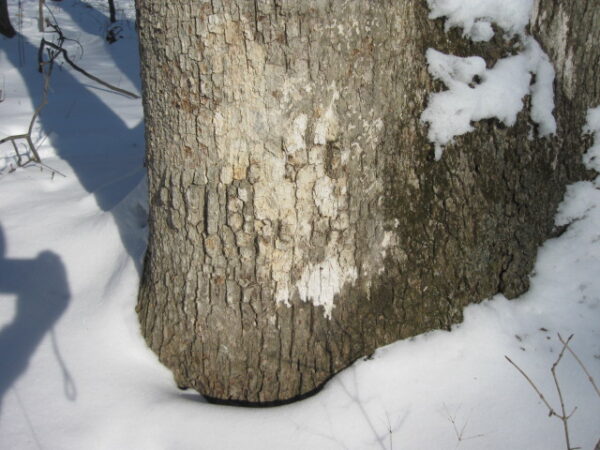
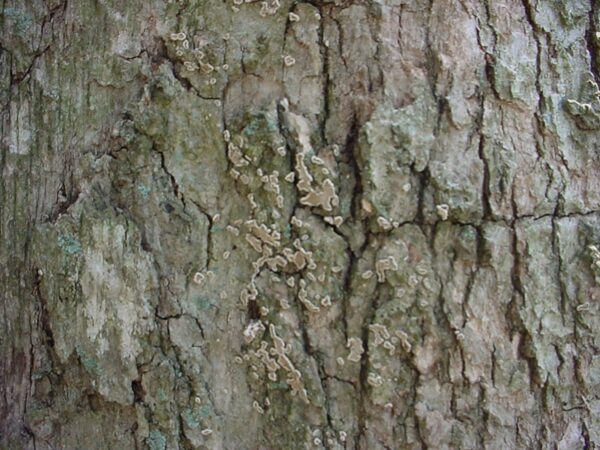
The fungal structures may be mistaken for wood decay fungi, but because smooth patch fungi invade only the nonliving, outer bark tissues, they do not affect the health of the tree. No control measures are needed.
Resources:
Indiana Forestry & Woodland Owners Association (IFWOA) YouTube Channel
District Forester, Indiana DNR Division of Forestry, for over 10 acres of woodlands
Directory of Professional Foresters, Indiana Forestry & Woodland Owners Association (IFWOA)
Indiana Woodland Steward E-newsletters, Eleven Member Organization
The Nature of Oaks Webinar, Purdue Extension-FNR YouTube Channel, Shared from Indiana Forestry & Woodland Owners Association
Purdue Arboretum Explorer
Native Trees of the Midwest, Purdue University Press
A Woodland Management Moment, Playlist, Purdue Extension – Forestry and Natural Resources (FNR) YouTube Channel
Conservation Tree Planting: Steps to Success, Purdue Extension – FNR YouTube Channel
Forest Improvement Handbook, The Education Store
Woodland Stewardship for Landowners, Playlist, Purdue Extension – FNR YouTube Channel
ID That Tree – Video Playlist, Purdue Extension – Forestry and Natural Resources (FNR) YouTube Channel
Invasive Species, Playlist, Purdue Extension – FNR YouTube Channel
Invasive Plant Species Identification, Video, Purdue Extension – FNR YouTube Channel
Report Invasive Species, Purdue Invasive Species
Subscribe – Purdue Extension-FNR YouTube Channel
Tom Creswell, Plant & Pest Diagnostic Laboratory Director
Purdue Botany and Plant Pathology
Welcome to “ID That Tree.” In this edition, Purdue Extension Forester Lenny Farlee introduces us to an autumn olive shrub found across Indiana. This dense shrub requires extensive control and management due to its effects on the habitat. Watch the video to learn about its aggressive growth, wildlife impact, leaf pattern, and other features!
If you have any questions regarding wildlife, trees, forest management, wood products, natural resource planning or other natural resource topics, feel free to contact us by using our Ask an Expert web page.
Resources:
ID That Tree – Video Playlist, Purdue Extension – Forestry and Natural Resources (FNR) YouTube Channel
Purdue Arboretum Explorer
Conservation Tree Planting: Steps to Success, Purdue Extension – FNR YouTube Channel
A Woodland Management Moment, Playlist, Purdue Extension – FNR YouTube Channel
Woodland Stewardship for Landowners, Playlist, Purdue Extension – FNR YouTube Channel
Indiana Department of Natural Resources: Invasive Species
Indiana Invasive Species Council
Cooperative Invasive Species Management Area (CISMA)
Report Invasive, Purdue Extension
Fifty Common Trees of Indiana, Purdue Extension – FNR
Episode 11 – Exploring the challenges of Invasive Species, Habitat University-Natural Resource University
Shrubs and Woody Vines of Indiana and the Midwest, The Education Store
Native Trees of the Midwest, The Education Store
Professional Forester, Indiana Forestry Woodland Owners Association
Forest Improvement Handbook, The Education Store
Find an Arborist, International Society of Arboriculture
Lenny Farlee, Extension Forester
Hardwood Tree Improvement and Regeneration Center
Purdue Department of Forestry & Natural Resources
Welcome to ID That Tree! In this video, Purdue forester Lenny Farlee examines one of Indiana’s most troublesome invasive shrubs: Amur honeysuckle. This aggressive species, along with other Asian honeysuckle varieties, is widespread across the state. It’s easily identified by its long, pointed leaves, smooth edges, and fine fuzz. Watch the video to learn more about its distinguishing features and the impact on Indiana’s ecosystems!
If you have any questions regarding wildlife, trees, forest management, wood products, natural resource planning or other natural resource topics, feel free to contact us by using our Ask an Expert web page.
Resources:
ID That Tree – Video Playlist, Purdue Extension – Forestry and Natural Resources (FNR) YouTube Channel
Purdue Arboretum Explorer
Conservation Tree Planting: Steps to Success, Purdue Extension – FNR YouTube Channel
A Woodland Management Moment, Playlist, Purdue Extension – FNR YouTube Channel
Woodland Stewardship for Landowners, Playlist, Purdue Extension – FNR YouTube Channel
Indiana Department of Natural Resources: Invasive Species
Indiana Invasive Species Council
Cooperative Invasive Species Management Area (CISMA)
Report Invasive, Purdue Extension
Fifty Common Trees of Indiana, Purdue Extension – FNR
Episode 11 – Exploring the challenges of Invasive Species, Habitat University-Natural Resource University
Shrubs and Woody Vines of Indiana and the Midwest, The Education Store
Native Trees of the Midwest, The Education Store
Professional Forester, Indiana Forestry Woodland Owners Association
Forest Improvement Handbook, The Education Store
Find an Arborist, International Society of Arboriculture
Lenny Farlee, Extension Forester
Hardwood Tree Improvement and Regeneration Center
Purdue Department of Forestry & Natural Resources
Welcome to this edition of “ID That Tree”. In this video Purdue Extension forester Lenny Farlee will introduce you to leatherwood, a charming Indiana shrub. Typically found in the understory of forest areas, this compact shrub is easy to identify by its oblong leaves with smooth margins and alternate leaf arrangement. Join us to learn more about leatherwood and its unique characteristics!
If you have any questions regarding wildlife, trees, forest management, wood products, natural resource planning or other natural resource topics, feel free to contact us by using our Ask an Expert web page.
Resources:
ID That Tree – Video Playlist, Purdue Extension – Forestry and Natural Resources (FNR) YouTube Channel
Purdue Arboretum Explorer
Conservation Tree Planting: Steps to Success, Purdue Extension – FNR YouTube Channel
A Woodland Management Moment, Playlist, Purdue Extension – FNR YouTube Channel
Woodland Stewardship for Landowners, Playlist, Purdue Extension – FNR YouTube Channel
Indiana Department of Natural Resources: Invasive Species
Indiana Invasive Species Council
Cooperative Invasive Species Management Area (CISMA)
Report Invasive, Purdue Extension
Fifty Common Trees of Indiana, Purdue Extension – FNR
Episode 11 – Exploring the challenges of Invasive Species, Habitat University-Natural Resource University
Shrubs and Woody Vines of Indiana and the Midwest, The Education Store
Native Trees of the Midwest, The Education Store
Professional Forester, Indiana Forestry Woodland Owners Association
Forest Improvement Handbook, The Education Store
Find an Arborist, International Society of Arboriculture
Lenny Farlee, Extension Forester
Hardwood Tree Improvement and Regeneration Center
Purdue Department of Forestry & Natural Resources
 Indiana Forestry & Woodland Owners Association (IFWOA) News: If you live in Indiana and own more than ten acres of woodlands, then you may want to enroll in the Classified Forest and Wildlands Program offered through the Indiana Department of Natural Resources (DNR), Division of Forestry. This program encourages timber production, watershed protection, and wildlife habitat management on private lands in Indiana. Program landowners receive a property tax reduction in return for following a professionally written management plan. In addition to the tax incentive, landowners receive free technical assistance from DNR foresters and wildlife biologists, priority for cost-share to offset the cost of doing management, and the ability to “green” certify their forests. The minimum requirement for program enrollment is 10 acres of forest, wetland, shrubland, and/or grassland.
“Once enrolled in our program, you get a reduced property tax assessment,” says Gretchen Herbaugh, District Forester with Indiana DNR serving southwestern Indiana.
“Property can be anything from forest ground to native grasses to pollinator habitats to wildlife food plots—we span a large range of habitat types and management styles,” Herbaugh says.
For full IFWOA article view: Indiana DNR Offers a Special Program for Woodland Owners.
To learn more about the program with more resources view the Hoosier Ag Today article, Indiana DNR Offering a Special Program for Woodland Owners.
Resources:
Subscribe, IFWOA YouTube Channel (includes The Nature of Oaks, Be Tick Aware, Population Ecology of Deer and more)
Find an Indiana Professional Forester, Indiana Forestry & Woodland Owners Association (IFWOA)
Purdue Arboretum Explorer
Native Trees of the Midwest, The Education Store
Shrubs and Woody Vines of Indiana and the Midwest, The Education Store
Investing in Indiana Woodlands, The Education Store
Forest Improvement Handbook, The Education Store
ID That Tree, Purdue Extension-Forestry & Natural Resources (FNR) YouTube playlist
Woodland Management Moment , Purdue Extension-FNR YouTube playlist
District Foresters for 10 plus acres, Indiana Department of Natural Resources
Financial and Tax Aspects of Tree Planting
Diana Evans, Extension and Web Communication Specialist
Purdue University Department of Forestry and Natural Resources
Liz Jackson, Engagement Lead
Indiana Forestry & Woodland Association (IFWOA)
Join Purdue Extension forester Lenny Farlee and wildlife specialist Brian MacGowan as they help you prepare for the holidays while keeping your family and local wildlife safe. This video discusses everything from how to choose and care for a real Christmas tree as well as what to do with it after the season and also how to make wildlife/nature-friendly decorations.
Topics Include:
– What can I do with my tree after Christmas that would benefit wildlife?
– Are artificial structures legal in Indiana lakes?
– What types of items can I collect from the wild for holiday decorations?
– How do I do it in an environmentally responsible way?
– Are there some things I shouldn’t or can’t collect?
– What outdoor holiday decorations can benefit wildlife?
– How do I make it last longer?
– Can I avoid problems with non-target wildlife?
If you have any questions regarding trees, forest management, wildlife, wood products or other natural resource topics, feel free to contact us by using our Ask an Expert web page.
Resources
Selecting an Indiana-Grown Christmas Tree, The Education Store, Purdue Extension resource center
Tips for First-Time Buyers of Real Christmas Trees, The Education Store
Indiana Christmas Tree Growers Association
Purdue University Invasive Species resources
Indiana DNR Division of Fish and Wildlife for wildlife possession rules
Feed the birds with a DIY wreath, Audubon
Dan Cassens: Tips for First-Time Christmas Tree Buyers, Video, Purdue Agriculture
Dan Cassens: Starting Your Own Christmas Tree Farm, Video
Lenny Farlee, Sustaining Hardwood Extension Specialist
Purdue University Department of Forestry and Natural Resource
Brian MacGowan, Extension Wildlife Specialist
Department of Forestry & Natural Resources, Purdue University
Agricultural & Natural Resources (ANR) Newsletter: Since joining the faculty at Purdue in 1997, Rado Gazo, a professor of wood processing and industrial engineering, has educated students, industry professionals and the general public about the possibilities of the wood products industry.
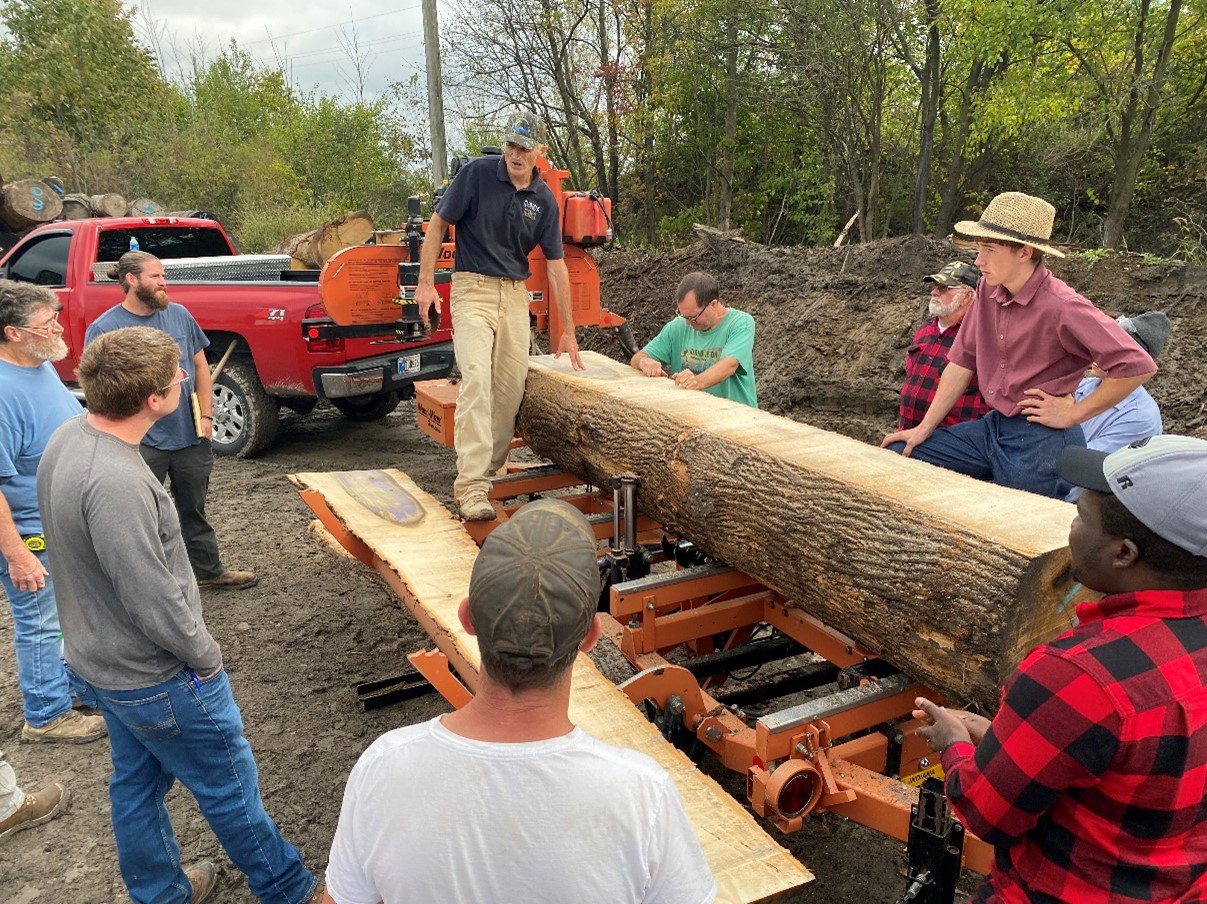
Prof. Gazo demonstrates hardwood log grade-sawing process on a portable Wood-Mizer sawmill.
In addition to teaching undergraduate courses in Properties of Wood, Wood Products Manufacturing and Furniture Design for CNC Manufacturing, Gazo conducts research focused on evaluating tree, log and lumber quality using CT (X-ray computed tomography), laser and image scanning and related manufacturing. He also investigates the competitiveness of furniture manufacturers as well as the application of industrial engineering techniques to value-added wood products manufacturing.
In 2020, Gazo created Hardwood University, a self-sustaining collaborative program with the Indiana Hardwood Lumbermen’s Association, which aims to provide hardwood industry professionals and landowners in the Central Hardwood region with cutting-edge information and training. Gazo is one of the primary instructors for the program.
Hardwood University, which consists of 10 sessions annually, is intended for new employees in the hardwood industry as well as those preparing for advancement or cross-training. The program, which takes place monthly at various Indiana hardwood plants and Purdue agricultural centers, offers informational and technical sessions on topics ranging from forest taxation to tree and log scaling and grading; log bucking; marketing hardwood veneer, stave and sawlogs; grade-sawing lumber; air drying and kiln drying lumber; hardwood lumber grading; lean manufacturing and logistics; and sawmill efficiency and quality control.
In addition, Gazo has worked with nearly 300 companies, providing technical assistance, troubleshooting and consulting services as well as implementation of manufacturing best practices.
To learn more about Rado Gazo’s work view: Rado Gazo, Forestry and Natural Resources profile page.
To read the rest of the newsletter and view the original article, see the ANR November 2024 Newsletter.
Resources:
Wood Products Manufacturing Technology Minor, FNR Minor
Hardwoods of the Central Midwest, The Purdue Arboretum
Wood Products, Purdue Extension – Forestry & Natural Resources (FNR)
Wood is Best Video, Forestry and Natural Resources YouTube Channel, Woodisbest.org
An Introduction to Trees of Indiana, The Education Store, Purdue Extension resource center
Native Trees of the Midwest, The Education Store
Shrubs and Woody Vines of Indiana and the Midwest, The Education Store
ID That Tree, Playlist, Subscribe to Purdue Extension – Forestry and Natural Resources YouTube Channel
A Woodland Management Moment, Playlist, Purdue Extension – FNR YouTube Channel
Investing in Indiana Woodlands, The Education Store
Forest Improvement Handbook, The Education Store
Finding help from a professional forester, Indiana Forestry & Woodland Owners Association
District Foresters for 10 plus acres, Indiana Department of Natural Resources
Hardwood Tree Improvement & Regeneration Center (HTIRC)
Agricultural & Natural Resources (ANR), Purdue Extension
Wild Bulletin, IN DNR, Division of Fish & Wildlife: Epizootic hemorrhagic disease (EHD) is a naturally occurring viral disease commonly seen in the Indiana deer herd. Each year, typically in late summer, Indiana DNR receives reports of deer displaying signs of EHD throughout the state.
This year, DNR confirmed a significant EHD outbreak that began in the northern region of the Hoosier State. In some years, EHD can affect a larger-than-normal portion of the deer and becomes widespread across a county. In those instances, DNR lowers the County Bonus Antlerless Quotas (CBAQs) in the impacted counties to offset the effect of the counties’ EHD outbreak on the deer herd in that region.
EHD is transmitted by biting midges, also known as sand gnats or “no-see-ums.” Deer infected with EHD may display unusual behaviors such as lethargy, excessive salivation, or disorientation. EHD also causes fever in deer, which can cause deer to seek water. As a result, many deer that die from EHD are found in or near open water sources like ponds and rivers. Anyone who finds a deer showing signs of EHD or dead in water is asked to report it at on.IN.gov/sickwildlife.
County bonus antlerless quotas reduced in three counties for 2024-25
 Due to the number of reported deer mortalities and extent of EHD in the region, DNR has lowered the County Bonus Antlerless Quotas (CBAQs) in Wabash, Porter, and Allen counties from two bonus antlerless deer to one to help offset the effects of EHD on the deer herd in that region. During the winter, DNR biologists will fully evaluate the effects of EHD and will propose changes to bag limits as required. Hunters can stay informed about CBAQ changes at on.IN.gov/EHD-quotas.
To find out more view the Indiana Department of Natural Resources EHD Antlerless Bonus Quota Reductions.
Resources:
Be on the Watch for Epizootic Hemorrhagic Disease (EHD) in Deer, Got Nature? Blog, Purdue Extension – FNR
Report a Sick or Dead Deer, Indiana Department of Natural Resources (IN-DNR)
EHD Virus in Deer: How to Detect and Report video, Quality Deer Management Association
Epizootic Hemorrhagic Disease (pdf), Cornell University
How to Score Your White-Tailed Deer video, Purdue Extension – FNR YouTube Playlist
Deer Harvest Data Collection, Purdue FNR Got Nature? blog
Woodland Stewardship for Landowners: Managing Deer Damage to Young Trees, Purdue Extension-FNR YouTube Channel
Introduction to White-tailed Deer Impacts on Indiana Woodlands, Deer Impact Toolbox, Got Nature? Blog & The Education Store
Purdue Extension Pond and Wildlife Management
Managing White-tailed Deer Impacts on Indiana Woodlands, The Education Store
How to Build a Plastic Mesh Deer Exclusion Fence, The Education Store
Managing Your Woods for White-Tailed Deer, The Education Store
Deer Harvest Data Collection, Got Nature? Blog, Purdue Extension – FNR
Handling Harvested Deer Ask an Expert? video, Purdue Extension – FNR YouTube Channel
Subscribe to Purdue Extension-Forestry & Natural Resources YouTube Channel, Wildlife Playlist
A Woodland Management Moment – Deer Fencing, Purdue Extension – FNR YouTube Video
Division of Fish and Wildlife, Indiana Department of Natural Resources

Recent Posts
- Popular Landscape Shrub is Invasive
Posted: October 15, 2026 in Alert, Forestry, Forests and Street Trees, Invasive Plant Species, Plants, Woodlands - Purdue Extension’s Regional Teams Are Here: Connecting Communities with Expertise and Opportunity
Posted: October 14, 2026 in Community Development, Forestry, Forests and Street Trees, Gardening, How To, Timber Marketing, Urban Forestry, Wildlife, Woodlands - Why Do Our Trees Go From Green Leaves to Different Colors?
Posted: in Forestry, Forests and Street Trees, Urban Forestry, Woodlands - Distinguishing Dogwoods
Posted: October 13, 2026 in Forestry, Urban Forestry, Wildlife, Woodlands - Burning for Benefits: Why Fire Belongs in Indiana
Posted: October 12, 2026 in Forestry, Safety, Woodlands - Woodland Flowers of Late Summer
Posted: September 14, 2026 in Forestry, Gardening, Wildlife, Woodlands - New Indiana Woodland Steward Newsletter
Posted: August 12, 2026 in Forestry, Urban Forestry, Wildlife, Woodlands - ID That Tree: Nannyberry Viburnum
Posted: July 22, 2026 in Forestry, Plants, Wildlife, Woodlands - ID That Tree: Eastern Swamp Privet
Posted: in Forestry, Plants, Wildlife, Woodlands - ID That Tree: Carolina Buckthorn
Posted: July 15, 2026 in Forestry, Wildlife, Woodlands
Archives
Categories
- Alert
- Aquaculture/Fish
- Aquatic/Aquaculture Resources
- Ask the Expert
- Christmas Trees
- Community Development
- Disease
- Drought
- Forestry
- Forests and Street Trees
- Gardening
- Got Nature for Kids
- Great Lakes
- How To
- Invasive Animal Species
- Invasive Insects
- Invasive Plant Species
- Land Use
- Natural Resource Planning
- Nature of Teaching
- Plants
- Podcasts
- Ponds
- Publication
- Safety
- Spiders
- Timber Marketing
- Urban Forestry
- Webinar
- Wildlife
- Wood Products/Manufacturing
- Woodland Management Moment
- Woodlands