 Purdue University - Extension - Forestry and Natural Resources
Got Nature? Blog
Purdue College of Agriculture News: Purdue University has received $12 million of a $35 million project led by the American Forest Foundation and funded by the U.S. Department of Agriculture’s Partnership for Climate Smart Commodities to help family forest owners practice climate-smart forestry in Indiana and eight other states throughout the eastern half of the U.S.
The project’s other partners are The Nature Conservancy, the Center for Heirs Property Preservation, and Women Owning Woodlands. The project could sequester an estimated 4.9 million tons of atmospheric carbon—a greenhouse gas that affects climate—over a 20- to 30-year period.
“Our digital forestry group has been working on various tools and thinking about how to apply these tools to real-life problems,” said Songlin Fei, who directs Purdue’s Integrated Digital Forestry Initiative. “This is an opportunity to apply our expertise to solving part of the climate-change puzzle.” Purdue’s cross-disciplinary Integrated Digital Forestry Initiative includes faculty members from the colleges of Agriculture, Engineering, Sciences, Liberal Arts and Libraries and the Polytechnic Institute. The Integrated Digital Forestry Initiative, one of the five strategic investments in Purdue’s Next Moves, leverages digital technology and multidisciplinary expertise to measure, monitor and manage urban and rural forests to maximize social, economic and ecological benefits. “We’re bringing a traditional field into the digital age,” said Fei, professor, Forestry and Natural Resources, and Dean’s Chair of Remote Sensing.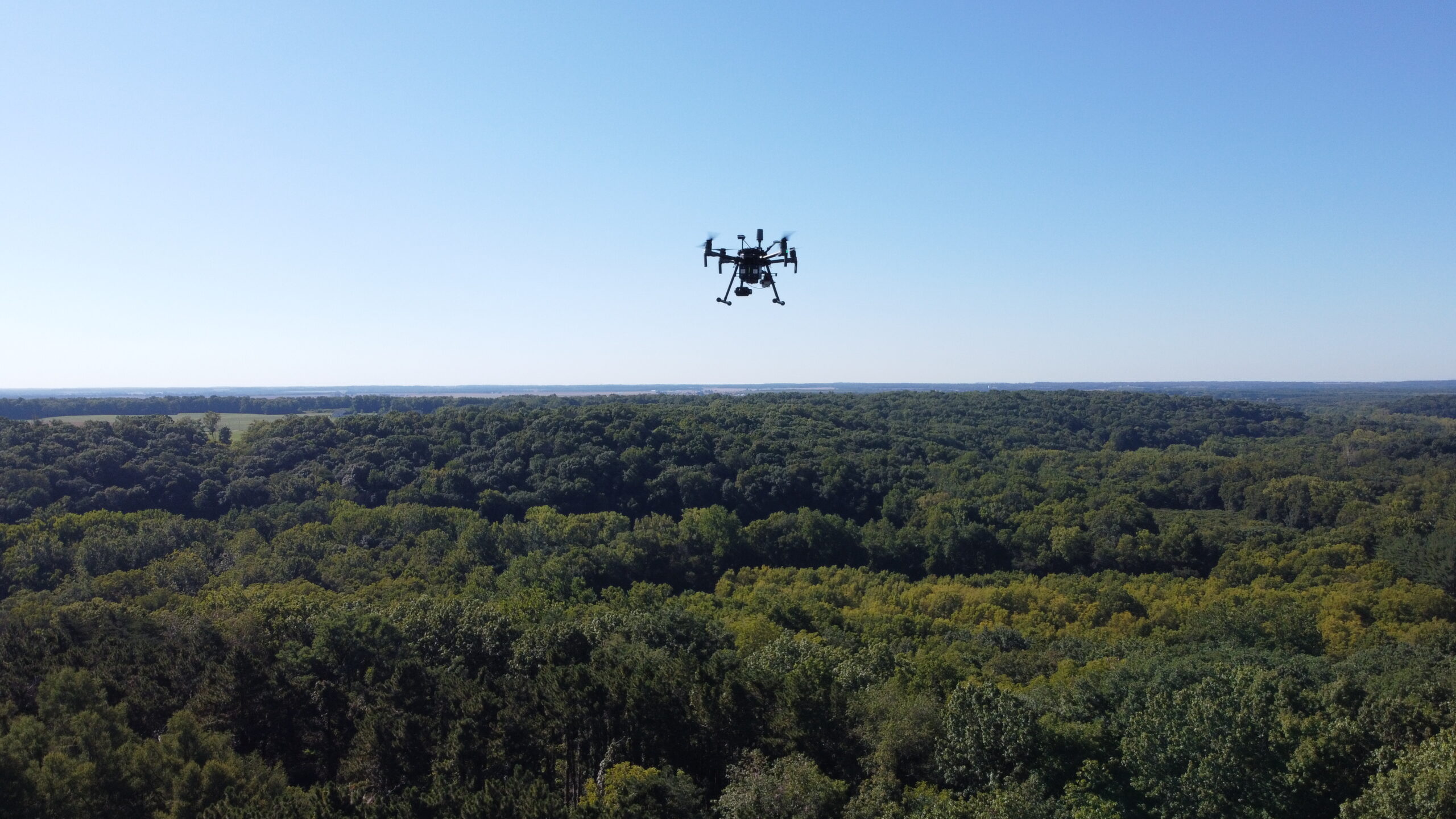
Purdue will utilize advanced digital forestry technologies to do the measurement, monitoring, reporting and verification of carbon sequestrations that the project requires. The automated technology, applied at a regional scale with unprecedented accuracy, will be based on data collected by satellites and drones with various sensors, such as light detection and ranging (LiDAR). The team will also develop a simulation system that will utilize artificial intelligence to generate optimized forest management scenarios.
The work will result in a web-based tool that landowners can use to estimate and predict the climate-smart commodity market potential of their properties. The team is also building a smartphone-based app for tree measurement and monitoring.
American families own nearly 40 percent of the nation’s forests, yet few of them take part in forest carbon projects or work from a management plan. However, with proper management, trees can grow faster and sequester more carbon, Fei said.
Landowners will receive economic incentives for participating in the program. Payment to landowners will depend on which climate-smart carbon practices they use. Project staff or consulting foresters will also provide landowners technical advice and guidance in establishing a forest management plan.
Resources:
Timber Harvesting and Logging Practices for Private Woodlands, The Education Store, Purdue Extension’s resource center
Investing in Indiana Woodlands, The Education Store
Marketing Timber, The Education Store
Woodland Wildlife Management, The Education Store
A Landowner’s Guide to Sustainable Forestry: Part 3: Keeping Your Forest Healthy and Productive, The Education Store
Investing in Indiana Woodlands, The Education Store
ID That Tree, Playlist, Purdue Extension – Forestry & Natural Resources (FNR) YouTube Channel
Woodland Stewardship for Landowners Video Series, Playlist, Purdue Extension – FNR YouTube Channel
The classic and trusted book “Fifty Common Trees of Indiana” by T.E. Shaw was published in 1956 as a user-friendly guide to local species. Nearly 70 years later, the publication has been updated through a joint effort by the Purdue Department of Forestry and Natural Resources, Indiana 4-H, and the Indiana Department of Natural Resources, and reintroduced as “An Introduction to Trees of Indiana.”
The full publication is available for download for $7 in the Purdue Extension Education Store. The field guide helps identify common Indiana woodlot trees.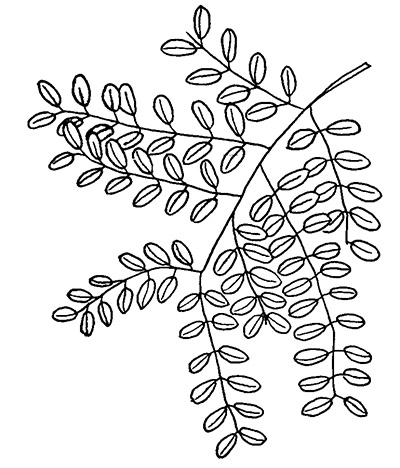
Each week, the Intro to Trees of Indiana web series will offer a sneak peek at one species from the book, paired with an ID That Tree video from Purdue Extension forester Lenny Farlee to help visualize each species as it stands in the woods. Threats to species health as well as also insight into the wood provided by the species, will be provided through additional resources as well as the Hardwoods of the Central Midwest exhibit of the Purdue Arboretum, if available.
This week, we introduce the honey locust or Gleditsia triacanthos.
This tree, also called “thorn-tree,” has multi-pronged thorns of two inches or more in length, which occur on the trunk as well as on the limbs and twigs. Honey locust can be found with doubly compound leaves with very small oval leaflets arranged alternately on the main leaf stem, or it can have singly compound leaves with very small leaves on a straight stem. Leaves produce a bright yellow fall color.
The bark is tight and red-brown on young trees and features gray-brown scaly strips on older trees. The fruit of the honey locust is a wavy, glossy brown flat pod that reaches lengths of between eight inches and one foot and curl or twist at maturity. These pods, which contain several seeds, are held on the tops of the trees and are highly favored by wildlife.
Honey locusts grow 70 to 80 feet tall.
For full article with additional photos view: Intro to Trees of Indiana: Honey Locust
If you have any questions regarding wildlife, trees, forest management, wood products, natural resource planning or other natural resource topics, feel free to contact us by using our Ask an Expert web page.
Other Resources:
Hardwoods of the Central Midwest: Honey Locust
Hardwood Lumber and Veneer Series: Honey Locust
Morton Arboretum: Honey Locust
Fifty Common Trees of Indiana
An Introduction to Trees of Indiana
Native Trees of the Midwest, The Education Store
Shrubs and Woody Vines of Indiana and the Midwest, The Education Store
Investing in Indiana Woodlands, The Education Store
Forest Improvement Handbook, The Education Store
ID That Tree, Purdue Extension-Forestry & Natural Resources (FNR) YouTube playlist
Woodland Management Moment , Purdue Extension-FNR YouTube playlist
Honey Locust, Native Trees of Indiana River Walk, Fort Wayne-Purdue University
Wendy Mayer, FNR Communications Coordinator
Purdue University Department of Forestry and Natural Resources
Lenny Farlee, Sustaining Hardwood Extension Specialist
Purdue University Department of Forestry and Natural Resources
The classic and trusted book “Fifty Common Trees of Indiana” by T.E. Shaw was published in 1956 as a user-friendly guide to local species. Nearly 70 years later, the publication has been updated through a joint effort by the Purdue Department of Forestry and Natural Resources, Indiana 4-H, and the Indiana Department of Natural Resources, and reintroduced as “An Introduction to Trees of Indiana.”
The full publication is available for download for $7 in the Purdue Extension Education Store. The field guide helps identify common Indiana woodlot trees.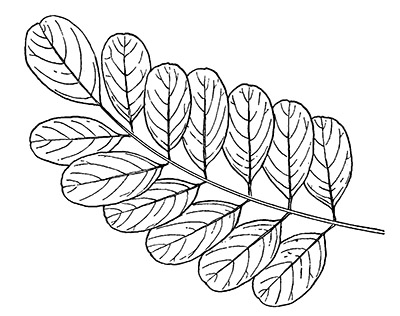
Each week, the Intro to Trees of Indiana web series will offer a sneak peek at one species from the book, paired with an ID That Tree video from Purdue Extension forester Lenny Farlee to help visualize each species as it stands in the woods. Threats to species health as well as also insight into the wood provided by the species, will be provided through additional resources as well as the Hardwoods of the Central Midwest exhibit of the Purdue Arboretum, if available.
This week, we introduce the black locust or Robinia pseudoacacia.
This tree has compound leaves that are eight to 10 inches long, made up of seven to 17 small rounded leaflets arranged alternately on the twigs. The black locust has thorns on the twig where the buds and leaf stems branch off and also on the limbs and trunks of young trees. The bark is a light to medium gray marked by very rough, long running ridges. An orange coloration can be seen when scraping the bark surface.
In the spring, black locust produces long hanging clusters of fragrant white flowers. It is a member of the broad legume family and its fruit resembles a bean, with brown or black pods that are approximately three inches long and very thin and papery.
For full article with additional photos view: Intro to Trees of Indiana: Black Locust
If you have any questions regarding wildlife, trees, forest management, wood products, natural resource planning or other natural resource topics, feel free to contact us by using our Ask an Expert web page.
Other Resources:
Hardwood Lumber and Veneer Series: Black Locust
Morton Arboretum: Black Locust
The Wood Database: Black Locust
Fifty Common Trees of Indiana
An Introduction to Trees of Indiana
Native Trees of the Midwest, The Education Store
Shrubs and Woody Vines of Indiana and the Midwest, The Education Store
Investing in Indiana Woodlands, The Education Store
Forest Improvement Handbook, The Education Store
ID That Tree, Purdue Extension-Forestry & Natural Resources (FNR) YouTube playlist
Woodland Management Moment , Purdue Extension-FNR YouTube playlist
Wendy Mayer, FNR Communications Coordinator
Purdue University Department of Forestry and Natural Resources
Lenny Farlee, Sustaining Hardwood Extension Specialist
Purdue University Department of Forestry and Natural Resources
The classic and trusted book “Fifty Common Trees of Indiana” by T.E. Shaw was published in 1956 as a user-friendly guide to local species. Nearly 70 years later, the publication has been updated through a joint effort by the Purdue Department of Forestry and Natural Resources, Indiana 4-H, and the Indiana Department of Natural Resources, and reintroduced as “An Introduction to Trees of Indiana.”
The full publication is available for download for $7 in the Purdue Extension Education Store. The field guide helps identify common Indiana woodlot trees.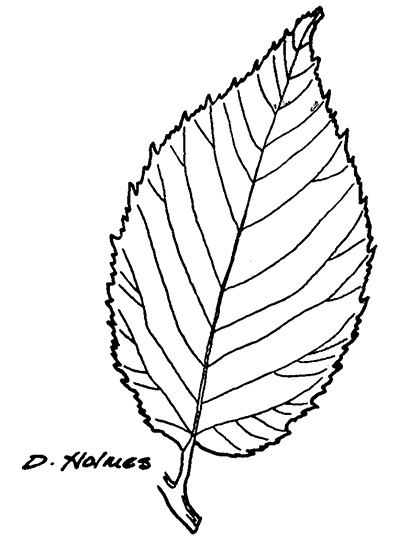
Each week, the Intro to Trees of Indiana web series will offer a sneak peek at one species from the book, paired with an ID That Tree video from Purdue Extension forester Lenny Farlee to help visualize each species as it stands in the woods. Threats to species health as well as also insight into the wood provided by the species, will be provided through additional resources as well as the Hardwoods of the Central Midwest exhibit of the Purdue Arboretum, if available.
This week, we introduce the ironwood or Ostrya virginiana.
This tree, also known as Eastern hop hornbeam, is identifiable by its oblong leaves with doubly-toothed margins, which are held alternately on very fine twigs, and its fruit, a loosely formed green pod at the tip of the branches, which resembles hops. The bark is medium to dark brown with flakes and prominent flaky ridges which develop as the tree ages. The leaves of ironwood produce vibrant yellow fall color.
The ironwood, typically an understory species but sometimes found as a landscape tree, is closely related to the American Hornbeam or blue beech or musclewood, although the bark of the latter is gray and appears stretched across the muscles and sinews of the tree.
For full article with additional photos view: Intro to Trees of Indiana: Ironwood
Other Resources:
Fifty Common Trees of Indiana
An Introduction to Trees of Indiana
Native Trees of the Midwest, The Education Store
Shrubs and Woody Vines of Indiana and the Midwest, The Education Store
Investing in Indiana Woodlands, The Education Store
Forest Improvement Handbook, The Education Store
Information for Carpinus caroliniana tree species, The Purdue Arboretum Explorer
ID That Tree, Purdue Extension-Forestry & Natural Resources (FNR) YouTube playlist
Woodland Management Moment , Purdue Extension-FNR YouTube playlist
Wendy Mayer, FNR Communications Coordinator
Purdue University Department of Forestry and Natural Resources
Lenny Farlee, Sustaining Hardwood Extension Specialist
Purdue University Department of Forestry and Natural Resources
The classic and trusted book “Fifty Common Trees of Indiana” by T.E. Shaw was published in 1956 as a user-friendly guide to local species. Nearly 70 years later, the publication has been updated through a joint effort by the Purdue Department of Forestry and Natural Resources, Indiana 4-H, and the Indiana Department of Natural Resources, and reintroduced as “An Introduction to Trees of Indiana.”
The full publication is available for download for $7 in the Purdue Extension Education Store. The field guide helps identify common Indiana woodlot trees.
Each week, the Intro to Trees of Indiana web series will offer a sneak peek at one species from the book, paired with an ID That Tree video from Purdue Extension forester Lenny Farlee to help visualize each species as it stands in the woods. Threats to species health as well as also insight into the wood provided by the species, will be provided through additional resources as well as the Hardwoods of the Central Midwest exhibit of the Purdue Arboretum, if available.
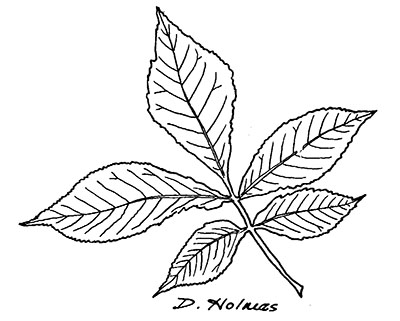 This week, we introduce the Pignut hickory or Carya glabra.
This tree is identifiable by its five-leaflet compound leaves and its small, smooth round nut with a partially open husk at the top. The pignut hickory has smaller buds and finer twigs than its cousins shagbark and mockernut hickory, and its nut is smooth and not ribbed. Its alternately held leaves are typically five leaflets, but may be seven leaflets, sometimes held on the same tree. The bark typically has long, running ridges that are medium or dark gray in color.
Pignut hickories grow to a mature height of 50-60 feet tall, but can be over 100 feet tall. They grow mostly on upland sites or in other places with good soil moisture drainage from New Hampshire west to Iowa and south to Texas and east to northern Florida except for the flood plain of the Mississippi River from Memphis south.
For full article with additional photos view: Intro to Trees of Indiana: Pignut Hickory
Other Resources:
Hickory and Pecan Species in the Hardwood Lumber and Veneer Series, The Education Store, Purdue Extension’s resource center
Sustaining Our Oak-Hickory Forests – Hardwood Ecosystem Experiment, The Education Store
The Hardwood Ecosystem Experiment: 2006-2016, The Education Store
Indiana Forestry and Wildlife: The Hardwood Ecosystem Experiment, The Education Store
Fifty Common Trees of Indiana
An Introduction to Trees of Indiana
Native Trees of the Midwest, The Education Store
Shrubs and Woody Vines of Indiana and the Midwest, The Education Store
Investing in Indiana Woodlands, The Education Store
Forest Improvement Handbook, The Education Store
Pignut Hickory, Native Trees of Indiana River Walk, Purdue University-Fort Wayne
ID That Tree, Purdue Extension-Forestry & Natural Resources (FNR) YouTube playlist
Woodland Management Moment , Purdue Extension-FNR YouTube playlist
Wendy Mayer, FNR Communications Coordinator
Purdue University Department of Forestry and Natural Resources
Lenny Farlee, Sustaining Hardwood Extension Specialist
Purdue University Department of Forestry and Natural Resources
The classic and trusted book “Fifty Common Trees of Indiana” by T.E. Shaw was published in 1956 as a user-friendly guide to local species. Nearly 70 years later, the publication has been updated through a joint effort by the Purdue Department of Forestry and Natural Resources, Indiana 4-H, and the Indiana Department of Natural Resources, and reintroduced as “An Introduction to Trees of Indiana.”
 The full publication is available for download for $7 in the Purdue Extension Education Store. The field guide helps identify common Indiana woodlot trees.
Each week, the Intro to Trees of Indiana web series will offer a sneak peek at one species from the book, paired with an ID That Tree video from Purdue Extension forester Lenny Farlee to help visualize each species as it stands in the woods. Threats to species health as well as also insight into the wood provided by the species, will be provided through additional resources as well as the Hardwoods of the Central Midwest exhibit of the Purdue Arboretum, if available.
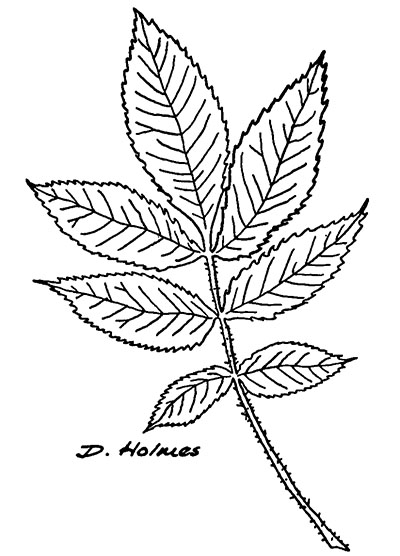
This week, we introduce the White hickory or Carya tomentosa.
This tree, also known as mockernut hickory, has stout twigs like those of shagbark hickory and large terminal buds, but its bark is not shaggy. Instead, mockernut hickory features thick, interlacing bark ridges that is often silvery on top. Its leaves are made up of seven to nine leaflets that are hairy beneath, instead of five. The bud is very rounded, resembling a scoop of ice cream. The bud, leaf stems and twigs may have hair on them. The nuts of the mockernut hickory are smooth and round with mild ridges with four seams, which break open in the fall. The leaves produce a golden-yellow color in the fall.
Mockernut hickories grow to a mature height of 50-60 feet tall. They grow mostly in high dry ridges and other well-drained soil locations from New Hampshire west to Iowa and south to Texas and east to northern Florida except for the flood plain of the Mississippi Rive from Memphis south.
For full article with additional photos view: Intro to Trees of Indiana: Mockernut Hickory
Other Resources:
Hickory and Pecan Species in the Hardwood Lumber and Veneer Series, The Education Store, Purdue Extension’s resource center
Sustaining Our Oak-Hickory Forests – Hardwood Ecosystem Experiment, The Education Store
The Hardwood Ecosystem Experiment: 2006-2016, The Education Store
Indiana Forestry and Wildlife: The Hardwood Ecosystem Experiment, The Education Store
Fifty Common Trees of Indiana
An Introduction to Trees of Indiana
Native Trees of the Midwest, The Education Store
Shrubs and Woody Vines of Indiana and the Midwest, The Education Store
Investing in Indiana Woodlands, The Education Store
Forest Improvement Handbook, The Education Store
ID That Tree, Purdue Extension-Forestry & Natural Resources (FNR) YouTube playlist
Woodland Management Moment , Purdue Extension-FNR YouTube playlist
Wendy Mayer, FNR Communications Coordinator
Purdue University Department of Forestry and Natural Resources
Lenny Farlee, Sustaining Hardwood Extension Specialist
Purdue University Department of Forestry and Natural Resources
Purdue Landscape Report, Using Pneumatic Digging Equipment to Correct Root Deformations, Deep Planting, and Compaction on Established Trees: When transplanting trees, it is important to consider the long-term viability. Since the typical life span of an urban tree is 7-20 years (USDA), proper establishment techniques are very important to decrease this mortality rate. When a tree becomes established, it is much more difficult to correct below ground problems.
Root deformations can occur for many reasons in established trees, but the most common are due to not making corrections prior to transplanting. Plants that have girdling and circling roots must 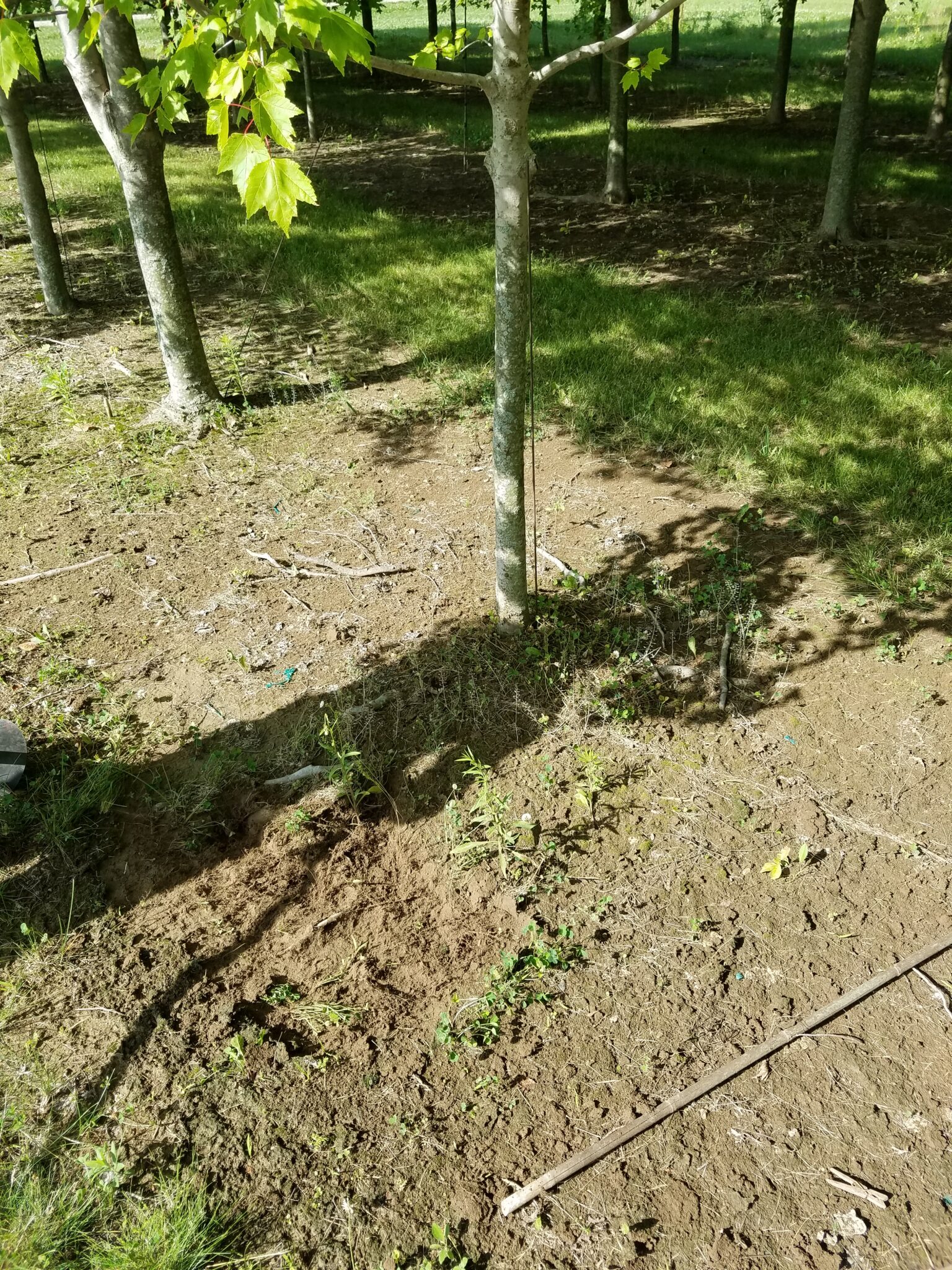 be addressed at the time of planting. If this issue is not addressed many problems may ensue when the tree is established, which includes decline, tree failure, blow-overs, and more.
Another common problem that occurs at transplanting is deep planting. In the past, plants were often planted deep in the nursery for two main reasons: 1) cold protection of the roots and root flare and 2) prevent the use of staking. In fields that are cultivated, the soil often mounds around the trees which can increase the depth of the root flare. Additionally, when planting into the landscape, trees can be planted too deep, exacerbating the problems associated with planting too deep.
Deep planting can cause an increase in disease, insects, decreased tolerance to flooded soils, adventitious roots, and root circling/girdling. Day and Harris (2008) found that there is significantly more girdled root at 30 cm below grade than at grade or 15 cm below grade. They also found that excavated trees at 30 cm had more girdling roots than non-excavated roots at 30 cm.
Compaction can become an issue when trees are located in high traffic areas. Compaction will cause a decline in trees over time and become more susceptible to increased insect and disease pressure.
Excavating the root system with a pneumatic digger is a method that can be used to correct all of these problems. Removing soil around the tree will allow root deformations to be located and corrected. Removing the soil around the collar to correct planting depth and girdling roots will increase the longevity of the tree. Compaction can be reduced by using a pneumatic digger to remove the soil from the root hairs that are typically located in the top 6 inches of soil for most trees (Morris, et.al., 2009).
To read the full article with additional images and video please visit: Using Pneumatic Digging Equipment to Correct Root Deformations, Deep Planting, and Compaction on Established Trees
For more information on correcting root problems after a tree becomes established:
Stem Girdling Roots
Root Growth on Urban Trees
Tree Root Problems
Air Digging Trench or Loosening Soil
Tree Planted Too Deeply
Roots and the Pneumatic Soil Excavation Tool
Tree Preservation Efforts
Getting Roots Right
Supersonic Air Jets Preserve Tree Roots in Underground Pipeline Installation
More resources:
Root Rot in Landscape Plants, The Education Store
Ask The Expert: Tree Inspection, Purdue Extension- FNR YouTube Channel
Ask The Expert: Tree Selection and Planting, Purdue Extension- FNR YouTube Channel
Surface Root Syndrome, The Education Store, Purdue Extension resource center
The Nature of Teaching: Trees of the Midwest, The Education Store
Tree Appraisal and the Value of Trees, The Education Store
Construction and Trees: Guidelines for Protection, The Education Store
Kyle Daniel, Extension Specialists
Purdue University Department of Forestry and Natural Resources
The classic and trusted book “Fifty Common Trees of Indiana” by T.E. Shaw was published in 1956 as a user-friendly guide to local species. Nearly 70 years later, the publication has been updated through a joint effort by the Purdue Department of Forestry and Natural Resources, Indiana 4-H, and the Indiana Department of Natural Resources, and reintroduced as “An Introduction to Trees of Indiana.”
 The full publication is available for download for $7 in the Purdue Extension Education Store. The field guide helps identify common Indiana woodlot trees.
Each week, the Intro to Trees of Indiana web series will offer a sneak peek at one species from the book, paired with an ID That Tree video from Purdue Extension forester Lenny Farlee to help visualize each species as it stands in the woods. Threats to species health as well as also insight into the wood provided by the species, will be provided through additional resources as well as the Hardwoods of the Central Midwest exhibit of the Purdue Arboretum, if available.
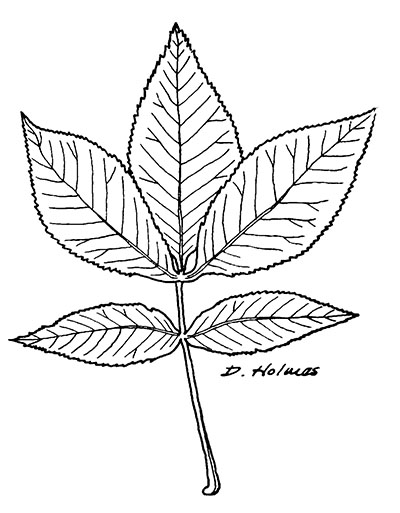
This week, we introduce the Shagbark hickory or Carya ovata.
This species is easily identifiable by its rough, shaggy bark, which is often peeling off from the trunk in thin strips. Its unique leaves feature five leaflets, two held opposite one another toward the base of the stem and three held at the end of the leaf. The fruit is a large, four-ribbed nut with a husk that will split all the way open. In the fall, shagbark hickory can provide fall color in the form of its stunning golden or yellow leaves.
Shagbark hickory has several close relatives. Shagbark can be differentiated from its cousin shellbark hickory, which features large stout twigs, seven to nine leaflets and typically has substantially larger nuts.
Shagbark hickories grow to a mature height of 60 to 80 feet tall. They grow mostly in moist, well-drained soil and are often found in upland woodlands and savannas, ranging across the Eastern United States, except in the gulf and Atlantic coastal plains, as well as in portions of Canada along Lake Erie and Ontario and the St. Lawrence River.
Shagbark hickory has a unique application in the furniture industry known as “Old Hickory Furniture,” which originated around 1900 in Indiana. This rustic furniture is made from hickory rounds or sapling with the bark left on, and was used in parks and other natural areas during his prime production.
For full article with additional photos view: Intro to Trees of Indiana: Shagbark Hickory
Other Resources:
Shagbark Hickory in Hardwoods of the Midwest, Purdue Arboretum Explorer
Hickory and Pecan Species in the Hardwood Lumber and Veneer Series, The Education Store, Purdue Extension’s resource center
Sustaining Our Oak-Hickory Forests – Hardwood Ecosystem Experiment, The Education Store
The Hardwood Ecosystem Experiment: 2006-2016, The Education Store
Indiana Forestry and Wildlife: The Hardwood Ecosystem Experiment, The Education Store
Fifty Common Trees of Indiana
An Introduction to Trees of Indiana
Native Trees of the Midwest, The Education Store
Shrubs and Woody Vines of Indiana and the Midwest, The Education Store
Investing in Indiana Woodlands, The Education Store
Forest Improvement Handbook, The Education Store
ID That Tree, Purdue Extension-Forestry & Natural Resources (FNR) YouTube playlist
Woodland Management Moment , Purdue Extension-FNR YouTube playlist
Wendy Mayer, FNR Communications Coordinator
Purdue University Department of Forestry and Natural Resources
Lenny Farlee, Sustaining Hardwood Extension Specialist
Purdue University Department of Forestry and Natural Resources
 The classic and trusted book “Fifty Common Trees of Indiana” by T.E. Shaw was published in 1956 as a user-friendly guide to local species. Nearly 70 years later, the publication has been updated through a joint effort by the Purdue Department of Forestry and Natural Resources, Indiana 4-H, and the Indiana Department of Natural Resources, and reintroduced as “An Introduction to Trees of Indiana.”
The full publication is available for download for $7 in the Purdue Extension Education Store. The field guide helps identify common Indiana woodlot trees.
Each week, the Intro to Trees of Indiana web series will offer a sneak peek at one species from the book, paired with an ID That Tree video from Purdue Extension forester Lenny Farlee to help visualize each species as it stands in the woods. Threats to species health as well as also insight into the wood provided by the species, will be provided through additional resources as well as the Hardwoods of the Central Midwest exhibit of the Purdue Arboretum, if available.
This week, we introduce the bitternut hickory or Carya cordiformis.
This cousin of the pecan, has anywhere from five to 11 leaflets, commonly seven to nine, on each alternately held compound leaf. Leaflets are much longer than they are wide and are often curved backwards.
A sulphur-colored, elongated bud is a standout identifying characteristic. Bitternut hickory has tight light to silvery gray bark with interlacing ridges throughout the life of the tree.
The fruit is a light colored, small, round nut, with a thick hull and a slight wing where the sutures meet. It is quite bitter and not preferred by animals or humans.
The bitternut hickory is one of the fastest growing hickory species in the state behind the pecan, and produces some fall beauty with yellow and gold foliage. Bitternut hickory, one of the most abundant and wide spread hickory species, can be found on dry gravelly uplands as well as rich moist bottomland from the Atlantic coast to the Great Plains, north through Minnesota and the St. Lawrence River valley, except the gulf coastal plains and the lower Mississippi flood plain regions.
For full article with additional photos view: Intro to Trees of Indiana: Bitternut Hickory.
Other Resources:
Hackberry in Hardwoods of the Midwest, Purdue Arboretum Explorer
Hickory and Pecan Species in the Hardwood Lumber and Veneer Series, The Education Store, Purdue Extension’s resource center
Sustaining Our Oak-Hickory Forests – Hardwood Ecosystem Experiment, The Education Store
The Hardwood Ecosystem Experiment: 2006-2016, The Education Store
Indiana Forestry and Wildlife: The Hardwood Ecosystem Experiment, The Education Store
Fifty Common Trees of Indiana
An Introduction to Trees of Indiana
Native Trees of the Midwest, The Education Store
Shrubs and Woody Vines of Indiana and the Midwest, The Education Store
Investing in Indiana Woodlands, The Education Store
Forest Improvement Handbook, The Education Store
ID That Tree, Purdue Extension-Forestry & Natural Resources (FNR) YouTube playlist
Woodland Management Moment , Purdue Extension-FNR YouTube playlist
Wendy Mayer, FNR Communications Coordinator
Purdue University Department of Forestry and Natural Resources
Lenny Farlee, Sustaining Hardwood Extension Specialist
Purdue University Department of Forestry and Natural Resources
 The classic and trusted book “Fifty Common Trees of Indiana” by T.E. Shaw was published in 1956 as a user-friendly guide to local species. Nearly 70 years later, the publication has been updated through a joint effort by the Purdue Department of Forestry and Natural Resources, Indiana 4-H, and the Indiana Department of Natural Resources, and reintroduced as “An Introduction to Trees of Indiana.”
The full publication is available for download for $7 in the Purdue Extension Education Store. The field guide helps identify common Indiana woodlot trees.
Each week, the Intro to Trees of Indiana web series will offer a sneak peek at one species from the book, paired with an ID That Tree video from Purdue Extension forester Lenny Farlee to help visualize each species as it stands in the woods. Threats to species health as well as also insight into the wood provided by the species, will be provided through additional resources as well as the Hardwoods of the Central Midwest exhibit of the Purdue Arboretum, if available.
This week, we introduce the slippery elm or Ulmus rubra.
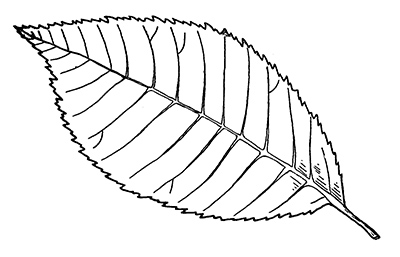
The slippery elm, also called red elm, is easily identified by its doubly-serrated simple leaves on short leaf stems, with a sandpapery upper surface. The bark features strong vertical ridges, which when sliced open feature alternating layers of tan and dark brown. The inner bark is slick, which gives the tree its name. The species also is called red elm due to its reddish heartwood.
Slippery elm has slightly larger leaves than its relative, the American elm, as well as a sandpapery texture on the leaves and twigs. The slippery elm is typically found more in upland areas, while the American elm is found in moist soil conditions such as valleys as well as river and creek bottoms.
Slippery elm can be found throughout much of the eastern and central United States, from Minnesota south into central Texas and as far west as central Kansas and Nebraska. Its range extends from northern Florida to Vermont along the east coast.
Like the American elm, which used to be a common street tree in Indiana, the number of slippery elms has dwindled due to Dutch elm disease, a fungal diseased which ravaged the species in the second half of the 20th century. Another disease called Elm Yellows (formerly phloem necrosis) also seriously affected slippery elms.
For full article with additional photos view: Intro to Trees of Indiana: Red Elm
Resources:
Elm, The Education Store, Purdue Extension resource center
Slippery Elm, Native Trees of Indiana River Walk, Purdue – Fort Wayne
Top 5 List for Tree Selection and Planting, Purdue Extension-Forestry & Natural Resources (FNR) Got Nature? Blog
Fifty Common Trees of Indiana
An Introduction to Trees of Indiana
Native Trees of the Midwest, The Education Store, Purdue Extension’s resource center
Shrubs and Woody Vines of Indiana and the Midwest, The Education Store
ID That Tree, Purdue Extension-FNR’s YouTube playlist
Woodland Management Moment , Purdue Extension-FNR’s YouTube playlist
Investing in Indiana Woodlands, The Education Store
Forest Improvement Handbook, The Education Store
Wendy Mayer, FNR Communications Coordinator
Purdue University Department of Forestry and Natural Resources
Lenny Farlee, Sustaining Hardwood Extension Specialist
Purdue University Department of Forestry and Natural Resources

Recent Posts
- New Indiana Woodland Steward Newsletter
Posted: August 12, 2026 in Forestry, Urban Forestry, Wildlife, Woodlands - ID That Tree: Nannyberry Viburnum
Posted: July 22, 2026 in Forestry, Plants, Wildlife, Woodlands - ID That Tree: Eastern Swamp Privet
Posted: in Forestry, Plants, Wildlife, Woodlands - ID That Tree: Carolina Buckthorn
Posted: July 15, 2026 in Forestry, Wildlife, Woodlands - Identifying Evergreens
Posted: June 24, 2026 in Forestry, Wildlife, Woodlands - Pruning Highlight-Pollarding Trees: A Traditional Pruning Practice with Modern Uses
Posted: June 11, 2026 in Forestry, Forests and Street Trees, Urban Forestry, Wildlife, Woodlands - Danielle Howard Hired as FNR Extension Prescribed Fire Specialist
Posted: June 10, 2026 in Forestry, Wildlife, Woodlands - Flat-Faced Longhorn Beetle Found in Hardwood Logs – IDNR Division of Entomology
Posted: June 8, 2026 in Alert, Forestry, Forests and Street Trees, Invasive Insects, Urban Forestry, Wildlife, Woodlands - Connecting Research to Practice: Natural Resources & Land Use Spring Training
Posted: June 5, 2026 in Forestry, Forests and Street Trees, How To, Invasive Animal Species, Invasive Plant Species, Land Use, Natural Resource Planning, Urban Forestry, Wildlife, Woodlands - Spring Storms Are Coming: How to Reduce Tree Damage and Risk
Posted: May 1, 2026 in How To, Urban Forestry, Wildlife, Woodlands
Archives
Categories
- Alert
- Aquaculture/Fish
- Aquatic/Aquaculture Resources
- Ask the Expert
- Christmas Trees
- Community Development
- Disease
- Drought
- Forestry
- Forests and Street Trees
- Gardening
- Got Nature for Kids
- Great Lakes
- How To
- Invasive Animal Species
- Invasive Insects
- Invasive Plant Species
- Land Use
- Natural Resource Planning
- Nature of Teaching
- Plants
- Podcasts
- Ponds
- Publication
- Safety
- Spiders
- Timber Marketing
- Urban Forestry
- Webinar
- Wildlife
- Wood Products/Manufacturing
- Woodland Management Moment
- Woodlands