 Purdue University - Extension - Forestry and Natural Resources
Got Nature? Blog
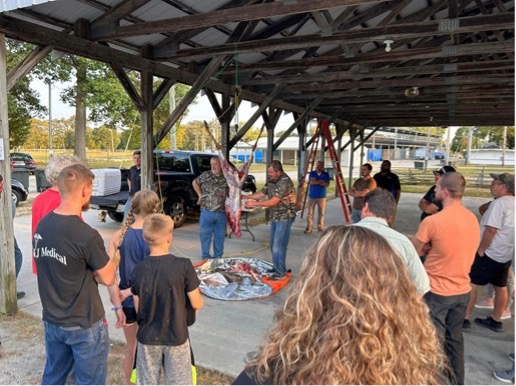
A Venison workshop recently conducted in Noble County. Photo credit by Jonathan Ferris.
Agricultural & Natural Resources: Hunting is a way of life for many citizens of Indiana. In 2022, 121,812 deer were harvested across the state. While some of these deer end up at commercial meat processing facilities, many are butchered by hunters at home. Of those who choose to process their harvested animals themselves, few have formal training about how to properly process a wild game animal and must rely on practices that have simply been passed down from relatives or learned from friends. In addition, commercial processors are often concerned by the dirty, spoiled deer carcasses that end up at their facilities.
In response to this need, Purdue Extension educators Dave Osborne and Jonathan Ferris conducted a series of venison processing workshops in Wayne, Noble and Tippecanoe counties. During each workshop, the educators discussed the proper techniques for field dressing and aging of deer; skinned and quartered the deer; discussed proper storage and preservation methods; cut up the meat and prepared it in a variety of ways for participants to taste. Extension wildlife specialist Jarred Brooke also presented information about proper meat handling and safety, and provided an update about deer health issues in Indiana. At the conclusion, participants had the opportunity to sample venison products prepared that evening as well as some donated from local deer processors.
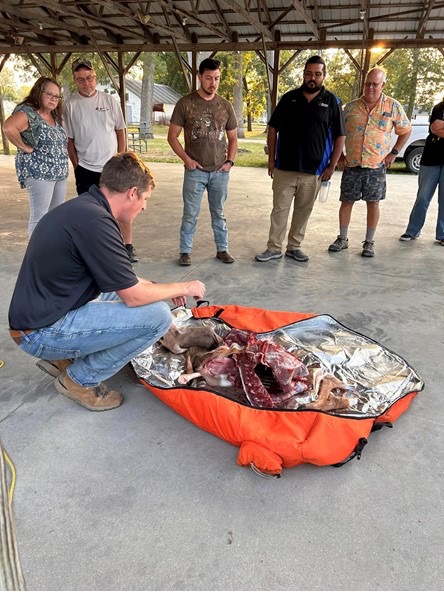
FNR Extension Wildlife Specialist Jarred Brooke is part of the Venison Processing workshop team. Photo by Jonathan Ferris.
Survey results showed that 78 participants representing 25 Indiana counties, as well as one county each from Michigan and Illinois, attended the programs. All respondents indicated they learned field-dressing tips that would help them keep the carcass clean and free of contamination, while also learning something about food safety. And 98% responded that they had learned butchering techniques that will allow them to make better use of the meat. Also, 96% of respondents indicated they planned to change how they handle their deer meat after attending this workshop, 100% indicated they would like to see similar workshops that focused on additional upland game and fish, and 66% indicated this was the first Extension program they had ever attended. When asked about the most valuable part of the program, one participant said, “I feel fully equipped to fill my freezer and provide for my family this upcoming deer season.”
Check out the Purdue Extension – Forestry and Natural Resources Calendar to view upcoming late summer and fall workshops.
View this article, along with other current extension projects, by visiting the December ANR Newsletter.
Resources:
Ask an Expert, Playlist, Purdue Extension – FNR YouTube Channel
Handling Harvested Game: Episode 1, Field Dressing, video, Purdue Extension – FNR YouTube Channel
Handling Harvested Game: Episode 2, Hanging & Skinning, video, Purdue Extension – FNR YouTube Channel
Handling Harvested Game: Episode 3, Deboning, video, Purdue Extension – FNR YouTube Channel
Handling Harvested Game: Episode 4, Cutting, Grinding & Packaging, video, Purdue Extension – FNR YouTube Channel
Introduction to White-tailed Deer Impacts on Indiana Woodlands, Got Nature? Blog & The Education Store
Purdue Extension Pond and Wildlife Management
Understanding White-tailed Deer and Their Impact on Indiana Woodlands, The Education Store
Monitoring White-tailed Deer and Their Impact on Indiana Woodlands, The Education Store
Managing White-tailed Deer Impacts on Indiana Woodlands, The Education Store
How to Build a Plastic Mesh Deer Exclusion Fence, The Education Store
Managing Your Woods for White-Tailed Deer, The Education Store
Deer Harvest Data Collection, Got Nature? Blog, Purdue Extension – FNR
Handling Harvested Deer Ask an Expert? video, Purdue Extension – FNR YouTube Channel
Subscribe to Purdue Extension-Forestry & Natural Resources YouTube Channel, Wildlife Playlist
A Woodland Management Moment – Deer Fencing, Purdue Extension – FNR YouTube Video
Agricultural & Natural Resources (ANR), Purdue Extension
Jarred Brooke, Wildlife Extension Specialist
Purdue Department of Forestry and Natural Resources
Jonathan Ferris, Wayne County Extension Director
Purdue Extension
Dave Osborne, County Extension Director
Purdue Extension – Ripley County
In this episode of A Woodland Management Moment, Purdue Extension forester Lenny Farlee discusses the benefits of maintaining certain areas of your forest land with alternative types of cover rather than traditional forest. It’s a good idea to keep some areas open not only for recreational purposes but also for future timber harvesting and to provide habitat for many wildlife. By allowing some of your land to be open, you help maintain the natural habitat around you and can even get some interesting plants that will grow on their own.
If you have any questions regarding trees, forests, wildlife, wood products or other natural resource topics, feel free to contact us by using our Ask an Expert web page.
Resources:
A Woodland Management Moment, Playlist, Purdue Extension – Forestry and Natural Resources (FNR) YouTube Channel
Learn How to Support Oak-Hickory Ecosystems, Purdue Extension – FNR Got Nature? Blog
The Nature of Oaks Webinar, Purdue Extension-FNR YouTube Channel, Shared from Indiana Forestry & Woodland Owners Association
Oak Leaf Tatters, Purdue Landscape Report
Inonotus Dryadeus, Butt and Root Rot of Oaks, Purdue Extension – FNR Got Nature? Blog
Predicting the Height Growth of Oak Species Reproduction Over a 23-year Period Following Clearcutting, Hardwood Tree Improvement & Regeneration Center (HTIRC)
Conservation Tree Planting: Steps to Success, Purdue Extension – FNR YouTube Channel
Shrubs and Woody Vines of Indiana and the Midwest, The Education Store, Purdue Extension Resource Center
Native Trees of the Midwest, The Education Store
ID That Tree, Playlist, Purdue Extension – FNR YouTube Channel
Investing in Indiana Woodlands, The Education Store
Woodland Stewardship for Landowners Video Series, Playlist, Indiana Department of Natural Resources YouTube Channel
Ask an Expert: Tree Selection and Planting, Purdue Extension – FNR YouTube Channel
Forest Improvement Handbook, The Education Store
Find an Indiana Professional Forester, Indiana Forestry & Woodland Owners Association (IFWOA)
Purdue Arboretum Explorer
Lenny Farlee, Extension Forester
Hardwood Tree Improvement and Regeneration Center
Purdue Department of Forestry & Natural Resources
MyDNR, Indiana’s Outdoor Newsletter: Donate your harvested deer to feed hungry Hoosiers. In Indiana, you can enjoy a great day hunting and also help Hoosiers in need. In fact, one donated deer can provide 200 meals for a Hoosier family!
Follow these simple steps:
- Enjoy a deer hunting experience.
- Harvest a deer.
- Drop off the field-dressed deer at a local participating processor.
- Processing fees are paid for by Hunt for Hunger (at no cost to you).
- The processor creates healthy venison burgers to distribute to food banks.
This is a part of the program Indiana Hunt for Hunger (also known as Sportsmen’s Benevolence Fund). The Indiana Department of Natural Resources launched this in 2008 to provide an easy way for hunters across Indiana to help hungry Hoosiers in need. Since its launch, the program has grown across the state to collect thousands of deer donations, providing hundreds of thousands of meals for Hoosiers.
For more information, visit the Hunt for Hunger page.
To subscribe to the newsletter, visit MyDNR Email Newsletter.
Resources:
Ask an Expert: Wildlife Food Plots, video, Purdue Extension – Forestry and Natural Resources (FNR) YouTube Channel
Handling Harvested Game: Episode 1, Field Dressing, video, Purdue Extension – FNR YouTube Channel
Handling Harvested Game: Episode 2, Hanging & Skinning, video, Purdue Extension – FNR YouTube Channel
Handling Harvested Game: Episode 3, Deboning, video, Purdue Extension – FNR YouTube Channel
Handling Harvested Game: Episode 4, Cutting, Grinding & Packaging, video, Purdue Extension – FNR YouTube Channel
Deer Harvest Data Collection, Got Nature? Blog, Purdue Extension – FNR
How to Score Your White-tailed Deer, video, The Education Store, Purdue Extension Resource Center
White-Tailed Deer Post Harvest Collection, video, The Education Store
Age Determination in White-tailed Deer, video, The Education Store
Handling Harvested Deer Ask an Expert? video, Purdue Extension – FNR YouTube Channel
How to Build a Plastic Mesh Deer Exclusion Fence, The Education Store
Bovine Tuberculosis in Wild White-tailed Deer, The Education Store
Woodland Stewardship for Landowners: Managing Deer Damage to Young Trees, video, Purdue Extension – FNR YouTube Channel
Integrated Deer Management Project, Purdue FNR
New Deer Impact Toolbox, Purdue Extension-Forestry and Natural Resources (FNR)
Indiana Department of Natural Resources, Department of Fish & Wildlife
Wild Bulletin, Indiana Department of Natural Resources (DNR) Fish and Wildlife: Interested in processing your own deer? Head over to our new webpage to view instructional videos from our partners at the International Hunter Education Association (IHEA) and National Deer Association (NDA). They’ll guide you through each step, including grinding and preserving the meat. Plus, you can download our printable PDF that includes step-by-step instructions for skinning and processing your own deer.
To learn more, view the Deer Processing page on the official Indiana DNR website. This is where you can find the instructional PDF along with training videos and other resources!
Subscribe to the Indiana Department of Natural Resources YouTube Channel.
Resources:
Ask an Expert, Playlist, Purdue Extension – FNR YouTube Channel
Handling Harvested Game: Episode 1, Field Dressing, video, Purdue Extension – FNR YouTube Channel
Handling Harvested Game: Episode 2, Hanging & Skinning, video, Purdue Extension – FNR YouTube Channel
Handling Harvested Game: Episode 3, Deboning, video, Purdue Extension – FNR YouTube Channel
Handling Harvested Game: Episode 4, Cutting, Grinding & Packaging, video, Purdue Extension – FNR YouTube Channel
Introduction to White-tailed Deer Impacts on Indiana Woodlands, Got Nature? Blog & The Education Store
Purdue Extension Pond and Wildlife Management
Understanding White-tailed Deer and Their Impact on Indiana Woodlands, The Education Store
Monitoring White-tailed Deer and Their Impact on Indiana Woodlands, The Education Store
Managing White-tailed Deer Impacts on Indiana Woodlands, The Education Store
How to Build a Plastic Mesh Deer Exclusion Fence, The Education Store
Managing Your Woods for White-Tailed Deer, The Education Store
Deer Harvest Data Collection, Got Nature? Blog, Purdue Extension – FNR
Handling Harvested Deer Ask an Expert? video, Purdue Extension – FNR YouTube Channel
Subscribe to Purdue Extension-Forestry & Natural Resources YouTube Channel, Wildlife Playlist
A Woodland Management Moment – Deer Fencing, Purdue Extension – FNR YouTube Video
Indiana Department of Natural Resources – Division of Fish & Wildlife
 Wild Bulletin, Indiana Department of Natural Resources (DNR) Fish and Wildlife: Instead of raking and bagging leaves this fall, consider allowing them to stay and naturally decay. Fallen leaves, plant stems, flower heads, twigs, and logs provide crucial winter habitat for Indiana’s wildlife.
The warmth and cover of leaves provide shelter for Eastern box turtles, salamanders and frogs, as well as insulation for butterflies and moths. Leaf piles can even benefit landscaping, as they can suppress weeds, retain moisture, and add nutrients to the soil as they decay. Leaves don’t have to be left exactly where they fall—you can rake them into flower beds and around tree bases.
For more information about creating habitat for wildlife in your backyard, visit the DNR website and the Wildlife Habitat Fact Sheet.
Resources:
Frost Seeding to Establish Wildlife Food Plots and Native Grass and Forb Plantings – The Education Store, Purdue Extension’s resource center
Wildlife Habitat Hint: Tips for Evaluating a First Year Native Grass and Forb Plantings, Purdue Extension – FNR YouTube Channel
Drone Seeding Native Grasses and Forbs: Project Overview & Drone Setup, Purdue Extension – FNR YouTube channel
Forest Improvement Handbook, The Education Store
Ordering Seedlings from the State Forest Nursery System, Got Nature? – Purdue Extension-Forestry & Natural Resources (FNR)
Designing Hardwood Tree Plantings for Wildlife – The Education Store
ID That Tree – YouTube Playlist
Forest Management for Reptiles and Amphibians: A Technical Guide for the Midwest, The Education Store
Ask the Expert: Hardwood Ecosystem Experiment – Birds and Salamander Research, Purdue Extension – FNR
A Template for Your Wildlife Habitat Management Plan, The Education Store
Managing Your Woods for White-Tailed Deer, The Education Store
Woodland Stewardship for Landowners, Playlist, Purdue Extension – FNR YouTube channel
Nature of Teaching Unit 1: Animal Diversity and Tracking, The Education Store
Subscribe Purdue Extension – Forestry and Natural Resources YouTube Channel, Playlists include wildlife, Nature of Teaching, Moments in the Wild and much more.
Indiana Department of Natural Resources – Division of Fish & Wildlife

Sandhill cranes at Jasper-Pulaski Fish & Wildlife Area. Photo by Indiana DNR.
Wild Bulletin, Division of Fish & Wildlife, IN DNR: Each fall, thousands of sandhill cranes visit the marsh at Jasper-Pulaski Fish & Wildlife Area (FWA) as they migrate, and their visits make for a prime wildlife viewing opportunity from its observation deck. To spot the flocks of cranes, visit at sunrise or sunset until mid-December. The observation deck has a few stationary viewing scopes, but bringing your own spotting scope or binoculars may enhance your viewing experience.
If you can’t make it to the area, you can follow along with our sandhill crane counts, which we update weekly during the migratory season.
Jasper-Pulaski Fish & Wildlife Area provides quality outdoor recreational opportunities while maintaining 8,179 acres of wetland, upland, and woodland game habitat. It provides an ideal stopover for migratory birds. More than 15,000 sandhill cranes stop during fall migration.
Best time to view:
- Sunrise: Gigantic flocks rise and fly from their roosting marshes to feed in surrounding private land (agricultural fields). On their way to feed some birds stop in the open grassland areas of the refuge.
- Sunset: Beginning about one hour before sunset, flocks of cranes kite into the refuge near the observation area from all directions. They gab and socialize again before returning to roosting marshes at dusk.
While this is the cranes’ usual routine, it is important to remember they are wild animals and are not always predictable.
Best location to view
The crane spectacle is best seen from the observation platform at the Sandhill Crane Observation Area (view map). During the day, cranes can be spotted feeding and dancing in nearby harvested farm fields. Roosting marshes in the Waterfowl Resting Area are closed to the public so that migrating birds can rest without human disturbance.
Viewing tips
While cranes may gather close to the observation platform, they are usually several hundred yards away. A few stationary viewing scopes are available but bringing your own spotting scope or binoculars is recommended. If you are photographing cranes, your most powerful zoom lens will be handy, as trying to get too close to these birds will easily spook them.
Learn more about the fall sandhill crane migration at Jasper-Pulaski FWA.
Sign up to receive the Wild Bulletin E-Newsletter.
Resources:
International Crane Foundation
Birds and Residential Window Strikes: Tips for Prevention, The Education Store, Purdue Extension resource center
Breeding Birds and Forest Management: the Hardwood Ecosystem Experiment and the Central Hardwoods Region, The Education Store
Managing Woodlands for Birds Video, Purdue Extension-Forestry and Natural Resources (FNR) YouTube Channel
Ask An Expert, Playlist, Purdue Extension – FNR YouTube channel
No Room at the Inn: Suburban Backyards and Migratory Birds, Education Store, Purdue Extension resource center
Subscribe, Purdue Extension – FNR YouTube Channel
Indiana Department of Natural Resources
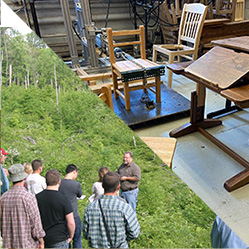 Purdue Extension’s annual report showcases the accomplishments, outcomes and activities that highlight the impact of Purdue Extension across Indiana. Extension specialists and educators provide educational programs and research-based knowledge to help families, individuals, and communities prosper and thrive.
The Purdue Extension – Forestry and Natural Resources specialists featured:
Private Woodland Owners Make Decisions and Take Actions to Improve Acreage Value – project specialist include Lenny Farlee, Ron Rathfon, Don Carlson, and Jarred Brooke, along with county extension educators Dave Osborne, and Phil Woolery. Indiana has 20% forest lands, most privately owned. Forests are important habitats for wildlife and provide environmental and social benefits. Purdue Extension offers Forest Management for the Private Woodland Owner, in-person and virtually. The in-person program has eight 2.75-hour evening sessions and two Saturday three-hour field day tours. Purdue Extension and local forestry and natural resource professionals provide presentations and direct activities. Participants receive a tree measuring stick and a flash drive containing more than 100 publications and resources.
Participant forest management knowledge improved after the program. More than 90% found it useful for making decisions, and 80% plan to take actions in the next year. A participant said, “This course provided exactly the information I needed to understand the DNR forester’s report on my classified forest and to act on it. It will also help form a land management plan of my own (beyond what the forester provided), find programs to help manage and expand the forest, and earn a little money from the property in future years.”
Furniture Production Addresses Workforce Development and Rebuilds Lives in Indiana – project specialist include Dr. Eva Haviarova and Dr. Henry Quesada. Most U.S. school furniture is made overseas and from nonrenewable materials (steel, plastic, and composite). Increasingly, the product sustainability, the circular economy, and the benefits of natural materials are being shown to be important in learning environments.
To create a new market for low-value hardwoods, urban woods, and plantation resources by designing and producing innovative products, including wooden school furniture, Purdue’s Wood Research Lab has tested all strength and environmental attributes. At the same time, Purdue Extension is focusing on workforce development for Indiana’s wood products industry. An approach is to provide potential employment and entrepreneurial opportunities to residents with troubled pasts, underprivileged workers, and those needing a second chance in life by partnering with Purposeful Design, the Forest Service, Indiana Hardwood Lumbermen’s Association, Urban Forest Products and other industry players to train workers in furniture production and qualify for future work.
To view full report visit: Purdue Extension Showcase.
To learn more about Purdue Extension visit: About Us.
For all Purdue Extension – Forestry and Natural Resources publications, videos, webinars and initiatives view: Purdue Extension – Forestry and Natural Resources.
Resources:
A Woodland Management Moment, Playlist, Purdue Extension – Forestry and Natural Resources Youtube Channel
Invasive Species, Playlist
Woodland Stewardship for Landowners, Playlist
Invasive Plant Species Identification, Video
Invasive plants: impact on environment and people, The Education Store, Purdue Extension resource center
Investing in Indiana Woodlands, The Education Store
Woodland Invaders, Got Nature? Blog
District Forester, Indiana DNR Division of Forestry, for over 10 acres of woodlands
Directory of Professional Foresters, Indiana Forestry & Woodland Owners Association (IFWOA)
Indiana Woodland Steward E-newsletters, Eleven Member Organization
Conservation Tree Planting: Steps to Success, Purdue Extension – FNR Youtube Channel
Forest Improvement Handbook, The Education Store
Joint Design Manual for Furniture Frames Constructed of Plywood and Oriented Strand Board, The Education Store
The Shrinking and Swelling of Wood and Its Effect on Furniture, The Education Store
Performance Test Method for Intensive Use Chairs – FNEW 83-269: A Description of the Test Method with Drawings, The Education Store
How Baby Bear’s Chair Was Made, The Education Store
Diana Evans, Extension & Web Communications Specialist
Purdue University Department of Forestry and Natural Resources
Indiana Department of Natural Resources has all of your hunting resources for a fun season. The Wild Bulletin, Division of Fish and Wildlife, newsletter and the MyDNR – Enjoy the Outdoors newsletter brings you all the resources you need in one email. Check out the recent information shared in the newsletters below:
Wild Bulletin
IN DNR Newsletter: If you’ve been hunting for a license instead of deer, look no further: Buy your license now via our online license system. Get your firearms and muzzleloader licenses before the seasons begin.
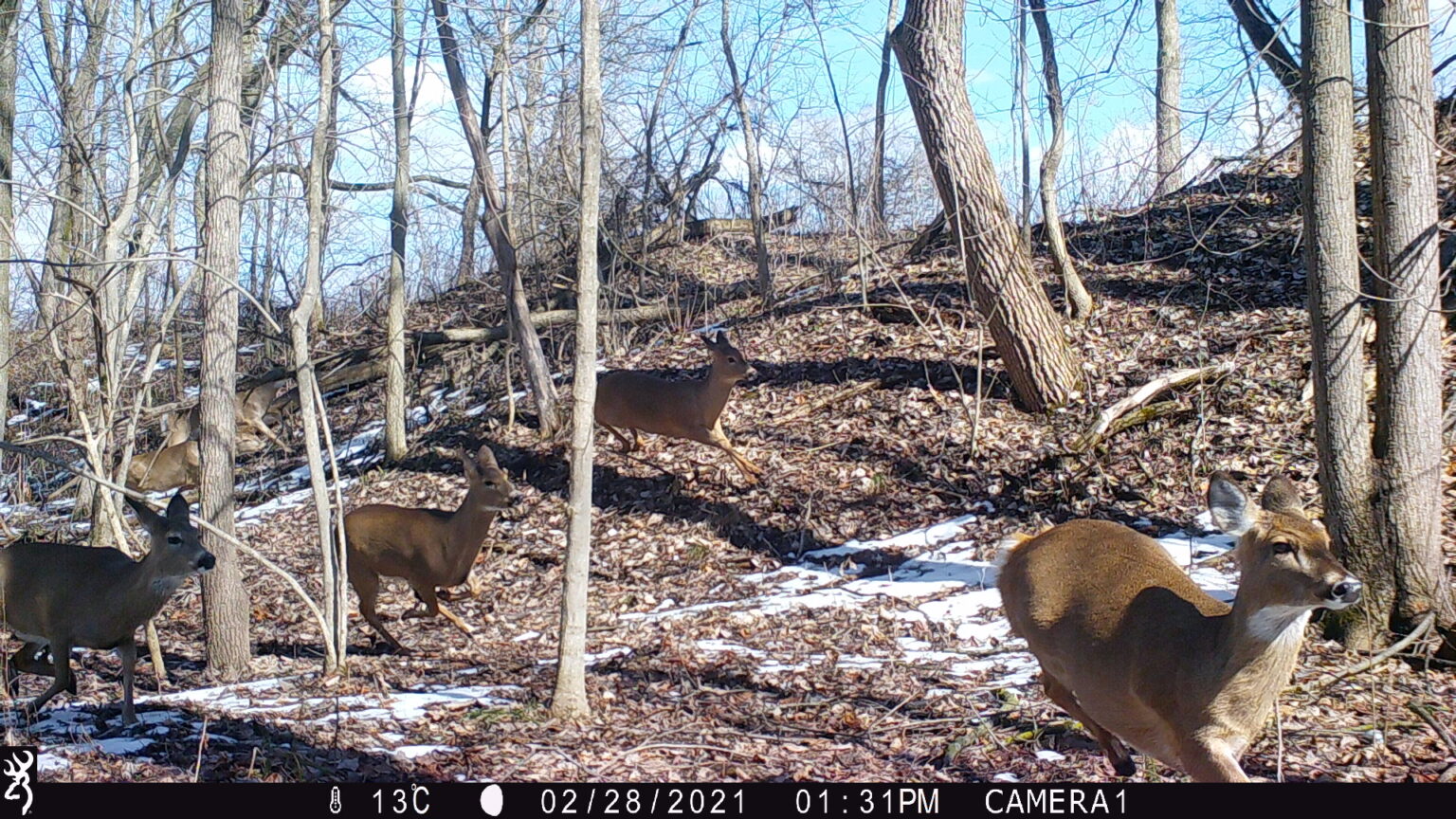
Are you prepared for deer hunting? Make sure to bring and wear your blaze orange item of clothing, your firearm or bow, and a print or digital copy of your hunting license.
If you haven’t bought your deer license yet, consider buying DNR’s Deer License Bundle for the season. The Deer License Bundle includes privileges to harvest a total of two antlerless deer plus one antlered deer. It can be used in the special youth, archery, firearms, muzzleloader, and special antlerless deer seasons.
For younger hunters, 2024’s final free youth hunting days are Nov. 30 & Dec. 1. For more information on the online license system, visit Indiana Fish & Wildlife Online License System.
My DNR
Indiana’s Outdoor News: Hunting for answers or a new license? Search no more. For questions about equipment, regulations, or which license you need, use the Deer Hotline by calling 812-334-3795 or emailing indeerhotline@dnr.IN.gov.
For questions related to the CheckIN Game system, your online license system account, license-purchasing errors, or deer control permits, email inhuntfish@dnr.IN.gov or call 317-232-4082.
Remember to buy your deer license early. Find a list of license retailers online and be sure to check your license for accuracy before you leave the store. If you plan to purchase your license online, log into your Access Indiana account before the season begins—don’t risk delays.
To find out more view the Indiana Department of Natural Resources Hunting Deer in Indiana.
Resources:
Ask an Expert: Wildlife Food Plots, video, Purdue Extension – Forestry and Natural Resources (FNR) YouTube Channel
Handling Harvested Game: Episode 1, Field Dressing, video, Purdue Extension – FNR YouTube Channel
Handling Harvested Game: Episode 2, Hanging & Skinning, video, Purdue Extension – FNR YouTube Channel
Handling Harvested Game: Episode 3, Deboning, video, Purdue Extension – FNR YouTube Channel
Handling Harvested Game: Episode 4, Cutting, Grinding & Packaging, video, Purdue Extension – FNR YouTube Channel
Deer Harvest Data Collection, Got Nature? Blog, Purdue Extension – FNR
How to Score Your White-tailed Deer, video, Purdue Extension
White-Tailed Deer Post Harvest Collection, video, The Education Store
Age Determination in White-tailed Deer, video, Purdue Extension
Handling Harvested Deer Ask an Expert? video, Purdue Extension – FNR YouTube Channel
How to Build a Plastic Mesh Deer Exclusion Fence, The Education Store
Bovine Tuberculosis in Wild White-tailed Deer, The Education Store
Woodland Stewardship for Landowners: Managing Deer Damage to Young Trees, video, Purdue Extension – FNR YouTube Channel
Integrated Deer Management Project, Purdue FNR
New Deer Impact Toolbox, Purdue Extension-Forestry and Natural Resources (FNR)
Division of Fish and Wildlife, Indiana Department of Natural Resources
In this edition of ID That Tree, Purdue Extension forester Lenny Farlee takes us through the different characteristics of Hoptree, a relatively common shrub here in Indiana. This is a unique native plant with three-part leaves and hop-like seed pods. Also called Wafer Ash due to its distinctive wafer-shaped seeds, this shrub can often be confused with Poison Ivy or Bladdernut, so be sure to pay attention to key differences in the video. Features include trifoliate leaves and the temperate areas in which it grows.
If you have any questions regarding wildlife, trees, forest management, wood products, natural resource planning or other natural resource topics, feel free to contact us by using our Ask an Expert web page.
Resources:
ID That Tree: Firs and Spruces, Video Playlist, Purdue Extension – Forestry and Natural Resources (FNR) YouTube Channel
ID That Tree – Jack Pine, Scotch Pine, Red Pine, Virginia Pine, Eastern White Pine, Video Playlist, Purdue Extension – Forestry and Natural Resources (FNR) YouTube Channel
Beat Back Borers Attacking Pines and Other Cone Bearing Trees, Purdue Landscape Report
Tree Diseases: White Pine Decline in Indiana, The Education Store, Purdue Extension Resource Center
Purdue Arboretum Explorer
Conservation Tree Planting: Steps to Success, Purdue Extension – FNR YouTube Channel
A Woodland Management Moment, Playlist, Purdue Extension – FNR YouTube Channel
Woodland Stewardship for Landowners, Playlist, Purdue Extension – FNR YouTube Channel
Indiana Department of Natural Resources: Invasive Species
Indiana Invasive Species Council
Cooperative Invasive Species Management Area (CISMA)
Report Invasive, Purdue Extension
Episode 11 – Exploring the challenges of Invasive Species, Habitat University-Natural Resource University
Shrubs and Woody Vines of Indiana and the Midwest, The Education Store
Native Trees of the Midwest, The Education Store
Professional Forester, Indiana Forestry Woodland Owners Association
Forest Improvement Handbook, The Education Store
Find an Arborist, International Society of Arboriculture
Lenny Farlee, Extension Forester
Hardwood Tree Improvement and Regeneration Center
Purdue Department of Forestry & Natural Resources
The aquaculture industry in the Midwest region of the United States has limited or no access to economically feasible seafood processing infrastructure for farmed seafood products, leaving producers to rely on live ethnic fish and recreational markets. This handbook highlights the necessary elements of processing fish to guide any interested fish farmer or entrepreneur.
Local kitchens, such as shared-use commercial kitchens and licensed on-farm kitchens, can provide resources for fish farming entrepreneurs interested in adding some form of value to their fish, by allowing them to diversify their market. These shared-use commercial kitchens can be found in many communities and are rented by food producers, local food entrepreneurs, and caterers to prepare and process their food products for consumer markets. Using local facilities for processing fish and developing aquaculture products could diversify marketing opportunities for small-scale fish farmers and have a positive impact on farm profitability. A diversified market also reduces market risks for fish farmers. Embarking on processing is an additional investment for a fish farmer and requires resources.
This handbook provides some information and resources for fish farmers interested in using licensed kitchen facilities for fish processing or setting up their own on-farm processing kitchen. This handbook highlights the necessary elements of processing fish to guide any interested fish farmer or entrepreneur.
To receive the free download, visit the Purdue Extension’s resource center: The Education Store – Handbook on Processing Fish for Small-Scale Fish Farmers.
Resources:
Profitability of Hybrid Striped Bass Cage Aquaculture in the Midwest, The Education Store, Purdue Extension resource center
A Guide to Marketing for Small-Scale Aquaculture Producers, The Education Store
A Guide to Small-Scale Fish Processing Using Local Kitchen Facilities, The Education Store
Marine Shrimp Biofloc Systems: Basic Management Practices, The Education Store
Aquaculture Industry in Indiana Growing, Purdue Today
Tilapia Farmed Fish Fact Sheet, The Education Store
Rainbow Trout Farmed Fish Fact Sheet, The Education Store
Pacific White Shrimp Farmed Fish Fact Sheet, The Education Store
Walleye Farmed Fish Fact Sheet: A Guide for Seafood Consumers, The Education Store
Sustainable Aquaculture: What does it mean to you?, The Education Store
The Benefits of Seafood Consumption The Education Store
Walleye Farmed Fish Fact Sheet: A Guide for Seafood Consumers, The Education Store
Pond and Wildlife Management website, Purdue Extension
Fish Cleaning with Purdue Extension County Extension Director, Got Nature? Blog, Purdue Extension – Forestry and Natural Resources
Aquaponics: What to consider before starting your business, YouTube, Purdue Ag Economics
Aquatics & Fisheries, Playlist, YouTube, Purdue Extension – Forestry and Natural Resources
Eat Midwest Fish, Illinois-Indiana Sea Grant online resource hub
Kwamena Quagrainie, Aquaculture Marketing Director/Clinical Engagement Full Professor
Purdue Agricultural Economics/Department of Forestry and Natural Resources/Illinois Indiana Sea Grant Program
Amy Shambach, Aquaculture Marketing Outreach Associate
Purdue Department of Forestry and Natural Resources/Illinois Indiana Sea Grant Program

Recent Posts
- Beetle that attacks Tree-of-Heaven found in Indiana, Purdue Landscape Report
Posted: March 20, 2026 in Invasive Insects, Wildlife, Woodlands - ID That Tree: Dwarf Chinkapin Oak
Posted: in Forestry, Urban Forestry, Wildlife, Woodlands - DNR Hiring for Indiana Conservation Officer Positions, MyDNR
Posted: March 9, 2026 in Urban Forestry, Wildlife, Woodlands - ID That Tree: Shumard Oak
Posted: in Plants, Urban Forestry, Wildlife, Woodlands - Uniting Indiana Residents Against Invasive Species
Posted: February 27, 2026 in Community Development, Invasive Insects, Wildlife - Have You Seen a Soaring Eagle Lately? Morning Ag Clips
Posted: February 25, 2026 in Urban Forestry, Wildlife - Register for Natural Resources Teacher Institute’s Class of 2026
Posted: February 19, 2026 in Forestry, Wildlife, Woodlands - ID That Tree: Fragrant Sumac
Posted: February 4, 2026 in Plants, Urban Forestry, Wildlife - Woodsy Owl Edition for Educational Learning, USDA – U.S. Forest Service
Posted: January 21, 2026 in Forestry, Forests and Street Trees, Got Nature for Kids, Urban Forestry, Wildlife - Opt-in to the Deer Management Survey, MyDNR
Posted: January 12, 2026 in Forestry, Wildlife
Archives
Categories
- Alert
- Aquaculture/Fish
- Aquatic/Aquaculture Resources
- Ask the Expert
- Christmas Trees
- Community Development
- Disease
- Drought
- Forestry
- Forests and Street Trees
- Gardening
- Got Nature for Kids
- Great Lakes
- How To
- Invasive Animal Species
- Invasive Insects
- Invasive Plant Species
- Land Use
- Natural Resource Planning
- Nature of Teaching
- Plants
- Podcasts
- Ponds
- Publication
- Safety
- Spiders
- Timber Marketing
- Uncategorized
- Urban Forestry
- Webinar
- Wildlife
- Wood Products/Manufacturing
- Woodland Management Moment
- Woodlands