 Purdue University - Extension - Forestry and Natural Resources
Got Nature? Blog

“The U.S. Fish and Wildlife Service announced today it is protecting the northern long-eared bat as a threatened species under the Endangered Species Act (ESA), primarily due to the threat posed by white-nose syndrome, a fungal disease that has devastated many bat populations.
At the same time, the Service issued an interim special rule that eliminates unnecessary regulatory requirements for landowners, land managers, government agencies and others in the range of the northern long-eared bat. The public is invited to comment on this interim rule as the Service considers whether modifications or exemptions for additional categories of activities should be included in a final 4(d) rule that will be finalized by the end of the calendar year. The Service is accepting public comments on the proposed rule until July 1, 2015, and may make revisions based on additional information it receives.
‘Bats are a critical component of our nation’s ecology and economy, maintaining a fragile insect predator-prey balance; we lose them at our peril,’ said Service Director Dan Ashe. ‘Without bats, insect populations can rise dramatically with the potential for devastating losses for our crop farmers and foresters. The alternative to bats is greater pesticide use, which brings with it another set of ecological concerns.’
In the United States, the northern long-eared bat is found from Maine to North Carolina on the Atlantic Coast, westward to eastern Oklahoma and north through the Dakotas, reaching into eastern Montana and Wyoming. Throughout the bat’s range, states and local stakeholders have been some of the leading partners in both conserving the long-eared bat and addressing the challenge presented by white-nose syndrome.” Read more…
Resources
Northern Long-Eared Bat, U.S. Fish & Wildlife Service
Bats, The Education Store
U.S. Fish and Wildlife Service
 The Purdue Center for Global Soundscapes has been recognized by PBS. NOVA, a PBS documentary series focused on science, interviewed Bryan Pijanowski, Professor of Human-Environment Modeling and Analysis Laboratory, and Matt Harris, Graduate Research Assistant, to learn more on the subject and to share this story on the NOVA website in video format. Soundscape ecology is the study of how the environment changes by studying the sounds within that environment.
Anyone can be a citizen scientist and download their “sounds of earth” to the soundscape ecology database. There is no cost, and it is easy to do. Just visit the website, Record the Earth, for instructions.
Resources
Soundscape Ecology Research Projects, Forestry and Natural Resources
Purdue Boiler Bytes Highlights Discovery Park Global Soundscape Research Center Led by FNR’s Dr. Bryan Pijanowski, Got Nature?
Bryan Pijanowski, Professor of Human-Environment Modeling and Analysis Laboratory
Department of Forestry and Natural Resources
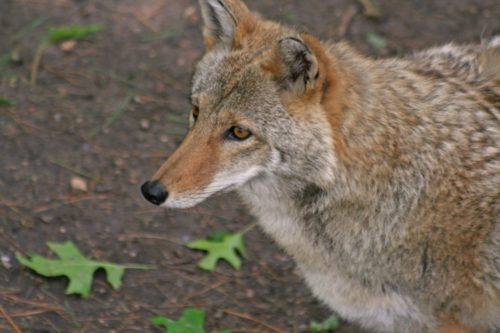 There have been multiple sightings of coyotes in the Indianapolis suburbs, especially the southern part of Indianapolis. As habitats for these animals shrink, the coyote sightings have increased. Coyotes no longer have any natural predators, but they are afraid of humans. These animals mainly eat small animals like rabbits, mice and squirrels but have been known to attack small pets. It is imperative to go outside with your pet to ensure their safety from coyotes. The Indiana Department of Natural Resources (INDNR) will be hosting a coyote seminar for the public in April.
What: Living with Coyotes, Greenwood
Where: Greenwood Library, 310 S. Meridian St., Greenwood, IN
When: April 2, 2015
Time: 5:30-7:30 pm
Cost: Free
Registration is required.
Resources
Coyotes a Constant Problem in Indy Suburbs, IndyStar
Dealing with Nuisance Coyotes, INDNR
Should I Be Worried About Coyotes In My Yard?, Got Nature?
Coyotes, Wildlife Conflicts, Department of Entomology, Purdue University
Dealing with Nuisance Coyotes, Indiana Department of Natural Resources
Permitted Wildlife Rehabilitators, Indiana Department of Natural Resources
 Have you ever wondered what an unfettered rainforest sounds like? Or maybe been curious about the sounds of the shifting coastal tides of Alaska? Well Purdue Department of Forestry and Natural Resources Professor Bryan Pijanowski and his students have now made it possible to hear sounds from a wide number of locations around the world. Dr. Pijanowski, Professor of Human-Environment Modeling & Analysis Laboratory, has led teams to locations across the globe, including Costa Rica, Borneo and the Sonaran Desert, in an effort to record and archive the sounds produced by various ecosystems. Dr. Pijanowski and his team have developed a series of applications for mobile devices and other technologies for soundscape recordings and research.
You can help capture and preserve sounds of the Earth and highlight their bellwether role in alerting scientists to environmental habitat changes by using the free app available at The Education Store, Purdue Extension. On Earth Day, April 22, 2015, The Global Soundscapes Research Center will try to surpass the number of downloads these received in 2014 on Earth Day.
Resources
Center for Global Soundscapes
Conserving Biodiversity in Agricultural Landscapes, Purdue University Press
Managing Forest & Wildlife Resources: An Integrated Approach, The Education Store
Bryan Pijanowski, Professor of Human-Environment Modeling & Analysis Laboratory
Department of Forestry and Natural Resources, Purdue University
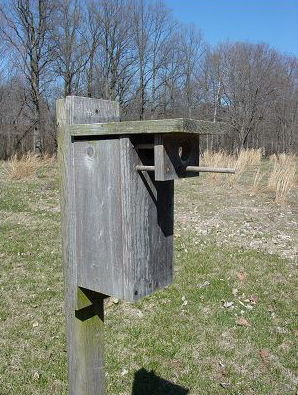
Remove perches from wildlife nest boxes like the bluebird box pictured here. Perches allow undesirable birds to harass native cavity nesters and take over a nest box.
Even though we have had some rough weather lately, this winter didn’t seem so bad to me. Now that the weather forecast is looking positive and the days are getting longer (this month, we gain about 75 minutes – I am embarrassed to admit that I check this frequently during the winter because it helps me get through the winter doldrums), it is a good time to think about wildlife habitat projects.
Many species of native birds and mammals will utilize nest boxes. When we put out a nest box, all we are doing is replicating what nature already provides with cavities in both live and dead trees. Woodpeckers are primary cavity users because they create their own. Other birds and mammals are secondary cavity users because they use what is already there – either those that occur in older, dying trees or those that are created by woodpeckers. Installing nest boxes in areas where cavities are likely scarce such as urban environments or young woods may be particularly beneficial.
Tips
- Use quality materials that are weather resistant. Exterior grade plywood and lumber are good choices. Cedar and other rot-resistant woods are best. Avoid using treated lumber and metal.
- Avoid painting or staining inside nest boxes. Painting the outside can prolong its life and may be attractive for some species (white for purple martins, for example).
- The roof should be sloped to allow water runoff and should hang over the sides.
- Drill at least four 3/8-inch drainage holes on the floor.
- The roof or one side should open to allow easy access for cleaning.
- Avoid perches. Natural cavities don’t have them and neither should your nest box. Perches also allow European starlings and English house sparrows, non-native invasive species, to harass native cavity nesters and take over a nest box.
- Near the top of each side, leave gaps or drill 5/8-inch holes (at least two per side).
More tips on design, such as nest box specifics by species (dimensions, hole size and placement, box placement and location), maintenance and problem species, can be found in our Nest Boxes for Wildlife publication.
Other resources available:
Attracting Hummingbirds to Your Yard, The Education Store
Birds of Benton County, Indiana, The Education Store
Brian MacGowan, Extension Wildlife Specialist
Department of Forestry and Natural Resources, Purdue University
 Purdue University is partnering with three Indiana zoos and the state in a conservation program that will involve raising year-old hellbender salamanders and then returning them a few years later to their southern Indiana habitat to be tracked.
Rod Williams, associate professor of wildlife science and leader of the university’s hellbender effort, approached officials at Columbian Park Zoo in Lafayette, Fort Wayne Children’s Zoo and Mesker Park Zoo in Evansville about joining the program, which also includes the Indiana Department of Natural Resources.
North America’s largest salamander is in decline nationally and is most vulnerable to predators when young. “Mortality can be as high as 99 percent in the wild,” Williams said. “By rearing them in captivity for three to four years, they will have a much better survival rate.” Read the full article from Purdue Agriculture News.
Resources
Help the Hellbender, Purdue University
Aquaculture Research Lab, Department of Forestry and Natural Resources
The Nature of Teaching, The Education Store, Purdue Extension (Search “Nature of Teaching” for a list of all available lessons)
Rod Williams, Associate Professor of Wildlife Science
Department of Forestry and Natural Resources (FNR), Purdue University
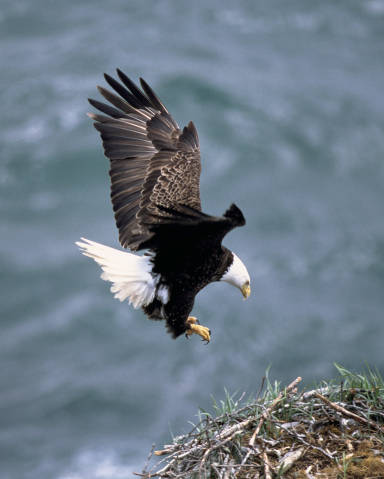
Photo Credit: Dave Menke/USFWS
While most of us think of spring as the bird breeding season, several species get a jump start during the winter. Bald Eagles are one of those species. Winter is a time when Bald Eagles build nests in large trees or snags near sources of food – rivers, streams and lakes. The nests they construct are very large (4-6 feet in diameter) and can weigh more than 1,000 pounds. They also construct alternate nests within their territory and will usually return to the same nesting territory year after year.
Bald Eagles were once listed under the Endangered Species Act. However, their populations recovered to a level where they were delisted. Even so, Bald Eagles are still offered some level of protection under the Bald and Golden Eagle Protection Act and Migratory Bird Treaty Act. Almost all birds in Indiana and the U.S. are protected under the MBTA. In fact, under the MBTA, it is unlawful to “take, possess, transport, sell, purchase, barter or offer for sale any migratory bird or the parts, nests or eggs of such bird.” The MBTA also protects nests from destruction while they have eggs or dependent young (i.e., prior to fledging).
For Bald Eagles, I think most people know you can’t directly harm them. But I do receive questions about what activities can be done around Bald Eagles and especially their nests – Bald Eagles are quick to abandon a nest in the presence of disturbance. The MBTA provides protection from harming an eagle or a nest with eggs or young. The Bald and Golden Eagle Protection Act provides additional protection during the breeding season as well as the nest.
According to the Bald and Golden Eagle Protection Act, it is unlawful to disturb eagles during the breeding season. In this case,
“Disturb means to agitate or bother a bald or golden eagle to a degree that causes, or is likely to cause, based on the best scientific information available 1) injury to an eagle, 2) a decrease in its productivity by substantially interfering with normal breeding, feeding or sheltering behavior or 3) nest abandonment by substantially interfering with normal breeding, feeding or sheltering behavior.”
To minimize the risk of disturbing eagles, the guidelines suggest a buffer between a nest and the activity, but it depends on the category activity, according to the guidelines. For example, Timber Operations and Forestry Practices list a distance of 330 feet from the nest at any time. They suggest avoiding harvesting operations within 660 feet of the nest during the breeding season.
The management guidelines are downloadable from the link provided below in the Resources. If you have questions about Bald Eagles and their protection, contact the U.S. Fish and Wildlife Service at their Bloomington Field Office.
Resources:
National Bald Eagle Management Guidelines (2007), U.S. Fish and Wildlife Service/South Dakota
Indiana Eagle Watch Events, Indiana Department of Natural Resources (INDNR)
Have You Seen a Soaring Eagle Lately, Morning AgClips, Purdue Extension – Forestry & Natural Resources (FNR) Got Nature? Blog
Indiana Department of Natural Resources Shares Bald Eagle Successfully Recovered, MyDNR, Indiana’s Outdoor News
Bald Eagle, Indiana Department of Natural Resources (IN DNR)
Forestry for the Birds Virtual Tour, Purdue Extension – Pond and Wildlife
Breeding Birds and Forest Management: the Hardwood Ecosystem Experiment and the Central Hardwoods Region, The Education Store, Purdue Extension resource center
Forest Birds, The Education Store
Managing Woodlands for Birds, The Education Store
Managing Woodlands for Birds Video, Purdue Extension – FNR YouTube Channel
Breeding Birds and Forest Management: the Hardwood Ecosystem Experiment and the Central Hardwoods Region, The Education Store
The Birders’ Dozen, Profile: Baltimore Oriole, Indiana Woodland Steward
Ask An Expert: Birdwatching, Playlist, Purdue Extension – FNR YouTube channel
Birds and Residential Window Strikes: Tips for Prevention, The Education Store
No Room at the Inn: Suburban Backyards and Migratory Birds, The Education Store
Dr. Brian MacGowan, Extension Wildlife Specialist
Department of Forestry & Natural Resources, Purdue University
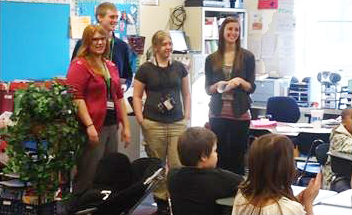 FNR is pleased to announce a new program that will provide undergraduate extension internship opportunities for qualified students this summer. This is an exciting program with the potential to build on an already strong set of FNR extension programs while providing valuable experience and training for undergraduates.
Purdue University’s Department of Forestry and Natural Resources seeks candidates for extension internship positions. The department extension program has a broad environmental scope including fisheries, forest management, invasive species, urban forestry, sustainability, wildlife and wood products. Student interns can enhance their career potential through practical, hands-on experience. Our extension internship program can help you:
- Develop leadership and decision-making skills in handling creative challenges
- Gain experience developing extension products including publications, online videos, presentations and/or more
- Participate in professional development opportunities
- Build professional references and contacts
- Clarify career goals
- Learn from a diverse and experienced group of natural resources professionals
Internships are open to non-Purdue students. Requirements for the position(s) include status as a junior or senior level college student in natural resources or related discipline, minimum 3.0 GPA, evidence of initiative, independence and commitment to conservation of natural resources. Internships are available for summer term (up to 40 hours/wk., up to 8 weeks) with pay at a rate of $12 per hour. Internship start dates and work hours are flexible depending on the applicant’s availability.
Resources
FNR Extension Internship Information, Purdue Forestry and Natural Resources (FNR)
Brian MacGowan, Extension Wildlife Specialist
Department of Forestry and Natural Resources, Purdue University
 Soundscape ecology is a new field of research that investigates how sound in the environment can be used to assess ecosystem health as well as human connection to nature and the environment in general. With this app, you can help capture and preserve sounds of the Earth and highlight their bellwether role in alerting scientists to environmental habitat changes by species. This app was originally launched to encourage the general public’s citizen researchers to capture natural sound recordings and upload them for preservation during Earth Day 2014. However, we are continuing to preserve sounds that you capture using this app.
Resources
Center for Global Soundscapes
Conserving Biodiversity in Agricultural Landscapes, Purdue University Press
Managing Forest & Wildlife Resources: An Integrated Approach, The Education Store
Bryan Pijanowski, Professor of Human-Environment Modeling and Analysis Laboratory
Department of Forestry and Natural Resources
 Randy Creaser, a graduate student working with Liz Flaherty, Assistant Professor of Wildlife Ecology and Habitat Management, is collaborating with Polar Bears International (PBI). This research consists of developing noninvasive methods to monitor the Western Hudson Bay polar bear population using photography. These methods will allow scientists to document trends in the population along with providing estimates of body condition. The ultimate goal of this project is to further develop a citizen science project that will allow the public to submit and measure their bear and wildlife photos using our methods. Watch the video to learn more about the program. You can learn what other graduate students are doing by visiting their profile pages or attending their events on campus.
Resources
Polar Bears International
Graduate Studies, Purdue FNR
Graduate Spotlight, Purdue Agriculture
Got Nature?
Department of Forestry and Natural Resources
Purdue University

Recent Posts
- Beetle that attacks Tree-of-Heaven found in Indiana, Purdue Landscape Report
Posted: March 20, 2026 in Invasive Insects, Wildlife, Woodlands - ID That Tree: Dwarf Chinkapin Oak
Posted: in Forestry, Urban Forestry, Wildlife, Woodlands - DNR Hiring for Indiana Conservation Officer Positions, MyDNR
Posted: March 9, 2026 in Urban Forestry, Wildlife, Woodlands - ID That Tree: Shumard Oak
Posted: in Plants, Urban Forestry, Wildlife, Woodlands - Uniting Indiana Residents Against Invasive Species
Posted: February 27, 2026 in Community Development, Invasive Insects, Wildlife - Have You Seen a Soaring Eagle Lately? Morning Ag Clips
Posted: February 25, 2026 in Urban Forestry, Wildlife - Register for Natural Resources Teacher Institute’s Class of 2026
Posted: February 19, 2026 in Forestry, Wildlife, Woodlands - ID That Tree: Fragrant Sumac
Posted: February 4, 2026 in Plants, Urban Forestry, Wildlife - Woodsy Owl Edition for Educational Learning, USDA – U.S. Forest Service
Posted: January 21, 2026 in Forestry, Forests and Street Trees, Got Nature for Kids, Urban Forestry, Wildlife - Opt-in to the Deer Management Survey, MyDNR
Posted: January 12, 2026 in Forestry, Wildlife
Archives
Categories
- Alert
- Aquaculture/Fish
- Aquatic/Aquaculture Resources
- Ask the Expert
- Christmas Trees
- Community Development
- Disease
- Drought
- Forestry
- Forests and Street Trees
- Gardening
- Got Nature for Kids
- Great Lakes
- How To
- Invasive Animal Species
- Invasive Insects
- Invasive Plant Species
- Land Use
- Natural Resource Planning
- Nature of Teaching
- Plants
- Podcasts
- Ponds
- Publication
- Safety
- Spiders
- Timber Marketing
- Uncategorized
- Urban Forestry
- Webinar
- Wildlife
- Wood Products/Manufacturing
- Woodland Management Moment
- Woodlands