 Purdue University - Extension - Forestry and Natural Resources
Got Nature? Blog
 We are thrilled to announce the launch of the Explore Oak Resources webpage — a dynamic new hub created by Purdue Forestry and Natural Resources Extension to celebrate and support one of Indiana’s most iconic tree groups: the oaks.
Whether you’re a landowner, educator, natural resource professional or simply an oak enthusiast, this comprehensive collection of science-based resources is designed to deepen your understanding and enhance your stewardship of oak ecosystems.
What You’ll Find
The new oak resource page is packed with tools and insights, including:
- Expert-reviewed publications on forest stewardship, oak regeneration, and habitat management
- Engaging videos like the ID That Tree series, featuring 17 oak species native to Indiana
- Webinars and podcasts exploring topics from oak woodland restoration to wildlife-friendly forestry
- Practical guides on threats like oak wilt and invasive beetles
- Seedling purchasing info for select white and red oak varieties developed at Purdue
Why Oaks Matter
Oaks are more than just majestic trees — they’re keystone species that support biodiversity, provide critical wildlife habitat and contribute to Indiana’s ecological and cultural heritage. With challenges like invasive pests and regeneration difficulties, informed management is more important than ever.
Start Exploring
Ready to dive in? Visit the new Explore Oak Resources page and discover how you can help steward Indiana’s oak landscapes for generations to come.
Other Resources of Interest:
Purdue Extension – Forestry and Natural Resources (FNR) YouTube Channel:
A Woodland Management Moment, Playlist
Conservation Tree Planting: Steps to Success
ID That Tree, Playlist
Ask an Expert: Tree Selection and Planting
Woodland Stewardship for Landowners Video Series, Playlist
The Education Store – Purdue Agriculture’s resource center:
Investing in Indiana Woodlands
Forest Improvement Handbook
Purdue University Press:
Shrubs and Woody Vines of Indiana and the Midwest
Native Trees of the Midwest
Purdue Extension – FNR Got Nature? Blog:
Learn How to Support Oak-Hickory Ecosystems
Inonotus Dryadeus, Butt and Root Rot of Oaks
Hardwood Tree Improvement & Regeneration Center (HTIRC):
Predicting the Height Growth of Oak Species Reproduction Over a 23-year Period Following Clearcutting,
Indiana Forestry & Woodland Owners Association (IFWOA):
Find an Indiana Professional Forester
District Foresters, Indiana Department of Natural Resources
Diana Evans, Extension & Web Communications Specialist
Purdue University Department of Forestry and Natural Resources
Purdue Landscape Report: The last week has caused many to struggle with whether to turn the heat on inside. Mornings have been quite chilly, and I am guessing several readers may have also struggled with the decision to wear a jacket as they started their workday. These are tough decisions, no doubt. Several data sources have suggested we have had at least 2 weeks of consecutive below-average daily mean temperatures. While not a record, this is certainly noticeable! Perhaps we are hoping those tomato plants will produce just a few more tomatoes. Is it mum season, already? The good news – for those not quite ready to say goodbye to warm days, not needing coats, and garden delights – is warm temperatures are expected to return. Daily high temperatures are already in the 80s and Indiana is likely to see temperatures in the mid-90s by next week. There is significant confidence that this warmer-than-normal temperature trend is likely to continue through most of September. Average high temperatures typically range from 75°F – 85°F in mid-September and 70°F – 75°F in late September, so keep in mind climate outlooks are all relative. Indiana is not likely to experience triple-digit heat waves over the next few weeks, but nighttime low temperatures are likely to fight for temperatures warranting a sweater or jacket.


There’s been a noticeable lack of precipitation with Indiana receiving well below-normal precipitation throughout the state over the past 30 days except for the northwestern counties. This has led to expansion of both Abnormally Dry (D0) and Moderate Drought (D1) areas across the state (Figure 1). Unfortunately, both forecasts and climate outlooks suggest this below-normal precipitation pattern is likely to continue for a while. Over the next 7 days, very little precipitation is expected across much of Indiana (Figure 2). This below-normal precipitation pattern is likely to continue through most of next week. After that, climate outlooks are favoring near-normal precipitation through September 24th.

Figure 3. Average date of the first fall frost where temperature first reach or drop below 28°F. (Purdue Landscape Report)
Regarding first frost or even hard frost, we are still too early in the calendar year to worry about this being an extensive risk. Very localized, low-lying areas may be susceptible, but the climatological average date of the first hard freeze (28°F) is often not until mid-to-late October (Figure 3). With temperatures expected to warm again, widespread hard frost is not anticipated prior to October.
Explore the latest Indiana climate and drought maps, including first freeze and frost probabilities, view the Purdue Indiana State Climate Office.
View the original article on the Purdue Landscape Report website: A False Sense of Autumn.
Subscribe and receive the newsletter: Purdue Landscape Report Newsletter.
Resources:
Alert – Water Your Trees, Watch Video, Purdue Extension – Forestry and Natural Resources Got Nature? Blog
Find an Arborist video, Trees are Good-International Society of Arboriculture (ISA)
ID That Tree, Playlist, Purdue Extension – FNR YouTube Channel
Summer Tree Care, Purdue Landscape Report
Drought? Don’t Forget the Trees!, The Education Store, Purdue Extension resource center
Extreme Heat Including Fact Sheets, Purdue Extension – IN-PREPared
Extreme Heat – Resources, Extension Disaster Education Network (EDEN)
Drought Information, Indiana Department of Natural Resources
Planting Your Tree Part 1: Choosing Your Tree, Purdue Extension YouTube Channel
Tree Defect Identification, The Education Store
Surface Root Syndrome, The Education Store
Submit Sample, Purdue Plant & Pest Diagnostic Lab
What Are Invasive Species and Why Should I Care?, Purdue Extension-FNR Got Nature? Blog
Invasive Species Playlist, Playlist, Purdue Extension – FNR YouTube Channel
Subscribe Purdue Extension-Forestry and Natural Resources YouTube Channel
Beth Hall, Indiana State Climate Office Director
Purdue University Department of Agronomy
It is natural to think of spring as the season of flowers in our woodlands, but summer can also provide some outstanding displays of native bloom. In addition, these flowers are often attracting some of our largest and showiest butterflies and bumblebees. Here are a few of the late summer flowers you may encounter in local woodlands. (Click on photos to enlarge.)
 Wood Nettle is a look-but-don’t-touch type of plant. While I find the foamy white flowers attractive, the stinging hairs along the stems and under the leaves feel like instant poison ivy. This is one of the reasons Foresters don’t wear short pants in the woods! It is a good indicator of moist and fertile soils.

Wingstem is a large plant with thin ridges along the stems providing the name. These head-high and taller plants of edges, thin woodlands and fertile soils put on a great display. It seems to be a common plant in black walnut plantations as both the good soils and light shade favor its growth.
 Tall Bellflower catches the eye as blues seem to stick out in the green and yellow dominated foliage. I see this attractive star-shaped flower on tall stalks at the edge of woodlands and in areas where more sunlight enters the forest understory.

Pale or Yellow Jewelweed is in the same genus as the impatiens found in the garden stores. The tube flowers turn into spring-loaded seed pods that pop with the least amount of pressure applied by a finger and thumb. It is hard not to be startled even if you have experienced this mini-explosion before. Spotted Jewelweed is very similar, but has orange flowers with dark dots.
 White Snakeroot can be quite common in forest understories. The white flowers may be the dominant bloom in some woodlands, partly because of the toxic nature of the plant. It is toxic to both livestock and humans and is the source of the milk sickness that killed Abraham Lincolns mother. Cows grazing in woodlands would eat the white snakeroot, which tainted the milk consumed by the pioneer families.

Jack-in-the-Pulpit flowers in the spring, but the cluster of red berries which ripen in the late summer and fall are large and bright, so they draw attention. While toxic to humans some birds and other wildlife will consume the seeds. The less common, but related Green Dragon plant has similar berry clusters.
 Great Blue Lobelia has a name that matches its visual impact. The tall spikes of brilliant blue flowers are excellent for pollinators and put on a great show. This is a plant of woodland edges and moist soils, but can get to be 4 feet tall, with large numbers of flowers, so it is hard to miss when present.
Resources:
Celebrate Pollinator Week with Flowers of June Tour, Got Nature? Blog, Purdue Extension – FNR
Pollinator Conservation Education, Purdue Extension – Entomology
What’s buzzing in your backyard? Learn about protecting pollinators, beekeeping with Purdue Extension, Purdue Extension News
Indiana Monarch and Pollinator Conservation website
Protecting Pollinators: Protecting Pollinators in Home Lawns and Landscapes, publication, The Education Store, Purdue Extension’s resource center
Consider Pollinators When Planning Your Garden, Got Nature? Blog, Purdue Extension – FNR
Attract Hummingbirds to Your Yard video, Purdue Extension – FNR YouTube Channel
Tracking the Bloom, Got Nature? Blog, Purdue Extension – FNR
Indiana’s Native Orchids, Indiana Forestry & Woodlands Association (IFWOA) Webinar
Landscape Uses of Native Plants, Indiana Native Plant Society
Find an Arborist video, Trees are Good-International Society of Arboriculture (ISA)
Tree Installation: Process and Practices, The Education Store, Purdue Extension resource center
Tree Planting Part 1: Choosing a Tree video, Purdue Extension
Wildflowers and Ferns of Indiana Forests: A Field Guide, Google Books
Intro to Trees of Indiana: Flowering Dogwood, Got Nature? Blog, Purdue Extension – FNR
ID That Tree Spring Bloom Edition: Bladdernut, Got Nature? Blog, Purdue Extension – FNR
ID That Tree, Purdue Extension-FNR YouTube playlist
Lenny Farlee, Extension Forester
Hardwood Tree Improvement and Regeneration Center
Purdue Department of Forestry & Natural Resources
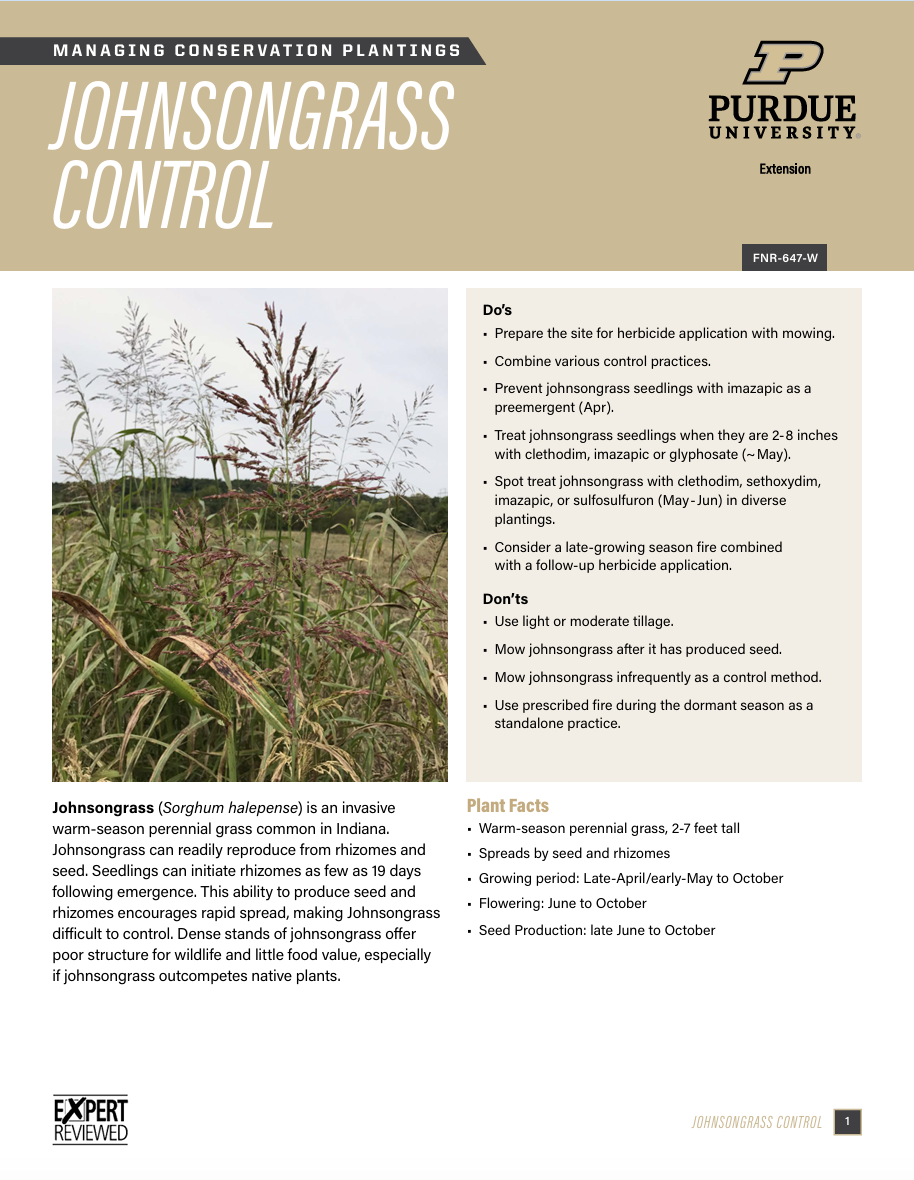 Discover effective strategies for controlling Johnsongrass, an invasive warm-season grass prevalent in Indiana. This guide explains several control options for johnsongrass issues in native conservation plantings. Essential reading for land managers and conservationists committed to maintaining healthy grassland ecosystems: Johnsongrass Control.
Check out the Managing Conservation Plantings Series which include details on how to control invasive species and other problematic plants in Conservation Reserve Program (CRP) plantings and native warm-season grass and wildflower conservation plantings.
Publications in this series include:
- Golden Rod Control
- Thinning Native Warm-Season Grasses
- Sericea Lespedeza Control
- Woody Encroachment and Woody Invasives
- Johnsongrass Control
- Reed Canarygrass Control
- Teasel Control (Common and Cut Leaved)
- Controlling Introduced Cool-season Grasses
- Crownvetch, Sweetclover and Birdsfoot Trefoil Control
Resources:
Deer Impact Toolbox & Grassland Management, Purdue Extension Pond and Wildlife Management
Pond and Wildlife Management, Purdue Extension
Forestry for the Birds Virtual Tour and Pocket Guide, Got Nature? Blog, Purdue Extension – FNR
Frost Seeding to Establish Wildlife Food Plots and Native Grass and Forb Plantings – Purdue Extension – FNR YouTube channel
Wildlife Habitat Hint: Tips for Evaluating a First Year Native Grass and Forb Plantings, Purdue Extension – FNR YouTube Channel
Drone Seeding Native Grasses and Forbs: Project Overview & Drone Setup, Purdue Extension – FNR YouTube channel
Ask an Expert: Wildlife Food Plots, video, Purdue Extension – FNR YouTube Channel
Handling Harvested Game: Episode 1, Field Dressing, video, Purdue Extension – FNR YouTube Channel
Managing Your Woods for White-Tailed Deer, The Education Store
Forest Improvement Handbook, The Education Store
Forest Management for Reptiles and Amphibians: A Technical Guide for the Midwest, The Education Store
A Template for Your Wildlife Habitat Management Plan, The Education Store
Woodland Stewardship for Landowners, Playlist, Purdue Extension – FNR YouTube channel
Nature of Teaching Unit 1: Animal Diversity and Tracking, The Education Store
Nature of Teaching, Purdue College of Agriculture
Invasive Species Playlist, Playlist, Purdue Extension – FNR YouTube Channel
Report Invasive, Purdue Extension
Subscribe Purdue Extension – Forestry and Natural Resources YouTube Channel
Jarred Brooke, Wildlife Extension Specialist
Purdue Department of Forestry and Natural Resources
 Explore the impact of tree and shrub encroachment on conservation plantings. This guide highlights how native woody species like blackberry and sumac can benefit wildlife, while invasives species and excessive woody encroachment can degrade habitat for species like Henslow’s sparrows. Learn how to manage woody invasives to preserve native grasses and wildflowers. Essential reading for conservationists and land managers interested in grassland ecosystems: Woody Encroachment and Woody Invasives.
This publication is part of a seven publication series The Managing Conservation Plantings Series which include details on how to control invasive species and other problematic plants in Conservation Reserve Program (CRP) plantings and native warm-season grass and wildflower conservation plantings.
Publications in this series include:
- Golden Rod Control
- Thinning Native Warm-Season Grasses
- Sericea Lespedeza Control
- Woody Encroachment and Woody Invasives
- Johnson Grass Control
- Reed Canarygrass Control
- Teasel Control (Common and Cut Leaved)
- Controlling Introduced Cool-season Grasses
- Crownvetch, Sweetclover and Birdsfoot Trefoil Control
Resources:
Deer Impact Toolbox & Grassland Management, Purdue Extension Pond and Wildlife Management
Pond and Wildlife Management, Purdue Extension
Forestry for the Birds Virtual Tour and Pocket Guide, Got Nature? Blog, Purdue Extension – FNR
Frost Seeding to Establish Wildlife Food Plots and Native Grass and Forb Plantings – Purdue Extension – FNR YouTube channel
Wildlife Habitat Hint: Tips for Evaluating a First Year Native Grass and Forb Plantings, Purdue Extension – FNR YouTube Channel
Drone Seeding Native Grasses and Forbs: Project Overview & Drone Setup, Purdue Extension – FNR YouTube channel
Ask an Expert: Wildlife Food Plots, video, Purdue Extension – FNR YouTube Channel
Handling Harvested Game: Episode 1, Field Dressing, video, Purdue Extension – FNR YouTube Channel
Managing Your Woods for White-Tailed Deer, The Education Store
Forest Improvement Handbook, The Education Store
Forest Management for Reptiles and Amphibians: A Technical Guide for the Midwest, The Education Store
A Template for Your Wildlife Habitat Management Plan, The Education Store
Woodland Stewardship for Landowners, Playlist, Purdue Extension – FNR YouTube channel
Nature of Teaching Unit 1: Animal Diversity and Tracking, The Education Store
Nature of Teaching, Purdue College of Agriculture
Invasive Species Playlist, Playlist, Purdue Extension – FNR YouTube Channel
Report Invasive, Purdue Extension
Subscribe Purdue Extension – Forestry and Natural Resources YouTube Channel
Jarred Brooke, Wildlife Extension Specialist
Purdue Department of Forestry and Natural Resources
The Hardwood Ecosystem Experiment (HEE) just updated their newsletter for the 2025 spring/summer season. The HEE is a long-term research initiative dedicated to understanding the ecological and social impacts of forest management in Indiana’s Central Hardwood Region. Launched in 2006, the HEE is one of the most ambitious forest ecology studies in the United States, designed to span 100 years across over 9,000 acres of state forest land. The HEE studies the effectiveness of different forest management methods in promoting successful oak and hickory regeneration and the effects of these management practices on plant and animal species. With nine partnering universities and agencies conducting research on the ecological and social impacts of long-term forest management, HEE has been an integral part of completed research for over 30 plus M.S. and Ph.D. level graduate students. The project has also employed more than 250 undergraduate and post-graduate students to conduct summer field work.
Highlights from the new Newsletter include:
- 2025 Field Season Round-Up
By Kat Shay
“The crew has been hard at work this field season—they finished all the Yellowwood State Forest plots and are in the last unit of Morgan Monroe State Forest now…”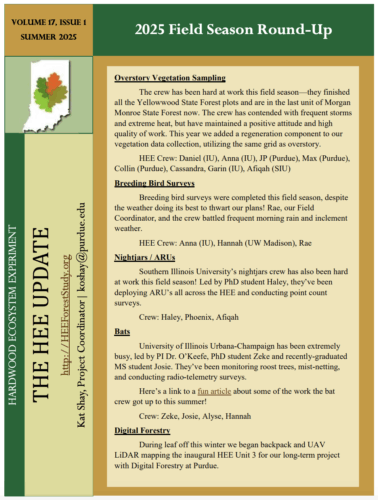
- Breeding Bird Surveys
By Rae Garrett
“Breeding bird surveys were completed this field season, despite the weather doing its best to thwart our plans!…” - Nightjars/ARUs
By Haley Holiman (SIU)
“Southern Illinois University’s nightjars crew deployed ARUs all across the HEE and conducted point count surveys…” - Bats
By Dr. Joy O’Keefe and Team
“The bat crew monitored roost trees, conducted mist-netting, and performed radio-telemetry surveys…” - Digital Forestry
By Purdue University Digital Forestry
“During leaf-off this winter we began backpack and UAV LiDAR mapping the inaugural HEE Unit 3 for our long-term project…” - Botany News
By Megan Crecelius
“Southern Illinois University’s nightjars crew deployed ARUs all across the HEE and conducted point count surveys…” - Out and About: HEE Outreach
By Kat Shay and Rae Garrett
“From radio interviews to presentations on fire ecology, the HEE team has been actively sharing research and connecting with partners across the state…” - HEE Proposal Request
By Mike Saunders
“Proposal requests for the 2026–2028 HEE budget will be sent out in the next few weeks… “
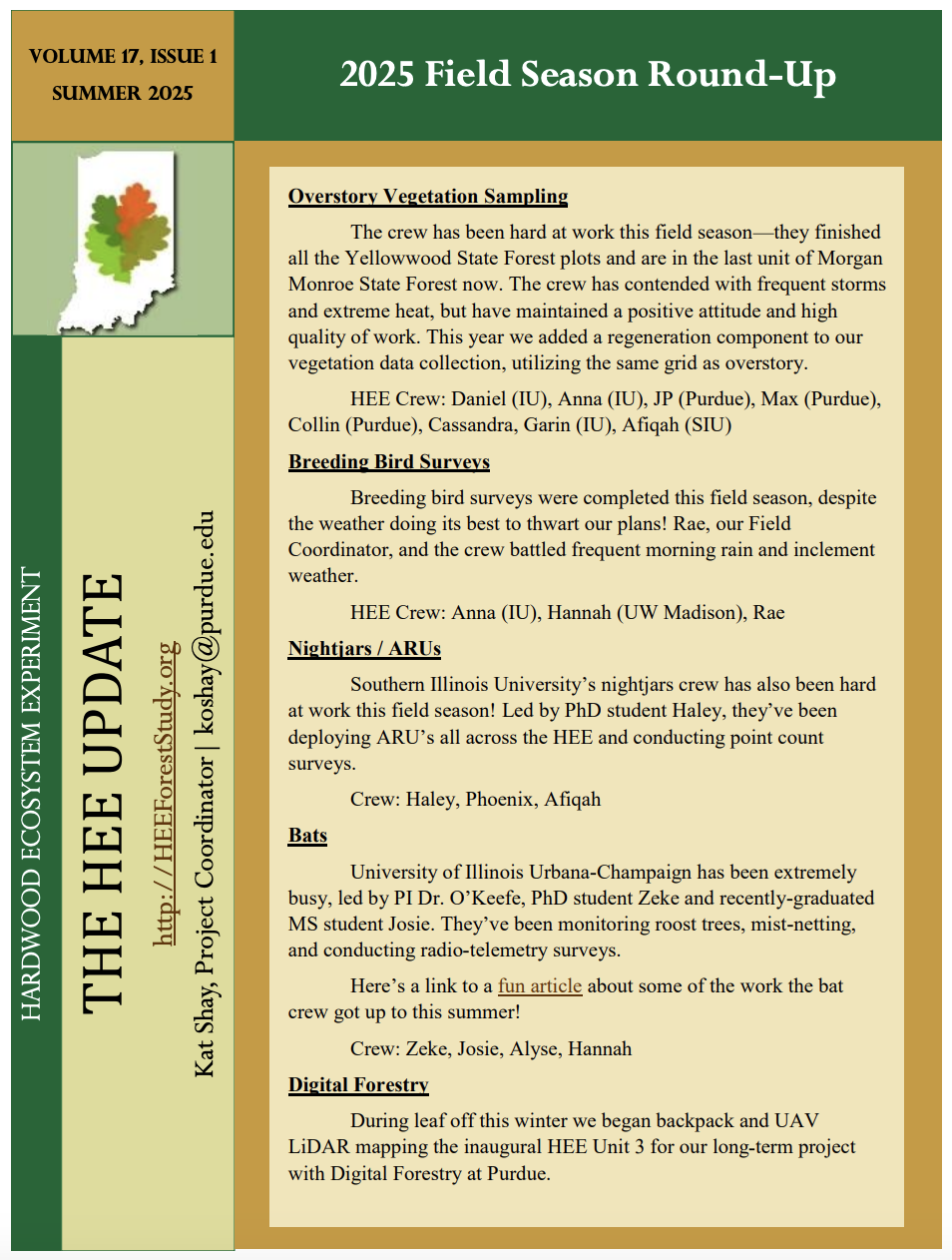
To view the full newsletter visit: HEE Newsletter.
Resources:
Hardwood Ecosystem Experiment – Wildlife Responses to Timber Harvesting, The Education Store, Purdue Extension’s resource center
The Hardwood Ecosystem Experiment: Indiana Forestry and Wildlife, The Education Store
Breeding Birds and Forest Management: the Hardwood Ecosystem Experiment and the Central Hardwoods Region, The Education Store
The Hardwood Ecosystem Experiment: 2006-2016, The Education Store
Shrubs and Woody Vines of Indiana and the Midwest, The Education Store
Hardwood Ecosystem Experiment Playlist, Subscribe to Purdue Extension – Forestry and Natural Resources (FNR) YouTube Channel
Hardwood Ecosystem Experiment – Prescribed Fire, Purdue Extension – FNR YouTube
A Woodland Management Moment, Playlist, Purdue Extension – FNR YouTube Channel
Investing in Indiana Woodlands, The Education Store
Forest Improvement Handbook, The Education Store
Finding help from a professional forester, Indiana Forestry & Woodland Owners Association
Kat Shay, Forest Project Coordinator
Hardwood Ecosystem Experiment (HEE)
Welcome to ID That Tree! In this episode, Purdue Extension Forester Lenny Farlee introduces us to a widespread and often overlooked native plant, the wild grape vine. Found across Indiana, this vine is especially noticeable in late summer and fall. Learn how to identify wild grape by its vine structure, bark, leaves and growth. Whether you’re a nature enthusiast, land manager or just curious about native plants, this video offers a quick and informative look at how to spot wild grape vine and appreciate its role in Indiana’s ecosystems.
If you have any questions regarding wildlife, trees, forest management, wood products, natural resource planning or other natural resource topics, feel free to contact us by using our Ask an Expert web page.
Resources:
ID That Tree – Video Playlist, Purdue Extension – Forestry and Natural Resources (FNR) YouTube Channel
Purdue Arboretum Explorer
Conservation Tree Planting: Steps to Success, Purdue Extension – FNR YouTube Channel
A Woodland Management Moment, Playlist, Purdue Extension – FNR YouTube Channel
Woodland Stewardship for Landowners, Playlist, Purdue Extension – FNR YouTube Channel
Indiana Department of Natural Resources: Invasive Species
Indiana Invasive Species Council
Cooperative Invasive Species Management Area (CISMA)
Report Invasive, Purdue Extension
Fifty Common Trees of Indiana, Purdue Extension – FNR
Habitat University, Episode 12 – Exploring the challenges of Invasive Species, Habitat University-Natural Resource University
Shrubs and Woody Vines of Indiana and the Midwest, Purdue University Press
Native Trees of the Midwest, Purdue University Press
Professional Forester, Indiana Forestry Woodland Owners Association
District Forester, Indiana Department of Natural Resources, 10+ acres
Find an Arborist, International Society of Arboriculture
Forest Improvement Handbook, The Education Store
Lenny Farlee, Extension Forester
Hardwood Tree Improvement and Regeneration Center
Purdue Department of Forestry & Natural Resources
Welcome to ID That Tree! In this episode, Purdue Extension Forester Lenny Farlee introduces us to a striking native shrub known as Wild Hydrangea. Found in forest understories and along wooded slopes in southern Indiana, this plant is especially noticeable in summer thanks to its large, white flowers. Learn how to identify this species by it’s unique characteristics. Whether you’re a student, hiker, gardener or just curious about native plants, this video offers a quick and informative look at how to spot Wild Hydrangea and appreciate its role in Indiana’s woodland ecosystems.
If you have any questions regarding wildlife, trees, forest management, wood products, natural resource planning or other natural resource topics, feel free to contact us by using our Ask an Expert web page.
Resources:
ID That Tree – Video Playlist, Purdue Extension – Forestry and Natural Resources (FNR) YouTube Channel
Purdue Arboretum Explorer
Conservation Tree Planting: Steps to Success, Purdue Extension – FNR YouTube Channel
A Woodland Management Moment, Playlist, Purdue Extension – FNR YouTube Channel
Woodland Stewardship for Landowners, Playlist, Purdue Extension – FNR YouTube Channel
Indiana Department of Natural Resources: Invasive Species
Indiana Invasive Species Council
Cooperative Invasive Species Management Area (CISMA)
Report Invasive, Purdue Extension
Fifty Common Trees of Indiana, Purdue Extension – FNR
Habitat University, Episode 12 – Exploring the challenges of Invasive Species, Habitat University-Natural Resource University
Shrubs and Woody Vines of Indiana and the Midwest, Purdue University Press
Native Trees of the Midwest, Purdue University Press
Professional Forester, Indiana Forestry Woodland Owners Association
District Forester, Indiana Department of Natural Resources, 10+ acres
Find an Arborist, International Society of Arboriculture
Forest Improvement Handbook, The Education Store
Lenny Farlee, Extension Forester
Hardwood Tree Improvement and Regeneration Center
Purdue Department of Forestry & Natural Resources
 Discover the challenges posed by Sericea lespedeza, an invasive plant species prevalent in Indiana. This guide provides essential facts and control options, highlighting how Sericea outcompetes native plants and offers little value to wildlife. A must-read for conservationists and land managers dedicated to preserving native ecosystems.
Learn the most effective strategies for managing Sericea lespedeza across diverse landscapes including old fields, conservation plantings and native grasslands: Sericea Lespedeza Control
This publication is part of a seven publication series The Managing Conservation Plantings Series which include details on how to control invasive species and other problematic plants in Conservation Reserve Program (CRP) plantings and native warm-season grass and wildflower conservation plantings.
Publications in this series include:
- Golden Rod Control
- Thinning Native Warm-Season Grasses
- Sericea Lespedeza Control
- Woody Encroachment and Woody Invasives
- Johnson Grass Control
- Reed Canarygrass Control
- Teasel Control (Common and Cut Leaved)
- Controlling Introduced Cool-season Grasses
- Crownvetch, Sweetclover and Birdsfoot Trefoil Control
Resources:
Deer Impact Toolbox & Grassland Management, Purdue Extension Pond and Wildlife Management
Pond and Wildlife Management, Purdue Extension
Forestry for the Birds Virtual Tour and Pocket Guide, Got Nature? Blog, Purdue Extension – FNR
Frost Seeding to Establish Wildlife Food Plots and Native Grass and Forb Plantings – Purdue Extension – FNR YouTube channel
Wildlife Habitat Hint: Tips for Evaluating a First Year Native Grass and Forb Plantings, Purdue Extension – FNR YouTube Channel
Drone Seeding Native Grasses and Forbs: Project Overview & Drone Setup, Purdue Extension – FNR YouTube channel
Ask an Expert: Wildlife Food Plots, video, Purdue Extension – FNR YouTube Channel
Handling Harvested Game: Episode 1, Field Dressing, video, Purdue Extension – FNR YouTube Channel
Managing Your Woods for White-Tailed Deer, The Education Store
Forest Improvement Handbook, The Education Store
Forest Management for Reptiles and Amphibians: A Technical Guide for the Midwest, The Education Store
A Template for Your Wildlife Habitat Management Plan, The Education Store
Woodland Stewardship for Landowners, Playlist, Purdue Extension – FNR YouTube channel
Nature of Teaching Unit 1: Animal Diversity and Tracking, The Education Store
Nature of Teaching, Purdue College of Agriculture
Invasive Species Playlist, Playlist, Purdue Extension – FNR YouTube Channel
Report Invasive, Purdue Extension
Subscribe Purdue Extension – Forestry and Natural Resources YouTube Channel
Jarred Brooke, Wildlife Extension Specialist
Purdue Department of Forestry and Natural Resources
Purdue Landscape Report: It’s that time again! With the arrival of warm temperatures and increased rainfall, many of us are getting to work on our lawns, gardens, and landscaping. Unfortunately, this often comes with discovering what new (or old) invasive species are here to haunt us. So far this year, the invasive I’ve gotten the most questions on is the Asian jumping worm. This earthworm’s life cycle tends to experience ‘boom & bust’ years due to their feeding habits, and, anecdotally speaking, we appear to be experiencing an increase in their populations throughout the state this season. Now is a great time to brush up on our understanding of this organism, and the revisit how it impacts our environment.
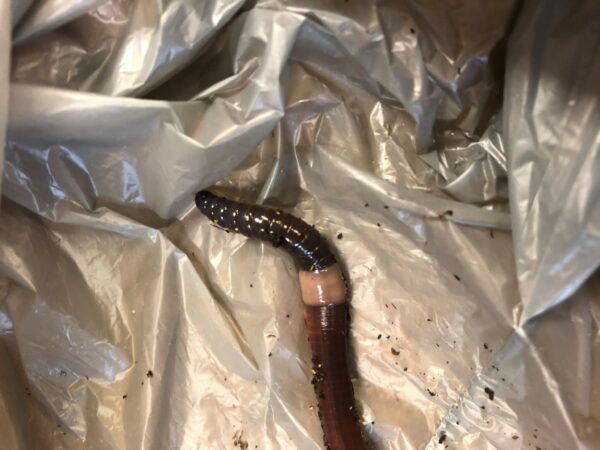
Figure 1. The clitellum, the set of pale, milky colored segments, is the reproductive organ of earthworms.
Identification
While Asian jumping worms share a lot of traits with other, less harmful earthworm species, they do have some features we can use to differentiate them from the rest. Jumping worms tend to be darker in color, since they live either on top of the soil or just under the first layer of plant detritus and get more exposure to sunlight. Asian jumping worms also have a significantly higher number of bristles, or setae, that they can use to move around. They can have as many as forty bristles per segment, in contrast to the eight found on other species, giving them the traction they need to wriggle and squirm as violently as they do. Perhaps the easiest feature we can use to identify them is the clitellum, the organ that contains they reproductive organs. On Asian jumping worms, the clitellum just looks like a very pale set of segments close to the anterior end of the worm, whereas on most other worms, it’s about midway down the body and saddle-shaped. Finally, we can detect their presence by changes in our soil. Asian jumping will not improve soil quality for growing like other earthworms can, but rather change the soil consistency into something like coffee grounds, rendering it unsuitable for growing most crops and ornamentals.
Environmental Impact
As I alluded to above, Asian jumping worms do significant damage to soil quality when left unmanaged. These earthworms, unlike their beneficial cousins, do not provide ecosystems services like soil aeration or castings that help add nutrients to the soil. Since they live at the surface, they do not burrow, and their castings lock in nutrients and often get swept away by hydrological events. Asian jumping worms also tend to gather in large groups whenever they infest an area, resulting in most of the decaying plant material and other organic material being stripped out of the soil. Often, the only plants capable of developing in those conditions are invasive themselves!
Reporting
We are still learning about the Asian jumping worms spread in Indiana, so we are asking everyone to please report sightings. You can report them either online by going to the EDDMapS website or you can call 1-866-NOEXOTIC. We ask that you take a picture and tell us where you were when you saw the worms. You can also check the Report Invasive webpage for up-to-date information on all kinds of invasive species, or reach out to Bob Bruner, Purdue University Exotic Forest Pest Educator, by emailing rfbruner@purdue.edu. With your help, we can map out this worm and create effective plans to limit its presence in our state.
View the original article on the Purdue Landscape Report website: Asian Jumping Worms: How to ID this soil pest.
Subscribe and receive the newsletter: Purdue Landscape Report Newsletter.
Resources:
Gardeners Asked to be Vigilant This Spring for Invasive Jumping Worm, Purdue Extension – FNR Got Nature? Blog
Fall webworms: Should you manage them?, Purdue Landscape Report
Mimosa Webworm, The Education Store, Purdue Extension resource center
Sod Webworms, Turf Science at Purdue University
Bagworm caterpillars are out feeding, be ready to spray your trees, Purdue Extension Forestry & Natural Resources (FNR) Got Nature? Blog
Landscape & Ornamentals: Bagworms, The Education Store
Purdue Plant Doctor App Suite, Purdue Extension-Entomology
Find an Arborist website, Trees are Good, International Society of Arboriculture (ISA)
ID That Tree – Video Playlist, Purdue Extension – Forestry and Natural Resources (FNR) YouTube Channel
Fifty Common Trees of Indiana, Purdue FNR web page list
Indiana Department of Natural Resources: Invasive Species
Indiana Invasive Species Council
Cooperative Invasive Species Management Area (CISMA)
Report Invasive, Purdue Extension
Native Trees of the Midwest, Purdue University Press
Bob Bruner, Exotic Forest Pest Educator
Purdue Entomology

Recent Posts
- Beetle that attacks Tree-of-Heaven found in Indiana, Purdue Landscape Report
Posted: March 20, 2026 in Invasive Insects, Wildlife, Woodlands - ID That Tree: Dwarf Chinkapin Oak
Posted: in Forestry, Urban Forestry, Wildlife, Woodlands - DNR Hiring for Indiana Conservation Officer Positions, MyDNR
Posted: March 9, 2026 in Urban Forestry, Wildlife, Woodlands - ID That Tree: Shumard Oak
Posted: in Plants, Urban Forestry, Wildlife, Woodlands - Uniting Indiana Residents Against Invasive Species
Posted: February 27, 2026 in Community Development, Invasive Insects, Wildlife - Have You Seen a Soaring Eagle Lately? Morning Ag Clips
Posted: February 25, 2026 in Urban Forestry, Wildlife - Register for Natural Resources Teacher Institute’s Class of 2026
Posted: February 19, 2026 in Forestry, Wildlife, Woodlands - ID That Tree: Fragrant Sumac
Posted: February 4, 2026 in Plants, Urban Forestry, Wildlife - Woodsy Owl Edition for Educational Learning, USDA – U.S. Forest Service
Posted: January 21, 2026 in Forestry, Forests and Street Trees, Got Nature for Kids, Urban Forestry, Wildlife - Opt-in to the Deer Management Survey, MyDNR
Posted: January 12, 2026 in Forestry, Wildlife
Archives
Categories
- Alert
- Aquaculture/Fish
- Aquatic/Aquaculture Resources
- Ask the Expert
- Christmas Trees
- Community Development
- Disease
- Drought
- Forestry
- Forests and Street Trees
- Gardening
- Got Nature for Kids
- Great Lakes
- How To
- Invasive Animal Species
- Invasive Insects
- Invasive Plant Species
- Land Use
- Natural Resource Planning
- Nature of Teaching
- Plants
- Podcasts
- Ponds
- Publication
- Safety
- Spiders
- Timber Marketing
- Uncategorized
- Urban Forestry
- Webinar
- Wildlife
- Wood Products/Manufacturing
- Woodland Management Moment
- Woodlands