 Purdue University - Extension - Forestry and Natural Resources
Got Nature? Blog
Purdue Landscape Report: As summer comes to a close, plants are rapidly releasing seeds and the most noticeable are the flying fluffy type. Thistles, asters and milkweed are just a few of the summer-flowering plants that depend on the wind to disperse their seeds, sometimes carrying them miles away to potentially suitable locations, though seeds typically land within a few meters of the mother plant. This may not be a concern if it’s a desirable plant, but can become extremely problematic when that seed comes from Canada Thistle (Cirsium arvense) (Fig. 1).
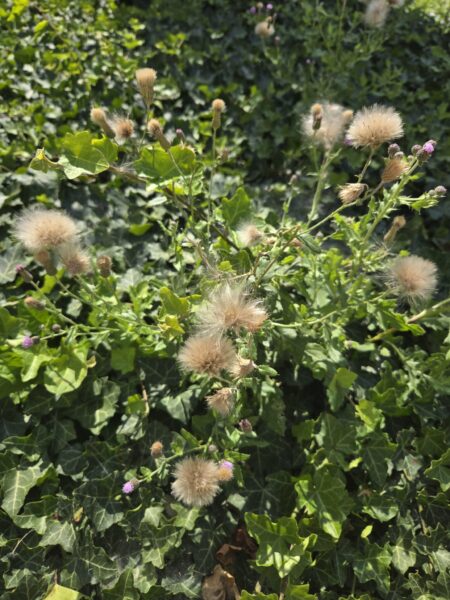
Figure 1. Canada thistle (Cirsium arvense), growing amongst common ivy (Hedera helix), produces a fluffy seed that is dispersed by wind.
Canada thistle is found on the list of Indiana Noxious Weeds (IC 15-16-7-2), which mandates that landowners take necessary steps to control and contain the spread of this highly invasive species. Formal enforcement of this Indiana Code falls to Township Trustees, though weed control is a responsibility that is often overlooked. Landowners and homeowners shouldn’t wait for a notice, or knock at the door, from a Township Trustee to begin controlling Canada thistle. It’s listed as a noxious weed for good reason.
Canada thistle is a perennial plant that can reproduce from seed or rhizomes making it difficult to control and contain. Each plant can produce thousands of wind-blown seeds that may remain viable for up to 20 years in the soil. Rhizomes are horizontal underground stems that can grow several feet and put out new shoots (Fig. 2). To add insult to injury, if a rhizome is cut or tilled, a separate plant may grow from each piece of rhizome.
Mechanical and cultural control options for Canada thistle are limited and may reduce plant density, but are not effective at eradicating large, established populations in a landscape. A new population, without an established root system, may be controlled with frequent mowing to deplete food reserves and prevent seed production.Small, isolated populations may be controlled with hand-pulling, but this will need to be repeated every few weeks.

Figure 2. Canada thistle (Cirsium arvense) reproduces by growing horizontal underground stems called rhizomes. Rhizomes can send up new shoots several feet from the mother plant.
Chemical control options include pre- and post-emergent herbicides and, in many cases, applications of both types are needed for complete eradication. A pre-emergent herbicide, with an active ingredient of dichlobenil, is effective at preventing seed from germinating, but will not control established plants. A post-emergent herbicide with the active ingredient of clopyralid is the most effective option for home gardeners. Clopyralid is a selective herbicide for broadleaf weeds, but most vegetable and ornamental plants are susceptible. Precautions should be taken to avoid off-target damage. Read and understand the herbicide label before use. The label is the law.
Regardless of the method used, complete control of an established Canada thistle population will take persistence over multiple seasons. If the fluffy seed is beginning to fly from your thistle patch, it will likely take many more seasons to rid the garden of this pest, but it is possible. To win the battle against Canada thistle, it takes serious grit and an effective herbicide, or a good realtor.
View the original article here: What the Fluff?!
Subscribe and receive the newsletter: Purdue Landscape Report Newsletter.
Resources:
ID That Tree, Playlist, Purdue Extension – FNR YouTube Channel
Find an Arborist video, Trees are Good-International Society of Arboriculture (ISA)
A Woodland Management Moment, Playlist, Purdue Extension – FNR YouTube Channel (Against Invasives, Garlic Mustard, Autumn Olive)
Woodland Stewardship for Landowners, Playlist, Purdue Extension – FNR YouTube Channel (Common Buckthorn, Japanese Barberry)
Planting Your Tree, Video, The Education Store
Tree Installation, The Education Store
Indiana Invasive Species Council
Indiana Department of Natural Resources: Invasive Species
Purdue Extension Pond and Wildlife Management Website
Control of Canada Thistle in CRP and Other Noncrop Acreage, The Ed Store
Invasive Thistles
Report Invasive Species, Purdue Invasive Species
Understanding and Controlling Thistle in the Nursery and Landscape, Purdue Landscape Report
Subscribe – Purdue Extension-FNR YouTube Channel
Karen Mitchell, Consumer Horticulture Extension Specialist
Purdue Horticulture & Landscape Architecture
Purdue Landscape Report: There have been a significant number of questions and problems regarding triclopyr that have come up this growing season.
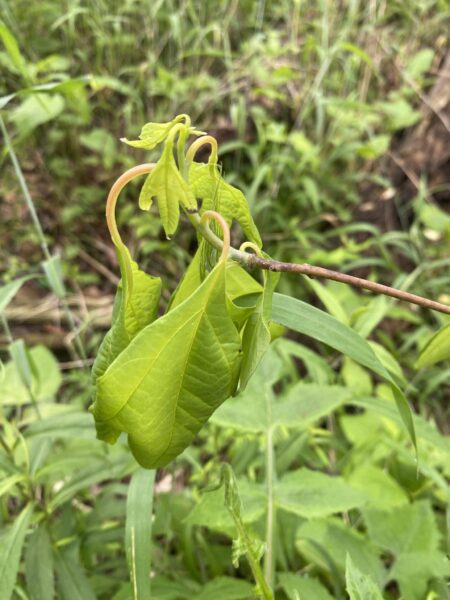
Figure 1. Confirmed damage from triclopyr on sassafras shows the growth regulator-type injury on leaves. Photo courtesy of the Office of the Indiana State Chemist.
Several of these problems have come through the Purdue Plant and Pest Diagnostic Laboratory from landscapers, nurseries, and property managers.
General Information about Triclopyr
Triclopyr is a selective systemic herbicide belonging to the pyridine class. It is primarily used to manage woody plants, vines, and some broadleaf weeds. Unlike glyphosate, a broad-spectrum herbicide, triclopyr specifically targets the growth hormones in dicotyledonous plants, making it effective in controlling species that are difficult to manage with other herbicides. It works by mimicking plant hormones, disrupting normal growth processes, and leading to the death of the treated plant (Fig. 1).
What Triclopyr Controls
Triclopyr is utilized in various settings to control unwanted vegetation. It is effective against species such as:
- Woody Plants: Includes trees like tree of heaven and callery pear and shrubs like autumn olive and honeysuckle (Fig. 2).
- Vines: Particularly those that can outcompete native flora, such as kudzu or English ivy (Fig. 3).
- Broadleaf Weeds: Some herbaceous plants that pose ecological or agricultural problems.

Figure 2. Invasive plants, such as, Pyrus calleryana (callery pear) can be controlled by triclopyr.

Figure 3. Invasive vines, such as Hedera helix (English ivy) can be controlled via multiple applications of triclopyr.
Where and When Triclopyr is Used
Triclopyr is applied in a range of environments, including:
- Forestry: To clear invasive species and manage forest regeneration.
- Agriculture: To control weeds and shrubs that interfere with crop production.
- Aquatic Areas: Formulations that are safe for aquatic environments help manage invasive species near water bodies.
- Rights-of-Way: To maintain clear paths and prevent the spread of invasive plants.
Timing of application is crucial. Triclopyr is most effective when applied during the growing season when plants are actively taking up nutrients and can transport the herbicide throughout their system.

Figure 4. Hack and squirt treatments with triclopyr is a common method to control invasive trees. Photo by Lenny Farlee.
Movement in the Plant
Triclopyr is absorbed through foliage and roots and is translocated systematically within the plant. Once inside, it moves upward through the xylem and downward through the phloem (ambimobile). This systemic movement allows triclopyr to affect not just the treated areas but also parts of the plant that are not directly sprayed. This attribute makes it effective for managing large, established plants, specifically through hack and squirt treatments (Fig. 4).
For the full article and conclusion sharing how Triclopyr is a valuable tool for managing invasive and woody plants view: The Summer of Triclopyr: Mounting evidence for off-target damage.
Subscribe and receive the newsletter: Purdue Landscape Report Newsletter.
Resources:
Find an Arborist video, Trees are Good-International Society of Arboriculture (ISA)
ID That Tree, Playlist, Purdue Extension – FNR YouTube Channel
Invasive Species Playlist, Playlist, Purdue Extension – FNR YouTube Channel
A Woodland Management Moment, Playlist, Purdue Extension – FNR YouTube Channel (Against Invasives, Garlic Mustard, Autumn Olive)
Woodland Stewardship for Landowners, Playlist, Purdue Extension – FNR YouTube Channel (Common Buckthorn, Japanese Barberry)
Report Invasive Species, Purdue Invasive Species
The GLEDN Phone App – Great Lakes Early Detection Network
Invasive Plants of the Eastern U.S.: An Introduction to the Problematic Non-Native Species, The Education Store, Purdue Extension’s resource center
EDDMaps – Early Detection and Distribution Mapping System
Episode 11 – Exploring the challenges of Invasive Species, Habitat University-Natural Resource University
What Are Invasive Species and Why Should I Care?, Purdue Extension-FNR Got Nature? Blog
Emerald Ash Borer Information Network, Purdue University and Partners
Aquatic Invasive Species, Illinois-Indiana Sea Grant (IISG)
Invasive plants: impact on environment and people, The Education Store, Purdue Extension’s resource center
Subscribe Purdue Extension-Forestry and Natural Resources YouTube Channel
Kyle Daniel, Commercial Landscape and Nursery Crops Extension Specialist
Purdue Horticulture & Landscape Architecture
It is in the vested interest of both humans and wildlife to reduce potential traffic collisions. Researchers in the Purdue Department of Forestry and Natural Resources and with the Indiana Department of Natural Resources looked at one possible option to do so in a five-year study involving the development and use of deer-reduction zones, areas where targeted recreational hunting was utilized to reduce animal-vehicle collisions.
The interdisciplinary research group recently published its findings in Science of the Total Environment. Along with lead author Zackary Delisle, a 2023 PhD alumnus, and Dr. Rob Swihart, professor emeritus of wildlife ecology with Purdue FNR, the research team included Carson Reeling, an associate professor with the Purdue Department of Agricultural Economics, Indiana state deer project leader Joe Caudell and 2018 PhD alumna Emily McCallen, a wildlife biometrician with the Indiana DNR Division of Fish and Wildlife.

“The initial goal for this research was to test a method for decreasing deer-vehicle collisions (DVCs) throughout Indiana,” Delisle said. “DVCs are quite frequent in Indiana. From 2003 to 2022, there were more than 300,000 reported DVCs in Indiana, with estimated costs to society of more than $2.5 billion dollars! Therefore, discovering a way to decrease the number of DVCs is important for deer management in Indiana.”
Researchers initially studied the activity of deer in delineated research units across the state, the findings of which are available in an article titled “Deer activity levels and patterns vary along gradients of food availability and anthropogenic development,” published in Nature’s Scientific Reports. The study examined the relationships between animal activity and the availability and quality of food, proximity to human development and other factors, utilizing trail cameras to sample more than 1,000 unique locations during the winters of 2019, 2020 and 2021.
“In that paper we found that deer in the northeast region of Indiana (what we called RMU 9) spend more of the day active than in other regions we studied,” Swihart explained. “Because traffic volume also tends to be higher during the day, deer in this region presumably are more likely to collide with a car. In the northeast region, we specifically estimated deer to be more active in the morning and less active at night, unlike the other regions.”
The publication summarizes the results:
“If animals either are active during a greater fraction of each day or shift their activity to coincide with periods of peak vehicular traffic volume, the chances of animals and vehicles colliding on the landscape likely will increase. In our study, we documented in RMU 9 the highest regional activity levels and a pattern characterized by a greater fraction of activity during the morning rush hours. Under such conditions, accidents involving collisions between motorists and deer might be expected. Indeed, deer-vehicle collisions occur at a rate 1.98 times higher in RMU 9 compared to RMU 3 and 4. Therefore, quantitative examinations of the relationships between characteristics of activity distributions and deer-vehicle collisions may help future management planning to reduce collisions. If positive relationships are found, incentivizing humans to hunt deer in close proximity to roadways may reduce occurrence of deer-vehicle collisions by causing deer to shift to nocturnal activity patterns, reduce movement rates, or select areas further from roads.”
Based on the results of the initial study, researchers tested how well policies designed to increase human hunting of deer (longer hunting seasons and increased harvest limits) reduced deer-vehicle collisions along 618 kilometers (or 384 miles) of high-risk roadways, or those in the upper 99th percentile in terms of DVCs.
Of the 51 selected roadways covering 949 km, relaxed hunting regulations were implemented among 15 of them, designated as treatment deer reduction zones (DRZs), while 36 roadways were left as is, designated as control DRZs. All parcels of land within 0.8 km of the high-risk road were included as part of the deer-reduction zone.
A unique license was developed specifically for hunters pursuing deer within treatment DRZs, with a cost ranging from $24 to $240 depending on the year and a hunter’s residence status.
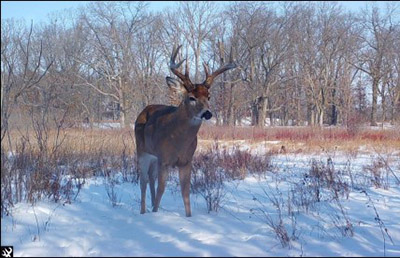
Findings from the study show both a decrease in number of deer-vehicle collisions and the amount of economic damages from those accidents, as well as increased revenue for the local wildlife management agency. The publication details:
“We estimated a strong interaction between treatment type and initiation of DRZs. Deer reduction zones decreased DVCs by a predicted 21.12 % along 618 km of high-risk roadways and prevented an estimated 69.6 DVCs from 2018 to 2022. Deer reduction zones saved up to $653,756 in economic damages to society during the 5-y treatment period. This total savings included $483,983 in estimated vehicular damage, $123,180 in avoided fatalities, and $46,593 in avoided injuries. The DRZs brought in $206,268 in revenue from license sales.”
Delisle said the success of the study lies not only in the fact that the methods tested worked in reducing DVCs, but also in the potential supplemental revenue for wildlife agencies, which are often underfunded and overwhelmed.
“Our findings are unique in that most previously tested methods for reducing DVCs cost a lot of money to implement, but our method actually generated revenue from hunting licenses,” Delisle noted. “We also found a way to decrease DVCs, which is massive in terms of the cost savings to society and the potential prevention of human injuries and fatalities, which unfortunately do occur in DVCs. In addition to nontraditional stakeholders, which could be defined as anyone driving a car in Indiana, our method for reducing DVCs also gives traditional stakeholders (i.e., hunters) more opportunities to harvest deer in certain areas of Indiana. Needless to say, we were very pleased with these findings because it was the first test of such methods across very large scales germane to state wildlife management.
“Knowing that we were able to figure out that increased recreational hunting worked at reducing DVCs feels special because we may have prevented someone from getting seriously hurt or killed. Personally, being able to analyze data on an experiment like that this has the potential to really influence how deer are managed in Indiana as well as help people (prevention of costs, human injuries and human fatalities) was really cool and I am thankful to have been given the opportunity to work on this project with my coauthors.”
Caudell believes that there is a future in applying these research findings beyond the original test areas and said the Indiana DNR is already working to do so.
“Now that we have evidence that this method can reduce deer vehicle collisions, the DNR is in the process of adding these deer reduction zones to our rules so that hunters will continue to use these areas over time,” Caudell said. “DNR’s deer biologists will also look for other areas around the state where we would expect this season to be effective and possibly expand the reduction zones to new areas around the state.”
Although the study shows that increased human hunting decreased the number of deer-vehicle collisions, more work must be done to explain the connection between hunting and a reduced number of accidents.
Delisle explains that the group has two main hypotheses: (1) the population density of deer may be reduced before most DVCs occur (mid-October to December), hence, there are fewer deer on the landscape to collide with vehicles; and (2) there is a behavioral change in deer where deer avoid areas with more human hunters (again, behavioral change before mid-October to December).
“Ultimately, although the findings of this project were pretty neat, more research is needed to discover what ecological mechanism is driving the reduction in DVCs,” Delisle noted. “As is typical in the awesome process of science, someone else will need to make that discovery.”
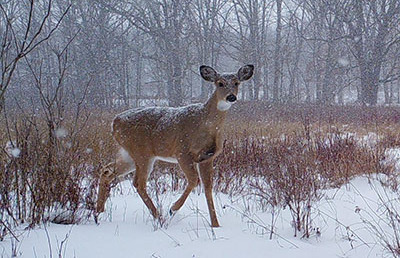
Beyond establishing the connection between hunting and reduced deer-vehicle collisions, another more specific hypothesis, related to No. 2 above, involves expanding the research to examine collision rates with bucks and does.
“Other researchers have shown that deer adjust their activity to avoid risky times and risky places, with greater tolerance for risk during breeding seasons (for bucks) and fawn-rearing seasons (for does),” Swihart said. “So, a prediction that could be tested in future research is that deer-reduction zone policies, which do not include fawning season, should be more effective in reducing deer-vehicle collisions with does than with bucks because does will be more likely to adjust their activity in response to greater hunting risk during fall/winter.”
To view this article along with other news and stories posted on the Purdue Forestry and Natural Resources website view: Researchers Study Deer-Vehicle Collision Reduction Method.
Resources:
Ask an Expert, Playlist, Purdue Extension – FNR YouTube Channel
Wildlife Habitat Hint, Playlist
Woodland Stewardship for Landowners: Managing Deer Damage to Young Trees, Purdue Extension-FNR YouTube Channel
Introduction to White-tailed Deer Impacts on Indiana Woodlands, Got Nature? Blog & The Education Store
Purdue Extension Pond and Wildlife Management
Understanding White-tailed Deer and Their Impact on Indiana Woodlands, The Education Store
Monitoring White-tailed Deer and Their Impact on Indiana Woodlands, The Education Store
Managing White-tailed Deer Impacts on Indiana Woodlands, The Education Store
How to Build a Plastic Mesh Deer Exclusion Fence, The Education Store
Managing Your Woods for White-Tailed Deer, The Education Store
Deer Harvest Data Collection, Got Nature? Blog, Purdue Extension – FNR
Handling Harvested Deer Ask an Expert? video, Purdue Extension – FNR YouTube Channel
Subscribe to Purdue Extension-Forestry & Natural Resources YouTube Channel, Wildlife Playlist
A Woodland Management Moment – Deer Fencing, Purdue Extension – FNR YouTube Video
Wendy Mayer, FNR Communications Coordinator
Purdue University Department of Forestry and Natural Resources
Purdue Landscape Report: Early June, we received a white pine sample at the Purdue University Plant and Pest Diagnostic Lab that showed early season needle loss lower in the tree canopy (Figure 1, 2). The majority of conifers hold onto their needles for multiple years, so loss of needles, even in the fall, can come as a shock to homeowners. In this particular case, we found multiple fungi that could be contributing to needle blight or needlecast.


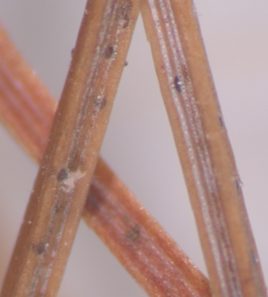
Figure 3: Black fungal structures developing on dead needles with white sporulation exuding from the top.
White pine needle damage/defoliation (WPND) was first observed in the state of Maine in 2010 and was attributed to three needle blight diseases, including Lecanosticta, and has since been observed throughout the Northeast US. However, researchers eventually determined that a new fungus, Septorioides strobi, was also found consistently in blighted needles and could be contributing to WPND.
This is the first time we have found this fungus in the state of Indiana, though it has been present for longer than a single season. We do not know how it will react to our climate nor if it will cause significant damage to affected trees. Like other needle blight pathogens, Septorioides has been observed to sporulate around the same time during humid, wet weather, but symptoms may not develop until the following year. White pines are the primary host for this needle cast disease, but it can also develop on 2, 3, and 5 needle pines. While we see white pine decline is a major problem, Septorioides will not likely be the final nail in the coffin for white pines in Indiana, though it certainly will not help us keep them healthy.
Original article posted: Septorioides Needle Blight of Pine.
Subscribe and receive the newsletter: Purdue Landscape Report Newsletter.
Resources:
ID That Tree: Virginia Pine
ID That Tree, Purdue Extension – FNR YouTube playlist
Borers of Pines and Other Needle Bearing Evergreens in Landscapes, The Education Store, Purdue Extension’s resource center
Tree Diseases: White Pine Decline in Indiana, The Education Store
Managing the Zimmerman Pine Moth, The Education Store
Purdue Arboretum Explorer
The Woody Plant Seed Manual, U.S. Forest Service
Native Trees of the Midwest, The Education Store
Root Rot in Landscape Plants, The Education Store, Purdue Extension resource center
Dead Man’s Fingers, Purdue Landscape Report
An Introduction to Trees of Indiana, The Education Store
Subscribe, Purdue Extension – FNR YouTube Channel
Tree Defect Identification, The Education Store
Tree Wound and Healing, Got Nature? Blog, Purdue Extension – FNR
Shrubs and Woody Vines of Indiana and the Midwest, The Education Store
Ask an Expert: Tree Selection and Planting, Purdue Extension – FNR YouTube playlist
Invasive Species, Playlist, Purdue Extension – FNR YouTube Channel
Report Invasive Species, Purdue Invasive Species
Find an Arborist, International Society of Arboriculture
John Bonkowski, Lead Extension Administrator
Purdue Department of Botany and Plant Pathology
MyDNR, Indiana’s Outdoor Newsletter: As a result of Indiana’s positive detection of chronic wasting disease (CWD) in LaGrange County in April, Indiana DNR has restricted moving deer from any CWD Positive Area for rehabilitation purposes.
With the change, an individual who finds an orphaned, sick, or injured deer in a CWD Positive Area may only surrender the deer to a DNR-permitted wild animal rehabilitator that is located within a CWD Positive Area. This restriction is to help minimize the spread of CWD to new parts of the state, as deer can carry this disease without appearing sick.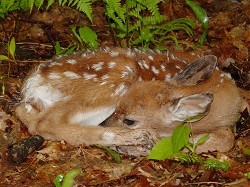
Currently, there is one CWD Positive Area in Indiana. It includes LaGrange, Steuben, Noble, and DeKalb counties. While no CWD positive deer have been documented in Steuben, Noble, or DeKalb counties, those counties are considered part of the CWD Positive Area because of their proximity to where the state’s first CWD-positive deer was found in LaGrange County.
During their first few weeks of life, fawns often hide by themselves and stay motionless to avoid predators while the mother is looking for food. If you find a fawn alone, you can help it by letting it be, giving it space, and leaving the area. Its mother is likely nearby.
For more information visit DNR: Chronic Wasting Disease (CWD).
To subscribe to the newsletter visit MyDNR Email Newsletter.
Resources:
Chronic Wasting Disease, USDA Animal and Plant Health Inspection Service (APHIS)
Bovine Tuberculosis in Wild White-tailed Deer, The Education Store, Purdue Extension resource center
Hunting & Trapping, Indiana Department of Natural Resources (DNR)
Designing Hardwood Tree Plantings for Wildlife , The Education Store
Wildlife Habitat Hint: Trail Camera Tips and Tricks, Got Nature? Blog
How to Score Your White-tailed Deer, video, The Education Store
White-Tailed Deer Post Harvest Collection, video, The Education Store
Age Determination in White-tailed Deer, video, The Education Store
How to Build a Plastic Mesh Deer Exclusion Fence, The Education Store
Ask the Expert: Hardwood Ecosystem Experiment – Birds and Salamander Research, Purdue Extension – FNR
A Template for Your Wildlife Habitat Management Plan, The Education Store
Managing Your Woods for White-Tailed Deer, The Education Store
Deer Impact Toolbox, Got Nature? blog, Purdue Extension-Forestry and Natural Resources (FNR)
Indiana Department of Natural Resources
How does forest management affect wildlife, specifically birds? Which birds prefer which types of forest habitat? How can you help birds thrive on your property?
The Forestry for the Birds Virtual Tour is a new tool developed by Purdue Forestry and Natural Resources and Purdue Extension, which offers answers to those questions and more in an easily digestible and visual format. The virtual tour is based on The Nature Conservancy’s Forestry for the Birds program.
The virtual tour is an interactive guide to forest management techniques and birds in the forest that features 360-degree images, including several taken on eight Purdue FNR properties across the state. Bird identification resources from Cornell Lab of Ornithology’s Macaulay Library, forest management resources from Purdue Extension and more make the tour come to life and allow landowners to improve their identification and management skillsets.
The tour was created and is narrated by Kaitlyn Young, a 2022 wildlife alumna and current FNR master’s degree student. Young spent the summer of 2023 monitoring birds as an avian monitoring and extension intern for the Purdue FNR Extension Internship program.
Young conducted breeding bird surveys and made recordings of all the species she encountered whether audibly or visually last summer. She utilized a GoPro Max to capture 360-degree images of the properties she surveyed. Song Meter Mini acoustic monitors allowed her to capture various bird songs, which are incorporated into the background of some of the virtual scenes of the tour. Still camera images also provide stunning visuals of each property and bird type.
“I think my favorite thing about the tour is that when you are exploring each scene, it really feels like you are there,” Young explains. “I want folks who may not be able to visit our properties to feel like they are right there, inside the scene, while learning a thing or two about bird conservation and managing our forests for our rapidly declining feathery friends.”
Young is quick to note, however, that it is much easier to spot the birds she added to each scene of the tour than when trying to look for them during surveys, when they are often hiding behind the leaves in the canopy.
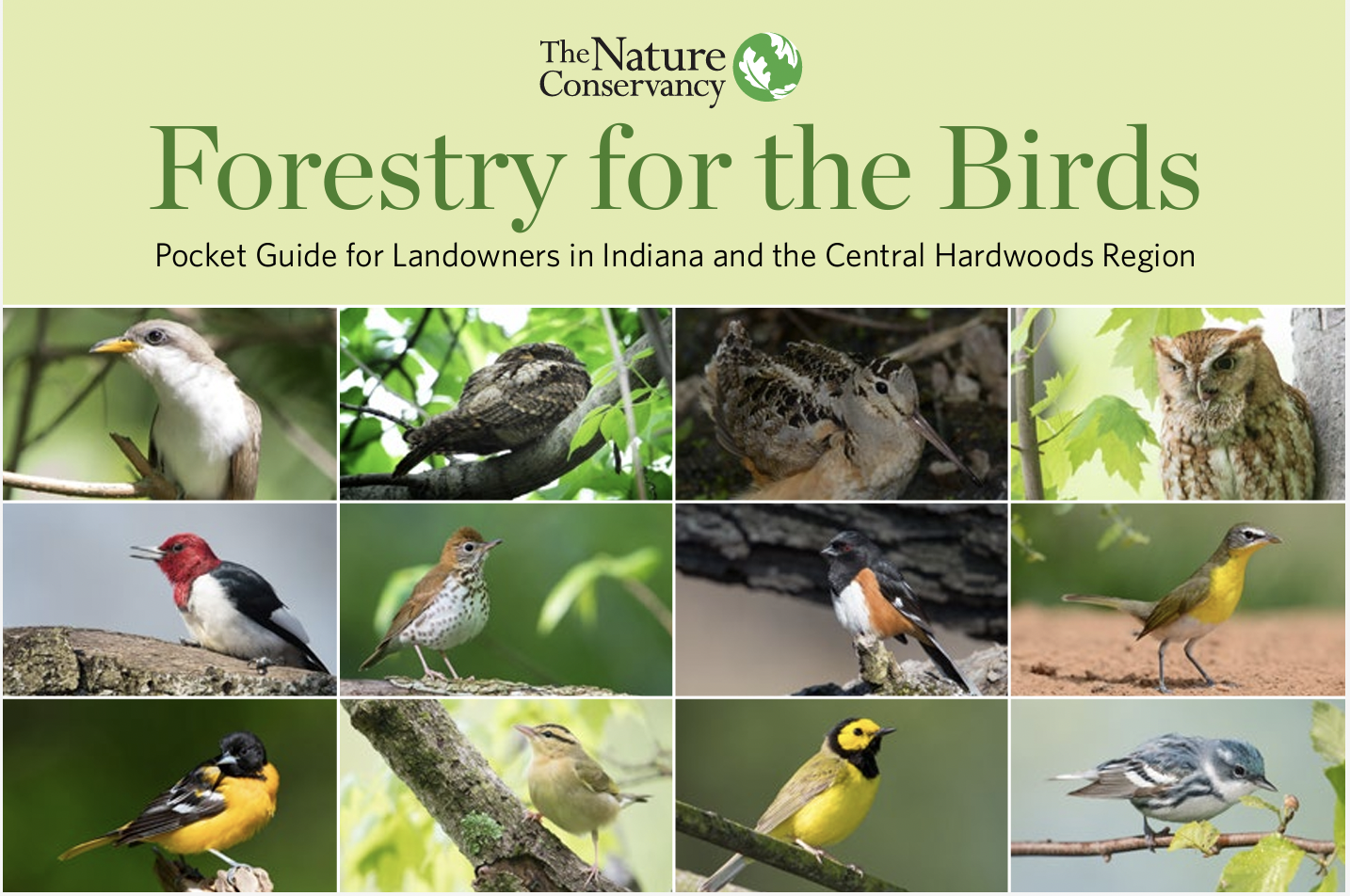
Forestry for the Birds is a project developed by the Indiana Chapter of The Nature Conservancy, which provides foresters and private landowners with the information and tools needed to enhance their forests in a way that fosters thriving bird communities. Many resources, including the Forestry for the Birds pocket guides, focus on the “Birders’ Dozen,” or 12 bird species which nest in the Central Hardwood ecoregion of Indiana that are easy to identify by sight and/or sound, and need conservation action to assist with range-wide or local population declines. The Birders’ Dozen species were selected by The Nature Conservancy and an independent group of birders, ornithologists and conservationists.
The virtual tour focuses on how different forest stewardship practices and forest types can benefit a variety of bird species, including the Birders’ Dozen. In each scene, there are three or more bird species to look for, recorded bird songs which are representative of what you could hear in that scene, interactive icons that link to images and videos and an audio description of the scene.
“I’m excited to see this virtual tour come to fruition – it provides some depth of information to complement the Forestry for the Birds Pocket Guide and Silvicultural Guide,” said Jessica Outcalt, Purdue Extension Educator, who helped develop the Forestry for the Birds materials for TNC. “I especially appreciate the visuals and audio that can’t be communicated via printed materials, and how this tour captures the sense of being in a forest that will make the material accessible to a wider audience.”
The properties shown illustrate a variety of forest stewardship techniques ranging from single tree selection to group tree selection, shelterwood, clearcut, oak woodland restoration and prescribed fire. The tour also highlights both young forests and mature closed-canopy forests.
The Birders’ Dozen includes:
- Yellow-billed and Black-billed Cuckoo
- Eastern Whip-poor-will
- American Woodcock
- Eastern Screech-Owl
- Red-headed Woodpecker
- Wood Thrush
- Eastern Towhee
- Yellow-Breasted Chat
- Baltimore Oriole
- Worm-eating Warbler
- Hooded Warbler
- Cerulean Warbler
*Bird species listed above with links will take you to the Indiana Woodland Steward website as they share highlights with this information in “The Birders’ Dozen Profile” written by Jessica Outcalt.
The American Woodcock, Wood Thrush and Cerulean Warbler are listed on the National Audubon Society watchlist, while the Cerulean warbler is state endangered in Indiana. The Eastern Whip-poor-will, American Woodcock, Worm-eating Warbler and Hooded Warbler have been noted as species of special concern by the Indiana Department of Natural Resources Division of Fish and Wildlife.
To view this article along with other news and stories posted on the Purdue Forestry and Natural Resources website view: Virtual Tour Brings Forest Management for the Birds to Life.
Resources:
Breeding Birds and Forest Management: the Hardwood Ecosystem Experiment and the Central Hardwoods Region, The Education Store, Purdue Extension – Forestry and Natural Resources
Forest Birds, The Education Store
Managing Woodlands for Birds, The Education Store
Managing Woodlands for Birds Video, Purdue Extension-Forestry and Natural Resources (FNR) YouTube Channel
Breeding Birds and Forest Management: the Hardwood Ecosystem Experiment and the Central Hardwoods Region, The Education Store
The Birders’ Dozen, Profile: Baltimore Oriole, Indiana Woodland Steward
Ask An Expert, Playlist, Purdue Extension – FNR YouTube channel
It’s For the Birds, Indiana Yard and Garden-Purdue Consumer Horticulture
Birds and Residential Window Strikes: Tips for Prevention, The Education Store, Purdue Extension resource center
No Room at the Inn: Suburban Backyards and Migratory Birds, Education Store, Purdue Extension resource center
Putting a Little Wildlife in Your Backyard This Spring, The Education Store
Wendy Mayer, FNR Communications Coordinator
Purdue University Department of Forestry and Natural Resources
In this webinar, hosted by Indiana Forestry & Woodland Owners Association, Joe Caudell, state deer biologist with Indiana DNR Division of Fish and Wildlife, shares recent efforts to better understand Indiana deer populations and how they vary across the landscape. The research from the Integrated Deer Management Project, a multi-year research project with Purdue Forestry and Natural Resources team working closely with the DNR biologists, created research management units (RMUs) so that they could be easily incorporated into deer management practices by the DNR.
Additional resources:
- Indiana Hunt for Hunger Program, Indiana Department of Natural Resources (IN DNR).
- If you’re interested in learning more about Indiana’s white tailed deer hunting and management, see the IN DNR page. There is a section on deer management with deer reports, survey results, and real time harvest data: White-Tailed Deer Hunting.
- Integrated Deer Management Project Website Introduced, Purdue College of Agriculture News.
- DNR Adopts RMU Research Techniques Created by Integrated Deer Management Project, Purdue College of Agriculture News.
- Deer Exclosures, Integrated Deer Management Project, Video, Purdue Extension – Forestry and Natural Resources (FNR) YouTube Channel
Check out the Indiana Forestry & Woodland Association YouTube Channel for videos including: What is IFWOA?; A New Carbon Program for Hardwood Landowners Webinar, Indiana’s Native Orchids, Magnificent Trees of Indiana, Be Tick Aware and much more.
The Indiana Forestry & Woodland Owners Association (IFWOA) was founded in 1977 and is a non-profit organization dedicated to conservation and sustainable management of woodlands in Indiana. IFWOA advocates for scientific best practices for management to achieve objectives of clean water, wildlife habitat, soil protection, native species diversity, timber production, recreation, carbon sequestration and many others.
IFWOA is an affiliate of the National Woodland Owners Association. IFWOA is a partner, collaborator or is represented on leading National and State organizations. These memberships or collaborations are selected to advance Indiana Woodland owner’s interests. IFWOA monitors and influences legislation and economic trends impacting Indiana woodlands and landowners for our members. Membership in IFWOA provides a valuable network linkage to information and resources at the leading edge of science, industry and politics impacting Indiana woodlands.
More Resources:
Ask an Expert, Playlist, Purdue Extension – FNR YouTube Channel
Wildlife Habitat Hint: Trail Camera Tips and Tricks, Video, Purdue Extension – FNR YouTube channel
Wildlife Habitat Hint, Playlist
Trail camera survey for white-tailed deer, Got Nature? Blog
Handling Harvested Game: Episode 1, Field Dressing, Video
Woodland Stewardship for Landowners: Managing Deer Damage to Young Trees, Purdue Extension-FNR YouTube Channel
Managing Your Woods for White-Tailed Deer, The Education Store, Purdue Extension’s resource center
Introduction to White-tailed Deer Impacts on Indiana Woodlands, Got Nature? Blog & The Education Store
Liz Jackson, Engagement Lead
Indiana Forestry & Woodland Association
In this edition of ID That Tree, Purdue Extension forester Lenny Farlee takes us through the different characteristics of coniferous trees found here in Indiana, particularly their foliage and the features that pertain to them. Come along as we look through real examples of shape, scales, leaf and branches of various local trees. The featured species include Eastern red cedarwood, Northern white cedar, and more.
If you have any questions regarding wildlife, trees, forest management, wood products, natural resource planning or other natural resource topics, feel free to contact us by using our Ask an Expert web page.
Resources:
ID That Tree: Firs and Spruces, Video Playlist, Purdue Extension – Forestry and Natural Resources (FNR) YouTube Channel
ID That Tree – Jack Pine, Scotch Pine, Red Pine, Virginia Pine, Eastern White Pine, Video Playlist, Purdue Extension – Forestry and Natural Resources (FNR) YouTube Channel
Beat Back Borers Attacking Pines and Other Cone Bearing Trees, Purdue Landscape Report
Tree Diseases: White Pine Decline in Indiana, The Education Store, Purdue Extension Resource Center
Purdue Arboretum Explorer
Conservation Tree Planting: Steps to Success, Purdue Extension – FNR YouTube Channel
A Woodland Management Moment, Playlist, Purdue Extension – FNR YouTube Channel
Woodland Stewardship for Landowners, Playlist, Purdue Extension – FNR YouTube Channel
Indiana Department of Natural Resources: Invasive Species
Indiana Invasive Species Council
Cooperative Invasive Species Management Area (CISMA)
Report Invasive, Purdue Extension
Episode 11 – Exploring the challenges of Invasive Species, Habitat University-Natural Resource University
Shrubs and Woody Vines of Indiana and the Midwest, The Education Store
Native Trees of the Midwest, The Education Store
Professional Forester, Indiana Forestry Woodland Owners Association
Forest Improvement Handbook, The Education Store
Find an Arborist, International Society of Arboriculture
Lenny Farlee, Extension Forester
Hardwood Tree Improvement and Regeneration Center
Purdue Department of Forestry & Natural Resources
In this edition of ID That Tree, Purdue Extension forester Lenny Farlee goes over leaf characteristics to look for when attempting to identify broadleaved deciduous trees in Indiana. He shares the features of both single and compound leaves while outlining the differences between tree leaves. He takes you through a thorough guide on analyzing the leaflets, leaves, stems and buds, while increasing your knowledge of your surroundings.
If you have any questions regarding wildlife, trees, forest management, wood products, natural resource planning or other natural resource topics, feel free to contact us by using our Ask an Expert web page.
Resources:
ID That Tree – Jack Pine, Scotch Pine, Red Pine, Virginia Pine, Eastern White Pine, Video Playlist, Purdue Extension – Forestry and Natural Resources (FNR) YouTube Channel
Beat Back Borers Attacking Pines and Other Cone Bearing Trees, Purdue Landscape Report
Tree Diseases: White Pine Decline in Indiana, The Education Store, Purdue Extension Resource Center
Purdue Arboretum Explorer
Conservation Tree Planting: Steps to Success, Purdue Extension – FNR YouTube Channel
A Woodland Management Moment, Playlist, Purdue Extension – FNR YouTube Channel
Woodland Stewardship for Landowners, Playlist, Purdue Extension – FNR YouTube Channel
Indiana Department of Natural Resources: Invasive Species
Indiana Invasive Species Council
Cooperative Invasive Species Management Area (CISMA)
Report Invasive, Purdue Extension
Episode 11 – Exploring the challenges of Invasive Species, Habitat University-Natural Resource University
Shrubs and Woody Vines of Indiana and the Midwest, The Education Store
Native Trees of the Midwest, The Education Store
Professional Forester, Indiana Forestry Woodland Owners Association
Forest Improvement Handbook, The Education Store
Lenny Farlee, Extension Forester
Hardwood Tree Improvement and Regeneration Center
Purdue Department of Forestry & Natural Resources
MyDNR, Indiana’s Outdoor Newsletter: Every May, wild turkey chicks (poults) begin to hatch in Indiana, and DNR needs your help counting turkey broods (hens with poults) and hens without poults.
Brood reports have been collected every year since 1993 to calculate the annual Wild Turkey Production index, which informs biologists about population status and guides management decisions for the species. Please share your 2024 observations with us online from July 1 until Aug. 31. Recording observations takes less than five minutes, and no login is required.
In 2023, DNR received more than 2,203 reports across all 92 counties in Indiana, and we’re hoping for even more this year. Our goal is to receive 3,000 total observations with at least 25 per county.
Why count turkeys?
Brood surveys provide useful estimates about annual production by wild turkey hens and the survival of poults (young turkeys) through the summer brood-rearing period. Summer brood survival is generally the primary factor influencing wild turkey population trends. Information on summer brood survival is essential for sound turkey management. Information gathered through the brood survey includes:
- Average brood sizes (hens + poults). For example, in the photo above there is one hen with seven poults, for a brood size of eight.
- Percentage of adult hens with poults.
- Production Index (PI) = total number of poults/total number of adult hens
What is a wild turkey brood?
A wild turkey brood is composed of at least one adult hen with young (poults). As the summer progresses, multiple broods may gather into what is termed a “gang” brood with several adult hens and multiple broods of poults of varied ages. During summer, adult gobblers (male turkeys) play no role in raising a brood and either form small male only “bachelor” flocks or are observed as a single gobbler.
The Indiana Department of Natural Resources – Department of Fish and Wildlife rely on your observations to calculate their Production Index, so every report counts! Indiana DNR appreciates your participation.
Jarred Brooke, extension wildlife specialist with Purdue Forestry & Natural Resources, shares how you can participate in the Indiana Department of Natural Resources’ annual turkey brood survey in a quick video.
To learn more, visit DNR: Turkey Brood Reporting.
To subscribe to the newsletter visit MyDNR Email Newsletter.
Resources:
Four Simple Steps, Help Indiana DNR Estimate Wild Turkey Populations, Purdue Extension – Forestry & Natural Resources
Truths and Myths about Wild Turkey, The Education Store, Purdue Extension resource center
Wildlife, Playlist, Purdue Extension – Forestry and Natural Resources YouTube Channel
Forest Improvement Handbook, The Education Store
Turkey Brood Reporting, Indiana Department of Natural Resources (IDNR)
Wild Turkey, Indiana Department of Natural Resources (IDNR)
Wild Turkey Hunting Biology and Management, Indian Department of Natural Resources (IDNR)
Subscribe to Purdue Extension-Forestry & Natural Resources YouTube Channel, Wildlife Playlist
Indiana Department of Natural Resources

Recent Posts
- Beetle that attacks Tree-of-Heaven found in Indiana, Purdue Landscape Report
Posted: March 20, 2026 in Invasive Insects, Wildlife, Woodlands - ID That Tree: Dwarf Chinkapin Oak
Posted: in Forestry, Urban Forestry, Wildlife, Woodlands - DNR Hiring for Indiana Conservation Officer Positions, MyDNR
Posted: March 9, 2026 in Urban Forestry, Wildlife, Woodlands - ID That Tree: Shumard Oak
Posted: in Plants, Urban Forestry, Wildlife, Woodlands - Uniting Indiana Residents Against Invasive Species
Posted: February 27, 2026 in Community Development, Invasive Insects, Wildlife - Have You Seen a Soaring Eagle Lately? Morning Ag Clips
Posted: February 25, 2026 in Urban Forestry, Wildlife - Register for Natural Resources Teacher Institute’s Class of 2026
Posted: February 19, 2026 in Forestry, Wildlife, Woodlands - ID That Tree: Fragrant Sumac
Posted: February 4, 2026 in Plants, Urban Forestry, Wildlife - Woodsy Owl Edition for Educational Learning, USDA – U.S. Forest Service
Posted: January 21, 2026 in Forestry, Forests and Street Trees, Got Nature for Kids, Urban Forestry, Wildlife - Opt-in to the Deer Management Survey, MyDNR
Posted: January 12, 2026 in Forestry, Wildlife
Archives
Categories
- Alert
- Aquaculture/Fish
- Aquatic/Aquaculture Resources
- Ask the Expert
- Christmas Trees
- Community Development
- Disease
- Drought
- Forestry
- Forests and Street Trees
- Gardening
- Got Nature for Kids
- Great Lakes
- How To
- Invasive Animal Species
- Invasive Insects
- Invasive Plant Species
- Land Use
- Natural Resource Planning
- Nature of Teaching
- Plants
- Podcasts
- Ponds
- Publication
- Safety
- Spiders
- Timber Marketing
- Uncategorized
- Urban Forestry
- Webinar
- Wildlife
- Wood Products/Manufacturing
- Woodland Management Moment
- Woodlands