 Purdue University - Extension - Forestry and Natural Resources
Got Nature? Blog
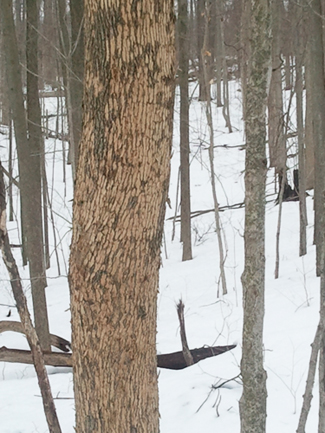 If you’re walking in the woods or maybe even traveling along a road this spring in Indiana, you may come across some trees that look like the one in the photos. Clearly, something unusual is going on here. What made the bark change color so quickly, and why are there holes in the bark?
The answer to both of those questions for ash trees around the state is Emerald Ash Borer and woodpeckers. As Emerald Ash Borer spreads across Indiana, the population of Emerald Ash Borer larvae overwintering under the bark of ash trees can quickly increase. These grubs provide a tasty treat and important winter and early spring nutrition to hungry woodpeckers.
 Woodpeckers of several species are experts at detecting and extracting these grubs by pounding holes in tree bark. Ash bark is generally gray on the surface, but the inner bark is a light corky tan color. Once the woodpeckers find the EAB larvae, their excavation activities flake off the outer bark to expose the lighter colored inner bark. This is actually one of the best indicators of the presence of Emerald Ash Borer in a tree. The woodpecker activity often starts in the upper main stem and branches of ash trees, but as the population of EAB larvae in the trees increase, the woodpecker activity spreads down the trunk of the tree. Trees with this much inner bark exposed indicate an advanced infestation of EAB and signal ash tree mortality in the next year or two.
If you would like to learn more about ash trees and the Emerald Ash Borer, visit the Purdue Emerald Ash Borer website.
Resources
Arrest That Pest! – Emerald Ash Borer in Indiana, Purdue Extension
Purdue Extension – Forestry & Natural Resources website with search bar, place “Invasive Insect”
Emerald Ash Borer, Indiana Department of Natural Resources (IDNR)
Emerald Ash Borer in Indiana, Purdue Extension
New Hope for Fighting Ash Borer, Purdue Extension – Forestry and Natural Resources Got Nature? blog
Lenny Farlee, Extension Forester
Purdue University Department of Forestry and Natural Resources
When you rush to the closet to grab your favorite shorts and T-shirt, remember that you are not the only creature looking forward to the warmer weather. It is important to check yourself or have a buddy check you for passengers when you get back from the field to lessen the likelihood of bringing ticks home with you.
Indiana has 15 tick species, but the three listed below are the most prevalent.
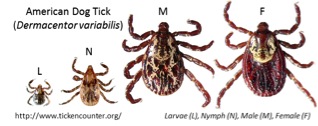
American Dog Tick (Dermacentor variabilis): Found primarily along trails, walkways or in fields, American Dog ticks are rarely found in forests. Despite their name, these ticks feed on a multitude of hosts in addition to the family pet and can transmit Rocky Mountain Spotted Fever, a potentially fatal disease contracted by 32 people in Indiana last year. The American Dog Tick also carries Tularemia, a rare but dangerous disease that is often misdiagnosed for the flu.
American Dog ticks can survive for two years at any stage in life until a suitable host is found. Male ticks mate with the female while she is feeding as after she is sated, she drops off of the host and lays 4,000+ eggs before dying. Larval ticks only feed for three to four days from a host before molting into nymphs. The nymph feeds on a variety of small/medium-sized hosts before dropping to the leaf litter and molting into adults. Interestingly, these ticks are least likely to bite humans.
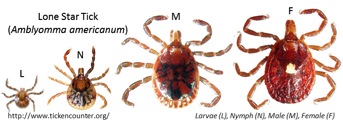 Lone Star Tick (Amblyomma americanum): Found primarily in dense underbrush and forested areas. As with the American Dog Tick, these ticks are capable of transmitting Rocky Mountain Spotted Fever in addition to Monocytic Ehrlichiosis, another tickborne disease that presents with symptoms similar to the flu but was confirmed in 49 Indiana cases in 2013. ‘Stari’ (Southern Tick-Associated Rash Illness) Borreliosis is a tick-vectored disease that presents with a large round or elliptical rash and flu symptoms transmitted by the Lone Star Tick.
Voracious eaters, adult Lone Star ticks often take human hosts or other large mammals. After a week, the female is capable of laying 3,000+ eggs. The larval Lone Star ticks only feed for four days before detaching, burying themselves in leaf litter and molting into nymphs. Able to quickly ascend up pant legs, these nymphs can be firmly attached to a host in < 10 minutes. After five days, the nymphs detach and molt into adults.
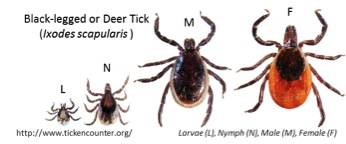
Black-legged or Deer Tick (Ixodes scapularis): Found primarily in deciduous forests, these ticks predominantly use white-tailed deer or other large mammals as hosts. Unlike the relatively accelerated life cycles of the American Dog and Lone Star ticks, the Deer Tick life cycle takes nearly two years to complete.
Deer ticks are most notorious for spreading Lyme disease, a dangerous disease that causes flu-like symptoms that, if left untreated, can spread to joints and compromise the nervous system. More than 100 cases of Lyme disease were confirmed in Indiana in 2013. Babesiosis is caused by microscopic parasites that infect red blood cells, and Anaplasmosis is caused by the bacterium Anaplasma phagocytophilum. Both of these diseases are transmitted through the bite of an infected Deer Tick.
Only the female Deer Tick feeds, and once completely engorged, they lay an egg mass of 1,900+ eggs before dying in late-May. Deer Tick larvae and nymphs remain in the moist leaf litter within forested areas and prefer smaller hosts. After feeding for three days in each developmental stage, they burrow into the litter to molt. Larvae emerge as nymphs in spring, and nymphs emerge as adults in fall.
 The table here illustrates the months of activity for the larval, nymph, male and female tick life cycle stages which gives you a quick reference for Indiana. This information was gathered from the resources listed in this post.
Indiana ticks can carry several diseases, but the three most common are Rocky Mountain Spotted Fever, Lyme Disease and Ehrlichiosis. Symptoms of all three diseases range from spreading rashes, headaches, fatigue, fevers and muscle aches. Likelihood of infection is rare; however, instances of each disease are increasing in Indiana.
Be careful and try not to pick up eight-legged hitchhikers. If you suspect that you have been bitten by a tick or develop a rash along with flu symptoms, contact your local health department for a disease screening.
Resources
Ticks, Indiana Department of Natural Resources
Ticks, Medical Entomology, Purdue University
Rocky Mountain Spotted Fever, Centers for Disease Control and Prevention
Tularemia, Centers for Disease Control and Prevention
Lyme Disease, Centers for Disease Control and Prevention
Ehrlichiosis, Centers for Disease Control and Prevention
Parasites – Babesiosis, Centers for Disease Control and Prevention
Anaplasmosis, Centers for Disease Control and Prevention
‘Stari’ Borreliosis, Columbia University Medical Center
tickencounter.org, Tick Encounter Resource Center, University of Rhode Island
Shaneka Lawson, Adjunct Assistant Professor
Department of Forestry and Natural Resources
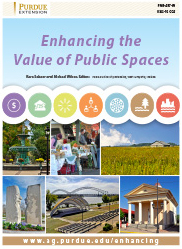 A 20+ extension team led by Kara Salazar, sustainable communities extension specialist, and Michael Wilcox, assistant program leader for extension community development, have produced a new publication and curriculum titled “Enhancing the Value of Public Spaces.” This must-have spiral bound notebook and curriculum zip file download is a great resource for decision makers and local leaders developing community public spaces including park boards, planning commission members, members of organizations, public officials and staff whose missions are related to providing services, programs or management of public spaces. This program serves as a “how-to” guide for creating high-quality action plans to achieve great public spaces.
A one day workshop starts the process with collaborative activities to identify best practices for improving public spaces with emphasis on forming partnerships to achieve desired community goals. Follow-on working group meetings provide the resources and technical support needed to plan and implement projects tailored to individual communities. The completed high quality public spaces action plan can be used as part of comprehensive planning efforts, parks and recreation master plans and fundraising initiatives.
Resources
Enhancing the Value of Public Spaces, The Education Store
Kara Salazar, Sustainable Communities Extension Specialist
Department of Forestry and Natural Resources
Illinois-Indiana Sea Grant
Michael Wilcox
Assistant Program Leader, Extension Community Development Program
Senior Associate, Purdue Center for Regional Development
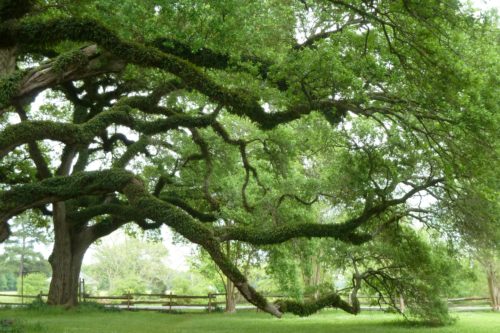
In the first study of its kind, scientists David Nowak and Eric Greenfield of the U.S. Forest Service Northern Research Station have calculated just how beneficial trees are to human health. As well as providing oxygen, shade and beautification, trees help to remove air pollution by catching harmful airborne particles on the leaves and branches and by absorbing gases like nitrogen dioxide (NO2), ozone (O3), and sulfur dioxide (SO2). Nowak and Greenfield concluded that trees save over 850 human lives a year and prevent over 670,000 cases of acute respiratory symptoms from diseases like asthma, bronchitis, emphysema and chronic pulmonary obstructive disease (COPD).
While trees in suburban areas remove a higher amount of pollution due to their large quantity, urban trees have a greater direct effect on human health and monetary savings due to their closer proximity to people. Altogether, trees improved air quality in the continental U.S. by less than 1% in 2010, according to computer simulations iTree and BenMAP. This might not sound like much, but this means that trees removed 17.4 million tons of air pollution and saved the country over $6.8 billion in medical expenses. This really goes to show how much of a difference trees can add to the quality of our lives, especially in urban areas.
Resources
Tree and Forest Effects on Air Quality and Human Health in the United States, Science Direct
Urban Trees Help Us Breathe, National Association of State Foresters
Value of Urban Forests, U.S. Department of Agriculture (USDA)
iTree, U.S. Forest Service
BenMAP, United States Environmental Protection Agency
U.S. Forest Service Northern Research Station
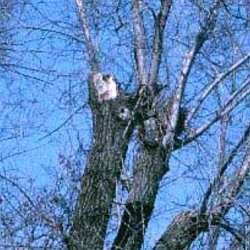 If a bad haircut was fatal, you would be very choosy about your hairstyle. But each year, hundreds of homeowners have their trees pruned by topping, a horticultural “bad haircut” that shortens the life of the tree and leads to greater expense later.Tree care professionals and university experts caution tree owners that topping a tree is the kiss of death in many instances. This damaging pruning practice can shorten the life span of trees significantly, and the damage is long-term; in some instances, the beheaded tree will die within a few years, if not less.
Many people don’t realize topping is a poor practice because trees can be remarkably effective in overcoming the damage in the short term – some can take years to die, a few can even withstand multiple toppings. So the real damage is not easily noticed by the tree owners until the trees can no longer survive such a drastic removal of canopy.
People see trees leaf out year after year and give little thought to the actual effect of the topping. The most immediate effect is a reduced leaf mass, or crown. This smaller number of leaves reduces the amount of energy the tree manufactures to sustain itself. Less energy causes the roots to die back as well. This creates a tree that is less able to supports itself or withstand heavy winds.
The haircut analogy breaks down when you look at what happens after the tree topping occurs. Whereas hair just continues to grow out from the same follicle, branches do not continue to grow out from the same growing point. Tree limbs sprout from previously dormant buds just below the internodal pruning cut. This causes an unhealthy flush of growth near the end of the poorly pruned branch that is typically thin and weakly attached to the tree’s main growth stems.
These weak limbs are easily ripped from the tree in storms, causing damage and creating a liability for property owners. It has been long known that tree topping is harmful to trees, yet the practice of tree topping continues. Reputable arborists will work with a tree’s natural growth habit when pruning and understand the importance of pruning and tree health. Proper pruning can extend the life of a tree and reduce ongoing homeowner expense; however, once a tree is topped, it will require much more frequent pruning to prevent branch failure, costing the owner more money.
The best advice is to hire reputable tree care companies that have recognized qualifications and insurance. Ask the company for credentials from professional organizations such as the International Society of Arboriculture and the Tree Care Industry Association to prove their knowledge and abilities. Also ask for references of where they have pruned trees at other properties to see what their work looks like after the project. A homeowner wouldn’t hire a plumber or carpenter without references, so why shouldn’t an important asset to your property like trees not receive the same consideration?
Trees are a valuable resource and asset to your property that helps make our environment cleaner, healthier and a more beautiful place to live. Those trees deserve better than a life-shortening bad haircut.
Resources
What’s Wrong with Topping Trees? The Education Store
Trees and Storms, The Education Store
First Aid for Trees, Indiana Department of Forestry and Natural Resources
Prune Your Trees, Indiana Department of Forestry and Natural Resources
Lindsey Purcell, Urban Forestry Specialist
Department of Forestry and Natural Resources, Purdue University
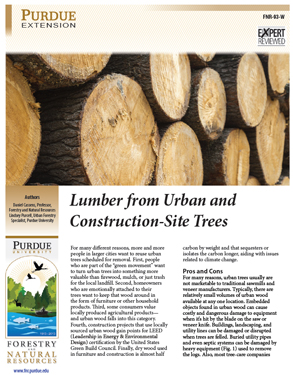 For many different reasons, more and more people in larger cities want to reuse urban trees scheduled for removal. People who are part of the “green movement” want to turn urban trees into something more valuable than firewood, mulch or just trash for the local landfill. This publication describes the pros and cons of using urban trees for lumber, the types of lumber that are economical to produce from urban trees and how you might find a sawyer who can turn your tree into usable lumber.
Resources
Mechanical Damage to Trees: Mowing and Maintenance Equipment, The Education Store
The Education Store, Purdue Extension Resource Center (Find apps, publications, videos and much more)
Lindsey Purcell, Urban Forestry Specialist
Department of Forestry and Natural Resources, Purdue University
Daniel Cassens, Professor of Wood Products
Department of Forestry and Natural Resources, Purdue University
Trees are a major part of our community environment. Although trees have been an important part of human settlements throughout history, only recently has their full value to cities and towns been recognized. Trees and green spaces play an important role in improving city living conditions and more importantly, our quality of life.
FNR Extension has a wide variety of resources to help you receive the benefits of trees.
These resources include:
– lowering annual heating and cooling costs for homes and businesses.
– planting trees for windbreaks in open areas.
– prevent soil erosion.
– improving urban drainage systems.
– improving air pollution.
– how hospital and nursing home patients benefit from trees.
– increasing wildlife.
– how trees can add to and increase real estate.
– how trees improve economic value.
Trees provide as many environmental, aesthetic, and monetary benefits as there are communities. View Urban Forestry and Arboriculture.
Check out our FNR Videos which include:
Urban Forestry at Purdue University
Underhand Chop Demonstration
Springpole
Free publication downloads at The Education Store, Purdue Extension Resource Center. Includes:
Tree Installation: Process and Practices
Tree Pruning Essentials
Trees and Storms
Additional Resources:
Indiana Arborist Association (IAA)
The Indiana Arborist Association (IAA) strives to enhance the quality of life for Indiana residents by encouraging the planting, maintenance and preservation of trees. IAA seeks to do this by increasing public awareness of the benefits provided by well maintained trees, and promoting the advantages of working with qualified professional arborists who use current industry standards. IAA endeavors to efficiently serve the needs of its members by fostering opportunities for training and the exchange of ideas, and encouraging high ethical standards among its members and in the industry at large.
To find an arborist near you, verify credentials and where to find more information on trees view:
International Society of Arboriculture (ISA)
Through research, technology, and education, the International Society of Arboriculture (ISA) promotes the professional practice of arboriculture and fosters a greater worldwide awareness of the benefits of trees.
US Forest Service Webinars
The US Forest Service is a multi-faceted agency that manages and protects 154 national forests and 20 grasslands in 44 states and Puerto Rico. The agency’s mission is to sustain the health, diversity, and productivity of the nation’s forests and grasslands to meet the needs of present and future generations.
Faculty and staff in the Department of Forestry and Natural Resources (FNR) are engaged in environmental planning around the state. Extension programs help managers and decision-makers improve Indiana’s natural resource management and environmental planning. We deliver programs to help communities consider how to plan for their unique and life-sustaining environmental resources and provide education and technical assistance to plan commissions. Programs are developed and delivered in collaboration with the Purdue Extension Community Development Program and Illinois-Indiana Sea Grant. Some of the programs FNR faculty and extension staff have developed in collaboration with our partners include:
American Citizen Planner – Indiana (ACP-IN)
American Citizen Planner – Indiana provides training to Indiana citizen planners who currently serve or plan to serve on area or advisory plan commissions. The program features 31 topics detailing core planning theories, practices, and processes. A comprehensive assessment and four virtual training events reinforce the content learned in the units. The program is hosted by a local Purdue Extension educator for either a county or a region.
Conservation Through Community Leadership (CCL)
Communities face many challenges, and many of these are their natural resources. The Conservation through Community Leadership program serves as a roadmap for communities tackling complex land use and natural resource management challenges. The program provides information, tools, and resources to help communities work with diverse stakeholders.
Enhancing the Value of Public Spaces (EVPS)
The Purdue University Extension program, Enhancing the Value of Public Spaces, addresses public spaces and their role in enhancing the quality of place by helping regions, communities and neighborhoods plan and prepare for a sustainable future. The Indiana-based curriculum is designed for use by decision makers and local leaders with oversight and management of community public spaces such as parks boards and planning commission members, public officials and their staff and members of organizations whose missions provide services related to programs or management of public spaces. The program provides a framework for collecting data on community assets and using that data to plan public spaces improvements.
Green Infrastructure and Hazard Mitigation
Communities face several challenges and complex decisions related to natural hazards, which are increasingly exacerbated by climate change. The program supports a collaborative community planning approach to evaluate the relevance and effectiveness of existing community policies and to identify goals, motivations, and barriers for hazard mitigation planning, focusing on water resources, flooding, and green infrastructure.
Land Use
The Purdue University Land Use Team provides research-based resources and educational programs for Extension professionals, government officials, citizen planners, and residents on land use issues impacting their communities. Land Use Team efforts are underpinned by a timely and rigorous professional development system that prepares Purdue Extension professionals to effectively serve on Plan Commissions.
Rainscaping Education Program
Rainscaping is a combination of sustainable landscape design and management practices that prevents polluted runoff from reaching water bodies — directing stormwater to be absorbed by plants and soils. The program provides training and resources on rainscaping practices that can be installed in residential settings or small-scale public spaces projects.
Renewable Energy
Renewable Energy for Community Planning brings resources for general renewable energy, solar and wind. This includes: community planning guidebooks for renewable energy, solar development, landowner leasing for solar, qualifications for a wind lease, wind farm impact statements and much more.
Sustainable Communities
Extension programs that support sustainable community development strategies are available to communities throughout Indiana. These support decision makers with evaluating, prioritizing, and implementing sustainability strategies for their communities.
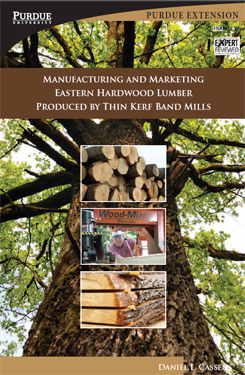 This full-color, soft-cover book brings together a lifetime of sawmill experience and technical training to help readers solve lumber manufacturing problems and save money. It includes chapters on wood quality and characteristics, softwood lumber grading, logs for fine face veneer, wood residues and potential markets, sales techniques and more. It is a comprehensive reference guide for those who manufacture and market Eastern hardwood lumber in the United States. While it’s written for owners of small, home-based lumber mills, the information is also useful for traditional lumber manufacturers.The author has spent 30 years in close association with both the hardwood lumber and veneer-producing industries, as well as with the users of hardwood products. He has participated in hundreds of plant visits, organized and conducted many educational seminars and written extensively.
This 380-page book was produced in conjunction with the U.S. Forest Service.
View sample pages of the book or place an order through The Education Store, Manufacturing and Marketing Eastern hardwood Lumber Produced by Thin Kerf Band Mills.
Resources
Lumber from Hardwood Trees, The Education Store
The Education Store, Purdue Extension Resource Center (Find apps, publications, videos and much more)
Daniel Cassens, Professor of Wood Products
Department of Forestry and Natural Resources, Purdue University
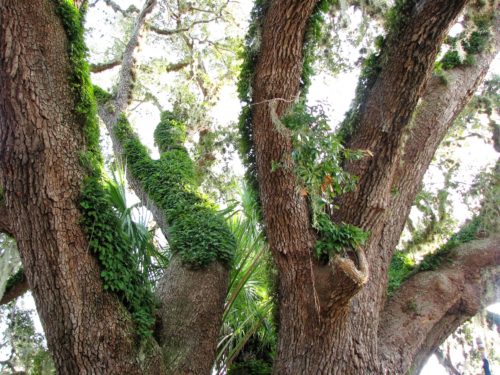 Question: I just finished cutting down the last of my backyard oaks due to oak wilt. I have also lost several redbuds due to verticillium wilt. I would like to replant a tree in the spot where the oaks and redbuds were, but I would like some advice on the most resistant tree I can find. I live in Crown Point, IN, primarily clay, on a slope, with heavy brush on my property lines. I know most people would say NEVER plant again once wilt has been detected, but I thought I might ask before giving up (and moving all my shade plants). Do you have information/research on an appropriate and sturdy replacement shade tree?
Response: In general, replanting of oaks in an old oak wilt disease center does not result in disease occurrence in the replanted trees. Root grafts are not thought to form with the dead, diseased oaks. It does not appear that the fungus is transmitted outside the primary phases of transmission: vector-borne via insects (e.g., Nitidulidae) and xylem-limited disease spread via live root grafts of infected trees (MacDonald et al., 2009). This does not mean, of course, that the young oak trees are immune to oak wilt as they grow and age over time; rather, it simply means that oak wilt is not sitting dormant in the soil waiting to attack newly planted or germinated oak seedlings.
Thus, it is only through insect spread from active oak wilt centers in the vicinity that disease would occur in replanted oaks. Healthy oak trees are not susceptible to oak wilt in an infected area. Bur oak, white oak and other members of the white oak family are resistant to the fungus and can be planted in oak wilt centers. For additional prevention measures, plant tree species other than oaks to guarantee no infection from the disease.
Resources
Oak Wilt, The Education Store
Diseases in Hardwood Tree Plantings, The Education Store
Tree Installation: Process and Practices, The Education Store
Forest Health Problems Impacting Indiana Forest Resources, Indiana Department of Natural Resources
Lindsey Purcell, Urban Forestry Specialist
Department of Forestry and Natural Resources

Recent Posts
- Urban Tree Spotlight: Planting Deciduous Shade Trees, Purdue Landscape Report
Posted: March 25, 2026 in Forests and Street Trees, Urban Forestry, Woodlands - ID That Tree: Dwarf Chinkapin Oak
Posted: March 20, 2026 in Forestry, Urban Forestry, Wildlife, Woodlands - DNR Hiring for Indiana Conservation Officer Positions, MyDNR
Posted: March 9, 2026 in Urban Forestry, Wildlife, Woodlands - ID That Tree: Shumard Oak
Posted: in Plants, Urban Forestry, Wildlife, Woodlands - A Woodland Management Moment: Windbreak Around Walnut Plantings
Posted: March 3, 2026 in Forestry, Urban Forestry, Woodland Management Moment - Getting Certified as an Indiana Certified Prescribed Burn Manager
Posted: March 2, 2026 in How To, Urban Forestry, Woodlands - Have You Seen a Soaring Eagle Lately? Morning Ag Clips
Posted: February 25, 2026 in Urban Forestry, Wildlife - ID That Tree: Fragrant Sumac
Posted: February 4, 2026 in Plants, Urban Forestry, Wildlife - Tree Silvics and Succession Webinar: A Biological Basis for Management
Posted: January 30, 2026 in Forests and Street Trees, Urban Forestry, Woodlands - Southwest Damage, Scalding or Frost Cracking
Posted: in Forestry, Urban Forestry
Archives
Categories
- Alert
- Aquaculture/Fish
- Aquatic/Aquaculture Resources
- Ask the Expert
- Christmas Trees
- Community Development
- Disease
- Drought
- Forestry
- Forests and Street Trees
- Gardening
- Got Nature for Kids
- Great Lakes
- How To
- Invasive Animal Species
- Invasive Insects
- Invasive Plant Species
- Land Use
- Natural Resource Planning
- Nature of Teaching
- Plants
- Podcasts
- Ponds
- Publication
- Safety
- Spiders
- Timber Marketing
- Uncategorized
- Urban Forestry
- Webinar
- Wildlife
- Wood Products/Manufacturing
- Woodland Management Moment
- Woodlands