 Purdue University - Extension - Forestry and Natural Resources
Got Nature? Blog
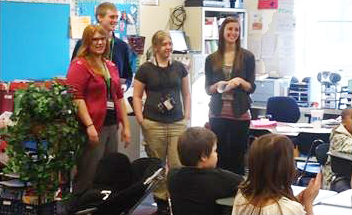 FNR is pleased to announce a new program that will provide undergraduate extension internship opportunities for qualified students this summer. This is an exciting program with the potential to build on an already strong set of FNR extension programs while providing valuable experience and training for undergraduates.
Purdue University’s Department of Forestry and Natural Resources seeks candidates for extension internship positions. The department extension program has a broad environmental scope including fisheries, forest management, invasive species, urban forestry, sustainability, wildlife and wood products. Student interns can enhance their career potential through practical, hands-on experience. Our extension internship program can help you:
- Develop leadership and decision-making skills in handling creative challenges
- Gain experience developing extension products including publications, online videos, presentations and/or more
- Participate in professional development opportunities
- Build professional references and contacts
- Clarify career goals
- Learn from a diverse and experienced group of natural resources professionals
Internships are open to non-Purdue students. Requirements for the position(s) include status as a junior or senior level college student in natural resources or related discipline, minimum 3.0 GPA, evidence of initiative, independence and commitment to conservation of natural resources. Internships are available for summer term (up to 40 hours/wk., up to 8 weeks) with pay at a rate of $12 per hour. Internship start dates and work hours are flexible depending on the applicant’s availability.
Resources
FNR Extension Internship Information, Purdue Forestry and Natural Resources (FNR)
Brian MacGowan, Extension Wildlife Specialist
Department of Forestry and Natural Resources, Purdue University
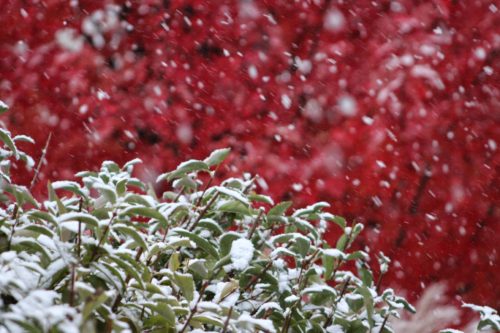 You may be considering giving a plant as a holiday gift this year. But before you buy your plant, there are precautions you need to take into consideration in order to keep it healthy. Purdue Yard and Garden News has some tips for you.
Your plant can get damaged due to cold, frigid air. Ensure that the salesperson wraps your purchase to protect it from the cold temperatures and wind as you walk back to your car. Also preheat your car to keep it out of the cold for the shortest time possible.
Keep plants away from drafts when you return home. Instead, put it in a place that is 60-70 degrees Fahrenheit during the day and provides plenty of bright light. Water your plant until some excess water comes through the drainage holes at the bottom.
View all of the tips on the Purdue Yard and Garden News page.
Resources
Effects of Cold Weather on Horticultural Plants in Indiana, The Education Store
Winter Injury of Ornamentals, Purdue e-Pubs
How To Care For Your Amaryllis, Purdue Yard and Garden News
Purdue Yard and Garden
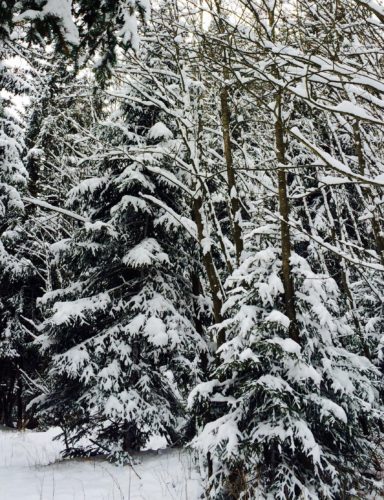 The Purdue Yard and Garden Calendar for January has provided some tips on how to care for your plants as a bitter cold winter sweeps upon us.
HOME
Keep plants near a bright window and hydrated. Increase humidity around houseplants by grouping plants together, placing them on a pebble-water tray or running a humidifier. Check stored produce and tender flower bulbs and roots for rot, shriveling or excess moisture. Remove and discard damaged material.
Repot houseplants as they outgrow current pots.
YARD
Check young trees for rodent injury on lower trunks. Prevent injury with hardware cloth or protective collars.
Keep road and sidewalk salt away from plants. Construct a screen of burlap, if necessary, to keep salt spray off plants.
GARDEN
Order seeds and plants as early as possible for best selection.
Wood ashes from the fireplace can be spread in the garden, but don’t overdo it. Wood ashes increase soil pH, and excess application can make some nutrients unavailable for plant uptake. Have soil tested to be certain of the pH before adding wood ash.
View all of the tips on the Purdue Yard and Garden Calendar page.
Resources
Winter Injury of Ornamentals, The Education Store
Steps To Ensure Your Plants Survive This Winter, Got Nature?
Winterize Your Trees, The Education Store
Purdue Yard and Garden Calendar
As winter comes swiftly upon us, there are precautions we need to take to ensure our plants, both indoor and outdoor, are well taken care of. Below are a few examples of how you can prevent certain problems that occur in the cold months ahead. View all of the steps you can take at the Purdue Extension Yard and Garden Calendar page.
HOME (Indoor plants and activities)
- Houseplants may not receive adequate light because days are short and gloomy. Move plants closer to windows, but avoid placing foliage against cold glass panes. Artificial lighting may be helpful.
- Because growth slows or stops in winter months, most plants will require less water and little, if any, fertilizer.
- Extend the lives of holiday plants such as poinsettias and Christmas cactus by placing them in a cool, brightly lit area that is free from warm or cold drafts.
YARD (Lawns, woody ornamentals and fruits)
- Prevent bark splitting of young and thin-barked trees, such as fruit and maple trees. Wrap trunks with tree wrap or paint them with white latex (not oil-based) paint, particularly on the south- and southwest-facing sides.
- Provide winter protection for roses by mounding soil approximately 12 inches high to insulate the graft union after plants are dormant and temperatures are cold. Additional organic mulch such as straw compost or chopped leaves can be placed on top.
GARDEN (Flowers, vegetables and small fruits)
- To protect newly planted or tender perennials and bulbs, mulch with straw, chopped leaves or other organic material after plants become dormant.
- Store leftover garden chemicals where they will stay dry, unfrozen and out of the reach of children, pets and unsuspecting adults.
- Once the plants are completely dormant and temperatures are consistently below freezing, apply winter mulch to protect strawberries and other tender perennials. In most cases, two to four inches of organic material such as straw, pine needles, hay or bark chips will provide adequate protection.
Resources
Winter Garden Calendar, The Education Store
Winter Storage of Geranium, Canna, Gladiolus, Caladium, and Begonia, The Education Store
Winterize Your Trees, The Education Store
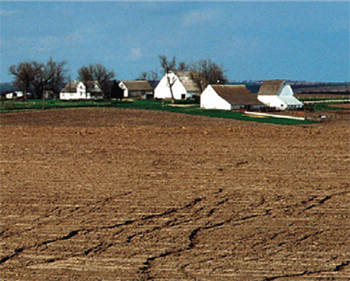 Agricultural educators, community organizers and others promoting environmental awareness can learn about the myths and realities of agricultural conservation from the perspective of a researcher, practitioner and student in a new Purdue Extension publication.
Adoption of Agricultural Conservation Practices: Insights from Research and Practice, developed by the Department of Forestry and Natural Resources at Purdue University, is available for free download from The Education Store.
The authors (Linda Prokopy, associate professor of Natural Resource Social Science; Dan Towery, Indiana Conservation Cropping System Initiative educator; and Nicholas Babin, postdoctoral research assistant in Forestry and Natural Resources) use academic studies and their own observations to address ways of motivating farmers to adopt environmentally-friendly farming practices.
To read the full article, visit Ag conservation publications available from Purdue Extension, Purdue Agriculture News.
Resources
Indiana Soils: Evaluation and Conservation Manual Review, Purdue Agronomy
Conservation Tillage and Water Quality, Purdue Extension
Optimizing Conservation Tillage Systems: Plant-to-Plant Uniformity is Essential for Optimum Yield in No-Till Cont. Corn, The Education Store
Linda Prokopy, Associate Professor of Natural Resource Social Science
Department of Forestry and Natural Resources

Although fresh chips from tree pruning and removals look great for mulch and compost, there are some hidden issues. First, fresh wood chips can be very acidic (sometimes down around a pH of 4) which can be detrimental to plant growth. Also fresh chips have a high C:N (carbon to nitrogen ratio), and it must borrow nitrogen from the soil to help the decomposing process. So mixing the chips with the soil can actually reduce fertility for a while. Both of those can be problems for plants trying to grow in a bed mulched or mixed with fresh chips. Ideally, the newly ground chips should compost properly for a full year. If nitrogen fertilizer is added to the soil/mulch mix, it can speed up the process.
The effects of wood chips as mulch involve mainly the surface of the soil, which means it’s mainly shallow-rooted plants like perennial and annual flowers that would run into fresh wood chip trouble. This includes serious chlorosis and other health issues involving establishment and development. Deeper-rooted trees and shrubs are less likely to be affected as much; however, they are subject to the effects of the poor C:N ratio. I would suggest removing as much of the chips as possible, piling them for composting and replacing with proper soil for perennial growth unless you can wait for a full year to allow the decomposition cycle to be completed. This may help eliminate issues with new plants going into that location.
Resources
Mulching Conserves Soil Moisture, Department of Horticulture and Landscape Architecture
Growing Perennial Flowers, The Education Store (Search keywords to find the resources you need)
Collecting Soil Samples for Testing, The Education Store
Soil and Water Conservation Districts, Indiana State Department of Agriculture
Certified Soil Testing Laboratories, Purdue Department of Agronomy/Extension
Lindsey Purcell, Urban Forestry Specialist
Department of Forestry and Natural Resources
It doesn’t sound like there would be much chance of the chemical to get into the shrubs if the imidacloprid is applied close to the base of the tree. Also another thing to consider is unless you’re eating solely certified organic food, there’s a really good chance you’ve consumed very small amounts of imidacloprid at some time.
The United States Department of Agriculture (USDA) Pesticide Data Program monitored imidacloprid residues in food and published their findings in 2006. Imidacloprid was detected in a range of fresh and processed fruits and vegetables. It was detected in over 80% of all bananas tested, 76% of cauliflower and 72% of spinach samples. In all cases, however, the levels detected were below the U.S. EPA’s tolerance levels. Imidacloprid was also found in 17.5% of applesauce and 0.9% raisin samples, although percentage of detections were greater in the fresh unprocessed fruit (26.6% of apples sampled and 18.1% of grapes sampled).
These findings were on direct application to the plant, which would indicate higher concentrations than that which you would find on plants nearby those that were treated. Additionally, it is advised that if homeowners want to use a product with imidacloprid as the active ingredient, then they use one specifically labeled for edible food crops. The product label will contain specific instructions on application, pre-harvest intervals and special instructions on limiting harm to pollinators.
Resources
Purdue Pesticide Programs
Office of Indiana State Chemist – Pesticide Section
Lindsey Purcell, Urban Forestry Specialist
Department of Forestry and Natural Resources, Purdue University
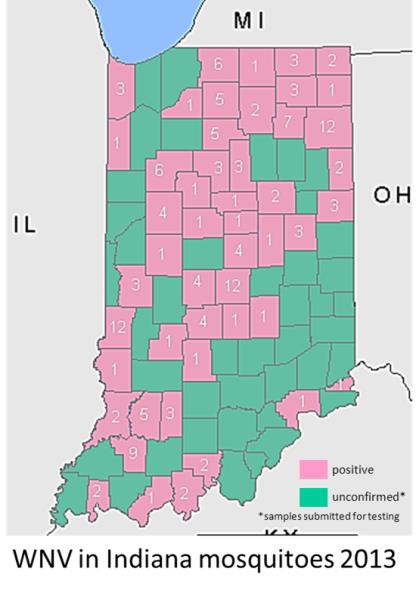
As foresters, woodland owners and tree and wildlife enthusiasts, we hear the word safety and immediately think about making sure our hard hat is packed, our gas tank is full, our cell phone is charged and we have a buddy to call in case of an emergency. How many of us think about diseases? Who thinks about West Nile Virus (WNV) or Eastern Equine Encephalitis (EEE)? For those of us that take our pets into the field, WNV and EEE are very real threats. West Nile Virus originated in Africa but spread quickly throughout the United States after an outbreak in New York in 1999. By 2003, 46 states had been infected, and nearly 10,000 people had fallen ill.
Although not contagious by contact with an infected person or animal, a protective layer is recommended when handling potential infected subjects. Most infected humans show no symptoms while a minority exhibit fevers, headaches, skin rashes, meningitis or encephalitis. Very few people die from WNV (< 1:1,000), but precautions should always be taken to prevent exposure. A total of 156 cases of WNV have been reported in Indiana this year with one sample being human. Other cases have been found in bordering states with 741 cases (mosquito) in Illinois, two mosquito and four human cases in Michigan, 64 mosquito cases in Ohio and zero cases of any kind in Kentucky as of August 20, 2013.
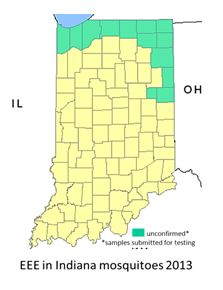
Eastern Equine Encephalitis is a rare viral disease that can be transmitted from host mosquitoes to a number of other animal species. Historical accounts of the disease show that in Midwestern states, EEE is most often found in southwestern Michigan; however, infected horses in Indiana have been found. EEE infects nearly all game birds, amphibians and reptiles, and last year in Michigan, an 8-week-old puppy.
Humans are not immune to EEE. Nearly 30% of people that develop the disease die, and approximately 50% of survivors have permanent neurological complications. Symptoms of infection may or may not occur and will often take between three and 10 days to be realized. EEE symptoms in humans range from fever, headache and nausea to abdominal pain, paralysis, seizures and fainting. An elderly woman in New England died on August 21, 2013, and was the first human casualty of the disease this year. A vaccine has been developed to prevent EEE in horses; however, no vaccine or treatment is available to protect humans or other animals from EEE or WNV. Elimination of standing water is our only defense against potential EEE and WNV threats.
As the summer is in full swing and more and more of us head out to the field, please do not forget to protect yourself and your pets from potential exposure to mosquitoes.
Sourced Information:
Beasley, D.W.C. et al. (2013) Resurgence of West Nile neurologic disease in the United States in 2012: What happened? What needs to be done? Antiviral Research 99:1–5.
Wendell, L.C. et al. (2013) Successful Management of Severe Neuroinvasive Eastern Equine Encephalitis. Neurocritical Care 19:111–115.
USGS Disease Maps
Van Buren County Horse Dies of Eastern Equine Encephalitis, Horse Owners Urged to Vaccinate Animals, MLIVE Media Group
Weymouth Officials Urge Caution After EEE Death, The Patriot Ledger
Resources
Mosquitoes, Purdue Extension Entomology
Shaneka Lawson, Plant Physiologist
Hardwood Tree Improvement and Regeneration Center (HTIRC)
Department of Forestry and Natural Resources, Purdue University
According to the USDA Forest Service, an invasive species is defined as “a species that is non-native to the ecosystem under consideration and whose introduction causes or is likely to cause economic or environmental harm or harm to human health.” Invasive species, along with habitat loss and pollution, are the most severe threats to biodiversity and ecosystem function. Why are they such a problem? One factor that my colleague, Lenny Farlee, points to is that people don’t know they have a problem. That is, they are all around us, and most folks don’t even know it. People must first be able to recognize invasive species from non-invasive species. One of the more recent invaders is tree-of-heaven (Ailanthus altissima).
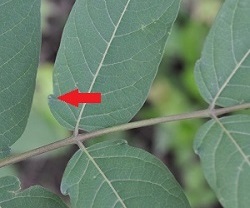
Figure 1. Tree-of-heaven have pinnately compound leaves with 11 to 27 leaflets. Each leaflet has one to several glandular teeth near the base. These are lacking on other trees and shrubs.
Don’t be fooled by the name. They are far from heaven for us. It’s actually been around for a couple hundred years. However, only over the past 10-20 years has it really begun to expand its range. This pattern is very typical of invasive species invasion. Mid-summer is one of the best times to identify and control this tree. Ohio State produced a publication on control methods, and this is linked at the end of this article. I want to focus on identification here.
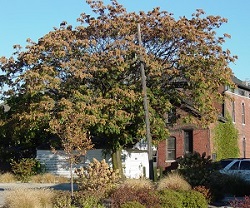
Figure 2. The fruit of tree-of-heaven are winged samaras. They can be green, red or brown in color. Numerous clusters of fruit are easily observed on tree-of-heaven during the summer.
Tree-of-heaven may be confused with similar-sized sumacs or even black walnut to the untrained eye. Because tree-of-heaven can grow very rapidly, they will often have several feet between branching along the main trunk. Some have also described the strong odor from tree-of-heaven similar to rotting peanuts. For most folks, the leaflets and fruit are the easiest features to go by. Each leaflet has one or more glandular lobes or teeth near the base. This is the best feature to differentiate it from similar species of similar size. On older trees, numerous fruit clusters will begin to form towards the end of June and will be present throughout most of July or longer. Black walnuts and other native trees with compound leaves lack these seed clusters.
Resources
Controlling Non-Native Invasive Plants in Ohio Forests: Ailanthus
Indiana Invasive Species Council
Dr. Brian MacGowan, Extension Wildlife Specialist
Department of Forestry & Natural Resources, Purdue University
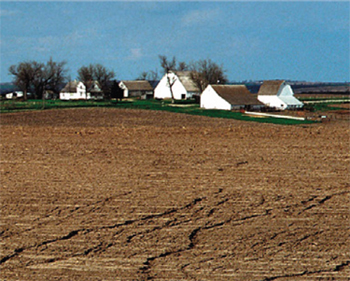 Because agriculture dominates the midwestern landscape, it has a huge impact on environmental quality. Agricultural producers are often advised to adopt practices that help to reduce the impact of agriculture on the environment. However, like all humans, they are often reluctant to change, which makes the work of conservation professionals extremely challenging. In this publication, we explore the myths and realities around what motivates farmers to adopt conservation practices. We draw on the authors’ combined research and applied practitioner experience with farmer adoption of conservation practices. Most evidence is based on studies and observations of traditional row-crop farmers in the midwestern United States.
Adoption of Agricultural Conservation Practices
The Education Store
Purdue Extension

Recent Posts
- ID That Tree: Shumard Oak
Posted: March 9, 2026 in Plants, Urban Forestry, Wildlife, Woodlands - ID That Tree: Fragrant Sumac
Posted: February 4, 2026 in Plants, Urban Forestry, Wildlife - It’s Not Too Late to Order Trees for Spring Planting
Posted: January 13, 2026 in Forestry, How To, Plants - Red in Winter – What Are Those Red Fruits I See?
Posted: December 1, 2025 in Forestry, Plants, Urban Forestry, Wildlife, Woodlands - Untangling and Identifying Vines, Purdue Landscape Report
Posted: September 29, 2025 in Invasive Plant Species, Plants, Wildlife - Control Management of Poison Hemlock
Posted: May 7, 2025 in Invasive Plant Species, Plants, Wildlife, Woodlands - Top 10 Spring Flowering Shrubs, Purdue Landscape Report
Posted: April 28, 2025 in Gardening, Plants, Urban Forestry - PPDL’s 2024 Annual Report – Enhancing Plant Health
Posted: March 21, 2025 in Forestry, Invasive Insects, Invasive Plant Species, Plants, Wildlife - What Are Invasive Species and Why Should I Care?
Posted: February 24, 2025 in Forestry, How To, Invasive Plant Species, Plants, Woodlands - Ask An Expert: Holidays in the Wild
Posted: December 9, 2024 in Christmas Trees, Forestry, Forests and Street Trees, How To, Plants, Wildlife, Woodlands
Archives
Categories
- Alert
- Aquaculture/Fish
- Aquatic/Aquaculture Resources
- Ask the Expert
- Christmas Trees
- Community Development
- Disease
- Drought
- Forestry
- Forests and Street Trees
- Gardening
- Got Nature for Kids
- Great Lakes
- How To
- Invasive Animal Species
- Invasive Insects
- Invasive Plant Species
- Land Use
- Natural Resource Planning
- Nature of Teaching
- Plants
- Podcasts
- Ponds
- Publication
- Safety
- Spiders
- Timber Marketing
- Uncategorized
- Urban Forestry
- Webinar
- Wildlife
- Wood Products/Manufacturing
- Woodland Management Moment
- Woodlands