 Purdue University - Extension - Forestry and Natural Resources
Got Nature? Blog

Issue:
Professional arborists, horticulturists, including lawn and tree care companies, garden centers, and landscapers, require training in proper management techniques and pest control to better serve their customers and protect the environment.
What Has Been Done:
The Professional Landscape Management School is a two-day workshop offered every winter to local commercial lawn and tree care companies, landscapers, nurseries, grounds managers, and garden centers. The topics chosen for the program are based on current trends and needs. I located speakers, created the program schedule and brochure, and advertised it to over 1000 professionals, using both print mail and email.
Results:
- Over 160 professional horticulturists attended the Professional Landscape Management School in 2015. Out of this number, 49 returned completed surveys. Some of the notable results:
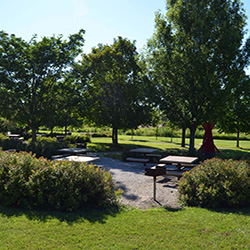
- Did you get your money’s worth from attending this year’s school? All forty-nine attendees replied – Yes.
- Do you think that you as an individual will benefit in the coming year because of your attending the 2015 Professional Landscape Management School? 100% said yes.
- Do you think that your company will benefit in the coming year because of your attending the 2015 Professional Landscape Management? 100% said yes.
- What horticultural practices do you think you will change in the coming year, based on what you learned at the 2015 Professional Landscape Management School?
- Plan on adding more native plants to my installations and designs.
- Will be more aware of honeybees when selecting and using pesticides.
- Tree Risk Assessment process can save lives and reduce my liability. Will definitely take further training in this subject.
- Will use information from Landscape Plants to Save Time and Money topic to reduce our campus manpower needs and budget requests.
- My staff and I have more knowledge to better serve our customers.
Purdue Commercial Nursery & Professional Landscape
Many of the invasive plant issues we experience in the urban ecosystem is due to improper plant selection when landscaping our homes and businesses. Often times, nurseries and garden centers stock trees and shrubs that create major issues in nearby natural areas. Landscapers everywhere seek beautiful, unusual, exceptionally hardy, drought-tolerant, or fast-growing plants. Unfortunately, plants selected for their resilience may be invasive because of their adaptable nature. Plants selected for their aesthetic value may be hard to banish from garden centers even after their invasive tendencies are revealed. These plants are typically prolific seed-producers which birds deposit everywhere creating competition for native plants.
Invasive species are damaging because they: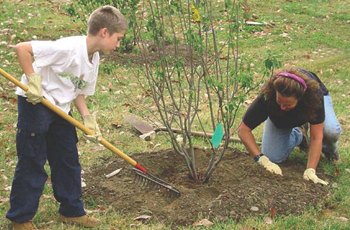
- produce large numbers of new plants each season.
- tolerate many soil types and weather conditions.
- spread easily and efficiently, usually by wind, water, or animals.
- grow rapidly, allowing them to displace slower growing plants.
- spread rampantly when they are free of the natural checks and balances found in their native range.
One of the worst offenders for invasive qualities is the Callery Pear. This ornamental pear, famous for its prolific white flowers in spring, creates a beautiful display in many landscapes. However, it is a poor choice for two major reasons. It is highly invasive and can take over entire natural areas with its heavy seed production. In addition, it is a very weak-wooded tree with poor branch structure, leaving it susceptible to splitting and breaking under heavy winds. Check out this publication for more information on the Callery Pear. See Invasive Plant Species: Callery Pear video for more information.
To help prevent the spread of invasive species, choose plants wisely. Use the following publication as a guide for alternatives for invasive landscape plants, Commercial Greenhouse and Nursery Production: Alternative Options for Invasive Landscape Plants.
Resources:
Invasive Plant Species: Callery Pear – The Education Store, Purdue Extension Resource Center
Invasive Plant Species: Oriental Bittersweet – The Education Store
Invasive Plant Species: Wintercreeper – The Education Store
Invasive Plant Species Fact Sheets: Poison Hemlock – The Education Store
Mile-a-minute Vine – The Education Store
Commercial Greenhouse and Nursery Production: Alternative Options for Invasive Landscape Plants, The Education Store
Invasive Species – Purdue Extension
Indiana’s “Most Unwanted” Invasive Plant Pest List – Indiana Cooperative Agricultural Pest Survey (CAPS) Program
Indiana Invasive Species Council – Includes: IDNR, Purdue Department of Entomology and Professional Partners
Invasive Species – Indiana Department of Natural Resources (IDNR)
National Invasive Species Awareness Week: February 27-March 3, 2017
Lindsey Purcell, Urban Forestry Specialist
Purdue University, Department of Forestry and Natural Resources
When biologists and land managers talk about managing native warm-season grasses (NWSG) they are really talking about managing early-successional plant communities. Early-successional vegetation (i.e., stands of annual or perennial grasses and forbs [broadleaf plants]) provide benefits for a variety of game and non-game wildlife species. Songbirds, northern bobwhite, and ring-necked pheasants use these areas to build nests and raise broods in the summer and for escape and thermal cover in the winter. White-tailed deer also use these areas heavily for bedding, to hide fawns from predators, and the forbs provide deer with excellent nutrition during the summer.
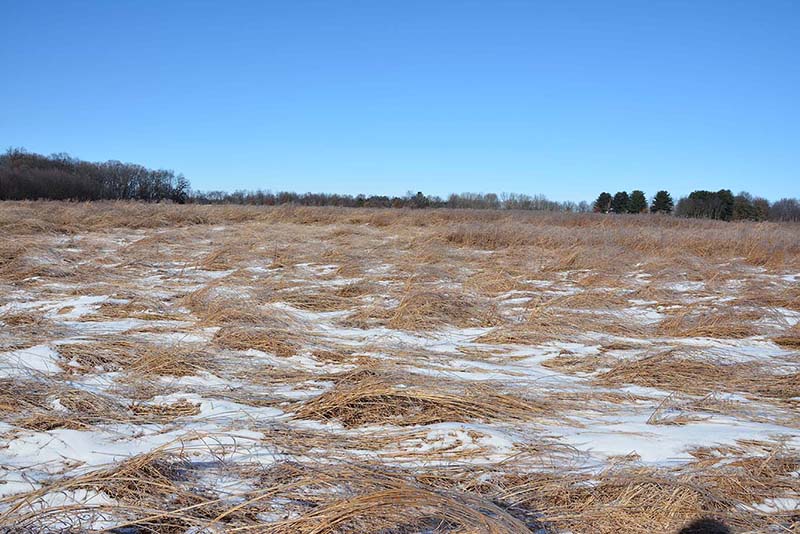
Forbs mixed with grasses help prevent the grasses from falling over and laying flat during the winter.
However, as these stands age their value to most wildlife species decreases drastically! Most stands of planted NWSG have little value, for species such as bobwhite, within 3-5 years of establishment. As the stands age, the tall perennial NWSGs (big bluestem and Indiangrass) become thicker; eventually crowding out all the forbs in the stand and creating a monoculture of grass. In the winter, the grasses fall over or “lodge”, as in the picture, and provide little to no cover.

Forbs mixed with grasses help prevent the grasses from falling over and laying flat during the winter.
This is why programs such as the Conservation Reserve Program require Mid-Contract Management (MCM) during years 4, 5, or 6 of the contract. MCM is aimed at maintaining or enhancing the wildlife value of NWSG stands by thinning the NWSGs providing room for planted and volunteering forbs to grow. These forbs act as supports for the grasses, helping them stand tall all winter, attract pollinators and insects important to foraging songbirds and game birds in the summer, and provide seed throughout the winter. Additionally, thinning the grasses and providing more room for weeds or forbs to grow will make it easier for ground dwelling wildlife to move and forage.
If your stand of NWSGs looks like the picture above, the time to manage them is not now but 2 years ago! However, managing them now can be effective and you have some options!
For most early successional wildlife species, you want the field to be from a 50/50 to 70/30 percent mix of forbs and grasses (favoring forbs). The field should be split into portions and managed on successive years. For larger fields, split the field into 4-5 acres sections. If you have multiple fields on your property you can manage the whole field. The key is to ensure that some cover is left on your farm throughout the winter.
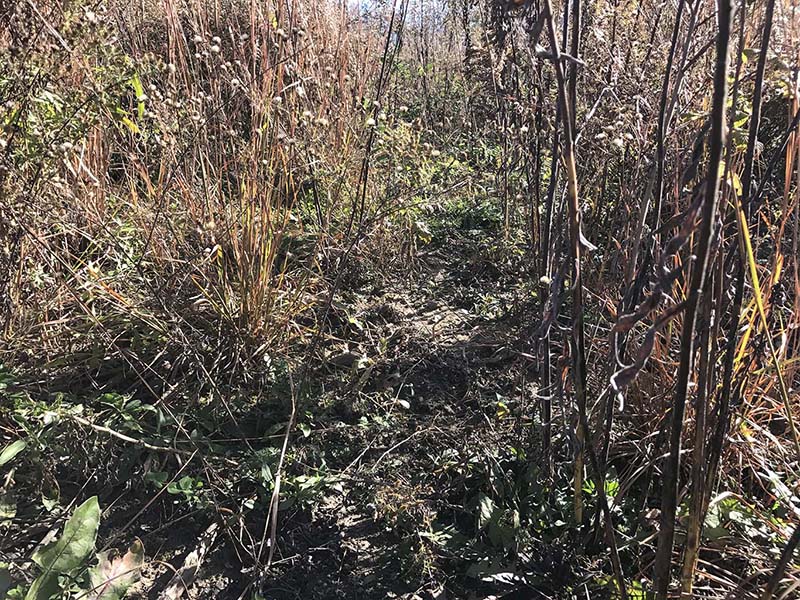
This picture gives you a “quail’s eye view” in a stand of native grasses and forbs with the ideal composition! Notice how the open space between plants and the bare ground would make it easy for a quail to maneuver and feed on insects or seed!
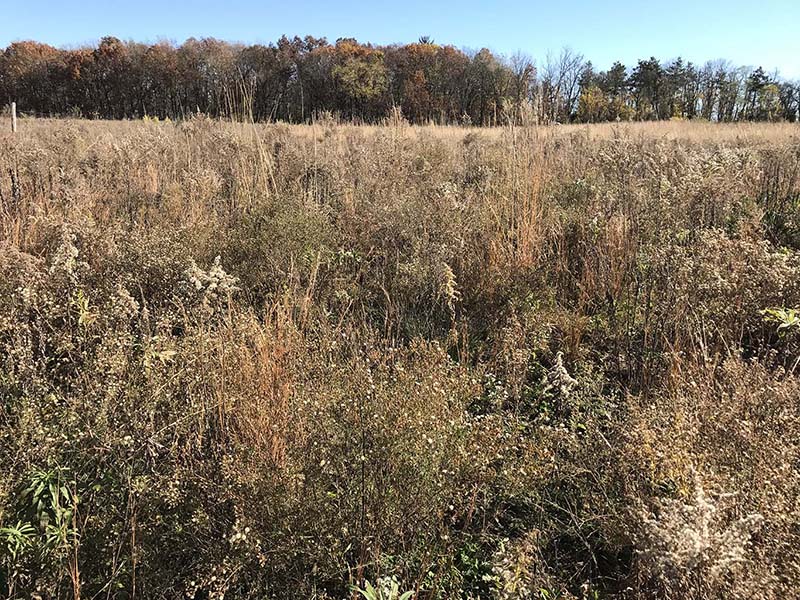
This picture represents the ideal composition of native grass stands; 50% or less of the stand is native grasses and 50% or greater of the stand is comprised of forbs.
September – March
Step 1. Burn or mow a portion of the field.
Step 2. Disk the same portion within a few weeks of burning or mowing the field.
By burning or mowing the field prior to disking, you make it easier for the disk to cut into the soil. The field should be disked so that a majority of the plant debris is worked into the soil and the soil is exposed.
Disking from September through March will result in a more beneficial plant composition than disking in the spring or summer.
May – June or August – September
Step 1. Just after winter and prior to spring green-up (late March or early April) the field should be burned to prepare the field for management. This step is not necessary but can improve the herbicide application. If applying herbicide in Aug-Sep, mowing or burning the field 2-3 weeks prior to application can be beneficial.
Step 2. Apply 2 quarts/acre of glyphosate OR 24 ounces/acre of imazapyr (53% active ingredient) to the field or portions of the field where native grasses are extremely thick.
NOTE: Spot spraying problematic areas are always better than whole field applications, but sometimes whole field applications are warranted.
CAUTION: Imazapyr can harm desirable trees; avoid spraying imazapyr within the drip line of desirable trees.
These management options will reduce or “thin” the native grasses enough to provide forbs from the seed bank with room to grow! The field may look “messy” or “weedy” the first summer or two after application but that’s okay! Actually, it’s what you want! Most of the “weeds” that come from the seed bank provide excellent cover and food for a variety of wildlife species. Just be sure to control undesirable weeds such as Canada thistle, if they appear.
For more information on how to manage NWSG or other early successional vegetation, contact your local IN-DNR wildlife biologist or NRCS office.
Additional Resources:
Herbicides to reduce NWSG density, SEAFWA
Landowner’s guide to NWSG management, TRACE
Quail Habitat – Putting the Numbers in Perspective, The Education Store
Control of Canada Thistle in CRP and Other Noncrop Acreage, The Education Store
Jarred Brooke, Extension Wildlife Specialist;
Purdue University Department of Forestry and Natural Resources
 Genetically Modified Organisms, or GMOs, is a topic that continues to be in the news and yet many of us know relatively little about this topic. We want to know what we’re eating, and we want to know how this topic is impacting the environment. Knowing more equips us to make the best decisions for ourselves and generations to come. That’s why The Science of GMOs website was created, to help break down the information and address some of the most important questions and concerns that many have. You can always count on this site to address this complicated and evolving issue with neutral, scientifically sound information.
Submit a question by visiting The Science of GMOs website: https://ag.purdue.edu/GMOs.
Resources:
GMO Issues Facing Indiana Farmers in 2001, The Education Store
Grain Quality Issues Related to Genetically Modified Crops, The Education Store
Field Crops: Corn Insect Control Recommendations – 2015, The Education Store
Indiana Vegetable Planting Calendar, The Education Store
Ornamental plants provide many environmental and ecological benefits to landscapes and urban areas. They can be aesthetically pleasing, reduce stormwater 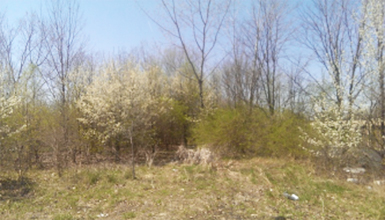 runoff, lower carbon dioxide and pollutants, alleviate the urban “heat island” effect, and provide habitats to pollinators, birds, and mammals. Unfortunately, a few of these landscape species can escape into wild areas and create ecological problems in unintended areas such as forests and woodlands.
The Indy Star shares article titled, “Bradford pears and other backyard bullies to avoid in Indiana” listing some of the invasive species that are taking over Indiana woodlands. If you are planning on adding trees or shrubs to your property this spring, you will want to view this article before planting.
Author:
Cara Anthony, cara.anthony@indystar.com
Release date of article April 2, 2016.
IndyStar
Resources from The Education Store, Purdue Extension Resource Center:
Commercial Greenhouse and Nursery Production: Alternative Options for Invasive Landscape Plants
Invasive Plant Species in Hardwood Tree Plantations
Invasive Plant Species Fact Sheets: Poison Hemlock
Mile-a-minute Vine
Native Trees of the Midwest
Shrubs and Woody Vines of Indiana and the Midwest: Identification, Wildlife Values, and Landscaping Use
Videos:
Invasive Plant Species: Callery Pear
Invasive Plant Species: Oriental Bittersweet
Invasive Plant Species: Wintercreeper
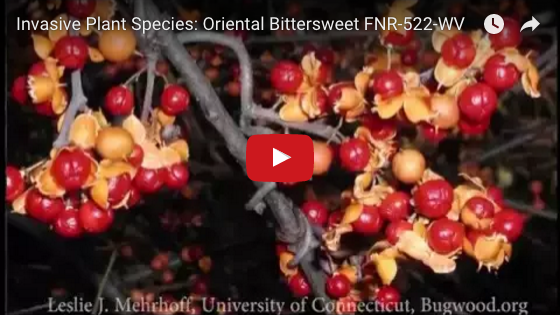 Purdue Extension-FNR now has two new expert-reviewed videos to help spread awareness of two significant invasive plant species in Indiana: the oriental bittersweet and wintercreeper. These videos share plant characteristics, their effect on forests, and alternative native species that can be utilized.
Oriental bittersweet is a vine that was brought over from Asia in the 1960’s. It is a pleasant looking plant that is popular in landscaping and home decor items. However, they can be harmful to trees as they wrap around them and cut off their access to light and are also problematic on the forest floor.
Wintercreeper was brought over as an ornamental ground cover in 1907 and is still planted for landscaping today. As birds eat its seeds, wintercreeper spreads from urban areas into the forests where it grows earlier in the spring than native plants and prevents new growth from emerging.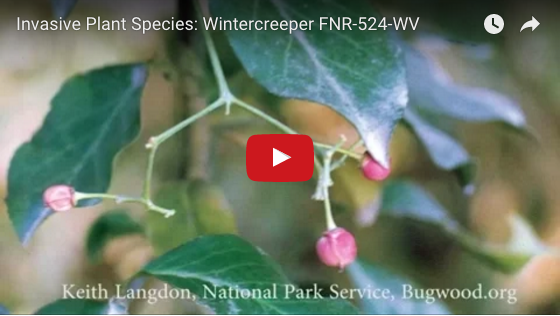
Check out the oriental bittersweet and wintercreeper videos to learn more about these invasive species and to how to join the fight to stop them from spreading further.
Resources:
Invasive Plants of the Eastern U.S.: An Introduction to the Problematic Non-Native Species – The Education Store
Invasive Plants – Purdue University, Department of Botany and Plant Pathology
Invasive Plants – Indiana Invasive Species Council
Purdue Extension-FNR Internship Program – Purdue University, Department of Forestry and Natural Resources
Danny Thomas, Purdue Extension-FNR intern
Purdue University Department of Forestry and Natural Resources
Lenny Farlee, Sustaining Hardwood Extension Specialist
Purdue University Department of Forestry and Natural Resources
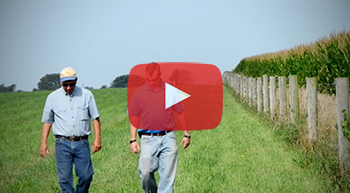 Since 2010, farmers in the Indian Creek watershed in Illinois have been working together to implement conservation practices and nutrient management strategies to reduce nutrient loading in Indian Creek. Postdoctoral Research Associate Sarah Church led the process of evaluating this watershed project and understanding which social conditions contributed to the project’s success. Her findings are presented in this new publication “Indian Creek Watershed Project: Key Takeaways for Success.”
In continuing sharing the research regarding the issues of Indian Creek Purdue Extension’s Aaron Doenges produced two videos. These videos focus on two key reasons for the project’s success: the people involved with the project’s steering committee; and the partnerships formed with agribusinesses.
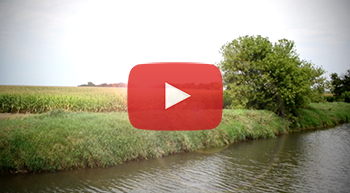 In the first video, “Partnerships and People“, Terry Bachtold of the Livingston County Soil and Water Conservation District, Chad Watts of CTIC, and several others involved in the watershed project, talk about how crucial forming a locally-led steering committee was to the project’s success. Partnerships led to friendships as the group worked together to make a difference in their watershed.
In the second video, “Partnerships with Agribusinesses“, agronomists Harold Reetz, Marion Shier, and other people involved in the watershed project discuss the importance of getting retailers like Mike Trainor involved. Agribusinesses are trusted farmer advisors, provide unique insights, and offer valuable support that can strengthen watershed projects.
“Indian Creek Watershed Project: Takeaways for Success” and the accompanying videos can provide watershed and conservation organizations with valuable insights for their own watershed projects. Moreover, farmers and retailers are encouraged read this publication, view these videos and consider becoming part of something bigger. As members of a watershed join together, economic and environmental improvements can take place.
Resources:
Indian Creek Watershed Project: Takeaways for Success – The Education Store, Purdue Extension Resource Center
Indian Creek Watershed Project – Conservation Technology Information Center (CTIC)
Indian Creek Watershed Project – Reetz Agronomics
Indian Creek Watershed Project Presentation – United States Environmental Protection Agency
A Watershed Approach – United States Environmental Protection Agency
Sarah P. Church, Post Doctoral Research Associate
Purdue University, Department of Forestry and Natural Resources
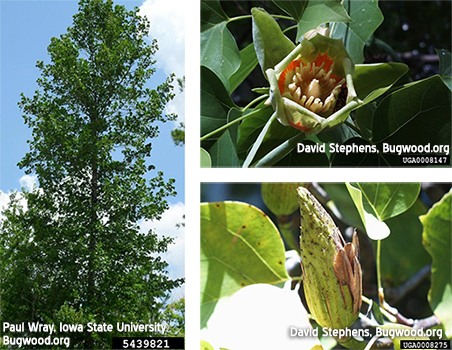 Tulip poplar (Liriodendron tulipifera) is one of the largest trees in Indiana and the eastern portion of the country. Tulip poplar reaching heights in excess of 50-60 m (160-200 ft) with a diameter at breast height (dbh) of 3 m (10 ft) have been reported while the majority of these eastern giants are between 20-30 m (70-100 ft) tall. This tree is fast-growing, has few health problems, and can live upwards of 200 years.
The tree looks best between April and June when it begins to flower as it is covered with large pale green to yellow flowers with an orange band encircling the tepals. These flowers are brimming with nectar and draw in large quantities of bees, birds, and butterflies. The tree has been deemed so magnificent that it is the state tree of Indiana, Kentucky, and Tennessee.
American ginseng (Panax quinquefolius) is an herbaceous perennial member of the ivy family that has traditionally been used in North America by Native Americans for its medicinal properties and cultivated in China for use in herbal remedies. In years past, American ginseng was widespread throughout the eastern United States until overharvesting, habitat fragmentation, urbanization, and deer browsing decimated wild populations.
Though not scientifically proven, ginseng is believed to remedy numerous health conditions such as inflammation, the flu, cancer, insomnia, erectile dysfunction, and hangovers. The herb has become one of the most popular unproven remedies in the world.
A new study noted that wild populations of American ginseng could benefit from being planted near tulip poplar. The data stated that new strategies need to be pursued in conservation efforts to save the rare American ginseng plant. The study advised that planting American ginseng on sites equally suited to tulip trees had the potential to increase outplanting success. The authors recommended planting in isolated, mostly closed canopy areas free of disturbances (trespassers, timber harvesting, large deer populations) and against planting in sites with wild sarsaparilla (Lindera benzoin).
Resources:
Ginseng: Old Crop, New Directions – Purdue University Department of Horticulture
Ginseng – Indiana Department of Natural Resources
American Ginseng – U.S. Fish & Wildlife Service
Liriodendron tulipifera – The IUCN Red List of Threatened Species
Can putative indicator species predict habitat quality for American ginseng? – ScienceDirect – Science Direct
Shaneka Lawson, Plant Physiologist
Purdue University Department of Forestry & Natural Resources
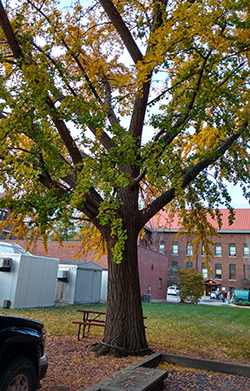 Ginkgo (Ginkgo biloba) trees also known as Maidenhair trees are slow-growing, relatively pest-free, wind-pollinated trees that can be found in all fifty of the contiguous United States. The only tree species within division Ginkgophyta to escape extinction, Ginkgo biloba is known as an ancient tree with prehistoric fossils dating back 270 million years found on every continent except Antarctica and Australia.
Ginkgo grow best in full sunlight and can reach heights greater than 35 m (115 ft). Ginkgo trees are valuable street trees because of their low susceptibility to smoke, drought, or low temperatures. These trees grow slowly and perform relatively well in most soil types provided they are well-drained. The leaves turn a vibrant yellow during autumn but drop soon after its brilliant fall color is observed.
Unfortunately, in late autumn, the dirty secret that female ginkgo trees hide is revealed. The “fruit” produced by female ginkgo trees is foul smelling (has been compared to rancid butter or animal excrement) and is cast in the fall following the first frost. Though immature when cast, the embryos within the fruit continue to mature on the ground for up to two months afterwards. This means that anyone unfortunate enough to step on the fruit during that time is exposed to its pungent odor.
Extreme caution should be used when selecting ginkgo trees for landscape ornamentals or for street trees since there is no way to discern a male from a female at the seedling stage. Several “Boys Only” cultivars have been developed such as ‘Autumn Gold’ or ‘Lakeview’ to ensure that you do not end up with a 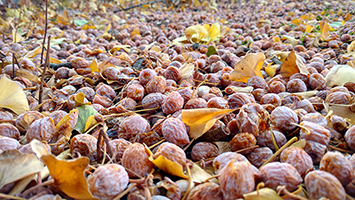 stinky yard or street when the trees begin to fruit. While the scent of the seed coat may be undesirable, the seed kernel is highly valued in Eastern Asia as a food product. In the United States, herbal extracts composed of ginkgo leaves are believed to improve short-term memory and concentration.
On the campus of Purdue University several ginkgo trees can be found although unfortunately for students the vast majority of these are female and the scent of crushed seed pods often follows many students to class on the bottoms of their shoes. A word of warning, the ginkgo trees planted near Pfendler Hall, Forestry, and the Cordova Center are all females. Watch your step this winter and this is the one rare example of when boys ARE better than girls.
Resources:
Ginkgo biloba – Purdue Arboretum Explorer
Ginkgo – Encyclopedia.com
Ginkgo biloba L. – USDA Forest Service
Shaneka Lawson, Plant Physiologist & Adjunct Assistant Professor
Purdue University Department of Natural Resources
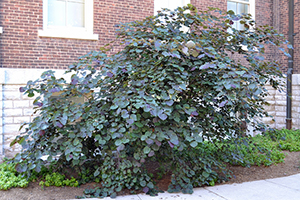
Photo credit: Purdue Arboretum
In July’s column of Purdue Yard & Garden News, Purdue Extension Consumer Horticulturist B. Rosie Lerner discusses several types of purple plants that could spice up your landscape, from small shrubs like Weigela and Ninebark to larger trees like Purple-leaf European Beech and Redbud Forest Pansy.
Resources
The Purple Landscape, Purdue Yard & Garden News
News Archive, Purdue Yard & Garden News
Purdue Master Gardener Program, Purdue Horticulture
B. Rosie Lerner
Extension Consumer Horticulturist, Purdue Extension

Recent Posts
- ID That Tree: Shumard Oak
Posted: March 9, 2026 in Plants, Urban Forestry, Wildlife, Woodlands - ID That Tree: Fragrant Sumac
Posted: February 4, 2026 in Plants, Urban Forestry, Wildlife - It’s Not Too Late to Order Trees for Spring Planting
Posted: January 13, 2026 in Forestry, How To, Plants - Red in Winter – What Are Those Red Fruits I See?
Posted: December 1, 2025 in Forestry, Plants, Urban Forestry, Wildlife, Woodlands - Untangling and Identifying Vines, Purdue Landscape Report
Posted: September 29, 2025 in Invasive Plant Species, Plants, Wildlife - Control Management of Poison Hemlock
Posted: May 7, 2025 in Invasive Plant Species, Plants, Wildlife, Woodlands - Top 10 Spring Flowering Shrubs, Purdue Landscape Report
Posted: April 28, 2025 in Gardening, Plants, Urban Forestry - PPDL’s 2024 Annual Report – Enhancing Plant Health
Posted: March 21, 2025 in Forestry, Invasive Insects, Invasive Plant Species, Plants, Wildlife - What Are Invasive Species and Why Should I Care?
Posted: February 24, 2025 in Forestry, How To, Invasive Plant Species, Plants, Woodlands - Ask An Expert: Holidays in the Wild
Posted: December 9, 2024 in Christmas Trees, Forestry, Forests and Street Trees, How To, Plants, Wildlife, Woodlands
Archives
Categories
- Alert
- Aquaculture/Fish
- Aquatic/Aquaculture Resources
- Ask the Expert
- Christmas Trees
- Community Development
- Disease
- Drought
- Forestry
- Forests and Street Trees
- Gardening
- Got Nature for Kids
- Great Lakes
- How To
- Invasive Animal Species
- Invasive Insects
- Invasive Plant Species
- Land Use
- Natural Resource Planning
- Nature of Teaching
- Plants
- Podcasts
- Ponds
- Publication
- Safety
- Spiders
- Timber Marketing
- Uncategorized
- Urban Forestry
- Webinar
- Wildlife
- Wood Products/Manufacturing
- Woodland Management Moment
- Woodlands