 Purdue University - Extension - Forestry and Natural Resources
Got Nature? Blog
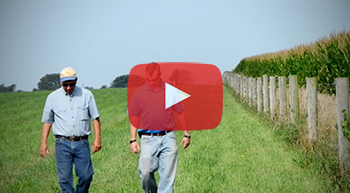 Since 2010, farmers in the Indian Creek watershed in Illinois have been working together to implement conservation practices and nutrient management strategies to reduce nutrient loading in Indian Creek. Postdoctoral Research Associate Sarah Church led the process of evaluating this watershed project and understanding which social conditions contributed to the project’s success. Her findings are presented in this new publication “Indian Creek Watershed Project: Key Takeaways for Success.”
In continuing sharing the research regarding the issues of Indian Creek Purdue Extension’s Aaron Doenges produced two videos. These videos focus on two key reasons for the project’s success: the people involved with the project’s steering committee; and the partnerships formed with agribusinesses.
 In the first video, “Partnerships and People“, Terry Bachtold of the Livingston County Soil and Water Conservation District, Chad Watts of CTIC, and several others involved in the watershed project, talk about how crucial forming a locally-led steering committee was to the project’s success. Partnerships led to friendships as the group worked together to make a difference in their watershed.
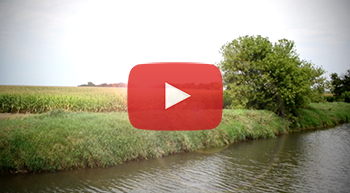
In the second video, “Partnerships with Agribusinesses“, agronomists Harold Reetz, Marion Shier, and other people involved in the watershed project discuss the importance of getting retailers like Mike Trainor involved. Agribusinesses are trusted farmer advisors, provide unique insights, and offer valuable support that can strengthen watershed projects.
“Indian Creek Watershed Project: Takeaways for Success” and the accompanying videos can provide watershed and conservation organizations with valuable insights for their own watershed projects. Moreover, farmers and retailers are encouraged read this publication, view these videos and consider becoming part of something bigger. As members of a watershed join together, economic and environmental improvements can take place.
Resources:
Indian Creek Watershed Project: Takeaways for Success – The Education Store, Purdue Extension Resource Center
Indian Creek Watershed Project – Conservation Technology Information Center (CTIC)
Indian Creek Watershed Project – Reetz Agronomics
Indian Creek Watershed Project Presentation – United States Environmental Protection Agency
A Watershed Approach – United States Environmental Protection Agency
Sarah P. Church, Post Doctoral Research Associate
Purdue University, Department of Forestry and Natural Resources
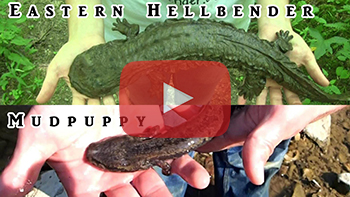 One of the main problems facing eastern hellbender (Cryptobranchus alleganiensis) conservation is that many people mistake this endangered salamander for another common species called a mudpuppy (Necturus maculosus). Conservationists and researchers encourage any outdoor enthusiasts to report eastern hellbender sightings by going to helpthehellbender.org or by reporting to a conservation officer. Unfortunately, many hellbender sightings are actually mudpuppy sightings. This can cause confusion in conservation efforts, so the need for public education on hellbender identification is strong.
We have created the “Eastern Hellbender ID Video” to teach people:
- How to identify an eastern hellbender
- How to tell the difference between a hellbender and a mudpuppy
- What to do if they see an eastern hellbender
Help the Hellbender Day at Columbian Park Zoo a Great Success – Got Nature?
Purdue partners with Indiana zoos for hellbender conservation – Purdue Agriculture News
The Nature of Teaching: Discovering the Watershed – The Education Store, Purdue Extension Resource Center
Purdue Department of Forestry and Natural Resources
Your real tree, once cut, is like fresh fruit in regards to its useful life expectancy. Just like fruit, care needs to be exercised in the trees selection and subsequent care according to Daniel Cassens, Professor in the Department of Forestry and Natural Resources, Purdue University and member of the National Christmas Tree Association. Over half of the tree’s weight consists of water when first cut and it is important that the water content be maintained.
First, it is important to select a fresh tree. If you cut the tree at a choose-and-cut farm, it has to be fresh. If the tree is pre-cut, make sure the needles are flexible and firmly attached to the stem. Also, the tree should look “normal” and not crushed with broken branches and distorted or missing needles. Fresh looking trees indicate they have been well cared for.
Fresh cut trees should be kept out of the sun and wind to prevent accelerated dehydration. If the tree needs to be temporarily stored, place it in an unheated building or on the north side of a building where it will be less exposed. It will also help to place the tree in a bucket of water.
Just before setting up the tree, using an inexpensive bow or other saw trim about one-half inch from the base of the trunk. The cut should be perpendicular to the main stem. If the tree cannot be set up within 6 to 8 hours, make another cut. About 6 to 8 hours after the cut is made, the living cells begin to die and become blocked so the tree cannot take up water.
The tree should now be placed in a stand capable of supporting the tree mechanically. Make sure the stand has extended legs to prevent the tree from tipping. Do not whittle down the outside diameter of the tree base. The outer layers of wood are the most effective in taking up water. The stand should also be able to hold at least one quart of water for each inch of stem diameter. A typical 7 foot tree will require a stand with a water holding capacity of about two gallons. Check the water level each day and add cool water as needed. Make sure the butt end of the tree stem is always in water contact. Some stands do not allow the stem to reach the bottom of the water holding container. Trees tend to take large quantities of water each day for the first week or so and then slow down. Remember, if the tree runs out of water, the cells in the very butt or exposed end will become blocked and subsequent water uptake will be prevented.
Some tree lights can also produce excessive heat. Small lights or those that produce low heat will also help to reducing localized drying of the tree.
For more information about Christmas trees or to locate a choose-and-cut tree farm near you, please visit the National Christmas Tree Growers Association.
Resources:
A Choose-and-Cut Pine and Fir Christmas Tree Case Study, The Education Store, Purdue Extension’s resource center
Selecting an Indiana-Grown Christmas Tree, The Education Store
Tips for First-Time Buyers of Real Christmas Trees, The Education Store
Daniel Cassens, Professor Emeritus
Department of Forestry and Natural Resources
The debate over rather the use of a real tree or an artificial tree is better for the environment continues, especially as the Holiday season nears. Real tree growers point out that their product is renewable, each species has its own characteristic odor, consumes carbon dioxide and gives off oxygen, can be recycled, provides wildlife habitat and creates jobs in rural America. Artificial trees contain non biodegradable plastics and possible metal toxins such as lead. Most artificial trees are made in China and must be shipped long distances to the United States. On the other hand the artificial tree industry points out that their product can be reused and thus saves several real trees from being harvested. The industry goes on to claim that their trees do not need fertilizers or pesticides and do not create a mess or hassle. These are just examples of claims being made by two distinctly different industries. Considering the entire production cycle for real and artificial trees, it is difficult to determine which type of tree is best for the environment, based on scientific based data. Conducting a “Life Cycle Assessment” (LCA) for real and artificial trees would be one approach to answer this question.
Real Christmas trees, like all green plants, consume carbon dioxide and produce oxygen. The carbon dioxide is absorbed through the leaves or needles, combined with sunshine and water to make food and release oxygen. This process is called photosynthesis. The “carbon” is stored in the wood, needles, and leaves and constitutes about one-half of the dry weight. If the trees are burned or otherwise decomposed the “stored” or sequestered carbon is released back into the atmosphere. Other existing or planted trees absorb the carbon making trees carbon neutral. Some of the carbon is also stored in the soil. Growing trees also require some carbon dioxide back into the atmosphere.
Artificial trees use petroleum based products. Petroleum based products are ancient, stored sources of carbon dioxide and if burned as in the case of gasoline, release new carbon dioxide into the atmosphere. Transportation becomes a significant source of carbon release regardless of the tree being real or artificial.
Carbon dioxide is important because it traps heat from the earth’s surface. This is often referred to as the “greenhouse effect”. The amount of carbon dioxide in the atmosphere has been increasing since the late 1800’s and scientific data shows a particularly significant increase since the 1960’s. “Global warming” is the term being used to describe an increase in the world’s average surface temperature as a result of more heat being trapped.
“Cradle to Grave” or “Life Cycle Assessments” are used to summarize all of the positive and negative activities associated with developing a product and delivering it to the consumer. LCA’s become complicated, costly and the results are dependent on exactly which set or sets of circumstances are considered. Only one documented study on real and artificial trees is available. A Canadian Environmental consulting firm, Ellipsos has completed a LCA for both real and artificial trees. (Ellipsos/Strategists in Sustainable Development)
In this study, the carbon balance for an individual 7 foot high real Christmas tree was about +24 Kg (53 lbs) of CARBON DIOXIDE after all factors such as labor, use of machinery, transportation, and other inputs are considered. The tree was grown south of Montreal, Canada. It was assumed that the tree was grown in the nursery for four years and in the field for 11 years. In Indiana, two year old nursery stock and about 7 years in the field to produce a 7 foot tree are more typical and would probably result in less carbon being released. The “+” indicates that the overall process of growing a tree is carbon positive (i.e. carbon is released).
The carbon balance for a similar six foot artificial tree was about +48Kg (106 lbs) of CARBON DIOXIDE or twice that of the real tree. Most of the positive carbon release in this case is due to the manufacturing of the tree and transportation of the tree by boat from China to Vancouver and then by train to Montreal, Canada.
For comparison purposes, the average American car emits about 1.5 tons or 3000 pounds of carbon into the atmosphere on a yearly basis. (Green Car Congress)
The Ellipsos report assumed that the real tree would be burned for fuel at the end of the life cycle, thus releasing all of the stored carbon in the tree. If the real tree is recycled for mulch or fish habitat or other uses the carbon budget would be closer to zero at least until the tree finally decomposes. The study goes on to conclude that considering climate change impact along with environmental and public health impact, real trees appear to be a better choice for a responsible customer and that artificial trees must be displayed for more than 20 years in order for it to compare favorably with the real Christmas tree.
The assessment method used for the life cycle analysis groups problems into four damage oriented impacts areas on the environment. These are 1) climate change, 2) human health, 3) ecosystem quality, and 4) resource depletion. The results for the Ellipsos report are interesting. Considering climate change, the real tree has much less impact due to a smaller amount of carbon being released into the atmosphere as discussed above. The LCA also considers the products impact on human health, ecosystem quality and resource depletion. Considering human health, the artificial tree is a slightly better choice than the real tree. Considering ecosystem quality, the artificial tree is a better choice. This is likely due to the use of land for plantations and associated cultural practices (fertilizer, pesticide, irrigation) for real trees. In regards to both climate change (global warming) and resource depletion (use of non-renewable energy and mineral extraction), the real tree is a better choice than the artificial tree. The Ellipsos report titled “Comparative life Cycle Assessment (LCA) of Artificial vs Natural Christmas trees” can be viewed by Googling “Ellipsos report 1043-RF3-09.”
Both real and artificial trees have positive and negative attributes. Based on this study, the real tree has less effect on global warming than the artificial tree ie less carbon is released. The amount of carbon released by either the real or artificial tree is relatively small compared to that released by the average car over the course of the year. To reduce carbon production, consumers might be better advised to limit (plan ahead) the use of the car over the holiday season.
For more information about Christmas trees or to locate a choose-and-cut tree farm near you, please visit the National Christmas Tree Growers Association.
Other resources:
A Choose-and-Cut Pine and Fir Christmas Tree Case Study, The Education Store, Purdue Extension’s resource center
Selecting an Indiana-Grown Christmas Tree, The Education Store
Tips for First-Time Buyers of Real Christmas Trees, The Education Store
Daniel Cassens, Professor Emeritus
Department of Forestry and Natural Resources
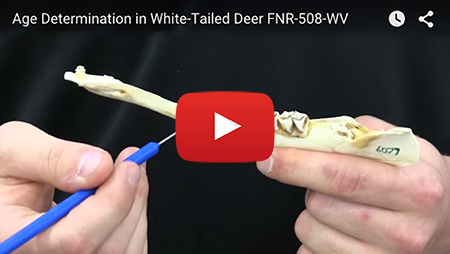 The age of a harvested deer is important for both hunters and landowners to know. The relationship between the age of a deer and its antler development can be an indicator of the deer’s health, and whether foraging conditions or harvest strategies should be changed. To help with determining this, the Purdue Student Chapter of the Quality Deer Management Association has created a How-To video to walk you through two of the techniques used to deduce how old the deer is using it’s jawbone.
This free video is available to view through The Education Store: Age Determination in White-Tailed Deer.
Other Resources:
How to Score Your White-Tailed Deer video, The Education Store-Purdue Extension Resource Center
Food Plots for White-tailed Deer, The Education Store
Boiler Up for Wildlife: Fall outbreaks of EHD and Blue Tongue in deer, Got Nature? Podcasts
Boiler Up for Wildlife: Deer Warts, Got Nature? Podcasts
iTunes – Got Nature? Podcasts
Rod Williams, Associate Professor of Wildlife Science
Department of Forestry and Natural Resources, Purdue University
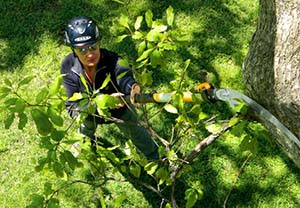 Trees continue to survive in spite of the many challenges they face in the urban environment. However, to grow from seedling to a mature tree in the urban forest, they need our help. They are the largest, oldest living organisms on the planet and can live long, healthy lives with some assistance. We often place trees in less-than-favorable growing locations that don’t allow natural development and maturity and often require pruning to develop a durable structure, improve clearance and maintain aesthetics.
Pruning has been called “one of the best, worst maintenance practices” performed on trees. The process creates wounds, which have a major impact on plant processes. Improper cutting on a tree causes severe damage or even death. To prune properly, it is important to understand both the proper techniques and how the tree responds to pruning.
In this publication, Urban Forestry Specialist Lindsey Purcell explores the techniques behind good pruning, from the planning process before planting to monitoring the tree’s response after the pruning cuts. Check out Tree Pruning Essentials and make sure you are pruning your trees to maximize safety, aesthetics and tree health!
Resources
Tree Pruning Essentials, Purdue Extension
Tree Pruning Essentials Video, Purdue Extension
Trees and Storms, Got Nature?
Tree Risk Management, The Education Store, Purdue Extension Resource Center
Pruning, Indiana Department of Natural Resources
Prune Your Trees, Indiana Department of Natural Resources
Lindsey Purcell, Urban Forestry Specialist
Department of Natural Resources, Purdue University
 Indiana Department of Natural Resources (INDNR) recently received an inquiry asking what to do with an abandoned animal. The INDNR web resource titled Orphaned and Injured Animals has steps to follow as you decide if the animal is truly abandoned.
Got Nature? Orphaned Animals author Brian MacGowan, extension wildlife specialist, Purdue University, says, “In most cases, the young animal is simply ‘spreading its wings’ and exploring or mom simply left it to get something to eat. Fawn deer are programmed to hide and remain motionless while mom is away. The fact is wildlife rarely abandons their young. They may leave briefly only to return.
Remember that you should never handle wild animals unless absolutely necessary. Any animal can bite you, and many harbor diseases and pests that can be transmitted to people.
In Indiana, wildlife rehabilitators have necessary state and federal permits to house and care for sick or injured wild animals. If you think you have found a sick or injured animal, you can find a list of licensed Wild Animal Rehabilitators in your area on the DNR Division of Fish and Wildlife’s website.”
Resources
Mammals of Indiana, J.O. Whitker and R.E. Mumford
Common Indiana Mammals, R.N. Chapman and R.N. Williams, publication number FNR-413-W
Indiana DNR Orphaned and Injured Animals
The Education Store (search keywords to find the resources you need)
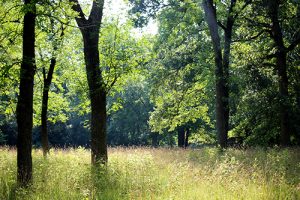 The Indiana Department of Natural Resources (INDNR) has just released a new and updated application for iPhone and Android users. A successor to the previous app released in March 2011, this iteration introduces new features and DNR Director Cameron Clark calls it a “portable field guide.” The free app contains helpful information about any DNR-related properties such as forests, wildlife areas and state parks and serves as a helpful companion while planning outdoor activities. To download this app, visit iTunes for iPhone users or Google Play Store for Android users.
Resources
Indiana DNR Smartphone Apps, Indiana Department of Natural Resources
DNR Releases New, Improved Mobile Apps, WANE15
Publications and Maps, Indiana Department of Natural Resources
 A new educational exhibit aimed for kindergartners to fifth graders called “A Salamander Tale” is ready to be shipped around the country and spread amphibian awareness. This interactive attraction is roughly 300 square feet and helps educate visitors at all ages about hellbenders, other salamanders and amphibians in general. Built into the exhibit is a video game called “Hellbender Havoc,” which provides a fun and unique way to learn about hellbenders. “Hellbender Havoc” is also playable online using Chrome or Firefox browsers.
Rental fees do apply for reserving the exhibit. Indiana state and extension professionals, also including Purdue staff, can rent the exhibit for free after paying for shipping. For more information, please check out the Salamander Tale web page, or feel free to take a look at other current exhibits on the Purdue Traveling Exhibits page. Check out Herbie the Hellbender today and inspire the Herpetologists of tomorrow!
Resources
Purdue Traveling Exhibits, Purdue Agriculture
Help the Hellbender, Purdue Extension
Salamanders of Indiana Book, The Education Store
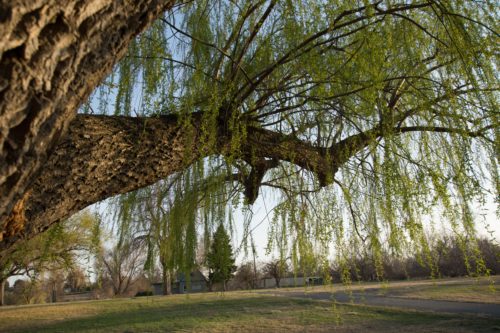 Question: Weeping willow, six years old and 9″ diameter. Wet, clay ground and thriving. Suddenly late last summer, I noticed the leaves were dead, and the bark on the trunk was completely loose and falling off. No other trees or shrubs within 50 feet (black walnut, sycamore, maple, rose of sharon) were affected. No obvious sign of insects, boring, trails, worms, etc.
Answer: When a tree starts to lose leaves, especially in the spring when they should be expanding for the new growing season, it can be puzzling. Often, this is a sign of troubles which can be caused by biotic or abiotic issues but not always a major cause for alarm. The dropping leaves can be a symptom of foliar diseases which weakens the tree, or it could be the result of an insect pest feeding on the petioles of the leaves. There are many pests which can cause leaf drop.
Another possible cause is the response to abiotic disorders which is typically a complex of issues. Leaf drop can occur on trees that have been exposed to prolonged wetness in heavy, clay soils. Some tree species like wet soils but not prolonged wetness without drainage. If trees are exposed to continual wetness, their roots can become diseased and cause the leaf drop. Additionally, it has been noted that trees which were planted improperly, especially if planted too deep, can result in several physiological issues such as decline and dieback.
If trees reveal symptoms of premature fall color, yellowing of leaves or unusual leaf drop, it may be necessary to send in a sample for diagnosis. The Purdue Plant and Pest Diagnostic Laboratory (PPDL) provides this service by a very capable team of pathologists, entomologists and extension specialists to analyze plant issues in the landscape. This is an inexpensive approach to investigating the issues and leading to the best possible curative measures. Protocol for submitting plant samples can be found on the PPDL website.
Resources
Hardwood Tree Improvement and Regeneration Center, Paula Pijut, Research Plant Physiologist, Purdue University
Relationships Between Advance Oak Regeneration and Biotic and Abiotic Factors, Songlin Fei, Associate Professor of Measurements and Quantitative Analysis, Purdue University
Diseases of Landscape Plants: Leaf Diseases, The Education Store, Purdue Extension Resource Center
Lindsey Purcell, Urban Forestry Specialist
Department of Forestry and Natural Resources, Purdue University

Recent Posts
- Purdue Extension: Empowering Indiana Through Innovation, Education and Community Impact
Posted: January 28, 2026 in Community Development, How To, Invasive Insects, Invasive Plant Species, Natural Resource Planning, Woodlands - Forest Landowners: Share Your Experience with Regeneration and Restoration
Posted: January 27, 2026 in Forestry, How To, Timber Marketing, Woodlands - It’s Not Too Late to Order Trees for Spring Planting
Posted: January 13, 2026 in Forestry, How To, Plants - Now Is The Time To Control Non-Native Bush Honeysuckle
Posted: October 30, 2025 in Forestry, How To, Invasive Plant Species, Woodlands - October Is Firewood Month: Protect Indiana’s Forests by Making Smart Choices
Posted: October 13, 2025 in Forestry, Forests and Street Trees, How To, Invasive Insects, Urban Forestry - ID That Tree: Smooth Sumac
Posted: October 2, 2025 in Forestry, How To, Wildlife - ID That Tree: Wild Grape Vine
Posted: August 12, 2025 in Forestry, How To, Urban Forestry, Wildlife - Publication – Sericea Lespedeza Control
Posted: July 7, 2025 in Forestry, How To, Invasive Plant Species, Wildlife - How to ID Asian Jumping Worms, Purdue Landscape Report
Posted: July 2, 2025 in How To, Invasive Insects, Wildlife - Alert – Water Your Trees, Watch Video
Posted: June 20, 2025 in Alert, Drought, Forests and Street Trees, How To, Urban Forestry, Wildlife, Woodlands
Archives
Categories
- Alert
- Aquaculture/Fish
- Aquatic/Aquaculture Resources
- Ask the Expert
- Christmas Trees
- Community Development
- Disease
- Drought
- Forestry
- Forests and Street Trees
- Gardening
- Got Nature for Kids
- Great Lakes
- How To
- Invasive Animal Species
- Invasive Insects
- Invasive Plant Species
- Land Use
- Natural Resource Planning
- Nature of Teaching
- Plants
- Podcasts
- Ponds
- Publication
- Safety
- Spiders
- Timber Marketing
- Uncategorized
- Urban Forestry
- Webinar
- Wildlife
- Wood Products/Manufacturing
- Woodland Management Moment
- Woodlands