 Purdue University - Extension - Forestry and Natural Resources
Got Nature? Blog
 Soundscape ecology is a new field of research that investigates how sound in the environment can be used to assess ecosystem health as well as human connection to nature and the environment in general. With this app, you can help capture and preserve sounds of the Earth and highlight their bellwether role in alerting scientists to environmental habitat changes by species. This app was originally launched to encourage the general public’s citizen researchers to capture natural sound recordings and upload them for preservation during Earth Day 2014. However, we are continuing to preserve sounds that you capture using this app.
Resources
Center for Global Soundscapes
Conserving Biodiversity in Agricultural Landscapes, Purdue University Press
Managing Forest & Wildlife Resources: An Integrated Approach, The Education Store
Bryan Pijanowski, Professor of Human-Environment Modeling and Analysis Laboratory
Department of Forestry and Natural Resources
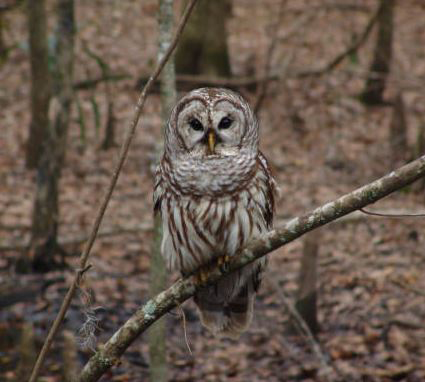
Photo Credit: U.S. Fish and Wildlife Service.
It’s me, the crazy wildlife student again. This time, I’m running around in the dark playing owl calls in the middle of the woods.
What was I doing? Owl surveys, and I was helping provide data for the Hardwood Ecosystem Experiment (or HEE). Basically what we’re trying to figure out is if barred owls and eastern screech owls prefer managed or unmanaged forests. Do they like pristine, untouched areas? Or do they desire a changing atmosphere where timber harvests are opening up new areas and there’s more variation in the age of trees? The data may tell. However, the process to get it is interesting. We drive between different checkpoints with about 90 for barred owls and 100 for eastern screech owls. At each of these, we blare owl noises out of a truck and wait for anything to respond.
How is this fun? Well first, I got to travel with Jeff Riegel, Field Supervisor of the HEE. He helped me understand what we were doing and told me all about the HEE as we bumped along logging roads just wide enough for his truck. “Be prepared for anything,” he told me as he took out a blowtorch to unfreeze lock after lock. He also had a chainsaw in case of fallen trees among various other tools I’m sure have been put to good use.
It was pretty cold outside, just hovering under 20 degrees Fahrenheit, and it was dropping as snow began to quilt the forest. It was also very quiet. One of the only disturbances was when we spooked an eastern screech owl; it flew away in its unique way, wings flapping rapidly but its body perfectly still in flight. As we repeated the process of the survey again and again (pop in the CD, roll down the windows, open both back doors and stand in front of the truck with the lights off), I scanned the trees for the silhouettes of owls as snow filtered down through the scarce frozen leaves. Jeff talked about how some owls would perch at the same branch every year and respond to the calls. He also talked about the volunteers that kept up the data flow, how some did it to enjoy the quiet night atmosphere, while others did it just to get the chance to hear the eerie but beautiful sounds of the owls. Even better was the chance to see dark wings among the trees.
The surveys are conducted in the winter to avoid messing with the owls’ nesting season. An owl’s eggs can freeze quickly if left unattended, and the birds will come to investigate the calls to make sure their territory is not being encroached upon, leaving the eggs. The timing has to be careful.
They’re mysterious creatures, but their calls remind us that the forest is alive in the darkness.
Learn more about the Hardwood Ecosystem Experiment.
Morgan Sussman, Freshman
Department of Forestry and Natural Resources, Purdue Univeristy
 Ever wondered why people go into wildlife? I mean, we’re expected to have low salaries. Why are we spending so much money to get a degree where we’ll go out to observe animals for a living or manage them? Can’t we do that as an everyday person with pets?
I can’t answer this question for everyone, but I’ll give it a shot. We are fascinated by the world around us. We love it and want to understand it, along with our role in it. It’s that simple.
There’s so much to be learned as a student in wildlife, even though we’ve been living alongside the concepts we’re learning about all our lives. Every time I walk into my Introduction to Environmental Conservation class, I walk out and gain an entirely new viewpoint. Recycling has taken on a whole new meaning when put into the dimensions of its actual effects. All my bathroom products give me a deep sense of suspicion because there are simply so many different chemicals and plastics being used with them. I have developed a rational hatred for ginkgo trees while on Purdue’s campus; not only do they stink, they’re also not even native. I worry about the squirrel population because that many squirrels in 10 yards of grass cannot be healthy. I’m all for wooden buildings, so long as it’s sustainable, thanks to carbon sequestration. Did you know wood is made up of 50 percent carbon? So when it’s built into buildings, it’s not actually harming the environment because it’s still holding in all that carbon dioxide that would have gone into the atmosphere had the tree been burned or decomposed. All this to say, I just pay a lot more attention to the environment around me.
Those are just some of the concepts we’ve learned so far, and it’s a blast. On top of this, I feel like we’re actually doing something good for humanity. Not many people want to do the dirty work or have months of research credited with one line in a scientific paper. However, we get to better see how it’s all interconnected. The world is more entwined than anyone knows. If everyone took just one day to be a wildlife student, it would be an incredible transformation in the world, even if each person only took one aspect away from the lesson learned.
Resources
FNR Majors and Minors, Purdue FNR
Prospective Students, Purdue FNR
We Know Nature! FNR This is Your Class Project Video
Morgan Sussman, Freshman
Department of Forestry and Natural Resources, Purdue University
 The Wildlife Habitat Education Program (WHEP) helps students understand wildlife ecology and management practices. In addition, students gain skills in teamwork, oral and written communication, decision-making and leadership. The WHEP career development event includes three activities: Wildlife Challenge, Wildlife Management Practices and Wildlife Management Plan. Each activity has an important role in teaching about the management of wildlife populations. The instructions in this publication can help leaders teach students to evaluate habitat for Wildlife Management Practices (WMPs).
Wildlife Habitat Education Program – Teaching and Learning Wildlife Management Practices is available at The Education Store today.
Resources
Wildlife Habitat Education Program (WHEP)
A Template for Your Wildlife Habitat Management Plan, The Education Store
Managing Forest and Wildlife Resources: An Integrated Approach, The Education Store
Teaching and Learning Wildlife Management Practices, The Education Store
Indiana’s State Wildlife Action Plan, Indiana DNR
Brian MacGowan, Extension Wildlife Specialist
Department of Forestry and Natural Resources
As hellbenders continue to decline, Dr. Rod Williams and his research team have been sharing awareness of how important it is that these salamanders continue to thrive in the current ecosystem.
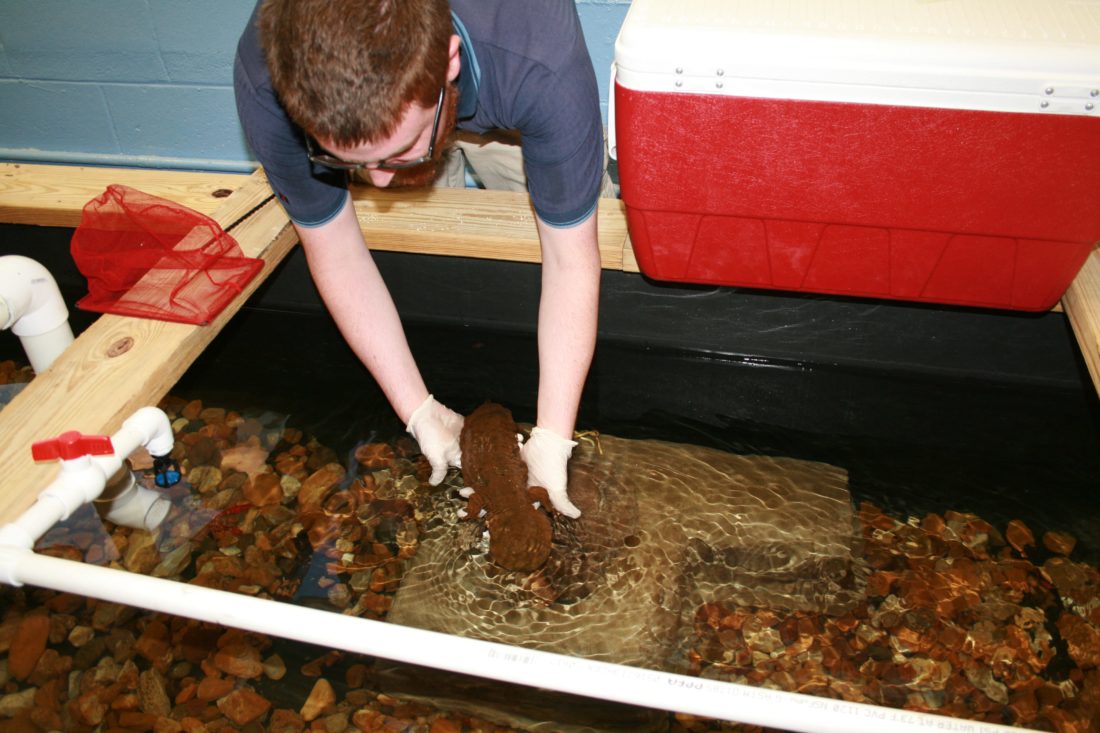
Eastern hellbenders are the largest salamander in North America. Adults can reach 29 inches in length, though most individuals are typically 11-24 inches long. Clean water is important for Hellbenders because they obtain most of their oxygen from the water by “breathing” through their skin. When breathing, their fleshy folds expand in surface area, enabling them to absorb more oxygen from the water.
Hellbender populations are declining across their range, from Missouri to New York. This decline, which affects the hellbender population in Indiana’s Blue River, is likely caused by human influences such as habitat degradation and destruction. The stream-bottom habitat of hellbenders can be degraded by sediment from eroded banks and fields and destroyed when streams are dammed or dredged. Hellbenders are also captured inadvertently by anglers or purposefully for illegal sale in the pet trade. Finally, emerging diseases may be impacting some populations of hellbenders.
Many states are developing conservation programs to help the hellbender. For more information and to learn more on conservation efforts, view Help the Hellbender.
Dr. Rod Williams and his hellbender research team have recently made national news:
CBS News
Trying To Save The Hellbender, America’s Largest Salamander
July 10, 2014
Resources:
Help the Hellbender Facebook page
Ask the Expert: Learn All About Hellbenders and Take a Tour, Subscribe Purdue Extension – Forestry & Natural Resources (FNR) YouTube Channel
Ask the Expert video: Help the Hellbender – Dr. Stephen Spear of The Wilds, Purdue Extension – FNR YouTube Channel
Ask the Expert video: Live with Mesker Park Zoo and Botanical Gardens – Hellbenders, Purdue Extension – FNR YouTube Channel
A Moment in the Wild video: Hellbender Hide, Purdue Extension – FNR YouTube Channel
A Moment in the Wild video: Release Moment of Hellbenders,
How Anglers and Paddlers Can Help the Hellbender video, Purdue Extension – FNR YouTube Channel
Eastern Hellbender ID Video, Purdue Extension – FNR YouTube Channel
Hellbenders Rock!, The Education Store, Purdue Extension’s resource center
Help the Hellbender, North America’s Giant Salamander, The Education Store
How Our Zoos Help Hellbenders, The Education Store
The Nature of Teaching: Adaptations for Aquatic Amphibians, The Education Store
Healthy Water, Happy Home – Lesson Plan, The Education Store
Purdue Expert: Hellbender Salamander, Purdue University News YouTube Channel
FNR Assists in First Natural Breeding of Eastern Hellbender in Captivity, Purdue FNR News & Stories
Helping the Hellbender: Mesker Park Zoo Begins Captive Breeding Efforts, Purdue Agriculture News
Rod Williams, Professor of Wildlife science and Assistant Provost for Engagement at Purdue University
Department of Forestry and Natural Resources, Purdue University
Diana Evans, Extension Information Coordinator
Department of Forestry and Natural Resources, Purdue University
Indiana Department of Natural Resources (INDNR) recently received inquiries asking what to do with an abandoned animal. The INDNR web resource titled Orphaned and Injured Animals has steps to follow as you decide if the animal is truly abandoned.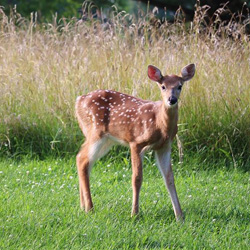
Resources
Got Nature? Orphaned Animals, author Brian MacGowan, extension wildlife specialist, Purdue University:
In most cases, the young animal is simply “spreading its wings” and exploring, or mom simply left it to get something to eat. Fawn deer are programmed to hide and remain motionless while mom is away. The fact is wildlife rarely abandons their young. They may leave briefly only to return.
Remember that you should never handle wild animals unless absolutely necessary. Any animal can bite you, and many harbor diseases and pests that can be transmitted to people.
In Indiana, wildlife rehabilitators have necessary state and federal permits to house and care for sick or injured wild animals. If you think you have found a sick or injured animal, you can find a list of licensed Wild Animal Rehabilitators in your area on the DNR Division of Fish and Wildlife’s website.
Mammals of Indiana, J.O. Whitker and R.E. Mumford
Common Indiana Mammals, R.N. Chapman and R.N. Williams, publication number FNR-413-W
Orphaned and Injured Animals, Indiana DNR
The Education Store (Search keywords to find the resources you need)
Spring time brings a cacophony of frog calls around ponds and wetlands, but as spring slowly transitions into summer, the warmer temperatures signal the breeding season for many of our native reptiles. One of the oldest and most primitive reptile groups are the turtles. These ancient reptiles have remained relatively unchanged for 225 million years. There are currently ~300 species of turtles worldwide, and 18 species are found in Indiana. Most turtles in Indiana are associated with water, particularly waters that provide a variety of food items, basking sites and adjacent upland habitats. While Indiana is home to a diversity of turtle species, many are declining in number across their range. There are many factors contributing to these declines, but one that is particularly important this time of year is road mortality.
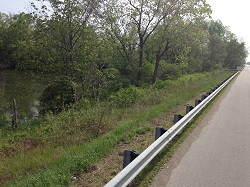
Figure 1: Small pond containing semi-aquatic turtles with a major road intersecting adjacent breeding habitat.
Why do you see so many turtles crossing the road in late spring and early summer (May-June)? This is the time of year when most of our turtles are searching for adequate nesting sites. Unlike amphibians that generally lay their eggs directly in the water, female turtles search for nesting spots in open, unshaded areas where the soil is not muddy or subject to flooding. Nests are often located on the nearest spot of land providing these conditions, but females of some species may travel 1-2 kilometers in search of a suitable net site.
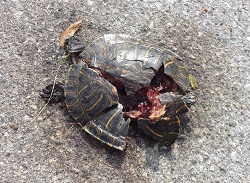
Figure 2: Female Red-eared Slider killed while attempting to cross the road to lay eggs at nearby upland nesting site.
Unfortunately, many of the upland sites are separated from ponds, lakes and streams by roads (Figure 1). As the females leave the ponds to lay eggs, they are forced to cross busy roads and may suffer incredibly high mortality rates (Figure 2). Females are more prone to road mortality than males (which are not required to leave the water to lay eggs), resulting in some populations consisting of nearly all male turtles. Increased female mortality lowers population growth rates (once the female is killed, so are the eggs she was carrying). To further complicate matters, turtles are long-lived species (up to 100 years), and females may not reach sexual maturity for 8-25 years.
What can you do to help? Increase vigilance and slow down when driving, especially in areas where roads intersect ponds and adjacent uplands. If you encounter an injured turtle that needs medical attention, call the Indiana DNR at 800-893-4116 or 317-232-4080 during business hours, 765-473-9722 (northern half of Indiana) or 812-837-9536 (southern half of Indiana) after hours or visit wildlifehotline.info.
For more information on turtles:
The Turtles of Indiana
The Education Store (Search keywords for more information)
Rod Williams, Associate Professor of Wildlife Science
Department of Forestry and Natural Resources, Purdue University
The month of May is not only known for producing flowers but the start of the white-tailed deer fawning season. In fact, nearly 90% of all white-tailed deer fawns are born between mid-May and mid-June. This time of year coincides with many of the outdoor activities that we all enjoy (hiking, mushroom hunting and shed hunting) and may sometimes bring us into contact with deer fawns.
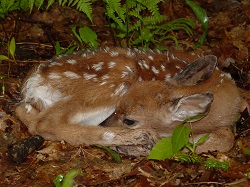
Figure 1. White-tailed deer fawn hiding in cover while the mother is off feeding.
When out enjoying nature, it is not uncommon to come upon a fawn tucked away under brushy cover, alone (Figure 1). At first glance, it may appear that the fawn has been abandoned by its mother, but this is rarely the case. This is actually part of the doe’s strategy to keep her fawn alive. Caching fawns in heavy cover serves to keep the fawn out of sight and away from would-be predators. A fawn will instinctively stay bedded down, remain motionless and silent until its mother returns from feeding. However, if harassed, the fawn may eventually leave the safety of cover and bleat in distress which results in the doe returning immediately to her fawn.
If you happen upon a fawn in the wild, you should not handle or harass it. Handling young fawns can distress not only the fawn, but the mother that is likely close by. If you happen to find a fawn cached in the woods, admire its hiding spot, spotted camouflage pattern and perhaps snap a photo. Take pride in knowing that the young fawn is not an abandoned orphan and will soon grow into the largest wild mammal in Indiana.
Under no circumstance should you remove a fawn from its hiding place. Removing wildlife from the environment is illegal without a proper handling permit from the Department of Natural Resources. If you find a sick or injured animal, you should contact your DNR law enforcement district or regional headquarters. The DNR does not care for injured animals but can connect you to licensed wildlife rehabilitators with the appropriate permits to care for injured wildlife.
Sources
Mammals of Indiana, J.O. Whitker and R.E. Mumford
Common Indiana Mammals, R.N. Chapman and R.N. Williams, FNR-413-W
Indiana DNR Orphaned and Injured Animals
Rod Williams, Associate Professor of Wildlife Science
Department of Forestry and Natural Resources, Purdue University
Box turtles are so-called because unlike most turtles, they can completely close up their shell, much like a box. They have a hinged belly that can close so tightly that even an ant couldn’t get inside. They have probably evolved this capability in order to be safe from predators such as raccoons and opossums. There is a wonderful British Broadcasting Corporation (BBC) video called Eastern Box Turtle.
We have two box turtle species in Indiana, the ornate box turtle and the eastern box turtle. Both are protected by law from disturbance of any kind with the single exception of moving them out of danger, such as helping one cross a road (place it on the side it was headed; it will cross again if you return it to the original side). 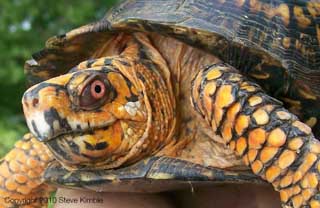 Both box turtles in Indiana are state protected because their numbers are declining, probably due to habitat loss and road deaths. What can you do to help? Slow down when driving, especially on rainy spring, summer or fall mornings. If you wish to have a box turtle as a pet, make sure that it was captive-reared, not wild-caught, though both are illegal in Indiana. If you encounter an injured box turtle that needs medical attention, call the Indiana DNR at 800-893-4116 or 317-232-4080 during business hours, 765-473-9722 (northern half of Indiana) or 812-837-9536 (southern half of Indiana).
To learn more about box turtles and other turtle species in Indiana, visit The Education Store for Turtles of Indiana.
Steve Kimble, Post Doctoral Research Associate
Department of Forestry and Natural Resources, Purdue
Rod Williams, Associate Professor of Wildlife Science
Department of Forestry and Natural Resources, Purdue
Salamanders are often mistaken for lizards, but the two groups are very different.
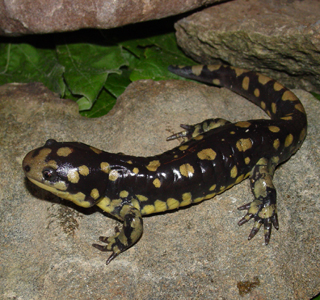
Tiger salamanders are a common species found in Indiana. The bright spotting is probably a sign to predators that they taste bad.
Though they both have similar body shapes, lizards are reptiles (along with turtles, snakes, crocodiles, dinosaurs, and yes, birds) while salamanders are amphibians (along with toads, frogs and a weird and rarely seen group called caecilians). This means lizards have dry scaly skin, while salamanders have moist, porous skin. Lizards all must breathe with lungs, just as humans do. Salamanders, on the other hand, can breathe through their skin, via gills, via lungs or in some cases via their skin and lungs!
Another major difference between lizards and salamanders is their reproduction. Lizards have leathery, partly calcified (shelled) eggs that are typically buried in sand or dirt, but a few species are hatched while still inside the mother before birth. Salamanders, as amphibians, mostly lay their eggs in water where the larvae hatch and after some time usually metamorphose and return to land. Lizards can be found most anywhere on land, while salamanders must stay where they won’t dry out: under logs or leaves, underground or directly in water. We have about six species of lizards and 23 species of salamanders here in Indiana.
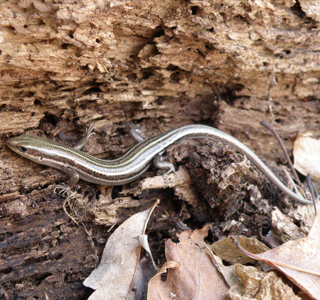
The five-lined skink is another Indiana native. Females will aggressively guard their nests, sometimes biting a threatening finger (don’t worry, they’re not venomous).
Several of the salamander species are listed as Special Concern or State Endangered. Regardless of their legal status, all wildlife should be left where you find it unless it’s in immediate danger, such as on a road.
For more information on how to identify Indiana salamanders and lizards:
Salamanders of Indiana book
Snakes and Lizards of Indiana
Place keywords in the search field at the Purdue Extension resource center for more information: The Education Store.
View Help The Hellbender website for more information on salamanders.
Steve Kimble, Post Doctoral Research Associate
Department of Forestry and Natural Resources, Purdue
Rod Williams, Associate Professor of Wildlife Science
Department of Forestry and Natural Resources, Purdue

Recent Posts
- Woodsy Owl Edition for Educational Learning, USDA – U.S. Forest Service
Posted: January 21, 2026 in Forestry, Forests and Street Trees, Got Nature for Kids, Urban Forestry, Wildlife - Unexpected Plants and Animals of Indiana: Nine-Banded Armadillo
Posted: October 27, 2025 in Got Nature for Kids, Wildlife - Question: Should You Feed Birds in Summer? Understanding the Impact on Migration
Posted: May 13, 2025 in Ask the Expert, Got Nature for Kids, Wildlife - Purdue Alumnus Magazine Highlights FNR Graduate and Nature of Teaching Program
Posted: September 13, 2024 in Got Nature for Kids, Nature of Teaching, Wildlife - Magnificent Trees of Indiana Webinar
Posted: May 12, 2023 in Forestry, Forests and Street Trees, Gardening, Got Nature for Kids, Urban Forestry, Webinar, Woodlands - “Fifty Trees of Indiana” Now Has New Name and New Additional Trees
Posted: January 13, 2022 in Forestry, Forests and Street Trees, Got Nature for Kids, How To, Urban Forestry, Woodlands - Introduction to Nature of Teaching Sneak Peek Videos
Posted: November 2, 2020 in Aquaculture/Fish, Aquatic/Aquaculture Resources, Gardening, Got Nature for Kids, How To, Land Use, Nature of Teaching, Plants, Ponds, Urban Forestry, Wildlife, Woodlands - Nature of Teaching Program Receives Environmental Education Award
Posted: October 30, 2020 in Aquaculture/Fish, Aquatic/Aquaculture Resources, Disease, Drought, Forestry, Forests and Street Trees, Gardening, Got Nature for Kids, How To, Invasive Animal Species, Invasive Insects, Land Use, Natural Resource Planning, Nature of Teaching, Plants, Ponds, Safety, Wildlife - New Publication – The Nature of Teaching: Disease Ecology
Posted: May 20, 2020 in Disease, Forestry, Got Nature for Kids, How To, Nature of Teaching, Plants, Ponds, Publication, Wildlife - Join us on Facebook LIVE – Hellbender Virtual Tour
Posted: April 20, 2020 in Forestry, Got Nature for Kids, Wildlife, Woodlands
Archives
Categories
- Alert
- Aquaculture/Fish
- Aquatic/Aquaculture Resources
- Ask the Expert
- Christmas Trees
- Community Development
- Disease
- Drought
- Forestry
- Forests and Street Trees
- Gardening
- Got Nature for Kids
- Great Lakes
- How To
- Invasive Animal Species
- Invasive Insects
- Invasive Plant Species
- Land Use
- Natural Resource Planning
- Nature of Teaching
- Plants
- Podcasts
- Ponds
- Publication
- Safety
- Spiders
- Timber Marketing
- Uncategorized
- Urban Forestry
- Webinar
- Wildlife
- Wood Products/Manufacturing
- Woodland Management Moment
- Woodlands