 Purdue University - Extension - Forestry and Natural Resources
Got Nature? Blog
A girdling root is one that circles the base of a tree at or just below the surface. Girdling roots can also girdle other roots but without harm. The most commonly affected species are maples, lindens and ashes.
The threat of a girdling root depends on two major factors, the size of the root and the amount of circumference affected on the tree. The expansion of the root and the stem squeezes them against each other, interfering with the transport of water, nutrients, sugars and other necessary compounds. Eventually, there may be damage which reduces vigor and often leads eventually to whole stem failure.
The only sure sign is to see a root circling the main stem at or crossing other roots at or just below the soil surface. Typically, roots should grow laterally, away from the trunk. Poor root systems grow horizontally, across each other and the main stem at the root flare. Look for a crossing network of roots near the trunk or larger woody roots growing horizontally. It may be helpful to gently displace the soil at the tree base to see if a circling root lies just under the soil surface.
Common symptoms include one side of the trunk flattened, marginal and/or tip scorching on the leaves, crown discoloration or dieback. However, many of these symptoms can be caused by other factors such as root damage, flooding or wilt diseases.
Treatment should be conducted by a qualified, International Society of Arboriculture Certified Arborist who understands the proper protocol for root surgery. This is done by the use of a saw or chisel to sever the girdling root. Arborists who remove stem girdling roots as part of their regular tree care program report that roots can be removed until their total cross sectional area is 25 percent of the trunk cross sectional area at 4.5 feet from the ground. Root severance is very serious work that requires knowledge and experience but can be done successfully in the right situations and especially prior to worsening conditions.
Resources
The Education Store (Search keywords to find the resources you need)
When Tree Roots Surface, Purdue Yard & Garden News
Lindsey Purcell, Urban Forestry Specialist
Department of Forestry and Natural Resources, Purdue University
 Woodland owners seem to have a lot to worry about these days. Threats to the health of their woodlands are announced regularly as new insects or diseases are detected, drought rages or invasive plant species compete with native vegetation. Some threats, like the emerald ash borer or a large tornado, can result in nearly unstoppable destruction. However, there are some actions that woodland owners can take to make their woodlands more resistant to other damaging agents or events. One of the best preventative measures is to use forest management practices to make the trees in your woodland as healthy and vigorous as possible. Competition between trees is a natural part of forest growth and development, but excessive competition as trees become more crowded and fight for growing space can make trees more susceptible to attack by insects and diseases and damage by weather extremes like droughts. Thinning around desirable trees provides additional growing space and reduces stress on these trees. Thinning can be done by harvesting trees for firewood or other personal use products, selling trees in a timber sale, or felling or girdling trees to be left for wildlife habitat. Gradual thinning in your woodland helps maintain the vigor of the remaining trees much like thinning carrots in a garden result in larger, faster growing carrots.
Vines and invasive plants can also create problems for tree health. Some vines, like wild grape, kudzu and Asian bittersweet, can climb over the crown of the tree, covering the leaves and reducing growth and vigor, and in some cases, killing the tree. Trees with large vines in their crowns may also be more susceptible to damage during wind, snow or ice storms, due to the extra weight of the vines. Cutting vines that climb into desirable trees is a good way to protect their health. Invasive plants like Asian bush honeysuckles and tree-of-heaven can become serious competitors with native forest trees and shrubs for space, water and nutrients required for tree growth and regeneration. Heavy infestations of invasive plant species can even change the soil environment, making it more difficult for trees to regenerate. Controlling invasive plants in your woodland is an important step in encouraging long-term woodland health.
Professional foresters and arborists can help you manage the health of your woodland. You can find professional foresters through the website findindianaforester.org or from the Indiana Division of Forestry.
The Education Store, available through Purdue Extension, has many resources available to help you manage your woodlands. Just place the keyword “woodland” in the search field box.
Forest Improvement Handbook.
Resources:
Resources and Assistance Available for Planting Hardwood Seedlings, The Education Store, Purdue Extension’s resource center
Creating a Wildlife Habitat Management Plan for Landowners, The Education Store
How to Build a Plastic Mesh Deer Exclusion Fence, The Education Store
Planting Forest Trees and Shrubs in Indiana, The Education Store
Shrubs and Woody Vines of Indiana and the Midwest, The Education Store
Investing in Indiana Woodlands, The Education Store
Woodland Stewardship for Landowners Purdue Extension – Forestry & Natural Resources (FNR) Extension YouTube Playlist
ID That Tree, Purdue Extension-FNR YouTube playlist
Woodland Management Moment , Purdue Extension-FNR YouTube playlist
Lenny Farlee, Extension Forester
Hardwood Tree Improvement and Regeneration Center (HTIRC)
Forestry and Natural Resources, Purdue University
 The National Association of State Foresters (NASF) posts an Purdue Agriculture research article titled “Hunting Gives Deer-Damaged Forests in Indiana State Parks a Shot at Recovery.” The Purdue research team led by Michael Jenkins, associate professor of forest ecology, shares that a 17-year-long Indiana Department of Natural Resources policy of organizing hunts in state parks has successfully spurred the regrowth of native tree seedlings, herbs and wildflowers rendered scarce by browsing deer.
“We can’t put nature in a glass dome and think it’s going to regulate itself,” Jenkins said. “Because our actions have made the natural world the way it is, we have an obligation to practice stewardship to maintain ecological balance.”
Resources
Electric Fences for Preventing Browse Damage by White-Tailed Deer, The Education Store, Purdue Extension
Emerging Issues in White-Tailed Deer Management and Conservation, The Education Store, Purdue Extension
Corn and Soybean Crop Depredation by Wildlife, Purdue Extension
Logs need to be at least 8 inch diameter inside bark small end, at least 8 feet long and straight and sound. Good grade logs do not develop until you get into at least the 14 inch diameter range and up. To be commercial, you will need at least a semi load. The issue here is hauling as well as the need to have a loader to load the semi.
If the above is not an option, you might go to the Wood-Mizer website and search for a sawyer. You will likely find one that would saw the logs for you and maybe one that would be interested in smaller quantities of logs.
You might also check with any local sawmill operation or district forester.
Resources
Wood-Mizer (Find a local portable sawmill service)
Indiana District Foresters
Forestry and Natural Resources Extension Workshops (Hardwood Lumber workshop)
The Education Store (Search the keyword “lumber” to find a large list of resources)
Dan Cassens, professor of wood products
Department of Forestry and Natural Resources
Purdue University
Indiana Department of Natural Resources (INDNR) recently received inquiries asking what to do with an abandoned animal. The INDNR web resource titled Orphaned and Injured Animals has steps to follow as you decide if the animal is truly abandoned.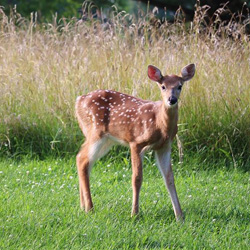
Resources
Got Nature? Orphaned Animals, author Brian MacGowan, extension wildlife specialist, Purdue University:
In most cases, the young animal is simply “spreading its wings” and exploring, or mom simply left it to get something to eat. Fawn deer are programmed to hide and remain motionless while mom is away. The fact is wildlife rarely abandons their young. They may leave briefly only to return.
Remember that you should never handle wild animals unless absolutely necessary. Any animal can bite you, and many harbor diseases and pests that can be transmitted to people.
In Indiana, wildlife rehabilitators have necessary state and federal permits to house and care for sick or injured wild animals. If you think you have found a sick or injured animal, you can find a list of licensed Wild Animal Rehabilitators in your area on the DNR Division of Fish and Wildlife’s website.
Mammals of Indiana, J.O. Whitker and R.E. Mumford
Common Indiana Mammals, R.N. Chapman and R.N. Williams, publication number FNR-413-W
Orphaned and Injured Animals, Indiana DNR
The Education Store (Search keywords to find the resources you need)
It doesn’t sound like there would be much chance of the chemical to get into the shrubs if the imidacloprid is applied close to the base of the tree. Also another thing to consider is unless you’re eating solely certified organic food, there’s a really good chance you’ve consumed very small amounts of imidacloprid at some time.
The United States Department of Agriculture (USDA) Pesticide Data Program monitored imidacloprid residues in food and published their findings in 2006. Imidacloprid was detected in a range of fresh and processed fruits and vegetables. It was detected in over 80% of all bananas tested, 76% of cauliflower and 72% of spinach samples. In all cases, however, the levels detected were below the U.S. EPA’s tolerance levels. Imidacloprid was also found in 17.5% of applesauce and 0.9% raisin samples, although percentage of detections were greater in the fresh unprocessed fruit (26.6% of apples sampled and 18.1% of grapes sampled).
These findings were on direct application to the plant, which would indicate higher concentrations than that which you would find on plants nearby those that were treated. Additionally, it is advised that if homeowners want to use a product with imidacloprid as the active ingredient, then they use one specifically labeled for edible food crops. The product label will contain specific instructions on application, pre-harvest intervals and special instructions on limiting harm to pollinators.
Resources
Purdue Pesticide Programs
Office of Indiana State Chemist – Pesticide Section
Lindsey Purcell, Urban Forestry Specialist
Department of Forestry and Natural Resources, Purdue University
 Woodlots are dynamic, vital ecosystems in the urban and suburban landscapes of the Midwest. People own these small wooded lots in urbanized areas for a variety of reasons: timber production, firewood production, recreation, wildlife habitat, aesthetics and alternative forest products. Many owners who keep and nurture these natural areas are motivated by powerful, non-economic motives based primarily on aesthetics and environmental protection.
This new Purdue Extension publication titled Indiana’s Urban Woodlots is a great way to aid you in a management plan and build your knowledge of what trees can do for you and the environment. This 24-page booklet covers benefits of trees, laws and zoning, stewardship planning, management, planting and renewal, and more.
View The Education Store for this and other Purdue Extension publications. Just type keywords in the search field to find the resources you need.
Lindsey Purcell, Urban Forestry Specialist
Department of Forestry and Natural Resources, Purdue University
Lenny Farlee, Sustaining Hardwood Extension Specialist
Hardwood Tree Improvement and Regeneration Center (HTIRC)
Department of Forestry and Natural Resources, Purdue University
An unsatisfactory approach to tree maintenance or pruning is “topping” it. Topping is the indiscriminant removal of branches of a tree above an arbitrary height, leaving unnatural, grotesque stubs and misshapen tree forms. In addition, increased risk tree conditions are introduced with development of decay, weak branch attachments and poor health.
Large evergreen trees do not respond well to topping. The removal of the upper main stem through topping opens the tree to internal decay, disease or damaging insects; it also removes the most productive portion of the tree. The practice of topping to control tree size or growth is not justified. If the tree is too large to fit the space, it should be removed and replaced with a smaller, more suitable species for its growing space.
Be aware that unprofessional tree service crews use this approach because it takes little skill and is easiest for them to perform. Do not let yourself be persuaded that topping serves your best interest; both you and your tree will suffer from such mistreatment.
The topmost part of an evergreen whose shape is pyramidal, such as a spruce tree, has a growing point known as the apical meristem. In evergreen trees, the apical meristem contains a hormone that suppresses lateral growth, helping it to keep its excurrent or pyramidal form. The further away from the tip (apical meristem), the less affect this hormone has on the lateral growth of the tree’s branches. This is why spruce trees have that pyramidal shape and are not more rounded or decurrent. By topping evergreen trees, it will destroy the apical dominance of the plant and result in growing more round than tall with a misshaped top. It will try to re-establish apical dominance as it matures, but it will most likely look very unusual and not like these species should appear with multiple competing growing tips. Remember, this is a natural form for many evergreens to help shed the heavy loads from snowfall. Remove the apical meristem (tip), and you reduce the suppression of lateral growth. This affects the shape of the spruce tree and exposes it to potentially splitting the tree down the trunk as well as exposure to the problems associated with topping.
Resources
Trees are Good
What’s Wrong with Topping Trees?
Lindsey Purcell, Urban Forestry Specialist
Department of Forestry and Natural Resources, Purdue University
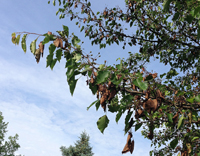 Fire blight is infecting flowering pear trees in large numbers in Indiana for the third consecutive year with a Purdue Extension specialist again urging homeowners to check their trees for symptoms.
Symptoms of the potentially deadly disease with no cure are wilting shoots, cankers on branches and blackened leaves, which give the disease its name because trees appear to be scorched.
Resources
Purdue Pest and Plant Diagnostic Laboratory
The Education Store
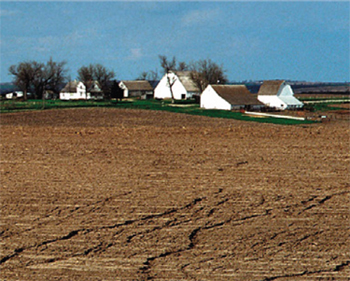 Because agriculture dominates the midwestern landscape, it has a huge impact on environmental quality. Agricultural producers are often advised to adopt practices that help to reduce the impact of agriculture on the environment. However, like all humans, they are often reluctant to change, which makes the work of conservation professionals extremely challenging. In this publication, we explore the myths and realities around what motivates farmers to adopt conservation practices. We draw on the authors’ combined research and applied practitioner experience with farmer adoption of conservation practices. Most evidence is based on studies and observations of traditional row-crop farmers in the midwestern United States.
Adoption of Agricultural Conservation Practices
The Education Store
Purdue Extension

Recent Posts
- Popular Landscape Shrub is Invasive
Posted: October 15, 2026 in Alert, Forestry, Forests and Street Trees, Invasive Plant Species, Plants, Woodlands - Purdue Extension’s Regional Teams Are Here: Connecting Communities with Expertise and Opportunity
Posted: October 14, 2026 in Community Development, Forestry, Forests and Street Trees, Gardening, How To, Timber Marketing, Urban Forestry, Wildlife, Woodlands - Why Do Our Trees Go From Green Leaves to Different Colors?
Posted: in Forestry, Forests and Street Trees, Urban Forestry, Woodlands - Distinguishing Dogwoods
Posted: October 13, 2026 in Forestry, Urban Forestry, Wildlife, Woodlands - It’s Not Too Early To Start Planning For Spring Tree Planting
Posted: in Forestry, How To - Can I Plant Trees in the Fall?
Posted: October 12, 2026 in Forestry, How To, Land Use, Plants, Urban Forestry, Wildlife - Burning for Benefits: Why Fire Belongs in Indiana
Posted: in Forestry, Safety, Woodlands - Disease May Cause Wilting and Eventual Death of Certain Trees and Shrubs, Purdue Landscape Report
Posted: October 5, 2026 in Disease, Forestry, Plants - October Is Firewood Month: Protect Indiana’s Forests by Making Smart Choices
Posted: October 1, 2026 in Forestry, Forests and Street Trees, How To, Invasive Insects, Urban Forestry - Woodland Flowers of Late Summer
Posted: September 14, 2026 in Forestry, Gardening, Wildlife, Woodlands
Archives
Categories
- Alert
- Aquaculture/Fish
- Aquatic/Aquaculture Resources
- Ask the Expert
- Christmas Trees
- Community Development
- Disease
- Drought
- Forestry
- Forests and Street Trees
- Gardening
- Got Nature for Kids
- Great Lakes
- How To
- Invasive Animal Species
- Invasive Insects
- Invasive Plant Species
- Land Use
- Natural Resource Planning
- Nature of Teaching
- Plants
- Podcasts
- Ponds
- Publication
- Safety
- Spiders
- Timber Marketing
- Urban Forestry
- Webinar
- Wildlife
- Wood Products/Manufacturing
- Woodland Management Moment
- Woodlands