 Purdue University - Extension - Forestry and Natural Resources
Got Nature? Blog
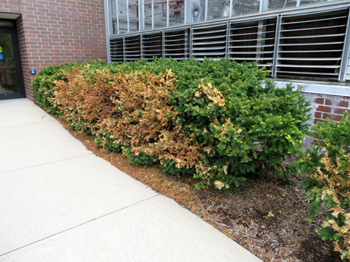 Extreme cold last winter, unrelenting winds and unusually large amounts of salt that were applied to roads, sidewalks and parking lots are taking their toll on landscape plants this spring, a group of Purdue University experts say.
They are seeing considerable damage and expect more this summer and beyond. While it is difficult to determine winter injury until bud break, they say it is now time for homeowners and others with ornamental plants to evaluate their plants for damage that needs to be corrected.
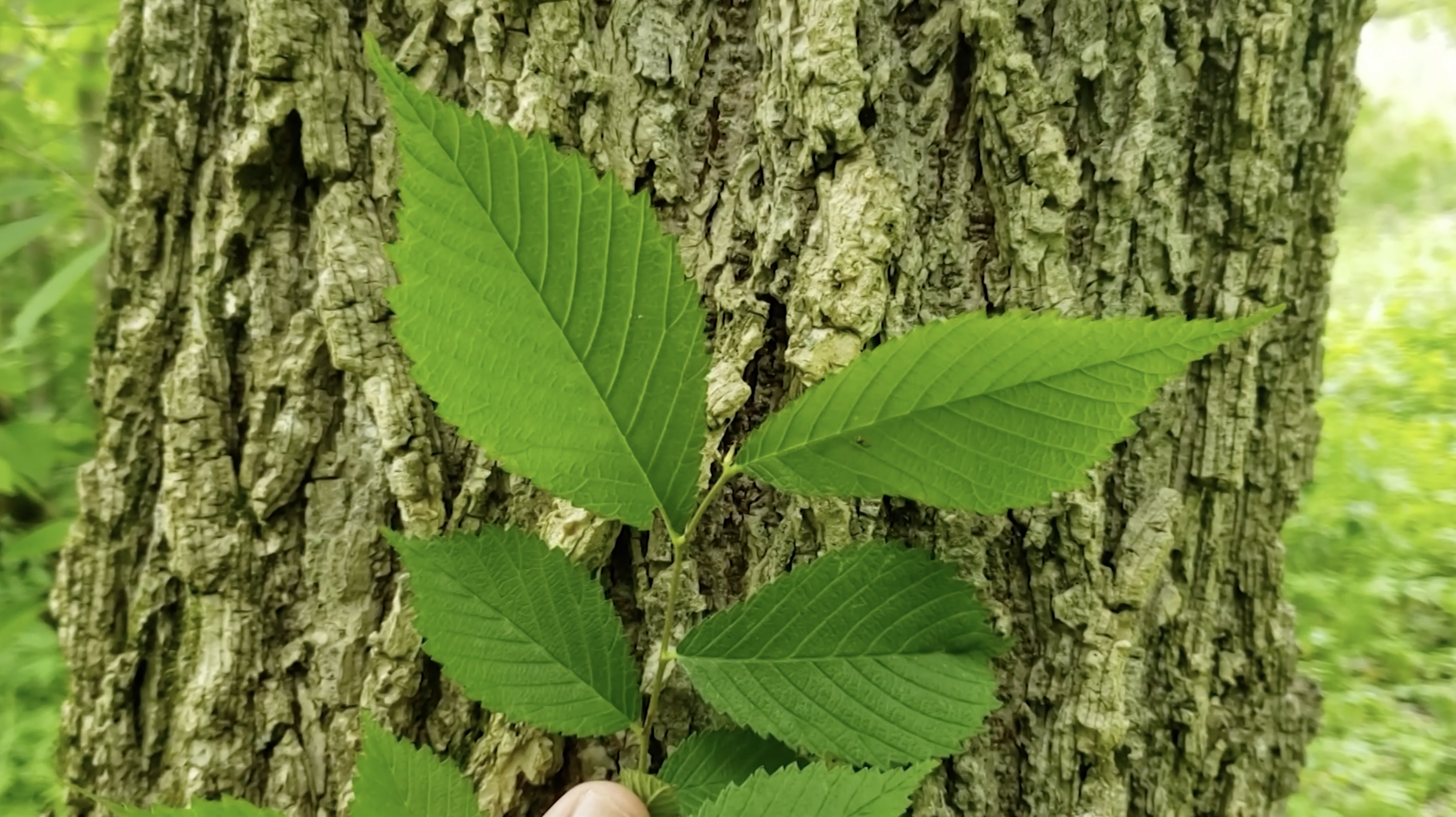 American elms have been the victim of a decimating disease known as DED or Dutch Elm Disease. However, there are a few that linger and remain, gracing our city streets with their majestic arching form. Many elms are mistakenly identified as American; however, there are many other “weedy” elms that have naturally inhabited our urban landscape. Due to the incredible interest in these trees, plant breeders have developed resistant American elms which are showing excellent results. Unfortunately, many of those trees proved to be susceptible to other diseases such as Elm Yellows.
Providing that the tree has been identified as an American elm, proper management is required to maintain its health and vigor to provide a sustainable tree in the landscape.
Strategies include:
Sanitation: Quick removal of diseased trees and symptomatic branches is necessary in managing this disease. Removal of the damaged parts reduces breeding sites for the elm bark beetle and removes the fungus from the vicinity. Branches with “flagging” symptoms should be removed, making a cut well behind (5-8 ft.) any visual symptoms.
Pesticide Applications:
Insecticides to kill bark beetle vectors – Attempt to control the insect vector population by applying an insecticide. Timing of the application may depend on the type of insecticide you have selected. Some insecticides may target the spring feeding sites while others target the overwintering sites and should be applied during late autumn. Use of this management option should be considered carefully. It is difficult to attempt control over this beetle population due to the timing factor, the complete coverage issue, expense and pesticide exposure.
Preventative fungicide injections – There are effective fungicides capable of protecting elm trees from infection, but this method of management should be considered carefully. Fungicide injection must be performed by someone trained in the technique and may be expensive. Protection lasts 1-3 years and then must be repeated. In addition, some researchers are concerned that repeated wounding of the tree (by drilling holes) for the injection may open trees to decay. If there is concern for infestation, it is critical to contact a reputable tree care company specializing in good plant healthcare. Always contact an International Society of Arboriculture Certified Arborist to help insure best practices. For more information on DED and management strategies, click on the links below.
Resources
Dutch Elm Disease
Diseases in Hardwood Tree Plantings
Pest Tracker: Dutch Elm Disease
Lindsey Purcell, Urban Forestry Specialist
Department of Forestry and Natural Resources, Purdue University
I am noticing several weeping cherries in the neighborhood which appear to be damaged, maybe dead over the winter. Forsythia bloom was poor, and my Cornus mas failed to bloom too. Will they recover?
Damage is just now starting to reveal itself due to the late growing season this year. Cherry trees appear to have been hit very hard, especially sweet cherries with over 90% of the crop damaged. Many landscape trees bloomed sporadically or not at all due to the extreme cold. Redbuds were light to no bloom but appear to be leafing out fine. Forsythia seems to be dependent on species and if they are planted in a protected area or microclimate. Many forsythia flowered well this spring, but many in open, exposed areas bloomed very little. Also it appears that Cornus mas is failing to bloom as well. Another consideration is impact of the drought from last year. I believe we will be seeing even greater impact with extreme cold providing an additional blow to our trees and shrubs. Plants may fail to bloom but still be alive.
The best suggestion is be patient and to provide good cultural practices with water when needed this spring and summer and provide the proper levels of mulch. Avoid fertilization and only lightly prune when necessary. Most likely trees are in stress conditions, still in recovery from the previous drought along with the extreme cold. Too much care can be lethal.
Resources
Pruning Ornamental Trees and Shrubs
Why Plants Fail to Bloom
Lindsey Purcell, Urban Forestry Specialist
Department of Forestry and Natural Resources, Purdue University
This winter was a brutal one for sure, but the emerald ash borer still has plenty of life left in it.
Although the Midwest experienced abnormally cold temperatures this winter, it is unlikely that populations of the highly destructive beetle were significantly affected by it, said Adam Witte, exotic forest pest educator in the Purdue University Department of Entomology.
“Headlines have been circulating, suggesting that EAB may have met its match,” Witte said. “But the EAB, as well as most insects in colder climates, is effective at surviving cold temperatures.”
EAB larvae overwintering within ash trees die when temperatures reach minus-28 degrees Fahrenheit below the bark, Witte said. U.S. Forest Service scientists predicting areas in North America where temperatures were cold enough to kill EAB larvae conclude that only parts of Minnesota and North Dakota historically have reached temperatures that low.
Contacts
Adam Witte, Exotic Forest Pest Educator
Department of Entomology
Matthew Ginzel, Associate Professor
Departments of Entomology & Forestry and Natural Resources
Early spring brings the emergence of new life in the forest. Unfortunately, not all that life actually belongs there. Several invasive plants are encroaching on woodlands and crowding out the desirable native plants we enjoy and wildlife depend upon for food and shelter. One of the characteristics of some invasive plants is early leaf emergence and growth, which allows us to scout for their presence more easily, while native species are still waking up from winter. Two species that start growing very early in the spring are garlic mustard and Asian bush honeysuckles. Both plants are rapidly greening up and growing as I speak. Look for the kidney to heart shaped leaves of garlic mustard on the forest floor. This biennial will soon be sending up flower stalks from the second season plants that will have white four-petaled flowers. The flower stalks can be up to three feet tall or more depending on the health of the plant and the quality of the growing site.
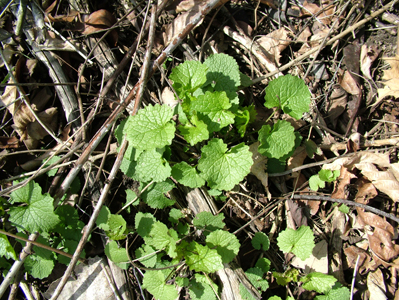
Early spring leaves of garlic mustard.
Asian bush honeysuckle is a medium to large bush that also inhabits the forest understory and edge or disturbed areas. Leaves and twigs area arranged opposite each other. If you slice the stems open, they are hollow inside with fuzzy brown or tan lining. Flowers are yellow, white or even pinkish and tube-shaped. The fine twigs and stems have a light tan or gray-tan color. Leaves are rapidly expanding now, so they will be easily detected until our native plants catch up with leaf cover.

Early growth of Asian bush honeysuckle.
Controlling these plants helps native plants continue to thrive and provide habitat for our wildlife. Garlic mustard can be pulled from moist soil. If seed pods are present, remove the plants from the area and burn or bury them. Foliar herbicides like glyphosate products may be used to spray garlic mustard. If the plants have already set seed pods, the seed may become viable even if the plant has been sprayed, so removal may be the only effective treatment at that time.
Asian bush honeysuckle can be controlled in several ways, depending on the size of the plants. Small plants can be pulled from moist soil. Foliar sprays with herbicides like glyphosate can be effective. Large bushes may be cut and the stumps treated with a brush-killing herbicide. For any herbicide application, read and follow label directions.
Purdue University has invasive species information resources at FNR Extension and Indiana’s ‘Most Unwanted’ Invasive Plant Pests/Indiana Cooperative Agricultural Pest Survey (CAPS) Program.
Lenny Farlee, Sustaining Hardwood Extension Specialist
Hardwood Tree Improvement and Regeneration Center (HTIRC)
Forestry and Natural Resources, Purdue University
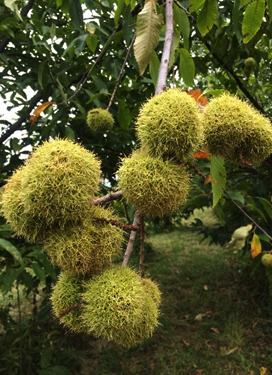
American chestnut fruit protected by a spiny bur. Photo: Dr. Shaneka Lawson, USDA Forest Service, Purdue HTIRC
In the late 1800s, 25% of hardwood trees in North America’s eastern forest were American chestnuts, 40 meters high and two meters across, they provided abundant resources for both people and wildlife in the form of food, shelter and building materials. Lightweight, rot-resistant, straight-grained and easy to work with, chestnut wood was used to build houses, barns, telegraph poles, railroad ties, furniture and even musical instruments. The rapid decline of the chestnut due to the pathogenic fungus Cryphonectria parasitica has been a subject of much debate and despair over the years, but now, chestnuts engineered to battle the fungus might give the iconic trees a chance to reclaim the North American stage.
Research conduced in 2014 was taking genes from wheat, Asian chestnuts, grapes, peppers and other plants and inserting them into American chestnut trees. William Powell of S.U.N.Y.–ESF and scores of collaborators, created hundreds of transgenic trees with the goal of almost 100 percent genetically identical wild American chestnut yet immune to C. parasitica. Testing and gathering data continues to help with future research.
Douglass Jacobs, the Fred M. van Eck Professor of Forest Biology at Purdue University, and a team of scientists at Purdue, use genomics which involves working with the complete set of an organism’s genetic material, to learn more about what causes disease. Genomics also can help identify the genes responsible for useful traits such as pest resistance.
Blight began afflicting the American chestnut in the 1900s, killing billions of trees. Despite being the target of decades-long tree-breeding efforts, the chestnut’s prospects remain in doubt. The list of at-risk species also includes ash, butternut, and bristlecone pine among other members of the five-needle white pine family.
The Hardwood Tree Improvement & Regeneration Center, a joint effort between Purdue and the Forest Service, for years has maintained a breeding program for pest resistance. Almost all of the center’s efforts to date have focused on traditional tree breeding and genomics.
“The chance to work with chestnut and help reintroduce it back to the landscape was a big reason I took the Purdue job in the first place back in December of 2001,” Jacobs said. “Watching species disappear from the landscape provides me personally with a lot of motivation to contribute whatever I can toward helping to save some of these at-risk species.”
To learn more about his research and collaboration with the U.S. Forest Service view full article Biotechnology offers holistic approach to restoration of at-risk forest tree species – Purdue University News, by Purdue Agriculture News.
Resources
A New Generation of American chestnut Trees May Redefine America’s Forests – Scientific American
Consequences of Shifts in Abundance and Distribution of American Chestnut for Restoration of a Foundation Forest Tree – Forests Open Access Forestry Journal
Transgenic American chestnuts show enhanced blight resistance and transmit the trait to T1 progeny – Science Direct (Plant Science)
Scientists Work to Create a Blight-Resistant Chestnut with Hopes of Restoring Tree to America, Forest Service, U.S. Department of Agriculture
FNR Hardwood – American Chestnut, Purdue Arboretum Explorer
Hardwood Tree Improvement Regeneration Center (HTIRC) Research Publications
American Chestnut Trees return to the Hoosier National Forest, Indiana Woodland Steward
Forest Regeneration and Restoration Laboratory, Purdue Forestry and Natural Resources, Dr. Doug Jacobs
Indiana American Chestnut Foundation
Purdue Extension – Forestry and Natural Resources (FNR)
Winter burn is a common occurrence to boxwood, holly, rhododendron and most conifers. Winter burn symptoms often develop when temperatures warm up in late winter and early spring. This type of winter damage is often misdiagnosed as an infectious disease or damage from excessively cold temperatures.
To understand winter injury, it is important to understand that while a plant is creating its food by photosynthesis, it is releasing large amounts of water through the process of transpiration (the evaporation of water from the plant). Over the course of a day, a large tree can lose hundreds of gallons of water. When plants are unable to obtain the water they need (due to drought or frozen soil), the water lost through transpiration cannot be replenished, resulting in dehydration, foliar damage and even death.
Contacts
Michael Mickelbart, Clinical Engagement Assistant Professor
Horticulture and Landscape Architecture
Purdue University
Janna Beckerman, Associate Professor
Botany and Plant Pathology
Purdue University
Tree owners who have broken limbs in their trees or are just taking advantage of early pruning opportunities may notice large amounts of “water” that seem to be pouring out of the branch. This is actually “sap” seeping out of the damaged area, and it would have been going into the limb or branch that was removed. However, since the limb is no longer there, the sap has nowhere to go but out of the freshly cut limb or wound.
Spring weather signals to trees to come out of dormancy, and all trees start pumping water, minerals and carbohydrates upwards into the tree to allow growth of buds, leaves and shoots and will continue throughout the growing season. Certain tree species, such as maple, birch, dogwood and elms, have an exceptionally heavy sap flow in the early spring. When pruned or wounded, these trees will “bleed” quite noticeably. Under normal circumstances, it is best to delay pruning these trees until later in the growing season when the flow of sap is slower.
There is no need for alarm if this sap flow occurs and the overall health of the tree is not going to be affected. The “bleeding” may be objectionable from a cosmetic standpoint, especially if the sap is dripping directly onto people, cars or other targets beneath the wounded area. As the affected area on the tree develops callus material and naturally seals off the wound, it will slow the flow to a stop.
It is not recommended to use any type of wound dressing or covering as this will impede the ability of the tree to seal off the damaged area. Be patient and allow natural healing of the wound to occur. Always use good pruning practices and minimize the size of cut branches to reduce wound size on the tree.
Refer to the following Purdue Extension publication, Trees Need a Proper Start: Prune Them Right, for more information.
Other resources can be found at The Education Store: Pruning Ornamental Trees and Shrubs.
Lindsey Purcell, Urban Forestry Specialist
Department of Forestry and Natural Resources, Purdue University
A recent article in ScienceDaily titled “Excessive Deer Populations Hurt Native Plant Biodiversity” shares how an overpopulation of deer is hurting native plant growth. Landowners seek best management practices as these challenges arise.
For the article from the University of Miami, view: “Excessive deer populations hurt native plant biodiversity.” ScienceDaily, 20 March 2014.
Resources
Preventing Wildlife Damage, Purdue EVERYTHING Wildlife
How to Build a Plastic Mesh Deer Exclusion Fence, Purdue Extension Publication
Don’t be fooled by the cold weather; EAB has plenty of life left.
Headlines have been circulating suggesting that EAB may “have met its match.” Although the Midwest experienced abnormally cold temperatures this winter, it is unlikely EAB populations felt these effects as significantly as your heating bill. EAB, as well as most insects in colder climates, are effective at surviving cold temperatures. One way they survive the cold is by producing an antifreeze-like substance that prevents water in their cells from crystallizing and causing damage. Also the extra insulation provided by the tree bark helps larvae withstand such cold temperatures. For EAB larvae overwintering within ash trees, death occurs when temperatures reach -28 degrees Fahrenheit.
A model produced by U.S. Forest Service scientists predicts areas in North America where temperatures were cold enough to kill EAB larvae. This model suggests that in the U.S., only northern parts of Minnesota and North Dakota have reached frigid enough temperatures to affect EAB populations.
Although some parts of the United States may have fewer adults emerging in the spring as a result of the cold temperatures, they probably won’t notice. Due to a high reproductive rate, it will likely be only a matter of time before populations rebound to previous levels.
Despite the cold weather, experts are still advising to continue with EAB management plans. One effective means of saving ash trees and reducing management costs is to partner with interested neighbors and hire a company to treat trees in your neighborhood. This collaborative approach will likely reduce transportation and consultation costs for the company, and the savings will be passed down to homeowners.
For more information on EAB, treatment options and NABB (Neighbors Against Bad Bugs), visit Emerald Ash Borer in Indiana, Purdue Extension website.
Contacts
Adam Witte, Exotic Forest Pest Educator
Department of Entomology
Matthew Ginzel, Associate Professor
Departments of Entomology & Forestry and Natural Resources

Recent Posts
- Popular Landscape Shrub is Invasive
Posted: October 15, 2026 in Alert, Forestry, Forests and Street Trees, Invasive Plant Species, Plants, Woodlands - Purdue Extension’s Regional Teams Are Here: Connecting Communities with Expertise and Opportunity
Posted: October 14, 2026 in Community Development, Forestry, Forests and Street Trees, Gardening, How To, Timber Marketing, Urban Forestry, Wildlife, Woodlands - Why Do Our Trees Go From Green Leaves to Different Colors?
Posted: in Forestry, Forests and Street Trees, Urban Forestry, Woodlands - Distinguishing Dogwoods
Posted: October 13, 2026 in Forestry, Urban Forestry, Wildlife, Woodlands - It’s Not Too Early To Start Planning For Spring Tree Planting
Posted: in Forestry, How To - Can I Plant Trees in the Fall?
Posted: October 12, 2026 in Forestry, How To, Land Use, Plants, Urban Forestry, Wildlife - Burning for Benefits: Why Fire Belongs in Indiana
Posted: in Forestry, Safety, Woodlands - Disease May Cause Wilting and Eventual Death of Certain Trees and Shrubs, Purdue Landscape Report
Posted: October 5, 2026 in Disease, Forestry, Plants - October Is Firewood Month: Protect Indiana’s Forests by Making Smart Choices
Posted: October 1, 2026 in Forestry, Forests and Street Trees, How To, Invasive Insects, Urban Forestry - Woodland Flowers of Late Summer
Posted: September 14, 2026 in Forestry, Gardening, Wildlife, Woodlands
Archives
Categories
- Alert
- Aquaculture/Fish
- Aquatic/Aquaculture Resources
- Ask the Expert
- Christmas Trees
- Community Development
- Disease
- Drought
- Forestry
- Forests and Street Trees
- Gardening
- Got Nature for Kids
- Great Lakes
- How To
- Invasive Animal Species
- Invasive Insects
- Invasive Plant Species
- Land Use
- Natural Resource Planning
- Nature of Teaching
- Plants
- Podcasts
- Ponds
- Publication
- Safety
- Spiders
- Timber Marketing
- Urban Forestry
- Webinar
- Wildlife
- Wood Products/Manufacturing
- Woodland Management Moment
- Woodlands