 Purdue University - Extension - Forestry and Natural Resources
Got Nature? Blog

Issue:
Woodlands provide a multitude of environmental (e.g., carbon sequestration, enhance water quality, wildlife habitat), economic (e.g., timber, wood products manufacturing, tourism), and social (e.g., recreation, aesthetics) benefits to Indiana residents. The sustainability of these benefits is strongly tied to stability of the resource. In Indiana, 75 percent of the 4.65 million acres of forestland is owned by families. Actions they take on their property can impact the benefits woodlands provide all Indiana residents. However, many do not understand available options or sources of assistance.
What Has Been Done:
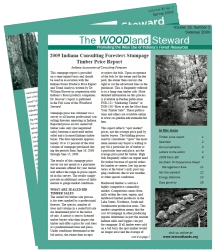 The Department of Forestry and Natural Resources, in partnership with many other organizations, helps produce and mail over 31,000 copies of the Indiana Woodland Steward to woodland owners three times each year. This 16-page, two-color publication includes in-depth articles on forest stewardship and health, invasive species and pests, wildlife habitat management, economics, and more.
Results:
Subscribers owned more woods (71.6 ac) for a longer tenure (33 years) than the average woodland owner in Indiana based on data from the National Woodland Owner Survey. As a group, they were also more active managers based on the proportion enrolled in assistance programs and who had a written stewardship plan. Fifty-four percent regularly utilized information from the Woodland Steward. In addition, 51 percent of respondents have implemented at least one practice they read about from The Woodland Steward, potentially impacting an estimated 1.2 million acres of forestland. His use of print media to communicate with woodland owners could be considered expensive, but clearly a large number of woodland owners regularly read and utilize the information making the average investment per landowner much lower.
When biologists and land managers talk about managing native warm-season grasses (NWSG) they are really talking about managing early-successional plant communities. Early-successional vegetation (i.e., stands of annual or perennial grasses and forbs [broadleaf plants]) provide benefits for a variety of game and non-game wildlife species. Songbirds, northern bobwhite, and ring-necked pheasants use these areas to build nests and raise broods in the summer and for escape and thermal cover in the winter. White-tailed deer also use these areas heavily for bedding, to hide fawns from predators, and the forbs provide deer with excellent nutrition during the summer.
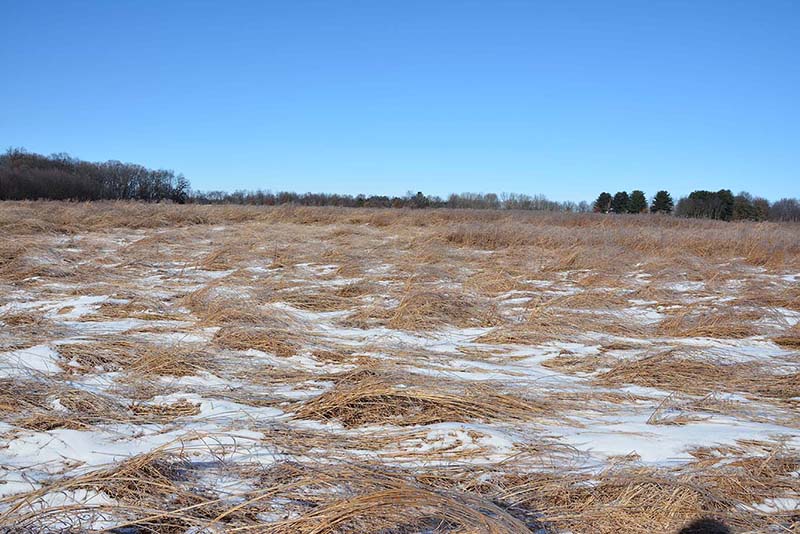
Forbs mixed with grasses help prevent the grasses from falling over and laying flat during the winter.
However, as these stands age their value to most wildlife species decreases drastically! Most stands of planted NWSG have little value, for species such as bobwhite, within 3-5 years of establishment. As the stands age, the tall perennial NWSGs (big bluestem and Indiangrass) become thicker; eventually crowding out all the forbs in the stand and creating a monoculture of grass. In the winter, the grasses fall over or “lodge”, as in the picture, and provide little to no cover.

Forbs mixed with grasses help prevent the grasses from falling over and laying flat during the winter.
This is why programs such as the Conservation Reserve Program require Mid-Contract Management (MCM) during years 4, 5, or 6 of the contract. MCM is aimed at maintaining or enhancing the wildlife value of NWSG stands by thinning the NWSGs providing room for planted and volunteering forbs to grow. These forbs act as supports for the grasses, helping them stand tall all winter, attract pollinators and insects important to foraging songbirds and game birds in the summer, and provide seed throughout the winter. Additionally, thinning the grasses and providing more room for weeds or forbs to grow will make it easier for ground dwelling wildlife to move and forage.
If your stand of NWSGs looks like the picture above, the time to manage them is not now but 2 years ago! However, managing them now can be effective and you have some options!
For most early successional wildlife species, you want the field to be from a 50/50 to 70/30 percent mix of forbs and grasses (favoring forbs). The field should be split into portions and managed on successive years. For larger fields, split the field into 4-5 acres sections. If you have multiple fields on your property you can manage the whole field. The key is to ensure that some cover is left on your farm throughout the winter.
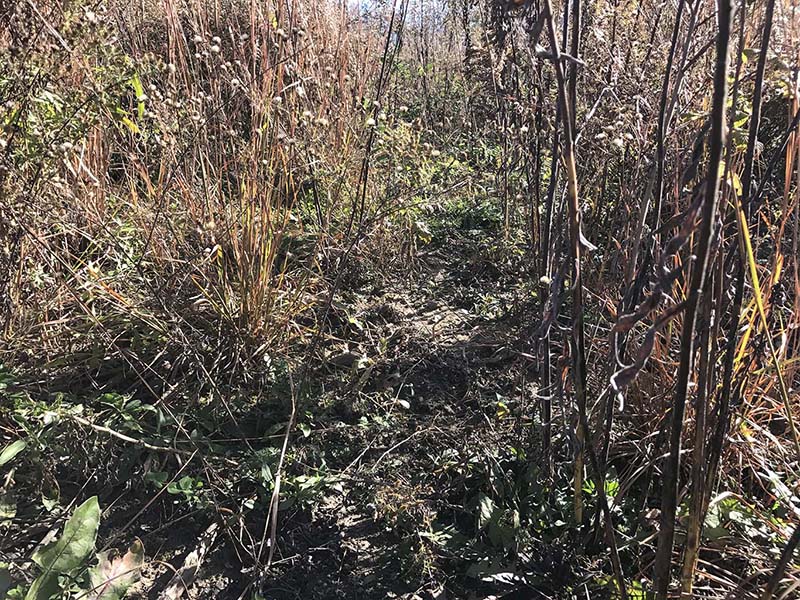
This picture gives you a “quail’s eye view” in a stand of native grasses and forbs with the ideal composition! Notice how the open space between plants and the bare ground would make it easy for a quail to maneuver and feed on insects or seed!
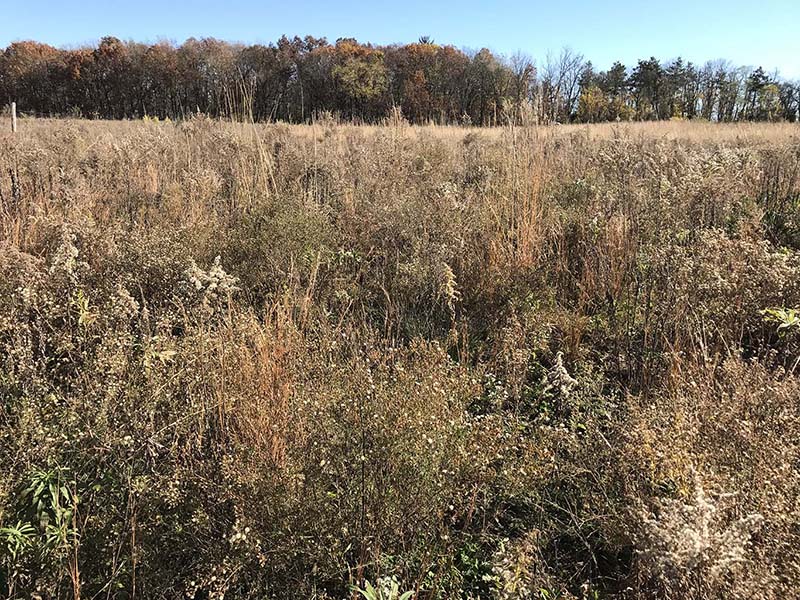
This picture represents the ideal composition of native grass stands; 50% or less of the stand is native grasses and 50% or greater of the stand is comprised of forbs.
September – March
Step 1. Burn or mow a portion of the field.
Step 2. Disk the same portion within a few weeks of burning or mowing the field.
By burning or mowing the field prior to disking, you make it easier for the disk to cut into the soil. The field should be disked so that a majority of the plant debris is worked into the soil and the soil is exposed.
Disking from September through March will result in a more beneficial plant composition than disking in the spring or summer.
May – June or August – September
Step 1. Just after winter and prior to spring green-up (late March or early April) the field should be burned to prepare the field for management. This step is not necessary but can improve the herbicide application. If applying herbicide in Aug-Sep, mowing or burning the field 2-3 weeks prior to application can be beneficial.
Step 2. Apply 2 quarts/acre of glyphosate OR 24 ounces/acre of imazapyr (53% active ingredient) to the field or portions of the field where native grasses are extremely thick.
NOTE: Spot spraying problematic areas are always better than whole field applications, but sometimes whole field applications are warranted.
CAUTION: Imazapyr can harm desirable trees; avoid spraying imazapyr within the drip line of desirable trees.
These management options will reduce or “thin” the native grasses enough to provide forbs from the seed bank with room to grow! The field may look “messy” or “weedy” the first summer or two after application but that’s okay! Actually, it’s what you want! Most of the “weeds” that come from the seed bank provide excellent cover and food for a variety of wildlife species. Just be sure to control undesirable weeds such as Canada thistle, if they appear.
For more information on how to manage NWSG or other early successional vegetation, contact your local IN-DNR wildlife biologist or NRCS office.
Additional Resources:
Herbicides to reduce NWSG density, SEAFWA
Landowner’s guide to NWSG management, TRACE
Quail Habitat – Putting the Numbers in Perspective, The Education Store
Control of Canada Thistle in CRP and Other Noncrop Acreage, The Education Store
Jarred Brooke, Extension Wildlife Specialist;
Purdue University Department of Forestry and Natural Resources
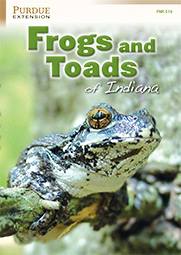
Videos:
Ask an Expert: Anurans (Frogs and Toads)
Ask an Expert: Salamanders
A Moment in the Wild: Wood Frogs
A Moment in the Wild: American Toad
A Moment in the Wild YouTube Playlist-Subscribe
Reptiles, Amphibians & the Scientific Method
Learn All About Hellbenders and Take a Tour
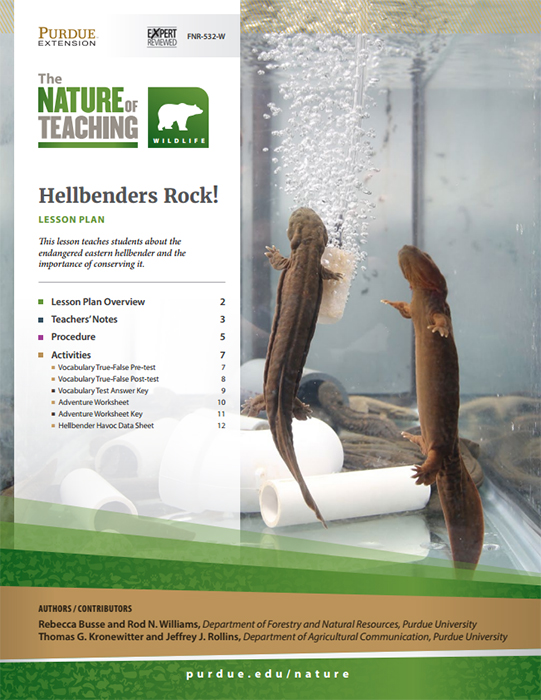 This new lesson plan from The Nature of Teaching titled Hellbenders Rock! is full of engaging activities to teach K-5 students about the endangered eastern hellbender, while meeting Indiana academic standards. Hellbenders Rock is available as a free download in The Education Store, complete with instructional PowerPoint, videos, vocabulary worksheets, along with instructions on how to download the free Hellbender Havoc app.
This lesson is unique in the way that it requires teachers to download the free Hellbender Havoc app from the Google Play Store or Apple App Store to help students apply the educational content learned throughout the lesson. The lesson requires 60 minutes of class time to complete, including time for the students to play the app and complete the worksheets that accompany it. Throughout the lesson, students learn how to identify the eastern hellbender, how to describe the hellbender’s lifecycle, how the hellbender relates to healthy water quality, and how we can help the hellbender.
To find more nature-themed lesson plans that incorporate academic standards and teach material in hands-on and engaging ways, visit The Nature of Teaching website. All lesson plans are free to download. To learn more about the eastern hellbender and how we can help, visit HelpTheHellbender.org.
Resources:
Hellbenders Rock! Lesson Plan, The Education Store, Purdue Extension Resource Center
The Nature of Teaching, Purdue Extension
Help the Hellbender, Purdue Extension
Hellbender Havoc App-Purdue Envision PC or Hellbender Havoc-Apple App Store
Rebecca Busse, Graduate Student
Purdue Department of Forestry and Natural Resources
Rod Williams, Associate Professor of Wildlife Science
Purdue Department of Forestry and Natural Resources
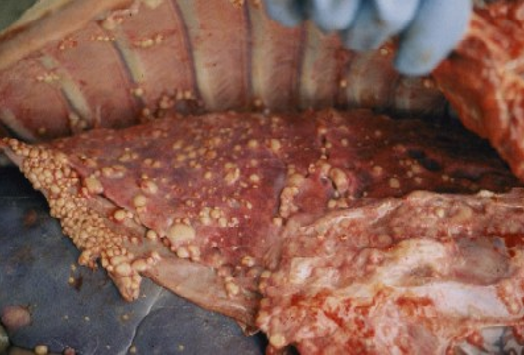
Lesions from bovine Tb infection in the chest cavity of a wild white-tailed deer. Photo by the Michigan Department of Natural Resources.
Bovine tuberculosis (bovine Tb) is an on-going issue in Indiana’s wild white-tailed deer herd. Bovine Tb was first discovered in wild deer in Indiana in August 2016 near a bovine Tb positive cattle farm in Franklin County. Since August 2017, Indiana Department of Natural Resources and the Board of Animal Health have been monitoring and managing the bovine Tb situation. A second cattle farm in Franklin County tested positive for bovine Tb in December 2016, but no hunter harvested deer have tested positive for bovine Tb during the 2016 deer season. The IDNR will continue to monitor and manage the bovine Tb situation according to a departmental management plan. View the following web page to find more information, Bovine Tb in Wild White-Tailed Deer: Background and Frequently Asked Questions.
Resources:
How to Score Your White-tailed Deer, video, The Education Store, Purdue Extension Resource Center
White-Tailed Deer Post Harvest Collection, video, The Education Store
Age Determination in White-tailed Deer, video, The Education Store
How to Build a Plastic Mesh Deer Exclusion Fence, The Education Store
Bovine Tuberculosis in Wild White-tailed Deer, The Education Store
Indiana Deer Hunting, Biology and Management, and Safe Food Handling and Preparation, IDNR
Jarred Brooke, Wildlife Extension Specialist
Purdue Department of Forestry and Natural Resources
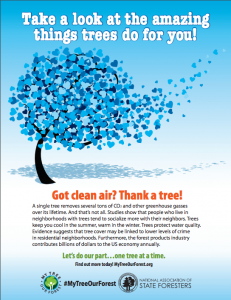 Both urban and community forests alike are indispensable staples of our ecosystem that we cannot live without. The My Tree—Our Forest® campaign, from The National Association of State Foresters, is an urban and community forestry campaign that aims to increase public understanding about the benefits that healthy forests offer to communities across the United States and the role that state forestry agencies play in protecting the nation’s urban trees.
For your next outreach event, consider downloading the My Tree—Our Forest® fact sheet, a free pdf that takes a look at the amazing things trees do for you.
Resources:
Indiana’s Urban Woodlots, The Education Store
Urban Wood and Traditional Wood: A Comparison of Properties and Uses, The Education Store
Tree selection for the “Un-natural” Environment, The Education Store
Planting Your Tree Part 1: Choosing Your Tree – Video, The Education Store
Lumber from Urban and Construction-Site Trees, The Education Store
National Association of State Foresters (NASF)
 Changing human behavior is not easy! But, with the right tools, you can effect change over time. Whether you are designing an education and outreach campaign to get people to protect an endangered species, save energy, reduce waste, or conserve water, one thing remains the same: you have to be vigilant about your campaign.
Using two previously developed campaigns as examples, the Promote Conservation through an Effective Campaign publication walks you through four steps to help you create an effective campaign to change people’s behavior. One campaign takes a comprehensive approach to protecting a group of endangered species and the other a less extensive approach to promoting rain barrel adoption. These two examples demonstrate different levels of complexity that you can refer to as you create your own effective education and outreach campaign.
Resources:
Using Social Indicators to Evaluate the Effectiveness of Outreach in Two Indiana Watersheds, Journal of Contemporary Water Research and Education
Conserving the Eastern Hellbender Salamander, Human Dimensions of Wildlife
Rain Barrel Information and Program, Wabash River Enhancement Corporation (WREC)
Uninteresting, Strange, or Ugly: Protecting non-charismatic species, Purdue Got Nature? blog
Belyna Bentlage, Research Associate/Outreach Coordinator
Purdue University Department of Forestry and Natural Resources
Linda Prokopy, Professor of Natural Resources Social Science
Purdue University Department of Forestry and Natural Resources
Trees and all forestlands are a major asset to our cities, towns, and communities. They work hard to provide aesthetic, functional and environmental benefits to improve the quality of life. A well-planted and maintained tree will grow faster and live longer than one improperly planted or maintained. Before planting your tree consider selection, placement, and maintenance to ensure an outcome that will meet your needs. This video will walk you through everything you need to know before you plant your tree.
Resources:
Tree Planting Part 1: Choosing a Tree, The Education Store
Tree Installation: Process and Practices, The Education Store
Financial and Tax Aspect of Tree Planting, The Education Store
Tree Risk Management – Got Nature? Blog, Purdue Extension – FNR
Designing Hardwood Tree Plantings for Wildlife, The Education Store
Planning the Tree Planting Operation, The Education Store
Lindsey Purcell, Urban Forestry Specialist,
Purdue Department of Forestry and Natural Resources
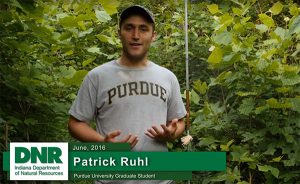 The Indiana Department of Natural Resources (IDNR) has released its latest video – Indiana’s Working Forests.
This video explores the origins of Indiana’s state forest system that developed after pioneer settlers cleared the original forests and left behind a nearly barren landscape.
State forests were established to demonstrate how to use science to grow and sustain healthy forest systems. Beginning with just 2,000 acres at Clark State Forest in 1903, the DNR Division of Forestry has expanded to cover more than 156,000 acres at 15 sites.
In the video, IDNR Forestry professionals discuss how management practices contribute to forest health by mimicking natural disturbances. Those practices promote regeneration of oaks and hickories that are valuable food sources for many forest wildlife species. They explain that although timber harvests have increased in recent years, the selective approach they use removes less than 1 percent of the available trees in any given year.
FNR graduate wildlife student Patrick Ruhl, Purdue adviser Dr. J. Barny Dunning, Jr., shares how the Hardwood Ecosystem Experiment provides him the opportunity to study the effects of forest management and the changes that are taking place among migratory songbirds. This project is a collaborative effort with the following sponsors: Indiana Department of Natural Resources, Division of Forestry; Indiana Department of Natural Resources, Division of Fish and Wildlife, Wildlife Diversity Section; Purdue University; Indiana Chapter of the Ruffed Grouse Society; National Geographic Society; and The Wildlife Management Institute. To view more partners view the Hardwood Ecosystem Experiment website: heeforestudy.org.
Resources:
A Landowner’s Guide to Sustainable Forestry: Part 1: Sustainable Forestry – What does it mean for Indiana?, The Education Store, Purdue Extension’s resource center
Indiana Forest Issues and Recommendations, The Education Store
The Hardwood Ecosystem Experiment: Indiana Forestry and Wildlife, The Education Store
Forest Ecosystem Management in Indiana, The Education Store
Forest Ecosystem Management in the Central Hardwood Region, The Education Store
Phil Bloom, Director
Indiana Department of Natural Resources
Every hunter knows the importance of acorns for game and non-game species alike. When acorns are plentiful it can alter the movements and patterns of game species and when acorns are absent wildlife must rely on alternative food sources to meet their nutritional needs during the fall, winter, and early spring. Knowing the importance of acorns to many wildlife species, it is beneficial to identify which trees are the most reliable and best producing in the woods.
Intro to oaks
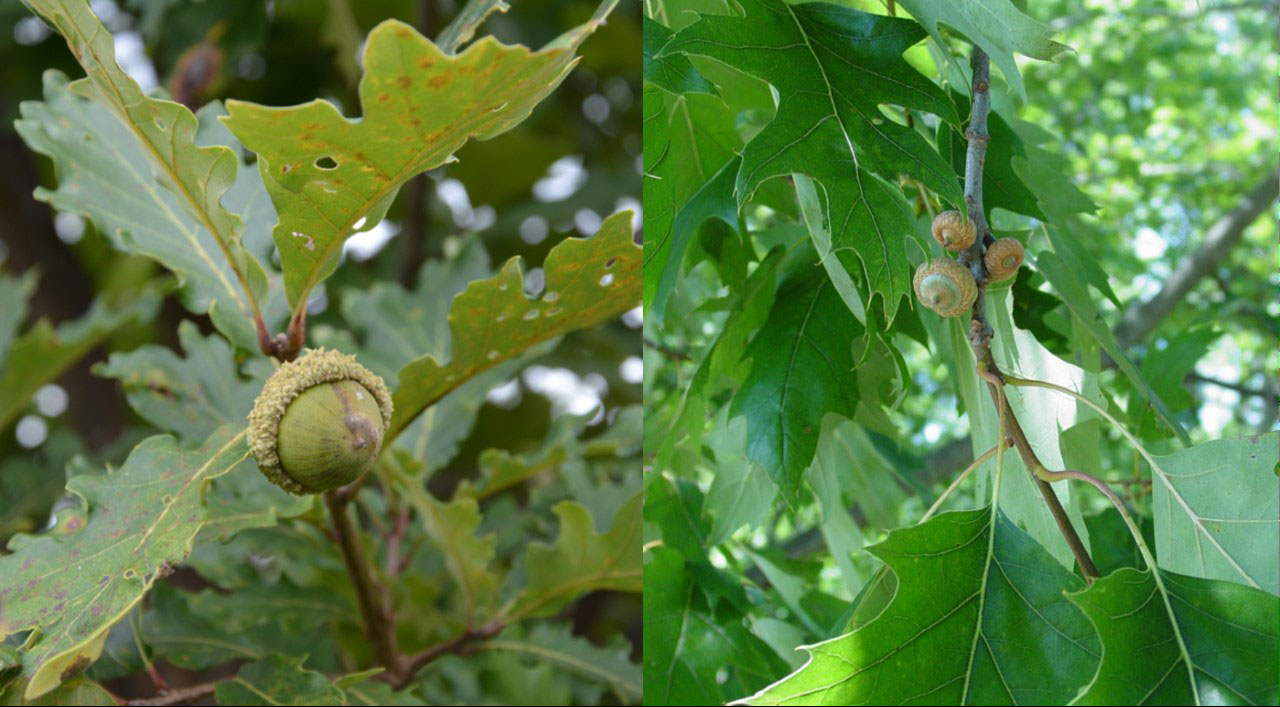
White oak acorns are clustered at the end of the branch – this year’s growth, like on this swamp white oak on the left. Whereas, red oak acorns are farther down the branch at the end of last year’s growth, like the northern red oak acorns on the right. (Photo by Brian MacGowan)
Oak trees in Indiana fall into 1 of 2 groups, white oak (e.g., white, swamp white, and chinkapin) or red oak (e.g., northern red, black, and pin). White oaks produce acorns in 1 growing season (acorns falling in 2016 are from flowers that were pollinated in the spring of 2016) and red oaks produce acorns in 2 growing seasons (acorns falling in 2016 are from flowers that were pollinated in the spring of 2015). This means a late frost in the spring may result in poor acorn production in white oaks in the fall of the same year, but will not influence red oak acorn production the same fall. However, a late frost in back-to-back years may result in a mast failure from both groups.
White oak acorns tend to be selected by wildlife more than red oak acorns because they contain less tannins resulting in a less bitter and more digestible acorn. Check out the Native Trees of the Midwest to learn more about oaks, their value for wildlife, and help you learn to identify different species.
Oak trees can be split into production groups based on their relative acorn production capabilities. Some individual oak trees are inherently poor producers and rarely produce acorns even in a bumper crop. Whereas other individuals are excellent producers and may produce acorns even in the poorest year. Research from the University of Tennessee reported poor mast producing trees represented 50% of white oaks in a stand and produced only 15% of the white oak acorn crop in a given year, whereas excellent producing trees represented 13% of white oaks, but produced 40% of the total white oak acorn production. When you included excellent and good producing white oaks together (31% of trees), they accounted for 67% of the total white oak acorn crop in a stand. This means a minority of the white oaks in a stand may produce a majority of the acorns!
Scouting oak trees
Understanding that some individual oak trees are poor producers, some are excellent, and some fall between poor and excellent, surveying oak trees can help identify important mast producing individuals. The late summer and early fall, just prior to or at the beginning of acorn drop, are perfect times to identify the best and worst producing oaks in your stand of timber. Scouting can be as formal as conducting a mast survey, National Deer Association, or as informal as taking mental notes of oak trees with heavy crops of acorns on the ground while you are walking to and from your tree stands in the fall. Either way, scouting oaks for acorn production capability can provide more information when determining where to hunt in the fall or which trees to retain and which trees to remove during a timber harvest. If wildlife management is an objective on your property, trees that you identify as the best acorn producers in the woods can be retained during a timber harvest, while poor producing trees can be removed with little detriment to overall acorn production. It is important to remember to retain a balance of oaks from both the red and white oak group, favoring red oak, to help safeguard against complete mast failures.
Forest management is insurance for mast failure

The top photo is of a mature forest with very few canopy gaps resulting in very little cover or food for wildlife. The bottom picture is of a forest stand where undesirable trees have been girdled (tree on the right-hand side of picture) to increase light to the forest floor and where multiple prescribed fire have been conducted to increase forage production and cover.
Annual acorn production in a stand of oaks is highly variably and can be dependent on environmental conditions. For example, late frosts, poor pollination, and insect infestations all can be culprits for poor mast production across a stand of oaks. Because of these factors, white oaks tend to only produce reliably 2 out of every 5 years, meaning 3 out of 5 years (60%) there is poor mast production or a failed mast crop in white oaks. Red oaks may produce a good crop as frequently as 2 to 5 years, but only produce a bumper crop an average every 5 to 7 years.
The extreme variability in acorn production underscores the importance in considering alternative food sources for fall, winter, and early spring for wildlife. In most mature forests with few canopy gaps there could be as little as 50-100 lbs of deer selected forage per acre in the understory. However, with some management, like thinning and prescribed fire the amount of deer selected forage can be increased to almost 1000 lbs/ac! Additionally, forest management also increases the amount cover throughout the year for species like white-tailed deer, wild turkey, ruffed grouse, woodcock, and many forest songbirds. Contrary to popular belief, cover can be more of a limiting factor for many wildlife species compared to food availability. Forest management could include girdling undesirable trees to expand growing space for mast producing trees or conducting a timber harvest removing undesirable trees and poor producing oak trees while retaining good producing trees. For more information on conducting a timber harvest for wildlife on your property contact a professional wildlife biologist or professional forester in your area.
When spending time in the woods this fall, take the time to look up and down to see which oaks in your woods are the best producers.
Resources:
Native Trees of the Midwest, The Education Store, Purdue Extension’s resource center
Masting Characteristics of White Oaks: Implications for Management, University of Tennessee
Wildlife Biologists, Indiana Department of Natural Resources (IDNR)
Find a Forester, Indiana Department of Natural Resources (IDNR)
Enrichment Planting of Oaks, The Education Store
Forest Improvement Handbook, The Education Store
The Hardwood Ecosystem Experiment: Indiana Forestry and Wildlife, The Education Store
Jarred Brooke, Wildlife Extension Specialist
Purdue University Department of Forestry and Natural Resources

Recent Posts
- Popular Landscape Shrub is Invasive
Posted: October 15, 2026 in Alert, Forestry, Forests and Street Trees, Invasive Plant Species, Plants, Woodlands - Purdue Extension’s Regional Teams Are Here: Connecting Communities with Expertise and Opportunity
Posted: October 14, 2026 in Community Development, Forestry, Forests and Street Trees, Gardening, How To, Timber Marketing, Urban Forestry, Wildlife, Woodlands - Why Do Our Trees Go From Green Leaves to Different Colors?
Posted: in Forestry, Forests and Street Trees, Urban Forestry, Woodlands - Distinguishing Dogwoods
Posted: October 13, 2026 in Forestry, Urban Forestry, Wildlife, Woodlands - It’s Not Too Early To Start Planning For Spring Tree Planting
Posted: in Forestry, How To - Can I Plant Trees in the Fall?
Posted: October 12, 2026 in Forestry, How To, Land Use, Plants, Urban Forestry, Wildlife - Burning for Benefits: Why Fire Belongs in Indiana
Posted: in Forestry, Safety, Woodlands - Disease May Cause Wilting and Eventual Death of Certain Trees and Shrubs, Purdue Landscape Report
Posted: October 5, 2026 in Disease, Forestry, Plants - October Is Firewood Month: Protect Indiana’s Forests by Making Smart Choices
Posted: October 1, 2026 in Forestry, Forests and Street Trees, How To, Invasive Insects, Urban Forestry - Woodland Flowers of Late Summer
Posted: September 14, 2026 in Forestry, Gardening, Wildlife, Woodlands
Archives
Categories
- Alert
- Aquaculture/Fish
- Aquatic/Aquaculture Resources
- Ask the Expert
- Christmas Trees
- Community Development
- Disease
- Drought
- Forestry
- Forests and Street Trees
- Gardening
- Got Nature for Kids
- Great Lakes
- How To
- Invasive Animal Species
- Invasive Insects
- Invasive Plant Species
- Land Use
- Natural Resource Planning
- Nature of Teaching
- Plants
- Podcasts
- Ponds
- Publication
- Safety
- Spiders
- Timber Marketing
- Urban Forestry
- Webinar
- Wildlife
- Wood Products/Manufacturing
- Woodland Management Moment
- Woodlands