 Purdue University - Extension - Forestry and Natural Resources
Got Nature? Blog
As hellbenders continue to decline, Dr. Rod Williams and his research team have been sharing awareness of how important it is that these salamanders continue to thrive in the current ecosystem.
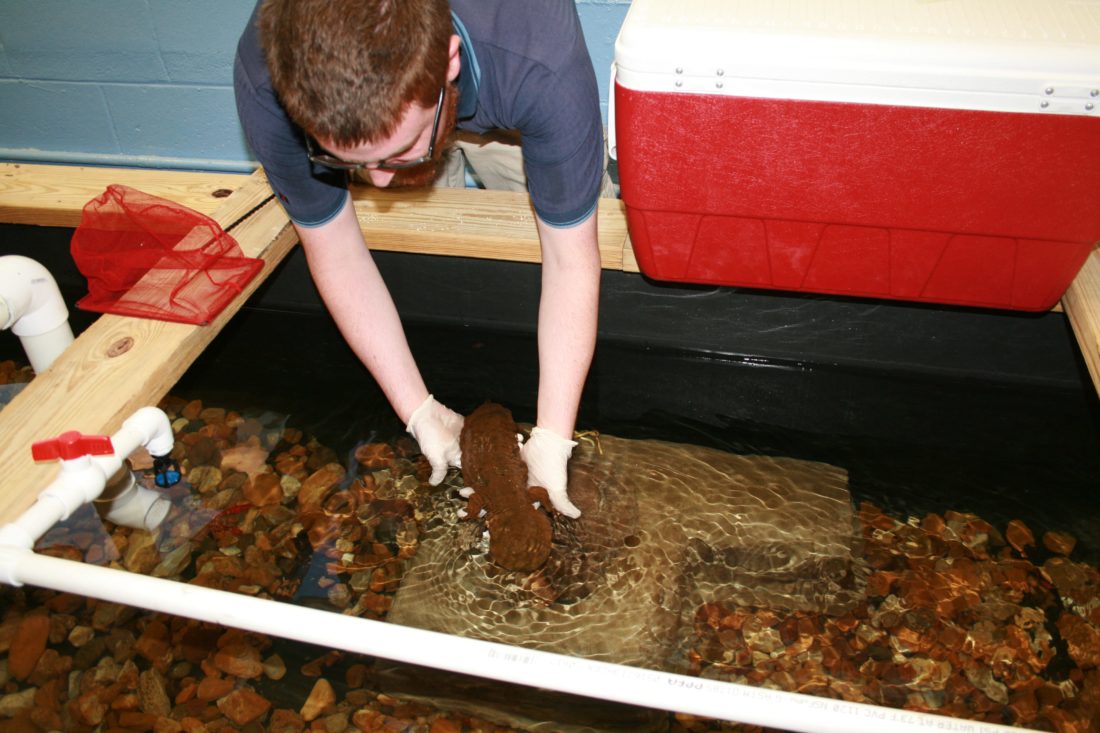
Eastern hellbenders are the largest salamander in North America. Adults can reach 29 inches in length, though most individuals are typically 11-24 inches long. Clean water is important for Hellbenders because they obtain most of their oxygen from the water by “breathing” through their skin. When breathing, their fleshy folds expand in surface area, enabling them to absorb more oxygen from the water.
Hellbender populations are declining across their range, from Missouri to New York. This decline, which affects the hellbender population in Indiana’s Blue River, is likely caused by human influences such as habitat degradation and destruction. The stream-bottom habitat of hellbenders can be degraded by sediment from eroded banks and fields and destroyed when streams are dammed or dredged. Hellbenders are also captured inadvertently by anglers or purposefully for illegal sale in the pet trade. Finally, emerging diseases may be impacting some populations of hellbenders.
Many states are developing conservation programs to help the hellbender. For more information and to learn more on conservation efforts, view Help the Hellbender.
Dr. Rod Williams and his hellbender research team have recently made national news:
CBS News
Trying To Save The Hellbender, America’s Largest Salamander
July 10, 2014
Resources:
Help the Hellbender Facebook page
Ask the Expert: Learn All About Hellbenders and Take a Tour, Subscribe Purdue Extension – Forestry & Natural Resources (FNR) YouTube Channel
Ask the Expert video: Help the Hellbender – Dr. Stephen Spear of The Wilds, Purdue Extension – FNR YouTube Channel
Ask the Expert video: Live with Mesker Park Zoo and Botanical Gardens – Hellbenders, Purdue Extension – FNR YouTube Channel
A Moment in the Wild video: Hellbender Hide, Purdue Extension – FNR YouTube Channel
A Moment in the Wild video: Release Moment of Hellbenders,
How Anglers and Paddlers Can Help the Hellbender video, Purdue Extension – FNR YouTube Channel
Eastern Hellbender ID Video, Purdue Extension – FNR YouTube Channel
Hellbenders Rock!, The Education Store, Purdue Extension’s resource center
Help the Hellbender, North America’s Giant Salamander, The Education Store
How Our Zoos Help Hellbenders, The Education Store
The Nature of Teaching: Adaptations for Aquatic Amphibians, The Education Store
Healthy Water, Happy Home – Lesson Plan, The Education Store
Purdue Expert: Hellbender Salamander, Purdue University News YouTube Channel
FNR Assists in First Natural Breeding of Eastern Hellbender in Captivity, Purdue FNR News & Stories
Helping the Hellbender: Mesker Park Zoo Begins Captive Breeding Efforts, Purdue Agriculture News
Rod Williams, Professor of Wildlife science and Assistant Provost for Engagement at Purdue University
Department of Forestry and Natural Resources, Purdue University
Diana Evans, Extension Information Coordinator
Department of Forestry and Natural Resources, Purdue University
As foresters, woodland owners and tree and wildlife enthusiasts, we hear the word safety and immediately think about making sure our hard hat is packed, our gas tank is full, our cell phone is charged and we have a buddy to call in case of an emergency. How many of us think about diseases? Who thinks about West Nile Virus (WNV) or Eastern Equine Encephalitis (EEE)? For those of us that take our pets into the field, WNV and EEE are very real threats. West Nile Virus originated in Africa but spread quickly throughout the United States after an outbreak in New York in 1999. By 2003, 46 states had been infected, and nearly 10,000 people had fallen ill.
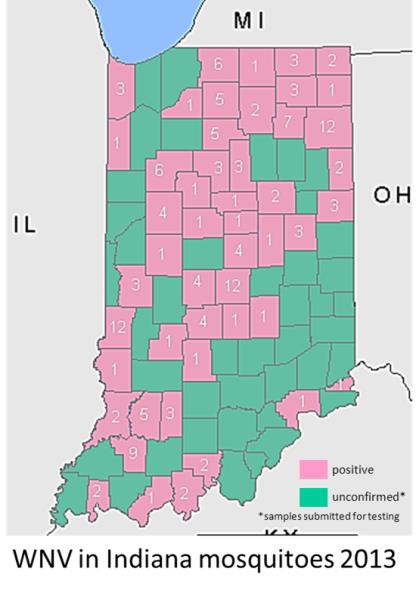
Although not contagious by contact with an infected person or animal, a protective layer is recommended when handling potential infected subjects. Most infected humans show no symptoms while a minority exhibit fevers, headaches, skin rashes, meningitis or encephalitis. Very few people die from WNV (< 1:1,000), but precautions should always be taken to prevent exposure. A total of 156 cases of WNV have been reported in Indiana this year with one sample being human. Other cases have been found in bordering states with 741 cases (mosquito) in Illinois, two mosquito and four human cases in Michigan, 64 mosquito cases in Ohio and zero cases of any kind in Kentucky as of August 20, 2013.
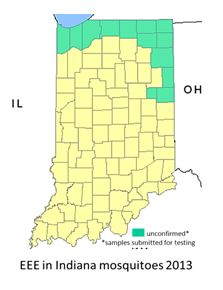
Eastern Equine Encephalitis is a rare viral disease that can be transmitted from host mosquitoes to a number of other animal species. Historical accounts of the disease show that in Midwestern states, EEE is most often found in southwestern Michigan; however, infected horses in Indiana have been found. EEE infects nearly all game birds, amphibians and reptiles, and last year in Michigan, an 8-week-old puppy.
Humans are not immune to EEE. Nearly 30% of people that develop the disease die, and approximately 50% of survivors have permanent neurological complications. Symptoms of infection may or may not occur and will often take between three and 10 days to be realized. EEE symptoms in humans range from fever, headache and nausea to abdominal pain, paralysis, seizures and fainting. An elderly woman in New England died on August 21, 2013, and was the first human casualty of the disease this year. A vaccine has been developed to prevent EEE in horses; however, no vaccine or treatment is available to protect humans or other animals from EEE or WNV. Elimination of standing water is our only defense against potential EEE and WNV threats.
As the summer is in full swing and more and more of us head out to the field, please do not forget to protect yourself and your pets from potential exposure to mosquitoes.
Sourced Information:
Beasley, D.W.C. et al. (2013) Resurgence of West Nile neurologic disease in the United States in 2012: What happened? What needs to be done? Antiviral Research 99:1–5.
Wendell, L.C. et al. (2013) Successful Management of Severe Neuroinvasive Eastern Equine Encephalitis. Neurocritical Care 19:111–115.
USGS Disease Maps
Van Buren County Horse Dies of Eastern Equine Encephalitis, Horse Owners Urged to Vaccinate Animals, MLIVE Media Group
Weymouth Officials Urge Caution After EEE Death, The Patriot Ledger
Resources
Mosquitoes, Purdue Extension Entomology
Shaneka Lawson, Plant Physiologist
Hardwood Tree Improvement and Regeneration Center (HTIRC)
Department of Forestry and Natural Resources, Purdue University
 A recent discussion about Asian carp as a food source has generated some concerns about the level of contamination in their fillets, and thus, whether or not they are safe to eat. Several Indiana agencies cooperate to evaluate the risks of fish consumption to the public; the agencies include the Indiana Department of Natural Resources (INDNR), Indiana Department of Environmental Management (IDEM), Indiana State Department of Health (ISDH) and Purdue University. Most of the fish assessed for contaminants are those that are regularly caught by anglers. Numerous catfish, bass, sunfish and sucker species are commonly included in tissue surveys (see links below for more info). Indiana then divides people into two risk groups: 1) men (over 15 years) and women beyond childbearing age (typically 45 years or older) and 2) women pregnant or capable of becoming pregnant and children under 15. The second group is considered the sensitive group, and allowable contaminant levels (that is, the amount of fish that is safe to consume) are set significantly lower.
It is important to recognize that there are differences in allowable contaminants among population groups mentioned above, and it is equally important to recognize that the same fish species can have different amounts of contaminants in different water bodies. Asian carp are a riverine species that frequently travel long distances, and as such, they are exposed to varying levels of contaminants. Indiana and many other states try to minimize the effects of variation in individual fish fillet by combining tissue from multiple individual fish and analyzing it as a composite. Sampling the tissue as a composite reduces the risk of a heavily contaminated fish or a fish with little contamination, giving a false impression of the risk. By combining the fillets, Indiana also saves money by not analyzing large amounts of single fillets. Indiana does divide the fish into a couple of size classes for each composite because contamination increases significantly as fish size increases. They have yet to begin testing Asian carp fillets, at least partially because of their difficulty to capture using traditional fish survey techniques.
Although most states have not started regularly testing Asian carp, there has been some published research evaluating Asian carp fillets and comparing their contaminants to other species caught in the same location. Not surprisingly, the results of the research found that Asian carp have different concentrations of contaminants depending on where they are found, and they have different levels than other species of fish including common carp. Common carp have a completely different diet than Asian carp, so it is not surprising that contamination levels are different. Like most other fish, the most common problems associated with Asian carp are Mercury and PCBs. However, where the research was conducted in Illinois and Missouri, the recommended restriction on consumption was typically one meal per week for the most sensitive groups. Most studies have demonstrated that larger fish tend to have higher concentrations in their tissues than smaller fish found in the same environments. This relates to the way Mercury and PCBs bioaccumulate in tissues – the longer a fish is around, the more contaminants per gram we would expect them to contain. This is not to say that Asian carp in Indiana is safe for that level of consumption or that it even contains the same amount of contaminants as in other states. It still needs to be evaluated by the state, but studies cited below have shown that for the most part, Asian carp are likely no riskier to consume than most of the fish species that Indiana currently evaluates.
Resources
Fish Consumption Advisory
Indiana State Department of Health
Asian Carp Solutions: Take Them to Market
Illinois-Indiana Sea Grant (IISG) Newsroom
No Bones About It: New Video Lays Out Easy Steps For Filleting Tasty Asian Carp
Illinois-Indiana Sea Grant (IISG) Newsroom
Published Papers
Levengood, J.M., D.J. Soucek, G.G. Sass, A. Dickinson, and J.M. Epifanio. In press. Elements of Concern in Fillets of Bighead and Silver Carp From the Illinois River, Illinois. Chemosphere 2013.
Rogowski, D.L., D.J. Soucek, J.M. Levengood, S.R. Johnson, J.H. Chick, J.M. Dettmers, M.A. Pegg, and J.M. Epifanio. 2009. Contaminant Concentrations in Asian Carps, Invasive Species in the Mississippi and Illinois Rivers. Environmental Monitoring and Assessment
Resources:
Walleye Farmed Fish Fact Sheet, The Education Store, Purdue Extension’s resource center
Pacific White Shrimp Farmed Fact Sheet, The Education Store
Yellow Perch Farmed Fish Fact Sheet, The Education Store
Tilapia Farmed Fish Fact Sheet, The Education Store
Rainbow Trout Farmed Fish Fact Sheet, The Education Store
American Paddlefish, The Education Store
A Guide to Small-Scale Fish Processing Using Local Kitchen Facilities, The Education Store
Aquaculture Family Coloring Book Development, The Education Store
Eat Midwest Fish, Illinois-Indiana Sea Grant online resource hub
Aquatics & Fisheries Videos, Purdue Extension-Forestry and Natural Resources YouTube Channel Playlist
Department of Forestry and Natural Resources (FNR)
Illinois-Indiana Sea Grant (IISG)
Purdue University
 Several myths have surfaced and resurfaced over many years. Indiana’s state forests have been managed by the Division of Forestry since the first state forest was established in 1903. Questions arise including acreage, management, level of harvest, the forestry profession and a number of other issues. The maintenance of ecosystem processes is inherently more important than a given stage of development that must be preserved.
Check out the Forest Management and Wildlife Habitat Myths and Truths of Indiana State Forests (pdf).
Resources:
Frost Seeding to Establish Wildlife Food Plots and Native Grass and Forb Plantings – Purdue Extension YouTube
Wildlife Habitat Hint: Tips for Evaluating a First Year Native Grass and Forb Plantings, Purdue Extension – FNR YouTube Channel
Drone Seeding Native Grasses and Forbs: Project Overview & Drone Setup, Purdue Extension – FNR YouTube channel
Forest Improvement Handbook, The Education Store
Ordering Seedlings from the State Forest Nursery System, Got Nature? – Purdue Extension-Forestry & Natural Resources (FNR)
Designing Hardwood Tree Plantings for Wildlife – The Education Store
ID That Tree – YouTube Playlist
Forest Management for Reptiles and Amphibians: A Technical Guide for the Midwest, The Education Store
Ask the Expert: Hardwood Ecosystem Experiment – Birds and Salamander Research, Purdue Extension – FNR
A Template for Your Wildlife Habitat Management Plan, The Education Store
Managing Your Woods for White-Tailed Deer, The Education Store
Woodland Stewardship for Landowners, Playlist, Purdue Extension – FNR YouTube channel
Nature of Teaching Unit 1: Animal Diversity and Tracking, The Education Store
Subscribe Purdue Extension – Forestry and Natural Resources YouTube Channel, Playlists include wildlife, Nature of Teaching, Moments in the Wild and much more.
Indiana Department of Natural Resources
Division of Fish and Wildlife

Recent Posts
- Discover the Great Lakes, The 2025 Helm Magazine is Available
Posted: November 17, 2025 in Aquaculture/Fish, Aquatic/Aquaculture Resources, Wildlife - Illinois-Indiana Sea Grant Newsletter Shares New Resources
Posted: November 13, 2025 in Aquaculture/Fish, Aquatic/Aquaculture Resources, Wildlife - Publication – Fish Muscle Hydrolysate
Posted: September 15, 2025 in Aquaculture/Fish, Aquatic/Aquaculture Resources - Publication – Direct Marketing Guidebook for Small/Medium-Scale Aquaculture Businesses
Posted: March 7, 2025 in Aquaculture/Fish, Aquatic/Aquaculture Resources, Publication - Conservationists Unite for Snuffbox Mussels – Wild Bulletin
Posted: February 20, 2025 in Aquaculture/Fish, Aquatic/Aquaculture Resources, Wildlife - Publication – Handbook on Processing Fish for Small-Scale Fish Farmers
Posted: October 17, 2024 in Aquaculture/Fish, Aquatic/Aquaculture Resources, How To, Publication, Wildlife - IISG Adds New Water Safety Videos
Posted: May 8, 2024 in Aquaculture/Fish, Aquatic/Aquaculture Resources, Community Development, Great Lakes, Wildlife - Farmers Helping Hellbenders RCPP Program Accepting Applications
Posted: May 1, 2024 in Aquaculture/Fish, Forestry, How To, Wildlife, Woodlands - 2024-25 Fishing Guide now available – Wild Bulletin
Posted: April 4, 2024 in Alert, Aquaculture/Fish, Aquatic/Aquaculture Resources, How To, Ponds, Wildlife - Look Out for Invasive Carp in Your Bait Bucket – Wild Bulletin
Posted: March 31, 2024 in Alert, Aquaculture/Fish, Aquatic/Aquaculture Resources, Invasive Animal Species, Wildlife
Archives
Categories
- Alert
- Aquaculture/Fish
- Aquatic/Aquaculture Resources
- Ask the Expert
- Christmas Trees
- Community Development
- Disease
- Drought
- Forestry
- Forests and Street Trees
- Gardening
- Got Nature for Kids
- Great Lakes
- How To
- Invasive Animal Species
- Invasive Insects
- Invasive Plant Species
- Land Use
- Natural Resource Planning
- Nature of Teaching
- Plants
- Podcasts
- Ponds
- Publication
- Safety
- Spiders
- Timber Marketing
- Uncategorized
- Urban Forestry
- Webinar
- Wildlife
- Wood Products/Manufacturing
- Woodland Management Moment
- Woodlands