
Mobile Elevating Work Platform Safety Program
Adopted: September 2022
The official version of this document will only be maintained on the EHS website.
Table of Contents
1. Purpose
The purpose of this program is to promote the safe use of Mobile Elevating Work Platforms (MEWPs) and prevent accidents, personal injuries, and property damage resulting from their use. This document provides the requirements for MEWPs application, inspection, training, maintenance, repair, and safe operation as well as the responsibilities of users, operators, supervisors, and occupants.
2. Scope and Purdue Policy
This program applies to all Purdue University personnel at the West Lafayette campus, regional campuses, university research farms and agricultural centers, and related facilities and operations.
It is the policy of Purdue University to take every reasonable precaution to provide a work environment free from recognized hazards for its employees in accordance with the General Duty Clause of the OSHA act (Public Law 91-596 Section 5(a)(1) and in accordance with specific OSHA standards. The University’s policy document is entitled Environmental Health and Safety Compliance (IV.A.4).
The Director of the department of Environmental Health and Safety (EHS) is responsible for establishing and maintaining the MEWP Safety Program.
3. Enforcement and Regulatory Requirement
Failure to follow the Purdue University MEWP Program can result in life threatening or serious injury situations. Failure to follow the MEWP Program may result in disciplinary action up to and including discharge.
OSHA 1910 Subpart F: Powered Platforms, Manlifts, and Vehicle-Mounted Work Platforms
- 29C CFR 1910.66 Powered platforms for building maintenance.
- 29C CFR 1910.67 Vehicle-mounted elevating and rotating work platforms.
- 29C CFR 1910.68 Manlifts.
OSHA 1926 Subpart L: Scaffolds
- 29 CFR 1926.453 Aerial lifts.
OSHA 1926 Subpart R: Steel Erection
- 1926.759 Falling object protection.
ANSI A92: Work/Aerial Work Platforms
- ANSI A92.20 – 2018: Design, Calculations, Safety Requirements And Test Methods For Mobile Elevating Work Platforms (MEWPs)
- ANSI A92.22 – 2018: Safe Use Of Mobile Elevating Work Platforms (MEWPs)
- ANSI A92.24 – 2018: Training Requirements For The Use, Operation, Inspection, Testing And Maintenance Of Mobile Elevating Work Platforms (MEWPs)
ANSI 121 – 2018: American National Standard For Dropped Object Prevention Solutions
4. Definitions
Aerial device: Any device, extensible, articulating or both, which is primarily designed and used to position personnel, designed to the ANSI/SAIA A92.20 standard.
Note: This device may handle material, if designed and equipped for that purpose.
Anchorage(s): A designated point of attachment used with a personal fall protection system.
Attendant (ground person): Person responsible for helping the operator in safe operation of the lift, assisting pedestrian and bystander safety.
Authorized personnel (authorized person): Personnel approved or assigned by the user to perform a specific type of duty or duties at a specific location or locations at a work site.
Care: To provide what is both necessary and required for the health, welfare, maintenance, and protection of personnel and the MEWP.
Chassis: Part of the MEWP that provides support for mobility of the elevating assembly.
Configuration: An allowable operating set up specific to the MEWP.
Control: By virtue of possession through custody, as defined in this standard, the required use of power, influence, and authority to behave and/or to direct the behavior of those who are involved in the application, use, inspection, maintenance of an MEWP, and compliance with all applicable provisions of this standard.
Control(s): A device actuated by an operator to affect a response from the MEWP.
Note: Examples of controls include interlocks, MEWP controls or powered functions.
Delivery: Transfer of care, control and custody of the MEWP from one person or entity to another person or entity.
Elevated travel position: Configuration of the MEWP for travel outside of the lowered travel position.
Elevating assembly: The work platform and the extending structure.
Extending structure: Structure connected to the chassis and supports the work platform, and which allows movement of the work platform to its required position.
Fall arrest system: Personal fall protection system designed to arrest the fall of a worker.
Fall restraint system: Protection system that restrains or prevents a worker from exposure to a fall.
Familiarization: Providing the necessary information regarding the features, functions, devices, limitations, and operating characteristics as defined by the manufacturer in the operator’s manual, of a specific model MEWP, to include the location of the manufacturer’s operation manuals.
Group A: MEWPs on which the vertical projection of the center of the platform area, in all platform configurations at the maximum chassis inclination specified by the manufacturer, is always inside the tipping lines.
Note: Refer to Section 1.1.3 MEWP Classification for application of groups and types.
Group B: MEWPs not in Group A.
Guardrail system: A vertical barrier primarily intended to protect personnel from falling to lower levels.
Hazardous atmosphere: Any location that contains, or has the potential to contain, an explosive or flammable atmosphere as defined in ANSI/NFPA 505.
Lessee: An entity to whom a MEWP is by lease, rental, loan or other arrangement.
Note: A manufacturer, dealer, owner, user, operator, lessor, or broker is and assumes the responsibilities of a lessee when that entity is acting in the capacity of this definition.
Lessor: An entity who leases, rents, loans or otherwise provides a MEWP to another party for the beneficial use of that party.
Note: A manufacturer, dealer, owner, user, operator, lessee, or broker is and assumes the responsibilities of a lessor when that entity is acting in the capacity of this definition.
Load sensing system: System of monitoring designated loads (by the design standard) on the work platform.
Lowered travel position: Configuration(s) of the MEWP as defined by the manufacturer for travel at maximum travel speed.
Maintenance: The act of upkeep such as inspection, lubrication, refueling, cleaning, adjustment and scheduled part(s) replacement.
Manual of Responsibilities: A document containing definitions and requirements mandated in applicable A92 Standards for the following entities: Manufacturers, Dealers, Owners, Users, Supervisors, Operators, Occupants, Lessors, Lessees and Brokers.
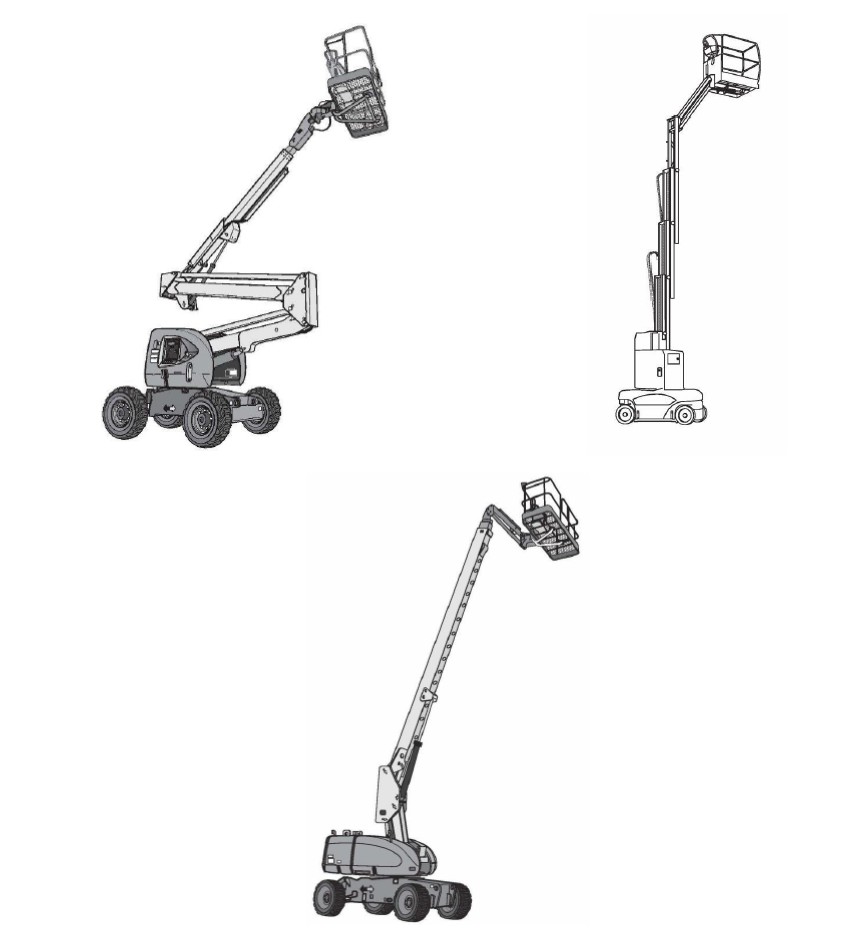
Mobile Elevating Work Platform (MEWP): Machine/device intended for moving persons, tools and material to working positions, consisting of at least a work platform with controls, an extending structure and a chassis.
Modification: Change(s) to a MEWP that affects the operation, stability, safety factors, rated load, or safety of the MEWP in any way.
Occupant: An individual on the work platform.
Operation manuals: Manuals provided by the MEWP manufacturer at the time of delivery located on the MEWP in a weather resistant storage location intended to be an integral part of the MEWP.
Operator: An individual qualified to control the movement of a MEWP.
Note: A manufacturer, dealer, owner, user, lessor, lessee or broker has and assumes the responsibilities of an operator when that individual is acting in the capacity of this definition.
Operator’s manual: A manual provided by the manufacturer and intended to be a part of the MEWP.
Note: The manual includes information to allow for safe operation of the MEWP.
Oscillating axle: Supporting structure allowing mainly vertical movement of the end wheel assemblies independently or in relation to each other.
Outriggers: Devices at the chassis that increase the stability of the MEWP and that are capable of lifting and levelling the MEWP.
Owner: An entity who has possession of the MEWP by virtue of purchase or legal possession of the MEWP.
Note: A manufacturer, dealer, user, operator, lessor, lessee or broker has and assumes the responsibilities of an owner when that entity is acting in the capacity of this definition.
Qualified person: Person who, by possession of a recognized degree, certificate or professional standing, or by extensive knowledge, training and experience, has successfully demonstrated his/her ability to solve or resolve problems related to the subject matter, the work or the project.
Rated horizontal force: Is the maximum horizontal force applied to the MEWP work platform as specified by the manufacturer.
Repair: The act of restoring to good condition that which has been broken, damaged or worn due to use, abuse, or other reasons.
Safety related bulletin: Publication from the manufacturer of the MEWP that requires attention to ensure safe operation of the MEWP that identifies and provides resolution to a safety-related issue.
Shall: The word “shall” have the meaning of being mandatory.
Should: The use of the word “should” is to be understood as advisory, and having the same effect as “recommended.”
Stability: A condition in which the sum of the moments tends to overturn the MEWP is less than the sum of the moments tending to resist overturning.
Stabilizers: Devices that increase the stability of the MEWP but are not capable of lifting or levelling the MEWP.
Stabilizing device(s): Device(s) that require deployment on a MEWP, such as stabilizers, outriggers, or extendible axles to meet the stability requirements.
Stowed position: Configuration of the MEWP as defined by the manufacturer when all extending equipment, stabilizers, out riggers, etc. are lowered and secured.
Supervisor: An entity assigned by the user to monitor operator performance and supervise their work.
Training: Instruction to enable the employee to become a qualified person regarding the task assigned, including knowledge regarding potential hazards.
Transport: A movement of the MEWP outside the boundaries of the working site.
Travelling: A movement of the chassis, except when the MEWP transported.
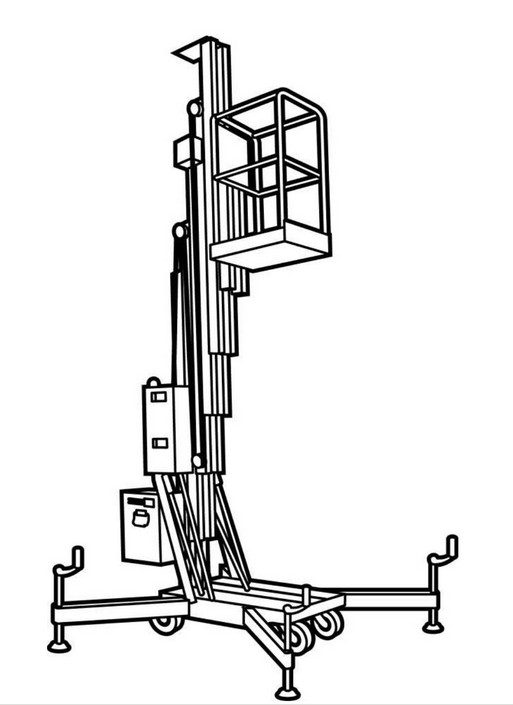
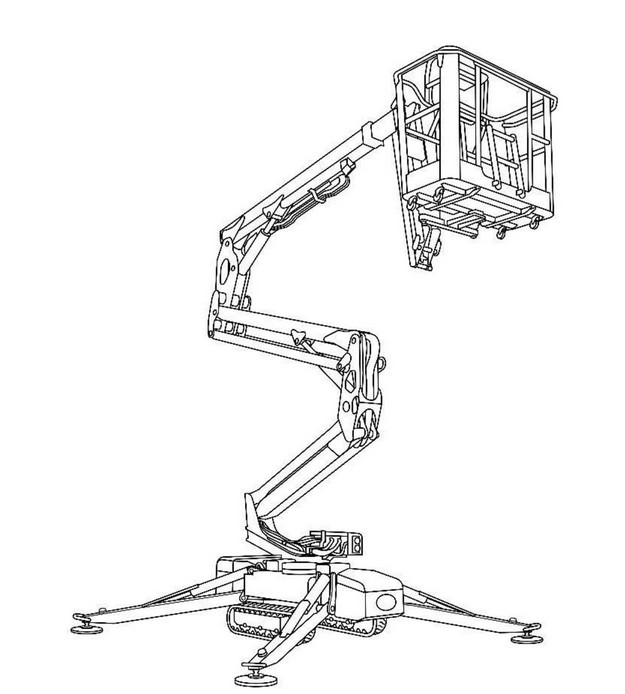
Type 1 MEWP: MEWP for which travelling is allowed only when in the stowed position. (Appendix A and Appendix B)
Note: Refer to Section 1.1.3 MEWP Classification for application of groups and types.
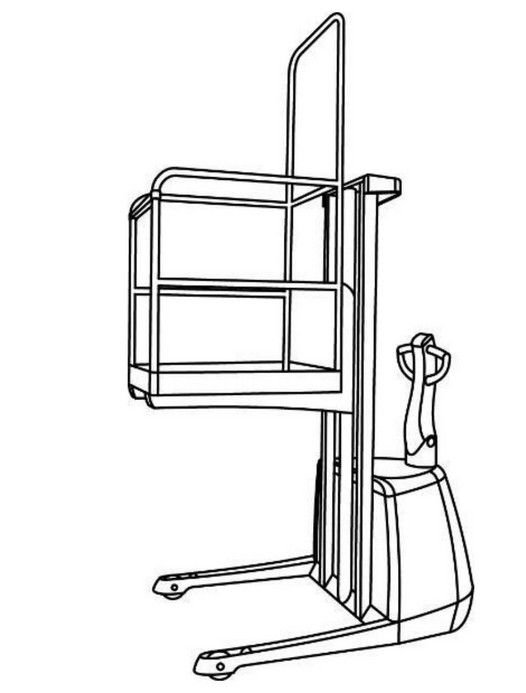
Type 2 MEWP: MEWP for which travelling with the work platform in the elevated travel position is controlled from a point on the chassis. (Appendix C)
Note: Type 2 and type 3 MEWPs can be combined.
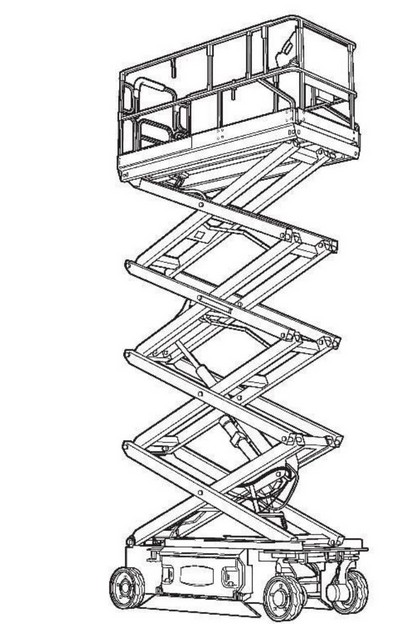
Type 3 MEWP: MEWP for which travelling with the work platform in the elevated travel position is controlled from a point on the work platform. (Appendix D and Appendix E)
Note: Type 2 and type 3 MEWPs can be combined.
Work platform: Component of the MEWP intended for carrying personnel along with their necessary tools and materials.
5. General Requirements
5.1 Basic Principles
- The department ensures trained, qualified, and authorized personnel have the knowledge of the intended use, safe operation, inspection, maintenance and familiarization of different models and classifications of MEWPs.
- The department has direct control over the application and operation of the MEWP, conformance with this program is the responsibility of the department supervision and operating personnel including operators, occupants/attendants, and supervisors
5.2 Manuals
- All MEWPs shall be provided with a manual of operation and stored in a weatherproof compartment on the unit.
- The department shall ensure the operator reviews and understands the operator’s manual or has it explained to them.
5.3 Modifications
- Permission is mandatory from the manufacturer for any modification of MEWPs.
- If the manufacturer no longer exists, a modification under the direction of an engineer with expertise in MEWPs is required.
6. Maintenance, Inspection, and Repair
The department shall set up a preventive maintenance program in accordance with the manufacturer’s recommendations and evaluate the environment of the workplace and severity of use of the MEWP.
- All malfunctions and problems identified that affect safe operation will be corrected by a qualified person and authorized by the department before the MEWP is put back in service.
- The department will verify any MEWP rented, leased, or used in any form is inspected, repaired, and adjusted in accordance with the manufacturer’s specifications prior to use.
- Prior to first use of the day or shift the lift must be inspected at least once per day or once per shift the supervisor shall ensure, and the operator shall perform, a pre-start and functions test that includes the following:
- Operating and emergency controls
- Audible and visual alarms and beacons
- Personal protective devices that will be worn while operating/occupying the MEWP
- Air, hydraulic and fuel-system leaks
- Electrical cables and wiring harness
- Loose, damaged, worn or missing parts
- Tires (where applicable tire pressure), wheels and wheel fasteners
- Instructions, warnings, control markings and operator’s manual(s)
- Structural items including extending structure and stabilizers/outriggers
- Work platform, including guardrail system, floor, anchorage and mounting
- Cleanliness and general signs of damage
- Brake operation and performance
- Fluid levels including engine coolant, engine oil and hydraulic oil
- Pins, pin securing devices and visible damage to the means of support of the work platform and extending structure
- Operation of stabilizers/outriggers, extendable and oscillating axles
- Any additional item specified by the manufacturer
7. Operations
7.1 Program Requirements
- All department personnel, supervisors, operators, and/or occupants, authorized to use a MEWP shall comply with this program.
- The department shall monitor personnel performance and supervise their work to ensure the use, application and operation of the MEWP is in conformance with the provisions set forth in this program.
- The department shall warn personnel of potential hazards and provide means to protect against identified hazards and explain the potential consequences of not following proper operating guidelines.
7.2 Risk Assessment
The department is responsible to ensure performance and documentation of the worksite risk assessment.
- The task shall be clearly identified, together with the location and timing.
- Select the appropriate MEWP for the task using the following criteria:
- Constraints of the work site
- Ground conditions
- Site access
- Proximity to the public and other workers
- Identify risks associated with MEWP operations during the task:
- Location
- Personnel
- Materials and equipment to be carried or used
- Identify control measures
- Site procedures and controls
- Operator and/or occupant safety requirements.
- The department shall communicate the results of the risk assessment to:
- Personnel involved in the task
- Individual requesting the task
- Develop a rescue plan
- Self-rescue by employee involved.
- Assisted rescue by occupant and/or attendant on site.
- Call 911. Emergency services technical rescue.
7.3 Before Operation
Supervisors and MEWP operators must:
- Understand the task to be performed
- Select MEWP appropriate for the task to be performed
- Understand of the potential hazards associated with the task, site, or environment and the means to safely deal with any such hazards
- Know the intended purpose and function of each control and items specified by the manufacture
- Understand the use and operation of stabilizing devices, such as outriggers, extendable axles, or other stability-enhancing means are used as required by the manufacturer
- Ensure guardrails are installed and access gates or openings are closed or in appropriate positions per manufacturer’s instructions
- Ensure loads and their distribution on the work platform and any platform extension are in accordance with the manufacturer’s rated load for that specific configuration
- Read and understand the manufacturer’s operating instruction(s) and user safety rules
- Read and understand all decals, warnings, and instructions displayed on the MEWP
- Use of appropriate personal protective equipment for the conditions including the environment in which the MEWP will be operated; and
- Ensure that there is another qualified person (attendant – ground person) on site, who is not working on the platform and knows how to use the emergency controls
7.4 Workplace Inspection
Before and during the use of the MEWP, the Department shall ensure the operator performs and documents a workplace inspection in the area the MEWP is used. The possible hazards include:
- Drop-offs or holes, including those concealed by water, ice, mud, etc.
- Slopes
- Bumps, floor obstructions and electric cables
- Debris
- Overhead obstructions
- Electrical conductors
- Hazardous atmospheres and/or hazardous locations
- Surfaces inadequate to sustain the ground-bearing pressures imposed by the MEWP in all operating configurations
- Winds greater than 22 mph
- Lightning within 10 miles of the work site and other weather conditions
- Presence of personnel and other mobile equipment
- Traffic hazards (use barriers in accordance with appropriate standard)
- Hazrdous environment where flammable, explosive gases or particles are present
7.5 Specific Requirements of Operation
- Fall Protection
- Guardrails are the primary means of fall protection. When the required use of personal fall protection, either fall restraint or fall arrest, is necessary operators and occupants shall comply with the instructions provided by the manufacturer regarding anchorage(s).
- All group B MEWP operators and occupants shall use personal fall arrest or fall restraint systems at all times.
- Weather Considerations
- Wind
- Lightning
- Ice
- Fog
- Heavy Rain
- Any other weather condition that directly or indirectly affects safe operation.
- Effect of Wind Forces on MEWP
- Shall not operate beyond the maximum limit allowed by the manufacturer or no more than 22 mph.
- No modifications or additions that affect MEWP’s wind loading shall be made without approval of the manufacturer.
- Effect of Wind on Equipment in the Work Platform
- Handling building materials
- Sheet materials
- Panels
- Other such materials, which can act as sails or catch wind.
- Local Wind Effects
- Shielding and funneling can cause high wind speeds and turbulence even under acceptable wind speeds in open ground.
- Localized high wind speeds near airports and along roadways.
- Anemometer use is recommended to determine local wind speeds.
- Use in lightning
- Shall not be used outdoors when lightning is detected within 10 miles of the worksite.
- Only inside of a building where personnel are not subject to a lightning strike.
- General Ground Condition Considerations
- Some soil types, moist soils, and un-compacted soils are unable to support MEWPs
- Some improved surfaces (paved, asphalt, compacted gravel) may not support outrigger pads or larger lifts.
- Must use spreader pads of sufficient size, stiffness and strength to reduce ground pressure from outrigger pads and wheels or tracks.
- Must consider subsurface voids such as utility tunnels, cellars, basements, culverts and pipes when MEWPs assessing ground support requirements.
- Electrical Hazards
- Stay at least 10 feet away from power lines with any part of their body, conductive object or any part of the MEWP.
- If task requires working nearer than 10 feet, stop and consult a qualified person with respect to electrical transmission and distribution to have appropriate measures taken (such as de-energizing and grounding).
- If there is a question that the power lines may carry more than 50kV, consult a qualified person with respect to electrical transmission and distribution before proceeding.
- While Working at Height
- Operator will use available devices to deactivate the work platform controls, whenever possible.
- Operator will ensure all materials and tools are secured and do not pose a hazard. This includes while traveling.
- Operator and any occupants shall always maintain a firm footing on the platform floor at all times. The following prohibitions apply:
- No climbing on the toe board, mid rail, or top rail of the work platform.
- No use of planks, ladders, or other devices on the work platform for achieving additional height or reach.
7.6 Exiting or Entering a MEWP at Height
MEWPs are not specifically designed to transfer personnel from one level to another or for leaving the work platform. Exiting or entering a MEWP at height shall only be permitted through a procedure provided by the manufacturer or supervisor that addresses the following:
- Fall prevention of persons during transfer from the work platform to the structure
- Fall prevention of tools and materials during transfer from the work platform to the structure
- Additional loads or changing of loads imposed on the MEWP for which it was not designed which could affect stability or overload the machine
- Dynamic and impact loads from personal fall protection equipment
- Damage to the MEWP or structure by an unintentional movement of the MEWP
- Stranding of people
- Use of extending decks and gates
- Use of single or double lanyards
- Distance between transfer surfaces, both horizontally and vertically
- Potential for movement of the MEWP platform due to changing loads
- Sudden movement of the MEWP or work platform.
7.7 MEWP Traveling
Before moving the work platform or the MEWP the operator shall do the following:
- Visually inspect the area around the platform for obstructions and check the direction of platform with references to the control indicators.
- Ensure that persons in the work site area are aware of the movement of the MEWP.
While moving or traveling:
- Maintain a clear view in the direction of movement, including above and below the work platform.
- Maintain an adequate clearance distance from hazards and avoid distractions.
- Travel with the boom/platform positioned at the lowest safe position for the conditions.
- Move at speeds that are appropriate for safe operation.
- Allow for movement of the platform when traveling over uneven surfaces, slopes and ramps.
- Allow for movement of the platform after the release of the controls or returning to a neutral position.
- No leaning on or over the guardrails while the MEWP is elevating or traveling close to obstructions.
- Avoid placing objects on or any part of the body over the platform control panel.
Parking the MEWP:
- Park MEWP in a designated area with the engine or motor switched off, the work platform lowered to its stowed position and the brakes applied.
- Unattended MEWP shall be left in the lowered/stowed position.
8. Training Requirements
Training shall be provided to MEWP operators and their supervisors and include the inspection, maintenance, use, application, and operation of MEWPs. Only personnel trained in compliance with this program and who have received unit-specific familiarization shall operate a MEWP. Training shall be required for each of the classifications of MEWP. The Department ensures that personnel whom they authorize as operators, occupants/attendants, and supervisors have been trained and familiarized in accordance with this program.
8.1 General Operator Training
There are two types of general operator training, theory and practical. Theory training involves classroom and/or online training. Practical training involves hands-on operation and evaluation.
8.1.1 Theory (i.e., classroom and/or online)
- The selection of appropriate MEWPs from the various classifications including available options
- The purpose and use of operation manuals, placards and decals, and safety rules
- Understanding that operation manuals are an integral part of the MEWP and need to be stored properly in the weather-resistant compartment on the MEWP when not in use
- Validation that annual inspection is current on the placard when present on the MEWP
- Knowledge of how to perform a pre-start inspection
- Responsibilities associated with problems or malfunctions affecting the operation of the MEWP
- Knowing and understanding factors affecting stability
- Recognition and avoidance of hazards associated with operation
- Knowing and understanding workplace inspections and that they must be performed prior to each use
- Knowing and understanding wind hazards and weather conditions
- Thorough understanding of the intended purpose and function of the MEWP controls, including platform, ground, and emergency descent controls
- General knowledge of various MEWPs and features and devices specified by the MEWP manufacturer to include physical characteristics and other machine options
- Applicable regulations, standards, and safety rules
- Use of personal protective equipment (PPE) appropriate to the task, worksite and environment and those required by the manufacturer
- Safe traveling practices
- Issues associated with transport (if appropriate)
- Understanding that authorization by the user is required to operate MEWP
- Understanding that securing the MEWP from unauthorized use is required
- The requirement for familiarization in addition to training
- Understanding of hazardous location(s) (flammable or explosive atmospheres)
- Warnings and instructions
- Familiarity with the requirements of operators
- The dangers associated with high pressure systems
- The responsibility of operator to inform platform occupants of applicable regulations, standards, and safety rules
- Other subjects required by the MEWP manufacturer
8.1.2 Practical (i.e., hands-on operation and evaluation)
- Walk around and familiarization with MEWP
- Major components – identification and function
- Perform pre-start inspection – carry out daily checks and inspections
- Operation and function of all controls
- Parking and securing the MEWP
8.2 Occupant/Attendant Training
The MEWP operator shall provide instruction or otherwise ensure all occupants have a basic level of knowledge to work safely on the MEWP. This instruction does not give the occupant authorization to operate the controls at any time except in an emergency. The knowledge that every occupant must have shall include as a minimum the following:
- The requirement to use fall protection and the location of fall protection anchors
- Factors including how their actions could affect stability
- Safe use of MEWP accessories they are assigned to use
- Site-specific work procedures the occupants must follow related to the operation of the MEWP
- Hazards related to the task at hand and their avoidance, to include any applicable site risk assessment
- General knowledge of the intended purpose and function of MEWP controls and safety-related items specified by the manufacturer, including emergency shut-down and lowering procedures, to the extent required to lower the MEWP safely to the ground/stowed position
- Manufacturer’s warnings and instructions
8.3 Supervisor Training
The department shall ensure supervisors of MEWP operators have the following training regarding:
- Proper selection of the correct MEWP for the work to be performed
- The rules, regulations, and standards applicable to MEWPs including the safe use, training and familiarization, and the work performed
- Potential hazards associated with use of MEWPs and the means to protect against identified hazards
- Manufacturer’s operation manuals are an integral part of the MEWP and need to be stored properly in the weather-resistant compartment on the MEWP
8.4 Testing
Each trainee shall show proficiency in both theory (classroom/online) and practical (hands-on). Results of the theory (classroom/online) and practical (hands-on) evaluations shall be documented.
8.5 Personal Documentation of Training
Upon completion of the training program, the MEWP operator will be given proof of completion by the trainer referencing compliance with this program. Documentation and MEWP Operator Certificate will include the following:
- Name of the person providing training or retraining
- Clear identification of the classification of MEWP covered in training
- Date of training completion
- Name of trainee
- The MEWP Operator Certificate is valid for 3 years
8.6 Retraining
Retraining required on a regular basis to ensure proficiency. Examples of situations when retraining would be necessary include, but are not limited to:
- Expiration of the operator’s 3-year valid training period
- Deterioration of the operator’s performance
- The operator’s extended period with no operation of greater than 2 years of a MEWP
- The operator’s introduction to new or significantly different MEWP technology
- The operator’s involvement in an accident or near miss with the MEWP
- Operator evaluation performed through practical (hands-on) operation for all retraining
Appendix A: Type 1, Group A MEWP
A.1 Type 1, Group A MEWP
Appendix B: Type 1, Group B MEWP
B.1 Type 1, Group B MEWP
Appendix C: Type 2 MEWP
C.1 Type 2 MEWP
Appendix D: Type 3, Group A MEWP
D.1 Type 3, Group A MEWP
Appendix E: Type 3, Group B MEWP
E.1 Type 3, Group B MEWP
Appendix F: MEWP Evaluation and Certification Form (Example)
- Appendix F: MEWP Evaluation and Certification Form
Appendix G: MEWP Pre-Start Inspection Form (Example)
- Appendix G: MEWP Pre-Start Inspection Form (2 Pages)