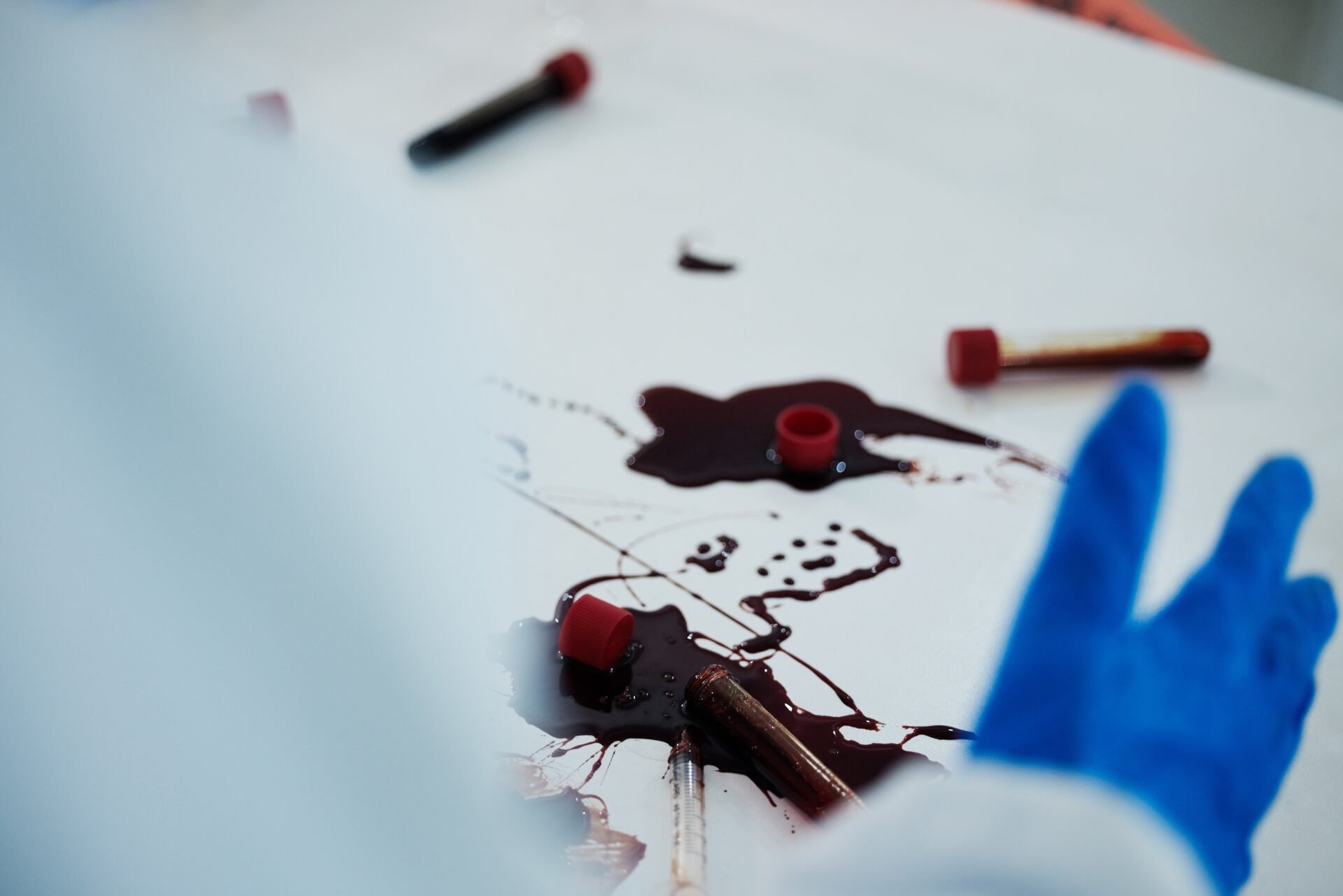
Blood Spill Procedures
Blood spills or other human body fluids that occur inside or in the outside environment need to be decontaminated to prevent the potential transmission of communicable disease. The circumstances associated with blood spills can obviously vary greatly depending on the volume and type of contact surface. A small amount of blood, if splashed, can cover a large surface area. A large volume, if undisturbed on a flat surface, can pool in a relatively small area. Because of the unpredictable nature of spills and the various volumes, each incident must be evaluated by a designated and trained individual (i.e. Environmental Health and Safety, Building Service Supervisor, PUFD personnel or a PUPD detective or investigator).
Indoor spills can either be cleaned by in-house service staff, or Building Services can be contacted to dispatch a clean-up crew. Outdoor spills can also be handled by in-house staff, Building Services, or in cases of large volume spills (accidents), the PUFD. After consultation with Environmental Health and Safety (EHS), assigned individuals from these areas will be authorized to contact an outside vendor in the event of a major spill.
Note: Blood spill clean-up procedures should only be utilized by employees who are current with their annual Bloodborne Pathogen Training.
Indoor Spills Clean-up Procedure
Small and Large Blood Spills
Response Team: Building Services or Trained In-House Staff
- The individual(s) cleaning the blood spill need to use the proper personal protective equipment (PPE), (e.g. water impervious gloves, outerwear, goggles).
- Spray the blood contaminated surfaces with a 1-10 solution of bleach and water.
- Absorb and remove all traces of the spill with paper towels or other acceptable materials (micro-encapsulation absorbent). Be careful not to contaminate the outside of the spray bottle.
- Re-spray the cleaned area with the bleach solution and allow to air dry.
- Place all waste materials, including disposable PPE, into a plastic autoclavable biohazard bag. Be careful not to contaminate the outside of the bag. Mattresses, rugs and other large items that cannot fit in a biohazard bag can be wrapped in plastic wrap after being decontaminated.
- This type of waste cannot be discarded through the regular trash service. Untreated biohazardous waste must be submitted to EHS at the Hazardous Materials Management Trailer (HMMT) M-F between the hours of 7:30 a.m. and 4:30 p.m. Call 765-494-0121 for more information.
Note: Inspect the blood spill area closely, making sure that there is nothing missed and that the clean-up process is complete.
Outdoor Spills Clean-up Procedure
Small Outdoor Spills
Response Team: Building Services, Fire Department or Trained In-House Staff
- The individual(s) cleaning the blood spill need to use the proper personal protective equipment (PPE), (e.g. water impervious gloves, outerwear, goggles).
- Make a disinfectant solution by pouring 1oz. house bleach to 10 oz. of water. This will give you a 1 to 10 ratio of chlorine disinfectant.
- As you enter the spill area, be careful not to step in any contaminated fluids. Flood the spill area with the bleach and water solution allowing it to stand for fifteen minutes. Note: Under certain conditions, a micro-encapsulation absorbent material may be applied to pooled blood so that the bulk of the contamination can be removed to a biohazard bag prior to decontamination.
- Disperse the disinfected spill with a five gallon bucket of clear water or a spray from a fire hose.
Large Outdoor Spills
Response Team: Fire Department
- The individual(s) cleaning the blood spill need to use the proper personal protective equipment (PPE), (e.g. water impervious gloves, outerwear, goggles, and in some cases a Tyvek suit, shoe covers, goggles, N-95 particulate mask).
- Large tissue particles must be removed and placed in an autoclavable biohazard bag prior to spill clean-up.
- Make a disinfectant solution by pouring two quarts of household bleach into a five-gallon container and add enough water to fill the container. This will give you a 1 to 10 ratio of chlorine disinfectant.
- As you enter the spill area, be careful not to step in any contaminated fluids. Flood the spill area with the bleach and water solution, allowing it to stand for fifteen minutes. Note: Under certain conditions a micro-encapsulation absorbent material may be applied to pooled blood so that the bulk of the contamination can be removed to a biohazard bag prior to decontamination.
- Disperse the disinfected spill with a generous spray from a fire hose.
- Place blood soaked articles into the red biohazard bags along with any contaminated single use PPE items.
- Articles that are too large for biohazard bags, i.e., carpets, mattresses or other blood soaked items, should be decontaminated with the bleach solution and wrapped in a non-absorbent leak proof material (plastic sheeting).
- Autoclave the biohazardous waste bags through PUSH.
Note: If there is an inadvertent blood product splash to your unprotected skin, wash the area with soap and water as soon as possible. If the splash is on abraded skin, in the eyes, mouth or nose be sure to notify your supervisor and report to PUSH Urgent Care as soon as possible so that follow-up procedures can take place.
Note: Inspect the blood spill area closely, making sure that there is nothing missed and the clean-up process is complete.
Blood Spill Clean-up
Suggested Clean-up Kit
- Single-use Tyvek suit and shoe covers
- Goggles or face shield
- Single-use Nitrile gloves
- Antibacterial hand-wipe towelettes
- Micro-encapsulation absorbent material
Clean-up Materials
- Five-gallon container
- Two quarts of household bleach
- Large autoclavable biohazard disposal bags
Contacts
Environmental Health and Safety
Biosafety Officer
Office: 765-494-1496
Cell: 765-366-8526
EHS Director
Office: 765-494-9227
Outside Vendors
Available for Major Spills Indoors or Outdoors
In the event of a major spill and after consultation with EHS, assigned individuals from either Building Services, PUPD and/or PUFD will be authorized to contact an outside vendor. For a list of potential vendors available to decontaminate major blood and body fluid spills associated with suicide/homicide situations, contact EHS.
Definitions
- Small Spill: A volume that is easily managed with a minimal amount of decontamination equipment and materials.
- Large Spill: A volume that would require more than one person, large amounts of decontamination equipment and material, and/or contamination of objects that would prove difficult to decontaminate, i.e., rugs, mattresses, furniture, electronic gear.
- Major Spill: Large amounts of blood and/or tissue (usually as a result of a homicide or suicide).
- Micro-encapsulation Absorbent: A dry material that rapidly converts a liquid into a solid. This material greatly simplifies blood spill clean-up and can be obtained through any lab safety vendor.