Skip to content
Purdue University Home Environmental Health and Safety
  • Home
  • Safety
    • Employee Safety
      • Medical Facilities
      • Report an Injury
      • Report a Near Miss
      • Report a Safety Concern
      • Return to Work
    • Personal Safety
      • Animal Bite and Scratch Exposure
      • Bloodborne Pathogens
      • Ergonomics
      • Food Safety
      • Minors in Labs and Other Hazardous Areas
      • Personal Protective Equipment
      • Pregnancy and Radiation
      • Presidential Safety Award
      • Situational Awareness
    • Building Safety
      • Asbestos Management Program
      • Excavation Safety
      • Indoor Air Quality
      • Indoor Water Quality
      • Lead Testing of Paint
      • Refrigerant Compliance Program
      • Silica
      • Slips, Trips and Falls
    • Lab and Equipment Safety
      • Autoclave Testing
      • Biosafety Cabinets and Clean Benches
      • Chemical Fume Hoods
      • Confined Space
      • Control of Hazardous Energy
      • Electrical Safety
      • Eyewashes and Safety Showers
      • Hazard Clearance and Declaration
      • Laser Safety
      • Mercury Thermometers
      • Mobile Elevating Work Platforms
      • Personal Protective Equipment
      • Researcher’s Guide
      • Scanning Electron Microscope
      • X-Ray Machines
  • Hazardous Waste and Materials 
    • Hazardous Materials
      • Biological Materials
      • Chemical Hygiene Plan
      • Chemical Materials
      • Controlled Substances
      • Hazard Communication
      • Laboratory Decommissioning
      • Laboratory Moves
      • Shipping Hazardous Materials
      • Standard Operating Procedures
      • Radioactive Materials
      • Worker Protection Standard
    • Hazardous Waste
      • Battery Disposal
      • Biological Waste
      • Chemical Waste Storage
      • Empty Container Disposal
      • Hazardous Waste Disposal
      • Household Hazardous Waste and E-Waste
      • HPLC Waste
      • Radioactive Waste
      • Universal Waste
      • Unknown Chemicals
      • Waste Containers
      • Waste Minimization
    • Spills
      • Blood Spills
      • Chemical Spills
      • Mercury Spills
      • Radioactive Materials Spills
  • ISP
    • ISP Certified Programs
    • Safety Committees
  • Compliance Programs
  • Environmental Programs
    • ECAD
    • Safe and Sustainable Labs Program 
  • About
    • Environmental Health
    • Environmental Safety Services
    • Hazardous Materials Management 
    • Industrial Hygiene
    • Occupational Safety
    • Radiation and Laser Safety
Environmental Health and Safety
  • Home
  • Safety
    • Employee Safety
      • Medical Facilities
      • Report an Injury
      • Report a Near Miss
      • Report a Safety Concern
      • Return to Work
    • Personal Safety
      • Animal Bite and Scratch Exposure
      • Bloodborne Pathogens
      • Ergonomics
      • Food Safety
      • Minors in Labs and Other Hazardous Areas
      • Personal Protective Equipment
      • Pregnancy and Radiation
      • Presidential Safety Award
      • Situational Awareness
    • Building Safety
      • Asbestos Management Program
      • Excavation Safety
      • Indoor Air Quality
      • Indoor Water Quality
      • Lead Testing of Paint
      • Refrigerant Compliance Program
      • Silica
      • Slips, Trips and Falls
    • Lab and Equipment Safety
      • Autoclave Testing
      • Biosafety Cabinets and Clean Benches
      • Chemical Fume Hoods
      • Confined Space
      • Control of Hazardous Energy
      • Electrical Safety
      • Eyewashes and Safety Showers
      • Hazard Clearance and Declaration
      • Laser Safety
      • Mercury Thermometers
      • Mobile Elevating Work Platforms
      • Personal Protective Equipment
      • Researcher’s Guide
      • Scanning Electron Microscope
      • X-Ray Machines
  • Hazardous Waste and Materials 
    • Hazardous Materials
      • Biological Materials
      • Chemical Hygiene Plan
      • Chemical Materials
      • Controlled Substances
      • Hazard Communication
      • Laboratory Decommissioning
      • Laboratory Moves
      • Shipping Hazardous Materials
      • Standard Operating Procedures
      • Radioactive Materials
      • Worker Protection Standard
    • Hazardous Waste
      • Battery Disposal
      • Biological Waste
      • Chemical Waste Storage
      • Empty Container Disposal
      • Hazardous Waste Disposal
      • Household Hazardous Waste and E-Waste
      • HPLC Waste
      • Radioactive Waste
      • Universal Waste
      • Unknown Chemicals
      • Waste Containers
      • Waste Minimization
    • Spills
      • Blood Spills
      • Chemical Spills
      • Mercury Spills
      • Radioactive Materials Spills
  • ISP
    • ISP Certified Programs
    • Safety Committees
  • Compliance Programs
  • Environmental Programs
    • ECAD
    • Safe and Sustainable Labs Program 
  • About
    • Environmental Health
    • Environmental Safety Services
    • Hazardous Materials Management 
    • Industrial Hygiene
    • Occupational Safety
    • Radiation and Laser Safety
Helpful links
  • CURRENT STUDENTS
  • FACULTY AND STAFF
  • Give
  • Events Calendar
  • Shop
  • News

Biological Waste

Shortcuts:
  • Biological Waste Types
  • Disposal Procedures
  • Animal Carcass Disposal
  • Contact
  • Definitions

Biological Versus Chemical Waste

Biological waste must be managed separately from chemical waste. A common example of chemical waste that is often mistaken for biological waste is agarose gel contaminated with ethidium bromide or heavy metals such as arsenic or chromium. This type of material must always be managed as chemical waste.

When both chemical and biological waste are present, the biological agents should be treated first. After the biological agents have been deactivated by autoclave or chemical disinfection, submit the remaining chemical waste through the Environmental Health and Safety Assistant (EHSA) system. For details about disposal procedures and pickup requests, visit the Hazardous Waste Disposal page.

Biological Waste Types

All sharps should be placed in properly labeled sharps containers or other rigid puncture-proof containers. Make sure the container is sealed, labeled and intact. Carefully place non-contaminated sharps next to the dumpster.

Contaminated waste should be managed as follows:

  • Biologically contaminated sharps should be treated and managed according to the Biological Waste Disposal and Pickup Procedures.
  • Chemically contaminated sharps should be submitted to Environmental Health and Safety (EHS) through EHSA. See the Hazardous Waste Disposal page.
  • Biological and chemical contaminated sharps should be treated first as a biological waste. Once the biological agents have been deactivated by autoclave, the remaining chemical waste should be submitted through EHSA. For more information, see the Hazardous Waste Disposal page.

Liquid biological waste should be collected in containers for autoclaving or chemical disinfection. Autoclaved or chemically disinfected liquid wastes can be disposed via the laboratory sink. Do not pour melted agarose down the drain. Allow it to cool and solidify, then dispose of it as solid waste in biohazardous waste bags.

Solid biological waste, including solidified agarose gels, should be collected in appropriate biohazardous waste autoclave bags. Once the waste has been autoclaved, the autoclave bags should be taped or tied shut and placed inside of the cardboard box provided by EHS.

Disposal and Pickup Procedures

  1. Determine whether the biological waste is Category 1 or Category 2.
    • Category 1 biological waste includes any human-derived biological or substance known, assumed or suspected of being infectious to humans, plants or animals before treatment that may cause harm to the general public if released into the environment. Category 1 biological waste also includes any material contaminated with the aforementioned infectious substances and all items containing or contaminated with human blood or fluids. All Category 1 biological waste must be treated by autoclave or with an appropriate chemical disinfecting agent such as bleach prior to pickup.
    • Category 2 biological waste, also known as “look-alike waste”, is non-infectious and includes material such as animal tissue, fluids, cell cultures and Petri dishes not fitting the Category 1 description. Category 2 waste does not require treatment.
  2. All solid biological waste, including sharps containers, must be placed into a cardboard box provided by EHS. The box should be taped shut once it is full. Do not overfill the box; the box flaps should easily fold down onto the top of the box (See pictures below).
  3. Once you are ready to have waste removed from your laboratory, complete an online waste pickup request through the Environmental Health and Safety Assistant (EHSA) system. Pickup usually occurs on the next working day.
  4. Once you have submitted the waste, place a green “Approved” sticker on the box(s) and write the pickup request number on the stickers. Additional stickers can be requested through the EHSA system.
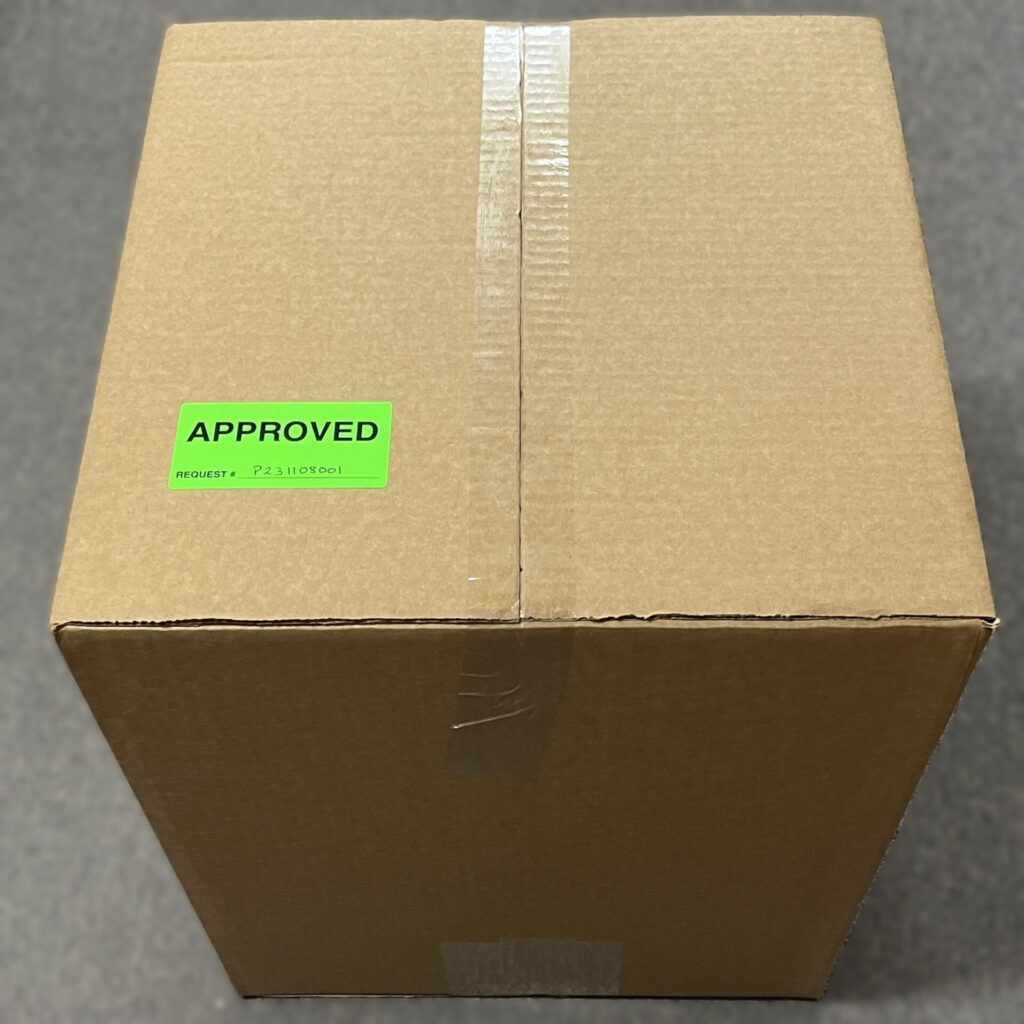
A sealed cardboard box with a bright green label on top that reads “APPROVED.” The label also lists a request number.
Correct Biological Waste Storage
  1. An EHS technician will come to your lab and remove the waste. The technician will leave behind the same number of boxes that were removed from the lab. It is the responsibility of the lab personnel to construct each new box.
  2. Once the waste is picked up from campus locations, it is transported back to Purdue’s Laboratory Materials Storage Building where it is consolidated into a 40 cubic yard roll off. A waste vendor routinely picks up this roll off and transports it to a nearby Subtitle D non-hazardous waste landfill. The landfill requires that all waste be non-infectious, free of EPA regulated chemical waste and contain no liquids.

Animal Carcass Disposal Procedures

EHS does not pick up animal carcasses. However, they can be taken to Purdue’s Animal Disease and Diagnostic Laboratory (ADDL) for incineration. 

  1. Collect frozen carcasses, tissues, etc. in cardboard boxes. ADDL’s incinerator will not accept any chemicals or inorganic material, such as gloves, bandages, or plastic (syringes, bags), etc. However, if the outside of the cardboard box is wet it can be placed in a garbage bag.
  2. Take your boxes to ADDL anytime Thursday or by noon on Friday. ADDL is located at 406 S. University St., West Lafayette, IN 47906.
  3. Go to the front desk and fill out a disposal form. An account number and faculty name is necessary as there is a charge for this service.
    • The charge depends on what is being incinerated. If it is over 50 lbs., the charge will be per animal; otherwise the charge is applied on a volume basis.
  4. Once the form is complete, go to the back dock and drop off the boxes there. The staff should be able to assist as needed.

Contact

If you have any additional questions, email hazwaste@purdue.edu.

Definitions

  • Biohazardous agent refers to an agent that is biological in nature, capable of self-replication and has the capacity to produce deleterious effects upon biological organisms. Biohazardous agents include, but are not limited to, bacteria, fungi, viruses, rickettsiae, chlamydia, prion, parasites, recombinant products, allergens, cultured human and animal cells and the potentially biohazardous agents these cells may contain, infected clinical specimens, tissue from experimental animals, plant viruses, bacteria and fungi, toxins and other biohazardous agents as defined by state and federal regulations.
  • Biological waste is any material that contains or has been contaminated by a biohazardous agent. Biological waste includes, but is not limited to, petri dishes, surgical wraps, culture tubes, syringes, needles, blood vials, absorbent material, personal protective equipment and pipette tips.
  • Sharps are items that are capable of puncturing, cutting or abrading the skin. Sharps include, but are not limited to, glass and plastic pipettes, broken glass, test tubes, razor blades, syringes and needles. See the Sharps and Infectious Waste: Handling and Disposal Guidelines (pdf) for more details.

Purdue Logo

Purdue University
610 Purdue Mall
West Lafayette, IN 47907

765-494-4600

Systemwide options

Follow Us

  • Facebook
  • Instagram
Systemwide options

  • West Lafayette Map
  • Careers
  • Center for Healthy Living
  • Colleges and Schools
  • Directory
  • Entrepreneurship and Commercialization
  • Human Resources
  • Libraries

  • Ethics and Compliance
  • Events
  • Give
  • Lost and Found
  • Office of Engagement
  • President
  • Tuition Calculator

  • BoilerConnect
  • Brightspace
  • Current Students
  • Faculty and Staff
  • myPurdue
  • Office 365
  • OneCampus Portal
  • Outlook

  • Annual Security Report
  • Construction
  • Emergency
  • Information Technology
  • Marketing and Communications
  • Purdue News
  • Purdue Hotline
  • Timely Warnings

Last modified: March 17, 2026

Copyright © 2026 Purdue University. All Rights Reserved. Trademark Statement.
Accessibility | EA/EO University | Integrity Statement | Free Expression | College Scorecard (ed.gov) | Privacy Policy | Contact Us