
Fall protection Program
Created: December 9, 2024
The official version of this document will only be maintained on the Environmental Health and Safety website.
Table of Contents
- 6.1 Floor Openings
- 6.2 Open Sided Floors or Platforms
- 6.3 Temporary Elevated Platforms
- 6.4 Skylights
- 6.5 Open Pits, Tanks, or Spillways
- 6.6 Dangerous Equipment
- 6.7 Excavations
- 6.8 Holes
- 6.9 Leading Edge(s)
- 6.10 Roofing Work or Low-Slope Roofs
- 6.11 Steep Roofs
- 6.12 Unprotected Sides and Edges
- 6.13 Wall Openings
- 6.14 Portable Ladders
- 6.15 Fixed Ladders
1. Purpose
1. Purpose
The purpose of this program is to ensure employees are protected from fall hazards by establishing guidelines and requirements for university supervisors and employees to identify and control potential fall hazards. This program will cover fall protection systems, equipment, and usage including regular inspections and maintenance, as well as the appropriate training for employees working at heights, near holes, and other potential fall hazard areas at Purdue University.
The Fall Protection Program is a part of the University’s compliance with the regulations set by
the U.S. Department of Labor, Occupational Safety and Health Administration (OSHA) entitled “Fall Protection”.
2. Scope
2. Scope
This program applies to all Purdue University personnel at the West Lafayette campus, regional campuses, university research farms and agricultural center, and related facilities and operations.
All employees will be protected from falling when working on a surface that has an unprotected side, edge, etc. or elevated work platforms at a height of 4 feet or more above an adjacent lower level.
3. Policy and Regulation
3. Policy and Regulation
Failure to follow the Purdue University Fall Protection Program can result in life threatening or serious injury situations. Failure to follow the Fall Protection Program may result in disciplinary action up to and including discharge.
OSHA Regulation, 29 CFR Subpart D: Walking Working Surfaces
- 1910,21 – Scope and definitions
- 1910.22 – General requirements
- 1910.23 – ladders
- 1910.28 – Duty to have fall protection and falling object protection
- 1910.29 – Fall protection systems and falling object protection-criteria and practices
- 1910.30 – Training requirements
OSHA Standard, 29 CFR Subpart I, 1910.140 – Personal Fall Protection Systems
OSHA Regulation 29 CFR Subpart M: Fall Protection
- 1926.500 – Scope, application, and definitions applicable to this subpart
- 1926.501 – Duty to have fall protection
- 1926.502 – Fall protection systems criteria and practices
- 1926.503 – Training requirements
ANSI/ASSE Z359 Fall Protection
4. Definitions
4. Definitions
- Anchorage – a secure point of attachment for lifelines, lanyards, or deceleration devices.
- Body harness – straps that may be secured about the worker in a manner that will distribute the fall arrest forces over at least the thighs, pelvis, waist, chest, and shoulders, with means for attaching it to other components of a personal fall arrest system.
- Buckle – any device for holding the body belt or body harness closed around the worker’s body.
- Competent person – one who can identify existing and predictable hazards in the surroundings or working conditions that are unsanitary, hazardous, or dangerous to workers, and has the authorization to take prompt corrective measures to eliminate them.
- Connector – a device that is used to couple (connect) parts of the personal fall arrest system and positioning device systems together. It may be an independent component of the system, such as a carabineer, or it may be an integral component of part of the system (such as a buckle or D-ring sewn into a body belt or body harness, or a snap hook spliced or sewn to a lanyard or self-retracting lanyard).
- Dangerous equipment – equipment (such as pickling or galvanizing tanks, degreasing units, machinery, electrical equipment, and other units) which, as a result of form or function, may be hazardous to workers who fall onto or into such equipment.
- Deceleration device – any mechanism (such as a rope grab, rip-stitch lanyard, specially woven lanyard, tearing or deforming lanyards, automatic self-retracting lifelines/lanyards, etc.) that serves to dissipate a substantial amount of energy during a fall arrest, or otherwise limit the energy imposed on a worker during fall arrest.
- Deceleration distance – the vertical distance a falling employee travels after the deceleration device begins to operate. It is measured as the distance between the attachment point at the moment of activation and the attachment point when the worker reaches a full stop.
- Equivalent – alternative designs, materials, or methods to protect against a hazard, which the employer can demonstrate will provide an equal or greater degree of safety for workers than the methods, materials, or designs specified in the standard.
- Load refusal – is the point where the ultimate strength is exceeded.
- Free fall – the act of falling before a personal fall arrest system begins to apply force to arrest the fall.
- Free fall distance – the vertical displacement of the fall arrest attachment points on the worker’s body belt or body harness between the onset of the fall and just before the system begins to apply force to arrest the fall. This distance excludes deceleration distance and lifeline/lanyard elongation but includes any deceleration device slide distance or self-retracting lifeline/lanyard extension before they operate and fall arrest forces occur.
- Guardrail system – a barrier erected to prevent workers from falling to lower levels.
- Hole – a gap or void 2 inches or more in its least dimension, in a floor, roof, or other walking or working surface.
- Lanyard – a flexible line of rope, wire rope, or strap that generally has a connector at each end for connecting the body belt or body harness to a deceleration device, lifeline, or anchorage.
- Leading edge – the edge of a floor, roof, or formwork for a floor or other walking or working surface (such as the deck) that changes location as additional floor, roof, decking, or formwork sections are placed, formed, or constructed. A leading edge is considered to be an “unprotected side and edge” during periods when it is not actively and continuously under construction.
- Lifeline – a component consisting of a flexible line for connection to an anchorage at one end to hang vertically (vertical lifeline), or for connection to anchorages at ends to stretch horizontally (horizontal lifeline), and which serves as a means for connecting other components of a personal fall arrest system to the anchorage.
- Mechanical equipment – all motor- or human-propelled wheeled equipment used for roofing work, except wheelbarrows and mop carts.
- Opening – a gap or void 30 inches or higher and 18 inches or wider, in a wall or partition, through which workers can fall to a lower level.
- Personal fall arrest system – a system used to arrest a worker in a fall from a working level. It consists of an anchorage, connectors, and a body harness. It may include a lanyard, deceleration device, lifeline, or suitable combinations of these. Note – the use of a body belt for fall arrest has been prohibited.
- Positioning device system – a body belt or body harness system rigged to allow a worker to be supported on an elevated vertical surface, such as a wall, and work with both hands free while leaning.
- Qualified Person – one who, by possession of a recognized degree, certificate, or professional standing, or who by extensive knowledge, training, and experience, has successfully demonstrated his ability to solve or resolve problems relating to the subject matter, the work, or the project.
- Rope grab – a deceleration device that travels on a lifeline and automatically, by friction, engages the lifeline and locks so as to arrest the fall of a worker. A rope grab usually employs the principles of inertial locking, cam/level locking, or both.
- Safety-monitoring system – a safety system in which a competent person is responsible for recognizing and warning workers of fall hazards.
- Self-retracting lifeline/lanyard – a deceleration device containing a drum-wound line which can be slowly extracted from, or retracted onto, the drum under slight tension during normal worker movement, and which, after the onset of a fall, automatically locks the drum and arrests the fall.
- Snap hook – a connector comprised of a hook-shaped member with a normally closed keeper, or similar arrangement, which may be opened to permit the hook to receive an object and, when released, automatically closes to retain the object. Snap hooks are generally one of two types:(1) The locking type with a self-closing, self-locking keeper that remains closed and locked until unlocked and pressed open for connection or disconnection; or (2) The non-locking type with a self-closing keeper that remains closed until presses open for the connection or disconnection.
- Toe board – a low protective barrier that will prevent the fall of materials and equipment to lower levels and provide workers protection from falls.
- Unprotected sides and edges – any side or edge (except at entrances to points of access) of a walking or working surface (for example, floor, roof, ramp, or runway) where there is no wall or guardrail system at least 39 inches high.
- Work area – that portion of a walking or working surface where job duties are being performed.
5. Roles and Responsibilities
5. Roles and Responsibilities
All Employees are responsible for:
- Recognizing fall hazards in their work environment
- Stopping work if unsafe conditions exist
Trained Employees are responsible for:
- Successfully completing training in procedures that they will be strictly working in and training on the requirements for personal fall protection
- Conducting inspections before the use of fall protection equipment
- Stopping work and bringing attention to any unsafe or hazardous conditions and/or equipment to management and supervisors
Competent Person(s) are responsible for:
- Providing an operations level of safety expertise in the subject of fall protection work for day-to-day operations in the department
- Providing training to employees on how to use fall protection
- Facilitating the correction of safety problems within the department
- Conducting assessments on elevated work and approving appropriate fall protection systems that meet the criteria and where trained employees will be exposed to fall related hazards (list continued on next page)
- Conducting inspections of all fall arrest equipment using the Fall Protection Inspection form (Appendix A)
Management and Supervisors are responsible for:
- Implementing procedures written in the Fall Protection Program
- Reviewing the Fall Protection Program for themselves and employees on an annual basis
- Ensuring all employees understand and follow the procedure of this plan and to follow the instruction of the team’s supervisor
- Maintaining records for inspections which include dates of inspections, signature of the person who performed the inspection and identification information of the equipment using the inspection forms (Appendix A) and sheets
- Using the records of inspection to create an inventory of all fall arrest equipment used by the team
- Ensuring there is a competent person trained in their area or having access to one when needed
Environmental Health and Safety is responsible for:
- Providing procedural guidelines, education offerings, administrative consultations, reviews of programs, and selecting technical and field services as needed
- Providing training for all employees who use fall arrest equipment
- Providing support on what fall protection equipment should be used
6. Fall Hazard Identification
As stated above, all employees are responsible for Identifying work processes, activities, or situations that have the potential to cause injuries or harm to a person due to the risk of a fall before working at a height.
The following types of fall hazards shall be evaluated by a competent person to determine the best method of fall protection to implement in order to protect employees from falls.
6.1 Floor Openings
Where an employee can accidentally walk into a floor hole opening measuring 12 inches but more than 1 inch in its least dimension, shall be guarded by either a standard railing with toe board, or a floor hole cover of strength and construction to support the required load. For stairway openings, standard railings shall be provided on all exposed sides except at the stairway entrance.
6.2 Open Sided Floors or Platforms
An open-sided floor or platform or a runway that is 4 feet or more above the ground level or above the adjacent floor shall be guarded by a standard railing on all open sides except for the entrance (to a ramp, stairway, or ladder). If equipment or materials could fall and create a hazard, then the railing system must include a toe board on each side.
6.3 Temporary Elevated Platforms
A temporary elevated platform such supported scaffolding can consist of one or more platforms. Mobile scaffolds are supported scaffolds that are on wheels or casters. All scaffolding shall be capable of supporting, without failure, its own weight and at least 4 times the maximum intended load applied or transmitted to it.
Scaffolds must be constructed, moved, altered, and dismantled in accordance with regulatory requirements by experienced staff. General fall protection requirements when using scaffolding include:
- Footing must be rigid and capable of carrying the maximum intended load.
- Access ladders or equivalent safe access to working levels must be provided.
- Scaffolds that are more than 10 feet high must have standard guardrails, midrails, and toeboards or netting. Cross members may be used as top or mid guardrails, but not both.
- If guardrails cannot be installed, then an external personal fall arrest system must be used with an overhead anchor point.
- Guardrails must not be used as an anchor point for a personal fall arrest system, unless the scaffold manufacturer specifies this is acceptable.
Scaffolds must not be moved horizontally while employees are on them. Employees must not work on scaffolds during storms, high wind, or when the working surfaces are covered with ice.
6.4 Skylights
Skylights are considered an opening when present on a roof. A standard guardrail or skylight screen capable of supporting at least 200 pounds must be provided around the opening to prevent employees from falling through to the surface below.
6.5 Open Pits, Tanks, or Spillways
Protect employees from hazards of open pits, tanks, and spillways by using covers and/or guardrails.
6.6 Dangerous Equipment
Employees working less than 4 feet above dangerous equipment (see section 4) shall be protected from falling into or onto the dangerous equipment by guardrail systems or by equipment guards.
Employees working 4 feet or more above dangerous equipment shall be protected from fall hazards by guardrail systems, personal fall arrest systems, or safety net systems.
6.7 Excavations
Employees working at the edge of an excavation 4 feet or more in depth shall be protected from falling by guardrail systems, fences, or barricades when the excavations are not readily seen because of plant growth or other visual barriers. Each employee at the edge of a well, pit, shaft, and similar excavation 4 feet or more in depth shall be protected from falling by guardrail systems, fences, barricades, or covers.
6.8 Holes
Employees on walking/working surfaces (including skylights) shall be protected from
- Falling through holes more than 4 feet above lower levels by personal fall arrest systems, covers, or guardrail systems erected around these areas.
- Tripping in or stepping into or through holes by placing covers over the holes.
- Objects falling through holes by placing covers over the holes.
6.9 Leading Edge(s)
Employees constructing a leading edge 4 feet or more above a lower level shall be protected from falling by guardrails systems, safety net systems, or fall arrest systems.
Employees working on a walking/working surface 4 feet or more above a lower level where leading edges are under construction, but who is not engaged in the leading-edge work, shall be protected from falling by a guardrail system, safety net system, or personal fall arrest system.
Exception: when the supervisor can demonstrate to EHS that it is infeasible or creates a greater hazard to use these systems. The supervisor shall develop a fall protection plan, and have it approved by a competent person and EHS before it can be implemented.
6.10 Roofing Work or Low-Slope Roofs
Employees engaged in roofing activities on low-slope roofs, with unprotected sides and edges 4 feet or more above lower levels shall be protected from falling by guardrail systems, safety net systems, personal fall arrest systems, or a combination of warning line system and guardrail system, warning line system and safety net system, or warning line system and personal fall arrest system, or warning line system and safety monitoring system.
6.11 Steep Roofs
Employees on a steep roof with unprotected sides and edges 4 feet or more above lower levels shall be protected from falling by guardrail systems with toe boards, safety net systems, or personal fall arrest systems.
6.12 Unprotected Sides and Edges
Employees on a walking/working surface (horizontal and vertical surface) with an unprotected side or edge that is 4 feet or more above a lower level shall be protected from falling using guardrail systems, safety net systems, or personal fall arrest systems.
6.13 Wall Openings
A wall opening 4 feet or more above an adjacent surface must be guarded. A rail, picket fence, half door or equivalent barrier must be placed across the wall opening. If the wall opening extends to the floor, a toe board at least 4 inches high must be installed to prevent materials from accidentally falling from the edge.
All employees working on, at, above, or near wall openings (including those with chutes attached) where the outside bottom edge of the wall opening is 4 feet or more above lower levels and the inside bottom edge of the wall opening is less than 39 inches above the walking/working surface, shall be protected from falling by the use of a guardrail system, a safety net system, or a personal fall arrest system.
6.14 Portable Ladders
Serious injuries can result when a ladder is used improperly, in an unsafe area, or if it is faulty and has not been properly maintained. Use the appropriate ladder for the surface it is placed on and the work that is to be done. Before using a ladder be sure to inspect the working area for overhead obstructions and any ground obstructions that would interfere with ladder stability.
Instructions on safe ladder setup and use and how to correctly maintain and store ladders can be found below.
Ladder setup and Use:
- All ladders must be inspected daily before use. If a ladder is found to be damaged and is deemed unsafe, it shall be tagged “out of service”, made inoperable, and removed from the jobsite.
- Only ladders made of other synthetic materials such as fiberglass shall be used across campus.
- Ladders should be free of oil, grease and other slipping hazards.
- Do not load ladders beyond their maximum intended load nor beyond their manufacturer’s rated capacity. All ladders should have appropriate labels indicating load capacity from their manufacturer.
- Ladders should be stored securely so that it prevents the ladder from sliding or collapsing.
- When setting up a portable ladder, be sure to set the ladder at the proper angle to the building (usually about 25% of the ladder’s vertical height).
- Never lean a ladder against cables or wires of any type.
- Use the help of another worker to extend the ladder to the proper height and positioning.
- Be sure the locks are secure before ascending the ladder.
- When a climber is ascending the ladder, another worker should be used to stabilize the ladder by holding the sides and supporting the feet of the ladder if available.
- The climber should use the three-point method when climbing a ladder. This means that two hands and one foot or two feet and one hand should be in contact with the ladder at all times during the climb.
- Never carry tools up the ladder in one hand. Always use two hands to climb.
- Never climb a ladder from the side or underside.
- Never “walk” or “shift” a ladder while standing on it.
6.15 Fixed Ladders
Fixed ladders a permanently attached to a structure, building, or equipment. Existing fixed ladders taller than 20 feet must have a cage, well, ladder safety system, or personal fall arrest system for fall protection. Cages must begin between 7 and 8 feet from the ground or lower level and extend 42 inches above the top of the landing.
A personal fall arrest system or ladder safety system or device will be used to protect employees when climbing ladders without cages or wells. Employees using a fixed ladder safety system must be trained by a competent person in the proper use and inspection of fall arrest equipment.
7. Fall Hazard Controls
7. Fall Hazard Controls
After assessing a work site for fall hazards, a competent person should be able to determine the best option for fall protection. Proper controls must be put in place to eliminate, prevent, or arrest a fall before to starting work. When selecting what type of fall protection to use, a competent person should consider the hierarchy of fall protection controls, which organizes risk control techniques from most to least effective (examples are shown below in order of decreasing effectiveness and preference).
- Elimination of the fall hazard can be achieved by bringing the work down to ground level or use tools to eliminate work above ground level.
- Passive fall protection systems, install physical barriers, such as guard rails, that do not require active participation by the worker.
- Fall restraint equipment that prevents or isolates a person from reaching a fall hazard.
- Fall arrest equipment that stops a fall after it occurs such as personal fall arrest equipment or safety nets.
- Administrative controls that increase a worker’s awareness of a fall hazard such as work practices or procedures to signal or warn a worker to avoid approaching a potential fall hazard.
8. Types of Fall Protection
When it is not feasible to eliminate a fall hazard, the use of a fall protection system is the next step. Fall protection systems may also be defined as “active” or “passive”.
Passive Fall Protection is a form of fall prevention that is already in place or put in place and designed to prevent a fall. Passive fall protection does not require an individual to use special equipment (harnesses, lanyards, warning line system etc.) to protect themselves from a fall. Examples include the following and detailed requirements for each system can be found in section 8.1.
- Guardrails
- Safety Nets
- Covers
Active Fall Protection requires individual involvement in preventing falls. It also requires training and understanding of specific equipment and proper use of each component within the system. These systems are intended to prevent a worker from reaching a fall hazard or arrest a fall should one occur. Examples include the following list and detailed requirements for each system can be found in section 8.2.
- Warning Line System
- Restraint Systems (list continued on next page)
- Positioning systems
- Personal Arrest systems
8.1 Passive Fall Protection:
8.1.1 Guardrail Systems
When it is not feasible to eliminate a fall hazard, physical barriers such as guardrail systems should be installed to prevent falls. A guardrail system must be durably constructed and meet the following OSHA design specifications:
Top Rails:
- A Top rail must be between 39 inches and 45 inches, above the walking/working level. When workers are using stilts, the top edge of the top rail must be increased to an amount equal to the height of the stilts.
- The top rail must be capable of withstanding a force of 200 pounds when applied in any downward or outward direction.
- If wire rope is used for top rails, it must be flagged at no more than 6-foot intervals with high-visibility material.
Midrails:
- Midrail is located midway between the top rail and the walking/working level.
- The midrail must withstand a force of 150 pounds applied in any downward or outward direction.
Top Rails and Midrails:
- Top rails and midrails will be constructed of materials at least one-quarter (0.25) inch in thickness or diameter. If wire rope is used for top rails, it must be flagged with a high-visibility material at least every 6 feet and can have no more than 3” of deflection.
- The ends of the top rail and midrails should not overhang the terminal posts, except when such overhang does not present a projection hazard.
- The system will be smooth to prevent punctures, lacerations or snagging of clothing.
- Steel and plastic banding cannot be used at top rails or midrails.
- Manila, plastic, or synthetic rope used for top rails or midrails must be inspected as frequently as necessary to ensure its strength and stability.
Toe Boards:
- Toe boards are required for all guardrails on elevated walking or working platforms where employees working below are exposed to falling objects.
- Toe boards must be 4 inches in height and must be securely fastened.
8.1.2 Safety Nets
When safety nets are the appropriate option for fall protection, they will be installed as close as practicable under the walking/working surface on which employees are working, but in no case more than 30 feet below such level. Safety nets must meet the following criteria:
- Pass a 400-pound drop test or be certified by the employer or competent person before being used as a fall protection system, whenever relocated, after major repairs or at 6-month intervals if left in place. The item used for the test should be dropped from the highest walking/working surface at which workers are exposed, but not from less than 42 inches above that level.
- Items that have fallen into safety nets including, but not restricted to, materials, scrap, equipment, and tools, must be removed as soon as possible and at least before the next work shift.
- Extend sufficiently from the outer edge of the walking/working surface to catch a falling employee
- Have a maximum mesh size that does not exceed 6 inches by 6 inches
- Be inspected at least weekly for wear, deterioration, and damage. Safety nets shall also be inspected after any occurrence which could affect the integrity of the safety net system.
- All objects must be removed from the net by the end of the shift.
- Have a 5,000 pounds minimum breaking strength of border rope
- Have an unobstructed fall area
- Defective nets shall not be used. Defective components shall be removed from service.
The introduction of safety nets as a form of fall protection must be approved by EHS before the system can be put in place.
8.1.3 Covers
All hole covers on a walking/working surface used in construction must be secured to prevent accidental displacement. They should be large enough to provide appropriate overlap to prevent workers from falling through and meet the requirements below.
Covers located in roadways and vehicular aisles shall be capable of supporting, without failure, at least twice the maximum axle load of the largest vehicle expected to cross over the cover.
All other covers shall be capable of supporting, without failure, at least twice the weight of employees, equipment, and materials that may be imposed on the cover at any one time.
All covers should be secured when installed to prevent accidental displacement by the wind, equipment, or employees.
8.2 Active Fall Protection:
8.2.1 Warning Line Systems
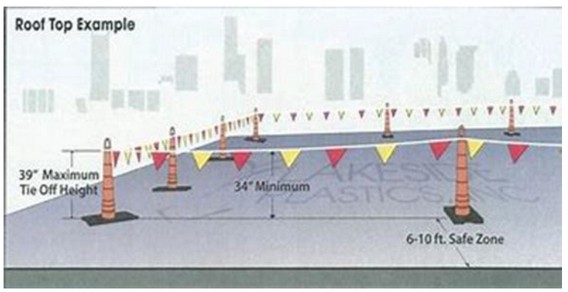
Warning line systems are typically composed of a physical barrier located near an unprotected side or edge to warn employees they are approaching a fall hazard area during roofing projects affecting large areas of the roof. Warning line system use is restricted to low slope roof top work only and shall be used in conjunction with a safety monitoring system at a minimum.
Warning lines are not engineered to physically prevent or arrest a fall. These systems may also utilize a guardrail or personal fall arrest system to minimize/eliminate the fall hazard. Workers are not allowed in the area between the warning line and the unprotected edge. The following are provisions set forth by OSHA that all warning line systems must comply with:
- Warning line systems consisting of supporting stanchions and ropes, wires, or chains are erected around all sides of open edged work areas.
- Warning line systems are erected at least six (6) feet from the edge, except in areas where mechanical equipment is in use.
- When mechanical equipment is in use, warning line systems are erected at least six (6) feet from the parallel edge, and at least ten (10) feet from the perpendicular edge.
- Lines are flagged at no more than six (6) foot intervals with high-visibility materials.
- The lowest point of the line (including sag) is between 34 and 39 inches from the walking/working surface.
- The line shall be attached to each stanchion in a way the pulling on one section of the line between stanchions will not result in slack being taken up in adjacent sections before the stanchion tips over.
- Stanchions of warning line systems must resist at least 16 pounds of force.
- Ropes, wires, or chains have a minimum tensile strength of 500 pounds.
8.2.2 Restraint Systems
Restraint systems prevent workers from falling any distance by keeping them from reaching an area where a fall hazard exists. This system is not designed to catch or arrest a falling worker which is why it is typically the preferred fall protection system when the environment allows.
Body harness systems are set up so that an employee is secured to an anchorage capable of supporting twice the maximum expected force needed to restrain the worker or 3,000 pounds, whichever is greater. Fall restraint systems can be used in the following conditions:
- Securing the individual to an anchorage point using a lanyard short enough to prevent the person’s center of gravity from reaching the fall hazard.
- Leading edge work where there are no guardrails.
- Within aerial boom lifts so employee’s center of gravity cannot move beyond the bucket rails.
8.2.3 Positioning Systems
A positioning device is not a substitute for a personal arrest system and is limited to use as the system is rigged to allow an employee to be supported on an elevated vertical face, such as a wall, and work with both hands free while leaning. This system is not designed to catch or arrest a falling worker. When a positioning device is used, it shall comply with the following:
- Body Harness – Only a full-body harness shall be worn as part of a positioning device system. Body belts are not to be used.
- Connecting Device – Positioning devices shall be rigged such that a free fall cannot be more than 2 feet.
- Anchorage – 3,000 lbs. of static strength (non-certified), static strength 2X foreseeable force (certified).
8.2.4 Personal Fall Arrest Systems
A personal fall arrest system is designed to arrest a person’s fall from an elevated working-walking surface (roof, floor, platform, etc.) The three main components to a personal fall arrest system consists of an anchorage point, full body harness, and connectors. Additional equipment may include shock-absorbing lanyards, retractable lifelines, and/or a deceleration device.
Before performing work that requires the use of a fall arrest system, a rescue plan (see section 15) should be written and/or reviewed. In the event of a fall the rescue plan will be put into action. A fall arrest system will come into service only if a fall should occur. A personal fall arrest system should only be used when passive systems are not feasible.
When a personal fall arrest system is used it must comply with the following requirements:
- The maximum arresting force on an employee shall be limited to 1,8000 pounds when used with a body harness.
- Employees must be rigged in a way that limits a free fall to no more than 6 feet and prevents any contact with a lower level.
- The fall arrest system must bring the employee to a complete stop and limit the deceleration distance an employee travels to 3.5 feet. (list continues on next page)
- The fall arrest system must have sufficient strength to withstand twice the potential impact energy of an employee free falling a distance of 6 feet or the free fall distance permitted by the system, whichever is less.
9. Selection of Personal Fall Arrest Equipment
Selection of an appropriate fall arrest system requires considerations of both user and site-specific attributes; these systems are not universal. Only competent persons are authorized to select a fall arrest system for a particular situation.
- Consideration of several user and site-specific factors such as the lanyard length, deceleration distance, height of the harness D-ring to worker’s feet, and a safety factor. Guidelines for calculating fall the required fall clearance can be found in the Equation for fall Clearence section.
- System components are generally designed to accommodate a specific maximum weight of the user (and their tools). Do not use any component that is not rated for the weight of the intended user. Reference manufacturer information to learn the maximum weight requirements for equipment.
- Individual components must be compatible. Refrain from mixing components that were not designed to be used together. Use only a single lanyard or self-retracting lifeline. Never use in series.
- Use only the designated anchorage points and fall arrest systems specified for a particular location and application.
Consult with a representative of a fall protection supply distributor during your selection process to ensure the appropriate ensemble for the intended application.
9.1 Fall Clearance
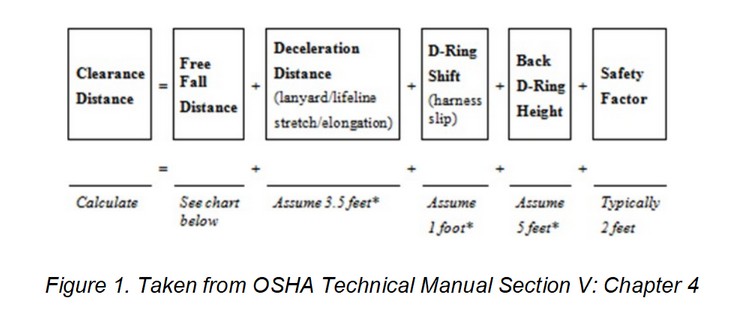
To prevent a worker on one level from falling and striking another level or obstruction below, the fall clearance needs to be determined. Fall clearance is the minimum vertical distance needed between the anchor point and a lower level (this can be the ground or lower obstruction) with a safety factor to prevent the worker from hitting the lower level in a fall. It considers the fall protection equipment available or proposed. This calculated fall clearance can’t be equal to or greater than the physically available clearance, or else the worker will risk injury.
Total fall clearance distance is based on the following factors:
- Free fall distance – The distance a worker falls before the personal fall arrest system begins to slow the fall. This distance must be 6 feet or less and prevent the worker from contacting a lower level.
- Deceleration distance – The distance the lanyard stretches to arrest the fall. The deceleration distance must not be greater than 3.5 feet.
- D-ring shift – The distance the D-ring moves and the harness shifts when they support the worker’s full weight. As the line tugs upwards, the harness can shift so the D-ring location is higher on the worker than it was before the fall. This shift is often assumed to be one foot, but can vary, depending on the equipment design and the manufacturer.
- Back D-ring height – The D-ring height is measured as the distance between the D-ring and the worker’s shoe sole while the worker us wearing the harness. This height is often standardized as 5 feet for six-foot-tall workers. Shorter workers may also be protected using this default distance; however, it is necessary to adjust the back D-ring height for workers taller than six feet.
- Safety factor – additional distance to ensure there’s enough clearance between a worker and a lower level.
9.2 Calculating Fall Clearance Using a Shock-Absorbing Lanyard
To calculate the total fall clearance distance the above values are added together.
It is important to note that the calculated minimum fall clearance of a specific fall protection system may never be equal or greater than the distance between the anchor point and the lower level. Be sure to compare your calculated distance with the actual distance before beginning work.
Calculating total fall clearance distance for a fall arrest system with a shock-absorbing lanyard use the equation below.
- First, add the length of the shock-absorbing lanyard (free fall distance), to the length of maximum elongation of the shock absorber during deceleration (deceleration distance).
- Reference section 9.3 to determine how anchor placement affects your free fall distance. (list continued on next page)
- Then add the height of the employee using the system and an additional 1 foot for D-ring shift.
- Finally, add a safety factor of 2 ft. to allow for the possibility of an improperly fit harness, a taller than average worker and/or a miscalculation of distance.
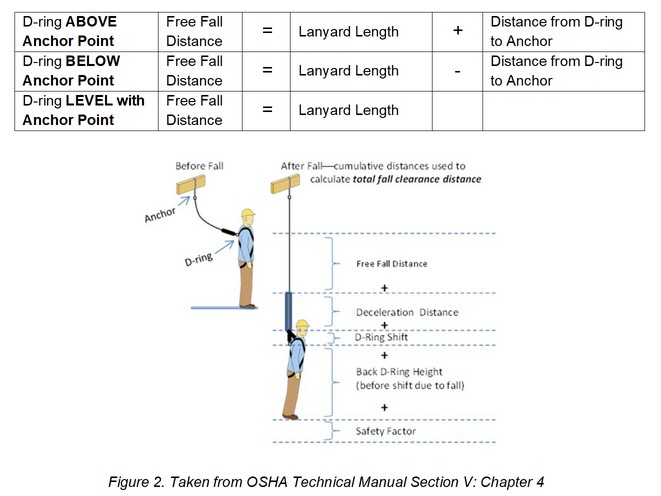
9.3 Calculating Free Fall Distance
Free fall distance is affected by the location of the D-ring in relation to the anchor point. The following chart applies to workers using a shock-absorbing lanyard.
9.4 Calculating Fall Clearance Using a Self-Retracting Lifeline
Self-retracting lanyards typically activate within 2 feet, thus limiting free fall distance. Refer to manufacturer specifications for activation details when calculating free fall clearance on a self-retracting lanyard.
When using a retractable lifeline, the distance is calculated from the point where the retractable attaches to the back D-ring of the employee’s harness. Calculating Total fall clearance distance for a fall arrest system with a self-retracting lanyard use the equation above.
- First, add the maximum free fall distance with a retractable lifeline to the maximum deceleration distance.
- Then Then add the height of the employee using the system and an additional 1 foot for D-ring shift.
- Finally, add a safety factor of 2 ft. to allow for the possibility of an improperly fit harness, a taller than average worker and/or a miscalculation of distance.
9.5 Swing Fall Hazard
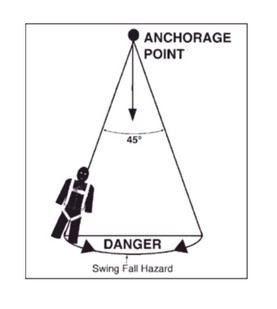
The swing fall hazard is created by the pendulum effect, which can swing a fallen worker into a nearby surface, such as a wall or protruding beam. In addition to calculating the total fall clearance distance before beginning work, it is important to evaluate the swing fall hazard at the edges where a worker might fall.
To reduce swinging, the anchorage point should be directly above the employee. Employees should not extend their work zone more than 30 degrees from their anchor point and maintain as much lanyard slack as possible.
10. Components of Fall Arrest Equipment
10. Components of Fall Arrest Equipment
Connecting Devices
This device can be a rope or web lanyard, rope grab, lanyards, or self-retractable lifeline. Listed below is a list of requirements for connecting devices.
- Only locking snap hooks may be used.
- Horizontal lifelines will be designed by a qualified person and installed in accordance with the design requirements.
- Lanyards and vertical lifelines need a minimum breaking strength of 5,000 pounds.
- The length of a single lanyard shall not exceed six feet.
- The use of steel lanyards is prohibited.
- Lanyards may not be clipped back to itself (e.g. around an anchor point) unless specifically designed to do so.
- If vertical lifelines are used, each employee will be attached to a separate lifeline.
- Lifelines need to be protected against being cut or abraded.
Anchorage
Secure anchor points are the most critical component when employees must use fall arrest equipment. Campus buildings may have existing structures (e.g., steel beams that may meet the criteria for a secure anchor point). Other work locations and assignments may require the installation of a temporary or permanent anchor. As a minimum, the following criteria must be considered for each type of anchor point:
- Structure must be sound and capable of withstanding a 5000 lb. static load.
- Structure/anchor must be easily accessible to avoid fall hazards during hook up.
- Direct tying off around sharp-edged structures can reduce breaking strength by 70% therefore; chafing pads or abrasion resistant straps must be used around sharp-edged structures to prevent cutting action against safety lanyards or lifelines.
- Structures used as anchor points must be at the worker’s shoulder level or higher to limit free fall to 6 feet or less and prevent contact with any lower level (except when using a self-retracting lifeline or 3-foot lanyard).
- Choose structures for anchor points that will prevent swing fall hazards. Potentially dangerous “pendulum” like swing falls can result when a worker moves horizontally away from a fixed anchor point and falls.
The arc of the swing produces as much energy as a vertical free fall and the hazard of swinging into an obstruction becomes a major factor. Raising the height of the anchor point can reduce the angle of the arc and the force of the swing. Horizontal lifelines can help maintain the attachment point overhead and limit the fall vertically. A qualified person must design a horizontal lifeline.
Permanent Anchor Requirements
In addition to all the criteria listed above, the following points must be considered:
- Environmental factors and dissimilarity of materials can degrade exposed anchors.
- Compatibility of permanent anchors with employee’s fall arrest equipment.
- Inclusion of permanent anchors into a Preventive Maintenance Program with scheduled annual re-certification.
- Visibly label permanent anchors.
- Roof anchors must be immediately removed from service and re-certified if subjected to fall arrest forces.
Reusable Temporary Anchors
- Reusable temporary roof anchors must be installed and used following the manufacturer’s installation guidelines.
- Roof anchors must be compatible with employee’s fall arrest equipment.
- Roof anchors must be removed from service at the completion of the job and inspected prior to reuse following the manufacturer’s inspection guidelines.
- Roof anchors must be immediately removed from service and disposed of if subjected to fall arrest forces.
11. Use of Fall Arrest Equipment
11. Use of Fall Arrest Equipment
The following are general rules regarding fall arrest components:
- Read and adhere to the manufacturer’s instructions for use and care. Strictly adhere to the manufacturer’s recommendations for assembling the components, attaching to anchorage points, and fitting of the body harness.
- Do not attempt to use a fall arrest system until you have been trained in its use and limitations by a competent person.
- The use of body belts is prohibited. Full body harnesses are required. Employees should be sure to use a properly sized harness.
- Never attempt to use makeshift components that have not been specifically designed for fall arrest applications.
- Certain work (e.g., welding, painting, electrical arc flash hazard, etc.) may necessitate special design features to minimize potential damage to system components. Use only components that are compatible with the work task.
- After sustaining a fall, immediately remove the system from service. Harnesses or lanyards that have been subjected to an impact load shall be destroyed. Depending on the type of equipment, it may be returned to the manufacturer for refurbishment in accordance with the manufacturer’s requirements.
- Consider other possible environmental hazards (e.g., heat, chemicals, corrosive environments, high voltage power lines, moving machinery, sharp edges, etc.) and implement additional risk mitigation as appropriate.
- The attachment point of the body harness is the center D-ring on the back.
- Employees must always tie off at or above the D ring of the harness except when using lanyards 3 feet or less in length.
- Purdue has determined that self-retracting lines are the preferred type of connecting device over shock absorbing lanyards.
- Load testing shall not be performed on fall protection equipment.
12. Inspection Of Fall Arrest Systems
12. Inspection Of Fall Arrest Systems
Always follow the manufacturer recommendations for inspection of personal fall protection systems and equipment. Employees must inspect their personal fall arrest equipment before each use. Annual inspections must be performed by a competent person or an employee who has been trained by a competent person to do the inspection. Any deteriorated, bent, damaged, impacted equipment showing excessive wear will fail inspection and must be removed from service immediately.
All employees on any project that requires them to use personal positioning, restraint, or arrest systems, will inspect the systems following these guidelines:
- Connectors will be inspected to ensure they are drop forged, pressed, or formed steel or are made of equivalent materials and that they have a corrosion resistant finish as well as that all surfaces and edges are smooth to prevent damage to interfacing parts of the system.
- Only shock absorbing lanyards or retractable lanyards are to be used to keep impact forces at a minimum on the body (fall arrest systems).
- Verify that D-rings and snap hooks have a minimum tensile strength of 5,000 lbs. and that the D-rings and snap hooks are proof tested to a minimum tensile load of 3,600 lbs. without cracking, breaking, or taking permanent deformation.
- Verify that all lanyards will have self-locking snap hooks.
- Verify that unintentional disengagement of snap hooks is prevented by either of the following means:
- Snap hooks are a compatible size for the member to which they are connected.
- Locking type snap hooks are used.
The following is a list of equipment-specific inspection criteria. If at any point the equipment fails to meet one of the following criteria, the equipment must be failed and removed from service immediately.
Full Body Harnesses Inspection Criteria:
- Inspect for cleanliness. Follow manufacturer’s recommendations for cleaning.
- Closely examine all of the nylon webbing to ensure there are no burn marks or holes.
- Verify there are no torn, frayed, broken fibers, pulled stitches, or frayed edges.
- Verify the presence of legible labels.
- Examine D-ring for excessive wear, pits, deterioration, cracks, or corrosion.
- Verify that buckles are not deformed, cracked, and will operate correctly.
- Check to see that all grommets and rivets are secure and not deformed.
Lanyards/Shock Absorbing Lanyards Inspection Criteria:
- Check lanyard material for cuts, burns, abrasions, kinks, knots, burns, broken stitches, excessive wear or soiling/staining, brittleness, chalking, or discoloration.
- Check carabiner for excessive wear, distortion, and lock operation.
- Ensure that all locking mechanisms seat and lock properly. Once locked, the locking mechanism should prevent the hood from opening.
- Verify that points where the lanyard attaches to the snap hooks are free of defects.
- On shock-absorbing lanyards look for signs of deployment such as torn out stitching.
Tie off/Anchorage Points Inspection Criteria:
- Inspect hardware for damage, distortion, sharp edges, burrs, cracks, and corrosion.
- Inspect webbing for cuts, burns, tears, abrasions, frays, excessive soiling, and discoloration. Inspect stitching for pulled or cut stitches.
- Inspect anchors for cracks, sharp edges, burrs, deformations, corrosion, distortion, and as otherwise recommended by the manufacturer.
Self-Retracting Lanyard, personal (SLR-P) Inspection Criteria:
- Visually inspect to ensure there is no physical damage to the body.
- Make sure all back nuts or rivets are tight.
- Make sure the entire length of the nylon strap is free of any cuts, burns, abrasions, kinks, knots, broken stitches, and excessive wear and retracts freely.
- Test the unit by pulling sharply on the lanyard to verify that the locking mechanism is operating correctly.
- Verify that it has been factory inspected at the proper interval.
Connectors, Snap hooks, Carabiners Inspection Criteria:
- Inspect for cleanliness. Follow manufacturer’s recommendations for cleaning.
- Inspect snap hook for any hook and eye distortions.
- Verify there are no cracks, pitted surfaces, eye distortions, sharp edges, burrs, or corrosion. The keeper latch should not be bent, distorted, or obstructed.
- Verify that the keeper latch seats into the nose without binding.
- Verify that the keeper spring securely closes the keeper latch.
- Test the locking mechanism to verify that the keeper latch locks properly.
13. Documentation of Fall Arrest Equipment
13. Documentation of Fall Arrest Equipment
All fall arrest equipment inventoried and documented. Documentation should include each piece of equipment (harnesses, lanyards, connectors, etc.) and their inspections forms (Appendix A).
A Competent Person will be assigned to use the fall protection inventory to complete a formal documented inspection every year in which they will update the inventory list and inspection tags. Management will be expected to maintain documentation of all completed inspections and make these available during the annual ISP audit.
Passing equipment should be included in the inventory list. Failed equipment should be destroyed, and an inspection form should be stored for recording purposes. It is also best practice to document corrective actions taken in the case of identified issues. Documentation of a formal fall protection inspection should include:
- The type of fall protection equipment being inspected
- The department and/or shop who owns the equipment
- Building and room number of where the equipment is stored
- The manufacturer’s name
- The equipment’s Model/Style number
- The equipment’s serial/inspection number
- The date when the equipment was manufactured
- The date of inspection
- The inspector and/or competent person who performed the inspection
- A record of if the equipment passed or failed
- In the case the equipment fails, the reason for failing the equipment should be recorded.
14. Storage Of Fall Arrest Equipment
14. Storage Of Fall Arrest Equipment
Harnesses and Lanyards must be stored in an assigned location. The following are requirements for proper storage of fall arrest equipment.
- Never store the personal fall arrest equipment in the bottom of a toolbox, on the ground, or outside exposed to the elements (i.e., sun, rain, snow).
- Hang equipment in a cool dry location in a manner that retains its shape.
- Keep equipment away from excessive heat, batteries, and chemicals. Never store in an area with exposure to fumes or corrosives elements.
- Avoid dirt and build-up on equipment.
- Clean with a mild, nonabrasive soap, and hang to dry after cleaning.
- Never use this equipment for any purpose other than personal fall arrest.
- Once exposed to a fall, remove equipment from service immediately.
15. Rescue Plan and Equipment
15. Rescue Plan and Equipment
A rescue plan must be established by a competent person to provide a prompt rescue in case a worker becomes suspended in the air as a result of a fall. Workers suspended for long periods of time are at risk of reduced blood flow, oxygen deprivation, brain damage, cardiac arrest and death. According to the American National Standards Institute (ANSI) Standard Z359, rescue should be completed within six minutes of a fall arrest to minimize the risk of adverse health outcomes. All workers using fall arrest systems must work in pairs and be promptly rescued in the event of a fall.
The following included fall arrest rescue equipment that needs to be available onsite when fall arrest equipment are used:
- Ladders
- Crane
- Aerial lift
- Scaffold
- Lifting or lowering device
The rescue plan is designed to minimize the amount of time in suspension by considering the systems used, heights involved, hazards present, and the risk for potential medical situations. The rescue plan should include all the following components:
- In the event of a fall call 911 immediately. Even if you can retrieve an employee from a fall without help from emergency services, the employee who experienced the fall should be assessed by paramedics before returning to work.
- The employee should attempt to self-rescue if they are able to reach the surface from which they fell.
- Employees must attempt to use the attached Relief Straps on the fall protection equipment to relieve pressure and reduce the risk of suspension trauma. Therefore, all body harnesses should be equipped with Relief Straps.
- If self-rescue is not possible, assisted rescue utilizing any of the fall arrest rescue equipment listed above must be considered. (list continued on next page)
- Emergency services should be contacted for rescue assistance if all other forms of rescue are not possible.
16. Training
16. Training
A Competent Person shall train every employee who requires the use of fall arrest equipment to perform their job. Training shall be done prior to the use of fall arrest equipment. It shall pertain to the specific fall arrest system used and equipment selected for the job or task.
The training shall be documented. Supervisors are responsible to maintain a training record to include the name of the employee, date(s) of training, name of the person conducting the training, and content of the training to include specific name/model of fall equipment.
At a minimum, this training must include the following topics:
- The nature of the fall hazards to which an employee is exposed.
- Information on the specific fall protection systems in use. In the case of personal fall arrest systems, this would include:
- Proper assembly of the personal fall arrest system to be used
- Location of appropriate anchorage points and proper means of attachment to the anchorage points
- Proper inspection techniques for all components of the personal fall arrest system.
- Instruction on care and storage of personal fall arrest system
- Instruction on procedure for removing components of the personal fall arrest system from service
In accordance with ANSI Z359.2, retraining is required every two years* or when the following conditions apply:
- Changes in the workplace render previous training incomplete or obsolete.
- Changes in the types of fall protection systems or equipment to be used render previous training incomplete or obsolete.
- Inadequacies in an employee’s knowledge or use of fall protection systems or equipment or observed behavior indicate that the employee has not retained the requisite understanding or skill.
Appendix A: Fall Protection Inspection Form
- Appendix A: Fall Protection Inspection Form
Appendix B: Summary of Change
B. 1 October 28, 2024
- Not Applicable