 Purdue University - Extension - Forestry and Natural Resources
Got Nature? Blog
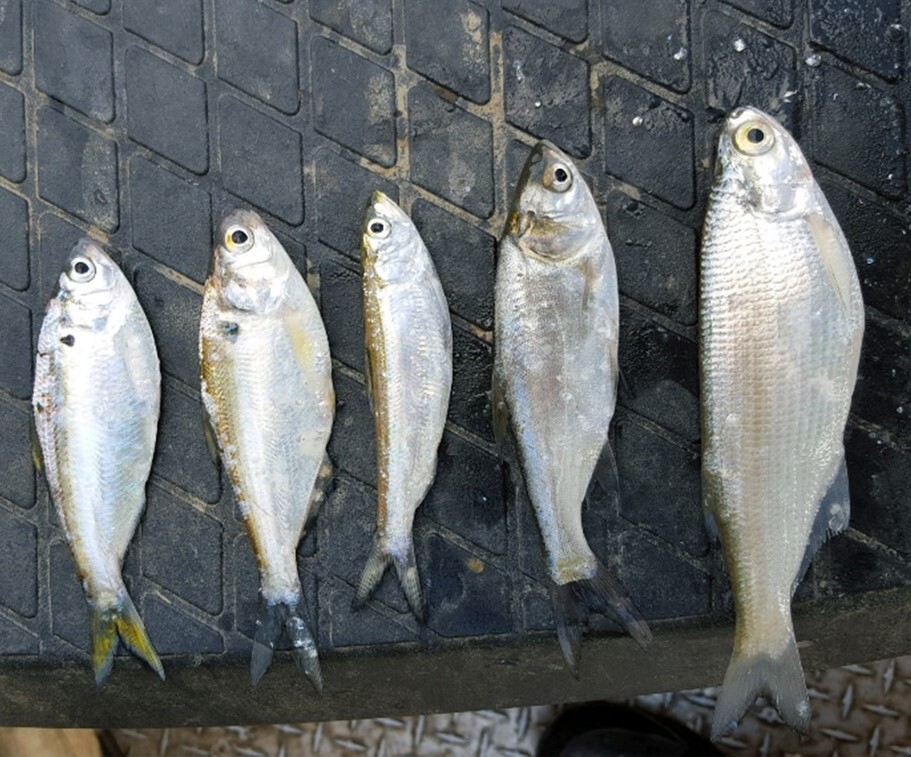
Fish from left to right: Threadfin Shad, Gizzard Shad, Skipjack Herring, Silver Carp (invasive carp), and Goldeye.
Wild Bulletin, Indiana Department of Natural Resources (DNR) Fish and Wildlife: Spring is the time anglers return to fishing on Indiana’s lakes and rivers. Often that includes catching and using live bait. Remember to dispose of all unused bait fish properly in the trash, as invasive carp could be lurking in your bait bucket. Improperly disposing of unused bait fish in a lake or stream could potentially allow invasive species, like silver carp, to spread in Indiana waters.
Invasive carp are a select group of cyprinid fishes (minnow family) that are native to Asia. The term “invasive carp,” formerly known as “Asian carp,” collectively refers to bighead carp, silver carp, grass carp, and black carp. Each of these species was intentionally introduced into the United States for different purposes; however, all are now considered invasive nationally and in Indiana. Invasive carp compete with native species and pose a threat to Indiana’s aquatic ecosystems.
Find out more about how you can help in the fight against invasive carp at DNR: Fish & Wildlife Resources.
Resources:
Asian Carp | Purdue University Report Invasive Species
Question: Aren’t There Concerns About Consuming Asian Carp As A Food Source In Indiana Streams?
Invasive Species, Playlist, Purdue Extension – FNR YouTube Channel
What are invasive species and why should I care?, Got Nature? Blog, Purdue Extension – Forestry and Natural Resources
Report Invasive Species, Purdue Invasive Species
Walleye Farmed Fish Fact Sheet, The Education Store, Purdue Extension’s resource center
Yellow Perch Farmed Fish Fact Sheet, The Education Store
A Guide to Small-Scale Fish Processing Using Local Kitchen Facilities, The Education Store
Eat Midwest Fish, Illinois-Indiana Sea Grant online resource hub
Indiana Department of Natural Resources
Wild Bulletin, Indiana Department of Natural Resources (DNR) Fish and Wildlife: Looking to build habitat that benefits wildlife species near you? February is a great time to complete winter habitat improvement projects, such as frost seeding native forbs, edge feathering forest boundaries, prescribe-burning warm-season grass, and removing invasive species.
DNR’s wildlife habitat fact sheets can teach you the best techniques for your desired management practices. Need more information for your unique property? Contact your district’s Wildlife Biologist, who can meet with you to provide suggestions on wildlife habitat improvements based on your specific goals.
To learn more please visit DNR: Wildlife Habitat Fact Sheets.
Resources:
Frost Seeding to Establish Wildlife Food Plots and Native Grass and Forb Plantings – The Education Store, Purdue Extension’s resource center
Tips for Evaluating a First Year Native Grass and Forb Planting, Got Nature? – Purdue Extension-Forestry & Natural Resources (FNR)
Wildlife Habitat Hint: Tips for Evaluating a First Year Native Grass and Forb Plantings, Purdue Extension – FNR YouTube Channel
Calibrating a No-Till Drill for Conservation Plantings and Wildlife Food Plots – The Education Store
Drone Seeding Native Grasses and Forbs: Project Overview & Drone Setup, Purdue Extension – FNR YouTube channel
Drone Seeding Native Grasses and Forbs: Seed Mixing, Loading the Hopper, Programming the Route, Purdue Extension – FNR YouTube channel
Drone Seeding Native Grasses and Forbs: Recapping the Project, Purdue Extension – FNR YouTube channel
Renovating Native Warm-season Grass Stands for Wildlife, The Education Store
Forest Improvement Handbook, The Education Store
Ordering Seedlings from the State Forest Nursery System, Got Nature? – Purdue Extension-Forestry & Natural Resources (FNR)
Designing Hardwood Tree Plantings for Wildlife – The Education Store
ID That Tree – YouTube Playlist
Forest Management for Reptiles and Amphibians: A Technical Guide for the Midwest, The Education Store
Ask the Expert: Hardwood Ecosystem Experiment – Birds and Salamander Research, Purdue Extension – FNR
A Template for Your Wildlife Habitat Management Plan, The Education Store
Managing Your Woods for White-Tailed Deer, The Education Store
Woodland Stewardship for Landowners, Playlist, Purdue Extension – FNR YouTube channel
Winter Weather Tree Tips, Got Nature? Blog, Purdue Extension – FNR
Indiana Department of Natural Resources
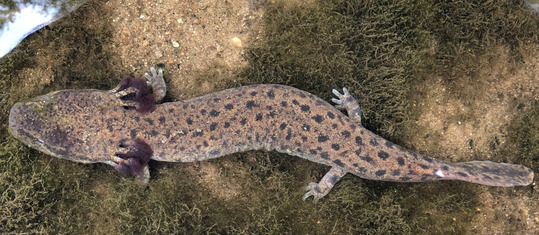
Photo by: Indiana DNR
Wild Bulletin, Indiana Department of Natural Resources (DNR) Fish and Wildlife: The Division of Fish & Wildlife asks anglers to report sightings of the mudpuppy (Necturus maculosus) to help biologists track their populations across the state. A Species of Special Concern in Indiana, this salamander inhabits the state’s lakes and streams.
Mudpuppies, like fish, live their entire lives in water, but they are more secretive and difficult to locate. During winter, mudpuppies move into shallow water and are more frequently caught by anglers. They may also be viewed from shore using a flashlight at night, while they walk along the lake bottom. Mudpuppies are not dangerous or poisonous. They can be identified by the red, fluffy gills on the back of their head, but the gills tend to lay flat against their body when they are out of the water.
If you catch a mudpuppy while fishing, please photograph it, cut your fishing line, and release the mudpuppy back into the water. Report your observation to the DNR herpetologist at HerpSurveys@dnr.IN.gov and include a clear photograph of it, the date, and the location where it was found. The DNR appreciates your help tracking this unique salamander.
To learn more please visit DNR: Amphibians and Reptiles.
Resources:
Researchers Discover Young Hellbender in Blue River, Purdue Forestry and Natural Resources News & Stories
Help the Hellbender, North America’s Giant Salamander, The Education Store
Help the Hellbender, Purdue College of Agriculture
Question: Which salamander is this?, Got Nature? Blog, Purdue Extension – Forestry and Natural Resources
Is it a Hellbender or a Mudpuppy?, Got Nature? Blog
Amphibians: Frogs, Toads, and Salamanders, Purdue Nature of Teaching
A Moment in the Wild, Playlist, Purdue Extension – Forestry and Natural Resources
Help the Hellbender, Playlist & Website
The Nature of Teaching: Adaptations for Aquatic Amphibians, The Education Store, Purdue Extension resource center
Hellbenders Rock!, The Education Store
Indiana Department of Natural Resources
Wild Bulletin, Indiana Department of Natural Resources (DNR) Fish and Wildlife: Did you know that wild game shot with lead ammunition can sometimes contain lead fragments all the way to the dinner table? Adopting different shot placement and butchering techniques can help alleviate the problem.
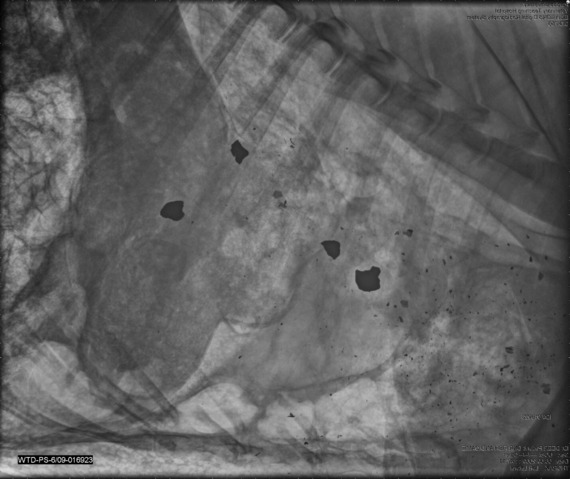
An X-ray of lead ingested by an animal.
When shooting: Avoid shooting animals in heavily boned areas, such as the front shoulders, as this is more likely to cause bullet fragmentation. Instead, shoot animals in softer tissue, such as around the heart and lungs, to decrease fragmentation.
When butchering: Carefully observe the wound channel in the animal and generously trim away any meat that shows bullet trauma. This will help keep fragments out of your finished meat product. Properly dispose of your trimmed meat by sending it to the local landfill or burying it on private property.
Looking for another way for you and your family to avoid ingesting lead fragments? Talk to your local retailer about finding a nontoxic ammunition that’s right for you.
To learn more please visit DNR: Effects of lead on wildlife.
Resources:
Hunting Guide for 2023-2024, Indiana Department of Natural Resources
How to Score Your White-tailed Deer, video, The Education Store, Purdue Extension Resource Center
White-Tailed Deer Post Harvest Collection, video, The Education Store
Age Determination in White-tailed Deer, video, The Education Store
How to Build a Plastic Mesh Deer Exclusion Fence, The Education Store
Managing Your Woods for White-Tailed Deer, The Education Store
Bovine Tuberculosis in Wild White-tailed Deer, The Education Store
Help With Wild Turkey Populations, Video, Purdue Extension – Forestry and Natural Resources YouTube Channel
Turkey Brood Reporting, Indiana Department of Natural Resources (IDNR)
Wild Turkey, Indiana Department of Natural Resources (IDNR)
Wild Turkey Hunting Biology and Management, Indian Department of Natural Resources (IDNR)
Subscribe to Purdue Extension-Forestry & Natural Resources YouTube Channel, Wildlife Playlist
Indiana Department of Natural Resources
Wild Bulletin, Indiana Department of Natural Resources (DNR) Fish and Wildlife: In 2023, we saw wildlife wins for many rare and endangered species. We found a very young hellbender salamander in the Blue River and increased public awareness and interest in bat conservation. We discovered the banded pygmy sunfish at Twin Swamps Nature Preserve and doubled the number of active barn owl nests from five years ago.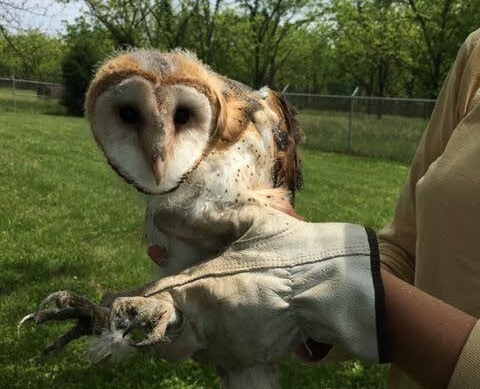
These wildlife wins would not have been possible without those who support the Nongame Wildlife Fund. To all of you who help care for Indiana’s rare and endangered wildlife, thank you!
If you’d like to make a positive impact on Indiana’s wildlife, consider getting involved today. Subscribe to the Indiana DNR Division of Fish & Wildlife Newsletter, IN Fish & Wildlife Instagram, and IN Fish & Wildlife Facebook to stay up to date with the IN DNR-Division of Fish & Wildlife’s latest wildlife wins. Make a volunteer profile and learn more about how to become a DNR volunteer, or make a donation to the Nongame Wildlife Fund. For every $50 given to the Nongame Wildlife Fund, an additional $43 is unlocked in federal funding, making every dollar you donate go even further for Indiana’s wildlife.
To learn more please visit DNR: Nongame and Endangered Wildlife.
Resources:
Researchers Discover Young Hellbender in Blue River, Purdue Forestry and Natural Resources News & Stories
Help the Hellbender, North America’s Giant Salamander, The Education Store
Help the Hellbender website
Help the Hellbender Facebook page
Barn Owl, Indiana Department of Natural Resources
Bats in Indiana, Indiana Department of Natural Resources (IN DNR)
Bat Houses, Bat Conservation International
Creating a Wildlife Habitat Management Plan for Landowners, The Education Store, Purdue Extension’s resource center
Ask an Expert: Turtles and Snakes, video
Ask an Expert: Managing Your Property for Fish and Wildlife, video
A Template for Your Wildlife Habitat Management Plan, publication
Frost Seeding to Establish Wildlife Food Plots and Native Grass and Forb Plantings, video
Connecting Youth to Wildlife Webinar
A Template for Your Wildlife Habitat Management Plan, The Education Store
Indiana Department of Natural Resources
Wild Bulletin, Indiana Department of Natural Resources (DNR) Fish and Wildlife: Indiana DNR has been working with neighboring states to address the invasive carp problem in our waters. The Kentucky Department of Fish and Wildlife Resources has been using contract fishers to harvest invasive carp from the middle Ohio River at the leading edge of invasive carp’s established population, and the Indiana Division of Fish & Wildlife provides support as needed. The contract fishing program will be operating through the winter and spring. Most fishing will occur from Leavenworth to Cannelton, Indiana, in small tributaries and backwaters off the Ohio River. Agency staff will ride along with contract fishers to collect data and ensure native fish populations are not negatively impacted.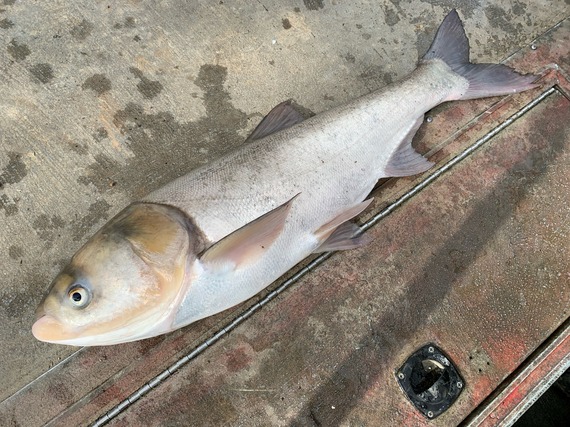
Throughout the year, biologists are involved in several other collaborative research and monitoring projects to slow the spread of invasive carp within the Ohio River basin. If you encounter an invasive carp and are wondering what to do with it, try eating it! Our website includes information on how to clean and prepare silver carp for a tasty meal, as well as descriptions of other DNR projects that address invasive carp.
To learn more please visit DNR: Invasive Carp.
Resources:
Asian carp solutions: Take them to market, Illinois-Indiana Sea Grant
Asian carp, Illinois-Indiana Sea Grant
Asian carp, Purdue College of Agriculture
Invasive Species, Playlist, Purdue Extension – FNR YouTube Channel
What are invasive species and why should I care?, Got Nature? Blog, Purdue Extension – Forestry and Natural Resources
Report Invasive Species, Purdue Invasive Species
Walleye Farmed Fish Fact Sheet, The Education Store, Purdue Extension’s resource center
Pacific White Shrimp Farmed Fact Sheet, The Education Store
Yellow Perch Farmed Fish Fact Sheet, The Education Store
Tilapia Farmed Fish Fact Sheet, The Education Store
Rainbow Trout Farmed Fish Fact Sheet, The Education Store
American Paddlefish, The Education Store
A Guide to Small-Scale Fish Processing Using Local Kitchen Facilities, The Education Store
Eat Midwest Fish, Illinois-Indiana Sea Grant online resource hub
Indiana Department of Natural Resources
Wild Bulletin, Indiana Department of Natural Resources (DNR) Fish and Wildlife: Your contributions to the 2023 Turkey Brood Survey surpassed the goal of 3,000 observations. Between July 1-Aug. 31, you contributed a whopping 3,639 observations of wild turkey hens with or without poults. Thank you!
After DNR Division of Fish & Wildlife biologists removed duplicates and reports without exact locations, 2,203 brood observations are being factored into regional production estimates.
Because of your help, we can continue to track population trends and make important management decisions to foster healthy ecosystems in Indiana.
Why count turkeys?
Brood surveys provide useful estimates about annual production by wild turkey hens and the survival of poults (young turkeys) through the summer brood-rearing period. Summer brood survival is generally the primary factor influencing wild turkey population trends. Information on summer brood survival is essential for sound turkey management. Information gathered through the brood survey includes:
- Average brood sizes (hens + poults). For example, in the photo above there is one hen with seven poults, for a brood size of eight.
- Percentage of adult hens with poults.
- Production Index (PI) = total number of poults/total number of adult hens
What is a wild turkey brood?
A wild turkey brood is composed of at least one adult hen with young (poults). As the summer progresses, multiple broods may gather into what is termed a “gang” brood with several adult hens and multiple broods of poults of varied ages. During summer, adult gobblers (male turkeys) play no role in raising a brood and either form small male only “bachelor” flocks or are observed as a single gobbler.
To learn more please visit DNR: Turkey Brood Reporting.
Resources
Truths and Myths about Wild Turkey, The Education Store, Purdue Extension resource center
Wildlife, Playlist, Purdue Extension – Forestry and Natural Resources (FNR) YouTube Channel
Managing Your Property for Fish & Wildlife, Ask an Expert. FNR YouTube Channel
Forest Improvement Handbook, The Education Store
Help With Wild Turkey Populations, Video, Purdue Extension – Forestry and Natural Resources YouTube Channel
Turkey Brood Reporting, Indiana Department of Natural Resources (IN DNR)
Wild Turkey, Indiana Department of Natural Resources (IN DNR)
Wild Turkey Hunting Biology and Management, Indian Department of Natural Resources (IN DNR)
Subscribe to Purdue Extension-Forestry & Natural Resources YouTube Channel, Wildlife Playlist
Indiana Department of Natural Resources
Wild Bulletin, Indiana Department of Natural Resources (DNR) Fish and Wildlife: Join the fun this fall and hunt one of Indiana’s gorgeous grassland birds. Quail hunting in Indiana starts on Nov. 10 and requires a Game Bird Habitat Stamp and a general hunting license. These species are present in grasslands across the state, such as Goose Pond FWA and Glendale FWA. There are no equipment restrictions for quail, but we recommend a 12- or 20-gauge shotgun with 6 to 9 shot. Remember to wear your hunter orange!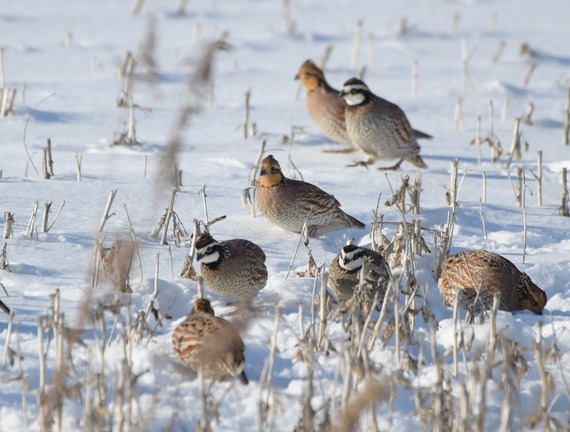
Some DNR properties may have additional regulations for quail hunting. Check with the property you’re planning to hunt for more details.
General Characteristics:
Northern bobwhites are a ground-dwelling species that only rely on flight on rare occasions. They rely on cryptic plumage color combinations and contrasts that provide excellent camouflage. They are minimally sexually dimorphic, meaning males and females have different physical characteristics. In the case of the Northern bobwhite, males have a white throat and chin, along with a white stripe above the eye extending to the back of the head. Those same areas on a female, are buffy brown in color. Underparts are tawny and white, blending with chestnut and gray. Each breast feather sports a black chevron. Upper parts of the shoulders, back, and rump, are a mixture of warm brown, cream, and shades of black. In Indiana, adult Northern bobwhites weigh an average of 180 grams (~6.5 ounces) and are about 10 inches long from bill tip to tail.
To identify and learn more about this species, please visit DNR: Fish and Wildlife: Northern Bobwhite.
Resources
Quail Habitat: Putting the Numbers in Perspective – The Education Store, Purdue Extension Resource Center
Bobwhite Quail – Indiana Department of Natural Resources
Developing a Wildlife Habitat Management Plan – Purdue Extension
Breeding Birds and Forest Management: The Hardwood Ecosystem Experiment and the Central Hardwoods Region – The Education Store
Small Woodlots: Important Rest Stops for Migratory Songbirds – The Education Store
Subscribe to Purdue Extension-Forestry & Natural Resources YouTube Channel, Wildlife Playlist
Ask An Expert, Purdue Extension – FNR Playlist
Indiana Department of Natural Resources

A large flock of birds flying over a field. Photo: Indiana DNR
The latest Wildlife Bulletin, provided by the Indiana Department of Natural Resources-Division of Fish and Wildlife, has all the Indiana hunting information you need to know along with upcoming events and resources. Topics include: Get your deer licenses now; Deer hunting checklist; Deer processing videos on YouTube; Hunting seasons dates; Four options to check in game; Sandhill crane migration at Jasper-Pulaski; and much more.
The Wild Bulletin is a free email newsletter offering information about Indiana’s fish and wildlife resources and recreation opportunities. Subjects covered include profiles, information about hunting and fishing season dates, regulation updates, wildlife and fisheries research status reports, tips on wildlife watching and reminders about important dates for Hoosier outdoor enthusiasts.
To subscribe to this free e-newsletter visit Wild Bulletin, Indiana Department of Natural Resources.
Other resources:
State Parks, Indiana Department of Natural Resources (IN DNR)
Outdoor Indiana, Indiana Department of Natural Resources (IN DNR)
Indiana Department of Natural Resources

Recent Posts
- It’s Timberdoodle Time!
Posted: April 3, 2026 in Got Nature for Kids, How To, Wildlife - Keep An Eye Out for Hammerhead Worms, Purdue Landscape Report
Posted: April 2, 2026 in Invasive Animal Species, Wildlife, Woodlands - When is the Peak Migration For Hummingbirds and How Can You Attract Them?
Posted: in How To, Wildlife - ID That Tree Featured in National Woodland Owners Association Newsletter
Posted: April 1, 2026 in Urban Forestry, Wildlife, Woodlands - New 2026 Indiana Woodland Steward Newsletter
Posted: March 30, 2026 in Urban Forestry, Wildlife, Woodlands - A Woodland Management Moment: Why Aspect Matters
Posted: in Urban Forestry, Woodland Management Moment, Woodlands - 2026 Winter Bat Survey In Progress, MyDNR
Posted: March 27, 2026 in How To, Wildlife - Fast-Growing Trees for the Landscape, Purdue Landscape Report
Posted: March 26, 2026 in Forestry, Urban Forestry, Woodlands - Urban Tree Spotlight: Planting Deciduous Shade Trees, Purdue Landscape Report
Posted: March 25, 2026 in Forests and Street Trees, Urban Forestry, Woodlands - Beetle that attacks Tree-of-Heaven found in Indiana, Purdue Landscape Report
Posted: March 20, 2026 in Invasive Insects, Wildlife, Woodlands
Archives
Categories
- Alert
- Aquaculture/Fish
- Aquatic/Aquaculture Resources
- Ask the Expert
- Christmas Trees
- Community Development
- Disease
- Drought
- Forestry
- Forests and Street Trees
- Gardening
- Got Nature for Kids
- Great Lakes
- How To
- Invasive Animal Species
- Invasive Insects
- Invasive Plant Species
- Land Use
- Natural Resource Planning
- Nature of Teaching
- Plants
- Podcasts
- Ponds
- Publication
- Safety
- Spiders
- Timber Marketing
- Uncategorized
- Urban Forestry
- Webinar
- Wildlife
- Wood Products/Manufacturing
- Woodland Management Moment
- Woodlands