 Purdue University - Extension - Forestry and Natural Resources
Got Nature? Blog
Wild Bulletin, Indiana Department of Natural Resources (DNR) Fish and Wildlife: Your contributions to the 2023 Turkey Brood Survey surpassed the goal of 3,000 observations. Between July 1-Aug. 31, you contributed a whopping 3,639 observations of wild turkey hens with or without poults. Thank you!
After DNR Division of Fish & Wildlife biologists removed duplicates and reports without exact locations, 2,203 brood observations are being factored into regional production estimates.
Because of your help, we can continue to track population trends and make important management decisions to foster healthy ecosystems in Indiana.
Why count turkeys?
Brood surveys provide useful estimates about annual production by wild turkey hens and the survival of poults (young turkeys) through the summer brood-rearing period. Summer brood survival is generally the primary factor influencing wild turkey population trends. Information on summer brood survival is essential for sound turkey management. Information gathered through the brood survey includes:
- Average brood sizes (hens + poults). For example, in the photo above there is one hen with seven poults, for a brood size of eight.
- Percentage of adult hens with poults.
- Production Index (PI) = total number of poults/total number of adult hens
What is a wild turkey brood?
A wild turkey brood is composed of at least one adult hen with young (poults). As the summer progresses, multiple broods may gather into what is termed a “gang” brood with several adult hens and multiple broods of poults of varied ages. During summer, adult gobblers (male turkeys) play no role in raising a brood and either form small male only “bachelor” flocks or are observed as a single gobbler.
To learn more please visit DNR: Turkey Brood Reporting.
Resources
Truths and Myths about Wild Turkey, The Education Store, Purdue Extension resource center
Wildlife, Playlist, Purdue Extension – Forestry and Natural Resources (FNR) YouTube Channel
Managing Your Property for Fish & Wildlife, Ask an Expert. FNR YouTube Channel
Forest Improvement Handbook, The Education Store
Help With Wild Turkey Populations, Video, Purdue Extension – Forestry and Natural Resources YouTube Channel
Turkey Brood Reporting, Indiana Department of Natural Resources (IN DNR)
Wild Turkey, Indiana Department of Natural Resources (IN DNR)
Wild Turkey Hunting Biology and Management, Indian Department of Natural Resources (IN DNR)
Subscribe to Purdue Extension-Forestry & Natural Resources YouTube Channel, Wildlife Playlist
Indiana Department of Natural Resources
Each year, the Indiana DNR conducts its Turkey Brood Survey to determine wild turkey productivity. The DNR relies on Hoosier outdoor enthusiasts from across the state to report the number of hens and poults they see from July 1st to August 31st. This helps them calculate a Productive Index (number of poults per hen; figure 1) for counties across the state. Does this sound like something you are interested in? Here are four simple steps to be involved!
- Register for the turkey brood reporting system.
- Spend time outdoors from July 1st to August 31st.
- Count the number of hens and poults you see while spending time outdoors (figure 2).
- Report the number of hens and poults on the DNR’s online portal.
DNR biologists can’t collect brood observations across the state alone. In order to reach the goal of 3,000 observations this year, they need our help! If you’re interested in sharing your turkey brood observations with DNR, visit on.IN.gov/turkeybrood and register after June 10. Record observations any time from July 1 to August 31. Recording observations takes less than 5 minutes.
The DNR appreciates your help to document turkey broods around the state. Sharing observations is easy and critical to the management of wild turkey.
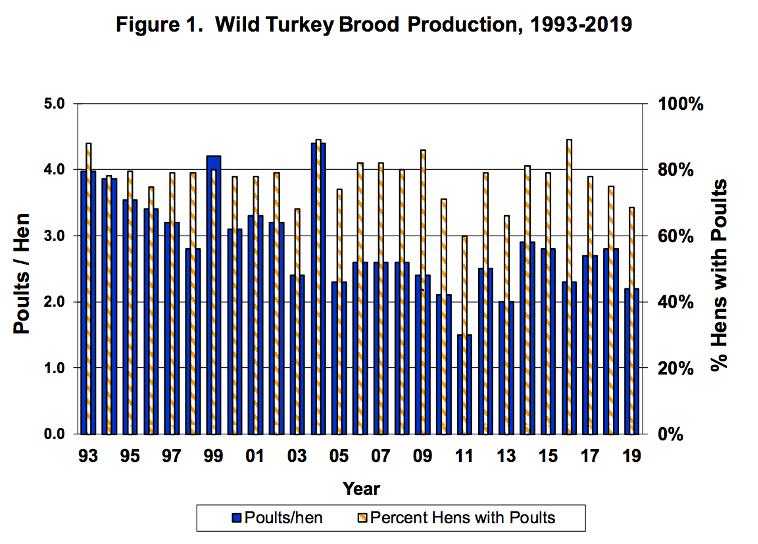
Figure 1. Wild turkey brood production from 1993 to 2019. Image is from the 2019 Wild Turkey Summer Brood Production Index.

Figure 2. Example of how to count and record turkey broods for the turkey brood survey. Image is from the Introduction to Documenting Turkey Brood Publication from the Indiana DNR.
As you enjoy the outdoors, whether it is for recreation or managing your property, we thank you in advance for helping with wildlife conservation.
Resources
Wild Turkey Hunting, Biology and Management, Indiana Department of Natural Resources (IDNR)
Wild Turkey, Indiana Department of Natural Resources (IDNR)
Truths and Myths about Wild Turkey, Purdue Extension
Forest Improvement Handbook, The Education Store
Jarred Brooke, Extension Wildlife Specialist
Purdue Department of Forestry and Natural Resources
Indiana Department of Natural Resources

Recent Posts
- Spring Storms Are Coming: How to Reduce Tree Damage and Risk
Posted: May 1, 2026 in How To, Urban Forestry, Wildlife, Woodlands - Cryptocline Leaf Spot (Anthracnose) of Elm, Purdue Landscape Report
Posted: April 30, 2026 in Disease, Forestry, Woodlands - Mechanical Damage to Trees: Mowing and Maintenance Equipment
Posted: April 24, 2026 in Forestry, Forests and Street Trees, Urban Forestry - A Woodland Management Moment: Growing Quality Black Walnut in Openings
Posted: April 20, 2026 in Urban Forestry, Woodland Management Moment, Woodlands - Spring Into Bloom With ID That Tree
Posted: in Forests and Street Trees, Urban Forestry, Woodlands - Question: Have Whippoorwill Birds Declined in Numbers?
Posted: in Ask the Expert, Wildlife - Invasive Species in Eastern Forests, Webinar Series
Posted: in Invasive Insects, Invasive Plant Species, Urban Forestry, Wildlife - Tree Risk Management: What Every Property Owner Needs to Know
Posted: April 17, 2026 in Forests and Street Trees, Wildlife, Woodlands - As the spring wildflowers emerge, so do the woodland invaders
Posted: April 16, 2026 in Forestry, Forests and Street Trees, Invasive Plant Species - Roadside Rehab: Rebuilding Soil and Cover After Utility Damage, Purdue Landscape Report
Posted: April 15, 2026 in Alert, Forests and Street Trees, Urban Forestry, Wildlife, Woodlands
Archives
Categories
- Alert
- Aquaculture/Fish
- Aquatic/Aquaculture Resources
- Ask the Expert
- Christmas Trees
- Community Development
- Disease
- Drought
- Forestry
- Forests and Street Trees
- Gardening
- Got Nature for Kids
- Great Lakes
- How To
- Invasive Animal Species
- Invasive Insects
- Invasive Plant Species
- Land Use
- Natural Resource Planning
- Nature of Teaching
- Plants
- Podcasts
- Ponds
- Publication
- Safety
- Spiders
- Timber Marketing
- Urban Forestry
- Webinar
- Wildlife
- Wood Products/Manufacturing
- Woodland Management Moment
- Woodlands