 Purdue University - Extension - Forestry and Natural Resources
Got Nature? Blog
Purdue Landscape Report: An unfortunate question I am sometimes asked is similar to this: “I lost my prized shade tree! What can I plant that will grow fast and give me shade?” While there is no instant fix to this scenario, let’s review a few trees that might be better choices here in northern Indiana.
One obstacle to consider is that many of the fast-growing trees are also fast-dying, meaning that, relatively speaking, they are not long-lived for trees. We’re already behind the 8-ball in our highly manipulated landscapes because we know that trees in landscapes tend to live much shorter lives than trees in their unmanipulated natural habitats.
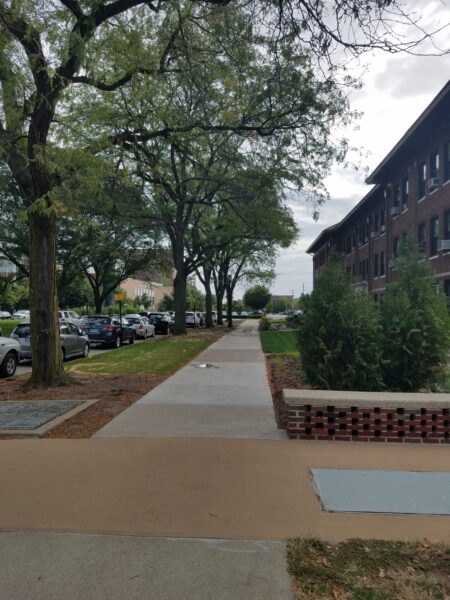
Figure 1. Honeylocust is a fast growing tree that performs well in urban plantings (Image from Purdue Landscape Report)
That said, here are a few trees to consider. I would still encourage homeowners to invest some time in researching the trees that they are considering. There are pros and cons to almost every tree, and there isn’t room in this article to fully explore all the advantages and disadvantages of each tree. Additionally, I will not be getting into detail about all the cultivars available.
Let’s start with our state tree, the Tuliptree (a.k.a Tulip-poplar or Yellow-poplar). Tuliptrees can become quite large and offer a pretty yellow fall color. They prefer deep, rich, well-drained soils.
If maples are on your mind, a couple of options would be Red maple and Freeman maple (a hybrid cross of Silver maple and Red maple). Red maple has more moderate growth. The Freeman maple is a faster grower and has stronger wood than one of its parents, the Silver maple. These maples do best in well-drained, slightly acid soils, but will tolerate a variety of soil conditions.
Northern catalpa is a fast grower, but dealing with the fruit litter, a long seed pod, may be a deterrent for some locations. It has large, heart-shaped leaves. It would grow well in moist sites.
Common hackberry is a fast grower, but it is susceptible to galls on the leaves (from a n insect), and limbs can become susceptible to wind and ice damage. It tolerates a wide variety of soil conditions. Thornless honeylocust is widely adapted to different soil types. Honeylocusts in the wild produce large thorns. The Thornless honeylocust is adapted to landscapes and allows dappled sunlight to reach turfgrass, so that it thrives more than it would under a tree that provides heavy shade.
Sweetgum is also a fast-growing shade tree with brilliant fall colors. It has a star-shaped leaf. One drawback of sweetgum is the spiny seed capsule. This fallen fruit can make walking in the yard barefoot a painful experience.
Eastern cottonwood is the tree on record for the fastest growth rate of any tree native to the U.S. However, those with cottonwoods in their yard can tell you that the cottony seed mass shed in the spring sticks everywhere. It can be a mess. Plus, cottonwood can shed limbs frequently, especially after storms. This tree is commonly found along rivers and streams, so it not surprisingly prefers moist soils.
Also found along rivers and streams, American sycamore is a fast-growing tree in some landscapes. However, it can be a messy landscape tree, shedding bark, leaves, limbs, and fruit nearly year-round. The large fallen leaves can smother grass if not mowed or raked. It is also sensitive to a spring disease called anthracnose, which can cause defoliation and twig death.
Wild black cherry may be another good choice. Although it may not be available in some nurseries, it can be grown from seed. It prefers rich, moist, well-drained soils.
A couple of faster-growing oaks to consider are Pin oak and Northern red oak. Pin oak would be better suited to slightly wetter spots, while Red oak would work on a wider variety of soils, preferring rich, moist, well-drained sites. Pin oak is susceptible to iron chlorosis (yellowing leaves) on alkaline soils.
Finally, American basswood also prefers rich, moist, well-drained soils and is somewhat shade-tolerant. This tree can grow quite tall and provide excellent shade.
In your research, find out how large the tree you will be purchasing will get. One common planting mistake is locating trees too close to structures. Consider the mature size when placing it in the landscape.
Time your spring planting near Arbor Day, the last Friday in April.
Original article posted: Fast-Growing Trees for the Landscape.
Subscribe and receive the newsletter: Purdue Landscape Report Newsletter.
Resources:
Fifty Common Trees of Indiana
An Introduction to Trees of Indiana
Native Trees of the Midwest, The Education Store
Shrubs and Woody Vines of Indiana and the Midwest, The Education Store
Tree Installation: Process and Practices, The Education Store
Wildlife Habitat Hint YouTube Playlist, Purdue Extension – FNR
Invasive Species YouTube Playlist, Purdue Extension – FNR
Report Invasive Species, Purdue Invasive Species
Find an Arborist video, Trees are Good-International Society of Arboriculture (ISA)
ID That Tree, Purdue Extension-FNR YouTube playlist
Purdue Plant and Pest Diagnostic Laboratory
Trees and Storms – The Education Store, Purdue Education’s resource center
Planting Your Tree, video, Purdue Extension
Subscribe Purdue Extension – Forestry and Natural Resources YouTube Channel
John Woodmansee, Extension Educator, Whitely County
Purdue Extension
Purdue Landscape Report: Spring is just around the corner, green spaces are beginning to wake from their winter slumber, Earth Day and Arbor Day are a little over a month away, and people are ready to get outside with planting on their minds. But before you go and get your tree(s) for planting, there is quite a lot to think about. Every tree is an investment, and if properly cared for, will outlast us and potentially future generations. So, what goes into planting trees, especially large trees?
One important note for successfully planting any tree is thinking about your goals, or what you want out of a new tree. In the case of large trees, the first thing that usually comes to mind is shade. Having a large shade tree to block the sun on your home in hot summers can significantly reduce power consumption from air conditioning. Large shade trees also give us great locations to play, picnic, or relax outside in our backyard, at local playgrounds, or parks. Given the space and care to grow, they can create wonderful local environments and beautiful aesthetics, driving down neighborhoods and city streets. The right species can benefit local wildlife with food production and habitat improvement.
When you know what you want, you can begin to assess your site to see if you have the right space for your future tree. Large trees require larger spaces. If your tree survives to a mature size, will it interfere with anything else around it? Are there utility lines above or below your planting site? What is the proximity to homes, buildings, or other structures? Will it obstruct road signs, lights, or line of sight? Will falling leaves, nuts, or fruits adversely affect anything around the tree? What is the quality of the soil: pH, well-drained, wet, clay, loam, or sand? A poorly assessed planting site could lead to a doomed planting project by placing the wrong tree in the wrong place.
Once you have your goals in mind and know what type of site you have, you can begin to consider what species you may want to plant. A couple of good resources for considering species selection in the Midwest include your local extension offices, reputable nurseries, and online resources like the Morton Arboretum. In the case of large shade trees, we all would like to have our shade now, but trees take time to reach mature heights. That being said, some species grow a little faster than others. Faster-growing trees that grow well in urban settings include:
- Tuliptree or tulip-poplar, Liriodendron tulipifera, the state tree of Indiana, can withstand varying light exposure, acidic soil that is moist to well-drained, is moderately sensitive to drought, and can reach heights up to 70-90 feet. It is susceptible to ice damage and has weaker wood than other species.
- Northern catalpa, Catalpa speciosa, is slightly smaller at about 60 feet in good conditions, thrives in full sun, and a little more alkaline soil that is moist to well-drained. Large leaves and long bean-like seed pods can be messy, and the wood and structure are on the weaker side.
- Dawn redwood, Metasequoia glyptostroboides, is a deciduous conifer (drops its foliage every fall) that can reach heights of 70-100 feet. A non-native tree, it does very well in urban settings without competing with native trees, and can survive full sun in acidic, moist to well-drained soils. It is tolerant of some drought and flooding as well as road salt during the winter.
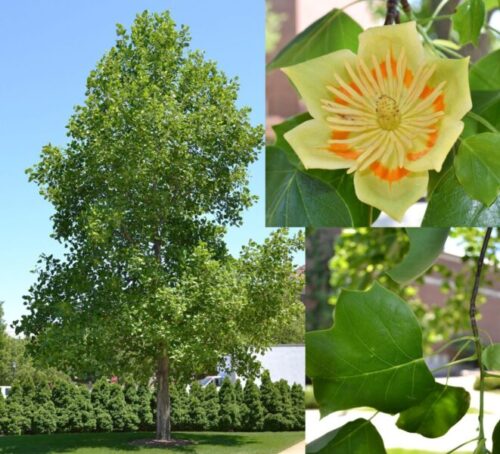
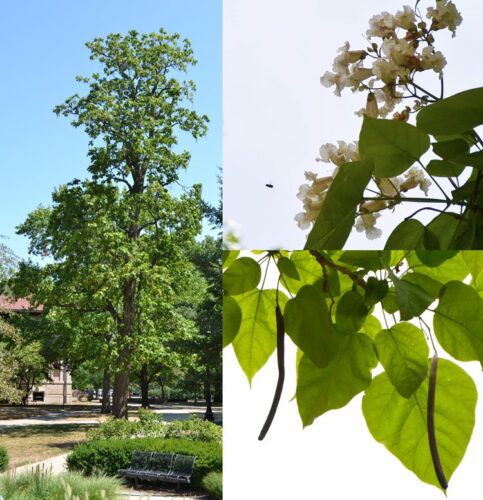
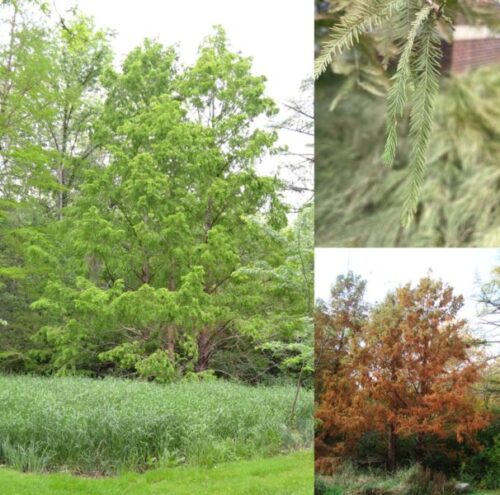
Next, we have some examples of trees slowing down to moderate growth:
- Silver linden, Tilia tomentosa, another non-native, is a common street tree that can reach heights up to 70 feet. Surviving in full sun to shade, it does well in moist to well-drained soils and is tolerant of some drought, alkaline soils, and road salt. Leaves that are dark green on top and silvery on the bottom, and flowers that can benefit some pollinators.
- Northern red oak, Quercus rubra, is one of my favorite native trees and reaches mature heights up to 75 feet. Preferring acidic, moist to well-drained soils, they can tolerate some drought as well as alkaline soils and clay soils. Leaves are dark green in summer and a beautiful red in the fall, with acorn production and interesting branch structure that benefits native birds and small mammals.
- Bald-cypress, Taxodium distichum, is similar to the dawn redwood. A deciduous conifer that loses its needles after the fall and can grow up to 70 feet. It can survive many soil types, but thrives in acidic, wet soils. In wetter sites, one thing to take into consideration is that it can send up “knee-like” roots well above the soil line to improve structural support and gas exchange. If these appear in lawn situations, they can both damage and be damaged by mowing operations. Extending mulch beds can reduce these negative interactions.
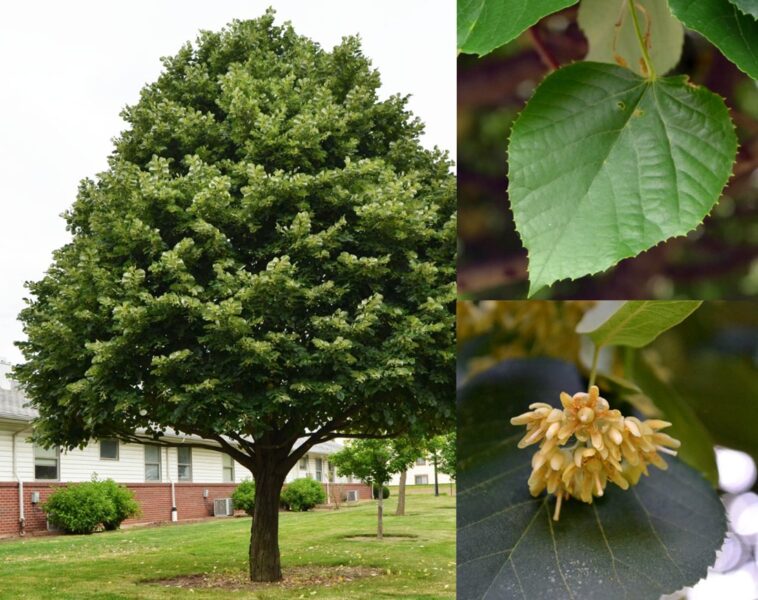
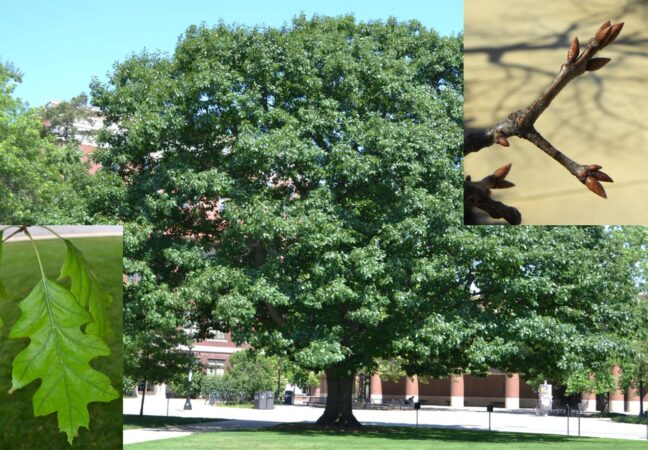
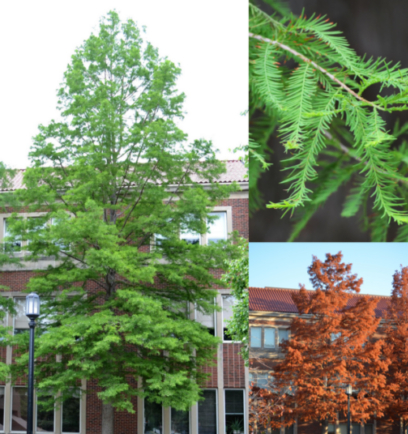
These suggestions are a small sample of large shade trees that can grow well in different urban settings. Remember to think of what the overall goal is for your planting and to assess your site to make informed species choices. With proper forethought, you can make a resilient landscape that your trees will be able to survive in for years and years. If you still have questions, you can contact your local extension office or find an ISA Certified Arborist at Find an ISA-Credentialed Arborist.
Subscribe and receive the newsletter: Purdue Landscape Report Newsletter.
Resources:
Re-mulch Your Trees, Purdue Landscape Report
Find an Arborist video, Trees are Good-International Society of Arboriculture (ISA)
Trees and Storms – The Education Store, Purdue Education’s resource center
Why Is My Tree Dying? – Got Nature? Blog, Purdue Extension – Forestry and Natural Resources
Tree Risk Management – The Education Store
Tree Pruning Essentials, Publication & Video, The Education Store
Trees and Electric Lines – The Education Store
Southwest Damage, Scalding or Frost Cracking, Got Nature? Blog, Purdue Extension – Forestry and Natural Resources (FNR)
Tree Defect Identification, The Education Store
Planting Your Tree, video, Purdue Extension
Tree Installation, The Education Store
Tree Wound and Healing, Got Nature? Blog, Purdue Extension – FNR
Subscribe – Purdue Extension-FNR YouTube Channel
Ben McCallister, Urban Forestry Specialist
Purdue Forestry & Natural Resources
The classic and trusted book “Fifty Common Trees of Indiana” by T.E. Shaw was published in 1956 as a user-friendly guide to local species. Nearly 70 years later, the publication has been updated through a joint effort by the Purdue Department of Forestry and Natural Resources, Indiana 4-H, and the Indiana Department of Natural Resources, and reintroduced as “An Introduction to Trees of Indiana.”
The full publication is available for download for $7 in the Purdue Extension Education Store. The field guide helps identify common Indiana woodlot trees.
Each week, the Intro to Trees of Indiana web series will offer a sneak peek at one species from the book, paired with an ID That Tree video from Purdue Extension forester Lenny Farlee to help visualize each species as it stands in the woods. Threats to species health as well as also insight into the wood provided by the species, will be provided through additional resources as well as the Hardwoods of the Central Midwest exhibit of the Purdue Arboretum, if available.
This week, we meet Tulip tree or Liriodendron tulipifera.
The state tree of Indiana, also known as the tulip poplar or yellow poplar, however, is actually more closely related to the magnolia family than the poplar family. It is easily identified by its large, simple tulip shaped leaves held alternately on long leaf stems. The leaves, which feature three lobes, including the top lobe which is widely notched in the middle, turn from glossy green to a golden yellow in the fall.
The bark on young trees is smooth and gray with streaks of white between the ridges, while the bark of older trees is gray-brown and features deep, long running ridges. The trunk is very straight and column-like as it grows toward the sunlight and the tree self-prunes lower branches.
In the spring, the tulip tree produces colorful green and yellow, tulip like flowers with an orange band at the base of each petal, which bloom in May or June, but are often found high up on the tree.
The cone-shaped fruit is a collection of winged seeds that resembles a small, dry pineapple, approximately two-inches in length, which sits upright on the branches.
Tulip trees, which grow 70 to 90 feet tall, are often among the tallest trees in Indiana woodland areas as they are shade intolerant and prefer to grow toward the light. They can often be found in woodlands as large as three to four feet in width on the trunk. Tulip trees prefer acidic, moist, well-drained soil, but can tolerate alkaline soil.
The natural range of the tulip tree is the eastern United States. Its western reach extends from spots in central Louisiana across the eastern edge of Missouri and Illinois up through Indiana and the southern part of Michigan, and reaches eastward across the gulf states and the panhandle of Florida. It can be found throughout much of the Atlantic coast, reaching northward to Pennsylvania, New York and Connecticut.
The Morton Arboretum warns that tulip trees are highly susceptible to ice damage and are marginally hard with weak wood and branch structure.
For full article with additional photos view: Intro to Trees of Indiana: Tulip Tree, Forestry and Natural Resources’ News.
If you have any questions regarding wildlife, trees, forest management, wood products, natural resource planning or other natural resource topics, feel free to contact us by using our Ask an Expert web page.
Other Resources:
ID That Tree: Tulip Tree
Morton Arboretum: Tuliptree
Finishing and Restoring Wood and Structures: Yellow-Poplar Lumber for Exterior Architectural Applications in New Construction and for Historical Restoration, The Education Store
Purdue Arboretum Explorer
Tulip Tree-Native Trees of Indiana Riverwalk, Purdue Fort Wayne
The Woody Plant Seed Manual, U.S. Forest Service
Fifty Common Trees of Indiana
An Introduction to Trees of Indiana
Native Trees of the Midwest, The Education Store
Shrubs and Woody Vines of Indiana and the Midwest, The Education Store
Investing in Indiana Woodlands, The Education Store
Forest Improvement Handbook, The Education Store
ID That Tree, Purdue Extension-Forestry & Natural Resources (FNR) YouTube playlist
Woodland Management Moment , Purdue Extension-FNR YouTube playlist
Wendy Mayer, FNR Communications Coordinator
Purdue University Department of Forestry and Natural Resources
Lenny Farlee, Sustaining Hardwood Extension Specialist
Purdue University Department of Forestry and Natural Resources
In this edition of ID That Tree, Purdue Extension forester Lenny Farlee teaches you about the state tree of Indiana, the tulip tree. It is also known as the tulip poplar or yellow poplar, although it is more closely related to the magnolia. This tree is known for its simple tulip shaped leaves and colorful flowers in the spring, although they are often high up on the tree.
If you have any questions regarding trees, forests, wildlife, wood products or other natural resource topics, feel free to contact us by using our Ask an Expert web page.
Resources
Indiana’s State Tree is a Popular Landscape Choice, Purdue Extension
Tulip Tree Scale, Purdue Plant and Pest Diagnostic Laboratory
Finishing and Restoring Wood and Structures: Yellow-Poplar Lumber for Exterior Architectural Applications in New Construction and for Historical Restoration, The Education Store, Purdue Extension resource center
Investing in Indiana Woodlands, The Education Store
Tree Appraisal and the Value of Trees, The Education Store
Forest Improvement Handbook, The Education Store
ID That Tree, Playlist, Purdue Extension – Forestry and Natural Resources Youtube Channel
A Woodland Management Moment, Playlist, Purdue Extension – Forestry and Natural Resources Youtube Channel
Lenny Farlee, Sustaining Hardwood Extension Specialist
Purdue University Department of Forestry and Natural Resources

Recent Posts
- As the spring wildflowers emerge, so do the woodland invaders
Posted: April 16, 2026 in Forestry, Forests and Street Trees, Invasive Plant Species - Ash Trees have Disappeared. What is Taking Their Place?
Posted: April 15, 2026 in Forestry, Urban Forestry, Woodlands - Why Is My Tree Dying?
Posted: April 14, 2026 in Forestry, Urban Forestry, Woodlands - Replace Invasives with Natives: 2026 Plant Swap Program
Posted: April 13, 2026 in Invasive Plant Species, Urban Forestry - Publication – Planting Forest Trees and Shrubs in Indiana
Posted: April 8, 2026 in Forests and Street Trees, Urban Forestry, Wildlife, Woodlands - ID That Tree: Virgin’s Bower Clematis
Posted: April 6, 2026 in Urban Forestry, Wildlife, Woodlands - It’s Timberdoodle Time!
Posted: April 3, 2026 in Got Nature for Kids, How To, Wildlife - Keep An Eye Out for Hammerhead Worms, Purdue Landscape Report
Posted: April 2, 2026 in Invasive Animal Species, Wildlife, Woodlands - When is the Peak Migration For Hummingbirds and How Can You Attract Them?
Posted: in How To, Wildlife - ID That Tree Featured in National Woodland Owners Association Newsletter
Posted: April 1, 2026 in Urban Forestry, Wildlife, Woodlands
Archives
Categories
- Alert
- Aquaculture/Fish
- Aquatic/Aquaculture Resources
- Ask the Expert
- Christmas Trees
- Community Development
- Disease
- Drought
- Forestry
- Forests and Street Trees
- Gardening
- Got Nature for Kids
- Great Lakes
- How To
- Invasive Animal Species
- Invasive Insects
- Invasive Plant Species
- Land Use
- Natural Resource Planning
- Nature of Teaching
- Plants
- Podcasts
- Ponds
- Publication
- Safety
- Spiders
- Timber Marketing
- Uncategorized
- Urban Forestry
- Webinar
- Wildlife
- Wood Products/Manufacturing
- Woodland Management Moment
- Woodlands