 Purdue University - Extension - Forestry and Natural Resources
Got Nature? Blog
Rooted in Research, USDA Forest Service: Non-native species are increasingly shaping forests across the eastern United States. While many introduced species coexist without major disruption, some become invasive: damaging ecosystems, reducing biodiversity and impacting the economic value forests provide. Over the past decade, the extent of forest land affected by invasive species has continued to grow, making management more complex and costly.

Hemlock woolly adelgid egg sacs on a hemlock branch. Photo from Rooted in Research newsletter.
To address these challenges, the USDA Forest Service Research and Development team is hosting a six-part webinar series focused on invasive species in eastern forests. This series brings together leading scientists to share research-backed management strategies and explore the ecological and economic impacts of invasive species across the region.
These are virtual webinars that will be held on select Tuesdays and Thursdays in May. Each webinar will be ~60 minutes and start at 2:00 PM Eastern time. All events are open to anyone interested in forest health, conservation and management!
Here is the schedule for the upcoming webinars:
- May 5 – Invasive Species in Eastern Forests: Extent, Impact, and Response
- May 7 – Managing Invasive Plants: Understanding Rapid Adaptation and Strategies for Control
- May 12 – Hemlock Woolly Adelgid: Protecting Hemlocks with Silviculture and Biocontrol
- May 14 – Management Solutions for Emerald Ash Borer
- May 19 – Tracking Spongy Moth Defoliations and the Economics of Slowing the Spread
- May 21 – Emerging Threats: Asian Needle Ant and Beech Leaf Disease
Participants must register for each webinar individually, visit to Research & Development Presents: Invasive Species in Eastern Forests learn more and sign up.
Forests play a critical role in supporting biodiversity, protecting water resources, and contributing to local and regional economies. As invasive species continue to spread, understanding how to manage and mitigate their impacts is more important than ever. This webinar series provides an opportunity to learn directly from experts working at the forefront of forest research.
To subscribe to the newsletter, visit Sign Up for Rooted in Research.
Learn and read more about the research done by the USDA Forest Service by exploring the Northern Research Station and Southern Research Station.
More Resources
ID That Tree, Playlist, Purdue Extension – FNR YouTube Channel
A Woodland Management Moment, Playlist, Purdue Extension – FNR YouTube Channel
Woodland Stewardship for Landowners, Playlist, Purdue Extension – FNR YouTube Channel
Native Trees of the Midwest, Purdue University Press
Investing in Indiana Woodlands, The Education Store
Forest Improvement Handbook, The Education Store
Invasive Species Playlist, Playlist, Purdue Extension – FNR YouTube Channel
Indiana Department of Natural Resources: Invasive Species
Indiana Invasive Species Council
Cooperative Invasive Species Management Area (CISMA)
Report Invasive, Purdue Extension
Episode 11 – Exploring the challenges of Invasive Species, Habitat University-Natural Resource University
What are invasive species and why should I care?, Got Nature? Blog, Purdue Extension – FNR
Invasive plants: impact on environment and people, The Education Store
New Hope for Fighting Ash Borer, Got Nature? Purdue Extension-FNR
Invasive Pest Species: Tools for Staging and Managing EAB in the Urban Forest, Got Nature?
Emerald Ash Borer, Purdue Extension-Entomology
Emerald Ash Borer Tools & Resources – Purdue Extension Entomology
U.S. Department of Agriculture (USDA) Forest Service, Research & Development
Break up with your Bradford pear (and other invasives)! Tippecanoe County Soil and Water Conservation District is hosting an Invasive Plant Swap open to residents of Tippecanoe County. Apply to swap up to 10 invasive trees or shrubs thanks to funding from Duke Energy. Ask your neighbor if you can help them swap an invasive plant for a native!
 Approved applicants will receive a native tree or shrub at the Tippecanoe County Soil and Water Conservation District Native Tree & Shrub Sale in September. We do not currently have funds to help with the costs of removing the invasive tree. All participants will be responsible for removing their invasive tree, shrub, or grass, providing proof of removal in the form of before and after pictures, picking up their native replacement, and planting their native replacement.
Applicants with city trees will work with the City Forester from Lafayette or West Lafayette on their tree removal and replacement process. Up to 10 plants can be replaced. Replacements come in 3 gallon pots. Shrubs will be approximately 2-3 feet tall and trees will be approximately 4-5 feet tall.
Please email tictaboutinvasives@gmail.com for any questions or about a specific species you would like to replace.
The 2026 application period will close August 1, 2026. Once 200 replacements have been applied for, applications will no longer be accepted.
For further information and the application, visit the event page on the Tippecanoe County SWCD website.
Resources:
Invasive Species, Playlist
Invasive Plant Species Identification, Video
Invasive plants: impact on environment and people, The Education Store, Purdue Extension resource center
Indiana Department of Natural Resources: Invasive Species
Indiana Invasive Species Council
Invasive Species Playlist, Playlist, Purdue Extension – FNR YouTube Channel
What are Invasive Species and Why Should I Care?, Purdue Extension – Forestry & Natural Resources (FNR) Blog
Report INvasive, Purdue Extension
The GLEDN Phone App – Great Lakes Early Detection Network
EDDMapS, Early Detection and Distribution Mapping System
Cooperative Invasive Species Management Area (CISMA)
Episode 11 – Exploring the challenges of Invasive Species, Habitat University-Natural Resource University
Emerald Ash Borer Information Network, Purdue University and Partners
What Nurseries Need to Know About the Invasive Species Regulation, The Education Store, Purdue Extension’s resource center
Invasive plants: impact on environment and people, The Education Store, Purdue Extension’s resource center
Tree Installation: Process and Practices, The Education Store
ID That Tree – Video Playlist, Purdue Extension – Forestry and Natural Resources (FNR) YouTube Channel
Tree Pruning Essentials Video, Purdue Extension YouTube Channel
Find an Arborist, International Society of Arboriculture
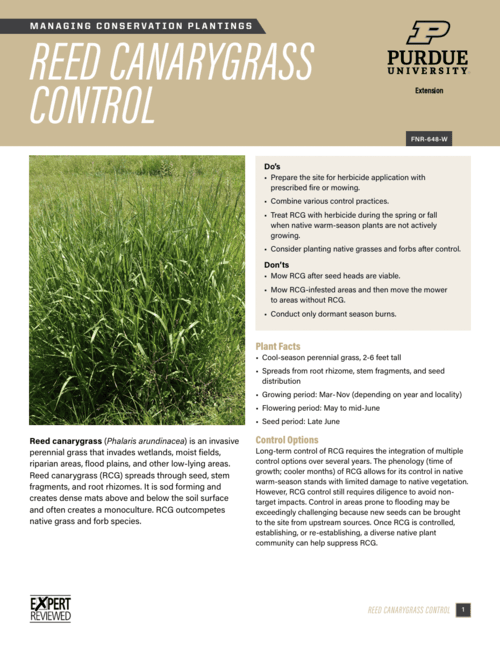 Uncover the challenges posed by reed canarygrass, an invasive perennial grass that threatens conservation plantings, wetlands and low-lying areas. This guide details control options for reed canarygrass. Essential for conservationists and land managers dedicated to preserving native ecosystems: Reed Canarygrass Control.
Check out the Managing Conservation Plantings Series which include details on how to control invasive species and other problematic plants in Conservation Reserve Program (CRP) plantings and native warm-season grass and wildflower conservation plantings.
Publications in this series include:
- Golden Rod Control
- Thinning Native Warm-Season Grasses
- Sericea Lespedeza Control
- Woody Encroachment and Woody Invasives
- Jonhsongrass Control
- Reed Canarygrass Control
- Teasel Control (Common and Cut Leaved)
- Controlling Introduced Cool-Season Grasses
- Crownvetch, Sweetclover and Birdsfoot Trefoil Control
Resources:
Deer Impact Toolbox & Grassland Management, Purdue Extension Pond and Wildlife Management
Pond and Wildlife Management, Purdue Extension
Forestry for the Birds Virtual Tour and Pocket Guide, Got Nature? Blog, Purdue Extension – FNR
Frost Seeding to Establish Wildlife Food Plots and Native Grass and Forb Plantings – Purdue Extension – FNR YouTube channel
Wildlife Habitat Hint: Tips for Evaluating a First Year Native Grass and Forb Plantings, Purdue Extension – FNR YouTube Channel
Drone Seeding Native Grasses and Forbs: Project Overview & Drone Setup, Purdue Extension – FNR YouTube channel
Ask an Expert: Wildlife Food Plots, video, Purdue Extension – FNR YouTube Channel
Handling Harvested Game: Episode 1, Field Dressing, video, Purdue Extension – FNR YouTube Channel
Managing Your Woods for White-Tailed Deer, The Education Store
Forest Improvement Handbook, The Education Store
Forest Management for Reptiles and Amphibians: A Technical Guide for the Midwest, The Education Store
A Template for Your Wildlife Habitat Management Plan, The Education Store
Woodland Stewardship for Landowners, Playlist, Purdue Extension – FNR YouTube channel
Nature of Teaching Unit 1: Animal Diversity and Tracking, The Education Store
Nature of Teaching, Purdue College of Agriculture
Invasive Species Playlist, Playlist, Purdue Extension – FNR YouTube Channel
Report Invasive, Purdue Extension
Subscribe Purdue Extension – Forestry and Natural Resources YouTube Channel
Jarred Brooke, Wildlife Extension Specialist
Purdue Department of Forestry and Natural Resources
 Discover how to manage non-native cool-season grasses like tall fescue and Kentucky bluegrass in native conservation plantings. This guide reveals how these invasive species form dense sod layers, which limits wildlife mobility, and also provides control options for these invasive species. Controlling Introduced Cool-Season Grasses is essential for anyone dedicated to preserving native ecosystems and enhancing biodiversity.
Check out the Managing Conservation Plantings Series which include details on how to control invasive species and other problematic plants in Conservation Reserve Program (CRP) plantings and native warm-season grass and wildflower conservation plantings.
Publications in this series include:
- Golden Rod Control
- Thinning Native Warm-Season Grasses
- Sericea Lespedeza Control
- Woody Encroachment and Woody Invasives
- Jonhsongrass Control
- Reed Canarygrass Control
- Teasel Control (Common and Cut Leaved)
- Controlling Introduced Cool-Season Grasses
- Crownvetch, Sweetclover and Birdsfoot Trefoil Control
Resources:
Deer Impact Toolbox & Grassland Management, Purdue Extension Pond and Wildlife Management
Pond and Wildlife Management, Purdue Extension
Forestry for the Birds Virtual Tour and Pocket Guide, Got Nature? Blog, Purdue Extension – FNR
Frost Seeding to Establish Wildlife Food Plots and Native Grass and Forb Plantings – Purdue Extension – FNR YouTube channel
Wildlife Habitat Hint: Tips for Evaluating a First Year Native Grass and Forb Plantings, Purdue Extension – FNR YouTube Channel
Drone Seeding Native Grasses and Forbs: Project Overview & Drone Setup, Purdue Extension – FNR YouTube channel
Ask an Expert: Wildlife Food Plots, video, Purdue Extension – FNR YouTube Channel
Handling Harvested Game: Episode 1, Field Dressing, video, Purdue Extension – FNR YouTube Channel
Managing Your Woods for White-Tailed Deer, The Education Store
Forest Improvement Handbook, The Education Store
Forest Management for Reptiles and Amphibians: A Technical Guide for the Midwest, The Education Store
A Template for Your Wildlife Habitat Management Plan, The Education Store
Woodland Stewardship for Landowners, Playlist, Purdue Extension – FNR YouTube channel
Nature of Teaching Unit 1: Animal Diversity and Tracking, The Education Store
Nature of Teaching, Purdue College of Agriculture
Invasive Species Playlist, Playlist, Purdue Extension – FNR YouTube Channel
Report Invasive, Purdue Extension
Subscribe Purdue Extension – Forestry and Natural Resources YouTube Channel
Jarred Brooke, Wildlife Extension Specialist
Purdue Department of Forestry and Natural Resources
Discover how to effectively manage the invasive common and cut-leaved teasel, which threatens open areas like prairies, savannas, sedge meadows, roadsides and conservation plantings. This publication provides essential information for exploring effective control options. Essential reading for conservationists and land managers interested in grassland ecosystems: Teasel Control (Common and Cut Leaved).
Check out the Managing Conservation Plantings Series which include details on how to control invasive species and other problematic plants in Conservation Reserve Program (CRP) plantings and native warm-season grass and wildflower conservation plantings.
Publications in this series include:
- Golden Rod Control
- Thinning Native Warm-Season Grasses
- Sericea Lespedeza Control
- Woody Encroachment and Woody Invasives
- Jonhsongrass Control
- Reed Canarygrass Control
- Teasel Control (Common and Cut Leaved)
- Controlling Introduced Cool-Season Grasses
- Crownvetch, Sweetclover and Birdsfoot Trefoil Control
Resources:
Deer Impact Toolbox & Grassland Management, Purdue Extension Pond and Wildlife Management
Pond and Wildlife Management, Purdue Extension
Forestry for the Birds Virtual Tour and Pocket Guide, Got Nature? Blog, Purdue Extension – FNR
Frost Seeding to Establish Wildlife Food Plots and Native Grass and Forb Plantings – Purdue Extension – FNR YouTube channel
Wildlife Habitat Hint: Tips for Evaluating a First Year Native Grass and Forb Plantings, Purdue Extension – FNR YouTube Channel
Drone Seeding Native Grasses and Forbs: Project Overview & Drone Setup, Purdue Extension – FNR YouTube channel
Ask an Expert: Wildlife Food Plots, video, Purdue Extension – FNR YouTube Channel
Handling Harvested Game: Episode 1, Field Dressing, video, Purdue Extension – FNR YouTube Channel
Managing Your Woods for White-Tailed Deer, The Education Store
Forest Improvement Handbook, The Education Store
Forest Management for Reptiles and Amphibians: A Technical Guide for the Midwest, The Education Store
A Template for Your Wildlife Habitat Management Plan, The Education Store
Woodland Stewardship for Landowners, Playlist, Purdue Extension – FNR YouTube channel
Nature of Teaching Unit 1: Animal Diversity and Tracking, The Education Store
Nature of Teaching, Purdue College of Agriculture
Invasive Species Playlist, Playlist, Purdue Extension – FNR YouTube Channel
Report Invasive, Purdue Extension
Subscribe Purdue Extension – Forestry and Natural Resources YouTube Channel
Jarred Brooke, Wildlife Extension Specialist
Purdue Department of Forestry and Natural Resources
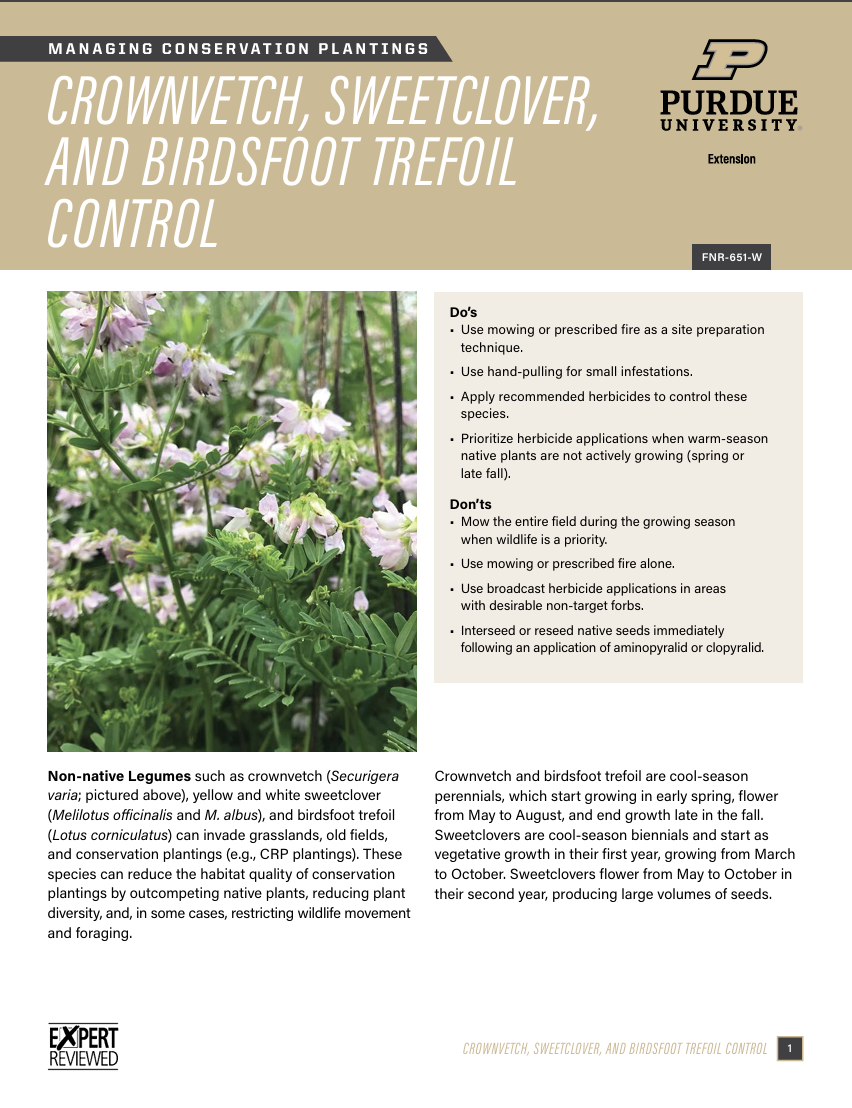 Discover the impact of non-native legumes like crownvetch, sweetclover, and birdsfoot trefoil on grasslands and conservation plantings. This guide provides control options for these non-native legumes. Essential reading for conservationists and land managers interested in grassland ecosystems: Crownvetch, Sweetclover and Birdsfoot Trefoil Control.
Check out the Managing Conservation Plantings Series which include details on how to control invasive species and other problematic plants in Conservation Reserve Program (CRP) plantings and native warm-season grass and wildflower conservation plantings.
Publications in this series include:
- Golden Rod Control
- Thinning Native Warm-Season Grasses
- Sericea Lespedeza Control
- Woody Encroachment and Woody Invasives
- Jonhsongrass Control
- Reed Canarygrass Control
- Teasel Control (Common and Cut Leaved)
- Controlling Introduced Cool-Season Grasses
- Crownvetch, Sweetclover and Birdsfoot Trefoil Control
Resources:
Deer Impact Toolbox & Grassland Management, Purdue Extension Pond and Wildlife Management
Pond and Wildlife Management, Purdue Extension
Forestry for the Birds Virtual Tour and Pocket Guide, Got Nature? Blog, Purdue Extension – FNR
Frost Seeding to Establish Wildlife Food Plots and Native Grass and Forb Plantings – Purdue Extension – FNR YouTube channel
Wildlife Habitat Hint: Tips for Evaluating a First Year Native Grass and Forb Plantings, Purdue Extension – FNR YouTube Channel
Drone Seeding Native Grasses and Forbs: Project Overview & Drone Setup, Purdue Extension – FNR YouTube channel
Ask an Expert: Wildlife Food Plots, video, Purdue Extension – FNR YouTube Channel
Handling Harvested Game: Episode 1, Field Dressing, video, Purdue Extension – FNR YouTube Channel
Managing Your Woods for White-Tailed Deer, The Education Store
Forest Improvement Handbook, The Education Store
Forest Management for Reptiles and Amphibians: A Technical Guide for the Midwest, The Education Store
A Template for Your Wildlife Habitat Management Plan, The Education Store
Woodland Stewardship for Landowners, Playlist, Purdue Extension – FNR YouTube channel
Nature of Teaching Unit 1: Animal Diversity and Tracking, The Education Store
Nature of Teaching, Purdue College of Agriculture
Invasive Species Playlist, Playlist, Purdue Extension – FNR YouTube Channel
Report Invasive, Purdue Extension
Subscribe Purdue Extension – Forestry and Natural Resources YouTube Channel
Jarred Brooke, Wildlife Extension Specialist
Purdue Department of Forestry and Natural Resources
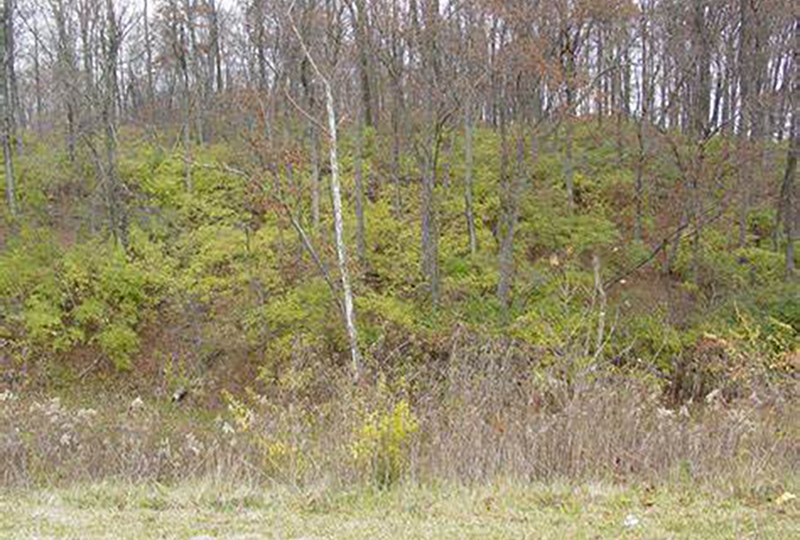
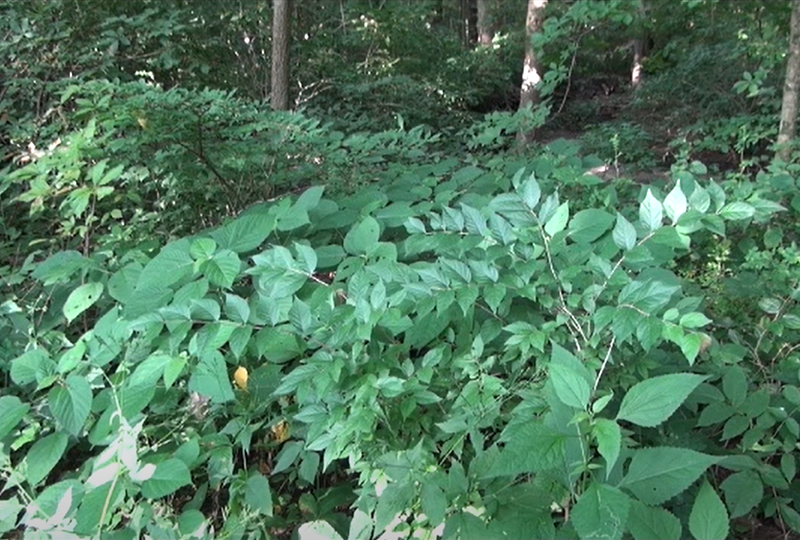
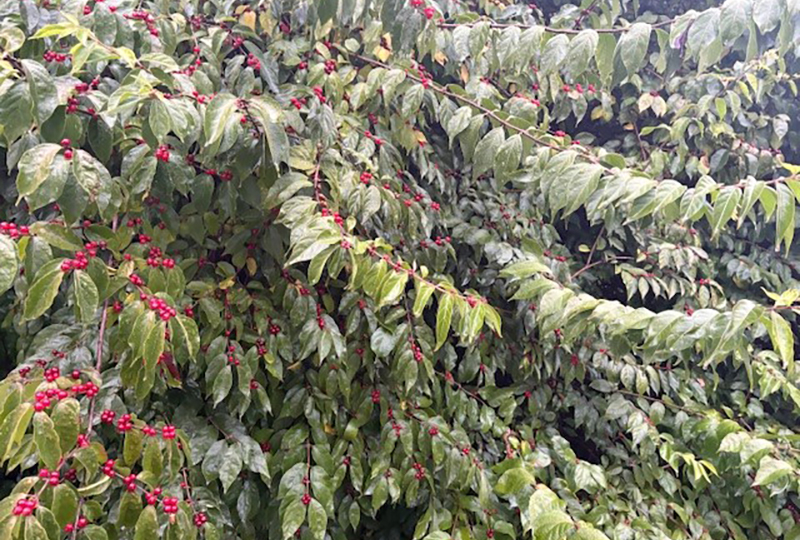
In early November, invasive bush honeysuckle is one of the only understory shrubs that are still green. While many of our native plants are dormant, Asian bush honeysuckle remains green longer making them easy to locate. Doing control measures this time of year also reduces impacts to non-target plants.
How do you control it? That depends on what resources you have available. Small plants can be easily pulled by hand; be sure to hang them on tree branch rather than laying them down on the ground so they don’t re-root. In most cases, some method of herbicide control will be necessary. Ohio State University has a good guide on various methods of control, Controlling Non-Native Invasive Plants in Ohio Forests: Bush Honeysuckle.
Not sure where to start on your property? One of the most daunting aspects of invasive plant control is where to begin. Ellen Jacquart, former Director of Stewardship for the Nature Conservancy in Indiana, wrote an article in the Indiana Woodland Steward. The Where do I Start?! Prioritizing Invasive Plant Control article describes how to plan your invasive plant control including prioritizing what to do first.
Click on the photos below for larger view to help as you identify Asian bush honeysuckle.

Resources:
Subscribe to the Indiana Woodland Steward Newsletter
Consider Fall Eradication of Asian Bush Honeysuckle, Purdue Landscape Report
Asian Bush Honeysuckle, Purdue Extension YouTube Video
A Woodland Moment: Asian Bush Honeysuckle, Purdue Extension – Forestry and Natural Resources (FNR) YouTube Video
Invasive Plants of the Eastern U.S.: An Introduction to the Problematic Non-Native Species, The Education Store, Purdue Extension’s resource center
Report Invasive Species, Purdue Invasive Species
Report Invasive Species: Asian Bush Honeysuckle, Purdue Invasive Species
The GLEDN Phone App – Great Lakes Early Detection Network
EDDMaps – Early Detection and Distribution Mapping System
Episode 11 – Exploring the challenges of Invasive Species, Habitat University-Natural Resource University
What Are Invasive Species and Why Should I Care?, Purdue Extension-FNR Got Nature? Blog
Emerald Ash Borer Information Network, Purdue University and Partners
Aquatic Invasive Species, Illinois-Indiana Sea Grant (IISG)
Invasive plants: impact on environment and people, The Education Store, Purdue Extension’s resource center
Subscribe Purdue Extension-Forestry and Natural Resources YouTube Channel
Brian MacGowan, Wildlife Extension Specialist
Department of Forestry and Natural Resources, Purdue University
Welcome to ID That Tree! In this episode, Purdue Extension Forester Lenny Farlee introduces us to multiflora, a non-native invasive shrub that has become widespread across Indiana. Once planted for practical purposes, it now creates big challenges for landowners and natural areas. Learn where you’re most likely to encounter it, why it spreads so aggressively and what makes it stand out on the landscape. Whether you’re a student, nature enthusiast or land manager, this video gives you a quick introduction to one of Indiana’s most troublesome invasive plants.
If you have any questions regarding wildlife, trees, forest management, wood products, natural resource planning or other natural resource topics, feel free to contact us by using our Ask an Expert web page.
Resources:
ID That Tree – Video Playlist, Purdue Extension – Forestry and Natural Resources (FNR) YouTube Channel
Purdue Arboretum Explorer
Conservation Tree Planting: Steps to Success, Purdue Extension – FNR YouTube Channel
A Woodland Management Moment, Playlist, Purdue Extension – FNR YouTube Channel
Woodland Stewardship for Landowners, Playlist, Purdue Extension – FNR YouTube Channel
Fifty Common Trees of Indiana, Purdue Extension – FNR
Indiana Invasive Species Council
Cooperative Invasive Species Management Area (CISMA)
Report Invasive, Purdue Extension
Habitat University, Episode 12 – Exploring the challenges of Invasive Species, Habitat University-Natural Resource University
Shrubs and Woody Vines of Indiana and the Midwest, Purdue University Press
Native Trees of the Midwest, Purdue University Press
Professional Forester, Indiana Forestry Woodland Owners Association
District Forester, Indiana Department of Natural Resources, 10+ acres
Find an Arborist, International Society of Arboriculture
Forest Improvement Handbook, The Education Store
Lenny Farlee, Extension Forester
Hardwood Tree Improvement and Regeneration Center
Purdue Department of Forestry & Natural Resources
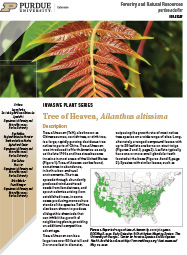 Tree-of-heaven (ToH), also known as Chinese sumac, varnish tree, or stink tree, is a large, rapidly growing deciduous tree native to parts of China. Tree-of-heaven was introduced to North America as early as the late 1700s and has since become invasive in most areas of the United States. Tree-of-heaven can be found, sometimes in abundance, in both urban and rural environments. The tree spreads through abundantly produced wind-scattered seeds from female trees, and sprout colonies arising from established trees, in some cases producing monoculture stands of the species. ToH has also been shown to produce allelopathic chemicals that can inhibit the growth of neighboring plants, providing an additional competitive advantage.
Tree-of-heaven is a serious threat as an invasive species in many habitats or untended areas. It can reach 80 feet or more, its growth rate outpaces most native tree species, and wind scatters seeds that female trees produce in abundance. Controlling ToH is a challenge. In this publication, Purdue University extension specialists and property managers explain herbicide options, application techniques and strategies to control and manage ToH.
To receive the free download visit the Purdue Extension’s resource center: The Education Store – Invasive Plant Series – Tree of Heaven, Ailanthus altissima.
View Forestry and Natural Resources (FNR) YouTube Video: ID That Tree: Invasive Tree of Heaven.
Resources:
Invasive Species, Playlist, Purdue Extension – FNR YouTube Channel
Report Invasive Species, Purdue Invasive Species
What are invasive species and why should I care?, Got Nature? Blog, Purdue Extension – Forestry and Natural Resources
Invasive plants: Impact on Environment and People, The Education Store, Purdue Extension’s resource center
A Woodland Management Moment, Playlist, Purdue Extension – Forestry and Natural Resources (FNR) Youtube Channel
Conservation Tree Planting: Steps to Success, Purdue Extension – FNR Youtube Channel
Forest Improvement Handbook, The Education Store
Tree Risk Management – Got Nature? Blog, Purdue Extension – FNR
Investing in Indiana Woodlands, The Education Store
Woodland Invaders, Got Nature? Blog, Purdue Extension – FNR
Indiana Department of Natural Resources: Invasive Species
Invasive Plant Species Identification, Video, Purdue Extension – FNR Youtube Channel
Mile-a-minute Vine, The Education Store
Lenny Farlee, Extension Forester
Hardwood Tree Improvement & Regeneration Center (HTIRC) & Purdue University Department of Forestry and Natural Resources
Ron Rathfon, Regional Extension Forester, Southern Indiana Purdue Agriculture Center (SIPAC)
Purdue Forestry and Natural Resources
Purdue Landscape Report: Despite the sublime name, tree-of-heaven, Ailanthus altissima, is a particularly bad actor when it comes to trees encountered in the Midwest. This native of Asia was introduced to North America more than 150 years ago and has since become a widespread invasive pest. Rapid growth, extremely high seed production (hundreds of thousands from a mature female tree), and root sprouting that can turn one tree into dozens makes this a formidable competitor with our native plants. Tree-of-Heaven can sprout and grow almost anywhere, including cracks in streets and sidewalks or building foundations, resulting in infrastructure damage and increased costs of maintenance. It is also the preferred host for a new and destructive invasive insect pest, the spotted lantern fly.
Reducing tree-of-heaven numbers on the landscape is a worthy goal, but can be a difficult task. Seed is windblown and can disperse for hundreds of yards or further, producing new populations. Tree-of-heaven will produce dozens of root sprouts if the stem is cut or girdled, even when herbicides are applied to the cuts. Both seedlings and root sprouts can grow rapidly, outpacing the native trees. However, there are effective control methods and even a potential biological control agent, a native wilt fungus, on the horizon. If you have tree-of-heaven or know of those who do, here are some methods to control this invasive tree.
Young seedlings and sprouts may be controlled with foliar applications of herbicides containing glyphosate during the summer growing season. Apply the herbicide and water mixture according to label directions, covering the entire leaf area. Pulling seedlings is an option, but any root fragments left in the soil may produce new sprouts.
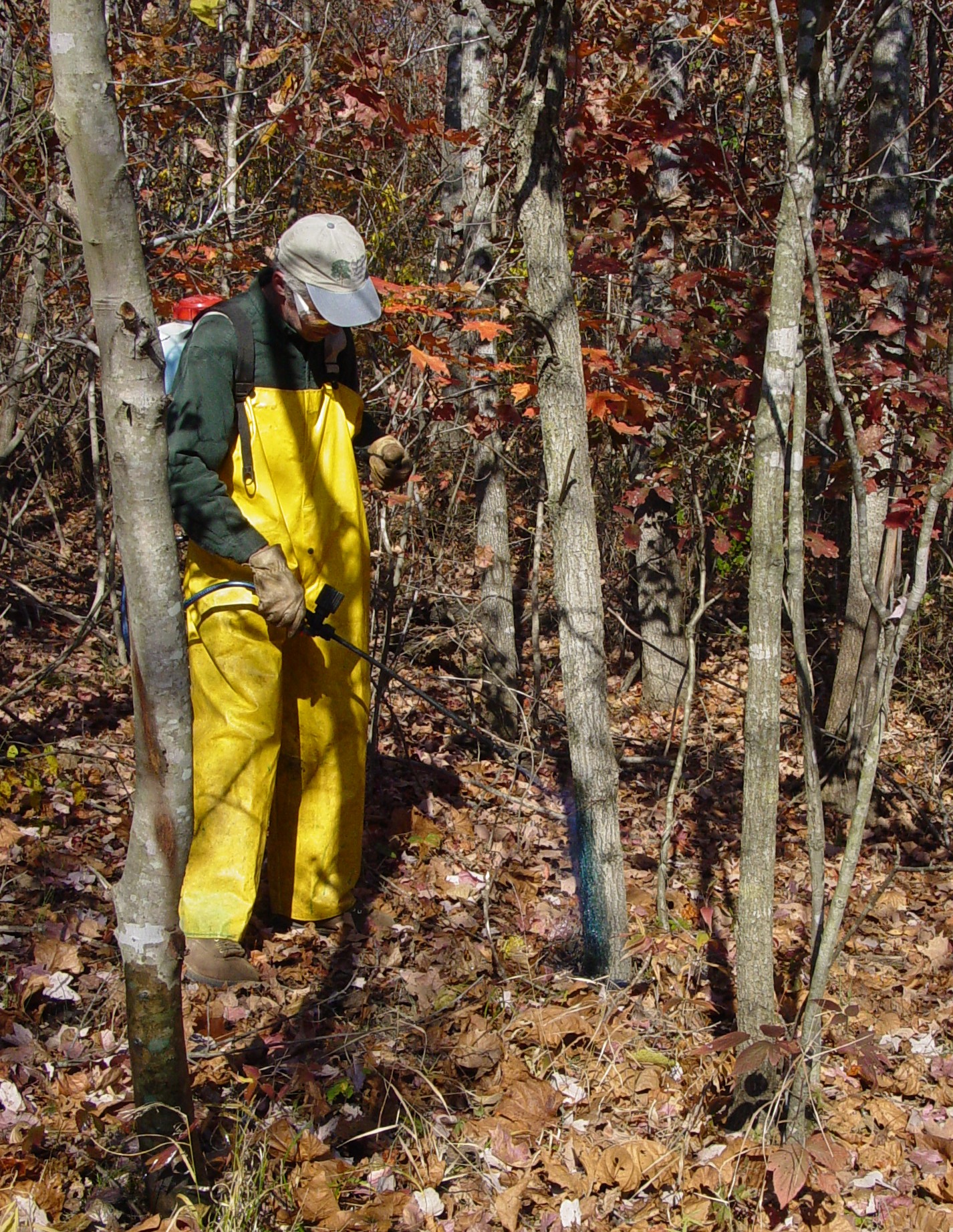
Larger tree-of-heaven too tall for foliar spray may be controlled with a couple of other techniques. The basal bark technique applies an herbicide and oil mixture to the lower 15-18 inches of the stem of the tree. The oil carries the herbicide into the tree stem and kills the tree while also limiting the amount of root sprouting. This method is recommended for stems up to 6 inches in diameter, but larger stems have been controlled effectively with this approach. The best seasons for application are summer to winter, but avoid days where temperature is over 85 degrees F as the herbicide and oil mix can volatilize and damage non-target plants. Also discontinue applications if stems are wet or when snow cover is present. Recommended herbicides are the triclopyr ester herbicides and a commercially available basal oil mixed in a ratio of 20% herbicide and 80% oil.
Trees three or more inches in diameter may also be controlled using the “hack and squirt” method, also referred to as the injection method in some cases. A narrow cutting tool like a shingle hatchet is used to make 45 degree angled cuts through the bark of the tree around the circumference, with equal-sized uncut spaces between the cuts. Herbicides like glyphosate or triclopyr amine formulations are applied as directed on the label into the pockets created by the cuts. This treatment results in very few root sprouts as compared to cutting down or girdling the tree. The number of cuts should approximately equal the diameter of the tree in inches, and be sure to leave the uncut spaces between the cuts.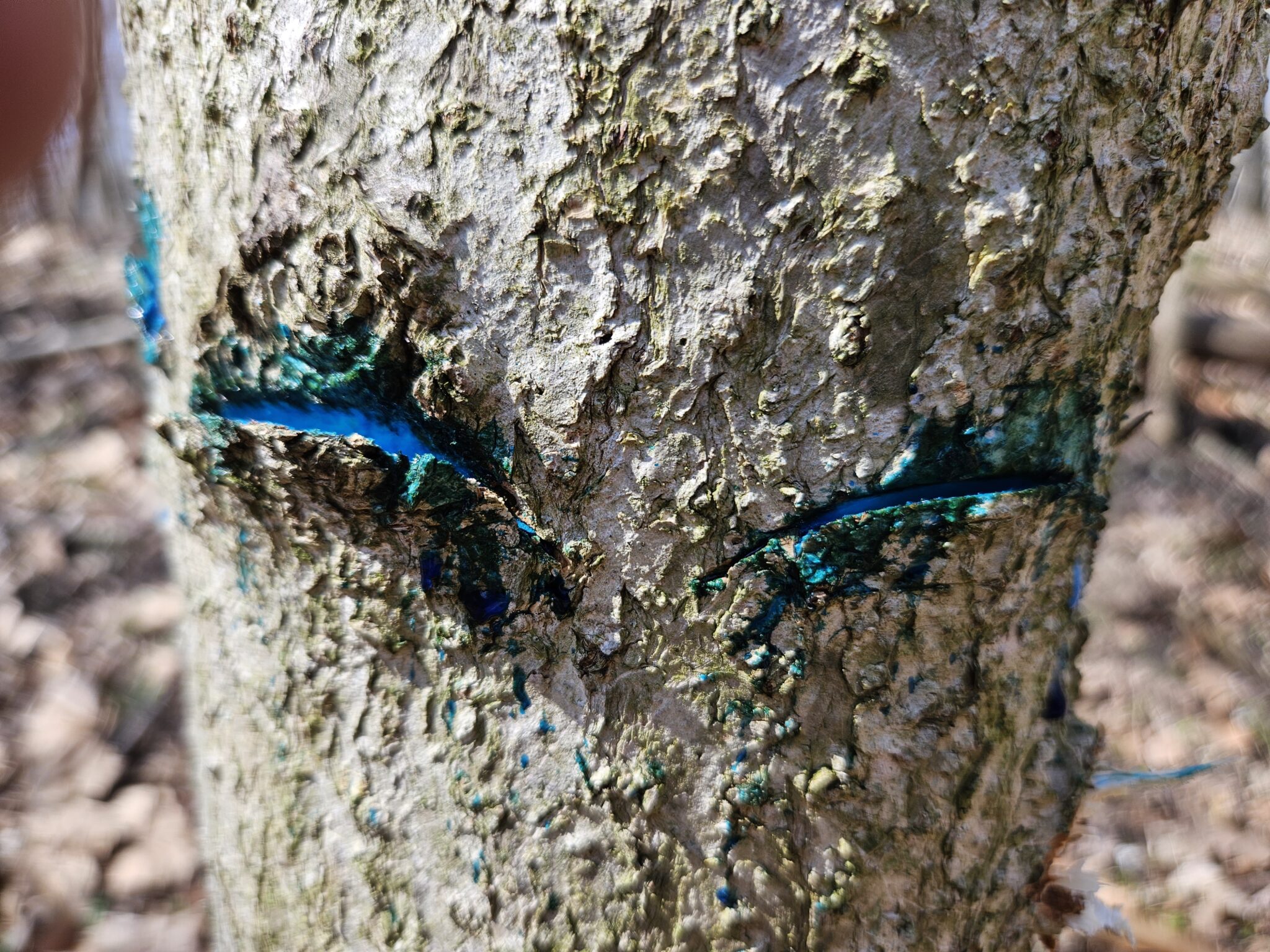
If the tree stems need to come down for safety or other reasons, apply the basal bark or hack and squirt treatments and wait approximately 30 days before cutting down the stem. This should allow time for the herbicide to impact the root system and limit the amount of root sprouting.
Work safely for yourself and the environment by reading and following the herbicide label, wearing the required personal protective gear, and working carefully with cutting tools.
To view this full article and other Purdue Landscape Report articles, please visit Purdue Landscape Report.
Subscribe and receive the newsletter: Purdue Landscape Report Newsletter.
Resources:
ID That Tree: Invasive Tree of Heaven, Purdue Extension – Forestry and Natural Resource (FNR) YouTube Channel
Control & Management — State of Indiana Cooperative Invasives Management (sicim.info)
Invasive Plant Control Database (wisc.edu)
Invasive Species, Playlist, Purdue Extension – FNR YouTube Channel
Report Invasive Species, Purdue Invasive Species
A Woodland Management Moment, Playlist, Purdue Extension – FNR Youtube Channel
Conservation Tree Planting: Steps to Success, Purdue Extension – FNR Youtube Channel
Forest Improvement Handbook, The Education Store
Tree Risk Management – Got Nature? Blog, Purdue Extension – FNR
Investing in Indiana Woodlands, The Education Store
Woodland Invaders, Got Nature? Blog, Purdue Extension – FNR
Indiana Department of Natural Resources: Invasive Species
Invasive Plant Species Identification, Video, Purdue Extension – FNR Youtube Channel
Lenny Farlee, Sustaining Hardwood Extension Specialist
Purdue University Department of Forestry and Natural Resources

Recent Posts
- Restoring Roots to Save the Salamanders, USDA – Natural Resources Conservation Service
Posted: May 6, 2026 in Aquaculture/Fish, Forestry, Wildlife - Spring Storms Are Coming: How to Reduce Tree Damage and Risk
Posted: May 1, 2026 in How To, Urban Forestry, Wildlife, Woodlands - Cryptocline Leaf Spot (Anthracnose) of Elm, Purdue Landscape Report
Posted: April 30, 2026 in Disease, Forestry, Woodlands - Mechanical Damage to Trees: Mowing and Maintenance Equipment
Posted: April 24, 2026 in Forestry, Forests and Street Trees, Urban Forestry - A Woodland Management Moment: Growing Quality Black Walnut in Openings
Posted: April 20, 2026 in Urban Forestry, Woodland Management Moment, Woodlands - Spring Into Bloom With ID That Tree
Posted: in Forests and Street Trees, Urban Forestry, Woodlands - Question: Have Whippoorwill Birds Declined in Numbers?
Posted: in Ask the Expert, Wildlife - Invasive Species in Eastern Forests, Webinar Series
Posted: in Invasive Insects, Invasive Plant Species, Urban Forestry, Wildlife - Tree Risk Management: What Every Property Owner Needs to Know
Posted: April 17, 2026 in Forests and Street Trees, Wildlife, Woodlands - As the spring wildflowers emerge, so do the woodland invaders
Posted: April 16, 2026 in Forestry, Forests and Street Trees, Invasive Plant Species
Archives
Categories
- Alert
- Aquaculture/Fish
- Aquatic/Aquaculture Resources
- Ask the Expert
- Christmas Trees
- Community Development
- Disease
- Drought
- Forestry
- Forests and Street Trees
- Gardening
- Got Nature for Kids
- Great Lakes
- How To
- Invasive Animal Species
- Invasive Insects
- Invasive Plant Species
- Land Use
- Natural Resource Planning
- Nature of Teaching
- Plants
- Podcasts
- Ponds
- Publication
- Safety
- Spiders
- Timber Marketing
- Urban Forestry
- Webinar
- Wildlife
- Wood Products/Manufacturing
- Woodland Management Moment
- Woodlands