 Purdue University - Extension - Forestry and Natural Resources
Got Nature? Blog
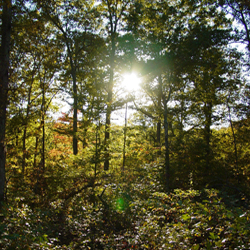 Tree disease and insect outbreaks are a lot like fires and floods – they make the news headlines and can lead to some anxiety on the part of landowners. They may also bring out those who use the crisis to make some fast money by taking advantage of that anxiety. I was recently contacted by a landowner who had been advised by a person wanting to buy some timber from him that he should sell some walnut trees “before they are all killed by Thousand Cankers Disease.” There certainly are times when we should consider harvesting trees before they are destroyed by a pest as part of a timber management program (Emerald Ash Borer, for instance), but the evidence we have related to Thousand Cankers Disease (TCD) would suggest that selling your trees immediately to avoid mortality and loss is not necessary. Thousand Cankers Disease has two components: a small twig beetle that carries a canker-forming fungus into the inner bark of walnuts. Black walnut trees in several states have been killed by this disease complex, but so far, although the fungus was found on some weevils in Brown County and the beetle was recently detected at a sawmill in Franklin County, no walnut trees in Indiana have been confirmed as killed by TCD. For additional information on TCD, you can visit the following websites: Thousand Cankers Disease and Indiana Department of Natural Resources (IDNR) TCD.
There is currently no strong evidence suggesting a need to rush to harvest walnut for fear of a massive die-off caused by TCD. In fact, some trees infected with TCD in Tennessee have shown some recovery from disease symptoms that has coincided with improved growing conditions at those sites. This would suggest doing management that keeps walnut healthy and vigorous like thinning, vine control and elimination of invasive plant species may help your trees resist damage from TCD and other diseases or environmental extremes. This story also demonstrates the importance of getting professional, science-based advice with your forest management decisions. Consult a professional forester when making decisions about the sale of trees. You can find foresters in your area at Indiana Forestry & Woodland Owners Association’s (IFWOA) Directory of Professional Foresters. You can learn more about considerations when selling timber at Call Before You Cut and the extension publications Tips on How to Get the Most From Your Timber Harvest and Marketing Timber.
Landowners, timber buyers and foresters form an important team to manage and utilize the amazing renewable resource that is our hardwood forest in Indiana. There are many reputable firms across the state that purchase timber, providing a great marketplace and economic value to landowners. Your professional forester can help you choose the right buyers, loggers and market outlets to provide a fair price for the products and good work in the woods. Get their help and do your homework before making that decision.
Resources
Indiana Department of Natural Resources (IDNR) TCD
Directory of Professional Foresters, Indiana Forestry & Woodland Owners Association (IFWOA)
Call Before You Cut
Tips on How to Get the Most From Your Timber Harvest, The Education Store, Purdue Agriculture Resource Center
Marketing Timber, The Education Store, Purdue Agriculture Resource Center
Lenny Farlee, Hardwood Ecosystem Extension Specialist
Department of Forestry & Natural Resources, Purdue University
 “The Walnut Twig Beetle (WTB), Pityophthorus juglandis, the insect involved in Thousand Cankers Disease of Black Walnut (TCD), has been detected in Indiana for the first time at a Franklin County sawmill.
The beetle was detected in a trap placed at the sawmill for a 2014 statewide survey for WTB. Additional WTBs were found during an inspection of walnut logs and lumber at the sawmill. TCD is caused by the fungus Geosmithia morbida that is transmitted by WTB.
The beetles bore into walnut branches, feeding on the tree’s tissues and depositing the fungus that creates a canker, or dead area, under the bark. Multiple feedings cause the formation of thousands of cankers under the bark and destroy the tree’s ability to transport water and nutrients. Gradually the tree dies.
Tests for the fungus from the collected beetles and walnut samples in Franklin County are ongoing. So far, the fungus has not been detected. Surveys at the sawmill have not detected any infested walnut trees. Another survey is planned for this summer for the area surrounding the sawmill.
State Entomologist Phil Marshall has ordered the sawmill quarantined. The sawmill is working with the DNR and is destroying walnut material on the property to prevent movement of TCD from the property.”
Note that no live trees have been found with TCD in Indiana yet. It is not recommended that landowners cut their walnut trees due to the disease. Instead, it is recommended that residents do not move firewood or other bark on materials of any species due to the risk of transporting known and unknown insects and diseases.
View Thousand Cankers Disease, Indiana Department of Natural Resources, for more information.
Resources
Walnut Anthracnose, Walnut Notes, U.S. Department of Agriculture, Forest Service, North Central Forest Experiment Station
Indiana Walnut Council, Industry Representatives include 45 states and 3 foreign countries
Diseases in Hardwood Tree Plantings, The Education Store, Purdue Extension resource center
Study: Fungus Behind Deadly Disease in Walnut Trees Mutates Easily, Complicating Control, Purdue Agriculture News
Indiana Walnut Council
Diseases in Hardwood Tree Plantings, The Education Store, Purdue Extension resource center
Why are my walnut trees dropping their leaves?, Purdue Extension – Forestry & Natural Resources (FNR) Got Nature? Blog
Invasive Species Walnut Twig Beetle Detected in Indiana, Purdue Extension – FNR Got Nature? Blog
Intro to Trees of Indiana: Black Walnut, Purdue Extension – FNR Got Nature? Blog
Planting Hardwood Seedlings in the Central Hardwood Region, The Education Store
Regenerating Hardwoods in the Central Hardwood Region: Soils, The Education Store
Fertilizing, Pruning, and Thinning Hardwood Plantations, The Education Store
Resources and Assistance Available for Planting Hardwood Seedlings, The Education Store
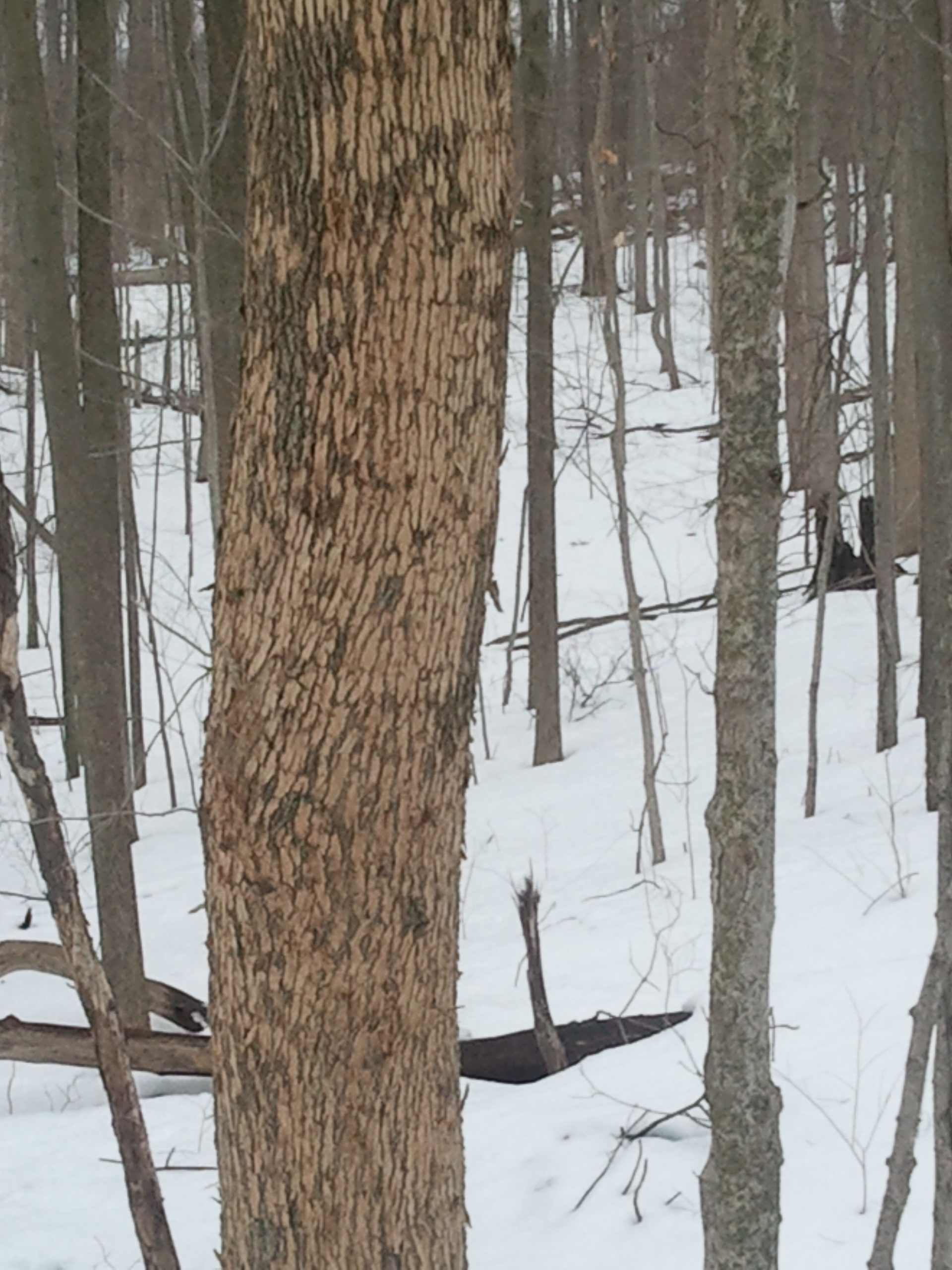
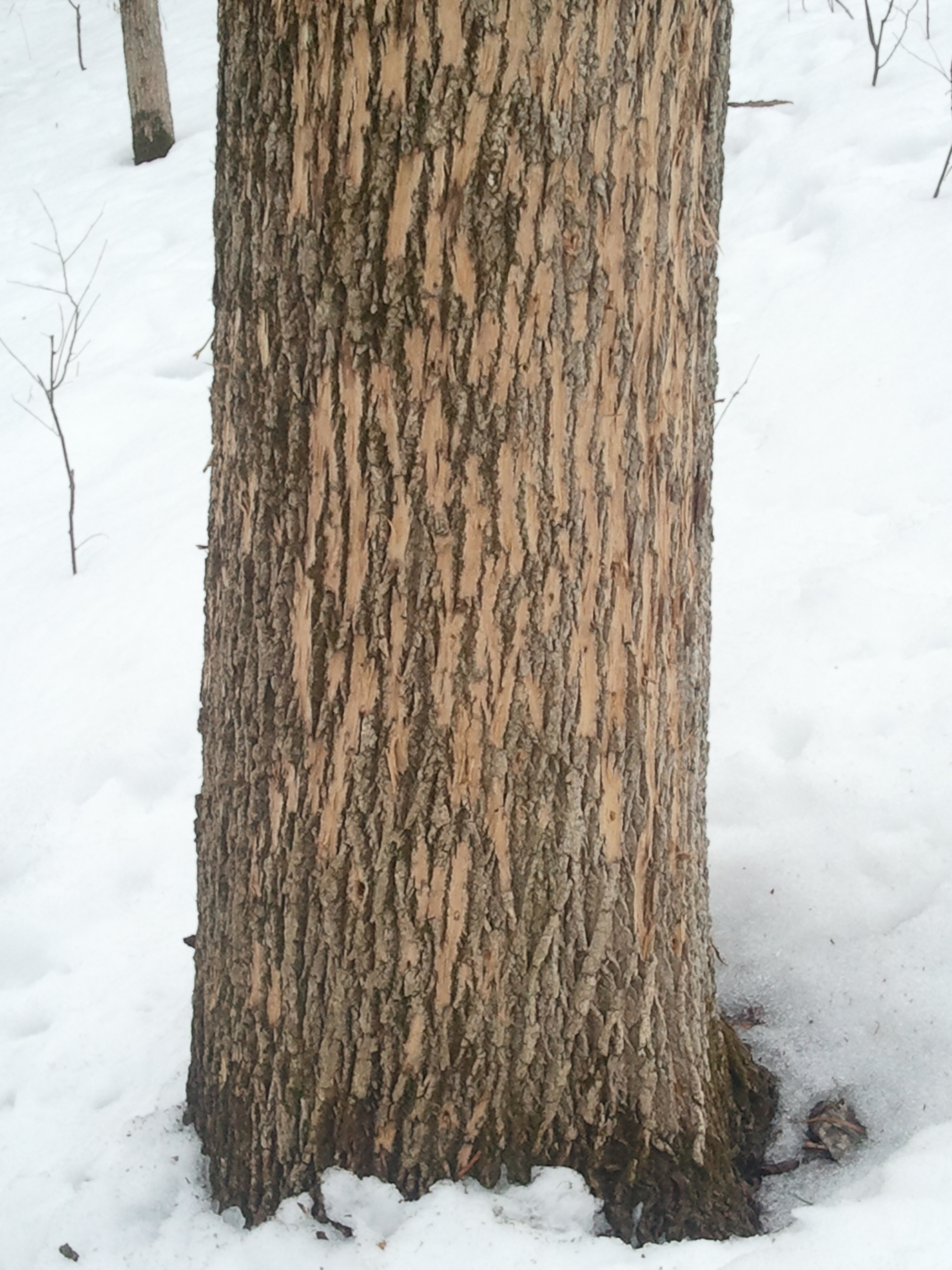
If you’re walking in the woods or maybe even traveling along a road this spring in Indiana, you may come across some trees that look like the one in the photos below. Clearly, something unusual is going on here. What made the bark change color so quickly, and why are there holes in the bark?
The answer to both of those questions for ash trees around the state is Emerald Ash Borer and woodpeckers. As Emerald Ash Borer spreads across Indiana, the population of Emerald Ash Borer larvae overwintering under the bark of ash trees can quickly increase. These grubs provide a tasty treat and important winter and early spring nutrition to hungry woodpeckers. Woodpeckers of several species are experts at detecting and extracting these grubs by pounding holes in tree bark. Ash bark is generally gray on the surface, but the inner bark is a light corky tan color. Once the woodpeckers find the EAB larvae, their excavation activities flake off the outer bark to expose the lighter colored inner bark. This is actually one of the best indicators of the presence of Emerald Ash Borer in a tree. The woodpecker activity often starts in the upper main stem and branches of ash trees, but as the population of EAB larvae in the trees increase, the woodpecker activity spreads down the trunk of the tree. Trees with this much inner bark exposed indicate an advanced infestation of EAB and signal ash tree mortality in the next year or two.
If you would like to learn more about ash trees and the Emerald Ash Borer, visit the Purdue Emerald Ash Borer website.
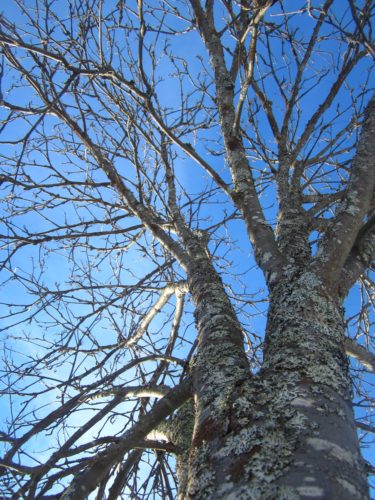 The Terre Haute area in Indiana is in a tree crisis. With Emerald Ash Borer and other deciding factors, 300+ trees a year will be removed. Over the next few years, this averages to approximately 24 percent of the total trees will be gone. Planning for the future with the knowledge of this loss is crucial. While the city will pay for removing the trees and tree-related projects, it is not in the city’s budget to replace the trees at this time. The city needs to apply for grants to fund replanting projects. The trees are removed due to diseases, age and when people run into them with cars. If you want to learn more about the tree crisis and the action that will be taken, you are welcome to attend the Emerald Ash Borer summit.
What: TREES Inc. Emerald Ash Borer Summit
Where: Vigo County Library, Meeting Rooms A, B and C
When: Thursday, February 12, 12-1:30 pm
Resources
Emerald Ash Borer in Indiana, Purdue Extension
Tree Installation: Process and Practices, The Education Store
Tree Risk Management, The Education Store
Got Nature?
Department of Forestry and Natural Resources
Purdue University
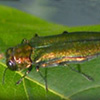 The invasive insect has made its way to its 79th county, Sullivan County. It was recently spotted in Jennings, Pike, Scott, Spencer and Warrick counties. There are only a few counties in southern Indiana that have not been affected by the Emerald Ash Borer (EAB). In order to slow the spread of the EAB, the Indiana Department of Natural Resources (DNR) has restricted the movement of ash trees, limbs and untreated ash lumber with bark attached or any cut hardwood lumber of any species with bark attached. Visitors to DNR properties may only bring in firewood that has been certified by the USDA or DNR Division of Entomology and Plant Pathology or is free of bark. Homeowners should also be aware of this invasive species. To learn more about the EAB and what signs to look for if your tree is infected, take a look at the resources below.
Resources
Arrest That Pest! – Emerald Ash Borer in Indiana, Purdue Extension
Invasive Species, Got Nature?
Emerald Ash Borer, Indiana Department of Natural Resources
Emerald Ash Borer in Indiana, Purdue Extension
Communities that have been infested by emerald ash borers can apply for a share of a federal grant received by the Indiana Department of Natural Resources. This federal grant worth $100,000 will allow for communities in the Great Lakes area to take on tree-planting projects. Due to the loss of trees in the infested areas, planting trees will help replace the large amounts of trees lost by the emerald ash borer. The tree planting project will also improve water quality. Flooding due to storms can cause raw sewage to enter waterways, but trees can intercept the water to stop the flooding. A three inch tree is able to intercept around 400 gallons of water; 800 trees can intercept 320,000 gallons of water which can greatly decrease the chances of flooding. Communities that would like to apply for a share in the grant can first subscribe to the grants information listserv by visiting the Indiana DNR’s forestry site and click on the red envelope on the left side of the page.
Resources
DNR Receives Grant to Help Communities Recover From Ash Borer, Indiana DNR
Emerald Ash Borer, Purdue Extension
Emerald Ash Borer, Indiana DNR
Invasive Insects, Got Nature?
Arrest That Pest! – Emerald Ash Borer in Indiana, Purdue Extension
Carrie Tauscher, Urban Forestry Specialist
Indiana Department of Natural Resources (INDNR)
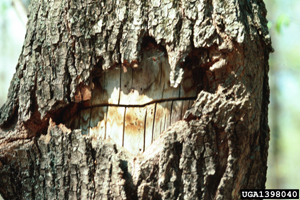
Glycobius speciosus, sugar maple borer, photo by Steven Katovich, USDA Forest Service.
Some of the most diverse taxa on the planet are rarely seen yet play critical roles within our environment. The insects found in the Order Coleoptera (beetles) are represented by over 500,000 species. Collectively, these insects provide a wide range of ecosystem services. They are important pollinators and predators on other insects, and they play essential roles in nutrient cycling. While most species are beneficial or vital for ecosystem functions, there are a few species that are considered pests.
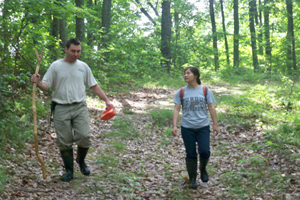
Dr. Jeff Holland and research team studying sugar maple borer in the woods.
The Sugar Maple Borer is a native species found throughout the eastern United States. The larval stage of the beetle specializes in feeding on sugar maple trees, particularly stressed or injured trees. In this podcast, our host, Rod Williams, will be interviewing Dr. Jeff Holland about the unique distribution of this wood-boring beetle, how to survey for this species on your property and the impacts to sugar maple trees throughout the eastern deciduous forests.
To find out more information about sugar maple borers, visit:
Holland Website
Bug Guide Identification
Resources
The Education Store (Search entomology or forest)
Got Nature? Blog Posts
Got Nature? Blog Posts
Jeff Holland, Associate Professor of Spatial Ecology and Biodiversity
Department of Entomology, Purdue University
Rod Williams, Associate Professor of Wildlife Science
Department of Forestry and Natural Resources, Purdue University
Emerald Ash Borer University will be providing webinars on the wood-boring pest, the Emerald Ash Borer, along with other pests and disease threats. These live sessions will allow participants to ask questions to the session presenter and moderators. The webinars will last from October to December 2014. To view the webinars, visit the Emerald Ash Borer website.
Resources
Emerald Ash Borer, Purdue Extension
Emerald Ash Borer, Indiana DNR
Invasive Species, Got Nature?
Arrest That Pest! – Emerald Ash Borer in Indiana, Purdue Extension
Cliff Sadof, Professor-Ornamental & Pest Management
Purdue Department of Entomology
As foresters, woodland owners and tree and wildlife enthusiasts, we hear the word safety and immediately think about making sure our hard hat is packed, our gas tank is full, our cell phone is charged and we have a buddy to call in case of an emergency. How many of us think about diseases? Who thinks about West Nile Virus (WNV) or Eastern Equine Encephalitis (EEE)? For those of us that take our pets into the field, WNV and EEE are very real threats. West Nile Virus originated in Africa but spread quickly throughout the United States after an outbreak in New York in 1999. By 2003, 46 states had been infected, and nearly 10,000 people had fallen ill.
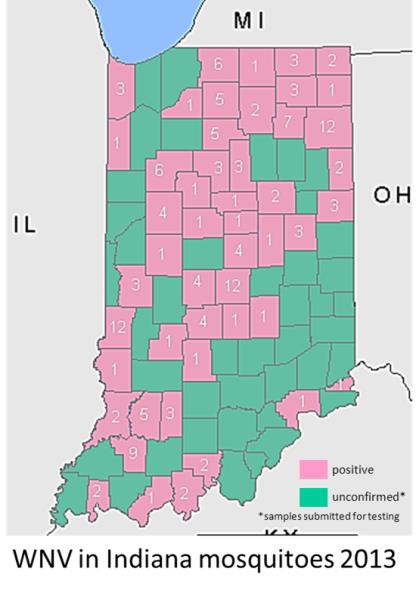
Although not contagious by contact with an infected person or animal, a protective layer is recommended when handling potential infected subjects. Most infected humans show no symptoms while a minority exhibit fevers, headaches, skin rashes, meningitis or encephalitis. Very few people die from WNV (< 1:1,000), but precautions should always be taken to prevent exposure. A total of 156 cases of WNV have been reported in Indiana this year with one sample being human. Other cases have been found in bordering states with 741 cases (mosquito) in Illinois, two mosquito and four human cases in Michigan, 64 mosquito cases in Ohio and zero cases of any kind in Kentucky as of August 20, 2013.
Eastern Equine Encephalitis is a rare viral disease that can be transmitted from host mosquitoes to a number of other animal species. Historical accounts of the disease show that in Midwestern states, EEE is most often found in southwestern Michigan; however, infected horses in Indiana have been found. EEE infects nearly all game birds, amphibians and reptiles, and last year in Michigan, an 8-week-old puppy.
Humans are not immune to EEE. Nearly 30% of people that develop the disease die, and approximately 50% of survivors have permanent neurological complications. Symptoms of infection may or may not occur and will often take between three and 10 days to be realized. EEE symptoms in humans range from fever, headache and nausea to abdominal pain, paralysis, seizures and fainting. An elderly woman in New England died on August 21, 2013, and was the first human casualty of the disease this year. A vaccine has been developed to prevent EEE in horses; however, no vaccine or treatment is available to protect humans or other animals from EEE or WNV. Elimination of standing water is our only defense against potential EEE and WNV threats.
As the summer is in full swing and more and more of us head out to the field, please do not forget to protect yourself and your pets from potential exposure to mosquitoes.
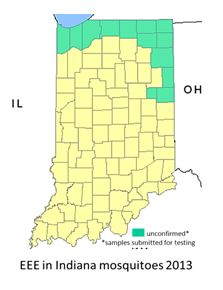
Sourced Information:
Beasley, D.W.C. et al. (2013) Resurgence of West Nile neurologic disease in the United States in 2012: What happened? What needs to be done? Antiviral Research 99:1–5.
Wendell, L.C. et al. (2013) Successful Management of Severe Neuroinvasive Eastern Equine Encephalitis. Neurocritical Care 19:111–115.
USGS Disease Maps
Van Buren County Horse Dies of Eastern Equine Encephalitis, Horse Owners Urged to Vaccinate Animals, MLIVE Media Group
Weymouth Officials Urge Caution After EEE Death, The Patriot Ledger
Resources
Mosquitoes, Purdue Extension Entomology
Shaneka Lawson, Plant Physiologist
Hardwood Tree Improvement and Regeneration Center (HTIRC)
Department of Forestry and Natural Resources, Purdue University
This winter was a brutal one for sure, but the emerald ash borer still has plenty of life left in it.
Although the Midwest experienced abnormally cold temperatures this winter, it is unlikely that populations of the highly destructive beetle were significantly affected by it, said Adam Witte, exotic forest pest educator in the Purdue University Department of Entomology.
“Headlines have been circulating, suggesting that EAB may have met its match,” Witte said. “But the EAB, as well as most insects in colder climates, is effective at surviving cold temperatures.”
EAB larvae overwintering within ash trees die when temperatures reach minus-28 degrees Fahrenheit below the bark, Witte said. U.S. Forest Service scientists predicting areas in North America where temperatures were cold enough to kill EAB larvae conclude that only parts of Minnesota and North Dakota historically have reached temperatures that low.
Contacts
Adam Witte, Exotic Forest Pest Educator
Department of Entomology
Matthew Ginzel, Associate Professor
Departments of Entomology & Forestry and Natural Resources

Recent Posts
- It’s Timberdoodle Time!
Posted: April 3, 2026 in Got Nature for Kids, How To, Wildlife - Keep An Eye Out for Hammerhead Worms, Purdue Landscape Report
Posted: April 2, 2026 in Invasive Animal Species, Wildlife, Woodlands - When is the Peak Migration For Hummingbirds and How Can You Attract Them?
Posted: in How To, Wildlife - ID That Tree Featured in National Woodland Owners Association Newsletter
Posted: April 1, 2026 in Urban Forestry, Wildlife, Woodlands - New 2026 Indiana Woodland Steward Newsletter
Posted: March 30, 2026 in Urban Forestry, Wildlife, Woodlands - A Woodland Management Moment: Why Aspect Matters
Posted: in Urban Forestry, Woodland Management Moment, Woodlands - 2026 Winter Bat Survey In Progress, MyDNR
Posted: March 27, 2026 in How To, Wildlife - Fast-Growing Trees for the Landscape, Purdue Landscape Report
Posted: March 26, 2026 in Forestry, Urban Forestry, Woodlands - Urban Tree Spotlight: Planting Deciduous Shade Trees, Purdue Landscape Report
Posted: March 25, 2026 in Forests and Street Trees, Urban Forestry, Woodlands - Beetle that attacks Tree-of-Heaven found in Indiana, Purdue Landscape Report
Posted: March 20, 2026 in Invasive Insects, Wildlife, Woodlands
Archives
Categories
- Alert
- Aquaculture/Fish
- Aquatic/Aquaculture Resources
- Ask the Expert
- Christmas Trees
- Community Development
- Disease
- Drought
- Forestry
- Forests and Street Trees
- Gardening
- Got Nature for Kids
- Great Lakes
- How To
- Invasive Animal Species
- Invasive Insects
- Invasive Plant Species
- Land Use
- Natural Resource Planning
- Nature of Teaching
- Plants
- Podcasts
- Ponds
- Publication
- Safety
- Spiders
- Timber Marketing
- Uncategorized
- Urban Forestry
- Webinar
- Wildlife
- Wood Products/Manufacturing
- Woodland Management Moment
- Woodlands