 Purdue University - Extension - Forestry and Natural Resources
Got Nature? Blog
Explore the latest newsletter updates on the Indiana Woodland Steward website. Stay up-to-date with forestry news and receive their free e-newsletter by subscribing at IWS Subscribe.
Highlights from the new Newsletter include:
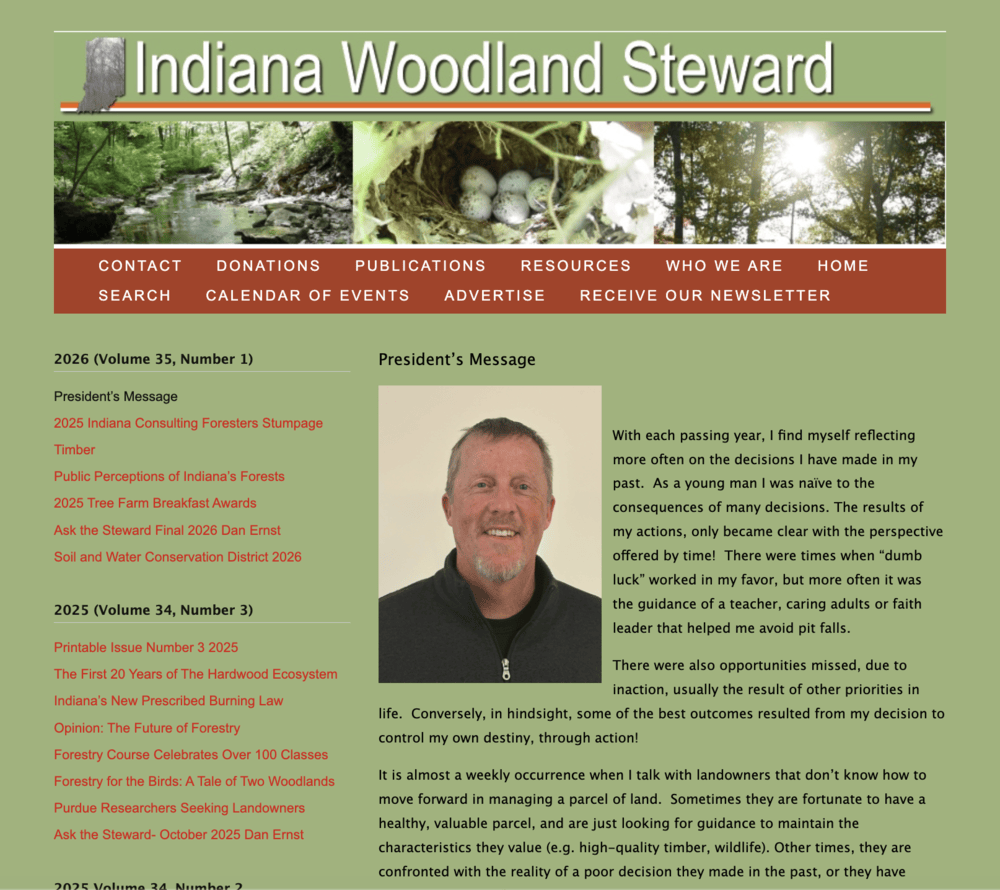
- President’s Message
By Dan McGuckin
“With each passing year, I find myself reflecting more often on the decisions I have made in my past…” - 2025 Indiana Consulting Foresters Stumpage Timber Price Report
“This report is provided annually and is intended to be used as a general indicator of timber stumpage prices and activity in Indiana…” - Public Perceptions of Indiana’s Forests and Woodlands: Insights from a Statewide Survey
By Erica Kronenberger, Zhao Ma, and Cynthia Longmire
“Public opinion plays a critical role in natural resource management. Natural resource agencies and organizations increasingly recognize that achieving and maintaining public approval…” - 2025 Tree Farm Breakfast Awards
By Ken Day
“Kline Contracting is the 2025 Indiana Logger of the Year. Mike Kline is third generation, and Miles Kline is a fourth generation Kline to operate the logging business…” - Ask the Steward – Final Column
by Dan Ernst
“‘Ask the Steward’ began as a Q&A column in the very first issue of Woodland Steward in 1992, with goals of being both informative and entertaining…“ - Soil and Water Conservation District 2026
“Thank you to all the supporting SWCD’s. Supporting the Woodland Steward Newsletter puts timely, relevant and science-based information…”
The Indiana Woodland Steward Newsletter is a resource offering a wealth of valuable information for foresters, woodland owners, timber marketing specialists, woodland and wildlife enthusiasts. The Indiana Woodland Steward Institute (IWS) is an entity made from 11 organizations within the state including Purdue University, Indiana Department of Natural Resources (DNR), and Indiana Hardwood Lumbermen’s Association (IHLA), that works to promote best usage practices of Indiana’s woodland resources through their Woodland Steward publication.
Resources
Hardwood Ecosystem Experiment (HEE) website
Hardwood Ecosystem Experiment – Wildlife Responses to Timber Harvesting, Purdue Extension
Forest Improvement Handbook, The Education Store
Invasive plants: impact on environment and people, The Education Store
Managing Your Woods for White-Tailed Deer, The Education Store
Shrubs and Woody Vines of Indiana and the Midwest, Purdue University Press
Virtual Tour Brings Forest Management for Birds to Life, Got Nature? Blog Post, Purdue Extension – Forestry and Natural Resources (FNR)
Breeding Birds and Forest Management: the Hardwood Ecosystem Experiment and the Central Hardwoods Region, The Education Store
Deer Impact Toolbox, Purdue Extension
Grassland Management Series, Purdue Extension Pond and Wildlife Management
Birdfeeder tips, The National Audubon Society
Explore the Rich World of Oaks with Purdue FNR Extension & Partners, Purdue Extension – FNR
Managing Woodlands for Birds Video, Purdue Extension-Forestry and Natural Resources YouTube Channel
Subscribe: Deer, Forest Management, ID That Tree, Woodland Management Moment, Invasive Species and many other topic video playlists Purdue Extension-Forestry and Natural Resources YouTube Channel
Dan McGuckin, President
Indiana Woodland Steward
Dr. Brian MacGowan, Extension Wildlife Specialist
Department of Forestry & Natural Resources, Purdue University
Purdue Extension has helped subdue invasive species ranging from kudzu and emerald ash borer to thousand canker disease and spongy moth. The work continues against new waves of invaders, such as tree of heaven and spotted lanternfly.
Aside from pushing out native species, spotted lanternfly presents an economic threat to Indiana’s forests, which annually provide $3.5 billion in value-added and $7.9 billion in value of shipments to Indiana’s economy (data from the Indiana Department of Natural Resources) and its commercial vineyards, which contribute $2.4 billion annually (data from the Indiana Wine Grape Council). Nationally, invasive species cost the U.S. an estimated $138 billion per year in damages, according to the Environmental Protection Agency.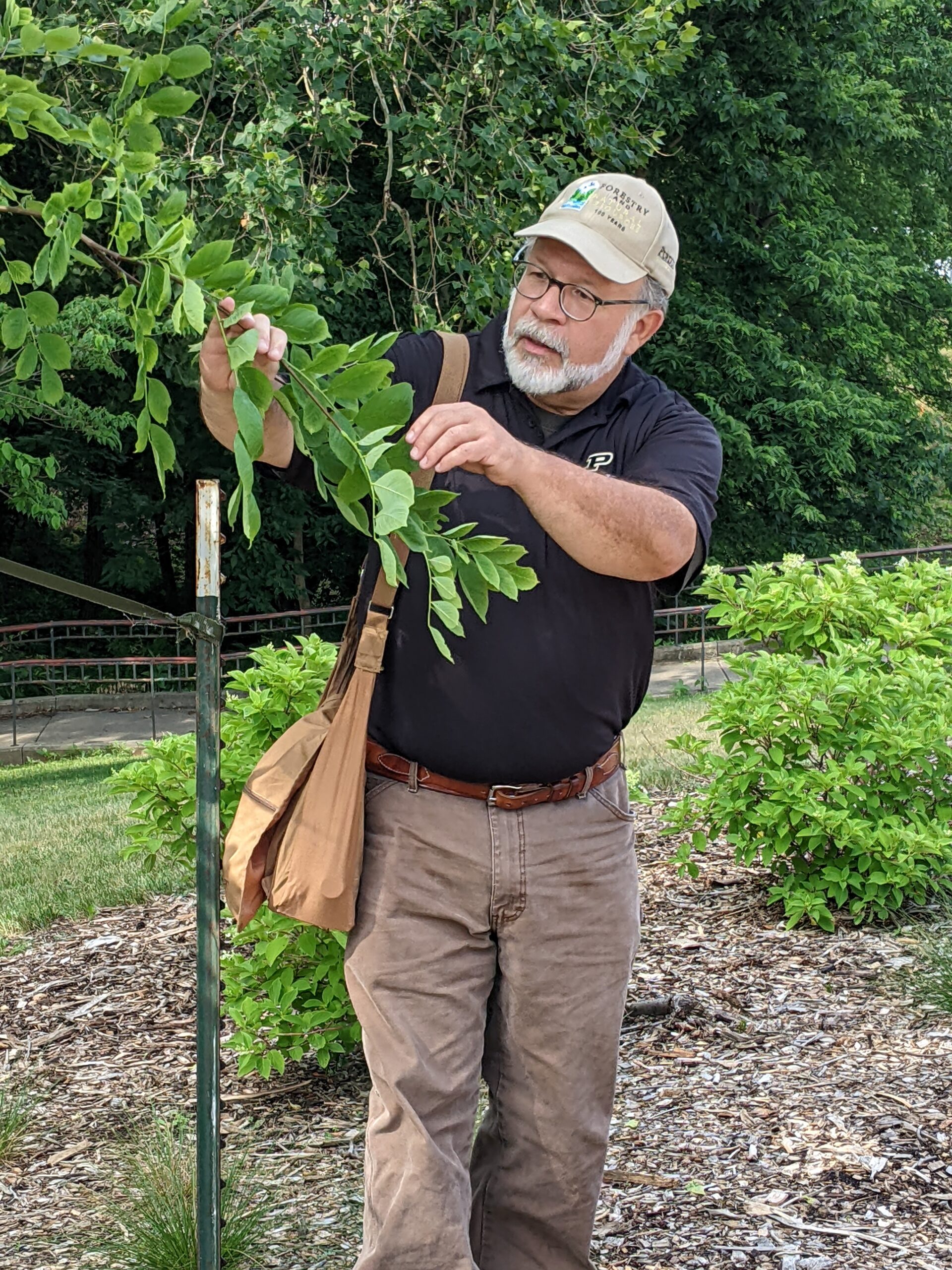
Spotted lanternfly is an imminent risk to Monroe County. That’s largely because of the tree of heaven, which has established scattered populations throughout Indiana.
“The spotted lanternfly has arrived in Indiana, and the tree of heaven is its preferred food source,” says Ellen Jacquart, president of Monroe County Identify and Reduce Invasive Species. “Indeed, some recent research shows that spotted lanternflies may not be able to complete their metamorphosis into an adult if they don’t feed on the tree of heaven. So now we have this push to get rid of tree of heaven because the spotted lanternfly was just found two counties east of us.”
Jacquart has worked with Extension’s Robert Bruner, exotic forest pest specialist, and Lenny Farlee, sustaining hardwood specialist, to combat the pest and other invasives.
“Bob Bruner and his updates on spotted lanternfly have been awesome,” Jacquart says. “Lenny has become one of the highlight speakers at many of the invasive species conferences that I go to because he is so good at explaining control techniques. He brings in a lot of experience and knowledge, whether you’re working at the scale of a small yard or 40 acres.”
The Forest Pest Outreach and Survey Project (FPOSP) — a joint effort between Purdue Extension Entomology and the Indiana Department of Natural Resources (DNR) — has long addressed the growing problem of exotic pests through detection, education and reporting. FPOSP’s outreach includes educational and professional development programming. The project also seeks to create a group of citizen scientists motivated to help report and manage invasive species.
Bruner expanded this effort in 2023 by launching a series of live webinars called ReportINvasive. He also began providing in-person presentations at events such as the Indiana Green Expo, Indiana Invasive Species Conference and Cooperative Invasive Species Management Areas meetings.
The bulk of invasive plant work in forestry involves herbicide applications to control the intruders, says Philip Marshall, forest health specialist at the Indiana DNR. Extension specialists are among the speakers at the annual Forest Pesticide Training Program, which provides approved continuing education credits from the Office of the Indiana State Chemist. Extension presenters regularly share best practices and research with attendees, who often engage in invasive species management in various capacities.
“I rely on Purdue and the Extension people for technical expertise.” – Philip Marshall, forest health specialist, Indiana Department of Natural Resources.
Marshall cites the value of the training program, as well as the Purdue Plant and Pest Diagnostic Lab, which helps county extension educators and other Indiana stakeholders identify invasive species and other plant and pest problems. An insect, a virus, a fungus or a plant can become an invasive pest or pathogen.
Marshall, Farlee and other experts from Purdue, Indiana DNR and elsewhere spoke in September at the 2025 Indiana Invasive Species Conference. Hosted by Extension and the Indiana Invasive Species Council, the conference catered to scientists, researchers, landscapers, landowners and concerned citizens alike.
Henry Quesada, Extension Agriculture and Natural Resources program leader, delivered the keynote address. His topic: Ecological, social and economic consequences of invasive species on forests and forest products, the same reasons that drive Extension’s work forward.
To view this article along with other news and stories posted on the Purdue Extension website view: Uniting Indiana Residents Against Invasive Species.
ID That Tree, Playlist, Purdue Extension – FNR YouTube Channel
A Woodland Management Moment, Playlist, Purdue Extension – FNR YouTube Channel
Woodland Stewardship for Landowners, Playlist, Purdue Extension – FNR YouTube Channel
Native Trees of the Midwest, Purdue University Press
Investing in Indiana Woodlands, The Education Store
Indiana Department of Natural Resources: Invasive Species
Indiana Invasive Species Council
Cooperative Invasive Species Management Area (CISMA)
Report Invasive, Purdue Extension
Episode 11 – Exploring the challenges of Invasive Species, Habitat University-Natural Resource University
What are invasive species and why should I care?, Got Nature? Blog, Purdue Extension – FNR
Spotted Lanternfly Found in Indiana, Purdue Landscape Report
Report Spotted Lanternfly, Purdue College of Agriculture Invasive Species
Welcome to ID That Tree! In this episode, Purdue Extension Forester Lenny Farlee introduces us to a familiar and useful native shrub, the Blackberry. Commonly found along woodland edges, open fields and roadsides across Indiana, this hardy plant is easy to spot in summer thanks to its features. Learn how to identify Blackberry by its stems, leaves and growth pattern. Whether you’re a forager, landowner, or someone who simply enjoys exploring nature, this video offers a quick and engaging look at how to recognize Blackberry and appreciate its role in Indiana’s natural landscapes.
If you have any questions regarding wildlife, trees, forest management, wood products, natural resource planning or other natural resource topics, feel free to contact us by using our Ask an Expert web page.
Resources:
ID That Tree – Video Playlist, Purdue Extension – Forestry and Natural Resources (FNR) YouTube Channel
Purdue Arboretum Explorer
Conservation Tree Planting: Steps to Success, Purdue Extension – FNR YouTube Channel
A Woodland Management Moment, Playlist, Purdue Extension – FNR YouTube Channel
Woodland Stewardship for Landowners, Playlist, Purdue Extension – FNR YouTube Channel
Fifty Common Trees of Indiana, Purdue Extension – FNR
Indiana Invasive Species Council
Cooperative Invasive Species Management Area (CISMA)
Report Invasive, Purdue Extension
Habitat University, Episode 12 – Exploring the challenges of Invasive Species, Habitat University-Natural Resource University
Shrubs and Woody Vines of Indiana and the Midwest, Purdue University Press
Native Trees of the Midwest, Purdue University Press
Professional Forester, Indiana Forestry Woodland Owners Association
District Forester, Indiana Department of Natural Resources, 10+ acres
Find an Arborist, International Society of Arboriculture
Forest Improvement Handbook, The Education Store
Lenny Farlee, Extension Forester
Hardwood Tree Improvement and Regeneration Center
Purdue Department of Forestry & Natural Resources
Purdue College of Agriculture News: An armored mammal, once limited to the swamps and forests of the Deep South, is now burrowing its way through the backyards and woodlands of Indiana. The nine-banded armadillo—a 10 to 15 pound mammal often associated with Texas or Louisiana—has become an increasingly common sight in the Hoosier state.
Brian MacGowan, Purdue Extension wildlife specialist and coordinator in Purdue University’s Department of Forestry and Natural Resources, explains that while this isn’t a brand-new arrival, the armadillo population and range have grown steadily and moved north in recent years.
“The nine-banded armadillo was first discovered living in Indiana around 2003,” MacGowan said. “Since then, they have been found throughout most of the state, even into the far northeast corner of Steuben County.”
MacGowan explains that armadillos are known to establish themselves in woodland areas in search of their food source. “Their diet is generally ground insects,” he said. “If an animal wants to find loads of insects, they will find an abundance in decaying wood.”
Another distinct characteristic of the nine-banded armadillo is their burrowing tactics.
“In some studies, these armadillos have been known to use multiple burrows, sometimes over 30 in a single year,” MacGowan said. “If they run into trouble, their first response is often to jump up and run into their burrow as fast as they can.”
As a nocturnal animal with many burrows to call home, their chances of being seen by humans are diminished. However, occasionally homeowners and farmers will find signs of armadillos on their property, such as where they dig up insects and grubs or burrow under a deck.
While armadillos are not known to be dangerous, there is a risk of humans or animals stepping into their open burrows. MacGowan compares this concern with the challenge farmers face with groundhogs and ground squirrels.
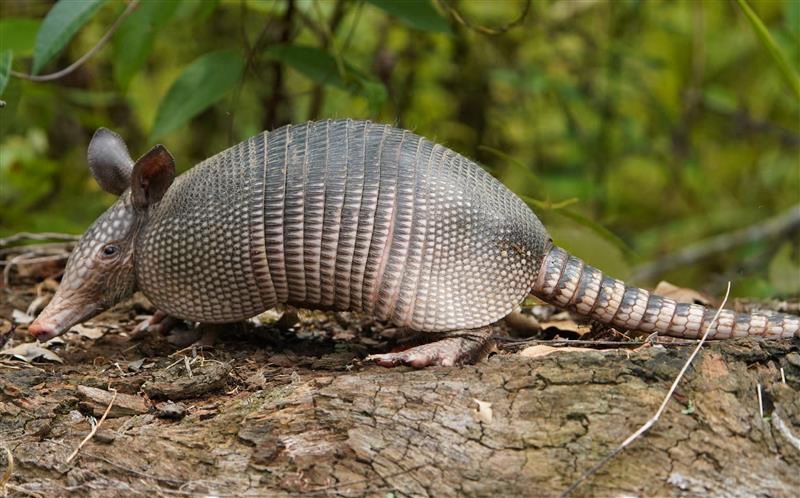 Rather than navigating by sight or sound, the nine-banded armadillos rely on smell, which could lead them to roadways while searching for food, MacGowan explains.
“The nine-banded armadillos also cannot curl up in a ball and protect their soft underbelly like other armadillo species can, so they’re vulnerable to predation by coyotes and other predators, said MacGowan.
Armadillo sightings are also influenced by the temperatures and moisture in an area. “If there’s a drought, it can kill off a lot of armadillos because the ground gets so hard and a lot of the insects and things they eat move below ground,” MacGowan said.
Typically, when it is cold out, the nine-banded armadillo adjusts its behavior to be more active during the day, partly because that helps them warm up. Also, some of the things they eat are more likely to be active when it’s warmer. MacGowan encourages people who encounter these animals to let them be.
“Armadillos are susceptible to a variety of diseases just like any wild animal,” he said. “You might have heard talk that armadillos can carry leprosy. That is generally an endemic issue for those animals specifically found in some regions in the south. While leprosy is quite deadly to armadillos, there is absolutely no evidence of transmission to people. However, they are wild animals, and the DNR will always caution people to keep their distance from any wild animal.”
The next time you spot this rare visitor in your backyard or scurrying across a Hoosier road, remember that you are witnessing history in motion. Reporting unusual animal sightings, like the nine-banded armadillo, not only helps the DNR track these shifts, but also deepens our understanding of a continually evolving ecosystem. After all, you never know what remarkable creature might be unexpectedly making its home in Indiana.
You can help the Indiana Division of Fish & Wildlife by submitting reports of certain mammals of interest. These mammals can potentially be seen from the comfort of your home, on your way to work, or while out biking, hiking, or camping. Reports can be made to the DNR here.
To view this article along with other news and stories posted on the Purdue College of Agriculture website view: Unexpected Plants and Animals of Indiana: The nine-banded armadillo.
Resources:
A Template for Your Wildlife Habitat Management Plan, The Education Store, Purdue Extension resource center
Wildlife Habitat Hint, Purdue Extension – Forestry & Natural Resources (FNR) YouTube Playlist
Woodland Stewardship for Landowners, Purdue Extension – FNR YouTube Playlist
Woodland Management Moment, Purdue Extension – FNR YouTube Playlist
Invasive Species, Playlist, Purdue Extension – FNR Youtube Channel
Invasive Plant Species Identification, Video, Purdue Extension – FNR Youtube Channel
Invasive plants: impact on environment and people, The Education Store, Purdue Extension’s resource center
Woodland Invaders, Got Nature? Blog, Purdue Extension – FNR
Preventing Wildlife Damage – Do You Need a Permit? – The Education Store, Purdue Extension resource center
Selecting a Nuisance Wildlife Control Professional, The Education Store
How to Construct a Scent Station, The Education Store
Question: How do I properly relocate raccoons from my attic?, Got Nature? Blog, Purdue Extension FNR
Nuisance Wildlife – Indiana Department of Natural Resources
Subscribe to our FNR Extension YouTube Channel with over 250 videos which include: aquatic, forestry, urban forestry, wildlife, community planning videos and much more.
Ericka Bethel, Digital Content Specialist
Purdue University Department of Forestry and Natural Resources
Dr. Brian MacGowan, Extension Wildlife Specialist
Department of Forestry & Natural Resources, Purdue University
Purdue Landscape Report: Spotted lanternfly (SLF) has been the subject of a lot of media attention in the last few years. In the east, states like Pennsylvania and New York have been dealing with heavy infestations since the insect was first detected in 2014. In Indiana, this invasive planthopper arrived three years ago, infesting two counties on the eastern side of the state. Since then, the Indiana Department of Natural Resources and Purdue University have been working together to mitigate the spread of this insect as well as educate Hoosiers on what they can do to help. Spotted lanternfly is still on the move, and this update will help refresh you on how this bug works, and where they are headed.
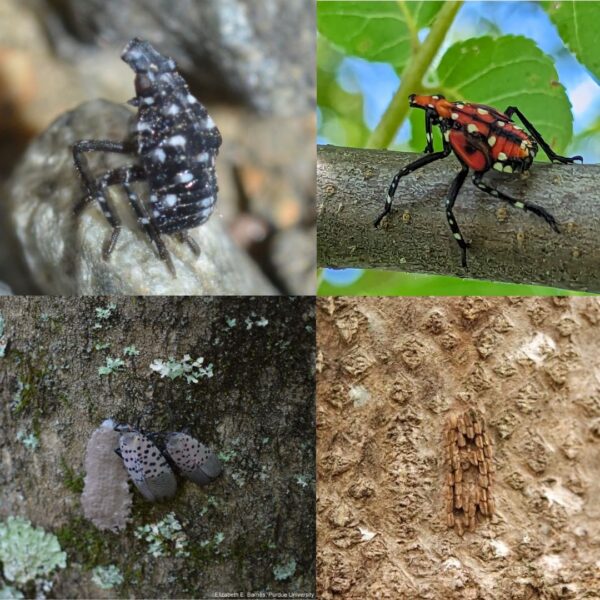
Figure 1. Upper left: early-instar SLF; upper right: late-instar SLF; bottom left: adult SLF with egg mass; bottom right: uncovered SLF eggs.
Life cycle
Spotted lanternfly is an annual insect, having only a single generation in a year under normal conditions. The insect goes through incomplete metamorphosis; immature stages, called nymphs, resemble smaller, wingless versions of the adults. Nymphs will begin to appear in April or May, developing through four instars, until they reach adulthood in late summer. With each instar, the period in between molting, the nymph will grow larger, develop wingpads, and eventually change color. Early instars are black with a white dot pattern, while later instars will be bright red with black and white patterning (Fig. 1). Late instar nymphs are often compared to milkweed bugs or lady beetles. Once they complete development in the late summer or early fall, they will mate and lay egg masses covered in a protective substance that makes them resemble mud. Eggs masses will overwinter until the spring, while adult insects will die as temperatures cool. In Indiana, depending on temperature, adults can be seen as late as early November.
Impact
Spotted lanternfly is a sap-feeding insect, using syringe-like mouthparts to drain nutrients directly from plant tissues. Like other sap-feeding insects, the activity of SLF wounds the plant, creating openings for various pathogens to exploit. Feeding by SLF has been shown to reduce overall health of their hosts, reducing their capacity to survive overwintering, and potentially kill the host plant depending on species. They also produce a sugary waste known as honeydew; while honeydew itself is not harmful, it acts as a growing substrate for sooty mold, which can have a serious impact the photosynthesis of understory foliage as well as attract other nuisance insects.
Spotted lanternfly is a generalist herbivore and can feed on over 100 different species of plant and tree in Indiana. However, this insect has shown strong preference towards certain species, often with devastating consequences. The most preferred host is tree-of-heaven, an invasive tree species in North America. Tree-of-heaven is the primary host of SLF in their shared native range, and the insect appears to experience high reproductive success on it even when they share a new environment. Grapes are also highly preferred by SLF, and infestations will typically result in overfeeding and the death of the plant. Black Walnut, American river birch, and various maple species are also at risk of severe damage from this insect. Evidence has also suggested that maple, when used for syrup production, will experience reductions in yield and quality when attack by spotted lanternfly.
Where are they now?
Spotted lanternfly has been present in Indiana since 2021, first arriving in Huntington and Switzerland Counties. In Huntington, the infestation occupies a stand of tree-of-heaven next to an industrial parking lot. Tree-of-heaven moved into the neighboring residential area, allowing SLF to also spread with it. The more rural infestation in Switzerland County was traced to a vehicle transported from Pennsylvania, and the insect has taken advantage of patches of tree-of-heaven in nearby wooded areas. While both infestations have strongly associated with the insect’s primary host, there is some evidence that SLF is beginning to take advantage of other nearby plants, such as maple. In the last year, SLF moved a significant distance and has been detected in several more counties, including Elkhart, St. Joseph, Porter, Allen, Dekalb, and Noble Counties. Most of the activity has been found on tree-of-heaven along rail lines, supporting the idea that the insect is dispersed by rail traffic moving westward out of infested areas.
It’s important to remember that trains aren’t the only vehicles that can have SLF passengers. These insects, and their egg masses, can be found on just about any surface, including the car you drive to work, the RV you used for recreation, semi-trucks that cross the country, and more. Purdue Entomology and Indiana DNR are encouraging everyone to inspect their vehicles when traveling through any of the infested areas. Also check all recreational vehicles and trailers for spotted lanternfly egg masses; if found, scrape them off into a bag or bucket filled with soapy water. This fall and winter, we also want to encourage everyone to please burn any firewood where you buy it, and please don’t move it off your property if you chop it yourself- especially if you are burning tree of heaven. Egg masses will stick to firewood and can survive our winters very well.
What can I do?
We are still learning about the spotted lanternfly’s distribution through Indiana, and we need the help of citizen scientists to effectively track the insect’s movement. If you believe you’ve seen spotted lanternfly, please report it using any of the resources listed below. You can also feel free to reach out to Bob Bruner, Exotic Forest Pest Educator, by emailing them at rfbruner@purdue.edu, or you can report sightings by calling 1-866-NOEXOTIC.
Original article posted: Spotted Lanternfly is on the Move!.
Subscribe and receive the newsletter: Purdue Landscape Report Newsletter.
Spotted Lanternfly Resources:
Spotted Lanternfly Found in Indiana, Indiana Woodland Steward
Spotted Lanternfly – includes map with locations, Indiana Department of Natural Resources Entomology
Report Spotted Lanternfly, Purdue College of Agriculture Invasive Species
Other Resources Available:
Invasive plants: impact on environment and people, The Education Store, Purdue Extension’s resource center
Woodland Management Moment: Invasive Species Control Process, Video, Purdue Extension – Forestry and Natural Resources (FNR) YouTube Channel
Invasive Species, Playlist, Purdue Extension – FNR YouTube Channel
What are invasive species and why should I care?, Got Nature? Blog, Purdue Extension – FNR
Report Invasive, Purdue College of Agriculture – Entomology
ReportINvasive, Purdue Report Invasive Facebook posts include webinars and workshops
Bob Bruner, Exotic Forest Pest Educator
Purdue Entomology
As the crisp autumn air settles in and campfires become a seasonal staple, October brings an important reminder: your firewood choices matter. That’s why October is officially Firewood Month, a nationwide campaign to raise awareness about the risks of moving firewood and the spread of invasive forest pests.
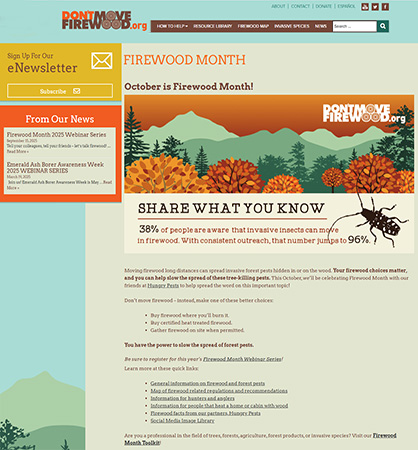 Why “Don’t Move Firewood” Matters
Transporting firewood, even just a few miles, can unintentionally spread destructive pests like emerald ash borer, Asian longhorned beetle and spongy moth. These invaders often hide inside or on firewood, threatening Indiana’s forests, parks and urban trees.
The Don’t Move Firewood website offers excellent resources to help you make informed choices. Whether you’re heating a cabin, heading out to hunt, or planning a backyard bonfire, they recommend:
- Buying firewood where you’ll burn it
- Choosing certified heat-treated wood
- Gathering wood on-site when permitted
You can also explore their Firewood Month Toolkit, maps of regulations and a webinar series designed for professionals and outdoor enthusiasts alike.
While October is Firewood Month, the risk of spreading invasive pests lasts well beyond the fall. Many forest pests remain a threat throughout the year. Adults may still be visible until the first hard freeze, and egg masses can be observed from now through June. The spotted lanternfly females lay egg masses in late summer through early winter, often peaking in October. These masses can survive through winter and hatch in the spring. Learn more about the Spotted Lanternfly from the Indiana Department of Natural Resources. This is why it’s important to practice safe firewood habits year-round.
Spotlight on ReportINvasive
Check out the latest post on the ReportINvasive Facebook which reinforces the importance of Firewood Month. ReportINvasive is a trusted source for updates on invasive species in Indiana, and their social media outreach is a great way to stay informed and engaged. Give the Facebook page a LIKE and FOLLOW for future webinars and workshops.
Concerned About Insects? Purdue Extension Entomology Can Help
 If you suspect insect damage or want to learn more about forest pests, the Purdue Extension Entomology team is an outstanding resource. Their experts provide science-based guidance on insect identification, management strategies, and outreach materials to help protect Indiana’s ecosystems.
Let’s work together to keep Indiana’s forests healthy and resilient. This October, make the smart choice—don’t move firewood!
More Resources
Spotted Lanternfly – including map sharing locations, Indiana Department of Natural Resources
October is Firewood Awareness Month!, Purdue Landscape Report
Indiana Department of Natural Resources: Invasive Species
Indiana Invasive Species Council
Cooperative Invasive Species Management Area (CISMA)
Aquatic Invasive Species, Illinois-Indiana Sea Grant (IISG)
Emerald Ash Borer Information Network, Purdue University and Partners
Invasive plants: impact on environment and people, The Education Store, Purdue Extension’s resource center
Entomology Weekly Review, Indiana Department of Natural Resources, Division of Entomology & Plant Pathology
Division of Entomology & Plant Pathology, Indiana Department of Natural Resources
Diana Evans, Extension and Web Communication Specialist
Purdue University Department of Forestry and Natural Resources
Welcome to ID That Tree! In this episode, Purdue Extension Forester Lenny Farlee introduces us to a widespread native shrub called smooth sumac. Found in open fields, roadsides and woodland edges across Indiana, this shrub is easily identified by its recognizable stems and leaves. Watch the video to learn about these characteristics, along with the differences in smooth sumac through the different seasons. For example, in summer, this shrub has flowers that turn into fruit heads! Whether you’re a student, naturalist or simply curious about native plants, this video offers a quick and helpful guide to identifying smooth sumac in the wild.
If you have any questions regarding wildlife, trees, forest management, wood products, natural resource planning or other natural resource topics, feel free to contact us by using our Ask an Expert web page.
Resources:
ID That Tree – Video Playlist, Purdue Extension – Forestry and Natural Resources (FNR) YouTube Channel
Purdue Arboretum Explorer
Conservation Tree Planting: Steps to Success, Purdue Extension – FNR YouTube Channel
A Woodland Management Moment, Playlist, Purdue Extension – FNR YouTube Channel
Woodland Stewardship for Landowners, Playlist, Purdue Extension – FNR YouTube Channel
Fifty Common Trees of Indiana, Purdue Extension – FNR
Indiana Invasive Species Council
Cooperative Invasive Species Management Area (CISMA)
Report Invasive, Purdue Extension
Habitat University, Episode 12 – Exploring the challenges of Invasive Species, Habitat University-Natural Resource University
Shrubs and Woody Vines of Indiana and the Midwest, Purdue University Press
Native Trees of the Midwest, Purdue University Press
Professional Forester, Indiana Forestry Woodland Owners Association
District Forester, Indiana Department of Natural Resources, 10+ acres
Find an Arborist, International Society of Arboriculture
Forest Improvement Handbook, The Education Store
Lenny Farlee, Extension Forester
Hardwood Tree Improvement and Regeneration Center
Purdue Department of Forestry & Natural Resources
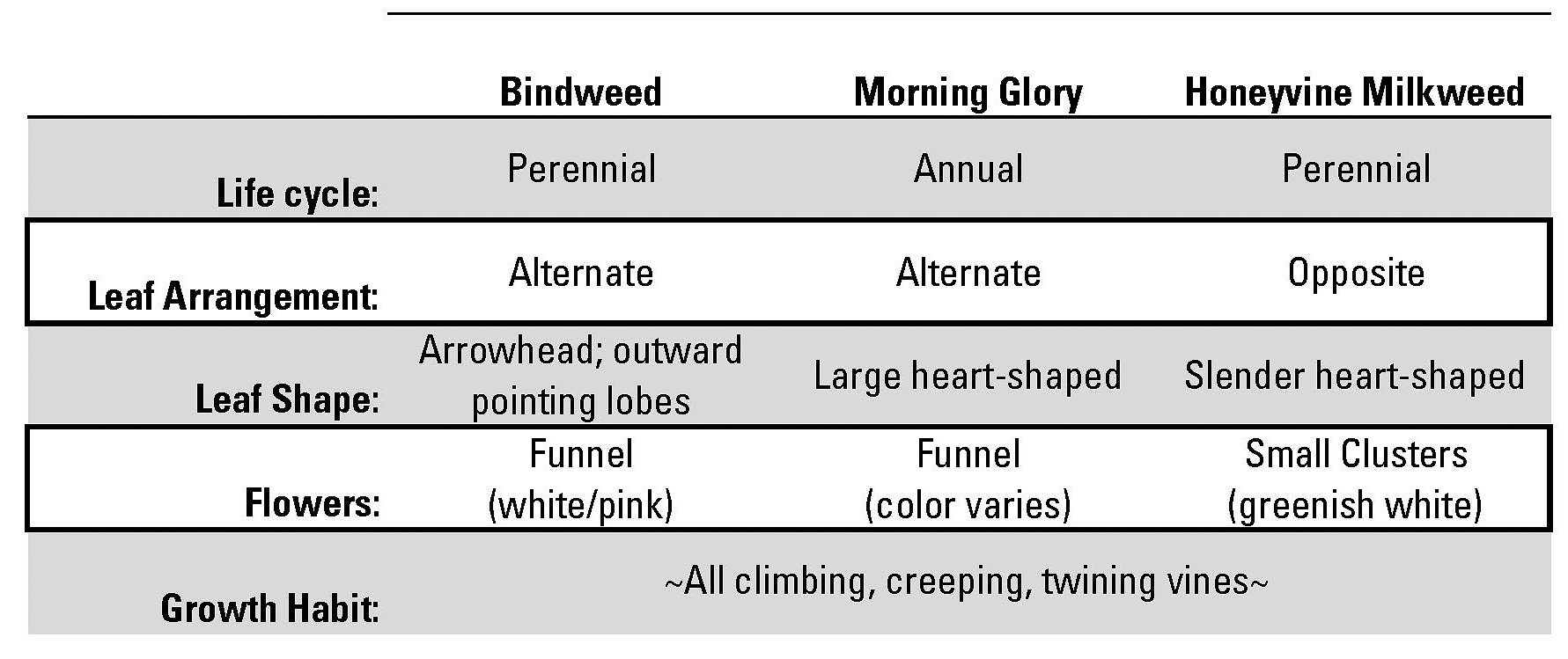
Figure 1. Chart comparing plant traits of bindweed, morning glory, and honeyvine milkweed. Credit: K. Mitchell
Purdue Landscape Report: Few garden problems cause as much frustration as untangling vines. Sometimes the vines are beautiful climbers planted with intention. Other times, they creep in uninvited and smother everything in their path. Among the most common, and the most confusing, vines in Indiana are bindweed, morning glory, and honeyvine milkweed. To the untrained eye, they look similar: all are fast-growing vines with heart-shaped leaves. However, there are noticeable differences in their physiological traits (Fig. 1) and ecological value. Recognizing the distinctions can improve management and help strike a balance between aesthetics, control, and ecological benefits.
Bindweed (Hedge bindweed: Calystegia sepium; Field bindweed: Convolvulus arvensis)
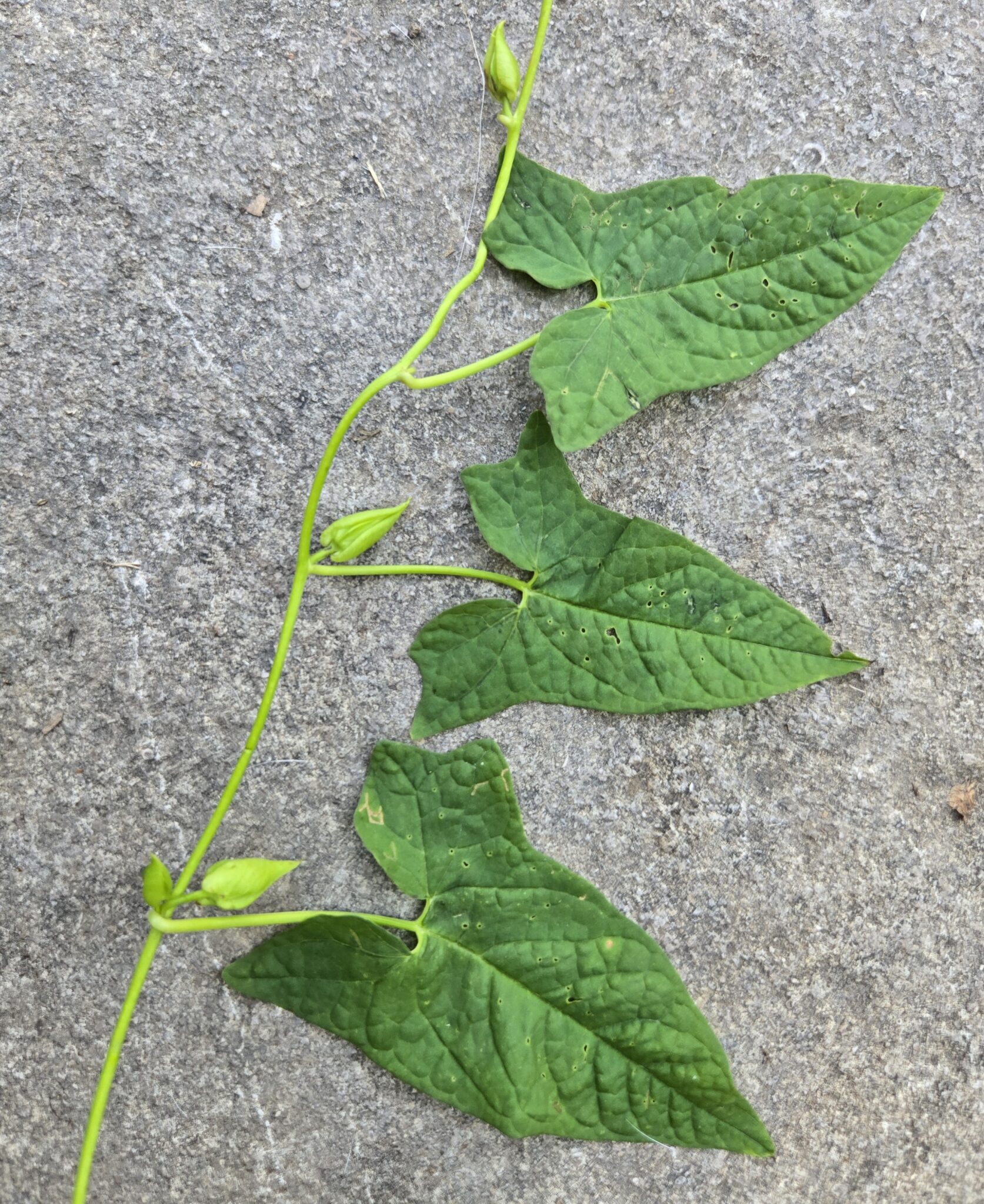
Bindweed is an aggressive vine with alternate, arrowhead-shaped leaves (Fig. 2) and small white or pink funnel-shaped flowers (Fig. 3). This perennial spreads readily from rhizomes (underground stems), forming vegetative colonies that become increasingly difficult to control. Hedge bindweed and field bindweed differ slightly in appearance, but both are aggressive invaders; in fact, field bindweed is listed as a prohibited noxious weed in Indiana. Cultural control methods, such as cultivation or light exclusion, can take 3 to 5 years to achieve eradication. The best results often come from combining these approaches with carefully timed herbicide applications.

Morning Glory (Ipomoea spp.)
Morning glories are a familiar vine often planted intentionally for their large, colorful flowers. Unlike bindweed, morning glory is an annual and dies off in winter. However, its abundant seed production allows it to return year after year. A single vigorous vine can produce hundreds of colorful, funnel-shaped flowers (Fig. 4) resulting in over a thousand seeds which may remain viable in the soil for decades. Morning glory will become weedy if left unmanaged. Thoughtful containment and regular deadheading can help to keep it under control.


Two types are most often seen (Fig. 5):
- Common morning glory (Ipomoea purpurea) has large, heart-shaped leaves and showy, funnel-shaped flowers in a wide variety of colors.
- Ivy-leaf morning glory (Ipomoea hederacea) has leaves with three distinct lobes that resemble ivy, and its smaller flowers are typically light blue or purple with white.
Honeyvine Milkweed (Cynanchum laeve)
Honeyvine milkweed has slender heart-shaped leaves like bindweed, but unlike bindweed, this native vine provides ecological value as a food source for monarch caterpillars. It’s easily distinguished from morning glory and bindweed by its opposite leaf arrangement (Fig. 6), small clusters of greenish-white flowers (Fig. 7), and long seed pods, typical of the milkweed family, that release hundreds of windblown seeds. While beneficial to pollinators, honeyvine can overwhelm a home landscape and should be contained to naturalized areas or pollinator gardens.


Correct identification is the first step toward effective management. Though bindweed, morning glory, and honeyvine milkweed are all fast-growing vines, they have key differences in their physiological traits and ecological value. Proper identification determines whether you are eradicating noxious weeds, containing ornamentals, or conserving natives where appropriate.
Quick Tips for Identification
- Leaf arrangement:
- Alternating leaves (only one leaf per node) – bindweed or morning glory
- Opposite leaves (two leaves per node) – honeyvine milkweed
- Flowers:
- White or pink funnel-shaped (~1 to 3 in) – bindweed
- Colorful funnel-shaped (2 to 4 in) – morning glory
- Small, greenish white clusters – honeyvine milkweed
- Seed pods:
- Tiny capsules – bindweed or morning glory
- Long pods with silky seeds – honeyvine milkweed
View the original article on the Purdue Landscape Report website: Untangling the Vines: Identifying Bindweed, Morning Glory, and Honeyvine Milkweed.
Subscribe and receive the newsletter: Purdue Landscape Report Newsletter.
Resources:
ReportINvasive, Purdue College of Agriculture
What are Invasive Species and Why Should I Care?, Got Nature? Blog, Purdue Extension – Forestry and Natural Resources
Large Spots on Maple Leaves that Look Like Tar, Purdue Extension News
Find an Arborist, International Society of Arboriculture
Fifty Common Trees of Indiana
An Introduction to Trees of Indiana
Native Trees of the Midwest, The Education Store
Shrubs and Woody Vines of Indiana and the Midwest, The Education Store
Tree Installation: Process and Practices, The Education Store
Planting Your Tree Part 1: Choosing Your Tree, Video, Purdue Extension – Forestry & Natural Resource (FNR) YouTube Channel
Investing in Indiana Woodlands, The Education Store
Forest Improvement Handbook, The Education Store
ID That Tree, Purdue Extension-FNR YouTube playlist
Purdue Plant and Pest Diagnostic Laboratory
Karen Mitchell, Consumer Horticulture Extension Specialist
Purdue Horticulture & Landscape Architecture
Purdue Landscape Report: The last week has caused many to struggle with whether to turn the heat on inside. Mornings have been quite chilly, and I am guessing several readers may have also struggled with the decision to wear a jacket as they started their workday. These are tough decisions, no doubt. Several data sources have suggested we have had at least 2 weeks of consecutive below-average daily mean temperatures. While not a record, this is certainly noticeable! Perhaps we are hoping those tomato plants will produce just a few more tomatoes. Is it mum season, already? The good news – for those not quite ready to say goodbye to warm days, not needing coats, and garden delights – is warm temperatures are expected to return. Daily high temperatures are already in the 80s and Indiana is likely to see temperatures in the mid-90s by next week. There is significant confidence that this warmer-than-normal temperature trend is likely to continue through most of September. Average high temperatures typically range from 75°F – 85°F in mid-September and 70°F – 75°F in late September, so keep in mind climate outlooks are all relative. Indiana is not likely to experience triple-digit heat waves over the next few weeks, but nighttime low temperatures are likely to fight for temperatures warranting a sweater or jacket.


There’s been a noticeable lack of precipitation with Indiana receiving well below-normal precipitation throughout the state over the past 30 days except for the northwestern counties. This has led to expansion of both Abnormally Dry (D0) and Moderate Drought (D1) areas across the state (Figure 1). Unfortunately, both forecasts and climate outlooks suggest this below-normal precipitation pattern is likely to continue for a while. Over the next 7 days, very little precipitation is expected across much of Indiana (Figure 2). This below-normal precipitation pattern is likely to continue through most of next week. After that, climate outlooks are favoring near-normal precipitation through September 24th.

Figure 3. Average date of the first fall frost where temperature first reach or drop below 28°F. (Purdue Landscape Report)
Regarding first frost or even hard frost, we are still too early in the calendar year to worry about this being an extensive risk. Very localized, low-lying areas may be susceptible, but the climatological average date of the first hard freeze (28°F) is often not until mid-to-late October (Figure 3). With temperatures expected to warm again, widespread hard frost is not anticipated prior to October.
Explore the latest Indiana climate and drought maps, including first freeze and frost probabilities, view the Purdue Indiana State Climate Office.
View the original article on the Purdue Landscape Report website: A False Sense of Autumn.
Subscribe and receive the newsletter: Purdue Landscape Report Newsletter.
Resources:
Alert – Water Your Trees, Watch Video, Purdue Extension – Forestry and Natural Resources Got Nature? Blog
Find an Arborist video, Trees are Good-International Society of Arboriculture (ISA)
ID That Tree, Playlist, Purdue Extension – FNR YouTube Channel
Summer Tree Care, Purdue Landscape Report
Drought? Don’t Forget the Trees!, The Education Store, Purdue Extension resource center
Extreme Heat Including Fact Sheets, Purdue Extension – IN-PREPared
Extreme Heat – Resources, Extension Disaster Education Network (EDEN)
Drought Information, Indiana Department of Natural Resources
Planting Your Tree Part 1: Choosing Your Tree, Purdue Extension YouTube Channel
Tree Defect Identification, The Education Store
Surface Root Syndrome, The Education Store
Submit Sample, Purdue Plant & Pest Diagnostic Lab
What Are Invasive Species and Why Should I Care?, Purdue Extension-FNR Got Nature? Blog
Invasive Species Playlist, Playlist, Purdue Extension – FNR YouTube Channel
Subscribe Purdue Extension-Forestry and Natural Resources YouTube Channel
Beth Hall, Indiana State Climate Office Director
Purdue University Department of Agronomy
Welcome to ID That Tree! In this episode, Purdue Extension Forester Lenny Farlee introduces us to a widespread and often overlooked native plant, the wild grape vine. Found across Indiana, this vine is especially noticeable in late summer and fall. Learn how to identify wild grape by its vine structure, bark, leaves and growth. Whether you’re a nature enthusiast, land manager or just curious about native plants, this video offers a quick and informative look at how to spot wild grape vine and appreciate its role in Indiana’s ecosystems.
If you have any questions regarding wildlife, trees, forest management, wood products, natural resource planning or other natural resource topics, feel free to contact us by using our Ask an Expert web page.
Resources:
ID That Tree – Video Playlist, Purdue Extension – Forestry and Natural Resources (FNR) YouTube Channel
Purdue Arboretum Explorer
Conservation Tree Planting: Steps to Success, Purdue Extension – FNR YouTube Channel
A Woodland Management Moment, Playlist, Purdue Extension – FNR YouTube Channel
Woodland Stewardship for Landowners, Playlist, Purdue Extension – FNR YouTube Channel
Indiana Department of Natural Resources: Invasive Species
Indiana Invasive Species Council
Cooperative Invasive Species Management Area (CISMA)
Report Invasive, Purdue Extension
Fifty Common Trees of Indiana, Purdue Extension – FNR
Habitat University, Episode 12 – Exploring the challenges of Invasive Species, Habitat University-Natural Resource University
Shrubs and Woody Vines of Indiana and the Midwest, Purdue University Press
Native Trees of the Midwest, Purdue University Press
Professional Forester, Indiana Forestry Woodland Owners Association
District Forester, Indiana Department of Natural Resources, 10+ acres
Find an Arborist, International Society of Arboriculture
Forest Improvement Handbook, The Education Store
Lenny Farlee, Extension Forester
Hardwood Tree Improvement and Regeneration Center
Purdue Department of Forestry & Natural Resources

Recent Posts
- It’s Timberdoodle Time!
Posted: April 3, 2026 in Got Nature for Kids, How To, Wildlife - Keep An Eye Out for Hammerhead Worms, Purdue Landscape Report
Posted: April 2, 2026 in Invasive Animal Species, Wildlife, Woodlands - When is the Peak Migration For Hummingbirds and How Can You Attract Them?
Posted: in How To, Wildlife - ID That Tree Featured in National Woodland Owners Association Newsletter
Posted: April 1, 2026 in Urban Forestry, Wildlife, Woodlands - New 2026 Indiana Woodland Steward Newsletter
Posted: March 30, 2026 in Urban Forestry, Wildlife, Woodlands - A Woodland Management Moment: Why Aspect Matters
Posted: in Urban Forestry, Woodland Management Moment, Woodlands - 2026 Winter Bat Survey In Progress, MyDNR
Posted: March 27, 2026 in How To, Wildlife - Fast-Growing Trees for the Landscape, Purdue Landscape Report
Posted: March 26, 2026 in Forestry, Urban Forestry, Woodlands - Urban Tree Spotlight: Planting Deciduous Shade Trees, Purdue Landscape Report
Posted: March 25, 2026 in Forests and Street Trees, Urban Forestry, Woodlands - Beetle that attacks Tree-of-Heaven found in Indiana, Purdue Landscape Report
Posted: March 20, 2026 in Invasive Insects, Wildlife, Woodlands
Archives
Categories
- Alert
- Aquaculture/Fish
- Aquatic/Aquaculture Resources
- Ask the Expert
- Christmas Trees
- Community Development
- Disease
- Drought
- Forestry
- Forests and Street Trees
- Gardening
- Got Nature for Kids
- Great Lakes
- How To
- Invasive Animal Species
- Invasive Insects
- Invasive Plant Species
- Land Use
- Natural Resource Planning
- Nature of Teaching
- Plants
- Podcasts
- Ponds
- Publication
- Safety
- Spiders
- Timber Marketing
- Uncategorized
- Urban Forestry
- Webinar
- Wildlife
- Wood Products/Manufacturing
- Woodland Management Moment
- Woodlands