 Purdue University - Extension - Forestry and Natural Resources
Got Nature? Blog
The 2025 issue of Illinois-Indiana Sea Grant’s magazine, The Helm, is now available. This annual publication is a collection of program research, outreach and education success stories, as well as ongoing activities to address coastal concerns. This issue covers this year’s Shipboard Science Immersion that took place on Lake Michigan, our long-standing team engaged in AIS prevention outreach, our new specialists diving into coastal resilience issues, and past and present program leadership.

Highlights from the newsletter include:
- Educators engage with Great Lakes scientists aboard the Lake Guardian
Teachers joined researchers on Lake Michigan aboard the R/V Lake Guardian, collecting samples, learning new field techniques, and bringing Great Lakes science back to their students. - Scientists and educators investigate Lake Michigan biological hotspots
Every year when a group of Great Lakes educators spend 6–7 days aboard the Lake Guardian as part of the Shipboard Science Immersion, they work side-by-side with scientists engaging in real monitoring work. - IISG looks back on 30 years of AIS outreach
Illinois-Indiana Sea Grant is in the midst of its 30th year of dedicated outreach to address the spread of aquatic invasive species (AIS) in Great Lakes waters. - Coastal communities face challenges in managing beach sand and structures
Beginning in 2025, IISD has not one, but two coastal resilience specialists who are providing support for communities along the southern Lake Michigan shore. - Shaping the Shoreline: Video Series
Explore how natural and engineered structures shape our Great Lakes coastlines. - Stuart Carlton is the new IISG director
Stuart Carlton, longtime Sea Grant communicator and leader, steps into the director role—continuing IISG’s mission of connecting research, education, and outreach. - Tomas Höök reflects on his Sea Grant legacy
After more than a decade as director, Tomas Höök looks back on milestones that shaped IISG’s growth and lasting partnerships.
To view the full newsletter visit: The Helm.
More Resources:
Prescription For Safety: How to Dispose of Unwanted Household Medicine, IISG Publications
A Guide to Marketing for Small-Scale Aquaculture Producers, The Education Store, Purdue Extension resource center
A Guide to Small-Scale Fish Processing Using Local Kitchen Facilities, The Education Store
Marine Shrimp Biofloc Systems: Basic Management Practices, The Education Store
Sustainable Aquaculture: What does it mean to you?, The Education Store
The Benefits of Seafood Consumption The Education Store
Walleye Farmed Fish Fact Sheet: A Guide for Seafood Consumers, The Education Store
Fish Muscle Hydrolysate, The Education Store
Fish Cleaning with Purdue Extension County Extension Director, Got Nature? Blog, Purdue Extension – Forestry and Natural Resources
Aquatics & Fisheries, Playlist, Purdue Extension – Forestry and Natural Resources
Eat Midwest Fish, Illinois-Indiana Sea Grant online resource hub
Community Development, Purdue Extension
Climate Change and Sustainable Development, The Education Store
Climate Change: Are you preparing for it?, The Education Store
Illinois-Indiana Sea Grant (IISG)
Diana Evans, Extension & Web Communications Specialist
Purdue University Department of Forestry and Natural Resources
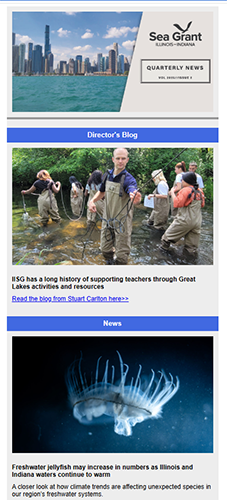 Dive into the latest stories from the Illinois-Indiana Sea Grant (IISG) Newsletter which highlights research, outreach, and partnerships making a difference across the Great Lakes region. In this issue, explore how communities, scientists and educators are working together to protect water quality, strengthen coastal resilience, and inspire stewardship.
Highlights from the newsletter include:
- IISG has a long history of supporting teachers through Great Lakes activities and resources
Read the blog from Stuart Carlton. - Freshwater jellyfish may increase in numbers as Illinois and Indiana waters continue to warm
A closer look at how climate trends are affecting unexpected species in our region’s freshwater systems. - New step-by-step guide and veterinary brochures expand UnwantedMeds.org resources
New tools help communities safely dispose of unwanted or expired medicine—from household to veterinary use—reducing pollution and protecting public health. - The Know Your H₂O Kit gets a real-world lab test by middle schoolers
Students dove into hands-on learning with IISG’s Know Your H₂O Kit, testing their local water and connecting science concepts to real environmental data. - Educators engage with Great Lakes scientists aboard the Lake Guardian
Teachers joined researchers on Lake Michigan aboard the R/V Lake Guardian, collecting samples, learning new field techniques, and bringing Great Lakes science back to their students. - IISG looks back on 30 years of AIS outreach
Illinois-Indiana Sea Grant is in the midst of its 30th year of dedicated outreach to address the spread of aquatic invasive species (AIS) in Great Lakes waters. - Coastal communities face challenges in managing beach sand and structures
Beginning in 2025, IISD has not one, but two coastal resilience specialists who are providing support for communities along the southern Lake Michigan shore. - The Helm
Our latest edition of The Helm brings together insights from field research, outreach efforts, and education across the Great Lakes region. - Shaping the Shoreline: Video Series
Explore how natural and engineered structures shape our Great Lakes coastlines. - Welcome Stuart Carlton, new IISG director
Stuart Carlton, longtime Sea Grant communicator and leader, steps into the director role—continuing IISG’s mission of connecting research, education, and outreach. - Tomas Höök reflects on a legacy of leadership, collaboration and impact at IISG
After more than a decade as director, Tomas Höök looks back on milestones that shaped IISG’s growth and lasting partnerships.
Subscribe to the IISG newsletter by sending your name and email to iisg@purdue.edu. To view the full newsletter visit: Illinois-Indiana Sea Grant (IISG) Quarterly Newsletter.
More Resources:
Prescription For Safety: How to Dispose of Unwanted Household Medicine, IISG Publications
A Guide to Marketing for Small-Scale Aquaculture Producers, The Education Store, Purdue Extension resource center
A Guide to Small-Scale Fish Processing Using Local Kitchen Facilities, The Education Store
Marine Shrimp Biofloc Systems: Basic Management Practices, The Education Store
Sustainable Aquaculture: What does it mean to you?, The Education Store
The Benefits of Seafood Consumption The Education Store
Walleye Farmed Fish Fact Sheet: A Guide for Seafood Consumers, The Education Store
Fish Muscle Hydrolysate, The Education Store
Fish Cleaning with Purdue Extension County Extension Director, Got Nature? Blog, Purdue Extension – Forestry and Natural Resources
Aquatics & Fisheries, Playlist, Purdue Extension – Forestry and Natural Resources
Eat Midwest Fish, Illinois-Indiana Sea Grant online resource hub
Community Development, Purdue Extension
Climate Change and Sustainable Development, The Education Store
Climate Change: Are you preparing for it?, The Education Store
Natty Morrison, Communications Coordinator
Illinois-Indiana Sea Grant (IISG)
Diana Evans, Extension & Web Communications Specialist
Purdue University Department of Forestry and Natural Resources
Illinois-Indiana Sea Grant (IISG) have four buoys now in place on the Great Lakes which inform scientists, weather forecasters, anglers, boaters, paddlers, surfers, swimmers and educational programs about current lake conditions. They collect data on wind speed, surface current, wave height, and water temperatures, providing valuable insights for scientists and the public.
- Michigan City Buoy – This buoy is located three miles offshore of Michigan City, Indiana. Purdue University’s Lyles School of Civil Engineering created the anchor used to keep the buoy in place. They also maintain and help deploy this buoy each year. The Michigan City Port Authority and the Lake Michigan Indiana Department of Natural Resources office played pivotal roles in helping deploy the anchor. The buoy itself was funded through a grant provided by Illinois-Indiana Sea Grant. A grant from the Indiana Department of Natural Resources Coastal Management Program allowed for the addition of the temperature chain.
- Chicago Buoy – This buoy, also called Chuoy, is based in the busy waters off Navy Pier, approximately a mile due east of the pier. This buoy is jointly owned and operated by Illinois-Indiana Sea Grant and the Lyles School of Civil Engineering at Purdue University.
For more information about Chuoy, check out this IISG article: New to Navy Pier waters, Chuoy the Buoy Proved a Valuable Forecasting Tool. - Wilmette Buoy – The Wilmette Buoy is situated approximately four miles off Wilmette, in Lake Michigan. The Sheridan Shore Yacht Club and the Coast Guard in Wilmette help deploy and store this buoy each year. Henry’s Sports and Bait shop in downtown Chicago helped deploy the anchor. The buoy was first deployed through a grant from the Great Lakes Observing System and the NOAA Coastal Storms Program.
- Waukegan Buoy – The Waukegan buoy is situated about a mile offshore from Waukegan Harbor in Lake Michigan. This buoy is owned and operated by the University of Illinois and the Illinois State Geological Survey. LimnoTech, Inc. and Illinois-Indiana Sea Grant play pivotal roles in helping deploy and support the buoy. The buoy was first deployed through a grant from NOAA. Continued funding support comes from the Illinois Department of Natural Resources Coastal Management Program.

For more information and photos view Purdue College of Agriculture News: Gearing Up for a Great Lake Day.
“The buoys act as a service to people who are active in Lake Michigan,” said Tomas Höök, director of Illinois-Indiana Sea Grant and professor of Forestry and Natural Resources at Purdue University. “A line runs from the surface of the buoy to the bottom of the lake, and sensors collect a variety of data. The buoy’s modem then communicates with a cell tower, providing data that anyone can access in real-time.”
“Near-record high water levels a few years ago were causing erosion along the shoreline, and there were even cases farther north in Lake Michigan of houses falling into the lake. But if you look back about 10 years, near-record low levels made the shoreline look like a mud flat,” Höök explained. “It’s important to understand because if infrastructure is built while the water is low, it’s highly likely the water level will rise back up and threaten that infrastructure.”
Subscribe to Illinois-Indiana Sea Grant YouTube Channel and view buoy videos along with fishing, water safety and other educational videos.
Illinois-Indiana Sea Grant is a partnership between NOAA, University of Illinois Extension, and Purdue University Forestry and Natural Resources, bringing science together with communities for solutions that work. Sea Grant is a network of 34 science, education and outreach programs located in every coastal and Great Lakes state, Lake Champlain, Puerto Rico and Guam.
Partners and Other Resources:
Lyles School of Civil Engineering, Purdue University
Henry’s Sports and Bait, Chicago, Illinois
Great Lakes Observing System
National Oceanic and Atmospheric Administration (NOAA) Coastal Storms
Illinois State Geological Survey
University of Illinois
Purdue University
Forestry and Natural Resources, Purdue University
LimnoTech
Illinois Department of Natural Resources Coastal Management Program
Indiana Department of Natural Resources Coastal Management Program
Lake Michigan Indiana Department of Natural Resources
Michigan City Port Authority
Center For Great Lakes Literacy (CGLL)
Eat Midwest Fish, Illinois-Indiana Sea Grant and North Central Regional Aquaculture Center
Informing the Development of the Great Lakes Region Decision Support System, The Education Store, Purdue Extension’s resource center
Fish Cleaning with Purdue Extension County Extension Director, Got Nature? Blog, Purdue Extension – Forestry and Natural Resources
Walleye Farmed Fish Fact Sheet: A Guide for Seafood Consumers, The Education Store
Meet the buoys of summer who help Purdue and Illinois study Lake Michigan: BTN LiveBIG, BTN
National Data Buoy Center (noaa.gov), National Data Buoy Center
Diana Evans, Extension & Web Communications Specialist
Purdue University Department of Forestry and Natural Resources
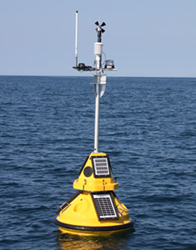
Illinois-Indiana Sea Grant Newsroom: May 2022, Illinois-Indiana Sea Grant (IISG) launched its third buoy in southern Lake Michigan—this one based in the busy waters off Navy Pier. This new buoy with its flow of in-the-moment data is helping the National Weather Service (NWS) Chicago develop more accurate forecasts and warnings, especially related to nearshore wave heights and wind speeds.
This third buoy, known affectionately as Chuoy, joins IISG buoys in the nearshore waters of Michigan City, Indiana and Wilmette, Illinois. Together, these three, along with two University of Illinois buoys closer to the Wisconsin border, paint a comprehensive picture of coastal lake conditions in the two states. In addition to meteorologists, the data is used by scientists, boaters, anglers and beach goers.
“Information from these buoys allows recreational water users to make better informed decisions when it comes to safety,” said Ben Szczygiel, IISG buoy specialist. “The data allows people to plan for current conditions and avoid the water when there are increased safety concerns.”
For full article and videos please visit New to Navy Pier waters, Chuoy the Buoy proved a valuable forecasting tool-IISG
About IISG: These are trying times for the environment. Climate change and other concerns such as population growth, aquatic invasive species, contaminated waters, and loss of natural habitat, the southern Lake Michigan region faces many challenges. Illinois-Indiana Sea Grant (IISG), with its unique mandate to bring the latest science to those who can best use the information, serves a critical role in empowering people to solve problems in sustainable ways. The program is funded through National Oceanic and Atmospheric Administration (NOAA), the University of Illinois and Purdue University, but IISG also works in partnerships with key organizations, institutions, and agencies in the region to reach more audiences and multiply opportunities for success. IISG brings together scientists, educators, policy makers, community decision makers, outreach specialists, business leaders, and the general public to work towards a healthy environment and economy.
Resources
Center For Great Lakes Literacy (CGLL), Website
Ask An Expert: Hot and Cold, Video, Purdue Extension – Forestry and Natural Resources YouTube channel
Informing the Development of the Great Lakes Region Decision Support System, The Education Store, Purdue Extension’s resource center
Urban Best Management & Low Impact Development Practices, The Education Store
Improving Water Quality Around Your Farm, The Education Store
New website: Eat Midwest Fish, Got Nature? Blog, Purdue Extension – Forestry and Natural Resources (FNR)
Scientists bring the Great Lakes to students learning from home, Got Nature? Blog
Adaptations for Aquatic Amphibians Activity 2: Water Quality Sneak Peak, Purdue Nature of Teaching
Illinois-Indiana Sea Grant (IISG)
Illinois-Indiana Sea Grant Newsroom: Many Great Lakes communities that have carried the burden of legacy pollution for decades have an opportunity for a new lease on life when local waterways are finally cleaned up. A new video series features five cities along waterways deemed Areas of Concern (AOCs) that are in various stages of the cleanup process and are experiencing revitalization.
Historically, the Great Lakes region was a center of industry—steel, leather and lumber, to name a few—that eventually shut down or moved elsewhere as economies and priorities changed. Left behind in these waters was a soup of contamination, leaving degraded waterways and depressed communities.
In the United States and Canada, dozens of sites were identified as AOCs in the Great Lakes Water Quality Agreement, and over the years, many have undergone remediation.
The U.S. EPA Great Lakes National Program Office (GLNPO) has provided leadership throughout the cleanup process, which involves dredging or capping contaminated sediment. Even before the cleanup and subsequent restoration, local agencies and organizations have a seat at the table to discuss processes and priorities.
Funding is often a partnership between the federal government, in the form of the Great Lakes Legacy Act (now through the Great Lakes Restoration Initiative), and state, regional and local stakeholders.
The videos feature five cities—Duluth, Minnesota; Muskegon, Michigan; Sheboygan, Wisconsin; Ashtabula, Ohio; and Buffalo, New York—that have had some or all of their contaminated sites cleaned up and ecosystems restored. Local government representatives, business owners and residents share the impact of this work on recreation, tourism, economic development, housing and quality of life in the area.
For full article and videos > > >
About IISG: These are trying times for the environment. Climate change and other concerns such as population growth, aquatic invasive species, contaminated waters, and loss of natural habitat, the southern Lake Michigan region faces many challenges. Illinois-Indiana Sea Grant (IISG), with its unique mandate to bring the latest science to those who can best use the information, serves a critical role in empowering people to solve problems in sustainable ways. The program is funded through National Oceanic and Atmospheric Administration (NOAA), the University of Illinois and Purdue University, but IISG also works in partnerships with key organizations, institutions, and agencies in the region to reach more audiences and multiply opportunities for success. IISG brings together scientists, educators, policy makers, community decision makers, outreach specialists, business leaders, and the general public to work towards a healthy environment and economy.
Resources
Center For Great Lakes Literacy (CGLL), Website
Ask An Expert: Hot and Cold, Video, Purdue Extension – Forestry and Natural Resources YouTube channel
Informing the Development of the Great Lakes Region Decision Support System, The Education Store, Purdue Extension’s resource center
Urban Best Management & Low Impact Development Practices, The Education Store
Improving Water Quality Around Your Farm, The Education Store
New website: Eat Midwest Fish, Got Nature? Blog, Purdue Extension – Forestry and Natural Resources (FNR)
Scientists bring the Great Lakes to students learning from home, Got Nature? Blog
Adaptations for Aquatic Amphibians Activity 2: Water Quality Sneak Peak, Purdue Nature of Teaching
Illinois-Indiana Sea Grant (IISG)
 Illinois-Indiana Sea Grant: Freedom Seekers were environmentalists who learned to navigate the land as they escaped slavery. Songs like “Wade in the Water” and “Follow the Drinking Gourd” remind us that history has always been connected to the land we occupy. The lessons featured in this free curriculum, Freedom Seekers: The Underground Railroad, Great Lakes, and Science Literacy Activities, acknowledge the enslaved Africans who had to rely on environmental science principles in their quest for life, liberty and the pursuit of happiness. These lessons provide educators with cross-curricular teaching opportunities for middle and high school students.
“I didn’t realize that the Great Lakes were linked to the Underground Railroad at all,” said Megan Gunn, aquatic education specialist with Illinois-Indiana Sea Grant and Purdue University Forestry and Natural Resources. Gunn worked with partners across the region to finalize the curriculum. “I grew up near Lake Michigan and never learned how my cultural roots were so closely connected to the natural world, so I’m excited for the next generation to have this educational opportunity.”
The Freedom Seekers curriculum is a collaborative project between several organizations and schools throughout the Great Lakes. It is part of a professional development effort for educators to increase their knowledge of the Great Lakes and environmental issues while incorporating Environmental Justice Education (EJE) approaches to K-12 teaching. These EJE approaches leverage cross-curricular connections that focus on increasing the awareness of local issues and history in the Great Lakes region.
Resources
Center For Great Lakes Literacy (CGLL), Website
Ask An Expert: Hot and Cold, Video, Purdue Extension – Forestry and Natural Resources YouTube channel
Diets of Lake Michigan Salmonids, The Education Store, Purdue Extension resource center
Informing the Development of the Great Lakes Region Decision Support System, The Education Store
Salmon and Trout of the Great Lakes: A Visual Identification Guide, The Education Store
New website: Eat Midwest Fish, Got Nature? Blog, Purdue Extension – Forestry and Natural Resources
Scientists bring the Great Lakes to students learning from home, Got Nature? Blog
ID That Tree: Alternate Leaved Dogwood, Got Nature? Blog
Illinois-Indiana Sea Grant (IISG)
 Illinois-Indiana Sea Grant (IISG): “I was 19 years old. I never even knew any of this stuff existed. I didn’t know I could be a scientist. I thought that was something way beyond what I could be,” said Susan Daniel, a Buffalo State College researcher who studies invertebrates that live at the bottom of the Great Lakes.
She was talking to students from Ellis Middle School in Elgin, Illinois, who had posed questions for her and a handful of other scientists taking part in a virtual session bringing these two groups together. These students in Holly Yee’s science classes had been studying the Great Lakes and the participating scientists are experts on the subject. They hail from the Environmental Protection Agency (EPA), universities and the Sea Grant program.
Illinois-Indiana Sea Grant (IISG) developed the Scientists to Students (S2S) program to connect students with Great Lakes scientists on board the EPA research ship, the Lake Guardian, via videocasts. While out on the lakes collecting samples, scientists visit classrooms virtually and talk with students about aquatic science, water quality monitoring, careers, and life on a ship. Since the program’s inception, over 25 scientists, 33 teachers, and more than 3400 students throughout the Great Lakes have participated.
This spring, due to COVID-19, as with most events, S2S videocasts needed to be rethought, if the program happened at all. Working with several teachers, IISG’s Kristin TePas and Allison Neubauer refashioned the get-togethers with everyone in their homes, both scientists and students alike.
“This has resulted in a fair amount of trial and error to find processes and platforms that work well,” said Neubauer, IISG Great Lakes outreach associate. “As it turns out, I think this has been beneficial in encouraging participation from different types of learners, ranging from those who feel comfortable unmuting themselves and directly asking the scientists questions to those who would prefer to type in a chat box.”
The interactions with scientists and the Elgin students included prerecorded videos created when convenient—introductory videos from scientists describing their work, students posing questions, and scientists’ recorded answers. Many of the questions focused on Great Lakes conditions and issues, but some were more personal in nature, such as what is your favorite thing about being a scientist?
For full article and the video >>>
Resources
New toolkit makes finding weather and climate lesson plans easy, Got Nature? Blog, Purdue Extension – Forestry and Natural Resources
Aquatics & Fisheries, Playlist, Purdue Extension – Forestry and Natural Resources Youtube channel
Best Practices Guide for Charter Fishing and COVID-19, The Education Store, Purdue Extension resource center
Diets of Lake Michigan Salmonids, The Education Store
Salmon and Trout of the Great Lakes: A Visual Identification Guide, The Education Store
Illinois-Indiana Sea Grant (IISG)

Recent Posts
- It’s Timberdoodle Time!
Posted: April 3, 2026 in Got Nature for Kids, How To, Wildlife - Keep An Eye Out for Hammerhead Worms, Purdue Landscape Report
Posted: April 2, 2026 in Invasive Animal Species, Wildlife, Woodlands - When is the Peak Migration For Hummingbirds and How Can You Attract Them?
Posted: in How To, Wildlife - ID That Tree Featured in National Woodland Owners Association Newsletter
Posted: April 1, 2026 in Urban Forestry, Wildlife, Woodlands - New 2026 Indiana Woodland Steward Newsletter
Posted: March 30, 2026 in Urban Forestry, Wildlife, Woodlands - A Woodland Management Moment: Why Aspect Matters
Posted: in Urban Forestry, Woodland Management Moment, Woodlands - 2026 Winter Bat Survey In Progress, MyDNR
Posted: March 27, 2026 in How To, Wildlife - Fast-Growing Trees for the Landscape, Purdue Landscape Report
Posted: March 26, 2026 in Forestry, Urban Forestry, Woodlands - Urban Tree Spotlight: Planting Deciduous Shade Trees, Purdue Landscape Report
Posted: March 25, 2026 in Forests and Street Trees, Urban Forestry, Woodlands - Beetle that attacks Tree-of-Heaven found in Indiana, Purdue Landscape Report
Posted: March 20, 2026 in Invasive Insects, Wildlife, Woodlands
Archives
Categories
- Alert
- Aquaculture/Fish
- Aquatic/Aquaculture Resources
- Ask the Expert
- Christmas Trees
- Community Development
- Disease
- Drought
- Forestry
- Forests and Street Trees
- Gardening
- Got Nature for Kids
- Great Lakes
- How To
- Invasive Animal Species
- Invasive Insects
- Invasive Plant Species
- Land Use
- Natural Resource Planning
- Nature of Teaching
- Plants
- Podcasts
- Ponds
- Publication
- Safety
- Spiders
- Timber Marketing
- Uncategorized
- Urban Forestry
- Webinar
- Wildlife
- Wood Products/Manufacturing
- Woodland Management Moment
- Woodlands